Recent from talks
Nothing was collected or created yet.
Raggare
View on Wikipedia


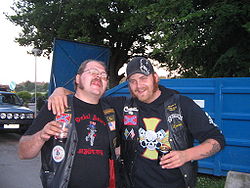
Raggare is a subculture found mostly in Sweden and parts of Norway[1][2], where they are known as Råner, in Finland,[3] and to a lesser extent in Denmark, Germany, and Austria.[citation needed] Raggare are related to the American greaser and rockabilly subcultures and are known for their love of hot rod cars and 1950s American pop culture. Loosely translated into English, the term is roughly equivalent to the American "greaser", English "rocker", and Australian "Bodgie" and "Widgie" culture; all share a common passion for mid-20th-century American cars, rockabilly-based music and related fashion (blue-collar in origin, consisting of the likes of white T-shirts, loose fitting denim trousers with rolled cuffs, and canvas top sneakers such as Keds or Converse Chucks, or low-topped boots of an industrial nature).[original research?]
Originating in the late 1950s youth counterculture, the raggare movement today is primarily associated with middle-aged men who take pleasure in gathering and displaying their vintage American cars. The subculture maintains its rural and small-town roots, as well as its blue-collar and down-to-earth vibe. While the original phenomenon once incited moral panic, contemporary raggare subculture is more likely to elicit amusement or mild disapproval from mainstream society.
Description
[edit]Influences
[edit]The Raggare subculture's influences are American popular culture of the 1950s, such as the movies Rebel Without a Cause with James Dean, and American Graffiti.[2]
Cars
[edit]
Cars are an important part of the subculture, especially V8-powered cars and other large cars from the United States.[4] Statistically, the most common raggare car (Swedish: raggarbil) is the 1960s Pontiac Bonneville.[citation needed] They are plentiful, classic, relatively cheap, and have a huge backseat so the Raggare can pile in all of their friends. Raggare have been described as closely related to the hot rod culture, but while hotrodders in the US have to do extensive modifications to their cars to stand out, raggare can use stock US cars and still stand out compared to the more sober Swedish cars.[4] Some raggare also drive European cars from the 1950s, 1960s and the 1970s.
According to an estimate by one Swedish car restorer, there are more restored 1950s American cars in Sweden than in the entire United States[5] and although only two 1958 Cadillac convertibles were sold in Sweden there are now 200 of them in Sweden.[5] Between 4000 and 5000 classic US cars were at one point imported to Sweden each year.[5]
The latest generation of raggare, the so-called pilsnerraggare such as the club Mattsvart who was the subject of the 2019 documentary "Raggarjävlar" ("Greaser scum")[6] do not show much interest in restoring vintage cars, instead opting for driving around in trashed old US cars, drinking alcohol and playing loud music, not necessarily the rockabilly and classic rock traditionally preferred by raggare. [7] Many of them often instead drive old rear-wheel drive domestic Volvo models, such as 240 or 740. Teenage raggare usually start out driving cars legally classified as "EPA-tractors", which by regulations have their maximum speed limited to 30 km/h. Driving age in Sweden is 18, but EPA-tractors can be legally driven by 15-17-year olds.[8][9]
Fashion
[edit]The clothes and hairstyle are that of 1950s rockabilly. Blue jeans, cowboy boots, white T-shirts, sometimes with print (also used to store a pack of cigarettes by folding the sleeve), leather[10] or denim jacket. The hair is styled using Brylcreem or some other pomade.
Symbols
[edit]The display of the battle flag of the Confederate States is popular in the subculture, as followers view it as a symbol of rebellion and American culture. They do not view it as a symbol of slavery or racism.[11]
History
[edit]Formation of the raggare culture was aided by Sweden staying neutral during World War II and untouched by the war. As a result, Sweden's infrastructure remained intact and export economy boomed, which made it possible for the working-class Swedish youth to buy cars, in contrast to most of Europe, which needed to be rebuilt.[12]
When raggare first appeared in the 1950s, they caused a moral panic with concerns about the use of alcohol, violence, high-speed driving, and having sex in the back seat. Raggare gangs were seen as a serious problem.[13] The film Raggare! covered the issue in 1959.
One especially infamous raggare gang was Stockholm-based "Road Devils", formed in the late 1950s by Bosse "Gamen" Sandberg (1939-1994), which was very heavily publicized in the press. The name of the gang originated from a 1957 movie Hot Rod Rumble, which featured a gang by the same name.[14][15]
Later, raggare often got into fights with hippies and punks,[16][17][18][19][20] something described in the punk rock song "Raggare Is a Bunch of Motherfuckers" by Rude Kids[21] (and later re-recorded by Turbonegro). When The Sex Pistols played in Sweden on 28 July 1977, a group of raggare waited outside and cornered some young girls who came out from the show. The girls had safety pins through their cheeks, and the raggare ripped them out of their faces. The band was upstairs drinking beer when they heard about it. Sid Vicious wanted to go down and fight, and someone else suggested they should get the limousine and run them over. In the end, the gig promoter called the police.[citation needed] The Hjo band Reklamation was forced to cancel a gig after threats from raggare.[22] Also, Rude Kids was forced to cancel a sold-out gig as the police didn't have the manpower to offer protection against raggare. When Rude Kids played in Stockholm the police had to bring in seven police cars to stop the raggare.[23] When The Stranglers played in Sweden, their followers were caught making Molotov cocktails, and the police intervened after a fight broke out.[24]
In 1996, the Swedish post office issued a stamp featuring raggare.[25]
Public image
[edit]
Because of their mostly rural roots, retro-aesthetics and attitude towards sex, raggare are often depicted as poorly educated and financially unsuccessful. A famous example is the 1990s TV series, "Ronny and Ragge", a pair of stereotypical raggare who cruise around in a beat-up Ford Taunus. There are several periodic gatherings for raggare around Sweden. The Power Big Meet is the most famous, and is also one of the biggest American car meets in the world.
In the media and other popular culture
[edit]- In 1975, then glam rocker Magnus Uggla made the song "Raggarna", which was a tribute to the culture. When performing live in late 1970s and early 1980s, raggare threw rocks and tried to thrash the arenas in which Uggla performed, accusing him of being a punk rocker due to his success with the more punk-oriented albums he released in the late 1970s.
- Eddie Meduza have performed songs like "Punkjävlar" ("Punk Bastards"), or "Ragga runt," a tribute to the Raggare subculture.
- Rude Kids made a song about raggare (later re-recorded by Turbonegro) called "Raggare Is a Bunch of Motherfuckers", as an answer to "punkjävlar" by Eddie Meduza. The large number of punk songs about raggare shows the conflict between the two subcultures.
- The 1959 film Raggare! was about raggare and the moral panic of the time.
- The TV series Ronny and Ragge is about two raggare who cruise around in a beat-up 1976 - 1994 Ford Taunus.
- Onkel Kånkel made a song about raggare behaviour during cruising called "Åka femtitalsbil" (later covered by Charta 77).
- The early Swedish punk band P.F. Commando has issued a song called "Raggare" on their 1978 Svenne Pop 7-inch EP[26]
- Raggargänget (1962) with Ernst-Hugo Järegård and Sigge Fürst
- Massproduktion published a compilation album titled Vägra Raggarna Bensin – Punk Från Provinserna.
- On 1 May 1979 about 100 punks formed their own parade down Kungsgatan under the slogan "Vägra raggarna bensin" ("Refuse the raggare gasoline").[27]
- Nadja's brothers "Roffe", "Ragge" and Reinhold, Bert
- Tjenare Kungen (2005)
- In Welcome to Sweden, Bengt is a raggare, and delighted to meet his niece's American boyfriend because of it.
- Raggarjävlar (2019) is a documentary about the new generation of raggare in the club Mattsvart from Köping[28]
- In the 2025 novel Punished by the Swedish-Sámi author, Ann-Helén Laestadius, Jon-Ante grows up to be a raggare in the Kiruna area during the 1980s, going by the name Jonne to hide his heritage.
See also
[edit]- Car subcultures like Kustom Kulture, and more generally the Import scene
- Biker subcultures like the rockers in the UK the Bōsōzoku in Japan, and Chicanos in the US
- Stereotypes like the Harry in Norway, Gopniks in eastern Europe and rednecks in the US
- Youth cultures, like Nozem in the Netherlands, and Teddy Boys in the UK
- Americanization relating to the assimilation of American and Canadian cultures into a pan-European soil.
- Politically inspired subcultures, like Neo-Confederates, Nazi chic, and Skinheads
References
[edit]- ^ The Police Journal, v. 38 1965, page 58
- ^ a b OA: Råning og ragging på utstilling
- ^ "Historiaa". Stadin Raggarit (in Finnish). Retrieved 20 March 2022.
- ^ a b Automobilities by Mike Featherstone, Nigel. Thrift, John Urry. p. 189
- ^ a b c Sweden's car kings: 'greasers' cruising in vintage US wheels
- ^ ""Raggarjävlar" inviger dokumentärfilmfestival".
- ^ ""Vi gör det vi älskar men det sticker i folks ögon"". 6 September 2019.
- ^ "A-traktor - Transportstyrelsen". www.transportstyrelsen.se (in Swedish). Archived from the original on 13 September 2020. Retrieved 6 November 2025.
- ^ Hugo (9 October 2024). "Epa raggare – En svensk subkultur fylld med frihet och gemenskap" (in Swedish). Retrieved 6 November 2025.
- ^ Crime and Its Correction: An International Survey of Attitudes and Practices by John Phillips Conrad, p. 126
- ^ Jalopnik: Your Guide To Europe's Weirdest Car Culture: Raggare
- ^ "Raggare Love Hot Rods and Rock 'n' Roll". 21 February 2013.
- ^ Statistics on Delinquents and Delinquency by Walter Albin Lunden, p. 134
- ^ "Raggare Love Hot Rods and Rock 'n' Roll". Vice.com. 21 February 2013. Retrieved 12 February 2022.
- ^ Berglind, Sten (2005). Raggare : rebellerna som skakade Sverige (in Swedish). Bokförlaget Max Ström. ISBN 9171260080.
- ^ Arbetaren: Raggaren lever än
- ^ England's dreaming: les Sex Pistols et le punk by Jon Savage, Denys Ridrimont, p. 435
- ^ Aftonbladet: Raggare rövade bort punkare [1]
- ^ Dala Demokraten: Förföljelserna mot oss hårdnar [2]
- ^ Vermlands Folkblad: Vi törs inte gå ut på kvällarna [3]
- ^ The Guardian: Raggare: the Swedish rock'n'roll cult comes of age
- ^ SLA: Unga musiker i Hjo hotade med stryk, 3 mars 1979
- ^ Aftonbladet: Raggare stoppar punkband [4]
- ^ "GT: Tvingades fly från raggarna". Archived from the original on 23 July 2011. Retrieved 13 October 2010.
- ^ Consumption: Critical Concepts in the Social Sciences by Daniel Miller, p. 155
- ^ "P.F. Commando – Svenne Pop E.P. 7". Killed by Death Records.
- ^ Vecko Revyn, Nr 30, 25 July 1979
- ^ https://tempofestival.se/program/raggarjavlar/ [dead link]
External links
[edit]- Cultural Imperialism or Hyper-Americanization – Swedish raggare and Chicano Lowriders – article by Scott Holmquist
- Raggare video guide
- Raggare – @The Movie
- Photos from Power Big Meet by Frank Aschberg
- Stadin Raggarit – Finnish Raggare site Over 6000 pictures and many articles (in Finnish), etc.
- Punktjafs: Raggare – music and period articles about punks and raggare
Raggare
View on GrokipediaRaggare is a Swedish subculture that originated in the 1950s among working-class youth, centered on a passion for vintage American automobiles, rock 'n' roll music, and a greaser aesthetic inspired by post-war United States culture.[1][2][3] Emerging during Sweden's economic boom and neutrality in World War II, which preserved resources for leisure pursuits, raggare adopted large, unmodified 1950s-1960s cars such as Cadillacs, Chevrolets, and Pontiacs, often equipped with V8 engines prized for their sound and power.[1][3] These vehicles serve as central artifacts of material culture, facilitating social bonding through cruising, garage work, and gatherings that emphasize sensory experiences like engine roar and chrome aesthetics.[1] Initially urban in Stockholm and marked by rebellious behaviors including street racing and romantic pursuits—reflected in the term "ragga" for picking up partners—the movement shifted to rural areas and small towns, evolving into a multi-generational pursuit maintained by middle-aged enthusiasts today.[1][2] Despite early media scrutiny and official investigations in the 1960s portraying raggare as disruptive, the subculture has gained mainstream acceptance, boasting an estimated 500,000 adherents and government incentives like tax exemptions for preserving classic vehicles.[4][1] Defining events include the annual Power Big Meet in Västerås, which draws tens of thousands of participants and vehicles, underscoring raggare's role as Sweden's largest pop-culture tribe focused on 1950s Americana, community respect, and mechanical craftsmanship.[4][3]
Definition and Core Characteristics
Historical Origins of the Term
The term raggare derives from the Swedish verb ragga, meaning to cruise around in a vehicle while seeking romantic encounters or flirting, a practice emblematic of the subculture's social rituals involving customized cars and group outings. This etymology underscores the 1950s origins of the movement, when postwar Swedish youth adopted American-influenced behaviors like driving through rural towns to attract partners, often in packs of modified vehicles.[5][3][6] Linguistically, ragga itself traces to dialectal Swedish raga, denoting unsteady or staggering movement, which may allude to the conspicuous, sometimes reckless driving style of early participants as they navigated roads in powerful, altered American automobiles. The slang term gained prominence in the late 1950s, coinciding with the influx of U.S. rock 'n' roll records and films into Sweden, though its precise coinage remains tied to informal youth vernacular rather than formal documentation.[7] Alternative interpretations link raggare to ragg, referring to unkempt or bristly hair, evoking the greased-back pompadours sported by adherents, but this appears secondary to the behavioral connotation of cruising and courtship. By the early 1960s, the label had solidified within Swedish working-class communities, distinguishing participants from mainstream society amid cultural tensions over imported Americana.[8]Defining Traits and Lifestyle
Raggare embody a lifestyle centered on the veneration of mid-20th-century American automotive culture, where vintage cars serve as extensions of personal identity and social bonds. Participants engage in cruising, a ritual of slow, collective drives along roads to exhibit vehicles, listen to rock 'n' roll music, and flirt or socialize, with the term "raggare" deriving from "ragga," slang for picking up women.[9][5] Garages function as communal workshops and gathering spots for maintenance, storytelling, and coffee, reinforcing a hands-on, mechanical ethos among members.[1] Social life revolves around organized events like the Power Big Meet in Västerås, held annually since 1978 and drawing approximately 20,000 attendees for car displays, dancing to rockabilly tunes, and parties.[1] These gatherings, along with informal Sunday meets at clubs such as Burning Wheels, emphasize respect, probationary integration for newcomers, and a shift from past brawls to responsible enjoyment.[4] The subculture maintains working-class, rural roots, with an emphasis on masculinity, hardness, and intergenerational continuity, often involving families in activities.[10][11] Contemporary raggare anthropomorphize their cars, attributing souls and personalities to them, viewing ownership as a lifelong passion sparked by nostalgia or inheritance.[1] This sensory engagement—encompassing engine sounds, leather scents, and visual aesthetics—cultivates a rebellious yet communal identity resistant to modern utilitarian norms.[1] While historically portrayed negatively in media, the lifestyle now garners recognition, including cultural stamps and mass events like drive-in weddings.[4]Cultural Influences and Inspirations
American Greaser and Rockabilly Roots
The greaser subculture emerged in the United States during the mid-1950s, primarily among working-class and lower-class teenagers and young adults in urban areas like New York and Philadelphia, as well as in the Midwest and California.[12] This group adopted a distinctive style centered on rebellion against post-World War II conformity, featuring greased-back hairstyles using pomade or Brilliantine to achieve slicked pompadours and DA (duck's ass) cuts, which inspired the subculture's name.[13] Typical attire included black leather or denim jackets, white fitted T-shirts, blue jeans or dark slacks rolled at the cuffs, and sturdy boots like engineer or motorcycle styles, often paired with accessories such as leather wristbands or chain wallets.[13] Greasers embraced a tough, anti-authoritarian ethos, frequently engaging in street racing, hot rodding—customizing older cars like Ford Model Ts or Chevrolet Bel Airs for speed and aesthetics—and listening to rhythm and blues, doo-wop, and emerging rock and roll music.[14] Closely intertwined with greaser culture was rockabilly, a musical genre that originated in the early 1950s in the American South, fusing the upbeat rhythms of rock and roll with country and Western, blues, and hillbilly influences.[15] Pioneered by artists such as Elvis Presley, whose breakthrough single "That's All Right" was recorded on July 5, 1954, at Sun Records in Memphis, Tennessee, rockabilly emphasized fast tempos, slapped upright bass, and twangy guitar riffs, achieving mainstream popularity through hits like Presley's "Heartbreak Hotel" in 1956.[15] The style's visual aesthetic mirrored greaser fashion, with men sporting sideburns, quiffs, and leather attire, while women favored full skirts, saddle shoes, and cat-eye makeup, evoking a playful yet defiant 1950s Americana.[16] Rockabilly events often involved dancing like the jitterbug or hand jive, reinforcing a culture of youthful energy and mechanical tinkering with vehicles, as enthusiasts modified cars to embody speed and personalization.[17] These American phenomena provided the foundational blueprint for the raggare subculture in Sweden, where postwar exposure to U.S. media, music, and surplus vehicles imported the greaser emphasis on customized hot rods and rockabilly's rhythmic soundtrack.[5] Raggare emulated the greaser's working-class machismo and rockabilly's nostalgic revivalism, adapting elements like flame-painted 1950s Chevrolets and pompadour hairstyles into a distinctly Scandinavian context amid the 1950s economic boom.[11] Unlike the often stigmatized greaser image in the U.S., tied to gang rivalries like those between greasers and socs depicted in S.E. Hinton's 1967 novel The Outsiders, rockabilly's lighter, music-driven appeal endured, influencing raggare's enduring focus on car meets and 1950s rock performances.[12]Post-WWII Cultural Transmission to Sweden
Sweden's neutrality during World War II shielded its economy and infrastructure from destruction, fostering a post-war economic boom that increased disposable income among the middle class and made car ownership feasible for youth by the early 1950s.[18][3] This prosperity contrasted with war-devastated Europe, positioning Sweden to import surplus American vehicles and cultural artifacts without the resource constraints faced elsewhere.[19] American greaser and rockabilly influences arrived primarily through transatlantic cultural exports, including Hollywood films portraying hot rod racing and juvenile delinquency, such as those inspired by 1950s drag culture, alongside imported rock 'n' roll records from artists like Chuck Berry and Elvis Presley.[5][4] These media depictions of customized cars, greased hairstyles, and rebellious youth aesthetics resonated in rural Swedish communities, where limited local entertainment amplified their appeal.[11] Swedish sailors and traders returning from U.S. ports further disseminated 45 rpm singles, denim fashion, and automotive magazines, bridging the Atlantic gap before widespread television.[19] By the late 1950s, these elements coalesced into raggare groups, initially in small towns and countryside areas, where young men pooled resources to acquire and modify pre-1960 American cars like Chevrolet Bel Airs, often sourced affordably due to U.S. export surpluses.[3][20] The subculture's adoption of English slang, such as "raggarbil" for hot rods, reflected direct linguistic borrowing, while local adaptations emphasized mechanical tinkering amid Sweden's nascent automotive industry.[5] Early raggare faced societal backlash as symbols of moral decay, mirroring U.S. greaser panics, yet persisted through informal cruising meets that echoed American drive-in rituals.[4]Vehicles and Mechanical Culture
Iconic Car Models and Preferences
Raggare exhibit a strong preference for large American automobiles produced between the 1950s and 1960s, valuing vehicles with powerful V8 engines, extensive chrome trim, tailfins, and convertibles that evoke the era's rock 'n' roll aesthetic.[1] These cars, often imported cheaply from the United States where they were discarded, are typically maintained in stock condition to preserve their original "soul" and sensory appeal, including engine roar and interior ambiance, though some feature minor modifications like lowered suspensions or decorative flames.[21] [3] Preservation efforts by raggare have resulted in Sweden possessing more restored 1950s American cars than the United States itself.[3] Prominent brands include Chevrolet, Cadillac, Ford, Pontiac, and Buick, with models selected for affordability, parts availability, and iconic styling.[4] The Chevrolet Bel Air, particularly the 1957 version, stands out for its tri-tone paint schemes and sculpted bodywork.[21] Similarly, the Chevrolet Impala from 1962 and 1965 models is favored for its spacious cabins and widespread presence in Sweden, often described as ubiquitous as Volvos in certain regions.[3] [22] Cadillac models, such as the 1954 hearse variant and 1956 sedans, appeal for their luxurious proportions and status symbolism within the subculture.[3] [1] Ford offerings like the 1958 Thunderbird, 1959 Galaxie, and 1957 Fairlane provide alternatives with sporty or full-size appeal.[23] [3] Pontiacs, including 1956 and 1965 examples, are prized for reliability and classic lines, with the latter acquired inexpensively as early as 1980.[1] [4] Other notable choices encompass the 1963 Imperial Crown Convertible for its rarity and the 1965 Oldsmobile Starfire for opulent features.[23] These selections underscore a dedication to authenticity over performance extremes, distinguishing raggare from hot rod purists.[21]Customization Techniques and Practices
Raggare customization emphasizes the preservation of original 1950s-1970s American vehicle aesthetics with selective personalization, contrasting American hot rod practices that often involve extensive structural and performance overhauls. Many raggarbilar remain in stock configuration or exhibit deliberate patina through minimal maintenance, embodying the "pilsnerbil" style where vehicles are kept in a weathered, functional state to evoke authentic vintage appeal rather than polished restoration.[19] This approach prioritizes subcultural identity over radical modification, with owners sourcing parts from imported wrecks or junkyards for repairs.[1] Aesthetic techniques include custom paint applications tailored to personal or gendered expression, such as pastel schemes for cars personified as female or bold colors like yellow on a 1971 Ford Torino.[1] Flame graphics and other graphic elements appear on select vehicles, enhancing visual drama during cruises or meets. Chrome work involves polishing existing trim for shine or adding elements like "lister chrome" and rubber mouldings to a 1956 Pontiac for refined detailing.[1] Interior personalization features seat and gear lever adjustments for comfort and style, alongside fixes like inserting glass planes to maintain usability.[1] Mechanical practices occasionally extend to engine swaps, such as installing modern V8 units in models like a 1956 Ford Vedette to amplify the characteristic rumble and acceleration, enabling street racing or spirited driving.[1] [5] However, such upgrades are not universal, as many prioritize the sensory experience of original powertrains, including the multi-sensory V8 sound that defines cruising phenomenology.[1] Non-standard adaptations, like painting Swedish Volvos black to mimic American iron, represent hybrid personalization for affordability.[2] Overall, these methods foster emotional bonds, with cars treated as extensions of the owner's identity through iterative, hands-on labor in garages.[1]Fashion, Grooming, and Aesthetics
Clothing and Accessories
Raggare clothing emulates the 1950s American greaser and rockabilly aesthetic, featuring leather jackets such as the Perfecto style often customized with patches or studs, tight-fitting Levi's 501 jeans rolled at the cuffs, and white cotton T-shirts with sleeves sometimes folded to hold cigarettes.[24] [8] Footwear includes cowboy boots, leather boots with buckles, brothel creepers, or Converse Chuck Taylors, paired with blue suede shoes in warmer weather that are swapped for snow boots during Swedish winters.[24] [4] [25] Accessories emphasize rugged masculinity and era-specific flair, such as wide leather belts with oversized buckles, chain wallets, bandanas, vintage watches, leather wristbands, and sunglasses.[24] Women in the subculture adopt complementary 1950s styles, including poodle skirts, elegant skirts, and high stiletto heels, often accessorized to match the male-dominated greaser look.[4] [25] Early raggare men favored Wrangler Blue Bell jeans sourced via ship workers and varsity or jean jackets emblazoned with club names, reflecting resourcefulness in adopting American imports.[25] This attire persists in modern gatherings, underscoring the subculture's commitment to vintage authenticity over contemporary trends.[4]Hairstyles and Personal Style
Raggare men favor slicked-back hairstyles, often styled into a ducktail or quiff using pomade like Brylcreem to achieve a greased, voluminous look reminiscent of 1950s American greasers.[25][4] This grooming emphasizes height and shine at the front and crown, with hair combed meticulously to project a tough yet polished masculine image.[25][26] Women in the subculture adopt voluminous "big hair" styles, commonly high ponytails adorned with clips or curls evoking rockabilly pin-up aesthetics.[25] These looks prioritize femininity and era-specific glamour, often paired with minimal but deliberate makeup such as eyeliner and tinted lip mixtures.[25] Personal grooming reflects a commitment to subcultural authenticity, with participants dedicating significant time to hair maintenance, including on-site combing at gatherings to preserve the greased finish.[25][4] This ritual underscores a broader ethos of respectability and self-presentation, blending working-class toughness with an idealized 1950s American-inspired dandyism.[4][26]Symbols, Iconography, and Identity Markers
Visual and Material Symbols
Raggare employ distinctive visual symbols drawn from mid-20th-century American hot rod and rockabilly aesthetics, prominently featuring flame graphics and pinstriping on their vehicles. These flame motifs, often painted in contrasting colors on car hoods and sides, evoke speed and rebellion, mirroring customization practices in U.S. custom car culture that raggare emulate. Pinstriping, thin hand-painted lines accentuating curves and edges, further enhances the retro mechanical allure, serving as badges of craftsmanship within the subculture.[1] The Confederate battle flag holds symbolic significance for some raggare, representing defiance against conformity and admiration for American Southern heritage, distinct from associations with racial animosity prevalent in other contexts. In Sweden, this emblem functions primarily as an icon of imported countercultural rebellion rather than ideological endorsement, often displayed on vehicles or at gatherings alongside American flags.[2] American flags and stars-and-stripes motifs appear in garages and as decorative elements like pillows, reinforcing the subculture's nostalgic ties to 1950s U.S. pop culture icons such as Elvis Presley and Marilyn Monroe via neon signage.[1] Material symbols extend to vehicle accoutrements, including dangling fuzzy dice, air fresheners shaped like evergreen trees (Wunderbaums), and vinyl records suspended from rearview mirrors, which materialize the era's automotive folklore. These items, combined with chrome polishing and low-slung chassis modifications, materially embody the raggare's commitment to preserving and performing vintage American mobility aesthetics in a Scandinavian setting.[1]Role in Subcultural Identity
Symbols within the raggare subculture, such as customized 1950s American cars featuring flame graphics and chrome accents, form the core of participants' identity by embodying mechanical craftsmanship and sensory experiences like V8 engine roars, which evoke emotional attachment and distinguish raggare from mainstream Swedish society.[1][27] These material elements enable individuals to construct a sense of self through anthropomorphic bonds with vehicles, often described as having "souls" due to handmade modifications, thereby reinforcing subcultural authenticity and personal agency.[1] The Confederate battle flag serves as an emblem of admired Southern American hot rod heritage and youthful rebellion, adopted by raggare without connotations of racism or slavery, instead symbolizing cultural affinity for 1950s rockabilly and automotive freedom in the Swedish context.[2][24] Alongside visual markers like slicked-back hairstyles and leather jackets, these symbols facilitate community recognition and cohesion during cruises and events such as the annual Power Big Meet, attended by approximately 20,000 people since 1978, where shared displays affirm collective identity rooted in working-class masculinity and resistance to conformity.[1][10] Car modification practices, including debadging and lowering, operate as identity-building rituals that transmit tacit knowledge across generations in garage settings, allowing newcomers to "become raggare" through embodied participation and fostering intergenerational ties that sustain the subculture's persistence.[1][28] This materiality underscores a rejection of modern consumerism, privileging vintage authenticity as a marker of subcultural loyalty and cultural preservation.[27]Historical Evolution
Emergence in the 1950s
The raggare subculture emerged in Sweden during the late 1950s amid a post-World War II economic boom enabled by the country's neutrality, which spared it from wartime destruction and positioned it to benefit from global trade, including the influx of affordable American goods and cultural exports.[25] Working-class youth, particularly in rural areas and small towns, were drawn to symbols of American modernity portrayed in smuggled films like Rebel Without a Cause, music by Elvis Presley, and rock 'n' roll records, which represented rebellion and freedom in contrast to Sweden's conservative social norms.[25] [19] This period saw Sweden importing thousands of surplus American cars annually at low prices, as U.S. manufacturers offloaded post-war stock, making vehicles like Chevrolet Bel Airs and Ford Thunderbirds accessible to young Swedes who modified them into hot rods with custom paint, chrome, and engines for speed and aesthetics.[3] Early raggare formed informal gangs such as the Road Devils and Road Stars, centering activities around customizing "pölsbilar" (sausage cars, slang for flashy American models) and cruising highways to "ragga"—the Swedish term for flirting or picking up girls—which gave the subculture its name from the verb "ragga."[25] [5] Participants adopted greaser aesthetics including leather jackets, rolled jeans, greased pompadour hairstyles, and a penchant for 1950s rockabilly music, often gathering at drive-ins or rural meets to showcase vehicles and socialize.[25] These practices stemmed from a desire for autonomy among teenagers in a rapidly industrializing society, where access to cars symbolized status and escape from agricultural or factory work.[4] The subculture quickly provoked moral panic in Swedish media and authorities, who portrayed raggare as rowdy hoodlums involved in speeding, drinking, fighting, and promiscuity, leading to police crackdowns and public campaigns against their perceived American-inspired degeneracy.[4] [3] Despite this, the movement persisted as a form of youth resistance, with early rockabilly bands forming in the late 1950s to amplify its soundtrack, laying the foundation for raggare as a distinctly Swedish adaptation of transatlantic greaser culture rather than a direct import.[29]Expansion and Adaptation (1960s-1980s)
![Raggare gathered on a 1960s car during a cruise][float-right] During the 1960s, the raggare subculture encountered intensified opposition in Sweden amid broader cultural shifts, including the 1965 Vietnam War protests that tarnished associations with American symbolism.[1] Governmental response included the 1962 Raggarutredningen, an inquiry into youth behaviors linked to raggare such as casual sexual encounters, culminating in legislation that authorized police stops of American vehicles perceived as raggare-associated.[1] [22] Despite media depictions of conflicts with authorities and rival groups, the movement expanded beyond initial urban hubs in Stockholm, migrating to rural regions and smaller towns where limited entertainment options amplified car-centered socializing.[1] In the 1970s and 1980s, raggare adapted by formalizing community structures through large-scale events, with the Power Big Meet in Västerås attracting around 20,000 participants by 1978, highlighting sustained enthusiasm for customized 1950s American cars.[1] Cruising rituals persisted as near-daily occurrences in provincial areas, serving as mobile social spaces that reinforced subcultural bonds amid Sweden's advancing welfare state and technological changes.[1] Practitioners broadened vehicle preferences to include select European models from the 1960s and 1970s, blending traditional hot rod aesthetics with practical adaptations while preserving core elements like rock 'n' roll music and anti-modernist sentiments.[19] This era marked a transition from perceived deviance to nostalgic preservation, enabling longevity despite evolving youth trends.[1]Persistence and Modern Revival (1990s-Present)
The raggare subculture exhibited strong persistence from the 1990s into the 21st century, evolving from a primarily youthful phenomenon into a multi-generational tradition sustained by family transmission and dedicated preservation efforts. Despite broader societal shifts toward modernism, core practices—such as customizing American cars from the 1940s to 1960s, embracing rockabilly music, and fostering community through gatherings—remained intact, with the movement described as vibrant and understudied within Scandinavia.[1][11] Central to this endurance was the expansion of organized events, particularly the Power Big Meet, which grew from its 1978 origins into the world's largest American car show by the 1990s and 2000s. Held annually in Västerås until 2016 and subsequently in Lidköping, the event attracted over 20,000 vehicles and tens of thousands of attendees in years like 2014, drawing participants from across Europe and underscoring raggare's role in automotive heritage preservation.[30][31] By 2009, raggare had emerged as Sweden's largest pop subculture, surpassing contemporary youth tribes in scale and cultural impact, with enthusiasts prioritizing vintage aesthetics and Chuck Berry-era influences.[4] In the modern era, raggare activities have incorporated urban cruising alongside traditional meets, with events like the 2025 Power Big Meet in Lidköping and city cruises in Stockholm and Rättvik demonstrating ongoing appeal and adaptation. These gatherings, often featuring thousands of cars parading through streets while playing period music, continue to reinforce subcultural identity and attract both longtime members and newcomers, ensuring the movement's relevance amid digital-age distractions.[32][26][33]Social Structure and Community Dynamics
Organizational Aspects and Gatherings
Raggare communities are structured around informal car clubs and associations that emphasize vehicle preservation, customization, and social bonding. Prominent examples include the Swedish Hot Rod Association (SHRA) in Örnsköldsvik and the Coast League Cruisers (CLC) in Ullånger, which function as communal garages for maintenance, weekly gatherings, and event coordination.[1] These groups, often cross-generational, unite enthusiasts through shared activities like coffee discussions and collaborative repairs, reinforcing subcultural identity without rigid hierarchies.[1] Central to raggare organization are periodic gatherings, ranging from local garage meets to large-scale national events. Informal sessions in club facilities occur regularly, such as weekly Wednesday assemblies, where members exchange knowledge on cars and lifestyle elements.[1] Major spectacles like the Power Big Meet, initiated in 1978 and held annually in locations such as Västerås or Lidköping, represent the subculture's pinnacle, attracting around 20,000 visitors and showcasing thousands of vintage American vehicles over multi-day formats.[1] The 2023 edition featured over 13,000 cars across three days, including swap meets with more than 200 vendors and cruise nights in city centers.[34] The 46th iteration is scheduled for July 4-5, 2025, in Lidköping, underscoring its enduring scale as one of the world's largest American car meets.[32] Cruising constitutes a core organizational tradition, involving convoys of raggarbilar—typically unmodified or customized 1950s-1960s American models—driving slowly along public highways to display craftsmanship and facilitate social interaction.[1] This practice, prominent in spring and summer, originated in the subculture's early days as a means of courtship ("ragga" derives from the Swedish verb for picking up dates) and persists in regional events like those in Delsbo or Ystad, where hundreds of cars converge for nocturnal parades.[35] Such cruises emphasize sensory immersion through V8 engine roars and rockabilly music, serving as mobile expressions of nostalgia and community cohesion.[1] Local variants, including street cruises on avenues like Sveavägen in Stockholm, blend everyday organization with celebratory displays.[11]Demographic Profile and Values
Raggare are concentrated in rural areas and smaller towns throughout Sweden, particularly in regions such as Västernorrland county, with limited presence in major urban centers like Stockholm, Gothenburg, or Malmö.[1] [10] The subculture draws primarily from working-class backgrounds, including low-skilled laborers, farmers, and petrol station operators, reflecting its origins among post-World War II youth in the late 1950s.[4] [10] It spans generations, from teenagers operating modified EPA tractors—vehicles legally drivable by those aged 15 and older—to middle-aged adults and seniors who have preserved vintage cars for decades.[1] Estimates place the number of adherents at approximately half a million in Sweden as of 2009.[4] The subculture remains male-dominated, emphasizing traditional masculinity, toughness, and gender-specific roles such as "raggning" (flirting or picking up women), though women participate as club members, family inheritors of vehicles, or in women-only groups.[10] [1] [4] Core values revolve around nostalgia for 1950s American culture, including rock 'n' roll music, hot rod automobiles, and associated aesthetics like leather jackets and pompadour hairstyles, which participants view as symbols of authenticity and personal identity.[1] [4] Cars are treated as sentient extensions of the self, possessing "souls" that foster social bonds through cruising, garage work, and events like the annual Power Big Meet, attended by around 20,000 people since 1978.[1] Raggare prioritize craftsmanship, mechanical skill, and simplicity, often rejecting modern societal complexities, environmental regulations, and mainstream trends in favor of tradition, respect, and communal responsibility.[4] [1] This outlook includes a cultural affinity for elements of the American South, such as Confederate iconography, though interpreted through a lens of rebellion rather than explicit political ideology.[20] Some observers link these values to working-class resistance against elite urban culture and alignment with nativist sentiments, as seen in occasional support for populist movements.[10]Cultural and Economic Impact
Automotive Preservation and Heritage
The raggare subculture has significantly contributed to the preservation of mid-20th-century American automobiles in Sweden, importing approximately 4,000 to 5,000 classic U.S. cars annually and restoring them to maintain operational condition while retaining original aesthetics.[3][36] These efforts stem from post-World War II imports of surplus vehicles, which were often abandoned or inexpensive, allowing raggare to amass and safeguard models like Buicks, Cadillacs, and Chevrolets that faced scrappage in the United States.[3] Restoration practices emphasize authenticity, with enthusiasts performing detailed repairs in communal garages to preserve the vehicles' "soul" through sensory and material engagement, avoiding excessive modifications that alter historical character.[1] Sites such as the Båstnäs junkyard, operational since the 1950s, house over 1,000 preserved vehicles, serving as repositories for parts and exemplars of raggare dedication to heritage amid otherwise declining domestic availability.[3] This preservation extends cultural value by embedding 1950s Americana into Swedish identity, transforming stigmatized "pilsner cars" into recognized artifacts of nostalgia and craftsmanship passed across generations.[1][36] Annual events like Power Big Meet, founded in 1978, underscore this heritage by showcasing 13,000 to 24,000 vehicles and drawing over 150,000 attendees from more than 40 countries, fostering global appreciation for restored raggarbilar through parades, displays, and mechanical demonstrations.[37][36][1] These gatherings not only highlight pristine restorations alongside patina-preserved examples but also reinforce community bonds and tacit knowledge transmission essential to sustaining the subculture's automotive legacy.[37][1]Influence on Swedish Society and Economy
The raggare subculture has endured as a significant element of Swedish societal identity since its emergence in the 1950s, representing a persistent embrace of American-inspired nostalgia amid rapid post-war modernization. Initially sparking moral panic as a symbol of rebellious working-class youth enamored with rock 'n' roll and hot rods, it has evolved into a multi-generational tradition estimated to involve up to 500,000 participants, making it Sweden's largest pop-culture tribe.[4] This longevity reflects a cultural resistance to contemporary trends, with raggare prioritizing simplicity, craftsmanship, and communal gatherings that foster social bonds, particularly in rural areas where car-centric lifestyles prevail.[20] Government recognition, including tax exemptions on classic car imports since the 1960s and a commemorative stamp, underscores its integration into national heritage.[4] Large-scale events organized by the raggare community reinforce social cohesion and visibility, drawing participants from across generations and regions for cruising, music, and swap meets. The annual Power Big Meet, initiated in 1978 with 80 cars and 400 attendees, has grown to attract 150,000 visitors and showcase 24,000 vehicles, exemplifying the subculture's capacity to mobilize communities around shared values of preservation and revelry.[38] These gatherings promote intergenerational transmission, with families passing down customized vehicles and traditions, while emphasizing respect and responsibility over early stereotypes of rowdiness.[4] Economically, raggare activities contribute through the importation and restoration of vintage automobiles, sustaining a niche market for parts, mechanics, and events that stimulate local commerce. In 2008, Sweden imported approximately 6,000 classic cars, often acquired cheaply abroad and appreciating significantly post-restoration—for instance, a 1965 Pontiac purchased for $2,000 in 1980 could fetch twenty times that value today.[4] Power Big Meet and similar meets generate tourism revenue in host towns like Västerås and Lidköping by accommodating thousands of out-of-town visitors, supporting hospitality, vendors, and related services, though precise figures remain event-specific and tied to attendance surges.[38] This ecosystem bolsters Sweden's classic car preservation sector, indirectly aiding heritage tourism without relying on state subsidies beyond import incentives.[4]Public Perception and Controversies
Admiration for Craftsmanship and Nostalgia
Raggare place significant value on the craftsmanship inherent in 1950s and 1960s American automobiles, appreciating the human labor involved in their construction over modern automated production methods. These vehicles are often described as possessing a unique "soul" derived from variations in hand-assembly, which enthusiasts like Niklas attribute to the artisanal differences between individual cars.[1] Restoration practices emphasize preserving originality to maintain authenticity, with members investing substantial time and skill in sourcing period-correct parts, respraying bodies, and performing mechanical overhauls; for instance, one enthusiast reported multiplying a car's value twentyfold through such meticulous work.[4][1] This hands-on approach fosters tacit knowledge shared in garages, where repairs become communal activities enhancing technical proficiency.[1] While some raggare favor limited modifications to retain a vehicle's character—such as aesthetic flourishes like flame decals or exhaust enhancements— the core admiration lies in the durable engineering of V8 engines and chrome detailing, which demand ongoing skilled maintenance to operate reliably.[1][39] The subculture's dedication to these practices has contributed to Sweden amassing more restored 1950s American cars than the United States, underscoring a collective commitment to automotive heritage preservation.[3][40] Nostalgia forms a foundational element of raggare identity, with cars serving as tangible links to the 1950s American culture of rock 'n' roll, freedom, and post-war optimism that captivated Swedish youth.[1] Participants often recount personal memories tied to these vehicles, such as childhood encounters or family heirlooms, evoking a sense of youth and escape from contemporary Swedish societal norms.[1] The act of driving becomes an end in itself—"the journey is the goal"—reinforcing emotional attachments where cars function as extensions of self or companions embodying past eras.[1] This sentimental orientation sustains the subculture's vibrancy, transforming it from a postwar youth movement into a enduring hobby centered on reliving idealized historical mobility.[19]Criticisms of Anti-Modernism and Stereotypes
Raggare have been critiqued for promoting an anti-modern worldview through their persistent embrace of 1950s American aesthetics, which prioritizes individualism, mechanical craftsmanship, and heteronormative masculinity over contemporary Swedish emphases on sustainability, gender fluidity, and collective welfare. This stance is seen as a form of cultural escapism that resists post-war modernization, including the shift toward efficient public transport, electric vehicles, and reduced carbon footprints in a country that reduced emissions by 27% from 1990 to 2020 while maintaining high living standards.[41] Detractors, including cultural analysts, argue that raggare gatherings exacerbate noise and emissions via unmodified V8 engines, conflicting with Sweden's stringent environmental policies, such as the 2045 net-zero target.[1] Such practices are portrayed as nostalgic regression, glorifying a pre-welfare state era of personal mobility and "hardness" that undermines progressive ideals.[10] Stereotypes often depict raggare as xenophobic and prone to violence, rooted in historical clashes with immigrant groups during Sweden's 1970s immigration influx. In 1977, raggare gangs in Södertälje attacked Assyrian immigrants, whom they derogatorily called "blackskulls" for allegedly exploiting welfare and pursuing Swedish women, marking the third such incident that year; similar groups terrorized 300 Romani families in Malmö with car caravans and weapons like bicycle chains.[42] These events fueled perceptions of raggare as reactionary defenders of ethnic homogeneity against multiculturalism, with media broadly attributing far-right crimes—such as Gypsy camp raids—to the subculture, even when unverified.[4] Punk subcultures amplified this by composing anti-raggare songs decrying their perceived aggression during 1970s-1980s tours.[8] In recent decades, stereotypes have evolved to link raggare authenticity with populist radical right politics, exemplified by musician Peter Jezewski's performances at Sweden Democrats events and his 2018 election anthem "Varje Liten Del," which invokes nativist themes of cultural preservation.[10] Critics highlight the subculture's hypermasculine imagery—leather vests, greased hair, and dominance displays—as reinforcing conservative gender norms and exclusionary nationalism, with implicit racial undertones in songs like Jezewski's "My Land" that romanticize a homogeneous Swedish past.[10] While not all raggare endorse such views, the overlap persists in working-class demographics supportive of anti-immigration policies, sustaining mainstream wariness despite the subculture's broader focus on automotive heritage.[10]Media Representations and Popular Culture
Films, Music, and Literature
The 1959 Swedish film Raggare!, directed by Olle Hellbom and released on November 13, depicted a gang of young raggare engaging in delinquent activities, including a kidnapping plot centered on romantic rivalries among greasers at a Stockholm café.[43] The film, also known internationally as Blackjackets, portrayed raggare as rebellious youth influenced by American car and music culture, contributing to the subculture's emergence as a pop cultural phenomenon in Sweden during the late 1950s.[44] A 2013 documentary-drama titled Raggare explored the lives of contemporary raggare and their attachment to American classic cars, emphasizing the subculture's persistence through personal stories and automotive heritage.[45] Raggare culture has been prominently featured in Swedish music compilations celebrating 1950s rock'n'roll and rockabilly, genres central to the subculture's identity.[4] Albums such as Raggare: Rocklåtarna som skakade Sverige (2014) compile tracks like Neil Sedaka's "I Go Ape" and Conway Twitty's "Mona Lisa," reflecting the era's music that raggare adopted and preserved.[46] Similarly, Raggare: Rockballaderna Som Smälte Sverige (2007) highlights rock ballads tied to raggare nostalgia. Swedish artist Eddie Meduza's song "Raggare," performed live at events like Muskelrock in 2018, satirically captures the subculture's rough-edged lifestyle and car enthusiasm.[47] In literature, raggare appear in Swedish novels depicting 1950s–1960s youth rebellion and rural life. Charlotte Lantz's Dom där raggarna (2018) portrays the social dynamics and flirtatious "ragga" pursuits of raggare groups.[48] Larz Lundgren's Min tid som raggare (2015) serves as a semi-autobiographical summer novel set in 1960s Halmstad and Falkenberg, evoking the era's cruising and camaraderie among car enthusiasts.[49] Author Birgitta Stenberg earned the nickname "raggarprinsessa" following her 1961 novel Chans, which was adapted into a 1962 film and featured raggare-inspired themes of youthful defiance and American cultural imports.[50]Contemporary Digital and Event Coverage
Contemporary raggare events, such as the annual Power Big Meet in Lidköping, continue to draw thousands of participants showcasing American cars from the 1950s and 1960s, with the 2025 edition featuring extensive cruising on July 4.[51] Videos of the event's roaring engines and gatherings amassed thousands of views on YouTube, highlighting the subculture's enduring appeal.[52] Similarly, Stockholm's traditional Sveavägen cruising on August 2, 2025, filled the street with raggarbilar, muscle cars, and enthusiasts, captured in footage emphasizing the vibrant motor procession.[53] Digital coverage amplifies these events through platforms like YouTube and Instagram, where raggare share real-time videos of cruises, vehicle restorations, and cultural displays.[54] One Stockholm cruising video from August 2025 garnered 96,000 views, illustrating the subculture's online visibility.[53] Facebook groups dedicated to raggarbilar and events like Power Big Meet facilitate discussions and photo sharing among enthusiasts, sustaining community ties.[55] TikTok clips from the 2025 Power Big Meet further document the festivities, blending nostalgia with modern short-form content. These digital channels not only record events but also promote upcoming gatherings, such as New Year cruising in Linköping for 2024/2025, extending raggare's reach beyond physical meets.[56] Academic and media analyses note the subculture's persistence via online materiality, though primary coverage remains enthusiast-driven rather than mainstream.[1]References
- https://en.wiktionary.org/wiki/raggare