


Community hub
Recent from talks
Contribute something
Nothing was collected or created yet.
R. D. Burman
View on Wikipedia
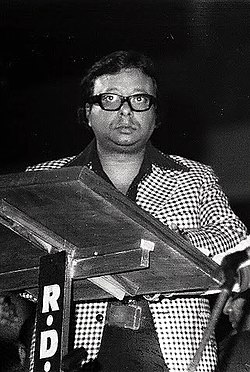
Rahul Dev Burman (ⓘ; 27 June 1939 – 4 January 1994) was an Indian music director and singer, who is considered to be one of the greatest and most successful music directors of the Hindi film music industry. From the 1960s to the 1990s, Burman composed musical scores for 331 films, bringing a new level of music ensemble with his compositions.[1] Burman did his major work with legendary singers Kishore Kumar, Lata Mangeshkar, Asha Bhosle and Mohammed Rafi.[2] He also worked extensively with lyricists like Majrooh Sultanpuri, Anand Bakshi and Gulzar, with whom he created some of the most memorable numbers in his career. Nicknamed Pancham, he was the only son of the composer Sachin Dev Burman and his Bengali lyricist wife Meera Dev Burman.
Key Information


He was mainly active in the Hindi film industry as a composer, and also provided vocals for a few compositions.[3] He influenced the next generation of Indian music directors,[3] and his songs remain popular in India and overseas. Many years after his death, his songs continued to inspire new singers and composers.[4]
Biography
[edit]Early life
[edit]Burman was born to the Hindi film composer and singer, Sachin Dev Burman, and his lyricist wife Meera Dev Burman (née Dasgupta), in Calcutta. Initially, he was nicknamed Tublu by his maternal grandmother, although he later became known by the nickname Pancham. According to some stories, he was nicknamed Pancham because, as a child, whenever he cried, it sounded in the fifth note (Pa), G note on c major scale, of music notation; in Hindustani Classical Music, Pancham is the name of the fifth scale degree: (IAST: Ṣaḍja, Ṛṣabha, Gandhāra, Madhyama, Pañcama, Dhaivata, Niṣāda). Another theory says that the baby was nicknamed Pancham because he could cry in five different notes. Yet another version is that when the veteran Indian actor Ashok Kumar saw a newborn Rahul uttering the syllable Pa repeatedly, he nicknamed the boy Pancham.[5]
Burman received his early education in West Bengal from Ballygunge Government High School in Kolkata. His father S. D. Burman was a noted music director in Hindi-language films, the Mumbai-based Hindi film industry. When he was seventeen years old, R. D. Burman composed his first song, Aye meri topi palat ke aa, which his father used in the film Funtoosh (1956). The tune of the song Sar jo tera chakraaye was also composed by him as a child; his father included it in the soundtrack of Guru Dutt's Pyaasa (1957).[6]
In Mumbai, Burman was trained by Ustad Ali Akbar Khan (sarod) and Samta Prasad (tabla).[7] He also considered Salil Chowdhury his guru.[8] He served as an assistant to his father and often played harmonica in his orchestras.[3]
Some of the notable films in which Burman is credited as the music assistant include Chalti Ka Naam Gaadi (1958), Kaagaz Ke Phool (1959), Tere Ghar Ke Samne (1963), Bandini (1963), Ziddi (1964), Guide (1965) and Teen Devian (1965). Burman also played mouth organ for his father's hit composition "Hai Apna Dil To Aawara", which was featured in the film Solva Saal, and sung by Hemanta Mukhopadhyay.[9]
In 1959, Burman signed up as a music director for the film Raaz, directed by Guru Dutt's assistant Niranjan. However, the film was never completed. The lyrics of this Guru Dutt and Waheeda Rehman-starrer film were written by Shailendra. Burman recorded two songs for the film before it was shelved. The first song was sung by Geeta Dutt and Asha Bhosle, and the second one had vocals by Shamshad Begum.[10]
Burman's first released film as an independent music director was Chhote Nawab (1961). When the noted Hindi film comedian Mehmood decided to produce Chhote Nawab, he first approached Burman's father Sachin Dev Burman for the music. However, S. D. Burman declined the offer, advising he was unavailable. At this meeting, Mehmood noticed Rahul playing tabla, and signed him as the music director for Chhote Nawab.[10] Burman later developed a close association with Mehmood, and made a cameo appearance in Mehmood's film Bhoot Bungla (1965).[10]
Personal life
[edit]Burman's first wife was Rita Patel, whom he had met in Darjeeling. Rita, a fan, had bet her friends that she would be able to get a film-date with Burman. They two married in 1966, and divorced in 1971.[11] The song Musafir Hoon Yaaron ("I'm a Traveller") from Parichay (1972) was composed while he was at a hotel after the separation.[12]
Burman married Asha Bhosle in 1980 after a protracted romance despite his mother's vehement opposition to their relationship. Together, the couple recorded many hit songs and also staged many live performances. However, towards the end of his life, they did not live together.[13] Burman had financial difficulties, particularly later in his life. His mother Meera died in 2007, thirteen years after his death.[14] She had been suffering from Alzheimer's even before her son's death. Just before her death she had been moved to an old age home, and moved back to her son's residence after the issue became a controversy.[15]
Death
[edit]R.D. Burman died on 4 January 1994 due to a heart attack. Burman had been suffering from Cardiovascular disease for around six years before his death and even underwent a surgery because of an earlier heart attack in 1988.[16]
Music career
[edit]1961–1975: Early career and rise to prominence
[edit]R. D. Burman began his career as a music director with the 1961 film Chhote Nawab, which proved to be a lukewarm success and so his next three ventures, Bhoot Bungla (1965), Teesra Kaun (1965) and Pati Patni (1966).[17] He established himself with Vijay Anand's musical mystery film Teesri Manzil (1966), which had Shammi Kapoor and Asha Parekh in the lead.[18] It went on to become a huge success at the box office which was attributed to its superhit songs, "O Haseena Zulfonwali Jane Jahan", "O Mere Sona Re Sona", "Aaja Aaja Main Hoon Pyar Tera", "Deewana Mujhsa Nahin" and "Tumne Mujhe Dekha Hokar Meherban", all of which were featured in the year-end annual list of Binaca Geetmala.[19][20] Also the soundtrack of Teesri Manzil proved to be the seventh best-selling Hindi film album of the 1960s.[21]
Burman's other notable work of the decade was the musical comedy Padosan (1968), whose songs like "Ek Chatur Naar", "Mere Samne Wali Khidki Mein", "Mere Bhole Balam" and "Kehna Hai Kehna Hai" remain popular to date and played a major part in making the film a commercial success.[22] In 1969, he delivered music for two hit films, Waris and Pyar Ka Mausam and also while working as an assistant to his father in Shakti Samanta's Aradhana, he played an instrumental role in making Kishore Kumar the playback voice of Rajesh Khanna, who became a superstar with the film's blockbuster success and same for Kumar whose singing career was boosted and he became the leading playback singer of Hindi cinema and remained at that position till his death in 1987.[23][24]
Burman emerged as the leading music director of Hindi cinema in the year 1970 with Shakti Samanta's musical romantic drama Kati Patang starring Rajesh Khanna and Asha Parekh. At the box office, it went on to become a blockbuster with almost all of its songs, such as "Yeh Shaam Mastani", "Pyaar Deewana Hota Hai", "Yeh Jo Mohabbat Hai", all three solos by Kishore Kumar and "Jis Gali Mein Tera Ghar", a solo by Mukesh proving to be chartbuster and playing an important role in the box office success of the film and making its soundtrack one of the highest-selling Bollywood album of the 1970s.[25][26] The same year, he also delivered music in another Rajesh Khanna hit The Train, which had the popular songs "Gulabi Aankhen", a solo by Mohammed Rafi and "Kis Liye Maine Pyar Kiya", a solo by Lata Mangeshkar.[27]
For the next three years he worked in top-grossing films, such as Haré Rama Haré Krishna (1971), Caravan (1971), Mela (1971), Amar Prem (1972), Mere Jeevan Saathi (1972), Apna Desh (1972), Jawani Diwani (1972), Raampur Ka Lakshman (1972), Parichay (1972), Seeta Aur Geeta (1972), Samadhi (1972), Anamika (1973), Aa Gale Lag Jaa (1973), Yaadon Ki Baaraat (1973) and Namak Haraam (1973), all of which had superhit songs like "Chadti Jawani Meri Chaal Mastani", "Piya Tu Ab To Aaja" and "Kitna Pyara Wada Hai" (Caravan), "Dum Maro Dum", "Phoolon Ka Taron Ka" and "Kanchi Re Kanchi" (Hare Rama Hare Krishna), "Rut Hai Milan Ki Sathi Mera Aa Re" and "Gori Ke Haath Mein Jaise Ye Challa" (Mela), "Raina Beeti Jaye", "Chingari Koi Bhadke", "Kuchh Toh Log Kahenge" and "Yeh Kya Hua" (Amar Prem), "O Mere Dil Ke Chain", "Chala Jaata Hoon" and "Aao Na, Gale Laga Lo Na" (Mere Jeevan Saathi), "Duniya Mein Logon Ko", "Kajra Lagake Gajra Sajake" and "Ro Na Kabhi Nahin Rona" (Apna Desh), "Samne Yeh Kaun Aaya", "Yeh Jawani Hai Deewani" and "Jaan-E-Jaan Dhoondta Phir Raha Hoon Tumhe Raat Din" (Jawani Diwani), "Gum Hai Kisi Ke Pyar Mein Dil Subah Sham" and "Rampur Ka Vasi Hoon" (Raampur Ka Lakshman), "Musafir Hoon Yaaron" and "Sa Re Ke Sa Re" (Parichay), "O Saathi Chal" and "Koi Ladki Mujhe Kal Raat" (Seeta Aur Geeta), "Kaanta Laga", "Jab Tak Rahe" and "Jaan-E-Jaana Jao" (Samadhi), "Panna Ki Tamanna" (Heera Panna), "Meri Bheegi Bheegi Si" and "Bahon Mein Chale Aao" (Anamika), "Vaada Karo" and "Tera Mujhse Hain Pehle Ka Nata Koi" (Aa Gale Lag Jaa), "Yaadon Ki Baaraat Nikli Hai Aaj Dil Ke Dwaare", "Chura Liya Hai Tumne Jo Dil Ko, Nazar Nahin Churana Sanam", "Lekar Hum Deewana Dil, Phirte Hai Manzil Manzil" and "Meri Soni, Meri Tamanna, Jhuth Nahin Hai Mera Pyar" (Yaadon Ki Baaraat), "Diye Jalte Hain Phool Khilte Hain" and "Main Shair Badnaam" (Namak Haraam).[28][29] The soundtrack of Caravan proved to be one of the best-selling Hindi film albums of the 1970s while that of Yaadon Ki Baaraat emerged as the second best-selling Hindi film album of the decade.[26] For Caravan, Amar Prem and Yaadon Ki Baaraat, Burman received three consecutive nominations at Filmfare for Best Music Direction.[30] In 1974, his notable ventures, included Aap Ki Kasam, Khote Sikkay, Ajanabee and Phir Kab Milogi, all of which had evergreen songs like "Karvatein Badalte Rahe", "Jai Jai Shiv Shankar", "Suno Kaho Kaha Suna", "Zindagi Ke Safar Mein, "Jeevan Mein Tu Darna Nahin", "Ek Ajanabee Haseena Se", "Hum Dono Do Premi", "Bheegi Bheegi Raaton Mein" and "Kahin Karti Hogi".[24] Burman's peak came in 1975 when he scored music for Sholay, Deewaar, Khel Khel Mein, Warrant, Aandhi, Khushboo and Dharam Karam, all of which were hugely successful at the box office, especially Sholay which emerged as an All Time Blockbuster and remains the biggest hit in the history of Indian cinema.[31] Its songs "Mehbooba Mehbooba", "Yeh Dosti Hum Nahin", "Haa Jab Tak Hai Jaan", "Koi Haseena" topped the year-end annual list of Binaca Geetmala and made its soundtrack one of the best-selling Hindi film albums of the 1970s along with winning Burman another nomination in the Best Music Director category at Filmfare.[32][26] Other notable songs composed by him that year were – "Kehdoon Tumhe Ya Chup Rahoon" (Deewaar), "Humne Tumko Dekha", "Ek Main Aur Ek Tu, Dono Mile Is Tarah", "Khullam Khulla Pyar Karenge Hum Dono" (Khel Khel Mein), "Sun Bhai Baarati", "Ruk Jana O Jana Humse" (Warrant), "Tere Bina Zindagi Se", "Tum Aa Gaye Ho Noor Aa Gaya", "Is Mod Se Jate Hain" (Aandhi), "O Majhi Re Apna Kinara" (Khushboo), "Ek Din Bik Jayega Mati Ke Mol", "Tere Humsafar Geet Hain Tere" (Dharam Karam).[33][34]
1976–1983: Setback and return to success
[edit]With Rajesh Khanna losing superstardom and change of box office equation from romantic musicals to action oriented multi-starrers, Burman saw a career slump in the latter-half of the 1970s.[35]
In 1976, most of his releases did not do well commercially, with notable exceptions being Nehle Pe Dehla, Balika Badhu and Mehbooba, all three of which were moderately successful with hit songs, such as "Sawan Ka Mahina Aa Gaya", "Bade Achhe Lagte Hain" and "Mere Naina Sawan Bhadon", respectively.[36] His prospects improved, the following year, with Nasir Hussain's musical blockbuster Hum Kisise Kum Naheen, which had a number of runaway hits, including "Bachna Ae Haseeno", "Mil Gaya, Hum Ko Saathi Mil Gaya", "Hai Agar Dushman Zamana, Gham Nahin", "Yeh Ladka Haay Allah Kaisa Hai Deewana", "Kya Hua Tera Vaada, Woh Kasam, Woh Iraada", "Chand Mera Dil, Chandni Ho Tum" and "Tum Kya Jaano Mohabbat Kya Hai".[37] Also its soundtrack proved to be the fourth-best selling Hindi film album of the decade.[26] His only other notable film that year was Gulzar's directional venture Kinara, which had memorable songs like "Naam Hum Jayega" and "Ek Hi Khwab".[38] In 1978, Burman composed for Amitabh Bachchan starrer Kasme Vaade and Dharmendra starrer Azaad, both of which were major box office successes with their songs "Kasme Vaade Nibhayenge Hum", "Aati Rahengi Baharen" in the former and "Raju Chal Raju", "Jaan Ki Kasam" in the latter proving to be very popular, though his other big-budget ventures, such as Shalimar and Bhola Bhala were commercial failures.[39][40] He concluded the decade with a hit in Gol Maal and a number of moderately successful films, Jhoota Kahin Ka, Jurmana and Nauker.[41] The songs from these films, such as "Aanewala Pal" (Gol Maal), "Jeevan Ke Har Mod" (Jhoota Kahin Ka), "Sawan Ke Jhoole Pade Hai" (Jurmana), "Pallo Latke Re Mharo Pallo Latke (Nauker) found a spot in the year-end annual list of Binaca Geetmala.[42]
The early-1980s saw Burman rise to top once again with two major blockbusters Love Story (1981) and Betaab (1983), both of which emerged two of the best selling soundtrack albums of the decade with songs that remain evergreen, such as "Kaisa Tera Pyaar", "Dekho Maine Dekha Hai Ek Sapna" in the former and "Jab Hum Jawan Honge", "Teri Tasveer Milgayi" in the latter.[43][44] This phase also saw him getting consecutive Best Music Director awards at Filmfare for Sanam Teri Kasam (1982), which had melodies like "Kitne Bhi Tu Karle Sitam" and "Dekhta Hoon Koi Ladki" was again one of the best-selling albums of the 1980s and Masoom (1983), whose songs "Tujhse Naraz Nahin Zindagi", "Lakdi Ki Kathi", "Do Naina Aur Ek Kahaani" received immense critical acclaim.[45]
His other popular numbers during this period were in - "Piya Bawri, Piya Bawri" and "Sun Sun Sun Didi" (Khubsoorat), "Yamma Yamma" and "Jaanu Meri Jaan" (Shaan), "Apne Pyar Ke" and "Manchali O Manchali" (Barsaat Ki Ek Raat), "Jahan Teri Yeh Nazar Hai" and "Tum Saath Ho Jab Apne" (Kaalia), "Kya Yehi Pyar Hai" and "Aa Dekhen Zara" (Rocky), "Preetam Aan Milo" and "Hothon Pe Beeti Baat" (Angoor), "Dilbar Mere" and "Dukki Pe Dukki Ho" (Satte Pe Satta), "Yeh Zameen Gaa Rahi Hai" and "Kya Hua Ek Baat Par" (Teri Kasam), "Jane Kaise Kab Kahan" and "Hamne Sanam Ko Khat Likha" (Shakti), "Agar Tum Na Hote" and "Dheere Dheere Zara Zara" (Agar Tum Na Hote), "Bachke Rehna Re Baba and "Samandar Mein Nahake" (Pukar), all of which were box office successes.[46][47]
1984–1994: Later career
[edit]From 1984 onwards, Burman's career as a composer began to decline as almost all the films he composed music for in 1984 and 1985 sank without a trace with two exceptions being Ramesh Sippy's romantic musical Saagar (1985) and Rahul Rawail's actioner Arjun (1985), both of which had lyrics written by Javed Akhtar and had memorable songs like "Chehra Hai Ya Chand Khila Hai" and "Saagar Kinare" (Saagar), "Mammaiya Kero Mamma" and "Dhadkan Pal Pal Badhti Jaaye" (Arjun). Also the music of Saagar proved to be one of the highest-selling Bollywood albums of the decade and got him a nomination in the Best Music Director category at 33rd Filmfare Awards.[48][44]
In the latter-half of the 1980s, Burman's notable ventures, included Gulzar's romantic drama Ijaazat (1987) and Vidhu Vinod Chopra's crime thriller Parinda (1989). Both the films opened to widespread acclaim for their direction, story and songs, such as "Mera Kuchh Saamaan", "Qatra Qatra Milti Hai" in the former and "Tumse Milke Aisa Laga Tumse Milke", "Kitni Hai Pyari Pyari" in the latter.[49][50]
After a dull beginning to the new decade with flops like Jeene Do (1990), Dushman (1990) and Indrajeet (1991), Burman delivered music in Priyadarshan's Gardish (1993), which proved to be a box office success with hit songs like "Hum Na Samjhe The", sung by S. P. Balasubrahmanyam and "Yeh Mera Dil To Pagal Hai", a duet by Balasubrahmanyam and Asha Bhosle.[51] In 1994, he once again collaborated with Vidhu Vinod Chopra for his magnum opus 1942: A Love Story. Although the film did not succeed commercially, its music was a huge hit and the third best-selling Hindi film album of 1994 with songs that remained popular such as "Ek Ladki Ko Dekha", "Kuchh Na Kaho", both solos by Kumar Sanu and "Pyar Hua Chupke Se", sung by Kavita Krishnamurthy.[52][53] Burman died a few days before the release of the film,[54] and was posthumously awarded his third Best Music Director at the 40th Filmfare Awards.[55]
Style
[edit]Burman has been credited with revolutionizing Hindi film music.[56] He incorporated a wide range of influences from several genres in his scores though his primary inspiration was Bengali folk. Burman's career coincided with the rise of Rajesh Khanna-starrer youth love stories. He made electronic rock popular in these popular love stories.[3] He often mixed disco and rock elements with Bengali folk music.[57] He also used jazz elements, which had been introduced to him by the studio pianist Kersi Lord.[58]
According to Douglas Wolk, Burman "wrapped sugary string swoops around as many ideas as he could squeeze in at once".[1] Biswarup Sen describes his popular music as one featuring multicultural influences, and characterized by "frenetic pacing, youthful exuberance and upbeat rhythms".[59]
Burman was influenced by Western, Latin, Oriental and Arabic music, and incorporated elements from these in his own music.[60] He also experimented with different musical sounds produced from methods such as rubbing sandpaper and knocking bamboo sticks together.[9] He blew into beer bottles to produce the opening beats of "Mehbooba, Mehbooba". Similarly, he used cups and saucers to create the tinkling sound for the song "Chura Liya Hai" from the film Yaadon Ki Baaraat (1973).[61] For Satte Pe Satta (1982), he made the singer Annette Pinto gargle to produce a background sound.[9] He also rubbed a comb on a rough surface to produce a whooshing sound in the song "Meri Samne Wali Khidki Main" from the film Padosan (1968)
On multiple occasions, Burman experimented with recording the same song with different singers. For Kudrat (1981), he recorded the light semi-classical version of the song "Hume tumse pyar kitna" in the voice of Kishore Kumar, while the classical version was recorded in the voice of Parveen Sultana.
Controversies
[edit]Allegations of plagiarism
[edit]Music critics and commentators have long discussed alleged instances of musical borrowing in Burman's work. Journalist Vivek Kaul wrote that "R.D. Burman was accused of plagiarising right through his career... this was probably one question that Pancham had to defend himself against in most of his interviews."[62] A retrospective article on classic Hindi film music similarly stated that "even revered composers such as R. D. Burman and S. D. Burman occasionally adapted foreign tunes."[63]
However researcher Vishaws Nerurkar commented in his book
"The late R.D. Burman has often been accused of lifting western tunes and of using them in their original format. This is somewhat true, but in my study of all his work, I cannot discover this piracy in more than 20 to 30 numbers. In a prolific output of over 1500 songs, this can be easily overlooked. And even in these so called 'lifted' tunes, one cannot help but notice how the composer with great dexterity and skill had changed the original "inspiration", only giving us a glimpse now and then of a western tune. All composers have their influences. Pancham had his. His uniqueness was the variations he created on inspired numbers. On the other hand his severe critics who have heard his other 1450 songs do attribute originality and great fountains of melody. That certainly makes him an original composer."[64]
Burman himself acknowledged using Western dance music "as a source of inspiration" for his compositions.[65] As was common in Hindi films, some of his songs featured the tunes of popular foreign songs. For example, Ramesh Sippy insisted that the tune of the traditional Cyprus song "Say You Love Me" (arranged and sung by Demis Roussos) be used for "Mehbooba Mehbooba" (Sholay, 1975), and Nasir Hussain wanted to use ABBA's "Mamma Mia" for Mil gaya hum ko sathi. Other examples of Burman songs inspired by foreign songs including "Aao twist karein" from Bhoot Bangla (Chubby Checker's "Let's Twist Again"), "Tumse milke" (Leo Sayer's "When I Need You"), and "Zindagi milke bitaayenge" (Paul Anka's "The Longest Day") and "Jahan teri yeh nazar hai" (Persian artist Zia Atabi's "Heleh maali") and "Dilbar mere" (Alexandra's "Zigeunerjunge").
Legacy
[edit]Several Hindi films made after Burman's death contain his original songs or their remixed versions. Dil Vil Pyar Vyar (2002), which contains several re-arranged hit songs of Burman, was made as a tribute to him.[66] Jhankaar Beats (2003), which catapulted the music director duo Vishal–Shekhar into the limelight, is also a tribute to him.[67] In Khwahish (2003), Mallika Sherawat's character is a Burman fan; the film features repeated references to him.[68] In 2010, Brahmanand Singh released a 113-minute documentary titled Pancham Unmixed: Mujhe Chalte Jaana Hai, which received critical acclaim.[9] Pancham Unmixed won 2 National Awards and was premiered at IFFLA, Los Angeles. The film is considered a landmark in documentary biopics in India and set a trend. A coffee-table book, co-authored by Brahmanand Siingh and Gaurav Sharma titled "Strings of Eternity" was released with Pancham Unmixed by Shemaroo. Mobius films, the producers of Pancham Unmixed, then went on to release an extended 5 hours version titled "Knowing Pancham". The launch was at prestigious venue Blue Frog in Mumbai and was graced by Manoj Bajpayee, Ashutosh Gowariker, Dolly Thakore, Sachin, Atul Tiwari, Ketan Mehta, Deepa Sahi amongst others. Brahmanand and Gaurav Sharma authored another coffee-table book with the extended version, titled "Diamonds and Rust". The music of Lootera (2013) is a tribute to Burman.[69] A number of Indian remix albums feature Burman's songs, which are also popular in the country's pubs and discos.[5] Several of his compositions were re-mixed by the South Asian DJs in the United Kingdom and North America, and feature in popular albums such as Bally Sagoo's Bollywood Flashback.[3] Kronos Quartet's You've Stolen My Heart (2005) contains Burman's compositions sung by his wife Asha Bhosle.[70] In the 2012 film Khiladi 786, Himesh Reshammiya-composed song Balma is also a tribute to R.D. Burman.[71]
In 1995, Filmfare Awards constituted the Filmfare RD Burman Award for New Music Talent in his memory. The award is given to upcoming music talent in Hindi cinema. In 2009, the Brihanmumbai Municipal Corporation named a public square in Santa Cruz after Burman.[72]
Burman inspired many later Hindi film music composers, such as Vishal–Shekhar. Jatin–Lalit are considered to have carried on Burman's legacy through the 1990s.[73] Notable musical assistants to Burman include Manohari Singh and Sapan Chakraborty. His instrumentalists included Hari Prasad Chaurasia, Shiv Kumar Sharma, Louis Banks, Bhupinder Singh and Kersi Lord.[9] He is also noted for his partnership with the lyricist Gulzar, who wrote the words for several of his finest compositions.[9]
Discography
[edit]Awards and recognitions
[edit]
- Wins
- 1983 – Best Music Director – Sanam Teri Kasam
- 1984 – Best Music Director – Masoom
- 1995 – Best Music Director – 1942: A Love Story (Posthumous)
- Nominations
- 1972 – Best Music Director – Caravan
- 1973 – Best Music Director – Amar Prem
- 1974 – Best Music Director – Yaadon Ki Baaraat
- 1975 – Best Music Director – Aap Ki Kasam
- 1976 – Best Music Director – Khel Khel Mein
- 1976 – Best Music Director – Sholay
- 1976 – Best Male Playback Singer – "Mehbooba Mehbooba" from Sholay
- 1977 – Best Music Director – Mehbooba
- 1978 – Best Music Director – Hum Kisise Kum Naheen
- 1978 – Best Music Director – Kinara
- 1979 – Best Music Director – Shalimar
- 1981 – Best Music Director – Shaan
- 1982 – Best Music Director – Love Story
- 1984 – Best Music Director – Betaab
- 1985 – Best Music Director – Jawaani
- 1986 – Best Music Director – Saagar
- Win
- Google Doodle
References
[edit]- ^ a b Douglas Wolk (December 1999). "SoundFiles: MP3s and other bytes worth your memory". Spin. 15 (12): 169. ISSN 0886-3032.
- ^ "Lata Mangeshkar on R D Burman: Pancham Died Too Young, Unhappy". The Indian Express.
- ^ a b c d e Tejaswini Ganti (2004). Bollywood: a guidebook to popular Hindi cinema. Psychology Press. pp. 111–112. ISBN 978-0-415-28854-5.
- ^ "Nelly Furtado's 'Say it Right' samples Asha Bhonsle and RD Burman's Duniya Mein Logon Ko".
- ^ a b Mini Anthikad-Chhibber (1 July 2003). "Beat poet". The Hindu. Archived from the original on 22 October 2010. Retrieved 2 March 2012.
- ^ Dinesh Raheja; Jitendra Kothari (1996). The hundred luminaries of Hindi cinema. India Book House Publishers. p. 119. ISBN 978-81-7508-007-2.
- ^ Deepa Ganesh (18 August 2010). "Backbones take centre stage". The Hindu. Archived from the original on 5 September 2010. Retrieved 2 March 2012.
- ^ Rajan Das Gupta (3 January 2012). "Dad's the spirit!". The Hindu. Retrieved 2 March 2012.
- ^ a b c d e f Avijit Ghosh (3 April 2010). "RDX unplugged". The Times of India. Archived from the original on 3 January 2013. Retrieved 2 March 2012.
- ^ a b c Hanif Zaveri (2005). Mehmood, a man of many moods. Popular Prakashan. pp. 72–74. ISBN 978-81-7991-213-3.
- ^ Chaitanya Padukone (1 January 2008). "An ode to Pancham". DNA. Retrieved 2 March 2012.
- ^ "Revealed: Unknown facts about RD Burman!". rediff.com. 5 May 2011. Retrieved 2 March 2012.
- ^ Ajitabh Menon. "when the beats stopped". Panchamonline. Archived from the original on 7 October 2024. Retrieved 27 June 2014.
- ^ "S.D. Burman's wife dead". The Hindu. 17 October 2007. Archived from the original on 17 October 2007. Retrieved 2 March 2012.
- ^ "A Bungalow, A Ma-In-Law". Outlookindia.com. Archived from the original on 27 July 2014. Retrieved 26 July 2014.
- ^ admin (4 January 2014). "4th January 1994: R.D. Burman, renowned music director, died –". What Happened On This Day in History – Maps of India. Retrieved 18 December 2024.
- ^ Ghosh, Avijit. "A tribute: Five rare gems from the early RD Burman". The Times of India. ISSN 0971-8257. Retrieved 6 August 2024.
- ^ "When Dev Anand came to blows with Nasir Hussain". Press Trust of India. 23 October 2016 – via Business Standard.
- ^ "R D Burman – My God, That's My Tune" (PDF). Archived from the original (PDF) on 21 April 2023. Retrieved 23 October 2006.
- ^ Back on air with Geetmala. Bella Jaisinghani. The Financial Express (India), Sunday, 11 March 2001. Transcript available online at "Ameen Sayani/Press Reviews". Archived from the original on 26 April 2006. Retrieved 2006-07-29., accessed online on 29 July 2006
- ^ "Music Hits 1960–1969". Box Office India. Archived from the original on 15 February 2008. Retrieved 2 September 2013.
- ^ Bhattacharya, Roshmila (9 August 2019). "This week, that year: 'Padosan' Saira Banu on her 'guru' Kishore Kumar". Mumbai Mirror. Archived from the original on 12 February 2023. Retrieved 20 June 2022.
- ^ "The Aradhana syndrome and S D Burman". Rediff. 31 October 2000. Archived from the original on 5 October 2013. Retrieved 24 July 2013.
- ^ a b "The unforgettable music Rajesh Khanna, Kishore Kumar and RD Burman created together". 19 July 2012.
- ^ Lokpally, Vijay (16 October 2014). "Blast from the Past: Kati Patang (1971)". The Hindu.
- ^ a b c d "Music Hits 1970–1979". Box Office India. 5 February 2010. Archived from the original on 5 February 2010.
- ^ Vijayakar, R. M. (27 July 2012). "Rajesh Khanna: A Look Back at a Legend". India-West. Archived from the original on 30 July 2012. Retrieved 30 July 2012.
- ^ "Remembering RD Burman: The Man, the Musician, the Legend". 27 June 2015.
- ^ "Revisiting RD Burman, the last music emperor". 4 January 2025.
- ^ "Filmfare Awards (1953–2005)" (PDF). Archived from the original (PDF) on 12 June 2009. Retrieved 5 November 2007.
- ^ "Rewind – Greatest Indian Film Sholay Is 43 Years Old". Box Office India.
- ^ Morcom, Anna (2007). Hindi film songs and the cinema. Ashgate Publishing, Ltd. p. 209. ISBN 978-0-7546-5198-7. Archived from the original on 17 May 2016. Retrieved 15 July 2016.
- ^ Anirudha Bhattacharjee Balaji Vittal (2012). R. D. Burman: The Man, The Music. HarperCollins Publishers. pp. 85–87. ISBN 978-93-5029-236-5.
- ^ "Khel Khel Mein (1975)". The Hindu. 7 November 2013. Archived from the original on 13 March 2017. Retrieved 27 June 2021.
- ^ "How The Bachchan Wave Of 1970s Ruined Bollywood's First Superstar – Rise And Fall Of 'Kaka'". 18 July 2023. Archived from the original on 17 January 2024. Retrieved 17 January 2024.
- ^ "Great Gambler". Archived from the original on 15 February 2009. Retrieved 1 May 2008.
- ^ "BLAST FROM THE PAST: Hum Kisise Kum Naheen (1977)". The Hindu. 7 March 2013.
- ^ "Gulzar's Madhur Dosti With R D Burman". 18 August 2023.
- ^ Lokapally, Vijay (27 February 2015). "Kasme Vaade (1978)". The Hindu. Archived from the original on 19 December 2018. Retrieved 18 December 2018.
- ^ "Azaad (1978)". The Hindu. 6 October 2016.
- ^ "Trade Guide Classification - 1979". Archived from the original on 27 August 2024. Retrieved 28 August 2024.
- ^ Mitra, Ananda (1993). Television and popular culture in India: a study of the Mahabharat. Sage Publications. pp. 83. ISBN 0803991347.
- ^ "Saiyaara Among The Biggest Newcomer Films Of All Time". 24 July 2025.
- ^ a b "Music Hits 1980–1989". Box Office India. 5 February 2010. Archived from the original on 5 February 2010.
- ^ "Filmfare Awards (1953–2005)" (PDF). Archived from the original (PDF) on 12 June 2009. Retrieved 5 November 2007.
- ^ "The Unchained Melody of R.D. Burman".
- ^ "Remembering Rahul Dev Burman: The composer's evergreen hits". 22 June 2017.
- ^ "Ramesh Sippy: One Didn't Need To Direct Rishi Kapoor!". Mid-Day. 1 May 2020. Retrieved 22 September 2020.
- ^ "The Master at His Best". Retrieved 14 December 2018.
- ^ "100 Filmfare Days: 69- Parinda". Filmfare. 2 July 2014. Archived from the original on 12 November 2017. Retrieved 12 November 2017.
- ^ Kesavan, Mukul (September–October 1993). "Gardish" (PDF). Manushi. No. 78. p. 36. Retrieved 29 May 2020.
- ^ "1942: A Love Story (1994)". Box office India. Archived from the original on 23 December 2016. Retrieved 9 June 2022.
- ^ "BoxOffice India.com". 2 January 2010. Archived from the original on 2 January 2010. Retrieved 17 November 2024.
- ^ "How RD Burman reclaimed his musical legacy with his swan song, 1942: A Love Story". 28 June 2017.
- ^ "40th Filmfare Awards 1995 Nominations". Indian Times. The Times Group. Archived from the original on 8 July 2007. Retrieved 24 June 2021.
- ^ "RD Burman". Outlook. 46 (26–38). Hathway Investments. 2006.
- ^ Kathryn Marie Kalinak (2010). Film music: a very short introduction. Oxford University Press. p. 112. ISBN 978-0-19-537087-4.
- ^ E. Taylor Atkins (2003). Jazz Planet. University Press of Mississippi. p. 67. ISBN 978-1-57806-609-4.
- ^ Biswarup Sen (2008). "The Sounds of Modernity". In Sangita Gopal and Sujata Moorti (ed.). Global Bollywood: travels of Hindi song and dance. University of Minnesota Press. p. 97. ISBN 978-0-8166-4579-4.
- ^ "Pulsating Pancham". The Hindu. 2 July 2007. Archived from the original on 7 January 2013. Retrieved 2 March 2012.
- ^ Savitha Gautam (26 February 2010). "Melodies and memories". The Hindu. Retrieved 2 March 2011.
- ^ Kaul, Vivek (29 August 2012). "Where does inspiration end and plagiarism begin?". VivekKaul.com. Retrieved 18 October 2025.
- ^ "Plagiarism in Hindi Film Music: Is Imitation the Most Sincere Form of Flattery?". Mr. and Mrs. 55. 24 August 2012. Retrieved 18 October 2025.
- ^ Vishwas Nerurkar (1997). Pancham An Anthology of R.D. Burman's Musical Works. Gayatri Publication. p. 10. ISBN 81-903959-5-5.
- ^ Ashok Da. Ranade (2006). Hindi film song: music beyond boundaries. Bibliophile South Asia. p. 309. ISBN 978-81-85002-64-4.
- ^ Radhika Bhirani (19 October 2011). "Sur, saaz and rockstar: When music is Bollywood's muse". The Times of India. Retrieved 2 March 2012.[dead link]
- ^ "Sujoy Ghosh plans 'Jhankaar Beats' sequel". IBNLive. 29 February 2012. Archived from the original on 9 October 2013. Retrieved 2 March 2012.
- ^ Saibal Chatterjee (7 June 2003). "Khwahish". Hindustan Times. Archived from the original on 21 January 2012. Retrieved 2 March 2012.
- ^ "'Lootera' songs – Amit Trivedi's tribute to R. D. Burman". Zee News. 8 June 2013.
- ^ Allan Kozinn (11 April 2006). "Kronos Quartet and Asha Bhosle Make Not-So-Strange Bedfellows". The New York Times. Retrieved 2 March 2012.
- ^ "KHILADI 786: RD Burman features with Akshay in new song". Hindustan Times. 18 October 2012. Archived from the original on 20 March 2013. Retrieved 17 January 2013.
- ^ Clara Lewis (2 January 2009). "R D Burman gets a chowk in Mumbai". The Times of India. Archived from the original on 1 July 2012. Retrieved 2 March 2012.
- ^ "Chilling with Bollywood's new songsters". rediff.com. 8 September 2005. Retrieved 2 March 2012.
- ^ "STL News | World News | Breaking News | Latest News | Today News". www.bfjaawards.com. Archived from the original on 22 April 2008. Retrieved 13 January 2022.
- ^ Google pays tribute to legendary composer R D Burman on his 77th birth anniversary. The Indian Express (27 June 2016). Retrieved on 2018-11-08.
Further reading
[edit]- Anirudha Bhattacharjee; Balaji Vittal (2011). R.D. Burman: the man, the music. Harper Collins India. ISBN 978-93-5029-049-1.
External links
[edit]

.svg)


- R. D. Burman at IMDb
- Pancham – Rahul Dev Burman Archived 4 August 2011 at the Wayback Machine


