Recent from talks
Nothing was collected or created yet.
Naushad
View on Wikipedia
Key Information
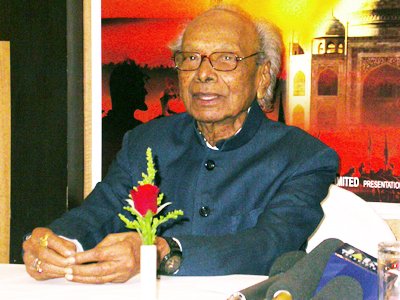
Naushad Ali (25 December 1919 – 5 May 2006) was an Indian composer for Hindi films.[1][2][3] He is widely considered to be one of the greatest and foremost music directors of the Hindi film industry. He is respectfully remembered as "Moseeqar-e-azam" ( The great musician) in the Hindi film industry.[4] He is particularly known for popularising the use of classical music in films.[5][6]
His first film as an independent music director was Prem Nagar in 1940.[7] His first musically successful film was Rattan (1944), followed by 35 silver jubilee hits, 12 golden jubilee and 3 diamond jubilee mega successes. Naushad was conferred the Dadasaheb Phalke Award and the Padma Bhushan in 1981 and 1992 respectively for his contribution to the Hindi film industry.[8]
Early life and education
[edit]Naushad Ali was born and raised in Lucknow,[1] a city with a long tradition as a centre of Indian Muslim culture. His father, Wahid Ali, was a munshi (court clerk). As a child, Naushad would visit the annual fair at the Deva Sharif in Barabanki, 25 km from Lucknow, where all the great qawwals and musicians of those days would perform before the devotees. He studied Hindustani music there under Ustad Ghurbat Ali, Ustad Yusuf Ali, Ustad Babban Saheb and others. He also repaired harmoniums.[2]
As a lad, he joined a junior theatrical club and was appointed the club's music maestro for their theatrical presentations. He used to watch silent films at the Royal theatre in Lucknow. Theatre owners would hire a team of musicians to play the tabla, harmonium, sitar and violin. The musicians would watch the film first, make notes, finalize the scales required. When the show began in the evening, they would sit in front of the screen and play music for the scenes. This was a great way to be entertained and learn music at the same time. It made him grasp the nuances required in composing a film's background music score.
In time Naushad formed his own Windsor Music Entertainers or just Windsor Entertainers, so named because he had seen the word "Windsor" around Lucknow and liked its ring. It led to the Indian Star Theatrical Company in a theatre at Golaganj colony in Lucknow. He was trained under Laddan Khan until he became capable of working independently as a composer. There he also developed the sense to pick rare musical jewels from the folk tradition of Punjab, Rajasthan, Gujarat and Saurashtra during the company's sojourns in those regions. The travelling players got as far as Viramgam in Gujarat, where they discovered penury, even after selling off theatrical props and musical instruments. The company limped back to Lucknow through the kindness of one of Naushad's friends.
Naushad had already become a cinema fan in the silent era and then, in 1931, Indian cinema got voice and music that further fascinated the 13-year-old boy. He learnt classical and folk music against the wishes of his father. He moved to Mumbai in late 1937 for a career as a musician.[9]
Career
[edit]In Mumbai, he initially stayed with an acquaintance from Lucknow (U.P.) at Colaba and after a while, shifted to Dadar opposite the Broadway theatre where he would sleep on the footpath. He assisted music director Ustad Jhande Khan who was at the peak of his success those days, at a monthly salary of Rs 40.
Then he worked on a film with a Russian producer with the studio located at Chembur. This film could not be completed. Naushad was a piano player so he worked as a pianist in composer Ustad Mushtaq Hussain's orchestra.[2] He then polished off an unfinished film score and got a credit as assistant to Mushtaq Hussain. Then the film company collapsed. Composer Khemchand Prakash took him on as his assistant for the film Kanchan at Ranjit Studios at a salary of Rs 60 per month, for which Naushad remained extremely grateful and in interviews, he had called Khemchand his guru.[2]
His friend, lyricist D. N. Madhok, trusted Naushad's unusual talent for composing music and introduced him to various film producers. Chandulal Shah, the owner of Ranjit Studios, offered to sign Naushad for one of his forthcoming films. Naushad composed a thumri for this film, "Bata de koi kaun gali gaye Shyam", but the film never went into production. He was assistant music director for the Punjabi film Mirza Sahib (1939).
He composed for his first independent film Prem Nagar in 1940 that had a story set in Kutch for which he did a lot of research into the folk music of the area.[9] With A.R. Kardar's film Nayi Duniya (1942), he got first credit as "music director" and he began to work regularly for Kardar Productions. He, however, had a flexibility that he could work outside Kardar Productions and this arrangement continued throughout his career. He first got noticed with A.R. Kardar's film Sharda (1942) wherein 13-year-old Suraiya debuted with the song "Panchhi Ja" for the playback for heroine Mehtab. It was Rattan (1944) that took Naushad right to the top and enabled him to charge Rs 25,000 a film during those days.[2][9]
Film expert and author Rajesh Subramanian opines that Kardar productions spent Rupees seventy five thousand in 1944 to make Rattan. The music by Naushad saheb was such a phenomenal hit that the company earned Rs 3 lacs as royalty from gramophone sales in the first year.
But his Lucknow-based family remained against music and Naushad had to hide from his family the fact that he composed music. When Naushad got married, the band was playing the tunes of the super hit songs of Naushad's film 'Rattan'. While Naushad's father and father-in-law were condemning the musician who had composed these songs, Naushad dared not tell them that it was he who had composed the music. Naushad understood Hindu and Muslim culture and the languages of those cultures.[9]
From 1942 until the late 1960s, he was one of the top music directors in Hindi films. While he did 65 films during his lifetime, 26 of those films celebrated Silver jubilees (25 weeks run) – 8 celebrated golden jubilees (50 weeks run) and 4 celebrated diamond jubilees (60 weeks run) – (inclusive count – a diamond jubilee film also celebrates Silver and Golden jubilees).
Naushad worked with several lyricists, including Shakeel Badayuni, Majrooh Sultanpuri, D. N. Madhok, Zia Sarhadi, Yusufali Kechery and Khumar Barabankvi.[9]
Mother India (1957),[9] for which he had composed music, was the first Indian film that got nominated for an Oscar award.
In 1981, Naushad was awarded the Dadasaheb Phalke Award for his lifetime contribution to Indian cinema.[6]
He composed the tunes of Taj Mahal: An Eternal Love Story (2005) at the age of 86.[2]
Amongst his assistants, Mohammed Shafi, Jerry Amaldev and Ghulam Mohammed stand out prominently.
The songs Naushad composed for the 1988 Malayalam film Dhwani which were sung by P. Susheela & K. J. Yesudas are evergreen superhits that Malayalis do repeatedly listen to even after 3 decades.
Five films have been made on his life and work. Biographical books published are Dastaan-E-Naushad (Marathi) by Shashikant Kinikar; Aaj Gaawat Man Mero (Gujarati); Hindi and Urdu biographical sketches in Shama & Sushma Magazines respectively, titled "Naushad Ki Kahani, Naushad Ki Zubani"; the last one was translated into Marathi by Shashikant Kinikar. Kinikar also came up with a book titled "Notes of Naushad" which puts together some interesting anecdotes of Naushad's life.
Naushad also composed background music for the TV serial "Akbar The Great" telecast in 1988 which was directed by Akbar Khan, brother of Hindi film stars Sanjay Khan and Feroze Khan as was also The Sword of Tipu Sultan produced and directed by Sanjay Khan and Akbar Khan which was telecast in 1990 and became very popular.
Death and legacy
[edit]Naushad died on 5 May 2006 in Mumbai due to cardiac arrest at age 86.[1][2] He was buried at the Juhu Muslim cemetery.[10][9]
He is survived by six daughters Zubeda, Fehmida, Farida, Sayeeda, Rashida, and Waheeda and three sons Rehman Naushad, Raju Naushad & Iqbal Naushad. Rehman Naushad being the eldest of all assisted him in some of his films. Also, Naushad composed music for two movies directed by Rahman Naushad, My Friend (1974) and Teri Payal Mere Geet (1989).[9]
Naushad was ranked as one of the most respected and successful music directors of Indian Film Industry.[11]
Naushad had requested the Maharashtra State Government to sanction a plot for an institution for promoting Hindustani music. This was sanctioned during his lifetime and the 'Naushad Academy of Hindustani Sangeet' was formed.
Writer
[edit]Naushad was also a respected and published poet and formally launched his book of Urdu poetry entitled Aathwaan Sur ("The Eighth Note") and the Navras label's album titled "Aathwan Sur – The Other Side of Naushad" having 8 ghazals as part of Hounslow's book fair and festival "Bookmela" in November 1998. The album has lyrics and composition by Naushad, arranged by Uttam Singh.[9]
Track list:
- Aabadiyon Mein Dasht Ka Munzar Bhi Aayega – A. Hariharan – 7:08
- Aaj Ki Baat Kal Pay Kyun Taalo – A. Hariharan & Preeti Uttam Singh – 6:17
- Ghata Chhaayi Thi Saawan Khul Ke Barsa – Preeti Uttam Singh – 7:19
- Kabhi Meri Yaad Unko Aati To Hogi – A. Hariharan & Preeti Uttam Singh – 6:18
- Mujh Ko Muaff Kijiye – A. Hariharan – 5:35
- Peenay Waalay Bekhudi Say Kaam Lay – A. Hariharan & Preeti Uttam Singh – 8:13
- Saawan Kay Jab Baadal Chhaaye – A. Hariharan – 6:50
- Tanhaa Khud Say Baat Karoon – Preeti Uttam Singh – 7:49
Music style
[edit]Naushad gave a new trend to popular film music by basing his tunes on classical music ragas and folk music. Bhairavi (Hindustani) is his favourite Raga[12] Naushad was known for his skillful adaptation of the classical musical tradition for movie songs. Among all contemporary singer, Naushad Ali gave numbers of the songs to Mohammad Rafi. Most of Naushad Ali popular songs are sung by Mohammad Rafi. For some movies like Baiju Bawra, he composed all scores in classical raga modes and arranged for the well-known vocalist Amir Khan to be a music consultant for this film. Naushad could easily work with Western instruments, including the clarinet, the mandolin and the accordion. He could incorporate Western musical idioms in his compositions and compose for Western-style orchestras.[1][2][11]
During the early 1940s, recordings were done in quiet parks and gardens after midnight because the studios did not have sound-proof recording rooms. In the gardens, there would be no echo and disturbances, unlike the studios where the sound reverberated because of the tin roofs.
For films like 'Uran Khatola' and 'Amar', he recorded the voice of a particular artiste on a scale of 90, then recorded it on 70, then on 50 and so on. After the complete recording, it was played for the scene and the impact it created was terrific.
He was one of the first to introduce sound mixing and the separate recording of voice and music tracks in playback singing. He was the first to combine the flute and the clarinet, the sitar and mandolin. He also introduced the accordion to Hindi film music and was among the first to focus on background music to extend characters' moods and dialogue through music. But perhaps his greatest contribution was to bring Indian classical music into the film medium. Many of his compositions were inspired by ragas and he even used distinguished classical artistes like Amir Khan and D.V. Paluskar in Baiju Bawra (1952) and Bade Ghulam Ali Khan in Mughal-e-Azam (1960). Baiju Bawra (1952) demonstrated Naushad's grasp of classical music and his ability to bring it to the masses, for which he won the first Filmfare Best Music Director Award in 1954.[2][1]
Naushad commented on a pre-release meeting about "Baiju Bawra": "When people heard that the film would be full of classical music and ragas, they protested, 'People will get a headache and they will run away.' I was adamant. I wanted to change public taste. Why should people be fed what they like all the time? We presented them with music from our culture and it worked".
For Aan (1952), he was the first to use a 100-piece orchestra. He was the first composer to have developed the system of western notation in India. The notation for the music of the film 'Aan' was published in book form in London.
In Uran Khatola (1955), he recorded an entire song without the use of orchestra, having replaced the sound of musical instruments with choral sound of humming.
For Mughal-e-Azam (1960) song Ae Mohabbat Zindabad, he used a chorus of 100 persons.
For Ganga Jamuna (1961), he used lyrics in chaste Bhojpuri dialect.[11]
He used just six instruments in the title song of Mere Mehboob (1963).
In 2004, a colorized version of the classic Mughal-e-Azam (1960) was released, for which Naushad had the orchestral music specially re-created (in Dolby Digital) by today's industry musicians, while maintaining all the solo vocals from the original soundtrack. To elaborate, the playback vocals (though not the chorus) recorded four decades ago are mixed with orchestra tracks created in the present millennium.
As Indian film music gradually assumed a Western bend starting in the late 1960s, Naushad came to be considered old-fashioned. Composers who could compose rock-and-roll and disco-inflected music started getting increasingly popular. Naushad was still esteemed as a maestro, but his talents were sought mostly for historical movies where traditional scores were appropriate. It can be said of Naushad that in the early days of popular cinema music in the thirties and forties he set the standards for classical and folk music that resonated with the idea of India. In short he brought out the beauty of Indian music in a short film song of a few minutes which was not an easy feat. The composers who followed him were inspired by this aspect of his compositions.
Filmography
[edit]Music director
[edit]| Film | Year | Director | Cast | Remarks/Verdict |
|---|---|---|---|---|
| Prem Nagar[2] | 1940 | Mohan Dayaram Bhavnani | Ramanand, Bimla Kumari, Husn Banu, Rai Mohan, Nagendra, Salu, Gulzar | Naushad was assistant for Baaghbaan (1938) and Kanchan (1941). According to him, he had composed one song in each film. |
| Darshan | 1941 | Chimanlal Muljibhoy Luhar | Prem Adib, Jyoti, Kaushalya, Bhudo Advani, Miradevi, M. Nazir, Shakir, Amirbai Karnataki, Madhusudan | |
| Mala | 1941 | Balwant Bhatt | Jayant, Rose, Jairaj, Nazir, Daya Devi, Heera | |
| Nai Duniya[6] | 1942 | Abdul Rashid Kardar | Jairaj, Shobhna Samarth, Wasti, Azurie, Mazhar Khan. Hari Shivdasani, Jeevan | Debut of Singer Surayya in the song "Boot Karoon main Polish" Silver Jubilee |
| Sharda[2] | 1942 | Abdul Rashid Kardar | Ulhas, Mehtab. Wasti, Nirmala, Badri Prasad | Silver Jubilee |
| Station Master | 1941 | Chimanlal Muljibhoy Luhar | Prem Adib, Pratima Devi, Gulab | |
| Kanoon | 1943 | Abdul Rashid Kardar | Mehtaab, Shahu Modak | Silver Jubilee |
| Namaste | 1943 | Mohammed Sadiq Sani | Wasti, Protima Das, Jagdish Sethi, Misra | Silver Jubilee |
| Sanjog | 1943 | Abdul Rashid Kardar | Charlie, Anwar Hussain, Mehtab | Silver Jubilee |
| Geet | 1944 | S. U. Sunny | Shahu Modak, Nirmala, Amir Ali | |
| Jeevan | 1944 | Mohammed Sadiq | Wasti, Mehtab, Badri Prasad, Anwar, Shyam Kumar | |
| Pehle Aap | 1944 | Abdul Rashid Kardar | Shamim, Wasti, Anwar Hussain, Jeevan, Dixit | Rafi's first song for Naushad "Hindustan Ke Hum Hain" in a chorus Silver Jubilee |
| Rattan[2] | 1944 | S Sadiq | Amir Banu, Karan Dewan, Swarnalata | Diamond Jubilee |
| Sanyasi | 1945 | Abdul Rashid Kardar | Shamim, Amar, Misra, Shyam Kumar, Naseem Jr., Gulam Mohamad | Silver Jubilee |
| Anmol Ghadi[6] | 1946 | Mehboob Khan | Noorjehan, Surinder, Suraiya | Diamond Jubilee |
| Keemat | 1946 | Nazir Ajmeri | Amar, Sulochana Chatterjee, A Shah, Sharda, Badri Prasad, Sofia, Anwari, Nawab | |
| Shahjehan[6][2] | 1946 | Abdul Rashid Kardar | Kundan Lal Saigal, Ragini | Silver Jubilee |
| Dard[2] | 1947 | Abdul Rashid Kardar | Uma Devi, Suraiya | Debut of Singer Uma Devi (Comedy Actress Tuntun) in the song "Afsana Likh Rahi Hoon" Silver Jubilee |
| Elaan | 1947 | Mehboob Khan | Himalaywala, Leela Mishra, Shah Nawaz | |
| Naatak | 1947 | S. U. Sunny | Suraiya, Amar, Sofiya, Kanwar, Sham Kumar, Pratima Devi | Silver Jubilee |
| Anokhi Ada | 1948 | Mehboob Khan | Surendra, Naseem Bano, Murad, Cuckoo | Golden Jubilee |
| Mela[6] | 1948 | S. U. Sunny | Dilip Kumar, Nargis, Jeevan | Golden Jubilee |
| Andaz[6][2][11] | 1949 | Mehboob Khan | Dilip Kumar, Raj Kapoor, Nargis | Golden Jubilee |
| Chandni Raat | 1949 | Mohammed Ehsan | Shyam, Naseem Bano | |
| Dillagi[6][2] | 1949 | Abdul Rashid Kardar | Shyam, Suraiyya, Sharda, Amir Banu, Amar | Silver Jubilee |
| Dulari[2] | 1949 | Abdul Rashid Kardar | Suresh, Madhubala, Geeta Bali | Silver Jubilee |
| Babul[11] | 1950 | S. U. Sunny | Dilip Kumar, Nargis | Also as Producer Silver Jubilee |
| Dastan[6] | 1950 | Abdul Rashid Kardar | Raj Kapoor, Suraiya, Veena, Suresh | Also as Co-producer Silver Jubilee |
| Deedar | 1951 | Nitin Bose | Dilip Kumar, Nimmi, Nargis, Ashok Kumar | Golden Jubilee |
| Jadoo[2] | 1951 | Abdul Rashid Kardar | Suresh, Nalini Jaywant | Also as Co-producer Silver Jubilee |
| Aan[2] | 1952 | Mehboob Khan | Dilip Kumar, Nimmi, Nadira | Golden Jubilee |
| Baiju Bawra[6][11] | 1952 | Vijay Bhatt | Bharat Bhushan, Meena Kumari | Also as Co-producer Film debut of singers Amir Khan and D. V. Paluskar in the song "Aaj gaavat man mero jhoomke" Diamond Jubilee |
| Deewana | 1952 | Abdul Rashid Kardar | Suraiya, Suresh, Sumitra Devi, Shyam Kumar | Silver Jubilee |
| Amar[6][11] | 1954 | Mehboob Khan | Dilip Kumar, Nimmi, Madhubala | |
| Shabaab[6][11] | 1954 | Mohammed Sadiq | Bharat Bhushan, Nutan | Silver Jubilee |
| Uran Khatola[6] | 1955 | S. U. Sunny | Dilip Kumar, Nimmi. | Also as Producer Silver Jubilee |
| Mother India[2] | 1957 | Mehboob Khan | Nargis, Raj Kumar, Rajendra Kumar, Sunil Dutt, Kanhaiyalal | Diamond Jubilee |
| Sohni Mahiwal | 1958 | Raja Nawathe | Bharat Bhushan, Nimmi | Debut of singer Mahendra Kapoor in the song "Chaand Chhupa Aur Taarey Doobey" |
| Kohinoor[11] | 1960 | S. U. Sunny | Dilip Kumar, Meena Kumari, Kumkum, Jeevan | Golden Jubilee |
| Mughal-e-Azam[6][2][11] | 1960 | Karim Asif | Dilip Kumar, Madhubala, Prithviraj Kapoor, Durga Khote, Ajit | Film debut of singer Bade Ghulam Ali Khan in the songs "Shubh din aayo" and "Prem jogan ban ke" Diamond Jubilee |
| Gunga Jumna[2] | 1961 | Nitin Bose | Dilip Kumar, Vyjayantimala Bali | Lyrics of several songs were in Bhojpuri dialect Golden Jubilee |
| Son of India | 1962 | Mehboob Khan | Kamaljit, Kumkum, Sajid, Simi Garewal, Jayant | |
| Mere Mehboob[2][11] | 1963 | Harnam Singh Rawail | Rajendra Kumar, Sadhana, Ameeta, Ashok Kumar, Nimmi | Silver Jubilee |
| Leader[2] | 1964 | Ram Mukherjee | Dilip Kumar, Vyjayantimala Bali | |
| Dil Diya Dard Liya[6][2] | 1966 | Abdul Rashid Kardar | Dilip Kumar, Waheeda Rehman, Pran | |
| Saaz Aur Awaaz | 1966 | Subodh Mukherji | Saira Banu, Kanhaiyalal, Joy Mukherjee | |
| Palki[2][11] | 1967 | S. U. Sunny | Rajendra Kumar, Waheeda Rehman, Rehman, Johnny Walker | Also as Writer |
| Ram Aur Shyam[2] | 1967 | Tapi Chanakya | Dilip Kumar, Waheeda Rehman, Mumtaz, Pran, Nirupa Roy, Leela Mishra | Golden Jubilee |
| Aadmi | 1968 | A. Bhimsingh | Dilip Kumar, Waheeda Rehman, Manoj Kumar | |
| Saathi | 1968 | C. V. Sridhar | Rajendra Kumar, Vyjayantimala Bali, Simi Garewal | |
| Sunghursh | 1968 | Harnam Singh Rawail | Dilip Kumar, Vyjayanthimala, Balraj Sahni | |
| Ganwaar | 1970 | Naresh Kumar | Rajendra Kumar, Vyjayantimala Bali, Nishi | |
| Pakeezah[9] | 1972 | Kamal Amrohi | Raj Kumar, Meena Kumari, Ashok Kumar | Background Score and a few songs Golden Jubilee |
| Tangewala | 1972 | Naresh Kumar | Rajendra Kumar, Mumtaz, Sujit Kumar | |
| My Friend | 1974 | M Rehman | Rajeev, Prema Narayan, Utpal Dutt, Jagdeep, Asit Sen, Tuntun | |
| Sunehra Sansar | 1975 | Adurti Subba Rao | Rajendra Kumar, Hema, Mala Sinha | |
| Aaina | 1977 | Kailasham Balachander | Mumtaz, Rajesh Khanna | |
| Chambal Ki Rani | 1979 | Radhakant | Mahendra Sandhu, Dara Singh, Chand Usmani | |
| Dharam Kanta | 1982 | Sultan Ahmed | Raj Kumar, Waheeda Rehman, Jeetendra, Reena Roy, Rajesh Khanna, Sulakhshana Pandit | |
| Paan Khaae Sainyyan Humaar | 1985 | Sujit Kumar | Sujit Kumar, Bandini, S. N. Tripathi | Bhojpuri film |
| Love and God | 1986 | K. Asif | Sanjeev Kumar, Nimmi, Pran | |
| Dhwani | 1988 | A. T. Abu | Prem Nazir, Jayaram, Shobana | Malayalam film |
| Teri Payal Mere Geet | 1989 | Rehman Naushad | Govinda, Meenakshi Seshadri | |
| Awaaz De Kahan Hai | 1990 | Sibte Hassan Rizvi | Bindu, Annu Kapoor, Satyendra Kapoor | |
| Guddu | 1995 | Prem Lalwani | Shah Rukh Khan, Manisha Koirala, Mukesh Khanna | |
| Taj Mahal: An Eternal Love Story[2][9] | 2005 | Akbar Khan | Kabir Bedi, Sonia, Monisha Koirala | Last released work of Naushad, famous for songs like "Apni Julfein" sung by Hariharan, and other songs |
| Hubba Khatoon | Unreleased | B. R. Chopra | Sanjay Khan, Zeenat Aman | "Jis Raat Ke Khwaab Aaye", sung by Rafi is released |
Non-film album
[edit]- Aathwan Sur – The Other Side of Naushad : This was a Ghazal album released in 1998 and had all its songs composed by Naushad and sung by Hariharan and Preeti Uttam Singh.[9]
Producer
[edit]- Maalik (1958) Music Director for this film was Ghulam Mohammed (composer)
- Uran Khatola (1955)
- Babul (1950)
- Jeevan Jyoti (1953, co-producer; music director for this film was SD Burman)
- Gawaiya (1954, co-producer; music director for this film was Ram Ganguly)
- Yasmin (1955, co-producer; music director for this film was C Ramchandra)
- Dastan (1950)
- Jadoo (1951)
Storywriter
[edit]- Palki (1967)
- Teri Payal Mere Geet (1989)
Awards and recognition
[edit]
- 1954: Filmfare Best Music Director Award – Baiju Bawra[6]
- 1961: Bengal Film Journalists' Association's 'Best Music Director Award' for film Gunga Jumna (1961)
- 1975: "Naushad Ali", a 30-minute documentary film produced by Television Centre, Mumbai
- 1981: Dadasaheb Phalke Award[6][2]
- 1984: Lata Mangeshkar Award (Madhya Pradesh State Government's Award)
- 1987: Amir Khusrow Award
- 1990: Best Music for The Sword of Tipu Sultan TV series
- 1992: Sangeet Natak Akademi Award
- 1992: Padma Bhushan Award for his lifetime contributions to Indian cinema[1]
- 1993: Awadh Ratna Award by Government of Uttar Pradesh
- 1994: Maharashtra Gaurav Puruskar Award[13]
- 2000: Screen Lifetime Achievement Award[13]
- 2008: The Carter Road situated at Bandra, was renamed as Sangeet Samrat Naushad Ali Marg in his memory[14]
Positions held
[edit]- President of Cine Music Directors Association
- Chairman of Indian Performing Rights Society
- President of Maharashtra State Angling Association
- President of Alam-E-Urdu Conference (Delhi)
- The title of Special Executive Magistrate, Mumbai
Bibliography
[edit]- Bharatan, Raju (2014). Naushadnama: The Life and Music of Naushad. Hay House Inc. ISBN 9789381398630.
References
[edit]- ^ a b c d e f "Naushad Ali | Indian composer and music director". Encyclopædia Britannica. Archived from the original on 19 September 2015. Retrieved 13 September 2019.
- ^ a b c d e f g h i j k l m n o p q r s t u v w x y z aa ab ac Karan Bali (5 May 2015). "Profile and filmography of Naushad". upperstall.com website. Retrieved 12 September 2019.
- ^ Bharatan, Raju (2013). Naushadnama: The Life and Music of Naushad. Hay House. p. 352. ISBN 9789381398630.
- ^ "Naushad Ali: India's foremost music director". Arab News. 3 August 2012. Retrieved 31 January 2018.
- ^ Raju Bharatan (1 August 2013). "Preface". Naushadnama: The Life and Music of Naushad. Hay House, Inc. pp. 48–. ISBN 978-93-81398-63-0. Retrieved 26 January 2015.
- ^ a b c d e f g h i j k l m n o p q Raju Bharatan (8 May 2006). "Naushad: Composer of the century". rediff.com website. Retrieved 10 September 2019.
- ^ Ganesh Anantharaman (January 2008). Bollywood Melodies: A History of the Hindi Film Song. Penguin Books India. pp. 31–. ISBN 978-0-14-306340-7. Retrieved 26 January 2015.
- ^ CHOPRA, SATISH. "The man, his music (Naushad)". The Hindu. Retrieved 12 September 2019.
- ^ a b c d e f g h i j k l Lalit Mohan Joshi (8 June 2006). "Naushad Ali: Master of Bollywood film music magic". The Guardian (newspaper). Retrieved 13 September 2019.
- ^ Jaisinghani, Bella (11 February 2010). "Rafi, Madhubala don't rest in peace here". The Times of India. Archived from the original on 11 August 2011. Retrieved 12 September 2019.
- ^ a b c d e f g h i j k l M. A. Siddiqqi (27 March 2018). "Naushad: The musical journey of a musical man". Herald (Dawn newspaper). Retrieved 13 September 2019.
- ^ Mausiqar e Azam. "Naushad Interview". Retrieved 24 September 2021 – via YouTube(videostreaming).
- ^ a b Bharatan 2019.
- ^ "Carter Rd becomes history, now Naushad Ali Rd". DNA (newspaper). 5 May 2008. Retrieved 13 September 2019.
External links
[edit]- Dr. Amjad Parvez (28 April 2011). "Naushad Ali – Music composer with rich melodies". Daily Times.
- Khayyam remembers Naushad
- Glowing tribute to Naushad: The Hindu (newspaper)
- Pandit Jasraj on Naushad: The Hindu (newspaper)
- Naushad at IMDb
- Naushad Ali Naushad Ali's Relationship with Mohammed Rafi
- Fan Site of Naushad
- Naushad's book Aathwan Sur
- Read a ghazal by Naushad
- Naushad's Letterhead
Naushad
View on GrokipediaEarly life
Family background
Naushad Ali was born on 25 December 1919 in Lucknow, Uttar Pradesh, into a conservative Muslim family of modest means.[5] His father, Wahid Ali, worked as a munshi, or court clerk, in the local administration, providing a stable but unremarkable livelihood for the household.[6] His mother was a homemaker who managed the daily affairs of the family, though specific details about her role in Naushad's upbringing remain limited in historical accounts.[7] Lucknow, known for its rich tradition as a center of Indian Muslim culture and artistic heritage, profoundly shaped Naushad's early environment.[8] The city buzzed with musical influences, including qawwalis performed by renowned artists at the annual fair in Deva Sharif, a Sufi shrine about 25 kilometers away in Barabanki, where Naushad frequently visited as a child.[9] He was also captivated by the live orchestras accompanying silent films at venues like the Royal Theatre on Latouche Road, near his family's home, where musicians played instruments such as the tabla, harmonium, and sitar to enhance the screenings.[8] These exposures ignited his passion for music from a young age, despite the family's orthodox outlook that viewed artistic pursuits with skepticism. The household dynamics reflected the era's conservative values, with Naushad growing up in a setting that prioritized practicality over creative endeavors. His father's profession influenced expectations for Naushad to pursue a similar clerical path, leading to parental disapproval of his growing interest in music.[6] Limited records exist on his siblings, but the modest family circumstances fostered an atmosphere of self-reliance, encouraging Naushad's initial self-taught explorations into melody and rhythm amid everyday constraints.[7] This early tension between familial duties and personal inclination laid the foundation for his independent musical journey.Musical training in Lucknow
Naushad Ali's musical journey began in Lucknow, where he received his foundational training in Hindustani classical music under the guidance of local maestros. He apprenticed with Ustad Ghurbat Ali at the harmonium repair shop Bhondu and Company, alongside Ustad Yusuf Ali and Ustad Babban Saheb, learning the intricacies of classical forms during his teenage years.[1][10][8] These mentors introduced him to various key ragas of Hindustani classical music, emphasizing the structural and melodic principles of the tradition, which he practiced rigorously despite his father's initial opposition to pursuing music as a profession.[11] Complementing his formal apprenticeship, Naushad developed self-taught skills through immersive exposure to local performances and media. He repaired harmoniums to support himself, honing his proficiency on the instrument while absorbing techniques from daily interactions with musicians.[1][10] Influenced by All India Radio broadcasts and gramophone records, he independently studied classical pieces, replicating melodies by ear and building a deep understanding of rhythmic and tonal nuances.[11] His frequent visits to the Royal Theatre in Lucknow, where he observed live orchestras accompanying silent films, further shaped his ear for ensemble playing and improvisation.[6][8] The cultural milieu of the Awadh region profoundly enriched Naushad's training, immersing him in its folk traditions alongside classical elements. Lucknow's syncretic heritage, blending Hindu and Muslim influences, exposed him to thumri, dadra, and other semi-classical forms rooted in Awadh's poetic and performative legacy.[12] Through participation in local theatrical clubs, including his role as music director for a junior group and later founding the Windsor Music Entertainers, he experimented with integrating these folk idioms into original scores for amateur plays.[10][8] These early compositions, often performed in community settings like Golagunj, solidified his foundational knowledge and prepared him for broader applications.[1]Career
Move to Mumbai and early struggles
In late 1937, at the age of 18, Naushad Ali left Lucknow for Mumbai, driven by his passion for music despite his father's disapproval, carrying only the skills in Hindustani classical and folk traditions he had acquired through informal training.[12] Upon arrival, he initially stayed with an acquaintance from Lucknow in Colaba, but soon faced the harsh realities of the city, including periods of homelessness where he slept on footpaths in areas like Dadar.[13] This relocation marked the beginning of his determined effort to enter the burgeoning Hindi film industry, though it was fraught with uncertainty and isolation from his family.[7] Naushad's early days in Mumbai were defined by financial desperation and menial labor to survive. He took up odd jobs, including repairing harmoniums—a skill he had honed in Lucknow—and working as a cleaner in a shop that sold and fixed musical instruments, where he observed and learned from customers and repairs.[14] These roles provided meager sustenance but exposed him to the local music scene, including amateur theatrical groups for which he occasionally composed. Despite these efforts, poverty persisted; he often went hungry and endured rejections from studios wary of an unproven talent from outside the established networks.[1] Gradually, Naushad began forming tentative associations with filmmakers during the transition from silent films to talkies. He worked uncredited on minor productions, contributing to the shift toward synchronized soundtracks, and secured his first formal role as an assistant pianist in composer Mushtaq Hussain's orchestra.[15] By around 1940, he joined Ranjit Studios as an assistant to music director Khemchand Prakash—whom he regarded as a mentor—for a salary of Rs 60 per month, arranging scores and gaining practical experience in film composition amid ongoing hardships.[7] These early positions, though low-paying and precarious, laid the groundwork for his persistence in the industry, as he navigated constant financial instability and the competitive environment of pre-independence Mumbai cinema.[13]Breakthrough films
Naushad's debut as an independent music director came with the 1940 film Prem Nagar, directed by Mohan Bhavnani, where he composed the score for a story set in Kutch, incorporating local folk elements after extensive research. However, the film had limited commercial and musical impact, failing to establish his name prominently in the industry at the time.[16][17] His true breakthrough arrived with Rattan in 1944, directed by M. Sadiq, which featured a soundtrack blending folk and classical influences and became a major musical success, achieving silver jubilee status with a 25-week theatrical run. The film's hits, including the poignant "Aaoge Jab Tum Saajna" sung by Noor Jehan, showcased Naushad's ability to create enduring melodies that propelled both the singer and composer to stardom, marking his shift from assistant roles to a leading figure in Hindi film music.[17][18] Naushad consolidated his reputation with Anmol Ghadi (1946), directed by Mehboob Khan, a romantic drama starring Surendra, Suraiya, and Noor Jehan that became the highest-grossing Indian film of the year and celebrated a silver jubilee run. The soundtrack's timeless songs, such as "Awaaz De Kahaan Hai," highlighted Naushad's melodic prowess and contributed to the film's breakthrough status for him as a composer capable of driving box-office success.[19][20] By 1949, Andaz, another Mehboob Khan production starring Dilip Kumar, Nargis, and Raj Kapoor, further elevated Naushad's standing with its blockbuster performance, briefly holding the record as the highest-grossing Indian film until surpassed later that year. The album featured key collaborations, including Mukesh's playback for Dilip Kumar in hits like "Tum Mere Aandhiyon," and marked Lata Mangeshkar's first major work with Naushad—introduced by Mukesh—through songs such as "Uthaye Ja Unke Sitam," blending emotional depth with commercial appeal and solidifying Naushad's transition to a top composer with multiple silver jubilee successes in the decade.[21]Established career and major works
Following his breakthrough in the late 1940s, Naushad Ali entered a prolific phase in the 1950s and 1960s, solidifying his reputation as one of Hindi cinema's premier composers through landmark films that blended classical elements with popular appeal. Over his career, he scored music for 65 films, achieving remarkable commercial success with 35 silver jubilee hits (running 25 weeks or more), 12 golden jubilee successes (50 weeks or more), and 3 diamond jubilee mega-hits (75 weeks or more).[22][4] This era showcased his ability to elevate epic narratives with enduring soundtracks, often drawing on Hindustani classical ragas while ensuring accessibility for mass audiences. One of Naushad's defining works was Baiju Bawra (1952), a musical drama centered on a legendary singer's rivalry, for which he composed a soundtrack deeply rooted in classical music, earning him the first Filmfare Award for Best Music Director in 1954.[23] The film's songs, including renditions in rare ragas like Miyan ki Malhar and Yaman, highlighted his innovative fusion of tradition and cinema, contributing to its status as a cultural milestone. Similarly, Mother India (1957), directed by Mehboob Khan, featured Naushad's evocative score that underscored themes of resilience and sacrifice; the film became the first Indian entry nominated for the Academy Award for Best Foreign Language Film in 1958.[24] Naushad's collaboration with director K. Asif reached its zenith in Mughal-e-Azam (1960), a lavish historical epic that took over a decade to complete and became one of Hindi cinema's highest-grossing films.[25] The soundtrack, comprising 20 songs, blended orchestral grandeur with romantic melodies, such as the iconic "Pyar Kiya To Darna Kya," and ran for over 50 weeks in theaters, exemplifying Naushad's skill in scoring for period dramas. Throughout this period, Naushad frequently partnered with lyricist Shakeel Badayuni, whose poetic verses complemented his melodies in films like Baiju Bawra and Mughal-e-Azam, creating timeless hits that explored devotion, love, and pathos.[26] He also forged strong ties with singers Mohammad Rafi and Lata Mangeshkar; Rafi's versatile voice brought emotional depth to tracks like "O Duniya Ke Rakhwale" from Baiju Bawra, while Mangeshkar's renditions, such as "Mohe Panghat Pe" from Mughal-e-Azam, showcased ethereal classical phrasing.[27] These alliances amplified the emotional resonance of his compositions, often tailored to actors like Dilip Kumar in Asif's projects. Naushad's established career was supported by a dedicated workshop where assistants played crucial roles in orchestration and arrangement. Notably, Mohammed Shafi, a skilled sitarist, served as his primary assistant for nearly 14 years, contributing to the intricate layering of instruments in major works like Mughal-e-Azam and helping maintain Naushad's rigorous standards for classical authenticity.[28][29] This collaborative environment not only enhanced production efficiency but also influenced the next generation of composers.Later years
In the 1970s and beyond, Naushad adopted a highly selective approach to his film compositions, limiting his output to just 65 films across a career spanning over 60 years, prioritizing quality and artistic integrity over volume.[30] This selectivity was evident in his uncredited contributions to Pakeezah (1972), where he completed the soundtrack following the death of primary composer Ghulam Mohammed, adding key elements like the thumri "Najariya Ki Maari" to enhance its classical depth.[31] As Bollywood evolved in the 1980s toward more commercial, fast-paced music driven by profit motives, Naushad's traditional fusion of classical ragas and folk elements found less alignment with industry trends, contributing to his reduced productivity alongside the challenges of advancing age.[12] His major works from earlier decades, such as Mughal-e-Azam, remained a foundation for occasional enduring demand, leading him to focus on legacy preservation through sparse but meaningful engagements rather than new prolific output. Naushad's final major project came at age 85 with the score for Taj Mahal: An Eternal Love Story (2005), praised for its evocative melodies despite the film's mixed reception, marking the culmination of his active period from 1940 to 2005.[32] In these years, he shifted emphasis toward guiding and influencing younger talents in the field, drawing on his vast experience to mentor emerging musicians.[33]Personal life
Marriage and family
Naushad Ali married Alia Begum in the early 1940s, a union facilitated by his parents who introduced him to the bride's family as a tailor to circumvent the social stigma associated with his emerging career in the film industry.[34][35] The couple settled in Mumbai, where Naushad established his professional life amid the bustling Hindi film scene. While details about his wife remain private, reflecting the family's low public profile. Together, they had nine children—six daughters and three sons—who pursued varied paths, with much of the family maintaining a low public profile.[32][36] One son, Rehman Naushad, entered the music and film industry as a composer and director, assisting his father on several projects and later helming his own films such as My Friend Ganesha (2007).[37] Naushad balanced the demands of his prolific career, which often required long hours in studios and on sets, with family responsibilities in their Mumbai home, though specific accounts of personal struggles or intimate family dynamics are limited in available records.[38]Interests and positions held
Naushad Ali was an avid angler, a hobby he pursued with great passion throughout his life, often finding solace in the activity amid his demanding professional schedule. He served as the president of the Maharashtra State Angling Association, a role in which he actively promoted sustainable fishing practices and organized events to foster community interest in the sport.[39] In addition to his recreational pursuits, Naushad held prominent leadership positions within the Indian music industry. He was the president of the Cine Music Directors Association, advocating for the rights and welfare of film composers during a transformative era for Bollywood.[39] He also chaired the Indian Performing Rights Society, where he played a key role in protecting intellectual property and ensuring fair royalties for musicians, as evidenced by his participation in high-level discussions with government officials on IPR reforms.[40] Beyond these organizational roles, Naushad nurtured a deep interest in poetry and literature, particularly Urdu, which reflected his cultural roots. He authored and published a collection of Urdu poetry titled Aathwaan Sur ("The Eighth Note"), showcasing his lyrical sensibility outside of film compositions.[41] This work highlighted his engagement with literary traditions, often drawing from themes of emotion and harmony that resonated within India's Urdu-speaking cultural milieu. Naushad's commitment extended to broader cultural preservation, including his presidency of the Alam-e-Urdu Conference in Delhi, where he supported initiatives to promote Urdu language and literature among diverse communities.[39] His involvement in such forums underscored his dedication to fostering cultural dialogue in urban centers like Mumbai, where he resided and contributed to intellectual and artistic circles.Musical style
Influences from classical and folk music
Naushad's compositions were deeply rooted in Hindustani classical music, particularly through the integration of traditional ragas that lent emotional depth and structural integrity to his film songs. He frequently employed ragas such as Bhairavi, Yaman, and Malkauns, drawing from their melodic frameworks to evoke pathos, devotion, and romance. For instance, in the 1952 film Baiju Bawra, the song "Tu Ganga Ki Mauj" is set in raga Bhairavi, capturing a serene yet poignant devotion, while "Man Tarpat Hari Darshan Ko Aaj" utilizes Malkauns to convey spiritual yearning.[42][22] Similarly, Yaman (also known as Aiman) appears in tracks like "Humein Kash Tum Se Mohabbat Na Hoti" from Mughal-e-Azam (1960), where its tranquil ascent underscores themes of unrequited love.[22] Folk traditions from the Awadh region, where Naushad was born and trained in Lucknow, profoundly shaped his melodic palette, blending semi-classical forms like thumri with regional dialects and rhythms. He incorporated Awadhi thumri elements, evident in songs such as "Ae Dil-e-Beqarar Jhoom" from Shahjehan (1946), which merges Bihag raga with thumri's expressive improvisation. Qawwali influences surfaced in devotional and Sufi-inspired numbers, like "Mein Idhar Jaoon Ya Udhar Jaoon" from Palki (1967), set in Tilang raga and featuring call-and-response patterns typical of qawwali assemblies. Punjabi folk traditions, including motifs from Pahadi raga, were conjoined with Awadhi styles in compositions like "Jo Main Jaanti Bisrat Hain Sayyan" from Shabab (1954), using Maand raga and Bhojpuri dialect to infuse rustic vitality.[42][22] These folk integrations preserved cultural authenticity while adapting to cinematic narratives.[43] In his orchestral arrangements, Naushad elevated traditional Indian instruments to create lush, symphonic textures that bridged classical purity with film demands. The sitar provided intricate melodic lines, as in "Madhuban Mein Radhika Naache Re" from Kohinoor (1960), where it anchors the Hameer raga's playful rhythm. Tabla and sarangi offered rhythmic propulsion and emotive bowing, respectively, underpinning songs like "O Duniya Ke Rakhwale" from Baiju Bawra, enhancing the Darbari Kanada raga's dramatic intensity. The harmonium, a staple in his early theatre exposure, sustained harmonic support in choral sections, ensuring tonal fidelity to the ragas employed.[42][22] This instrumentation not only amplified folk and classical nuances but also pioneered their orchestral scale in Hindi cinema.[44]Innovations and techniques
Naushad pioneered the integration of large-scale orchestration into Indian film music, notably introducing a 100-piece orchestra for the 1952 film Aan, which allowed for richer, more dynamic soundscapes unprecedented in the industry at the time.[44] This innovation extended to advanced recording techniques, including the separate tracking of vocals and music, marking one of the earliest applications of such methods in playback singing to achieve greater clarity and separation.[44] Building on his foundation in Indian classical music, Naushad masterfully fused Western instruments like the piano, violin, clarinet, and accordion with traditional Indian ones such as the sitar, flute, tabla, and dholak, creating harmonious blends that preserved the essence of classical ragas without dilution.[45][44] For instance, he innovatively paired the flute with the clarinet and the sitar with the mandolin, introducing novel timbres that enriched film scores while maintaining cultural authenticity.[44] Naushad emphasized situational composition, crafting songs that seamlessly aligned with the film's narrative and emotional context to enhance storytelling.[45] In historical epics, this approach ensured musical elements reflected period-specific traditions, such as incorporating Mughal court music styles blended with classical ragas for authenticity.[46] In playback singing, Naushad advanced vocal precision by mentoring singers to deliver classical nuances, particularly guiding Mohammed Rafi to refine his technique for intricate raag-based renditions that demanded exact intonation and expression.[26][45] This collaboration elevated playback to a level where singers could embody the composer's vision with technical accuracy rooted in classical training.[44]Other professional roles
As writer
Naushad Ali, renowned primarily for his contributions to Indian film music, also pursued literary endeavors, culminating in the publication of his Urdu poetry collection Aathwaan Sur in 2006 by the Naushad Academy of Hindustani Sangeet.[47] This book, meaning "The Eighth Note," compiles his ghazals, showcasing a poetic voice that intertwined his musical sensibilities with introspective verse.[48] The ghazals in Aathwaan Sur explore profound themes, including love, spirituality, and the emotional depths evoked by music. Love appears in poignant expressions of longing and attachment, as in the line "Mera Daaman Se Lipatana Aap Shayad Bhool Gaye" (You may have forgotten my passionate tying up with the hem of your apparel).[48] Spirituality manifests through philosophical reflections on transience, such as "Duniya Kahin Jo Banti Hai, Mit-Ti Zaroor Hai" (Wherever a new world emerges, it also gets obliterated).[48] The poetry's inherent musicality underscores music's role in conveying emotional nuance, with cadences transforming into verses that reflect Naushad's lifelong immersion in melody.[48] Examples like "Zindagi Mukhtasar Mili Thi Humein/ Hasratein Beshumaar Le Ke Chale" (I got a limited span of life/ Leaving with countless unfulfilled wishes) highlight resilience amid life's impermanence.[48] Naushad's motivation for this literary work stemmed from a desire to express personal philosophies unbound by the constraints of film narratives, allowing his poetry to stand independently and delve deeper into existential and emotional realms often overshadowed by his compositional fame.[48] Complementing the book, a non-film album titled Aathwan Sur: The Other Side of Naushad was released in 1998 by Navras Records, featuring eight ghazals from the collection.[49] Arranged by Uttam Singh with lyrics and compositions by Naushad, the album includes performances by artists such as Hariharan and Preeti Uttam, bringing his verses to life through melody while preserving their poetic essence.[49]As producer and administrator
Beyond his renowned role as a composer, Naushad Ali took on producing responsibilities for select films, beginning with Babul (1950), where he served as producer while also directing the music and managing key aspects of production to align the soundtrack with the story's emotional depth.[50] This debut production featured stars like Nargis and Dilip Kumar, showcasing Naushad's ability to oversee creative and logistical elements in a post-independence era of Indian cinema.[51] He extended this role to Uran Khatola (1955), producing the fantasy adventure starring Dilip Kumar and Nimmi, again composing the score and ensuring musical elements enhanced the film's whimsical narrative and aerial themes.[26] These ventures highlighted Naushad's holistic approach to filmmaking, bridging composition with production oversight to maintain artistic integrity amid budgetary and scheduling constraints typical of the 1950s Hindi film industry.[52] In administrative capacities, Naushad mentored key figures in the music scene, including composer Ghulam Mohammed, who assisted him for over twelve years, absorbing techniques in orchestration, raga-based composition, and film scoring that later defined Mohammed's own acclaimed works like Pakeezah.[53] This guidance extended to other assistants, fostering a generation of musicians attuned to blending classical traditions with cinematic demands.[54] Naushad also contributed to music education by establishing the Naushad Academy of Hindustani Sangeet, a charitable trust dedicated to training young artists in classical vocal and instrumental forms, fulfilling his vision for preserving and promoting Hindustani music amid the dominance of commercial film scores.[55] The academy, formed during his lifetime, continues to host performances and workshops, reflecting his commitment to nurturing talent beyond the film world.[56]Death and legacy
Final days and funeral
In his later years, Naushad experienced declining health, culminating in his admission to Nanavati Hospital in Mumbai on April 20, 2006, after complaining of uneasiness.[57] He remained under treatment there for several weeks amid ongoing cardiac issues.[32] Naushad died on May 5, 2006, from cardiac arrest at the age of 86 while still hospitalized in Mumbai.[58] His son Iqbal Naushad announced the death to the media, noting that the family had been by his side during his final days.[59] The funeral procession began from his Bandra residence the following day, with Naushad buried at Juhu Muslim cemetery in Mumbai.[59] The ceremony was attended by prominent figures from the film industry.[60] His family oversaw the arrangements, and he was survived by three sons and six daughters.Cultural impact and tributes
Naushad's integration of Hindustani classical music into Hindi film soundtracks revolutionized the genre, making ragas and traditional forms accessible to mass audiences and elevating film music's artistic depth.[61] His compositions in films like Baiju Bawra (1952) popularized classical elements such as raga-based melodies, influencing subsequent generations of composers by demonstrating how traditional music could blend with cinematic storytelling.[12] This approach inspired modern artists, including A.R. Rahman, who credited early encounters with Naushad's work for guiding his entry into film composition.[62][63] Rahman adopted the stage name Allah Rakha Rahman on Naushad's suggestion.[64] Critics and historians consistently rank Naushad among India's foremost music directors, praising his role in shaping Bollywood's golden era through over 35 silver jubilee hits that defined popular taste. His enduring influence is evident in the timeless appeal of his scores, which bridged folk, classical, and orchestral styles to create a uniquely Indian film music idiom adopted by later creators.[45] Posthumously, Naushad's legacy is preserved through institutions like the Naushad Academy of Hindustani Sangeet, established in fulfillment of his lifelong wish to train young artists in classical traditions, with family involvement in its founding and operations.[65] The academy continues to host events, such as instrumental concerts in 2025, promoting Hindustani music.[66] Tributes include detailed biographies such as Naushadnama: The Life and Music of Naushad by Raju Bharatan, which draws on decades of personal insights to chronicle his contributions.[67] Documentaries like Mausiqar-e-Azam (1986) and Sartaj-e-Mousiqui (2013) highlight his techniques and impact through archival interviews and performances.[68][69] Annual commemorations occur in Lucknow, his birthplace, via events like the Naushad Samman awards, and in Mumbai through music societies and cultural programs honoring his birth and death anniversaries.[70][71]Awards and recognition
National and film awards
Naushad Ali's contributions to Indian film music were recognized through several prestigious national and industry awards during his lifetime, highlighting his innovative fusion of classical and folk elements in cinematic scores. In 1981, he received the Dadasaheb Phalke Award, India's highest honor in cinema, for his lifetime achievement in composing music that elevated the artistic standards of Hindi films.[4] This award acknowledged his pioneering work across decades, including landmark scores that integrated ragas into popular melodies. The Government of India conferred the Padma Bhushan upon Naushad in 1992, the third-highest civilian honor, specifically for his excellence in the field of arts through film music direction.[72] The accolade reflected his enduring impact on Bollywood's musical landscape, where he composed for over 65 films. Naushad won the inaugural Filmfare Award for Best Music Director in 1954 for his score in Baiju Bawra (1952), a film celebrated for its classical renditions that brought Hindustani music to mainstream audiences. This victory marked a milestone, as the soundtrack's songs, such as those based on rare ragas, earned widespread acclaim for their authenticity and emotional depth. In 1961, he received the Bengal Film Journalists' Association Award for Best Music Director for Gunga Jumna. In 1984, Naushad was awarded the Lata Mangeshkar Award by the Government of Madhya Pradesh for his contributions to music.[73] His overall body of work was honored with a Special Award at the 50th Filmfare Awards in 2005, recognizing his foundational role in shaping Indian film music over five decades.[74] Additionally, the film Mere Mehboob (1963), for which Naushad composed the music, received a Certificate of Merit at the 11th National Film Awards as the Second Best Feature Film in Hindi, underscoring the score's contribution to the film's artistic success.[75]Posthumous honors
In 2013, India Post issued a commemorative postage stamp honoring Naushad Ali as part of the "100 Years of Indian Cinema" series, recognizing his enduring contributions to Hindi film music.[76] The Smule Mirchi Music Awards presented a special posthumous honor to Naushad in 2021, titled the "Golden Era" award, celebrating his iconic compositions such as those featuring Lata Mangeshkar in films like Baiju Bawra. In the 2020s, the World Book of Records posthumously included Naushad as one of the immortal music directors of the Indian film industry, acknowledging his pioneering fusion of classical and folk elements in Bollywood soundtracks.[77] Following his death, The Guardian published an obituary on June 8, 2006, describing Naushad as a master of Bollywood film music magic whose work blended Indian classical traditions with cinematic storytelling.[12] Ongoing tributes include annual music events and festivals dedicated to his legacy, such as the "Aathwan Sur" tribute concerts that highlight his compositions.[78]Filmography
As music director
Naushad Ali debuted as an independent music director with the film Prem Nagar in 1940, marking the beginning of a prolific career spanning over six decades in which he composed for over 65 Hindi films. His work emphasized classical Indian music influences blended with popular melodies, collaborating frequently with leading directors like Mehboob Khan and K. Asif, and stars such as Dilip Kumar and Nargis. While many of his compositions achieved commercial success, he maintained a selective approach, prioritizing quality over quantity.[79]1940s
Naushad's early films in this decade established his foundation in the industry, often under the banner of Kardar Productions, with modest budgets and emerging talents.- Prem Nagar (1940, dir. D.N. Madhok) – His debut feature.
- Kanchan (1941, dir. P.C. Barua).
- Darshan (1941, dir. D.N. Madhok).
- Mala (1941, dir. P.C. Barua).
- Nai Duniya (1942, dir. N.M. Zuberi).
- Sharda (1942, dir. K. Darbak, cast: Mehtab, Chandra Mohan).
- Leela (1943, dir. M. Sadiq).
- Rattan (1944, dir. M. Sadiq, cast: Swarnalata, Karan Dewan) – A musical breakthrough with hit songs like "Aayiye Aayiye".
- Anmol Ghadi (1946, dir. Mehboob Khan, cast: Noor Jehan, Surendra) – Blockbuster hit, known for timeless tracks like "Awaaz De Kahan Hai".[79]
- Mela (1948, dir. S.U. Sunny, cast: Dilip Kumar, Nargis) – Super hit, featuring the popular song "Dheere Se Aaja Ri Ankhiyan Mein".
- Chandni Raat (1949, dir. P.L. Santoshi, cast: Dev Anand, Suraiya).
- Dulari (1949, dir. A.R. Kardar, cast: Shyam, Madhubala).
1950s
This decade saw Naushad's rise to prominence with epic scores and box-office triumphs, collaborating on socially resonant narratives.- Babul (1950, dir. S.U. Sunny, cast: Nargis, Rajendra Kumar) – Also produced by Naushad; hit with songs like "Deewana Hua Baad."
- Deedar (1951, dir. Nitin Bose, cast: Dilip Kumar, Nargis) – Major success, featuring "Bachpan Ke Din."
- Jadoo (1951, dir. A.R. Kardar).
- Aan (1952, dir. Mehboob Khan, cast: Dilip Kumar, Nadira) – India's first Technicolor film; grand score including "Dil-e-Nadaan."
- Baiju Bawra (1952, dir. Vijay Bhatt, cast: Bharat Bhushan, Meena Kumari) – All-time blockbuster, celebrated for classical renditions like "O Duniya Ke Rakhwale"; won National Film Award for Best Music.[80]
- Amar (1954, dir. Mohan Segal, cast: Dilip Kumar, Madhubala).
- Shabaab (1954, dir. M. Sadiq, cast: Bharat Bhushan, Meena Kumari).
- Uran Khatola (1955, dir. S.U. Sunny, cast: Dilip Kumar, Nimmi) – Produced by Naushad; aerial adventure hit.
- Shatranj (1956, dir. S.S. Vasan).
- Mother India (1957, dir. Mehboob Khan, cast: Nargis, Sunil Dutt) – Monumental box-office success, achieving diamond jubilee run (over 50 weeks); first Indian film Oscar-nominated for Best Foreign Language Film; iconic tracks like "Duniya Men Hum Aaye."[81]
- Sohni Mahiwal (1958, dir. Raja Saheb, cast: Raaj Kumar, Nadira).
- Maalik (1958, dir. J. Rogers).
1960s
Naushad's compositions in this era blended historical grandeur with romantic themes, yielding several enduring classics.- Kohinoor (1960, dir. S.U. Sunny, cast: Dilip Kumar, Meena Kumari) – Major box-office hit, third highest-grossing film of 1960; famous for "Madhubaala."
- Mughal-e-Azam (1960, dir. K. Asif, cast: Dilip Kumar, Madhubala) – Epic blockbuster, one of India's highest-grossing films ever; legendary score including "Pyar Kiya To Darna Kya."[82]
- Gunga Jumna (1961, dir. Nitin Bose, cast: Dilip Kumar, Vyjayanthimala) – Hit rural drama with songs like "Doob Ja Re."
- Mere Mehboob (1963, dir. H.S. Rawail, cast: Rajendra Kumar, Sadhana) – Romantic success.
- Leader (1964, dir. Ram Mukherjee, cast: Dilip Kumar, Vyjayanthimala).
- Saathi (1968, dir. Manibhai Vyas, cast: Rajendra Kumar, Vyjayanthimala).
1970s
Naushad's output slowed, focusing on selective projects with deep emotional resonance.- Pakeezah (1972, dir. Kamal Amrohi, cast: Meena Kumari) – Posthumous release for the star; critically acclaimed score with gems like "Inhi Logon Ne."
- My Friend (1974, dir. Rahman Naushad).
- Sunehra Sansar (1975, dir. Adurthi Subba Rao).
- Aaina (1977, dir. K. Balachander).
- Chambal Ki Rani (1979, dir. Radhakant).
1980s–2000s
In his later years, Naushad contributed to fewer but meaningful films, including family dramas and historical retellings.- Dharam Kanta (1982, dir. Sultan Ahmed).
- Love and God (1986, dir. T. Rama Rao, cast: Naseeruddin Shah).
- Teri Payal Mere Geet (1989, dir. Rahman Naushad).
- Guddu (1995, dir. Prem Lalwani, cast: Govinda, Mahima Chaudhry).
- Le Chal Apne Sang (2000, dir. Aspi).
- Taj Mahal (2005, dir. T.K. Rajeevnath, cast: Mahima Chaudhry, Ronit Roy) – His final composition, a historical romance.
