Hubbry Logo
RajrappaRajrappaMain
Open search
Rajrappa
Community hub
Rajrappa
logo
8 pages, 0 posts
0 subscribers
Be the first to start a discussion here.
Rajrappa
Rajrappa
from Wikipedia

Rajrappa is a waterfall and a pilgrimage centre in the Chitarpur CD block in the Ramgarh subdivision of the Ramgarh district in the Indian state of Jharkhand.

Key Information

Geography

[edit]
Map
About OpenStreetMaps
Maps: terms of use
8km
5miles
f
Bhairavi
River
e
Damodar
River
d
Bokaro
River
0
CCL Rajrappa Area
0 Rajrappa Area
0 Rajrappa Area
0
CCL Kuju Area
0 Kuju Area
0 Kuju Area
0
CCL
Hazaribagh Area
0 Hazaribagh Area
0 Hazaribagh Area
0
CCL Argada Area
0 Argada Area
0 Argada Area
0
CCL Barka
Sayal Area
0 Barka Sayal Area
0 Barka Sayal Area
P
Patratu
Super TPP
P Patratu Super Thermal Power Project
T
Rajrappa
R
Gola
R Gola, Ramgarh (R)
R Gola, Ramgarh (R)
R
Ghatotand
R Ghatotand (R)
R Ghatotand (R)
R
Dulmi
R Dulmi (R)
R Dulmi (R)
R
Bhurkunda
R Bhurkunda (R)
R Bhurkunda (R)
R
Bhadani Nagar
R Bhadani Nagar (R)
R Bhadani Nagar (R)
M
Ramgarh Cantonment
M Ramgarh Cantonment (M)
CT
Topa
CT Topa (CT)
CT Topa (CT)
CT
Taping
CT Taping, Ramgarh (CT)
CT
Sirka
CT Sirka, India (CT)
CT
Sewai
CT Sewai (CT)
CT Sewai (CT)
CT
Seota
CT Seota (CT)
CT Seota (CT)
CT
Saunda
CT Saunda (CT)
CT Saunda (CT)
CT
Sanri
CT Sanri (CT)
CT Sanri (CT)
CT
Patratu
CT Patratu (CT)
CT Patratu (CT)
CT
Orla
CT Orla, Jharkhand (CT)
CT
Marar
CT Marar, Ramgarh (CT)
CT
Mandu
CT Mandu, Jharkhand (CT)
CT
Lapanga
CT Lapanga, Ramgarh (CT)
CT
Kuju
CT Kuju, Ramgarh (CT)
CT
Kedla
CT Kedla (CT)
CT Kedla (CT)
CT
Jainagar
CT Jainagar, Ramgarh (CT)
CT
Hesla
CT Hesla, Ramgarh (CT)
CT
Chitarpur
CT Chitarpur (CT)
CT Chitarpur (CT)
CT
Bongabar
CT Bongabar (CT)
CT Bongabar (CT)
CT
Barughutu
CT Barughutu (CT)
CT Barughutu (CT)
CT
Ara
CT Ara, Ramgarh (CT)
CT
Barkakana
CT Barkakana (CT)
CT Barkakana (CT)
CT
Balkundra
CT Balkundra (CT)
CT Balkundra (CT)
Cities, towns and locations in Ramgarh district in North Chotanagpur Division
M: municipality, CT: census town, R: rural/ urban centre, T: tourist centre, P: power plant
Abbreviation used- TPP: thermal power project
Owing to space constraints in the small map, the actual locations in a larger map may vary slightly

Location

[edit]

Rajrappa is located at 23°37′55″N 85°42′40″E / 23.632°N 85.711°E / 23.632; 85.711.

Rajrappa stands at the confluence of the Damodar and Bhairavi (locally called Bhera) rivers.[1]

Rajrappa is located off NH 23 connecting Ramgarh and Chas. It is 20 kilometres (12 mi) from Ramgarh,[2]65 kilometres (40 mi) from Hazaribagh,[3] 70 kilometres (43 mi) from Ranchi and 68 kilometres (42 mi) from Bokaro Steel City.[1]

Note: The map alongside presents some of the notable locations in the district. All places marked in the map are linked in the larger full screen map.

Waterfalls

[edit]
A view of Bhera river at its confluence with river Damodar

The Bhera or Bhairavi joins the Damodar, falling from a height of 9.1 metres (30 ft).[1][4]

Geographical significance

[edit]

Rajrappa Falls has tremendous geographical significance. The Damodar valley at Rajrappa is a typical example of polycyclic valley or topographic discordance which is characterized by two storey valley. The Damodar developed its broad and flat valley of senile stage before the onset of Tertiary upliftment. The river was rejuvenated due to upliftment of landmass during the Paleogene and Neogene Periods (66 million to 1.8 million years ago) by the side effects of the Himalayan orogeny and thus the Damodar excavated its new deep and narrow valley of youthful stage within its broad and flat valley of senile stage. The Bhera river coming from over the Ranchi plateau makes a waterfall while joining the Damodar and thus presents an example of a hanging valley. The Damodar gorge near Rajrappa is a typical example of incised meander.[5]

Pilgrimage centre

[edit]

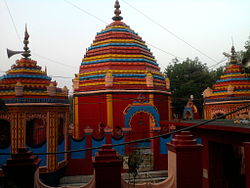
Rajrappa is a Hindu pilgrimage centre attracting an estimated 2,500-3,000 persons daily.[3] The main attraction of the Chhinnamasta (also known as Chinnamastika) temple located here is the headless deity of goddess Chinnamasta which stands on the body of Kamdev and Rati in the lotus bed. The Chhinnamasta temple is very popular for its Tantrik style of architectural design. The temple is very old but has that essence of enchantment.[6] Apart from the main temple, there are ten temples of various gods and goddesses such as the Sun God and Lord Shiva.[2] Animal sacrifice is still practised in the temple. The sacrifice is offered on Tuesdays and Saturdays and during Kali puja.[7]

Rajrappa also is a pilgrim centre for the Santals and other tribals who come for immersion of the ashes of their loved ones in the Damodar. They come mostly during the month of December, in groups known as yatri. As per their mythology it is their final resting place. In their folk songs Rajrappa is referred to as "Thel Kopi Ghat" (Water Ghat) and they use oil after bathing. They come in significant numbers from the southern parts of Jharkhand state such as East and West Singhbhum and Saraikela districts.

Civic administration

[edit]

Police station

[edit]

Rajrappa police station serves Chitarpur CD block.[8]

Economy

[edit]

Coal mining

[edit]
Map
About OpenStreetMaps
Maps: terms of use
4km
2.5miles
J
Bhera River
I
Damodar River
H
Maa Chhinamasta
Temple
H Chhinnamasta temple (H)
H
Rajrappa
Waterfall
CT
Chitarpur
CT Chitarpur (CT)
CT Chitarpur (CT)
A
CCL Rajrappa Area Office
A Rajrappa Area (A)
A Rajrappa Area (A)
W
Rajrappa washery
O
Rajrappa colliery
O
Burakhap colliery
O
Karma colliery
Collieries in the CCL Ramgarh Coalfield
U: Underground colliery, O: Open Cast colliery, M: Mixed colliery, W: Washery, S: Facility, A: Administrative headquarters, CT: census town, H: historical, religious, tourist centre
Owing to space constraints in the small map, the actual locations in a larger map may vary slightly

Rajrappa Area of Central Coalfields Limited (CCL), a subsidiary of Coal India Limited, is located in Ramgarh Coalfield. It is one of the biggest coal-fields in this region. It is widely known as the Rajrappa Project, which consist of the main quarry (a huge open cast mine), offices, colonies, recreation facilities, shopping complexes, a police out-post and public utility buildings. It is a complete township in itself.[7]

Education

[edit]

See also

[edit]

References

[edit]
[edit]
Revisions and contributorsEdit on WikipediaRead on Wikipedia
from Grokipedia
Rajrappa is a locality in the of , , best known for the ancient Chhinnamastika Temple (also called Rajrappa Mandir), a prominent Hindu site dedicated to the goddess —one of the ten Mahavidyas in Tantric tradition—situated at the confluence of the Bhairavi and Damodar rivers. The temple complex, which includes shrines to deities such as , , and the Sun God, attracts thousands of devotees annually, particularly from , , and , with peak visits occurring on Sundays, full moons (), and new moons (); it is also a favored venue for marriage ceremonies believed to ensure prosperous unions. The site's religious importance is underscored by its mention in ancient Hindu texts like the and as a powerful source of (divine feminine energy), and local legends hold that sincere devotion to Maa Chhinnamastika fulfills devotees' wishes. Architecturally, the main temple bears a striking resemblance to the in , featuring intricate stone carvings and a multi-shrined layout that highlights its Tantric heritage as a Peeth (a place of spiritual accomplishment). Beyond its spiritual role, Rajrappa encompasses a significant industrial landscape, serving as the base for the Rajrappa Area of Central Coalfields Limited (CCL), a of Limited, where open-cast operations have been active since 1976, contributing to Jharkhand's coal production with an annual capacity of around 3 million tonnes. The area's natural features, including a hot spring near the temple and seasonal waterfalls, enhance its appeal as a blend of sacred, ecological, and economic elements, though activities have raised environmental concerns related to and land stability.

Geography

Location

Rajrappa is situated at the geographic coordinates 23°37′55″N 85°42′40″E in the eastern part of , , at an elevation of approximately 281–340 meters above . Administratively, it falls within the Chitarpur of the Ramgarh subdivision in , a region known for its industrial and natural features. This positioning places Rajrappa in a strategically accessible area of the state, facilitating visits from surrounding urban centers. The site is approximately 20 kilometers from Ramgarh, 65 kilometers from , 70 kilometers from —the state capital—and 68 kilometers from , making it a convenient destination for pilgrims and tourists. is enhanced by its location off National Highway 23 (NH 23), which connects Ramgarh to Chas and supports road travel from major nearby cities. Nestled in a scenic landscape, Rajrappa marks the confluence point of the Damodar and Bhairavi (locally known as Bhera) rivers, contributing to its ecological and cultural prominence within the Ramgarh district. This river meeting point underscores the area's hydrological significance while providing a serene backdrop for religious activities.

Waterfalls and Rivers

Rajrappa Falls, a prominent hydrological feature, is formed by the Bhairavi River cascading from a height of 9.1 meters (30 feet) as it joins the Damodar River, creating a striking waterfall and a significant junction in the river system. This confluence occurs within the Hazaribagh plateau, where the Bhairavi, also known as Bhera, descends into a hanging valley to meet the broader Damodar channel, resulting in the formation of the Damodar Gorge nearby. The site's hydrological dynamics are influenced by monsoonal flows, with high-velocity discharges shaping the local riverbed morphology through processes like pothole formation in the underlying Precambrian granite gneiss bedrock. A notable feature near the is a hot water spring, which emerges close to the and adds to the area's unique hydrological characteristics, particularly during winter when it becomes a popular picnic spot. The , originating in the , serves as a major within the Ganga River system, stretching approximately 547 kilometers with a basin area of 22,005 square kilometers and an average discharge of 269 cubic meters per second. The Bhairavi River acts as a key to the , contributing to the falls and enhancing the overall flow at the junction, though its volume varies with seasonal rainfall patterns typical of the plateau region. This not only marks a critical point in the Damodar Valley but also holds sacred status in local traditions, as detailed in the context of the nearby . Ecologically, the rivers at Rajrappa play a vital role in supporting within the Chota Nagpur Plateau's dry forests, hosting a rich array of aquatic macrozoobenthos that includes over 100 taxa such as , molluscs, and annelids, many of which are endemic. The Damodar and its tributaries like the facilitate nutrient cycling through dominant functional feeding groups—primarily detritivores and carnivores—while seasonal water flow variations, peaking during monsoons and receding in dry periods, influence habitat availability and species distribution. These dynamics underscore the rivers' importance for maintaining the plateau's , including trophic interactions essential for local aquatic life, despite pressures from regional sources.

Geological Features

The Rajrappa area exhibits distinctive landforms resulting from extended fluvial processes over geological time scales. The Damodar here represents a polycyclic , featuring a two-story topographic profile where a narrow, youthful inner gorge is deeply incised into a wider, older outer floor, indicative of repeated cycles of downcutting and base-level changes during the Paleogene-Neogene rejuvenation linked to Himalayan uplift. This polycyclic development underscores the region's history of episodic , with the upper remnants preserving evidence of prior stages. At the of the and Damodar rivers, a prominent hanging forms, where the Bhairavi River descends sharply from an elevated plateau to join the entrenched Damodar, reflecting differential rates between the and due to variations in and gradient. Nearby, the Damodar Gorge showcases incised patterns, with the river carving tight bends into resistant Precambrian bedrock, accelerated by high-velocity monsoonal flows that enhance vertical incision over lateral migration. Geologically, Rajrappa is situated in the Ramgarh Coalfield of the , underlain by the Supergroup, which encompasses Permian sediments of the Barakar Formation characterized by sandstones, shales, and coal seams deposited in fluvial-deltaic environments. These rocks, part of the broader Damodar Valley Basin, form the structural foundation for the area's coal-bearing strata and influence local topography through their varying resistance to erosion. The prevailing erosion dynamics, including formation and gorge deepening driven by seasonal high-discharge events, impact soil stability by promoting and sediment mobilization in the Damodar valley, while contributing to heightened flood risks through altered hydrological regimes and basin-wide . Assessments of the Basin reveal mean annual soil loss rates of approximately 12 t/ha, exacerbating vulnerability to flash floods in upstream segments like Rajrappa.

History

Ancient Origins

Rajrappa's historical foundations trace back to its identification as a sacred , or sangam, in ancient Hindu traditions, where the meeting of the Bhairavi and Damodar rivers is revered for its spiritual potency linked to tantric practices. The site holds significance within Shakta and tantric lineages, with the goddess embodying themes of and transformative energy central to these esoteric traditions. References to the location appear in Puranic literature, positioning Rajrappa as a revered Shakti site, where divine power manifests at pivotal geographical junctures, drawing pilgrims for rituals tied to the Mahavidya pantheon. Tantric texts, such as the Pranatosini-tantra, describe Chhinnamasta's manifestation from Parvati, underscoring the site's role in medieval tantric sects prevalent in eastern India, which emphasized yogic and ritualistic paths to enlightenment. The Temple's origins are estimated to the medieval period, indicative of patronage by tantric communities in the region. Local reinforces this antiquity, recounting how Chhinnamasta's severed head landed at Rajrappa during a cosmic battle with an , establishing the temple as a focal point for her worship. Prior to widespread Hindu assimilation, Rajrappa served as a gathering site for Santal tribal communities, who conducted ancestral rituals at the river , including the immersion of ashes to honor the deceased. Evidence from Santal oral traditions, such as the folk song "Thel Kopi ," reflects these pre-Hindu practices, where the site facilitated communal ceremonies involving purification rites and seasonal observances in .

Modern Developments

In the 19th century, British colonial authorities conducted surveys of resources in the Ramgarh Coalfield through the , with detailed documentation of the area's coal seams appearing in official records as early as 1867, paving the way for initial explorations in the region. Following India's , the of coal mines in 1972-1973 led to the reorganization of operations under Central Coalfields Limited (CCL), a subsidiary of Coal India Limited, which integrated Rajrappa into the national coal production framework by 1975, marking a shift toward centralized management and expanded output from the area. The formation of as a separate state on November 15, 2000, transferred administrative oversight of Rajrappa from to the new state government, enabling localized governance focused on resource management and development in , which was formally carved out in 2007. In the 2020s, CCL pursued expansion of mining operations at the Rajrappa project, including plans to increase capacity despite delays in land acquisition, aiming to enhance production amid broader efforts to reach 150 million tonnes annually by 2030. Infrastructure improvements at the Chhinnamasta Temple continued from earlier initiatives, with ongoing development funded under Jharkhand's tourism plans to enhance facilities like access roads and visitor amenities, building on a Rs 200 crore allocation announced in 2017. Eco-tourism initiatives gained momentum, highlighted by Jharkhand's 2025 launch of India's first mining tourism program in partnership with CCL, featuring guided tours to nearby coal sites accessible via Rajrappa routes that combine industrial heritage with natural and cultural attractions.

Religious Significance

Chhinnamasta Temple

The in Rajrappa is dedicated to Goddess , a fierce and esoteric manifestation of as one of the ten Mahavidyas in the tantric tradition. It is regarded as one of the 51 Peethas, where the lips of Goddess Sati are believed to have fallen according to legend. The deity is iconographically represented as a nude, self-decapitated figure holding her severed head in her left hand and a sword in her right, with three streams of blood issuing from her neck to nourish her own head and her two attendant yoginis, and Varnini. She stands triumphantly upon the copulating forms of Kamdev (the god of desire) and (his consort), symbolizing the transcendence of and the integration of life's dual forces—creation and destruction—in tantric philosophy. This portrayal embodies (atma-yajna), where the goddess severs her ego and material attachments to sustain cosmic vitality, representing renewal through apparent annihilation. The temple's architecture exemplifies tantric stylistic elements, characterized by bold, symbolic forms and intricate carvings that evoke esoteric themes of transformation and power. Positioned on a at the sacred of the and Damodar rivers, the site's location enhances its spiritual potency, as river confluences are revered in Hindu tradition for their purifying energies and symbolic representation of life's flowing cycles. The structure houses a stone idol of the in her distinctive headless form, aligning with regional tantric temple designs that prioritize iconographic intensity over ornate elaboration. Theologically, Chhinnamasta holds profound significance as the sixth , embodying the awakening of —the dormant spiritual energy coiled at the base of the spine—through the piercing of the ajna chakra and transcendence of dualistic illusions. Her rare draws tantric practitioners seeking inner alchemical processes, where self-decapitation metaphorically signifies the dissolution of the ego to achieve union with divine consciousness, fostering spiritual liberation and control over vital forces. This makes the temple a focal point for advanced sadhana, emphasizing the tantric ideal of harnessing apparent paradoxes like desire and for enlightenment.

Other Temples and Rituals

In addition to the primary , Rajrappa features ten subsidiary shrines dedicated to various deities, forming a sacred complex around the main site. These include temples to the Sun God (), Lord , Goddess (), Goddess Tara, Lord Hanuman, Goddess Ashtamatrika, and Lord Bhairav, among others, which serve as complementary worship spaces for devotees seeking diverse spiritual blessings. Key rituals at Rajrappa emphasize tantric traditions, with animal sacrifices—primarily of —performed as offerings to fulfill vows, particularly on Tuesdays and Saturdays, as well as during the festival. These practices, rooted in worship, involve devotees presenting the animals at designated altars, symbolizing devotion and the transcendence of ego in tantric philosophy. Additionally, the Santal tribal community conducts annual ash immersion ceremonies in December at the confluence of the and Damodar rivers, where families gather to ritually deposit the ashes of deceased relatives, accompanied by folk songs and prayers for ancestral peace. As a prominent pan-Indian tantric site, Rajrappa attracts thousands of daily visitors, with footfall surging during major festivals like and Chhinnamasta Jayanti, drawing tantric practitioners and devotees from across the country for rituals focused on spiritual awakening and esoteric sadhana.

Administration and Demographics

Governance

Rajrappa falls under the administrative jurisdiction of the Chitarpur within the of , . The block, with location code 0170, serves as the primary unit for and planning in the area, coordinating local initiatives under the oversight of the administration headed by a . This structure ensures integrated management of resources, infrastructure, and services for villages and census towns in the block, including those surrounding Rajrappa. Law enforcement in Rajrappa is managed by the , which operates under the Ramgarh district police headquarters and the Department. The station, located in the Chitarpur block, is responsible for maintaining public order, preventing , and providing in a region that attracts large numbers of pilgrims to the as well as workers in nearby operations under Limited (CCL). It handles routine policing duties alongside specialized responses to crowd management during festivals and protection of industrial sites, contributing to the overall safety framework of the block. Local governance in Rajrappa is facilitated through the Panchayati Raj Institutions (PRIs), a three-tier system of elected bodies at the village, block, and district levels as per India's 73rd Constitutional Amendment. In the Chitarpur block, PRIs include gram panchayats—village-level councils with elected representatives such as sarpanchs—who oversee community projects like , , and minor maintenance. The block panchayat coordinates these efforts at an intermediate level, while the district Panchayati Raj Officer in Ramgarh provides guidance and funding allocation for development schemes. These institutions empower local decision-making, ensuring grassroots participation in addressing regional needs tied to tourism and mining activities.

Population Characteristics

Rajrappa is a village and locality within the Chitarpur of , . The locality is part of the Chitarpur block, which had a of 70,701 as per the 2011 census. The 2021 census has not been conducted as of 2025, so the latest official data remains from 2011. The social structure reflects significant influences from the local operations, including an influx of migrant workers from surrounding regions who contribute to the community's diversity and labor force. The features a Hindu , with a significant presence of Scheduled Tribes including Santhals, Sabars, and Kherias, reflecting the area's tribal heritage alongside its Hindu importance. As per the 2011 census, in the Chitarpur block was 67.3%, bolstered by industrial development that has introduced vocational training and facilities, though challenges persist due to the transient nature of the workforce. Culturally, Rajrappa's residents embody a fusion of indigenous tribal and mainstream Hindu traditions, evident in local festivals that incorporate Santal rituals alongside temple observances at the site. This syncretic heritage underscores the community's resilience amid economic shifts driven by and pilgrimage activities.

Economy

Coal Mining

The Rajrappa Area, managed by the Central Coalfields Limited (CCL), a subsidiary of Limited, primarily conducts open-cast operations within the Ramgarh Coalfield of , . This area focuses on extracting non-coking from the Lower coal measures, utilizing heavy earth-moving machinery for overburden removal and coal extraction. The operations include the Rajrappa Opencast (OCP), which integrates with a washery facility for beneficiation, supporting the supply of raw and washed to thermal power plants and industrial users across the region. Established following the of mines in 1973, the Rajrappa Area began systematic operations in 1976-77 under CCL's oversight, transitioning from private leases to management to enhance production efficiency and resource utilization. The area encompasses multiple projects, including the flagship Rajrappa OCP with a designed annual capacity of 3 million tonnes of run-of-mine , alongside supporting underground and expansion initiatives like the Amlo and Kedla projects. Over the years, production has scaled to contribute significantly to CCL's output, with the 2017-18 recording approximately 1.3 million tonnes; production in 2023 was approximately 1.32 million tonnes, with ongoing expansions aiming to increase output. Recent expansions target reserves estimated at 78 million tonnes as of 2018 to sustain long-term extraction. A dedicated in Rajrappa supports the workforce and their families, providing , amenities, and . Economically, the Rajrappa Area plays a vital role in meeting India's demand for , supplying millions of tonnes annually to power generation and industries, thereby bolstering CCL's contribution to national coal production targets exceeding 80 million tonnes in recent years. However, these operations have raised environmental concerns, particularly land induced by underground activities, which has led to surface , habitat disruption, and risks to local agriculture and settlements in the . Additional challenges include affecting water quality and from overburden dumps, prompting CCL to implement reclamation measures such as and backfilling to mitigate impacts.

Tourism Impact

Tourism in Rajrappa primarily revolves around to the and eco-tourism centered on the scenic Rajrappa Falls, generating substantial revenue for the local through temple offerings, sales by roadside vendors, and operations of guesthouses and eateries. The influx of visitors supports local employment in service-oriented roles, including guiding, hospitality, and handicraft sales, providing a vital alternative to the dominant sector. According to a 2009-10 Jharkhand survey, the —dominated by Rajrappa as its key attraction—recorded 643,924 overnight stays and 1,189,840 same-day domestic visits annually; more recent reports indicate peak daily footfalls reaching up to 100,000 during festivals as of 2025. Temple rituals, particularly during auspicious occasions, draw these crowds and amplify spending on religious items and local produce. In the 2020s, development initiatives have emphasized sustainable eco-tourism to diversify beyond religious visits, including projects for enhanced falls viewing platforms and guided cultural tours highlighting the site's tribal heritage and natural beauty. The Jharkhand Tourism Policy 2021 promotes such efforts by incentivizing private investments in low-impact infrastructure, aiming to extend visitor stays and boost off-season revenue. In 2025, a pact between Jharkhand Tourism Development Corporation and CCL launched India's first mining tourism initiative, aiming to integrate coal heritage with tourism for further economic diversification. Annual festivals like the Chhinnamasta Mela and Makar Sankranti fair provide significant boosts, with peak-day footfalls reaching up to 100,000, stimulating short-term economic surges through increased accommodations and vendor transactions. Despite these benefits, poses challenges, including seasonal that strains limited facilities, with normal daily visitors exceeding 20,000 and periods causing long queues and issues. Infrastructure pressures, such as inadequate roads and parking, have been noted in visitor feedback, exacerbating environmental concerns around the falls and riverbanks during high-traffic months. These issues highlight the need for balanced growth to mitigate impacts on local resources while sustaining economic gains.

Infrastructure

Education Facilities

Rajrappa features a mix of government and corporate-sponsored primary and secondary schools catering primarily to the children of families and local residents. The UPG High School Rajrappa Project, a government-run , provides education up to the secondary level with basic including , hand pumps for , and separate toilets for boys and girls. Additionally, the DAV Public School Rajrappa, established and managed by Central Coalfields Limited (CCL), operates as an English-medium co-educational affiliated with the CBSE board, offering facilities such as laboratories, libraries, and to support holistic learning for students from the surrounding mining township. Access to higher education in Rajrappa is available through the Ramgarh Engineering College, located in the Rajrappa Project area, which offers programs under a public-private . Additional undergraduate and postgraduate options can be pursued at other institutions in or further in , including universities like . CCL supports literacy initiatives through its (CSR) programs in industrial townships, focusing on mainstreaming school dropouts and providing skill development for tribal populations in command areas. The CCL Ke Lal-Laadli scheme, launched in 2012 for boys and expanded in 2016 to include girls, selects meritorious students from low-income communities for intensive and scholarships to prepare for competitive exams like IIT-JEE, thereby enhancing educational outcomes among tribal youth.

Transportation and Connectivity

Rajrappa benefits from connectivity via National Highway 23 (NH 23), which links it to major cities in and neighboring states, facilitating road travel for pilgrims and locals. Buses operated by state transport services run regularly from , approximately 70 kilometers away, with the journey taking 2 to 3 hours depending on traffic and road conditions. From Ramgarh, which is about 20 kilometers distant, bus travel requires 30 to 45 minutes, providing quick access for nearby residents. For rail connectivity, the nearest station is Railway Station, located roughly 28 kilometers from Rajrappa, from where s or local buses can be hired to cover the remaining distance. Air travelers can reach the area via in , situated about 78 kilometers away, followed by a or bus NH 23. Within Rajrappa, local mobility relies on auto-rickshaws for short trips around the temple and areas, supplemented by shuttles provided by companies such as Limited for workers commuting to project sites. However, during the season, heavy rainfall often leads to flooding along river-adjacent paths near the and Damodar rivers, disrupting local access and requiring caution for travelers.

References

Add your contribution
Related Hubs
User Avatar
No comments yet.