Hubbry Logo
Ranchos of CaliforniaRanchos of CaliforniaMain
Open search
Ranchos of California
Community hub
Ranchos of California
logo
8 pages, 0 posts
0 subscribers
Be the first to start a discussion here.
Contribute something
Ranchos of California
from Wikipedia

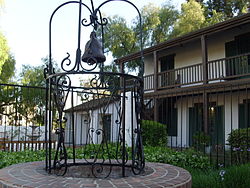
Pacheco Adobe, built 1835 by Salvio Pacheco on Rancho Monte del Diablo
The Guajome Adobe, built 1852–53 as the seat of Rancho Guajome

In Alta California (now known as California) and Baja California, ranchos were concessions and land grants made by the Spanish and Mexican governments from 1775[1] to 1846. The Spanish concessions of land were made to retired soldiers as an inducement for them to settle in the frontier. These concessions reverted to the Spanish crown upon the death of the recipient.

After independence, the Mexican government encouraged settlement in these areas by issuing much larger land grants to both native-born and naturalized Mexican citizens. The grants were usually two or more square leagues, or 35 square kilometres (14 sq mi) in size. Unlike Spanish Concessions, Mexican land grants provided permanent, unencumbered ownership rights. Most ranchos granted by Mexico were located along the California coast around San Francisco Bay, inland along the Sacramento River, and within the San Joaquin Valley.

When the Missions were secularized per the Mexican Secularization Act of 1833, a secular administrator ("mayor domo") was installed at each Mission to dispose of property not essential to support the religious functions of the remaining parish church. The Act further required that some of the secularized land be awarded to each neophyte (converted to Christianity) indigenous family who had been living at one of the Missions, but in most cases those grants didn't happen. Most of the former Mission land was acquired by Californios in large grants awarded by the governor.

Spain made about 30 concessions between 1784 and 1821. Mexico issued about 270 land grants between 1833 and 1846. The ranchos established permanent land-use patterns. The rancho boundaries became the basis for California's land survey system, and are found on modern maps and land titles. The "rancheros" (rancho owners) patterned themselves after the landed gentry of New Spain, and were primarily devoted to raising cattle and sheep. Their workers included Native Americans who had learned Spanish while living and working at one of the former missions.

The ranchos were often based on access to resources necessary for raising cattle, such as water and adequate grazing lands and water. Land development from that time forward has often followed the boundaries of the ranchos, and many of their names are still in use. For example, Rancho San Diego is now an unincorporated "rural-burb" east of San Diego, and Rancho Bernardo is a suburb in San Diego County.

Spanish era

[edit]
Manuel Domínguez built Domínguez Adobe on Rancho San Pedro in 1826.

Before 1754, only the Spanish Crown could grant lands in Alta California. For several years, the Franciscan missionaries were the only beneficiaries of this policy.[2] Spanish laws allowed four square leagues of land (one league being approximately 4,428 acres (1,792 ha)) to be granted to newly-formed settlements, or pueblos.

Settlement on the ranchos outside presidio, mission, and pueblo boundaries began in 1784. Private individuals applied to the Governor for grants and he issued a few written temporary permits. The Spanish crown retained title. In 1784, Juan José Domínguez received permission from Spanish Governor Pedro Fages to graze his cattle on the 48,000-acre (190 km2) Rancho San Pedro.[3]

Two years later the governor received authority to grant tracts not exceeding three square leagues, as long as they did not conflict with the boundaries of existing pueblos. The grantee was required to build a stone house and to keep at least 2,000 head of stock on each rancho.[2]

Mexican era

[edit]
The Flores Adobe was built 1838–45 by Governor José María Flores on Rancho San Pascual.

During the Mexican era (1821–1846), grantees received legal title to the land. In 1821, Mexico achieved its independence from Spain, and California came under control of the Mexican government. The 1824 Mexican Colony Law established rules for petitioning for land grants in California; and by 1828,[4] the rules for establishing land grants were codified in the Mexican Reglamento (Regulation).

The Acts sought to break the land monopoly of the missions and also paved the way for luring additional settlers to California by making land grants easier to obtain. The Mexican governors of Alta California gained the power to grant state lands, and many of the Spanish concessions were subsequently patented under Mexican law—frequently to local "friends" of the governor.

Secularization

[edit]
The Petaluma Adobe, built by General Mariano Guadalupe Vallejo in 1836 on Rancho Petaluma

Soldiers, rancheros, farmers, and those in power coveted the rich coastal lands that the missions controlled. The Mexican government was also fearful about the missions which remained loyal to the Pope and the Catholic Church in Spain. In August 1833, the government secularized all of the missions and their valuable lands, about 1,000,000 acres (400,000 ha) per mission. The Mexican government allowed the padres to keep only the church, priest's quarters, and priest's garden. The army troops guarding each Mission were dismissed.[5]

The government stipulated that one half the mission lands and property was to be given to neophytes in grants of 33 acres (13 ha) of arable land along with land "in common" sufficient "to pasture their stock." A board of magistrates was to oversee the mission's crops and herds, while the land was to be divided into communal pasture, a town plot, and individual plots intended for each Indian family. In addition, one half of the herds were to be divided proportionately among the neophyte families.[6][7]

But this purpose was never accomplished. In truth, only a very few Indians of Alta California were educationally or culturally equipped to accept the offering. Instead, they were further exploited by the rancheros and in many cases became virtual slaves.[7] Most mission property was bought by government officials or their wealthy friends, local Californios, individuals of Mexican or Spanish descent who had been born in Alta California.[5][8][9]

Ownership

[edit]
Diseño of Rancho Buena Ventura

The number of Mexican land grants greatly increased after secularization. The former Mission Indians, freed from forced labor on the missions, but without land of their own, and their former way of life destroyed, often had few choices. Some lived with Indian tribes in the interior or sought work on the new ranchos along with the troops formerly assigned to each mission. They sometimes congregated at rancherías (living areas near a hacienda) where an indigenous Spanish and mestizo culture developed.[6]

By 1846, the mission lands and its cattle had passed into the hands of 800 private landowners called rancheros. They collectively owned 8,000,000 acres (3,200,000 ha) of land, in units ranging in size from 4,500 acres (1,800 ha) to 50,000 acres (20,000 ha). They primarily produced hides for the world leather market and largely relied on Indian labor. Bound to the rancho by peonage, the Native Americans were treated as slaves. The Native Americans who worked on the ranchos died at twice the rate that of southern slaves.[6]

The boundaries of the Mexican ranchos were provisional. The new owner was required to complete a legal survey that established and marked the boundaries. Even if completed, the resulting 'diseño', a rough, hand-drawn relief map, often only vaguely defined the boundary lines.[10]

The grantee could not initially subdivide or rent the land. It had to be used for grazing or cultivation. A residence had to be built within a year—most were initially simple adobe-walled cabins. Public roads crossing through the property must remain open.[citation needed]

The survey and residence requirements could not be enforced. The poorly funded and relatively unorganized government had little interest in land that brought in no taxes. The government instead collected revenue from tariffs assessed on cargo arriving at Monterey, California.[citation needed]

American era

[edit]
The Rancho Los Méganos mansion was built in 1856 by John Marsh.

The Mexican–American War began on May 13, 1846 with a declaration of war by the United States of America. Action in California began with the taking of Monterey on July 7, 1846 (before knowledge of the declaration), Los Angeles in August, other battles in December, 1846, then retaking of Los Angeles in January, 1847, which terminated the authority and jurisdiction of Mexican officials later that year.[11][12][13] Armed resistance ended in California with the Treaty of Cahuenga signed on January 13, 1847. The Treaty of Guadalupe Hidalgo, ending the Mexican War, was signed February 2, 1848 and California became a Territory of the United States. Between 1847 and 1849, California was run by the U.S. military. A constitutional convention met in Monterey in September 1849, and set up a state government. It operated for 10 months before California was admitted to the Union as the 31st State by the United States Congress, as part of the Compromise of 1850, enacted on September 9, 1850.

Gold Rush

[edit]

While the end of the 1840s saw the close of Mexican control over Alta California, this period also marked the beginning of the rancheros' greatest prosperity. Cattle had been raised primarily for their hides and tallow, as there was no market for large quantities of beef, especially in the days prior to refrigeration, railroads or ice production. Demand dramatically changed with the onset of the Gold Rush, as thousands of miners and other fortune seekers flooded into northern California. These newcomers needed meat, and cattle prices soared with demand. The rancheros enjoyed the halcyon days of Hispanic California.[14]

Land claims

[edit]
The Pico Adobe, built by Pío Pico in 1853 on Rancho Paso de Bartolo
The Casa de Dana was built on Rancho Nipomo in 1839.

The Treaty of Guadalupe Hidalgo provided that the Mexican land grants would be honored. To investigate and confirm titles in California, American officials acquired the provincial records of the Spanish and Mexican governments in Monterey.[15][16]

The new state's leaders soon discovered that the Mexican government had given a number of grants just before the Americans gained control. The Mexican governors had rewarded faithful supporters, and hoped to prevent the new immigrants from gaining control of the land. Sponsored by California Senator William M. Gwin, in 1851 Congress passed "An Act to Ascertain and Settle Private Land Claims in the State of California".[4] The Act required all holders of Spanish and Mexican land grants to present their titles for confirmation before the Board of California Land Commissioners.[17] Contrary to the Treaty of Guadalupe Hidalgo, this Act placed the burden of proof of title on landholders.[18] Grantees were required to prove the validity of the grants they had received and establish their exact boundaries. The diseños (maps) available were often hand-drawn and imprecise. Land had until the gold rush been of little value and boundary locations were often quite vague, referring to an oak tree, a cow skull on a pile of rocks, a creek, and in some cases a mountain range.[4] The 588 grants made by Spanish and Mexican authorities in California between 1769 and 1846 encompassed more than 8,850,000 acres (3,580,000 ha), or nearly 14,000 square miles (36,000 km2).[19]

The settlement of land titles was frequently complicated and lengthy. Even in cases where the boundaries were more specific, many markers had been destroyed before accurate surveys could be made. Aside from indefinite survey lines, the Land Commission had to determine whether the grantees had fulfilled the requirements of the Mexican colonization laws. Mexican officials often did not keep adequate records and sometimes did not provide grantees with any documentation of the grant. Many grants required additional approvals before they were legal. Conditions of the grant required the grantee to live on the land. All of these requirements were rarely fulfilled.[20]

The Olivas Adobe was built on Rancho San Miguel in 1841.

While the Land Commission confirmed 604 of the 813 claims it reviewed, most decisions were appealed to US District Court and some to the Supreme Court.[21] The confirmation process required lawyers, translators, and surveyors, and took an average of 17 years (including the Civil War, 1861–1865) to resolve. It proved expensive for landholders to defend their titles through the court system. In many cases, they had to sell or give title to a portion of their land to pay for defense fees or gave attorneys land in lieu of payment.[22][23]

Rejected Spanish and Mexican land claims resulted in conflicting claims by the grantees, squatters, and settlers seeking the same land. This resulted in pressure on Congress to change the rules. Under the Preemption Act of 1841, squatters were able to pre-empt others' claims to portions of the land and acquire clear title by paying $1.25 an acre for up to a maximum of 160 acres (0.65 km2). Land from titles rejected by the courts became part of the public domain and available to homesteaders after the first federal Homestead Act of 1862 was passed, allowing anyone to claim up to 160 acres (0.65 km2). This resulted in additional pressure on Congress, and beginning with Rancho Suscol in 1863, it passed special acts that allowed certain claimants to pre-empt their land without regard to acreage. By 1866 this privilege was extended to all owners of rejected claims.[24][25]

A number of ranchos remained in whole or in part in the sliver of territory of Alta California left to Mexico by the Treaty of Guadalupe Hidalgo, which then became part of Baja California. Rancho Tía Juana (partially in San Diego County, California) lost its claim to title to its land in San Diego County but the balance of the rancho was confirmed by the Mexican government in the 1880s. Rancho El Rosario, Rancho Cueros de Venado and Rancho Tecate were each granted to citizens of San Diego in the 1820s or 1830s and lay wholly in what is now Baja California as was the Rancho San Antonio Abad, whose origin and title is more obscure. Their titles were never subjected to dispute in U.S. courts.[26]

Disintegration

[edit]
Map of the Spanish and Mexican rancho grants in Los Angeles County

The rancheros became land-rich and cash-poor, and the burden of attempting to defend their claims was often financially overwhelming. Grantees lost their lands as a result of mortgage default, payment of attorney fees, or payment of other personal debts. Land was also lost as a result of fraud. A sharp decline in cattle prices, the Great Flood of 1862, and droughts of 1863–1864 also forced many of the overextended rancheros to sell their properties to Americans. They often quickly subdivided the land and sold it to new settlers, who began farming individual plots.[27]

A shift in the economic dominance of grain farming over cattle raising was marked by the passage of the California "No-Fence Law" of 1874. This repealed the Trespass Act of 1850, which had required farmers to protect their planted fields from free-ranging cattle. The repeal of the Trespass Act required that ranchers fence stock in, rather than farmers fencing cattle out. The ranchers were faced with either the high expense of fencing large grazing tracts or selling their cattle at ruinous prices.[28][29]

Legacy

[edit]
Rancho Los Encinos is preserved as Los Encinos State Historic Park.

The ranchos established land-use patterns that are still recognizable in contemporary California.[30] Many communities still retain their Spanish rancho name. For example, Rancho Peñasquitos, the first land grant by the Spanish in today's San Diego County, is now a suburb within the city of San Diego. Modern communities often follow the original boundaries of the rancho, based on geographic features and abstract straight lines. Today, most of the original rancho land grants have been dismantled and sold off to become suburbs and rural-burbs. A very small number of ranchos are still owned by descendants of the original owners, retain their original size, or remain undeveloped.

Rancho Guejito in San Diego County is considered the last of the San Diego Ranchos to be undeveloped. Only a few historic structures and an 8,000 square feet (740 m2) ranch house, built in the 1970s, occupy the 13,300 acres (5,400 ha). Benjamin Coates purchased the land in the 1970s after Governor Jerry Brown vetoed a purchase that would have made Guejito a state park. Coates purchased an additional 8,700 acres (3,500 ha) of surrounding land between the 1970s and his death in 2004. Coates and his wife Nancy both expressed their wishes that the Rancho remain undeveloped. After her death in 2006, ownership of the land passed to their daughter, Theodate Coates, an artist from New York City. Despite her parents' wishes that development be kept off of the Rancho, she has taken steps to remove Rancho Guejito's status as an agricultural preserve and eventually develop the land into tract housing.[citation needed]

See also

[edit]

Notes and references

[edit]

Further reading

[edit]
[edit]
Revisions and contributorsEdit on WikipediaRead on Wikipedia
from Grokipedia
The Ranchos of California were expansive land grants awarded by Spanish and Mexican governments to individuals in Alta California from 1784 to 1846, establishing the primary framework for land ownership and economic activity in the region prior to American annexation. Numbering approximately 500 to 800 grants, these ranchos typically spanned tens of thousands of acres and were designed to promote settlement and development through cattle ranching, leveraging the abundant grazing lands and water resources. Grantees, including , civilians, and Californio elites, were required to occupy, cultivate, and stock the lands with , fostering a ranching culture that relied on vaqueros for and structures for habitation. The economy of the rancho period centered on the production of hides and from , which were traded with merchants for manufactured goods, sustaining a system until droughts, influx, and U.S. land confirmation processes disrupted it in the 1840s and 1850s. Secularization of the Spanish missions beginning in 1834 transferred vast mission-held lands into private ranchos, intensifying the distribution and embedding a hierarchical where large landowners dominated local affairs. While the rancho system enabled initial European-style agriculture and contributed to California's early export trade, it faced challenges from indigenous displacement, environmental , and post-conquest legal validations that confirmed only about one-eighth of claimed acreage due to rigorous surveys and disputes.

Origins in Colonial California

Spanish Mission System and Proto-Ranchos

The Spanish colonization of began with the establishment of the mission system, initiated on July 16, 1769, when Franciscan friar founded , the first of 21 missions stretching northward. Accompanying the expeditions were , including introduced by Spanish explorers and missionaries to sustain the outposts; initial shipments included around 200 head arriving overland in the early years. These animals formed the basis of ranching practices, with missions adopting techniques from , emphasizing large-scale grazing on unfenced ranges to support self-sufficient communities of missionaries, soldiers, and neophyte indigenous laborers. Missions functioned as de facto proto-ranchos by controlling extensive tracts of land—often tens of thousands of acres per mission—for livestock rearing, which supplied hides, , meat, and draft animals essential to mission economies. By 1800, mission herds had expanded to approximately 153,000 out of a total California livestock population of 187,000, demonstrating rapid growth through natural increase and minimal oversight, as the arid landscape favored extensive rather than intensive husbandry. These operations prioritized cattle multiplication over crop , with outlying mission ranchos dedicated to seasonal migrations, foreshadowing the scale of later private ranching but centralized under authority to convert and assimilate native populations. Amid mission dominance, early private land concessions emerged as precursors to formalized ranchos, primarily to incentivize settlement and loyalty among soldiers stationed at . In 1784, Spanish Governor issued the first permits for ranchos, allowing limited grazing rights near military outposts like and Monterey to provide for retired soldiers and their families. The initial grant went to soldier Manuel Butrón in the Monterey area, marking a shift toward individual incentives, though these were modest in size—typically a few leagues—and subordinate to mission and presidio needs, lacking the vast expanses of subsequent Mexican-era . Such allocations highlighted nascent private ranching motives, driven by the profitability of products amid sparse population and trade isolation.

Transition to Mexican Independence

Mexico's achievement of independence from Spain in 1821 marked a pivotal shift for Alta California, with news of the event arriving in 1822 and transitioning the territory from Spanish colonial rule to Mexican governance. This change introduced policies favoring private land ownership over the prior mission-dominated communal system, encouraging individual entrepreneurship among Californios. Under Mexican law, land grants became permanent property for recipients, contrasting with the temporary concessions of the Spanish era, thereby laying groundwork for expanded rancho development without immediate large-scale redistribution. A key economic consequence was the liberalization of trade, as the permitted foreign vessels to engage in commerce at California ports starting in , particularly for hides and . This opened markets to international demand, primarily from merchants seeking raw materials for leather goods and soap production, which stimulated early rancho production by increasing profitability of cattle-based outputs. Initial post-independence grants were modest in scale, often awarded to loyal Californios and settlers to foster settlement and economic activity, reflecting a deliberate pivot from mission communalism toward privatized agriculture and ranching. This policy supported demographic expansion, with the non-native population—primarily of Hispano-Indian descent—growing from approximately 3,000 in 1820 to around 8,000 by 1840, as rancho viability attracted families and laborers to the region.

The Rancho Land Grant System

Granting Mechanisms and Eligibility

The granting of ranchos under rule in followed a formalized process established by the 1824 Colonization Law and subsequent regulations, which empowered the territorial to issue provisional concessions to encourage settlement and economic productivity. Applicants, typically citizens or those swearing , were required to submit a detailed to the outlining their qualifications, including Catholic , good character, family size, and ability to occupy, defend, and improve the land for purposes such as grazing or . The was accompanied by a diseño, a rudimentary hand-drawn depicting the proposed boundaries and natural features, serving as the initial delineation before any formal survey. This framework prioritized empirical demonstrations of utility and loyalty, with grants often favoring veterans, influential families, or settlers capable of contributing to regional defense and development against external threats. Provisional approval granted immediate possession rights, but formal title required fulfillment of conditions within one year, such as constructing a habitable , planting crops or orchards, and introducing to evidence productive intent. Land sizes were capped by law at eleven square leagues (approximately 48,712 acres), though most grants ranged from one to five leagues (4,428 to 22,140 acres), calibrated to the applicant's resources and the land's suitability for ranching. Non-compliance risked forfeiture, ensuring grants incentivized tangible settlement and self-sustaining operations rather than speculative holdings. This merit-based eligibility underscored a causal link between demonstrated capability and property rights, promoting private incentives for land improvement in sparsely populated frontiers. From Mexican independence in until the U.S. conquest in , governors issued approximately 800 ranchos, transforming vast public domains into privately managed estates that spurred cattle-based economies through enforced occupancy and utilization. The system's emphasis on verifiable productivity rewarded grantees who successfully stocked and defended their holdings, fostering broader regional output without reliance on communal mission structures.

Geographic Scope and Major Examples

The ranchos established under Spanish and rule were predominantly located along the coastal strip of , extending from in the south to Sonoma in the north, with inland extensions into fertile valleys. Significant concentrations formed in the , where grants densely subdivided the landscape, and in the , while further north and east, ranchos clustered along the and within the , facilitating access to grazing lands and water sources. Grant sizes ranged widely, typically from several thousand to tens of thousands of acres, reflecting terrain suitability and grantee influence; for instance, Rancho San Antonio, awarded in 1820, covered 44,688 acres spanning modern Alameda County communities including Oakland and Berkeley. In the Los Angeles Basin, Rancho Los Alamitos originally encompassed about 30,000 acres across present-day Long Beach, Seal Beach, and adjacent territories. Further north in the Central Valley, expansive grants like Rancho Buena Ventura near modern Redding demonstrated the system's reach into interior regions. By 1846, authorities had issued over 500 ranchos, collectively exceeding 8 million acres and comprising roughly one-eighth of California's eventual territory, with boundaries later integrated into the state's to define contemporary county lines and property delineations.

Economic and Operational Foundations

Cattle-Based Economy and Hide-Tallow Trade

The -based economy formed the cornerstone of the ranchos in Mexican , where vast herds grazed on expansive lands granted for ranching purposes. By the , these operations supported hundreds of thousands of , with missions alone holding an estimated 400,000 head as of prior to secularization, after which ranchero herds proliferated through natural increase and distribution of mission . provided hides for production and for candles, , and lubricants, yielding the primary export commodities that sustained rancho prosperity without manufactured industry or significant crop . A single mature steer could produce a hide valued at around $1 and worth $2, forming the bulk of rancho income in a barter system where was scarce. Efficient herd management relied on annual rodeos, communal roundups derived from the Spanish verb rodear (to surround), during which vaqueros gathered semi-wild across multiple ranchos to brand calves, castrate males, and select animals for slaughter. Vaqueros, skilled horsemen inheriting techniques from Iberian traditions, employed braided rawhide reatas (lassos) for roping and , often working in teams to immobilize by securing fore and hind legs—a method enabling control over large, dispersed populations without modern fencing. These practices, honed since the mission era, allowed rancheros to maintain self-sufficient operations on grants requiring at least 150 to qualify, scaling to thousands per rancho as herds reproduced unchecked in California's favorable climate. The hide-tallow trade linked ranchos to international markets, with American vessels—primarily from —anchoring at coastal ports like Monterey and from the onward to exchange manufactured goods ( cloth, tools, and hardware) for raw materials. By 1840, rancheros supplied 50,000 to 80,000 hides annually to roughly 20 such ships, flooding tanneries and underscoring the trade's scale as California's dominant economic activity before . Hides functioned as , bartered directly for imports that ranchos lacked the capacity to produce, fostering wealth accumulation among grantees while integrating into Pacific commerce independent of Mexican subsidies or internal taxation. This exchange peaked in the and early , generating self-reliant prosperity tied to bovine productivity rather than diversified enterprise.

Labor Systems and Self-Sufficiency

The labor systems on California ranchos during the Mexican period (1821–1846) were hierarchical, with rancheros at the apex overseeing a workforce composed primarily of Native American laborers, vaqueros, and peons. Vaqueros, often skilled Native Californians, managed cattle and horse herds, performing tasks such as branding, herding, and protecting livestock from predators while moving them to suitable pastures. Peons and other native workers handled diverse roles including field cultivation, hide processing, tallow rendering in large iron cauldrons, and household maintenance like cooking and sewing. Family members of the ranchero contributed to oversight and specialized crafts, fostering a paternalistic structure where laborers received food, clothing, and shelter in exchange for their efforts rather than monetary wages. Adobe structures and haciendas served as multifunctional hubs for this labor organization, centralizing activities from meat preservation and leather tanning to small-scale and tool-making. These sites enabled integrated production chains, where hides were cured on-site for and grains or supplemented the cattle-based diet. Post-secularization of the missions in 1834, former neophyte Indians swelled the labor pool, sustaining rancho operations amid expanding herds that numbered tens of thousands per grant by the 1840s. Ranchos achieved high self-sufficiency by internalizing most needs, producing staples like , , and hides alongside rudimentary manufactures until foreign trade surges in the late introduced limited imports. This autonomy minimized external dependencies, with rancheros provisioning workers directly from on-site resources, supporting populations that could exceed 100 individuals per establishment. Evidence of effective land stewardship includes practices of seasonal herd relocation to fresh areas, which maintained viability and enabled sustained yields—often 10,000–50,000 head per rancho—over decades without widespread degradation until climatic events like the 1862–1864 droughts. Such countered later narratives of unchecked environmental harm by demonstrating functional productivity aligned with the era's .

Secularization and Peak Expansion

The Secularization Act and Mission Dissolution

The Mexican Secularization Act of August 1833, enacted by the Congress of Mexico, nationalized the 21 Franciscan missions in , stripping ecclesiastical control and vesting property in the Mexican government with the stated aim of emancipating indigenous neophytes from coerced labor and enabling their transition to self-sufficient agrarian communities. The act's implementing regulations, issued in 1834 under Governor , directed the conversion of missions into pueblos indios, theoretically allotting portions of land and to native families—typically up to two yoke of oxen, two horses, 20 cows, and plots of not exceeding 33 acres per adult male head of household—to foster independent farming while reserving larger communal grazing areas. However, administrative delays, resistance from missionaries, and gubernatorial discretion often undermined these provisions, with only nominal distributions occurring at select missions like and San Juan Bautista before broader reallocations favored Mexican citizens. In practice, the facilitated the rapid transfer of mission assets to private hands, as governors such as , Nicolás , and later and granted vast tracts of former mission ranchlands—often encompassing tens of thousands of acres—to prominent Californio elites, officers, and administrators under the pretext of promoting settlement and . By 1836, most missions had been effectively dissolved, with their extensive herds of approximately 400,000 , sheep, and horses dispersed to grantees, sparking a surge in private operations that expanded total numbers beyond one million head by the early through natural increase and reduced mission-era constraints. This redistribution, motivated by Mexico's anti-clerical and fiscal pressures to monetize church holdings, prioritized elite consolidation over native empowerment, as indigenous allotments were frequently eroded by peonage, abandonment, or reappropriation, leaving few viable native pueblos intact. The act's mechanics, including inventory commissions to appraise mission properties and Figueroa's August 9, 1834, proclamation mandating immediate dispersement, accelerated rancho formation by unlocking prime coastal and valley lands previously held in communal mission tenure, thereby shifting economic control from inefficient, subsistence-oriented mission economies to market-driven . While ostensibly causal in promoting native autonomy, empirical records indicate that exacerbated indigenous marginalization, with neophyte populations declining sharply due to , flight, and integration as underpaid vaqueros on the new ranchos, underscoring a disconnect between reformist intent and outcomes favoring a nascent Californio landowning class.

Rancho Proliferation and Regional Development

Following the Secularization Act of 1833, Mexican authorities issued over 500 land grants in , with the majority awarded during the 1830s and 1840s. This proliferation, peaking after the dissolution of mission lands, converted vast tracts of former mission properties into private ranchos, establishing a across coastal and inland regions. By , these grants encompassed millions of acres, shifting land use from mission-controlled neophyte labor to individual proprietorships focused on large-scale cattle operations. The period from to marked a "golden age" for the rancho system, characterized by economic driven by expanding herds and heightened production of hides and . Rancho grantees amassed wealth through ranching, with annual hide outputs reaching tens of thousands, as evidenced by 31,000 hides produced in 1834 alone. This boom fostered regional development, with southern ranchos near ports like and emphasizing hide processing for export, while northern areas integrated ranching with broader resource utilization suited to their terrains. Private initiative by grantees spurred investments in land improvements, including the construction of dwellings, corrals, and stock management , which extended beyond the limited developments under the mission system. These efforts promoted self-sustaining operations and localized economic activity, laying foundations for settlement patterns that persisted into later eras, though without extensive like roads, which remained rudimentary.

American Acquisition and Initial Disruptions

Mexican-American War and Treaty of Guadalupe Hidalgo

The Mexican-American War erupted in April 1846 following disputes over the annexation of Texas and border claims, with U.S. forces under Commodore seizing Monterey on July 7, 1846, and proclaiming part of the . Earlier that month, on June 14, 1846, American settlers in Sonoma launched the Bear Flag Revolt, capturing the Mexican garrison and declaring the short-lived under the Bear Flag, which symbolized resistance to Mexican authority amid growing Anglo-American immigration and tensions over land use. This revolt facilitated the broader conquest, as U.S. naval and army expeditions under Sloat, , , and subdued Mexican forces with minimal sustained opposition, capturing in August 1846 and securing a capitulation at Cahuenga on January 13, 1847, effectively ending hostilities in by early 1847. The war concluded with the , signed on February 2, 1848, by which ceded —along with vast territories forming present-day , , and parts of , , , and —to the for $15 million. Although the U.S. excised the treaty's original Article X, which explicitly promised validation of Mexican land grants, Articles VIII and IX upheld the property rights of Mexican citizens residing in ceded territories, including recognition of valid private land titles as legitimate under U.S. law, countering any presumption of territorial forfeiture through conquest. A supplementary protocol further affirmed the inviolability of such property, establishing a legal framework intended to preserve existing holdings rather than enabling wholesale dispossession. By 1848, approximately 500 to 800 Mexican-era rancho grants encompassed over 13 million acres in , held primarily by a few hundred Californio families descended from Spanish and settlers, totaling around 7,000 to 10,000 individuals in the province's non-indigenous population. These grants, formalized under law since , benefited from the treaty's protections, fostering initial post-war continuity for rancho operations under U.S. military governance, as provisional administrators like Richard Barnes Mason maintained order without immediate land seizures. Several prominent rancheros, including , the last , cooperated with U.S. forces during the conquest—Pico negotiating the Cahuenga terms—to safeguard their titles, reflecting pragmatic alliances that sustained economic activities like ranching in the transitional period before civilian adjudication. This stability underscored the treaty's role in treating ranchos as pre-existing private estates meriting legal continuity, rather than spoils of war subject to arbitrary redistribution.

Gold Rush Migration and Squatter Conflicts

The , triggered by the January 1848 discovery of gold at , precipitated a rapid influx of non-native migrants, swelling the state's non-native population from approximately 15,000 in 1848 to 165,000 by 1850. This demographic shock overwhelmed the sparsely settled ranchos, which comprised vast, unfenced expanses of land granted under Spanish and Mexican regimes, rendering them vulnerable to unauthorized occupation by gold seekers seeking arable plots or grazing areas en route to or beyond the mining districts. Migrants, often viewing Mexican-era titles as invalid or unenforceable under emerging American sovereignty, preemptively claimed portions of rancho holdings, erecting cabins, fences, and crops without legal recourse, thereby initiating widespread squatter encroachments across Central and . Tensions escalated into overt conflicts, exemplified by the Sacramento Squatters' Riots of August 1850, where armed settlers clashed with city officials and property claimants over riverfront lands, resulting in the death of Sheriff Joseph McKinney—the first Sacramento County sheriff killed in the line of duty—and the temporary seizure of municipal authority by rioters. These "Squatter Wars" stemmed from migrants' disregard for pre-existing titles, fueled by a doctrine of preemption that justified settlement on "public" lands, though many such sites overlapped with confirmed rancho boundaries; violence arose as rancheros and speculators attempted evictions, yet squatters leveraged numerical superiority and local sympathies to resist. Despite the hostilities, the influx created short-term economic openings for rancho owners, as the Gold Rush generated acute demand for beef among miners and support populations, driving cattle prices to unprecedented heights—such as $10 per pound for beef in some mining camps—prompting rancheros to cull herds for hides, tallow, and meat sales that temporarily bolstered their operations. However, this boon proved fleeting, as unchecked migration and speculative overgrazing introduced early pressures of herd oversupply, foreshadowing price collapses amid environmental strains, though immediate squatter disputes prioritized territorial assertions over sustained ranching viability. Rancho proprietors, lacking robust legal defenses in the transitional period post-Treaty of Guadalupe Hidalgo, often resorted to armed patrols or alliances with U.S. detachments to deter further incursions, highlighting the causal link between the Gold Rush's migratory wave and the erosion of traditional land control.

U.S. Land Claims Commission Process

The Land Act, enacted by Congress on March 3, 1851, instituted the Board of California Land Commissioners—a three-member panel appointed by the President—to systematically validate private land claims derived from Spanish and authorities following U.S. acquisition of . The mandated that claimants file petitions within two years of the act's passage, furnishing documentary evidence such as grant deeds (títulos), field maps (diseños), and supporting testimony to demonstrate compliance with the originating laws, usages, and customs. Surveys delineating boundaries were also required, with the full burden of substantiation resting on the grantees, inverting presumptions of validity under prior regimes. The commission commenced hearings in on January 5, 1852, under initial appointees Harry I. Thornton, James Wilson, and Massena B. Lewis, and operated until its dissolution on March 3, 1856, after Congress extended its term. It processed 813 claims, confirming 604 while rejecting 209 outright; a U.S. actively contested many on grounds of incomplete records or procedural irregularities. Decisions hinged on alignment with the Treaty of Guadalupe Hidalgo's Article VIII, which obligated U.S. recognition of legitimate grants subject to legislative verification, alongside precedents from U.S. Supreme Court rulings on territorial acquisitions. Appeals from commission rulings could proceed to the U.S. District Court for the Northern or Southern District of within 60 days of notice, with further recourse to the , often prolonging final issuance by 10 to 20 years or more. These layers of review, combined with prerequisites like professional surveys (costing hundreds to thousands of dollars each) and legal advocacy amid scarce translated expertise, yielded average per-claim expenses surpassing $10,000 in era currency—equivalent to approximately $350,000 in 2025 dollars—predominantly borne by claimants through fees for attorneys, witnesses, and administrative delays. Such fiscal strains typically necessitated property encumbrances or partial alienations to sustain proceedings. Ultimately, the process affirmed a majority of grants but fragmented holdings via interim subdivisions, embodying congressional prioritization of evidentiary rigor and clarity over expedited endorsements, thereby mitigating risks of unverified titles amid rapid settlement rather than effecting systemic dispossession. Of the confirmed titles, patents issued sporadically through the and , with boundary disputes persisting in federal surveys under the U.S. General Land Office.

Economic Burdens and Title Losses

The adjudication process mandated by the California Land Act of 1851 required grantees to substantiate their Mexican-era titles through testimony, documents, and surveys before the U.S. Land Commission, often entailing appeals to federal district courts and the Supreme Court that extended an average of 17 years per claim. These proceedings generated exorbitant litigation costs, including attorney fees, witness transportation, and boarding, which frequently compelled owners to barter land parcels directly to lawyers or creditors, initiating the erosion of intact holdings. Of 813 claims processed, 514 were confirmed and 280 rejected, with denials frequently attributable to incomplete Mexican records or procedural lapses under prior law, though confirmed titles remained susceptible to financial forfeiture. Even after title confirmation, grantees encountered escalating fiscal demands from state-imposed property taxes, which prioritized land assessments and strained cash-poor rancheros reliant on illiquid assets for revenue. Survey mandates for precise boundary demarcation, coupled with the imperative to construct fences amid squatter encroachments and the decline of communal open-range customs, amplified outlays without commensurate productivity gains. High-interest mortgages—often at 10% monthly rates to finance these obligations—precipitated foreclosures, as imperfect archival from the era prolonged uncertainties but secondary losses arose principally from grantees' limited proficiency in U.S. juridical mechanisms, including evidentiary standards and appellate navigation. These intertwined pressures culminated in widespread distress dispositions by the , whereby most ranchos underwent subdivision through forced sales to Anglo-American purchasers, reducing original ' control over high-value properties to roughly one-quarter by 1870. While evidentiary gaps in facilitated initial rejections, the preponderance of title attrition traced to amid protracted validation rather than wholesale invalidity of Mexican concessions, underscoring systemic mismatches in administrative capacity and economic adaptation.

Decline and Structural Transformation

Debt, Environmental Pressures, and Subdivision

Many rancho owners, having secured clear titles through the U.S. Land Claims process, faced mounting financial pressures from pre-existing debts to Anglo-American incurred during the hide-and-tallow trade era. These debts arose from imbalanced exchanges where rancheros traded cattle products for imported goods, but post-Gold Rush market saturation led to plummeting hide prices and an inability to repay, with interest often rolled over into larger obligations. By the late , such had ensnared numerous proprietors, including figures like Abel Stearns, whose vast holdings were progressively foreclosed upon to settle accumulated claims exceeding hundreds of thousands of dollars. Environmental stressors exacerbated these economic vulnerabilities, particularly the severe from 1862 to 1864, which caused widespread mortality due to scarcity and parched water sources. Statewide, herds declined by approximately 46 percent during the 1860s, with ranchos suffering near-total decimation of operations as surviving animals were often purchased at fire-sale prices by northern speculators. on marginal mission-era lands had already strained soils in some regions, yet rancho practices included seasonal and controlled burns that mitigated total degradation, as evidenced by persistent vegetative recovery in adjudicated parcels compared to unmanaged . To alleviate debt and adapt to aridity, proprietors subdivided expansive ranchos into smaller parcels sold to farmers, facilitating a transition from extensive cattle ranching to intensive dryland cropping of and by the 1870s. This shift empirically enhanced land productivity, with subdivided rancho soils yielding higher outputs per acre under plow-based methods than under nomadic herds; for instance, Central Valley former rancho tracts became foundational to California's wheat exports, which peaked at over 2 million tons annually by before evolving into specialized orchards that solidified the state's agricultural supremacy. Such partitioning, while fragmenting traditional estates, causally enabled capital reinvestment in and seed selection, averting wholesale abandonment and fostering sustained economic output from once-idle domains.

Shift to Intensive Agriculture and Urbanization

The subdivision of rancho lands after the mid-19th century enabled a pivot from large-scale cattle grazing to intensive crop production, as new owners converted extensive holdings into smaller farms focused on grains, fruits, vegetables, and vineyards. This change accelerated in the 1870s and 1880s with improvements in irrigation and market access, allowing for diversified agriculture that capitalized on California's climate advantages. By the turn of the 20th century, former rancho territories had become integral to the state's agricultural output, with intensive crops comprising over 20% of total production value, up from under 4% in 1879. Urban development similarly transformed rancho lands, particularly in regions like , where the release of subdivided parcels fueled settlement booms and infrastructural expansion starting in the 1870s. The availability of former rancho acreage supported rapid , as tracts were repurposed for , , and industry, laying the groundwork for metropolitan cores. This process directly contributed to economic vitality, as efficient land repurposing attracted investment and labor, generating wealth through heightened productivity and . Rancho boundaries demonstrated remarkable persistence in modern land surveys, providing a stable framework for parceling that minimized disputes and expedited division into viable economic units. Retained in cadastral systems, these delineations facilitated orderly transitions to both agricultural intensification and urban layouts, underscoring the enduring utility of prior land configurations in promoting scalable development.

Controversies Involving Indigenous Peoples

Native Labor Practices and Demographic Shifts

In the California missions established from 1769 onward, indigenous neophytes—baptized converts—were integrated into a labor system that required communal work in , , and to sustain the missions' self-sufficiency. This system involved , as refusal to labor after could result in , confinement, or withholding of rations, though initial often used incentives like food and trinkets. Following the Mexican Secularization Act of 1833, which aimed to emancipate neophytes and redistribute mission lands, many indigenous people transitioned to labor on emerging ranchos, where they served as vaqueros herding cattle, field hands, and domestics under systems resembling debt peonage, binding workers through advances on wages that rarely allowed escape. The indigenous population of California, estimated at approximately 310,000 prior to sustained European contact in the late , had declined to around 150,000 by 1846, with epidemic s introduced via Spanish expeditions—such as outbreaks in 1781, 1806, and 1833—accounting for the majority of mortality due to the absence of acquired immunity in isolated populations. Overcrowding in missions exacerbated transmission, contributing to high neophyte rates, though suppression from nutritional deficits and played secondary roles. Secularization nominally allotted mission lands to neophytes in communal pueblos, with each receiving small plots and shares, but implementation favored elite grantees, leaving most indigenous allotments minimal or unenforced, and many natives landless laborers on ranchos. Mission and rancho labor introduced indigenous people to European crops like and olives, management, and artisan skills such as and blacksmithing, fostering economic adaptations that persisted in rancho operations. Debates persist on these practices' impacts, with some contemporary scholars attributing mission-era declines primarily to deliberate exploitation akin to , emphasizing punitive labor and cultural erasure. Empirical analyses, however, highlight as the dominant causal factor in demographic collapse, noting Franciscan records indicate intent focused on religious assimilation and economic upliftment rather than systematic extermination, distinct from post-1849 American-era . Sources advancing interpretations often stem from modern activist frameworks, while demographic studies prioritize epidemiological data from mission baptismal and burial registers showing 80-90% mortality tied to infectious outbreaks.

Debates on Exploitation Versus Civilizational Benefits

Critics of the rancho labor system argue that it relied on coerced indigenous peonage, subjecting native workers—often former mission neophytes—to overwork, inadequate compensation, and conditions akin to , which contributed to cultural disruption and accelerated demographic declines beyond disease impacts alone. This perspective, drawn from analyses of rancho records and eyewitness accounts, posits that rancheros exploited native vulnerability post-secularization in , enforcing labor through advances on wages or goods that rarely allowed escape, while eroding traditional practices like seasonal foraging and communal land use. Defenders counter that such critiques overstate direct exploitation as the causal core, emphasizing empirical data on pre-existing intertribal raids, enslavement, and resource competition among tribes, which missions and ranchos mitigated by centralizing populations and providing structured food supplies amid catastrophic epidemics. pathogens, introduced via Spanish contact from 1769, drove the dominant share of population losses—estimated at 60% or more in mission-adjacent groups by 1830 due to diseases like and , independent of labor demands—leaving survivors reliant on rancho economies for stability where systems had collapsed. Mission baptismal and records document over 80,000 indigenous incorporations by 1834, with pockets of self-sustaining communities emerging around ranchos, where natives accessed European tools, livestock, and techniques that enhanced long-term adaptability. Rancho-era labor, while hierarchical, proved less regimented than mission neophyte systems, enabling skilled indigenous roles as vaqueros who managed vast herds using horsemanship and roping innovations derived from native equestrian traditions post-1769 horse introductions. These vaqueros, often operating with relative autonomy on the range, transmitted expertise that formed the backbone of Mexican ranching and later Anglo-American cowboy culture, yielding civilizational benefits like enduring stock-handling methods and economic productivity from California's grasslands. Net outcomes, per demographic reconstructions, reveal that while mortality remained high (native rancho worker death rates roughly double non-indigenous peers from 1820-1840), skill acquisition and partial integration offset total erasure claims, as evidenced by multi-generational native-rancho families persisting into the American period.

Property Rights and Historical Disputes

Validity of Mexican Grants Under U.S. Law

The Treaty of Guadalupe Hidalgo, ratified on July 4, 1848, obligated the United States to recognize valid property titles originating under Mexican sovereignty, including land grants in California, as private holdings immune from federal claims to public domain. Article VIII of the treaty explicitly protected such rights for Mexican citizens who chose to remain, converting them to U.S. citizenship while preserving their estates against escheat or confiscation. This provision stemmed from international law principles affirming that conquest does not extinguish pre-existing private property absent explicit abrogation, a stance reinforced by U.S. negotiators to facilitate ratification amid domestic concerns over territorial expansion. To implement these obligations, enacted the California Land Act of March 3, 1851, creating a three-member Board of Land Commissioners tasked with adjudicating claims within defined boundaries of former Mexican grants. Claimants bore the burden of proving grant authenticity through , witness testimony, and conformity to Mexican laws, usages, and customs, with appeals possible to federal district courts and ultimately the . Of approximately 813 claims filed by 1852, the board and subsequent courts confirmed 604, rejecting about 25% due to procedural irregularities, incomplete paperwork, or suspected fraud—issues common in Mexico's grant system, which often relied on verbal concessions, provisional possession papers (papeles de misión), or post-facto approvals lacking formal surveys or gubernatorial seals. Rejections hinged on empirical failures to demonstrate chain of title or compliance with colonization laws like the 1824 Regulations and 1833 Decree, rather than blanket invalidation. Legal debates centered on whether the U.S. process honored the 's intent or imposed confiscation by prioritizing rigorous proof over equitable possession. Proponents of strict validation, including commissioners like Henry W. Halleck, argued it safeguarded integrity against speculative or forged claims, aligning with property rights fundamentals that demand verifiable title to prevent chaos in land alienation. Californio advocates and some jurists contended the board's presumption of invalidity inverted presumptions of legitimacy, effectively favoring Anglo-American settlement by burdening resource-poor grantees with protracted litigation—averaging five to seven years per case—and legal fees often exceeding grant values. U.S. rulings, such as Botiller v. Dominguez (1889), upheld the mechanism as treaty-compliant, mandating confirmation for opposability against the government while deeming unconfirmed grants void under federal law, thus subordinating Mexican customs to Anglo-Saxon evidentiary standards. From a causal standpoint, the regime balanced anti-fraud protections—evident in exposed irregularities like duplicate grants or unauthorized extensions—with overreach that eroded holdings even among substantively valid claims, as evidentiary gaps from Mexico's decentralized administration (e.g., lost archives post-1846 upheaval) precluded proof despite long occupancy. Empirical data indicate most rejections targeted dubious postwar issuances under lax governors like , yet the process's formalism inadvertently facilitated title clouding, pressuring sales to speculators before final patents issued as late as 1866. This framework underscored tensions between treaty-bound realism—recognizing grants as presumptively private if lawfully issued—and U.S. imperatives for cadastral certainty to enable market transfer, ultimately affirming property as contingent on documented rather than mere assertion.

Role of Squatters, Fraud, and Bureaucratic Overreach

Following the California Land Act of 1851, American squatters invoked laws, originally enacted in 1841 and extended to , to assert claims on portions of disputed rancho lands by occupying and improving up to 160 acres each at $1.25 per acre, treating unconfirmed grants as . This preemptive settlement often overlapped with legitimate Mexican grants, fostering direct confrontations as squatters viewed expansive ranchos as barriers to smallholder farming and democratic access. These encroachments escalated into numerous violent conflicts, with squatters destroying survey equipment, stealing livestock and crops, and even killing grantees or officials attempting enforcement; local juries and courts frequently sided with squatters, undermining legal protections for titleholders. Such disputes, rooted in cultural clashes over , highlighted tensions between ranchero and , though empirical records show squatters' actions accelerated subdivision rather than outright dispossession in many cases. Fraud compounded these issues, with some Mexican-era grants involving forged documents or unauthorized issuances, as exemplified by Yves Limantour's 1856 claims to vast tracts including waterfronts, later exposed as involving perjured testimony and spurious archives in a scheme Jeremiah Black deemed "the most stupendous fraud ever perpetrated." Surveys for confirmed grants also faced manipulation, where inaccurate boundaries or inflated acreage enabled opportunistic claims, though federal oversight rejected many such attempts to validate only genuine titles. The U.S. Board of Land Commissioners, tasked with verifying 809 claims under the 1851 Act, imposed rigorous evidentiary burdens on grantees—requiring archival proofs often in Spanish—while confirming over 75% but averaging 17 years per case due to appeals, incomplete surveys, and understaffed transcription. These delays, essential to expose frauds like Limantour's that threatened millions in public assets, nonetheless rendered titles unmarketable, inviting squatter occupations likened to "locusts" and forcing owners into high-interest loans (up to 10% monthly) that precipitated foreclosures. While bureaucratic verification upheld causal property principles against prior lax Mexican practices, the protracted uncertainty eroded stability, enabling extra-legal pressures to reshape land control. In outcomes, many squatters transitioned to legal owners by purchasing subdivided parcels from financially strained grantees post-confirmation, facilitating and urban expansion on former ranchos without wholesale invalidation of grants. This dynamic, driven by market responses to institutional lags, underscores how preemptive occupation and verification costs, rather than inherent grant invalidity, catalyzed the ranchos' fragmentation.

Enduring Legacy

Institutional Impacts on Modern Land Use

The Mexican rancho system's irregular land demarcation and large-scale grants have left a detectable imprint on California's contemporary property patterns, as evidenced by empirical analysis of farm-level data from the late 19th to early 20th centuries. Areas originally under rancho tenure show persistently fragmented holdings and non-rectangular farm boundaries, which correlate with reduced land values due to inefficiencies in cultivation and placement. Older grants, particularly those from the Spanish era predating intensified awarding in the , exhibit higher fragmentation in successor parcels compared to federally surveyed lands, stemming from vague or disputed boundaries that resisted uniform subdivision under U.S. . This fragmentation slowed agricultural intensification, with rancho-influenced regions demonstrating lower rates of adoption—key to high-value cropping—through the 1880s, as irregular shapes hindered construction and water rights enforcement. Despite these constraints, rancho legacies contributed to boundary stability in surveyed landscapes, where original grant lines often aligned with or preempted federal grids, preserving delineations into the present. In modern , these historical contours continue to delineate approximately 800 original grant polygons, influencing parcel configurations across rural and peri-urban zones; for instance, rancho edges frequently mark transitions in contemporary from agricultural to residential or commercial use, complicating efficient land assembly for development. Such persistence affects efficiency, as fragmented inheritances elevate transaction costs for consolidation, evident in counties like and Ventura where rancho-derived irregularities correlate with patchwork land uses resistant to large-scale reconfiguration. The rancho era's emphasis on private, fee-simple titles—validated through U.S. land claim commissions—instilled an enduring of individualized , underpinning California's transition to commercial agriculture. This institutional foundation facilitated private capital inflows for and export-oriented farming, with rancho-descended properties forming the backbone of specialty crops like and nuts. By 2024, California's agricultural sector, built on this privatized base, generated $61.2 billion in cash receipts, representing over 2% of the state's GDP and dominating U.S. exports in almonds, , and grapes—outcomes traceable to the scale and security of early private holdings that encouraged long-term investment over communal or state-controlled alternatives.

Cultural and Economic Contributions

The tradition on California's ranchos originated from Spanish colonial horsemanship but evolved distinctly under Mexican rule, emphasizing skilled handling that laid the groundwork for American cowboy culture. Vaqueros, often Indigenous or workers on these estates, perfected roping with braided rawhide reatas—precursors to the lariat—and managed vast herds using techniques adapted to the region's terrain, such as agile horseback and branding. These methods influenced early Anglo ranchers in the and , where Californio horsemen migrated post-1840s, transmitting designs, bit-and-spur systems, and stockmanship that defined Western ranching traditions. By fostering a of self-reliant equestrian expertise, the ranchos contributed to the enduring of the mounted worker in U.S. . Economically, the ranchos drove a cattle-centric enterprise that integrated into global trade networks, primarily through the hide and export boom from the to . Rancho herds swelled to an estimated 1,220,000 head of by the mid-19th century, generating hides dubbed "California dollars" for their barter value and for industrial uses like and candles. This commerce attracted merchant ships, exchanging raw materials for textiles, tools, and luxury goods, which stimulated local wealth accumulation and port development at sites like Monterey and . Far from static , rancheros dynamically scaled operations via land grants and breeding, yielding annual outputs sufficient to supply emerging U.S. industries and foreshadowing 's sector dominance. Rancho innovations in arid-land management, including and vaquero-led herd control, optimized productivity on expansive grants averaging 48,000 acres, establishing scalable models for later commercial agriculture. These practices not only sustained high densities—exceeding 400,000 head transferred from secularized missions alone—but also introduced resilient strains that bolstered post-1850 ranching expansions.

References

Add your contribution
Related Hubs
Contribute something
User Avatar
No comments yet.