Hubbry Logo
Reference workReference workMain
Open search
Reference work
Community hub
Reference work
logo
8 pages, 0 posts
0 subscribers
Be the first to start a discussion here.
Contribute something
Reference work
Reference work
from Wikipedia

The Brockhaus Enzyklopädie, the best-known traditional reference book in German-speaking countries
The Lexikon des Mittelalters, a specialised German encyclopedia
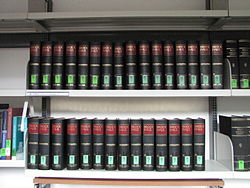
Encyclopædia Britannica, 15th edition: volumes of the Propedia (green), Micropedia (red), Macropedia (black), and 2-volume Index (blue)

A reference work is a document, such as a paper, book or periodical (or their electronic equivalents), to which one can refer for information.[1] The information is intended to be found quickly when needed. Such works are usually referred to for particular pieces of information, rather than read beginning to end. The writing style used in these works is informative; the authors avoid opinions and the use of the first person, and emphasize facts.

Indices are a common navigation feature in many types of reference works. Many reference works are put together by a team of contributors whose work is coordinated by one or more editors, rather than by an individual author. Updated editions are usually published as needed, in some cases annually, such as Whitaker's Almanack, and Who's Who.

Reference works include textbooks, almanacs, atlases, bibliographies, biographical sources, catalogs such as library catalogs and art catalogs, concordances, dictionaries, directories such as business directories and telephone directories, discographies, encyclopedias, filmographies, gazetteers, glossaries, handbooks, indices such as bibliographic indices and citation indices, manuals, research guides, thesauruses, and yearbooks.[2] Reference works, while traditionally printed, are often available in electronic form and can be obtained as reference software, CD-ROMs, DVDs, or online through the Internet. Wikipedia, an online encyclopedia, is both the largest and the most-read reference work in history.[3]

Library reference book

[edit]

In most public and academic libraries, reference books are usually not available to be borrowed by patrons like the rest of the library's holdings. Reference books are either used very frequently—a dictionary or an atlas, for example—or very infrequently, such as a highly specialized concordance. Because some reference books are consulted by patrons too frequently to have enough copies and others so infrequently that replacing it would be difficult, libraries prefer to make them available for photocopy rather than checkout.[4]

Types of reference work

[edit]

The main types and categories of reference works include:

  • Abstracting journal – a published summary of articles, theses, reviews, conference proceedings etc. arranged systematically
  • Almanac – an annual publication, listing a set of current, general or specific information about one or multiple subjects
  • Annals – concise historical record in which events are arranged chronologically
  • Atlas – a collection of maps traditionally been bound into book form
  • Bibliography – a systematic list of books and other works such as journal articles on a given subject or which satisfy particular criteria
  • Biographical dictionary – an encyclopedic dictionary limited to biographical information
  • Books of Quotations – collections of quotations satisfying particular criteria, arranged systematically
  • Calendar - a record or a schematic set-up of the days and dates in the months of a specific year
  • Chronicle/Chronology – a historical account of events arranged in chronological order
  • Compendium – a concise collection of information pertaining to a body of knowledge
  • Concordance – an alphabetical list of the principal words used in a book or body of work
  • Dictionary – a list of words from one or more languages, systematically arranged and giving meanings, etymologies etc.
  • Digest – a summary of information on a particular subject
  • Directory – a systematically arranged list of names, addresses, products, etc.
  • Encyclopaedia – a compendium providing summaries of knowledge either from all branches or from a particular field or discipline
  • Gazetteer – a geographical dictionary or directory used to provide systematic access to a map or atlas
  • Glossary – an alphabetical list of terms in a particular domain of knowledge with the definitions for those terms
  • Handbook – a small or portable book intended to provide ready reference
  • Index – a publication giving systematic access to a body of knowledge
  • Lexicon – a synonym for a dictionary or encyclopaedic dictionary
  • List – a published enumeration of a set of items
  • Manual – a handbook providing instructions in the use of a particular product
  • Phrase book – a collection of ready-made phrases, arranged systematically, usually for a foreign language together with a translation
  • Ready reckoner – a printed book or table containing pre-calculated values
  • Thematic catalogue – an index used to identify musical compositions through the citation of the opening notes
  • Textbook – a reference work containing information about a subject
  • Thesaurus – a reference work for finding synonyms and sometimes antonyms of words
  • Timetable – a published list of schedules giving times for transportation or other events
  • Yearbook – a compendium containing events relating to a specific year

Electronic resources

[edit]

An electronic resource is a computer program or data that is stored electronically, which is usually found on a computer, including information that is available on the Internet.[5] Libraries offer numerous types of electronic resources including electronic texts such as electronic books and electronic journals, bibliographic databases, institutional repositories, websites, and software applications.[5]

References

[edit]

Further reading

[edit]
[edit]
Revisions and contributorsEdit on WikipediaRead on Wikipedia
from Grokipedia
A reference work is a publication, such as a , periodical, database, or digital , designed to be consulted for authoritative factual information on specific topics rather than read cover-to-cover like a text. These works typically feature organized entries—often alphabetical, thematic, or indexed—for quick access to details like definitions, statistics, or overviews, and they serve as foundational tools in , , and . Common examples include dictionaries, encyclopedias, almanacs, atlases, bibliographies, directories, handbooks, and indexes, each tailored to provide concise, reliable data across general or specialized subjects. Reference works have long been essential in libraries and scholarly pursuits, evolving from ancient compendia like Pliny the Elder's Naturalis Historia (77 CE), which compiled knowledge on natural sciences, to modern standardized formats in the amid the rise of public education and specialized publishing. By the late 1800s, as libraries formalized reference services, these publications became central to assisting users with fact-finding and background , often shelved in non-circulating reference sections to ensure accessibility at service desks. Their purpose remains to deliver verified, synthesized information from primary and secondary sources, promoting efficiency in knowledge acquisition while minimizing the need for exhaustive searches. In the digital era, reference works have transitioned from print to electronic formats, beginning with CD-ROMs in the 1980s and accelerating with internet access in the 1990s, enabling searchable databases, multimedia integration, and real-time updates that surpass the limitations of static volumes. As of 2025, platforms like Gale's reference e-books or Oxford Reference offer vast, interconnected collections, blending traditional content with advanced search tools and mobile compatibility, though challenges persist in ensuring equitable access and combating misinformation. This evolution reflects broader shifts in information science, where reference works now support virtual services, AI-assisted queries, and interdisciplinary research in an increasingly online landscape.

Definition and Characteristics

Core Definition

A reference work is a or compiled to provide reliable, organized factual on specific subjects or topics, designed for quick consultation rather than continuous reading. Unlike narrative or textbooks, it emphasizes brevity in entries, systematic arrangement such as alphabetical indexing or thematic categorization, and tools like cross-references to facilitate rapid access to data. These works serve primary purposes including fact verification, term definition, and data location, supporting users in , , or professional tasks without requiring in-depth exploration. Core attributes include derived from reputable authors, editors, or publishers; accuracy through verified content and bibliographies; to reflect up-to-date ; and neutrality to present information objectively without bias. Examples such as dictionaries, encyclopedias, and atlases illustrate this scope, where the focus remains on authoritative, concise summaries tailored for repeated reference use. While increasingly available in electronic formats, the fundamental design prioritizes factual utility over entertainment or storytelling.

Key Features and Purposes

Reference works are distinguished by their structural elements, which facilitate efficient information retrieval and navigation. These include comprehensive indexes that list key terms, subjects, and names for quick location of content, cross-references that link related entries to provide contextual depth without redundancy, and appendices containing supplementary data such as tables, chronologies, or bibliographies that extend the main text. Standardized entry formats, such as alphabetical arrangements in dictionaries or thematic organizations in encyclopedias, ensure consistency and predictability, allowing users to locate information rapidly regardless of the work's complexity. In practice, reference works serve multiple purposes centered on accessible . They enable quick lookups of factual details, such as definitions, dates, or statistics, making them ideal for verifying information or resolving immediate queries. Beyond facts, they offer overviews of topics to build foundational understanding and aid in vocabulary development, particularly through linguistic resources that define terms and illustrate usage. Additionally, they function as starting points for deeper research by including bibliographies or suggestions for further reading, guiding users toward primary sources or specialized studies. These works are designed with user-oriented principles to support non-sequential reading, where content is consulted in fragments rather than linearly, accommodating brief consultations amid varied tasks. This approach enhances accessibility for diverse audiences, including students seeking educational overviews, professionals requiring precise for decision-making, and general readers exploring topics casually. Reliability in reference works is upheld through rigorous processes, including compilation by subject-matter experts who contribute authoritative entries based on verified . Editorial oversight often incorporates or by additional specialists to ensure accuracy and objectivity, minimizing errors in factual content. Regular updates via new editions or supplements address evolving information, maintaining relevance in dynamic fields like science or current events.

Historical Development

Ancient and Medieval Origins

The origins of reference works trace back to ancient , where Sumerian scribes created lists around 2500 BCE to record administrative data such as inventories of goods, land allocations, and personnel assignments on clay tablets. These documents, often excavated from sites like and , served as practical tools for economic and bureaucratic management in early urban societies. In ancient , contributed topical compilations like the Topics (fourth century BCE), a systematic collection of commonplaces and argumentative strategies categorized into ten predicates, which functioned as a reference for dialectical reasoning and philosophical analysis. Similarly, Claudius 's Geographia (c. 150 CE) assembled geographical data from earlier sources, including coordinates for approximately 8,000 places across the known world, establishing it as a pioneering reference for mapping and spatial understanding. Non-Western traditions also contributed early examples, such as the Chinese Erya (c. BCE), the oldest surviving Chinese that provided glossaries and classifications for classical texts, aiding scholarly interpretation. Roman innovations built on these foundations, with Pliny the Elder's Naturalis Historia (77 CE) emerging as an encyclopedic precursor that synthesized knowledge from over 2,000 volumes across 37 books, covering natural phenomena, arts, and medicines as a comprehensive consultation resource. Legal compilations also advanced, as seen in the (451–450 BCE), Rome's first codified law set inscribed on bronze panels and displayed publicly, which outlined procedures for debt, family, and property disputes to standardize justice. In the medieval period, Islamic scholars like produced influential mathematical tables in the ninth century, such as the Zij al-Sindhind, which provided astronomical data including sine values and planetary ephemerides derived from Indian and Greek sources, aiding calculations in navigation and timekeeping. European monastic centers developed glossaries, compiling annotations and vocabulary lists for Latin texts and scriptures to facilitate scholarly interpretation and teaching within cloistered communities. Byzantine scriptoria, particularly in monasteries, preserved classical Greek works by systematically copying manuscripts of authors like and , ensuring their transmission amid the empire's cultural continuity. This transition from predominantly oral knowledge transmission to written compilations emphasized preservation against loss, with early indexing techniques—such as marginal annotations and basic tables of contents—emerging in manuscripts to enhance navigability.

Modern Evolution

The invention of the movable-type by around 1450 revolutionized the production of reference works by enabling the mass reproduction of texts, dramatically reducing costs and increasing accessibility compared to handwritten manuscripts. Gutenberg's Bible, printed in 1455, exemplified this shift, as it became the first major book produced in large quantities using the new technology, allowing for the widespread dissemination of knowledge that laid the groundwork for future reference compilations. This technological advancement facilitated the emergence of comprehensive reference works during the Enlightenment, most notably and Jean le Rond d'Alembert's , ou Dictionnaire raisonné des sciences, des arts et des métiers (1751–1772), which systematized across disciplines and promoted rational inquiry as a tool for social progress. Spanning 17 volumes of text and 11 of plates, the drew contributions from over 140 intellectuals, including and Rousseau, and challenged traditional authorities by critically examining and reorganizing human understanding. In the , the rise of national encyclopedias reflected growing scholarly specialization and nationalistic impulses amid rapid scientific advancements, with works like the —first published in 1768 and completing its inaugural three-volume edition in 1771—expanding to meet demands for authoritative overviews of arts, sciences, and global affairs. The Britannica's 11th edition (1910–1911), a 29-volume benchmark, incorporated contributions from leading experts and set standards for depth and illustration, influencing subsequent national projects such as Germany's Brockhaus and France's Larousse. Parallel to this, specialized almanacs proliferated, providing annual compilations of astronomical data, weather patterns, and emerging scientific facts to support agricultural and navigational progress in an industrializing world. The brought further transformations, as the World Wars accelerated the demand for precise statistical data in areas like , demographics, and , spurring advancements in statistical publications including yearbooks that tracked wartime and reconstruction metrics. Post-World War II, the explosion in academic disciplines—fueled by expanded higher education and research funding—drove the proliferation of subject-specific handbooks, offering concise, expert-curated references tailored to fields like physics, , and social sciences. Key milestones included the of reference formats in the 1800s, such as alphabetical organization and pre-planned subject balances, which enhanced usability and influenced global publishing norms, and initial digital forays in the 1980s with CD-ROM encyclopedias like Grolier's Academic American Encyclopedia (1985), which compressed vast content onto optical discs for interactive access.

Classification by Type

Linguistic Reference Works

Linguistic reference works encompass a range of materials designed to support the study, usage, and understanding of , focusing on , , and expression. These tools provide essential guidance for speakers, writers, and scholars by offering definitions, etymologies, pronunciations, and rules for effective communication. Unlike broader factual compilations, they prioritize linguistic elements such as word meanings, syntactic conventions, and semantic relationships to aid in precise language articulation. Dictionaries form the cornerstone of linguistic reference works, systematically compiling lexical information to elucidate word meanings and usage. Monolingual dictionaries, such as the (OED), define words within a single language while tracing their historical development through illustrative quotations from and texts. First published in fascicles between 1884 and 1928, the OED covers over 500,000 words and phrases, incorporating pronunciations, etymologies, and evolving senses to reflect the dynamic nature of English. In contrast, bilingual dictionaries facilitate cross-linguistic translation by pairing equivalents from two languages, often including contextual examples and cultural notes to address idiomatic differences; for instance, the Collins English–French Dictionary provides bidirectional entries emphasizing practical usage in translation and language learning. These dictionaries emphasize phonetic transcription using systems like the International Phonetic Alphabet (IPA) for accurate pronunciation and semantic precision through nuanced definitions that distinguish shades of meaning. Thesauri complement dictionaries by organizing words based on conceptual relationships rather than alphabetical order, serving as aids for stylistic variation and rhetorical enhancement. Peter Mark Roget's Thesaurus of English Words and Phrases, first published in 1852, pioneered this format by classifying synonyms and antonyms into thematic categories, such as "existence" or "motion," to help users select precise or diverse terminology in writing and speech. This relational approach, distinct from definitional focus, promotes lexical creativity while maintaining semantic accuracy, influencing subsequent works that expand on synonymy and collocations for advanced language users. Grammars and style guides provide prescriptive frameworks for language structure and composition, guiding adherence to conventions in , , and . William Strunk Jr.'s , originally published in 1918 and later revised with , exemplifies this genre by outlining elementary rules of usage—such as "Omit needless words"—and principles of composition to foster clarity and vigor in prose. These works enforce standards for grammatical correctness and stylistic economy, often drawing on normative traditions to standardize written English for educational and professional contexts. The evolution of linguistic reference works traces from ancient glossaries—simple word lists appended to texts for clarification—to modern corpus-based dictionaries that leverage large-scale digital language data for empirical accuracy. Early glossaries, like those in medieval manuscripts, offered basic equivalents, but contemporary tools integrate corpora—vast collections of authentic texts—to inform definitions with frequency-based evidence and real-world collocations, enhancing semantic and phonetic reliability. This shift, evident in updated editions of the OED, underscores a move toward descriptive precision grounded in usage patterns rather than prescriptive ideals alone.

Factual and Topical Compilations

Factual and topical compilations represent a core category of reference works that systematically organize knowledge through concise, authoritative summaries of facts, events, and concepts across diverse subjects, enabling quick access to verified information without delving into extended narratives. These resources prioritize breadth and reliability, often drawing on contributions to provide overviews that serve as starting points for deeper . Encyclopedias exemplify this category by compiling knowledge in structured entries that cover general or specialized topics. General encyclopedias, such as the Encyclopædia Britannica (first published in 1768 and continuously updated), encompass all branches of knowledge in alphabetical order, offering brief articles on subjects ranging from history to science. Specialized encyclopedias, like the Routledge Encyclopedia of Philosophy (1998, with online editions), focus on particular disciplines, providing in-depth yet concise treatments of concepts such as ethics or metaphysics through thematic or alphabetical arrangements. These works typically feature signed articles authored by subject experts, ensuring scholarly accuracy, and include bibliographies at the end of entries to guide further reading. Almanacs and yearbooks function as annual factual compilations, updating users on current statistics, events, and trivia to reflect the passage of time. The and Book of Facts, originating in under the newspaper, serves as a premier example, presenting data on global events, sports, figures, and scientific facts in tabular and list formats for easy . Yearbooks, such as the Britannica Book of the Year (first issued in 1938), extend this by chronicling yearly developments in specific fields or globally, often supplementing encyclopedias with timely updates on , , and . Both formats emphasize verifiable data over interpretation, making them indispensable for and chronological overviews. Bibliographies and indexes within this category act as navigational tools, compiling lists of sources organized by topic or author to facilitate the location of relevant materials without providing the full texts themselves. The catalog, established in 1800 and now encompassing over 170 million items, exemplifies this by indexing books, manuscripts, and media across subjects, allowing researchers to identify factual resources on historical events or scientific topics. These works promote comprehensive coverage by cross-referencing entries, often including annotations for context, but they maintain a neutral, descriptive approach focused on accessibility rather than . Distinct features of factual and topical compilations include their commitment to expert-vetted, signed contributions for , integrated bibliographies for source tracing, and a design that favors exhaustive yet succinct coverage of facts over interpretive depth, distinguishing them from narrative-driven literature. This structure ensures they remain enduring tools in information ecosystems, adaptable to both print and digital formats while upholding standards of neutrality and verifiability.

Geographical and Statistical Resources

Geographical and statistical resources form a vital subset of reference works, focusing on the organization and presentation of spatial and quantitative data to facilitate understanding of locations, distributions, and trends. Atlases, such as The Times Atlas of the World, exemplify comprehensive map collections that integrate physical, political, and thematic representations; first published in 1895 by The Times of London, it has evolved through multiple editions to include over 200 maps covering global geography, with thematic sections on demographics, climate patterns, and economic activities. These works emphasize visual accuracy, enabling users to analyze spatial relationships, such as population densities or climatic zones, through layered cartographic depictions. Gazetteers complement atlases by providing detailed textual indexes to geographical features, arranged alphabetically with essential locational data. The Columbia Lippincott Gazetteer of the World, first issued in 1952 under the editorship of Leon E. Seltzer, contains over 130,000 entries on places worldwide, including coordinates, elevations, population figures, and brief historical or economic descriptions, serving as a key reference for verifying place names and attributes. Subsequent editions, like the 1998 Columbia Gazetteer of the World, expanded to 170,000 entries while maintaining this structured format to support research in geography and related fields. Statistical abstracts aggregate numerical data from official sources to track societal metrics over time, often incorporating visual aids for clarity. The Statistical Abstract of the , published annually by the U.S. Census Bureau from 1878 to 2012, compiles results, economic indicators, and demographic trends into hundreds of tables and charts, such as bar graphs illustrating or line charts showing rates. These resources prioritize data visualization techniques like histograms, pie charts, and thematic maps to reveal patterns without overwhelming detail, ensuring accessibility for policymakers and researchers. A distinctive feature of these resources is their attention to cartographic conventions for precision, including scale representations and map projections. Scale is typically denoted via representative fractions (e.g., 1:1,000,000), graphic bars, or verbal statements to relate map distances to real-world equivalents, preventing misinterpretation of spatial extents. The , introduced by in 1569, remains prevalent in atlases for its conformal properties that preserve angles and render rhumb lines as straight, aiding and general reference mapping, though it distorts areas at high latitudes. Such elements, combined with visualization methods like choropleth maps for demographic data, underscore the emphasis on accuracy and interpretability in geographical and statistical works.

Specialized Directories and Guides

Specialized directories and guides serve as targeted works that compile listings of entities, professionals, or procedures within specific domains, enabling users to locate contacts, verify details, or follow practical instructions efficiently. These resources prioritize and for niche audiences, such as researchers, practitioners, or industry professionals, by focusing on current, actionable rather than broad narratives. Unlike general compilations, they emphasize structured formats like alphabetical arrangements or indexed entries to facilitate rapid consultation. Directories, a core subset, include professional biographical listings and business registries that catalog individuals or organizations by field. The Who's Who, first published in 1849 as a 250-page volume listing ranks and appointments in Britain, evolved into an annual autobiographical reference with over 32,500 entries on influential figures across sectors, updated each December to reflect changes in status and contact details. Trade directories, such as or , provide alphabetical listings of tradespeople, manufacturers, and businesses, including addresses, products, and services, aiding commerce and historical research by tracking economic activities in specific regions. Handbooks and manuals offer field-specific procedural guidance and data summaries, designed for on-the-job use by experts. The Merck Manual, originating in 1899 as Merck's Manual of the —a compact 192-page guide for physicians and pharmacists on therapeutics and diagnostics—has expanded into a comprehensive resource for medical decision-making, emphasizing brevity to counter "treacherous" memory in practice. Similarly, the CRC Handbook of Chemistry and Physics, launched in 1913 as a 113-page ready-reference pocket book of chemical and physical constants, now spans thousands of pages in its annual editions, serving scientists with tabulated data for calculations and experiments. Catalogs and registers focus on archival records for targeted verification in creative or inventive fields. Art auction catalogs, indexed in databases like SCIPIO, document sales of artworks with details on , descriptions, and prices, functioning as essential references for appraisers and historians to trace object histories across major houses like or . Patent indexes, such as the USPTO's Patent Public Search tool, compile searchable records of inventions with classifications, abstracts, and citations, enabling inventors and researchers to identify and avoid duplication. A defining trait of these works is their need for frequent updates to maintain accuracy, as personnel changes, business relocations, or scientific advancements render static versions obsolete; for instance, provider directories in specialized sectors require verification every 90 days to ensure reliability. They also stress practical utility, delivering concise, indexed content for immediate application—such as quick diagnostics from the Merck Manual or constants from the CRC Handbook—over in-depth analysis, thereby supporting professional workflows in dynamic environments.

Formats and Accessibility

Traditional Print Formats

Traditional print reference works, such as encyclopedias and dictionaries, are often produced as multi-volume sets to accommodate extensive content while maintaining usability and portability for individual volumes. These sets typically feature durable bindings like , a stiffened cloth material coated for water, stain, and mildew resistance, which ensures a lifespan of 50 to 100 years under regular use. quality is prioritized for longevity, with acid-free varieties selected to prevent yellowing, brittleness, and degradation over time, making them suitable for frequent handling in institutional settings. The production of these works involves meticulous to ensure clear, legible layouts across dense pages, often using high-quality fonts and spacing optimized for quick reference. Illustrations, particularly in 19th-century atlases, were integrated via labor-intensive techniques, where metal plates were hand-etched and printed separately before assembly, adding to both cost and visual precision. Indexing methods include comprehensive back-of-book indexes compiled post-, as well as embedded aids like thumb tabs—semicircular cuts in page edges with affixed letter or section labels—for rapid volume navigation in multi-volume editions. Print formats offer tactile navigation benefits, allowing users to physically flip pages, use bookmarks, or rely on thumb tabs for intuitive access without electronic interfaces. Their independence from power sources ensures reliability in any environment, while the use of archival materials like and provides permanence ideal for long-term storage and institutional archiving. However, these works demand significant shelf space, particularly for multi-volume sets, leading to storage challenges in libraries. High production costs, coupled with the expense of periodic supplements for updates, limit accessibility, and heavy use can cause wear on bindings and pages despite durable materials.

Digital and Electronic Formats

The transition to digital formats began in the late 20th century with early experiments in electronic storage and distribution of reference materials. One pioneering effort was , launched in 1971 by Michael Hart, which digitized public-domain texts to create an accessible electronic library of classic works, marking the initial shift toward non-print reference resources. By the 1980s, compact disc-read only memory () technology enabled more interactive formats, exemplified by Compton's Multimedia Encyclopedia, released in 1989 as the first true multimedia encyclopedia, incorporating graphics, animation, and sound alongside traditional text. These products represented a bridge from print precursors, offering limited but innovative search capabilities on personal computers. In the 1990s and early , the facilitated the growth of online platforms, transforming reference works into dynamic, web-based resources. JSTOR, established in 1995 as a nonprofit , digitized academic journals and primary sources, providing subscription-based access to scholarly content with advanced search functions. Similarly, launched in 2001 as a free, collaborative , enabling through that supports real-time editing and hyperlinked navigation. These platforms introduced keyword-based searchability and internal hyperlinks, allowing users to traverse related topics efficiently, a feature absent in static print volumes. Digital reference works offer several key advantages over traditional formats, including real-time updates that keep information current without requiring physical revisions. integration enhances engagement, as seen in platforms embedding videos, interactive maps, and audio clips to illustrate complex concepts. Remote access via the further democratizes availability, permitting global users to consult resources from any connected device without physical presence in a . Despite these benefits, digital formats face significant challenges, such as the , which exacerbates inequalities in access to technology and high-speed , particularly affecting underserved populations. Paywalls on subscription databases like restrict entry to paying institutions or individuals, limiting broader dissemination of knowledge and creating barriers for independent researchers. Technically, digital reference works rely on metadata standards like MARC (Machine-Readable Cataloging), developed by the , to organize and retrieve bibliographic data in digital libraries. integrations further enable embedding content into external tools; for instance, JSTOR's Data for Research allows developers to perform faceted searches and extract datasets for analysis, facilitating seamless incorporation into research workflows.

Role in Information Ecosystems

Use in Libraries and Education

In libraries, reference works serve as foundational resources at reference desks, where librarians provide assisted consultations to guide patrons in navigating complex queries. These desks facilitate one-on-one interactions, enabling librarians to demonstrate search strategies and evaluate sources, thereby empowering users to conduct independent research rather than merely delivering answers. Library collection policies for reference works emphasize prioritizing core titles that align with institutional missions, such as authoritative encyclopedias, dictionaries, and handbooks in key subject areas, while favoring electronic formats for accessibility and space efficiency. These policies outline criteria for selection, including relevance to curriculum or community needs, positive reviews from sources like Choice or Library Journal, and cost-effectiveness, ensuring the collection remains current and authoritative. Weeding outdated print volumes is a routine practice in library maintenance, guided by objective criteria such as publication date, usage statistics, physical condition, and availability of digital alternatives, to prevent the accumulation of obsolete materials that hinder access to up-to-date information. In academic and public libraries, this process often involves tools like the CREW method or MUSTIE criteria, with subject specialists reviewing items annually or during space reconfigurations to retain only high-value resources. In educational settings, reference works support curriculum integration through school libraries, where they provide essential background and factual overviews to align with lesson plans across subjects like history, , and literature. For instance, encyclopedias and atlases offer structured entry points for student projects, helping educators reinforce content while building foundational skills. Reference works are integral to teaching information literacy, with tools like encyclopedias used to instruct students on source evaluation, recognizing authority through editorial processes, and understanding contextual credibility in academic communities. This approach, embedded in frameworks such as the ACRL's Framework for Information Literacy for Higher Education, encourages learners to assess publication types and biases, fostering critical thinking from early education through higher learning. Access to reference works is managed through strategies like interlibrary loans (ILL), which enable libraries to obtain photocopies or digital scans of rare or non-circulating items from other institutions, supplementing local collections without physical transfer. This service adheres to guidelines from organizations like the , prioritizing reciprocal agreements to deliver materials efficiently while respecting copyright for reproductions. To prevent circulation loss and ensure communal availability, many enforce reference-only policies, restricting physical materials to in-house use and prohibiting checkout, which preserves high-demand volumes like directories and compendia for repeated consultations. These policies balance user access with collection integrity, often complemented by digital equivalents to mitigate restrictions. Case studies from academic libraries illustrate a post-2000 shift to digital reference collections for cost , as seen in health sciences libraries where renovation-driven weeding projects discarded print volumes in favor of electronic resources, freeing space and reducing maintenance expenses. For example, Rutgers University's George F. Smith Library conducted a comprehensive review in the , interfiling or withdrawing obsolete s while retaining digital access, resulting in streamlined operations and alignment with user preferences for on-demand formats. Similarly, broader trends documented in Harvard's analysis show libraries transitioning from print-heavy "just in case" models to hybrid systems by the early , with electronic usage expanding dramatically and often surpassing print in many libraries by the early through patron-driven acquisitions and institutional repositories.

Impact on Research and Daily Life

Reference works play a pivotal role in facilitating scholarly inquiry by serving as initial sources of and specialized , enabling researchers to contextualize their studies and identify key concepts early in the process. For instance, encyclopedias and handbooks provide overviews that help scholars navigate complex topics, reducing the time spent on basic fact-gathering and allowing focus on original analysis. This foundational support minimizes duplication of efforts in , as cited facts from these works establish a shared , preventing redundant investigations into well-documented areas. In the process, reference works contribute to rigorous by offering verifiable background details that reviewers use to assess the accuracy and completeness of claims. Peer reviewers often submissions against established compendia to ensure alignment with accepted , thereby upholding the integrity of published and filtering out unsubstantiated assertions. This verification step is essential in fields like the sciences and , where inaccuracies can propagate if not caught early. Professionally, reference works enhance efficiency across disciplines by providing quick-access tools for decision-making. In , practitioners rely on citation manuals such as to construct arguments grounded in statutes, precedents, and regulations, streamlining case preparation and ensuring persuasive, authoritative briefs. Similarly, in , digital compendia like ClinicalKey deliver evidence-based overviews, drug monographs, and clinical guidelines at the point of care, enabling physicians and nurses to execute treatment plans swiftly and reduce diagnostic errors. These resources transform complex information into actionable insights, supporting high-stakes professional workflows. In daily life, reference works extend their utility through consumer guides that inform personal choices in areas like and . Publications such as those from offer ratings and recall alerts on products, empowering individuals to select reliable luggage, vehicles, or appliances, thereby avoiding costly mistakes and promoting safer consumption. This practical application fosters informed , from planning vacations to managing household health needs, while also influencing cultural phenomena like trivia-based media, where almanacs and fact books supply content for quizzes and entertainment. On a societal level, reference works have democratized by making authoritative information accessible beyond elites, a process accelerated by the in the , which slashed production costs and significantly increased literacy rates across , from approximately 10% in the early to around 30% by 1700 in northwestern regions including , through affordable editions in languages. However, over-reliance on these works poses risks, including superficial understanding, as users may prioritize concise summaries over deeper exploration, and outdated print editions can disseminate misleading facts, potentially harming informed judgment. Evaluating reference works involves assessing several key criteria to ensure their reliability and utility. Accuracy is paramount, achieved through rigorous protocols such as by subject experts and cross-verification against primary sources, which helps minimize errors in factual compilations. stems from the credentials of editors and contributors, including academic qualifications, , and institutional affiliations, which lend to the content. Completeness evaluates the scope and depth of coverage, ensuring the work addresses a broad yet focused range of topics without significant omissions relative to its intended purpose. focuses on ease, including clear indexing, logical arrangement (e.g., alphabetical or thematic), and user-friendly design elements like glossaries or hyperlinks in digital versions. Timeliness considers update frequency, with works requiring regular revisions to reflect evolving knowledge, particularly in fast-changing fields like and current events. Reference works face notable challenges in maintaining quality amid modern demands. Bias in curation can arise from editorial selections that favor certain perspectives, potentially skewing representation in historical or cultural topics, necessitating diverse contributor pools to mitigate this. Information overload in the digital era complicates user navigation, as vast online resources overwhelm traditional structured formats, requiring enhanced search functionalities to filter relevant data. The sustainability of open-access models is strained by funding issues, including high article processing charges and concerns over long-term maintenance, which can limit accessibility despite their goal of democratizing information. Future trends are reshaping reference works through technological integration. AI is enabling personalized queries via chat-based interfaces, allowing users to interact conversationally with reference content for tailored responses, a development prominent since the early 2020s in library systems. As of 2025, libraries are increasingly adopting generative AI tools for tasks like reference queries via chatbots and resource discovery, enhancing efficiency while raising needs for ethical oversight. Blockchain technology supports provenance tracking by creating immutable records of content origins and edits, enhancing trust in digital reference materials through verifiable histories. Global collaboration is fostering multilingual works, with international teams contributing to digital platforms that integrate diverse linguistic resources, promoting inclusive access across cultures. Print reference collections in libraries are expected to continue declining as digital alternatives dominate due to space constraints and user preferences. Immersive VR references are rising, offering virtual environments for interactive exploration of topics like historical sites or scientific concepts, potentially transforming educational applications in libraries. Ethical concerns over AI-generated content persist, including risks of bias propagation, , and intellectual property disputes, urging the development of guidelines for transparent sourcing in reference creation.

References

Add your contribution
Related Hubs
Contribute something
User Avatar
No comments yet.