
Hubbry Logo
Submersion (mathematics)Submersion (mathematics)Main
Open search
Submersion (mathematics)
Community hub
Submersion (mathematics)
logo
7 pages, 0 posts
0 subscribers
Be the first to start a discussion here.
Submersion (mathematics)
from Wikipedia

In mathematics, a submersion is a differentiable map between differentiable manifolds whose differential is everywhere surjective. It is a basic concept in differential topology, dual to that of an immersion.

Definition

[edit]

Let M and N be differentiable manifolds, and let be a differentiable map between them. The map f is a submersion at a point if its differential

is a surjective linear map.[1] In this case, p is called a regular point of the map f; otherwise, p is a critical point. A point is a regular value of f if all points p in the preimage are regular points. A differentiable map f that is a submersion at each point is called a submersion. Equivalently, f is a submersion if its differential has constant rank equal to the dimension of N.

Some authors use the term critical point to describe a point where the rank of the Jacobian matrix of f at p is not maximal.:[2] Indeed, this is the more useful notion in singularity theory. If the dimension of M is greater than or equal to the dimension of N, then these two notions of critical point coincide. However, if the dimension of M is less than the dimension of N, all points are critical according to the definition above (the differential cannot be surjective), but the rank of the Jacobian may still be maximal (if it is equal to dim M). The definition given above is the more commonly used one, e.g., in the formulation of Sard's theorem.

Submersion theorem

[edit]

Given a submersion between smooth manifolds of dimensions and , for each there exist surjective charts of around , and of around , such that restricts to a submersion which, when expressed in coordinates as , becomes an ordinary orthogonal projection. As an application, for each the corresponding fiber of , denoted can be equipped with the structure of a smooth submanifold of whose dimension equals the difference of the dimensions of and .

This theorem is a consequence of the inverse function theorem (see Inverse function theorem#Giving a manifold structure).

For example, consider given by . The Jacobian matrix is

This has maximal rank at every point except for . Also, the fibers

are empty for , and equal to a point when . Hence, we only have a smooth submersion and the subsets are two-dimensional smooth manifolds for .

Examples

[edit]

Maps between spheres

[edit]

A large class of examples of submersions are submersions between spheres of higher dimension, such as
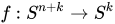
whose fibers have dimension . This is because the fibers (inverse images of elements ) are smooth manifolds of dimension . Then, if we take a path

and take the pullback

we get an example of a special kind of bordism, called a framed bordism. In fact, the framed cobordism groups are intimately related to the stable homotopy groups.

Families of algebraic varieties

[edit]

Another large class of submersions is given by families of algebraic varieties whose fibers are smooth algebraic varieties. If we consider the underlying manifolds of these varieties, we get smooth manifolds. For example, the Weierstrass family of elliptic curves is a widely studied submersion because it includes many technical complexities used to demonstrate more complex theory, such as intersection homology and perverse sheaves. This family is given by

where is the affine line and is the affine plane. Since we are considering complex varieties, these are equivalently the spaces of the complex line and the complex plane. Note that we should actually remove the points because there are singularities (since there is a double root).

Local normal form

[edit]

If f: MN is a submersion at p and f(p) = qN, then there exists an open neighborhood U of p in M, an open neighborhood V of q in N, and local coordinates (x1, …, xm) at p and (x1, …, xn) at q such that f(U) = V, and the map f in these local coordinates is the standard projection

It follows that the full preimage f−1(q) in M of a regular value q in N under a differentiable map f: MN is either empty or a differentiable manifold of dimension dim M − dim N, possibly disconnected. This is the content of the regular value theorem (also known as the submersion theorem). In particular, the conclusion holds for all q in N if the map f is a submersion.

Topological manifold submersions

[edit]

Submersions are also well-defined for general topological manifolds.[3] A topological manifold submersion is a continuous surjection f : MN such that for all p in M, for some continuous charts ψ at p and φ at f(p), the map ψ−1 ∘ f ∘ φ is equal to the projection map from Rm to Rn, where m = dim(M) ≥ n = dim(N).

See also

[edit]

Notes

[edit]

References

[edit]

Further reading

[edit]
Revisions and contributorsEdit on WikipediaRead on Wikipedia
from Grokipedia
In , a submersion is a smooth f:MNf: M \to N between smooth manifolds MM and NN with dimMdimN\dim M \geq \dim N, such that the differential dfp:TpMTf(p)Ndf_p: T_p M \to T_{f(p)} N is surjective at every point pMp \in M. This condition ensures that ff is locally equivalent to a linear projection , such as the canonical projection π:RmRn\pi: \mathbb{R}^m \to \mathbb{R}^n with mnm \geq n, where π(x1,,xm)=(x1,,xn)\pi(x_1, \dots, x_m) = (x_1, \dots, x_n). The submersion theorem, a fundamental result in the subject, states that if ff is a submersion at a point pp, then there exist local coordinates around pp in MM and f(p)f(p) in NN in which ff takes the form of this canonical projection. This local model highlights submersions as the dual concept to immersions, where the differential is injective rather than surjective, and plays a crucial role in understanding fiber bundles and fibrations. For instance, proper submersions—those that are proper maps—are locally trivial fibrations by Ehresmann's theorem, meaning the fibers over points in NN are diffeomorphic to each other locally. Submersions appear prominently in applications such as , where a Riemannian submersion preserves the metric structure by making the differential an isometry on the horizontal tangent spaces, facilitating the study of isospectral manifolds and metric constructions. Examples include the S3S2S^3 \to S^2, which is a submersion with S1S^1 fibers, and the projection of a product manifold onto one factor. These maps are stable under pullbacks in the category of smooth manifolds and form the basis for more abstract notions like smooth morphisms in .

Definition and Properties

Definition

In , the study of submersions relies on foundational concepts from smooth manifold theory. A smooth manifold is a that locally resembles and is equipped with a , allowing for the definition of differentiable functions and maps between such spaces. The TxMT_x M at a point xx on a smooth manifold MM is the vector space of all tangent vectors at xx, which can be identified with derivations of smooth functions at that point or, in local coordinates, with Rm\mathbb{R}^m where m=dimMm = \dim M. For a smooth map f:MNf: M \to N between smooth manifolds, the differential dfx:TxMTf(x)Ndf_x: T_x M \to T_{f(x)} N is the linear map that pushes forward tangent vectors, represented in local coordinates by the Jacobian matrix of partial derivatives. A smooth map f:MNf: M \to N between smooth manifolds of dimensions mm and nn with mnm \geq n is called a submersion if the differential dfxdf_x is surjective for every xMx \in M, meaning it has full rank nn and its image spans the entire Tf(x)NT_{f(x)} N. In local coordinates, this condition equates to the Jacobian matrix having rank nn at every point. Submersions are defined in the category of finite-dimensional smooth manifolds, where smoothness refers to CC^\infty-differentiability, though analogous notions exist using Fréchet differentiability in more general settings. This surjectivity condition is dual to that of an immersion, where the differential is injective. The concept of a submersion originated in the development of during the mid-20th century, with roots in Charles Ehresmann's work on fiber bundles and connections in the 1940s and 1950s.

Basic Properties

A submersion f:MNf: M \to N between smooth manifolds, where dimMdimN\dim M \geq \dim N, has constant rank equal to dimN\dim N at every point in MM, as the differential dfp:TpMTf(p)Ndf_p: T_p M \to T_{f(p)} N is surjective for all pMp \in M. This contrasts with general smooth maps, where the rank may vary across the domain. Submersions possess the open mapping property: the image of any in MM under ff is open in NN. To see this, cover MM with coordinate charts where ff locally resembles the standard projection RmRn\mathbb{R}^m \to \mathbb{R}^n, which is open; the then ensures these local images are open, and their union yields the global property. Submersions are stable under composition: if f:MNf: M \to N and g:NPg: N \to P are submersions with dimN=dimM\dim N = \dim M' matching the domain of gg, then gf:MPg \circ f: M \to P is a submersion, as the chain rule preserves the surjectivity of differentials. For a submersion f:MNf: M \to N, every point in NN is a regular value, meaning that for any qNq \in N, the differential dfpdf_p is surjective at all pf1(q)p \in f^{-1}(q); if qq lies outside the image, the empty preimage is vacuously a , while for qq in the image, f1(q)f^{-1}(q) is a smooth of dimension mnm - n.

Key Theorems

Fibers of submersions

The theorem on the fibers of submersions asserts that if f:MNf: M \to N is a smooth submersion between smooth manifolds, where dimM=m\dim M = m and dimN=n\dim N = n, then for every yNy \in N, the f1(y)f^{-1}(y) is a smooth embedded of MM of dimension mnm - n. This holds because the full rank condition ensures that every point in NN is a regular value of ff, allowing the fibers to inherit a smooth structure directly from the ambient manifold MM. The theorem characterizes the global geometry of preimages under submersions, reducing the dimension by exactly the dimension of the base while preserving smoothness. To outline the proof, note first that the differential dfp:TpMTf(p)Ndf_p: T_p M \to T_{f(p)} N is surjective for all pMp \in M, so ff has constant rank nn and every yNy \in N qualifies as a regular value without invoking explicitly. The Regular Level Set Theorem then applies: for each regular value yy, f1(y)f^{-1}(y) is an embedded of nn in MM. Locally, the Constant Rank Theorem provides charts around points in the fiber where ff takes a product form, ensuring local triviality and confirming the dimension mnm - n for connected components of the fiber; globally, the preimages form disjoint unions of such submanifolds. The dimension formula dim(f1(y))=mn\dim(f^{-1}(y)) = m - n applies to each connected component of the fiber, with uniformity across yy if the fibers are connected. If NN is connected, this dimensional reduction is consistent throughout, highlighting the theorem's role in foliating MM by level sets. Additionally, if the submersion is proper, Ehresmann's guarantees it is a , with all fibers diffeomorphic and the projection yielding a locally trivial . In non-compact settings, the fibers of a submersion need not be compact, even when the base is compact, unlike the case of immersions where compact domains map to compact images; this allows for unbounded or infinite structures in the preimages while maintaining the property.

Local Normal Form Theorem

The Local Normal Form Theorem provides a coordinate description of submersions near any point, revealing their local structure as projections. This result is often referred to as the submersion theorem in some sources. Let f:MNf: M \to N be a submersion between smooth manifolds of dimensions mm and nn with mnm \geq n. For any point xMx \in M, there exist local coordinate charts (U,ϕ)(U, \phi) on MM centered at xx and (V,ψ)(V, \psi) on NN centered at f(x)f(x) such that f(U)Vf(U) \subseteq V and the coordinate representation of ff is given by ψfϕ1(u1,,um)=(u1,,un),\psi \circ f \circ \phi^{-1}(u^1, \dots, u^m) = (u^1, \dots, u^n), which is the standard projection onto the first nn coordinates. This result follows as a special case of the Constant Rank Theorem for smooth maps of constant rank equal to dimN=n\dim N = n. The proof begins with the fact that the differential dfx:TxMTf(x)Ndf_x: T_x M \to T_{f(x)} N is surjective, so dimkerdfx=mn\dim \ker df_x = m - n. Choose a basis for kerdfx\ker df_x and extend it to a basis for TxMT_x M, then select a complementary subspace in Tf(x)NT_{f(x)} N to define local coordinates. Applying the to the surjective part of the differential yields charts where the matrix of ff takes the block form (In0),\begin{pmatrix} I_n & 0 \end{pmatrix}, confirming the projection form. The implies that every submersion is locally trivial, meaning near any point, ff resembles a product projection RmRn×Rmn\mathbb{R}^m \to \mathbb{R}^n \times \mathbb{R}^{m-n}, with fibers diffeomorphic to Rmn\mathbb{R}^{m-n}. Consequently, submersions exhibit no singularities, as the surjective differential ensures the map is "open" locally. While typically stated for CC^\infty (smooth) maps, the theorem holds more generally for CkC^k submersions with k1k \geq 1, relying on the CkC^k version of the . Real analytic versions also exist, using the analytic for holomorphic or real analytic maps between analytic manifolds.

Examples and Applications

Projections and Elementary Examples

One of the simplest examples of a submersion is the canonical projection f:RmRnf: \mathbb{R}^m \to \mathbb{R}^n for mnm \geq n, defined by f(x1,,xm)=(x1,,xn)f(x_1, \dots, x_m) = (x_1, \dots, x_n). This map is smooth, and its differential at any point pRmp \in \mathbb{R}^m is the linear projection onto the first nn coordinates, which is surjective since it maps the vectors e1,,ene_1, \dots, e_n to a basis of TpRnRnT_p \mathbb{R}^n \cong \mathbb{R}^n. The fibers of ff are affine subspaces diffeomorphic to Rmn\mathbb{R}^{m-n}, consisting of all points sharing the same first nn coordinates. Linear submersions provide a foundational case, where any surjective L:[V](/page/V.)[W](/page/W)L: [V](/page/V.) \to [W](/page/W) between finite-dimensional vector spaces [V](/page/V.)[V](/page/V.) and [W](/page/W)[W](/page/W) with dimVdim[W](/page/W)\dim V \geq \dim [W](/page/W) is a submersion when viewed as a smooth map between the corresponding manifolds. The differential dLdL coincides with LL itself, which is surjective by assumption, ensuring the rank condition holds everywhere. These extend to manifolds via local charts, where the rank theorem guarantees that submersions locally resemble such linear projections. Product projections offer another elementary illustration: for smooth manifolds MM and FF, the map π:M×FM\pi: M \times F \to M given by π(m,f)=m\pi(m, f) = m is a submersion. Its differential dπ(m,f):T(m,f)(M×F)TmMd\pi_{(m,f)}: T_{(m,f)}(M \times F) \to T_m M projects onto the TMT M factor and is surjective, as it sends basis vectors from the MM-component to a basis of TmMT_m M. The fibers are trivial copies of FF, highlighting the fibration structure inherent in submersions. A low-dimensional example involving the circle is the double covering map g:S1S1g: S^1 \to S^1 defined by g(z)=z2g(z) = z^2 for zS1Cz \in S^1 \subset \mathbb{C}. This is a smooth covering map, hence a local diffeomorphism, and thus a submersion since the dimensions are equal and the differential dgz:TzS1Tg(z)S1dg_z: T_z S^1 \to T_{g(z)} S^1 is an isomorphism at every point (for instance, in angular coordinates, it multiplies the derivative by 2, preserving surjectivity). The fibers are discrete pairs of antipodal points, demonstrating non-trivial topology in a basic setting. These examples achieve the local normal form of a submersion globally.

Maps Between Spheres

A fundamental example of a covering submersion is the double covering map π:SnRPn\pi: S^n \to \mathbb{RP}^n for n1n \geq 1, defined by identifying antipodal points on the sphere. This map is smooth and locally a , hence its differential is surjective everywhere, making it a submersion with discrete fibers consisting of two points each. More geometrically rich examples are provided by the , which are canonical submersions with connected spherical fibers. The classical , or Hopf map, π:S3S2\pi: S^{3} \to S^{2} (corresponding to the case n=1 of the complex Hopf fibration S2n+1CPnS^{2n+1} \to \mathbb{CP}^n), projects the unit sphere in C2\mathbb{C}^{2} onto the 2-sphere by identifying points differing by unit complex multiplication, yielding fibers diffeomorphic to S1S^1. The differential surjectivity follows from the compatible complex structure on the total and base spaces, ensuring the map is a Riemannian submersion when equipped with round metrics. The fibers are great circles linked with Hopf invariant 1. An extension to higher dimensions is the quaternionic Hopf fibration h:S7S4h: S^7 \to S^4, analogous to the complex case but using unit quaternions to identify points on the unit sphere in H2\mathbb{H}^2. This map is a smooth submersion with fibers diffeomorphic to S3S^3, and it preserves the round metric structure as a Riemannian submersion. By classification results, the only non-trivial smooth submersions f:SmSnf: S^m \to S^n with m>nm > n are the Hopf fibrations for specific dimensions (m=3,n=2 with fiber S^1; m=7,n=4 with fiber S^3; m=15,n=8 with fiber S^7). Such submersions exist only when the dimensions satisfy certain homotopy-theoretic conditions derived from the long of the associated , requiring the fiber dimension m - n to be 1, 3, or 7 (all odd). No such submersions exist from even-dimensional spheres to lower-dimensional manifolds. For instance, removing neighborhoods of critical points from a on an embedded sphere can yield local models for such submersions away from singularities, though global examples on compact spheres are precisely the Hopf maps. In the Hopf cases, the fibers are precisely (m-n)-spheres, reflecting the orientation-preserving nature and the zero of the odd-dimensional fibers.

Families of Algebraic Varieties

In algebraic geometry, submersions play a crucial role in parameterizing families of varieties, where a universal family over a base scheme BB is represented by a projection morphism π:XB\pi: X \to B, with XX the total space. Such a family is smooth if π\pi is flat and all geometric fibers are smooth varieties. When viewed in the category of complex manifolds, a smooth morphism π\pi between complex algebraic varieties corresponds to a submersion, meaning the differential dπd\pi is surjective everywhere, ensuring the fibers are complex submanifolds of the expected dimension. This translation bridges algebraic and differential structures, allowing tools from differential geometry to analyze algebraic families. A concrete example arises in resolution processes, such as blow-up maps. The blow-up morphism BlpPnPn\mathrm{Bl}_p \mathbb{P}^n \to \mathbb{P}^n at a point pp is an isomorphism away from pp, hence a submersion on the complement of the exceptional divisor, where the differential remains surjective. More generally, resolution of singularities morphisms, which replace singular varieties with smooth models, often behave as submersions over the smooth locus of the base, preserving local structure in families. In moduli theory, forgetful maps provide key examples of such submersions. For instance, the forgetful morphism π:Mg,nMg\pi: \mathcal{M}_{g,n} \to \mathcal{M}_g in the moduli stack of stable curves of genus gg with nn marked points, which forgets the marked points (stabilizing if necessary), is a smooth morphism, hence a submersion in the complex analytic sense. The fibers over a point [C]Mg[C] \in \mathcal{M}_g are configuration spaces of nn points on the curve CC, which are smooth varieties of dimension nn. This structure highlights how submersions encode the variation of geometric objects within parameter spaces. The differential condition for smoothness—surjectivity of differentials—underpins applications in deformation theory, where submersions model deformations of varieties, ensuring that nearby fibers remain smooth and the family is locally trivial. An algebraic analogue of Ehresmann's asserts that proper smooth morphisms between complex manifolds are locally trivial fibrations in the analytic , implying that algebraic families over a base are analytically fiber bundles with structure group the of the fiber. In recent developments, submersions appear in mirror symmetry via the SYZ conjecture, which posits that mirror Calabi-Yau threefolds admit dual special Lagrangian torus fibrations—proper submersions with Lagrangian torus fibers—explaining through these geometric duals.

Generalizations and Extensions

Topological Submersions

A topological submersion is a continuous f:MNf: M \to N between topological manifolds of dimensions mnm \geq n such that, for every point pMp \in M, there exist coordinate charts (U,ϕ)(U, \phi) around pp in MM and (V,ψ)(V, \psi) around f(p)f(p) in NN making ff the standard projection RmRn\mathbb{R}^m \to \mathbb{R}^n, given by (u1,,um)(u1,,un)(u_1, \dots, u_m) \mapsto (u_1, \dots, u_n). This property generalizes the notion of submersion to the topological category without requiring differentiability. Such maps are open, ensuring that the image of any open set in MM is open in NN, and the fibers f1(q)f^{-1}(q) for qf(M)q \in f(M) are topological submanifolds of MM of dimension mnm - n. Locally, the map behaves like a product projection, implying that it admits local sections and that the fibers are discrete unions of components homeomorphic to Rmn\mathbb{R}^{m-n}. Every smooth submersion between smooth manifolds induces a topological submersion when the manifolds are equipped only with their underlying topological structures. However, the converse does not hold in general: a topological submersion may not arise from a smooth submersion unless the manifolds admit compatible smooth structures, which fails for certain non-smoothable topological manifolds in dimensions 5\geq 5. Kirby and Siebenmann showed that triangulability is a key obstruction here, as non-triangulable topological manifolds (obstructed by the Kirby-Siebenmann invariant in Z/2\mathbb{Z}/2) cannot support PL or smooth structures that would make a topological submersion differentiable. Examples include the standard projections Rm×RkRm\mathbb{R}^m \times \mathbb{R}^k \to \mathbb{R}^m for k=mn0k = m - n \geq 0, which are prototypical topological submersions by definition. The Hopf fibrations, such as the map S3S2S^3 \to S^2 given by [z1,z2][2z1z2,z12z22][z_1, z_2] \mapsto [2 \overline{z_1} z_2, |z_1|^2 - |z_2|^2] in projective coordinates, are topological submersions with S1S^1-fibers, as they are smooth and thus satisfy the local projection condition topologically. Examples also include covering maps, such as the double cover S2S2S^2 \to S^2 restricted away from the two branch points, which is a topological submersion (in fact, a covering map) with two-sheeted fibers.

Submersions in Category Theory

In the category of smooth manifolds and smooth maps, a submersion is defined as a morphism f:XYf: X \to Y such that its differential df:TXTYdf: TX \to TY is surjective at every point, or equivalently, the induced map TXfTYTX \to f^* TY is a surjection of bundles. This definition extends to infinite-dimensional manifolds and aligns with the notion of formally smooth morphisms in more abstract settings. Surjective submersions generate a singleton Grothendieck pretopology on Diff, where covering families consist of single surjective submersions, enabling the construction of sheaves and stacks in this category. This pretopology supports the formation of étale stacks over smooth manifolds, as submersions provide the covers for the associated site, facilitating descent data for objects like principal bundles. In the context of synthetic differential geometry, surjective submersions serve as covers in the site for Diff, allowing infinitesimal cohesion and the study of formally smooth morphisms within the cohesive (,1)(\infty,1)- SynthDiff∞Grpd. Examples of submersions in categorical frameworks include their role in Lie groupoids, where surjective submersions define the structure maps and correspond to principal bundles via Ehresmann's theorem on proper submersions. In algebraic geometry, smooth morphisms between schemes act as algebraic analogs of submersions, locally resembling projections onto a base with smooth fibers, thus enabling similar descent properties. Key properties of submersions in these categories include pullback stability: the pullback of a submersion along any smooth map is again a submersion, ensuring the pretopology is well-behaved. Surjective submersions are regular epimorphisms in , which are pullback-stable and serve as effective descent morphisms for sheaves on manifolds. Modern extensions appear in \infty-categories, where submersions underpin derived geometry; for instance, in Lurie's framework of spectral algebraic geometry, they generalize to structured spaces and support higher theory for derived stacks.

References

Add your contribution
Related Hubs
User Avatar
No comments yet.






