Recent from talks
Nothing was collected or created yet.
Whitney embedding theorem
View on WikipediaIn mathematics, particularly in differential topology, there are two Whitney embedding theorems, named after Hassler Whitney:
- The strong Whitney embedding theorem states that any smooth real m-dimensional manifold (required also to be Hausdorff and second-countable) can be smoothly embedded in the real 2m-space, if m > 0. This is the best linear bound on the smallest-dimensional Euclidean space that all m-dimensional manifolds embed in, as the real projective spaces of dimension m cannot be embedded into real (2m − 1)-space if m is a power of two (as can be seen from a characteristic class argument, also due to Whitney).
- The weak Whitney embedding theorem states that any continuous function from an n-dimensional manifold to an m-dimensional manifold may be approximated by a smooth embedding provided m > 2n. Whitney similarly proved that such a map could be approximated by an immersion provided m > 2n − 1. This last result is sometimes called the Whitney immersion theorem.
About the proof
[edit]Weak embedding theorem
[edit]The weak Whitney embedding is proved through a projection argument.
When the manifold is compact, one can first use a covering by finitely many local charts and then reduce the dimension with suitable projections.[1]: Ch. 1 §3 [2]: Ch. 6 [3]: Ch. 5 §3
Strong embedding theorem
[edit]The general outline of the proof is to start with an immersion with transverse self-intersections. These are known to exist from Whitney's earlier work on the weak immersion theorem. Transversality of the double points follows from a general-position argument. The idea is to then somehow remove all the self-intersections. If M has boundary, one can remove the self-intersections simply by isotoping M into itself (the isotopy being in the domain of f), to a submanifold of M that does not contain the double-points. Thus, we are quickly led to the case where M has no boundary. Sometimes it is impossible to remove the double-points via an isotopy—consider for example the figure-8 immersion of the circle in the plane. In this case, one needs to introduce a local double point.
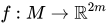
Once one has two opposite double points, one constructs a closed loop connecting the two, giving a closed path in Since is simply connected, one can assume this path bounds a disc, and provided 2m > 4 one can further assume (by the weak Whitney embedding theorem) that the disc is embedded in such that it intersects the image of M only in its boundary. Whitney then uses the disc to create a 1-parameter family of immersions, in effect pushing M across the disc, removing the two double points in the process. In the case of the figure-8 immersion with its introduced double-point, the push across move is quite simple (pictured).

This process of eliminating opposite sign double-points by pushing the manifold along a disc is called the Whitney Trick.
To introduce a local double point, Whitney created immersions which are approximately linear outside of the unit ball, but containing a single double point. For m = 1 such an immersion is given by

Notice that if α is considered as a map to like so:
then the double point can be resolved to an embedding:
Notice β(t, 0) = α(t) and for a ≠ 0 then as a function of t, β(t, a) is an embedding.
For higher dimensions m, there are αm that can be similarly resolved in For an embedding into for example, define
This process ultimately leads one to the definition:
where
The key properties of αm is that it is an embedding except for the double-point αm(1, 0, ... , 0) = αm(−1, 0, ... , 0). Moreover, for |(t1, ... , tm)| large, it is approximately the linear embedding (0, t1, 0, t2, ... , 0, tm).
Eventual consequences of the Whitney trick
[edit]The Whitney trick was used by Stephen Smale to prove the h-cobordism theorem; from which follows the Poincaré conjecture in dimensions m ≥ 5, and the classification of smooth structures on discs (also in dimensions 5 and up). This provides the foundation for surgery theory, which classifies manifolds in dimension 5 and above.
Given two oriented submanifolds of complementary dimensions in a simply connected manifold of dimension ≥ 5, one can apply an isotopy to one of the submanifolds so that all the points of intersection have the same sign.
History
[edit]The occasion of the proof by Hassler Whitney of the embedding theorem for smooth manifolds is said (rather surprisingly) to have been the first complete exposition of the manifold concept precisely because it brought together and unified the differing concepts of manifolds at the time: no longer was there any confusion as to whether abstract manifolds, intrinsically defined via charts, were any more or less general than manifolds extrinsically defined as submanifolds of Euclidean space. See also the history of manifolds and varieties for context.
Sharper results
[edit]Although every n-manifold embeds in one can frequently do better. Let e(n) denote the smallest integer so that all compact connected n-manifolds embed in Whitney's strong embedding theorem states that e(n) ≤ 2n. For n = 1, 2 we have e(n) = 2n, as the circle and the Klein bottle show. More generally, for n = 2k we have e(n) = 2n, as the 2k-dimensional real projective space show. Whitney's result can be improved to e(n) ≤ 2n − 1 unless n is a power of 2. This is a result of André Haefliger and Morris Hirsch (for n > 4) and C. T. C. Wall (for n = 3); these authors used important preliminary results and particular cases proved by Hirsch, William S. Massey, Sergey Novikov and Vladimir Rokhlin.[4] At present the function e is not known in closed-form for all integers (compare to the Whitney immersion theorem, where the analogous number is known).
Restrictions on manifolds
[edit]One can strengthen the results by putting additional restrictions on the manifold. For example, the n-sphere always embeds in – which is the best possible (closed n-manifolds cannot embed in ). Any compact orientable surface and any compact surface with non-empty boundary embeds in though any closed non-orientable surface needs
If N is a compact orientable n-dimensional manifold, then N embeds in (for n not a power of 2 the orientability condition is superfluous). For n a power of 2 this is a result of André Haefliger and Morris Hirsch (for n > 4), and Fuquan Fang (for n = 4); these authors used important preliminary results proved by Jacques Boéchat and Haefliger, Simon Donaldson, Hirsch and William S. Massey.[4] Haefliger proved that if N is a compact n-dimensional k-connected manifold, then N embeds in provided 2k + 3 ≤ n.[4]
Isotopy versions
[edit]A relatively 'easy' result is to prove that any two embeddings of a 1-manifold into are isotopic (see Knot theory#Higher dimensions). This is proved using general position, which also allows to show that any two embeddings of an n-manifold into are isotopic. This result is an isotopy version of the weak Whitney embedding theorem.
Wu proved that for n ≥ 2, any two embeddings of an n-manifold into are isotopic. This result is an isotopy version of the strong Whitney embedding theorem.
As an isotopy version of his embedding result, Haefliger proved that if N is a compact n-dimensional k-connected manifold, then any two embeddings of N into are isotopic provided 2k + 2 ≤ n. The dimension restriction 2k + 2 ≤ n is sharp: Haefliger went on to give examples of non-trivially embedded 3-spheres in (and, more generally, (2d − 1)-spheres in ). See further generalizations Archived 2016-09-30 at the Wayback Machine.
See also
[edit]- Representation theorem – Proof that every structure with certain properties is isomorphic to another structure
- Whitney immersion theorem – On immersions of smooth m-dimensional manifolds in 2m-space and (2m-1) space
- Nash embedding theorem – Every Riemannian manifold can be isometrically embedded into some Euclidean space
- Takens's theorem – Conditions under which a chaotic system can be reconstructed by observation
- Nonlinear dimensionality reduction – Projection of data onto lower-dimensional manifolds
- Universal space
Notes
[edit]- ^ Hirsch, Morris W. (1976). Differential topology. Graduate texts in mathematics. New York Heidelberg Berlin: Springer. ISBN 978-1-4684-9449-5.
- ^ Lee, John M. (2013). Introduction to smooth manifolds. Graduate texts in mathematics (2nd ed.). New York; London: Springer. ISBN 978-1-4419-9981-8. OCLC 800646950.
- ^ Prasolov, Victor V. (2006). Elements of Combinatorial and Differential Topology. Providence: American Mathematical Society. ISBN 978-1-4704-1153-4.
- ^ a b c See section 2 of Skopenkov (2008)
References
[edit]- Whitney, Hassler (1992), Eells, James; Toledo, Domingo (eds.), Collected Papers, Boston: Birkhäuser, ISBN 0-8176-3560-2
- Milnor, John (1965), Lectures on the h-cobordism theorem, Princeton University Press
- Adachi, Masahisa (1993), Embeddings and Immersions, translated by Hudson, Kiki, American Mathematical Society, ISBN 0-8218-4612-4
- Skopenkov, Arkadiy (2008), "Embedding and knotting of manifolds in Euclidean spaces", in Nicholas Young; Yemon Choi (eds.), Surveys in Contemporary Mathematics, London Math. Soc. Lect. Notes., vol. 347, Cambridge: Cambridge University Press, pp. 248–342, arXiv:math/0604045, Bibcode:2006math......4045S, MR 2388495
External links
[edit]- Classification of embeddings Archived 2017-12-22 at the Wayback Machine
Whitney embedding theorem
View on GrokipediaBackground Concepts
Smooth Manifolds
A smooth manifold provides the foundational structure for studying differentiable geometry and topology in higher dimensions. Formally, an -dimensional smooth manifold is a second-countable Hausdorff topological space that is locally Euclidean of dimension , meaning every point in has a neighborhood homeomorphic to an open subset of , together with a maximal atlas of charts where the coordinate transition maps are (infinitely differentiable) functions.[8] This atlas defines a smooth structure on , allowing the consistent extension of notions like differentiability and tangent spaces from Euclidean space to the manifold.[9] The key smoothness condition arises from the transition maps: for two charts and with , the composition must be a diffeomorphism between open subsets of .[8] These maps ensure that the manifold's geometry is compatible across overlapping local coordinates, enabling global definitions of smooth functions and vector fields on . A maximal smooth atlas is obtained by including all charts compatible with a given smooth atlas, guaranteeing that the smooth structure is uniquely determined up to diffeomorphism.[9] Classic examples illustrate these properties. The Euclidean space serves as the standard -dimensional smooth manifold with the identity atlas. The -sphere is a compact smooth manifold of dimension , covered by stereographic projection charts. The -torus ( times) inherits its smooth structure as a product manifold, while the real projective space is obtained by quotienting the sphere by antipodal identification, with charts away from the quotient points.[8] In the context of smooth manifolds, second-countability—requiring a countable basis for the topology—is a standard assumption that implies paracompactness. Paracompactness ensures every open cover admits a locally finite refinement, which is crucial for constructing partitions of unity and supporting the existence of embeddings into Euclidean spaces.[10] This property holds for all second-countable Hausdorff manifolds, facilitating many advanced constructions in differential geometry.[11]Embeddings and Immersions
In differential topology, smooth manifolds serve as the foundational spaces for studying mappings with differential structure. A smooth map between smooth manifolds and of dimensions is called a smooth immersion if its differential is injective at every point , meaning that the linear map has full rank everywhere. This condition ensures that the map locally preserves the tangent space structure without collapsing dimensions, allowing to be "locally like" a submanifold of near each image point.[12] A smooth embedding is a smooth immersion that is also a topological embedding, meaning is a homeomorphism from onto its image . For to be a topological embedding, it must be injective and proper (i.e., the preimage of every compact subset of is compact in ), which guarantees that inherits the topology of without self-intersections or "escaping to infinity."[12] In contrast, a topological embedding is a continuous injective proper map that is a homeomorphism onto its image, but lacks the smoothness or immersion condition; the smooth variant thus combines differential injectivity with topological fidelity.[13] A classic example of a smooth embedding is the standard inclusion , where the unit circle is mapped as itself, preserving both smoothness and injectivity while being proper due to compactness.[12] Conversely, the figure-eight curve, parametrized by with , is a smooth immersion because its differential is injective everywhere, but it fails to be an embedding as it is not injective—the map self-intersects at the origin.[12] Whitney's contributions emphasized general position arguments to achieve transversality in such mappings, allowing generic perturbations of smooth maps to intersect submanifolds transversely, which is crucial for constructing embeddings by avoiding degenerate intersections.[13] This transversality ensures that double points, if present, occur in controlled dimensions, facilitating their resolution in higher ambient spaces.[12]Statement of the Theorems
Weak Embedding Theorem
The weak Whitney embedding theorem states that every smooth -dimensional manifold , assumed Hausdorff and second-countable, admits a smooth embedding into .[3] This result, established by Hassler Whitney in 1936, guarantees the existence of a smooth map that is an immersion and a homeomorphism onto its image, ensuring the image is a smooth submanifold of without self-intersections and topologically equivalent to .[14] A smooth map is an embedding if it is an immersion—meaning the differential is injective for every —and if is a homeomorphism onto its image.Since and , injectivity is possible, ensuring full rank everywhere. This condition implies no singular points, and combined with global injectivity, the image has no self-intersections.[14] The dimension bound arises from early techniques using triangulations and approximation to construct embeddings, providing a higher-dimensional ambient space to avoid intersection issues present in lower dimensions.[14] A key corollary for compact manifolds: every compact smooth -manifold embeds into as a closed submanifold, ensuring properness and realizing globally without self-intersections.[14]
