Hubbry Logo
Robe RoyalRobe RoyalMain
Open search
Robe Royal
Community hub
Robe Royal
logo
8 pages, 0 posts
0 subscribers
Be the first to start a discussion here.
Robe Royal
Robe Royal
from Wikipedia

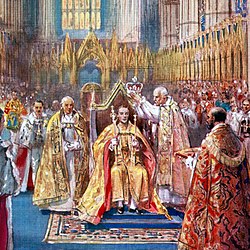
A depiction of George VI being crowned in Westminster Abbey in 1937, while wearing the Supertunica, Stole Royal and Robe Royal

The Robe Royal (also known as the Pallium Regale,[1] Imperial Mantle[2] or Dalmatic Robe[2]) is a robe worn by the British monarch when he or she is crowned. It is donned just before the monarch is invested with the Orb, Ring and Sceptres. It is worn during the crowning and paying of homage. The Robe Royal used is one originally created for the 1821 coronation of George IV.

Use

[edit]

The monarch enters Westminster Abbey for their coronation wearing the Robe of State. This is removed for the Anointing ceremony in which they wear the Colobium sindonis ("shroud tunic"), an intentionally plain robe. After the Anointing the monarch dons the more ornate Supertunica over the Colobium.[1] After they have been invested with regalia including the Spurs, Sword of Offering and the Armills the monarch dons the Robe Royal over the top of the Supertunica and also wears the Stole Royal.[1][3][4]

The monarch is then invested with the Orb, Ring and Sceptres and crowned by the Archbishop of Canterbury. They remain in the Robe Royal as they receive homage from the bishops, peers of the realm and members of the Royal Family and the Communion is conclude. The monarch then moves to the shrine and tomb of St Edward the Confessor where the regalia, Robe Royal and Stole Royal are removed and replaced with the Imperial Robe for the procession out of Westminster Abbey.[4] During the Coronation the monarch is enrobed by the Lord Great Chamberlain who is assisted by the Groom of the Robes and the Master of the Robes or Mistress of the Robes.[4]

Description

[edit]

Unlike most of the robes used in the coronation the Robe Royal is not typically made new for each monarch. The one in current use was made for the 1821 coronation of George IV.[1] The design of the robe was based on the earlier mantles worn by Tudor and Stuart monarchs and, indeed, is little changed from those worn in the mediaeval period which were based on the Dalmatic vestment used by clergy.[1][2] The association with ecclesiastical attire is intentional and meant as a reminder of the divine nature of the monarchy.[2] The George IV Robe Royal is the oldest robe used in the coronation ceremony.[1]

The George IV Robe Royal is gold-coloured with symbols including foliage, crowns, fleurs-de-lis, eagles, roses, thistles and shamrocks embroidered in coloured thread. It is worn as a mantle and closed by a gold clasp in the shape of an eagle.[1] The George IV Robe Royal was made by John Meyer for £24, with the gold clasp manufactured by goldsmiths Rundell, Bridge and Rundell. After the coronation of George IV the robe was retained by the Dean and Chapter of Westminster before passing into private hands. It was returned to the Crown in the early 20th century and was used at the 1911 coronation of George V, the 1937 coronation of George VI, the 1953 coronation of Elizabeth II, and the 2023 coronation of Charles III.[2][1][5] A new Robe Royal was made by Werner and Sons of Braintree, Essex, in preparation for the coronation of Edward VIII. After this coronation was cancelled his successor, George VI, elected to use the George IV robe instead.[6]

See also

[edit]

References

[edit]
Revisions and contributorsEdit on WikipediaRead on Wikipedia
from Grokipedia
The Robe Royal, also known as the Pallium Regale, is a historic ceremonial garment worn by the British monarch during the investiture portion of the coronation service, specifically at the moment preceding the bestowal of the crown. Originally commissioned for George IV's coronation in 1821, it consists of a loose, four-square mantel designed to evoke priestly vestments, underscoring the sacred and imperial dimensions of monarchy. Embroidered with gold stars, national emblems, and silver-thread imperial eagles at its corners, the robe is layered over the Supertunica after the anointing rite, as the sovereign receives the armills, stole, orb, ring, and sceptres symbolizing temporal and spiritual authority. Distinct from most coronation robes fashioned anew for each reign, the Robe Royal—along with the Supertunica—has endured through multiple ceremonies, including those of George V in 1911, George VI in 1937, Elizabeth II in 1953, and Charles III in 2023, preserving continuity in ritual tradition. Following the crowning, it is briefly removed before the monarch processes in the heavier Imperial Mantle, highlighting its precise role in the rite's vesting sequence.

Origins and History

Early Development

The Robe Royal, also known as the , first appeared in documented form as part of the layered vestments in medieval English , symbolizing the monarch's dual role as temporal ruler and anointed figure akin to ancient priesthood. The earliest surviving description of such coronation robes dates to a compiled during the reign of Edward III, which records garments resembling priestly dalmatics and tunics intended for the anointing rite, worn to evoke sacral before the presentation of . These elements, including a full-length coat opening at the front, prefigure the Robe Royal's structure as a post-anointing garment layered over simpler under-robes. This development drew from Byzantine imperial traditions of elaborate, gold-embroidered consular attire, which emphasized the emperor's divine mandate and were adapted in following the Carolingian revival of Roman sacral kingship models. English rites incorporated these via the 11th-century , as seen in the Liber Regalis manuscript of circa 1308–1327, which formalized the sequence of vesting during Edward II's , placing the after to signify priestly consecration and imperial continuity. By affirming the monarch's authority through ritual clothing predating statutory limitations on , the Robe Royal embedded a of unmediated divine ordinance in practice, with original medieval exemplars used until their destruction in the purge of . This foundational role persisted in subsequent rites, underscoring causal links to pre-parliamentary conceptions of rooted in biblical and imperial precedents rather than elective consent.

Evolution Through Coronations

Following the English Reformation, the Robe Royal preserved key medieval design elements, such as embroidered imperial eagles signifying the monarch's divine imperial authority, even as the rite adapted to Protestant theology. These Catholic-derived motifs endured without substantial alteration, as evidenced by the investiture robes in James I's 1603 coronation, which featured crimson velvet lined with ermine, maintaining structural and symbolic continuity from pre-Reformation precedents. By the , the Robe Royal achieved greater standardization, with the version crafted for George IV's 1821 coronation—ornately embroidered in gold with heraldic symbols evoking imperial sovereignty—reused for all subsequent male monarchs, including in 1831 and in 1902. For Queen Victoria's 1838 , a custom of gold tissue, hand-stitched with gold lace trimming and ermine accents, complemented the Robe Royal protocol, incorporating lavish goldwork to align with the era's imperial pomp. The longevity of these garments provides empirical documentation of adaptive conservation; the 1821 Robe Royal, employed in Edward VII's 1902 ceremony, survives in the Royal Collection, having undergone repairs to sustain its use across multiple reigns without fundamental redesign.

Design and Construction

Materials and Features

The Robe Royal, also referred to as the Imperial Robe or Imperial Mantle, consists primarily of purple silk velvet, a material chosen for its associations with imperial authority and penitence in coronation tradition. It is lined with white silk and trimmed with ermine fur sourced from Canada, providing both insulation and symbolic purity. The garment weighs approximately 15 pounds (6.8 kg) and extends roughly 6.5 meters from shoulder to the tip of its train, allowing for a full, flowing drape suitable for ceremonial procession. Embroidered details include gold eagles, emblematic of the , rendered in gold thread interwoven with motifs of foliage, crowns, and fleurs-de-lis on a cloth-of-gold base. The robe fastens at the front with a gold clasp and adopts a loose, cloak-like form without fitted sleeves, facilitating layering over the underlying during the investiture phase of the ceremony. This design, originating from the mantle crafted for George IV's 1821 coronation, has been reused and conserved for subsequent monarchs, including , , and . In the , conservation efforts for versions worn by in 1953 and later adapted for involved robemakers such as , who ensured structural integrity while preserving original embroidery techniques employing goldwork and subtle reinforcements. These updates maintained the robe's historical integrity without altering core materials or features.

Variations Across Eras

In the medieval period, the Robe Royal appeared as a loose, cloak-like mantle worn over the , featuring minimal embroidery with imperial eagles, gold figures, and national symbols on rich fabrics such as , often adorned with jewels like emeralds and pearls, as evidenced in descriptions from Edward III's 1327 coronation and the Liber Regalis manuscript of the 1380s. These early variants prioritized symbolic imperial motifs over elaborate decoration, reflecting the garment's roots in Byzantine and Roman influences adapted to English needs. By the Victorian and Edwardian eras, the Robe Royal evolved to include more intricate gold embroidery depicting wheat ears, branches, and fleurs-de-lis on trimmed with ermine, incorporating expanded national and imperial symbols amid the British Empire's growth, though its train remained shorter than the up to 14-foot lengths seen in contemporary state robes. Queen Victoria's 1838 version drew on Roman imperial precedents with added details, while George V's 1911 usage maintained these enhancements without major structural alterations. In the 20th and 21st centuries, the Robe Royal—originating as the 1821 Imperial Mantle for —shifted toward reuse and periodic restoration rather than full recreation, weighing approximately 15 pounds with a substantial train and gold-embroidered motifs preserved across coronations of (1911), (1937), (1953), and (2023). For , the garment underwent conservation incorporating embroidery by the Royal School of Needlework to ensure durability, adapting historical designs to contemporary craftsmanship standards while retaining original purple velvet and ermine elements. This approach marked a practical refinement, prioritizing artifact preservation over era-specific novelty amid fiscal constraints and sustainability considerations in maintenance.

Ceremonial Role

Position in the Coronation Sequence

The Robe Royal is donned after the monarch's anointing with holy oil and the vesting in the Supertunica, as the next step in the investiture rite. This occurs when the sovereign rises from the Coronation Chair, at which point the Robe Royal—also known as the Imperial Mantle—is brought forward and placed over the Supertunica, accompanied by the Stole Royal. Immediately following this vesting, the receives the Armills (bracelets of sincerity and defence), followed by , Ring, and Sceptres, preparing for the crowning. The Robe Royal remains in place throughout these presentations and the subsequent acts of homage, ensuring the sovereign's attire aligns with the progression to full regal before the from the . This sequence, detailed in official Coronation Rolls and service orders, has been protocol since the late 17th century, including the joint coronation of and Mary II in 1689, standardizing the transition from preparation to the vesting of temporal symbols of authority.

Associated Regalia and Rituals

![Crowning of George VI][float-right] The Robe Royal is invested during the investiture following the , paired with the , a narrow embroidered band placed over the shoulders. The is vested by a bishop, such as the in recent ceremonies, while assisting bishops and officials handle the Robe Royal. This association ensures the garments align with the sequence of presentation, including armills beforehand and orb, ring, , and sceptres thereafter. In the ritual, the oversees the vesting, pronouncing a such as: "Receive this . May the clothe you with the robe of righteousness and garments of salvation." During the of on May 6, 2023, the was presented by the Prince of Wales and the Robe Royal brought by Baroness Merron, with bishops assisting in the investment while the King sat in the . The 1937 of followed a comparable procedure, with the King invested in the Robe Royal embroidered with national emblems before further . The design of the Robe Royal, worn over the , permits the monarch's arms to remain free for grasping the with the cross in the right hand and the rod with the dove in the left, as occurs immediately after . This practical integration supports the ceremonial handling of symbols of power and mercy without hindrance.

Symbolism and Interpretation

Religious and Divine Elements

The Robe Royal, also known as the , embodies sacerdotal kingship through its design resembling ecclesiastical vestments, underscoring the monarch's divine consecration following the with holy oil. This garment, donned immediately after the unction rite, signifies the sovereign's transformation into a figure blending royal and priestly authority, rooted in the biblical concept of anointed rulers as intermediaries between divine will and earthly order. Its hue draws from ancient associations of the color with priestly dignity and imperial holiness, paralleling the fabrics of purple, blue, and scarlet used in the Aaron's as described in Exodus 28:5-6, which denoted sacred service and divine election. In , this coloration evokes the continuity of sacred kingship, where the assumes a mediatory role akin to precedents of divinely ordained leadership over the covenant people. Embroidered with gold eagles and crosses, the robe integrates symbols of transcendent and Christian ; the eagles recall Byzantine imperial motifs signifying vigilant divine oversight, while the crosses affirm the monarch's custodianship of the faith under God's mandate. These elements resist secular interpretations by maintaining an unbroken thread of sacred , as the garment's form persisted through the into Anglican usage, preserving the causal link between hereditary and unyielding spiritual authority rather than contractual or elective derivations.

Political and Sovereign Implications

The Robe Royal, invested upon the monarch at the moment of crowning, visually embodies the continuity of sovereign authority, transcending statutory enactments and affirming legitimacy derived from longstanding tradition rather than parliamentary grant alone. This extra-constitutional dimension was starkly evident following the and (1642–1660), when the restoration of Charles II in 1660 necessitated the recreation of coronation regalia, including robes, for his 1661 ceremony; these symbols served to reassert monarchical against republican precedents, signaling unbroken lineage despite the prior abolition. Such rituals have historically projected an image of enduring sovereignty, stabilizing governance amid factional strife by invoking pre-modern roots of authority that persist in the 's . Empirical analyses underscore the stabilizing effects of these monarchical traditions, with constitutional monarchies demonstrating superior and lower variance in compared to republics; for instance, from 1900–2010 reveal monarchies outperforming republics in effectiveness and property rights protection. The Robe Royal's role in coronations thus contributes to national cohesion by countering egalitarian republican models, which associates with heightened instability, as seen in frequent regime changes across French republics since 1792 versus the British monarchy's continuity since William the Conqueror's 1066 accession. Critiques portraying such as archaic relics, often advanced in mainstream outlets favoring ideological , overlook this track record of resilience; the persistence of robed coronations through events like the (1688) and World Wars has empirically fortified institutional trust, with surveys indicating the enhances unity and pride amid polarization. By visually linking contemporary sovereigns to medieval precedents, the Robe Royal debunks transient anti-monarchical narratives through centuries of demonstrated efficacy in preserving order.

Notable Instances and Legacy

Use in Key Coronations

During the coronation of King George VI on 12 May 1937 at Westminster Abbey, the monarch was vested in the Robe Royal, or Imperial Mantle, immediately following the anointing and donning of the Supertunica. This historic garment, originally commissioned for George IV's 1821 coronation, consists of cloth of gold richly embroidered with gold thread depicting double eagles, stars from the Order of the Garter, and the national emblems of England, Scotland, and Ireland—roses, thistles, and shamrocks—evoking the symbols of the British Empire during a period of global tension preceding World War II. The Robe Royal was fastened at the shoulders and worn during the presentation of the regalia and the act of crowning, after which it was temporarily exchanged for purple velvet before the final procession. Queen Elizabeth II's coronation on 2 June 1953 at followed the established ritual, with the sovereign being invested in the and the cloth-of-gold after the anointing and . The same 1821 Imperial Mantle, preserved in the Royal Collection, was employed, its golden embroidery symbolizing continuity of monarchical amid post-war reconstruction. The robe remained in place as the presented the Sovereign's Orb, Ring, and Sceptres prior to the crowning, underscoring the garment's role in the investiture sequence. This artifact, maintained under controlled conditions to prevent degradation, exemplifies the reuse of core vestments across generations to affirm institutional permanence. In the of King Charles III on 6 May 2023 at , the Robe Royal was layered over the and during the rite, adhering to the precedent set in prior ceremonies. The 1821 mantle, drawn from the Royal Collection and conserved through meticulous restoration, featured its longstanding gold embroidery of imperial and national motifs, worn as the king received the including and Sceptres before the crowning. This usage highlighted the robe's enduring function in bridging historical sovereignty with contemporary observance, with the garment returned to storage post-ceremony for future preservation.

Preservation and Modern Relevance

The Robe Royal, as part of the historic coronation vestments held by the Royal Collection Trust, undergoes regular conservation to maintain its structural integrity, including meticulous cleaning and minor repairs to address age-related wear on the crimson velvet, gold embroidery, and ermine trim. Prior to its reuse in the 2023 coronation of King Charles III, conservators at institutions such as the Royal School of Needlework assessed and adjusted the garment for fit and condition, ensuring it could be worn without compromising the original 1821 fabrication. These efforts prioritize non-invasive techniques to preserve the artifact's authenticity, reflecting the Trust's mandate for the care of royal ceremonial items. In contemporary contexts, the Robe Royal reinforces the continuity of Britain's by embodying enduring traditions during public ceremonies, as demonstrated by its prominent role in the 2023 Westminster Abbey service. drew an average television audience of 18.1 million viewers, with a peak of over 20 million, underscoring sustained in these symbolic elements despite shifts in media consumption. This engagement highlights the robe's function in upholding the monarchy's ceremonial framework, which links historical sovereignty to modern institutional stability without substantive alterations. Looking ahead, the Robe Royal's preservation supports its potential redeployment in future coronations, adhering to precedents of that emphasize fiscal prudence and historical fidelity over redesigns influenced by transient cultural pressures. Such practices ensure the garment remains a tangible link to monarchical precedents dating to , barring unforeseen material degradation requiring replacement.

References

Add your contribution
Related Hubs
User Avatar
No comments yet.