Hubbry Logo
Robert Anderson Van WyckRobert Anderson Van WyckMain
Open search
Robert Anderson Van Wyck
Community hub
Robert Anderson Van Wyck
logo
8 pages, 0 posts
0 subscribers
Be the first to start a discussion here.
Robert Anderson Van Wyck
from Wikipedia

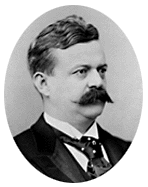
Robert Anderson Van Wyck (/væn ˈwk/ van WYKE;[1][2] July 20, 1849 – November 14, 1918) was the first mayor of New York City after the consolidation of the five boroughs into the City of Greater New York in 1898.[1][2]

Key Information

Early life and education

[edit]

Robert Anderson Van Wyck was the son of William Van Wyck and Lydia Ann Maverick. He was one of seven children, including two brothers Augustus and Samuel Maverick, a Confederate Regimental Surgeon.[3][4] He studied at the Wilson Academy in North Carolina, and later graduated from Columbia University, where he was valedictorian of his class.[5] His sister Lydia married Robert Hoke of North Carolina, a Confederate general during the American Civil War and businessman.

Career

[edit]

Van Wyck began working in business, then studied law and became an attorney. He enjoyed a large practice for many years before entering politics.

His business life depended on his social connections as well. Van Wyck was a member of the Holland Society, of which he became president. He belonged to many of the social clubs of the city and was prominent in Masonic circles, being a member of The Ancient Lodge, New York City.

Political career

[edit]

For many years Van Wyck took an active interest in Democratic Party matters, attending many conventions, state and national. Later, Van Wyck was elected Judge of the City Court of New York. He advanced to chief justice.

Van Wyck resigned as justice to accept the Democratic Party nomination for Mayor of New York City. He was elected in 1897 by a very large majority. He served as mayor of New York City between 1898 and 1901, as the first mayor to govern New York City after its five boroughs had been consolidated into a single city.

As Mayor, he brought together the innumerable municipal corporations comprising the greater city. He directed construction of the Interborough Rapid Transit's first subway in Manhattan.

Van Wyck is generally regarded as selected by the leaders of Tammany Hall as a man who would do little to interfere with their running of the city. Initially highly popular as a result of his reversal of the various reforms introduced by the preceding Fusion administration, Van Wyck's administration foundered on the so-called "Ice Trust" scandal of 1900. The New York World reported that the American Ice Company of Charles W. Morse planned to double the price of ice, from 30 to 60 cents per hundred pounds (45.4 kilograms). In the era before refrigeration, this had potentially fatal effects, as the ice was the only preservative available to keep food, milk, and medicines fresh. The high price would have put ice beyond the reach of many of the city's poor—Tammany's main power base in the years of waves of immigration.

American Ice was forced to reverse its decision due to the public outcry. Van Wyck's political rivals forced an investigation into the issue. It revealed that American Ice had secured an effective monopoly over the supply of its product to the city—it was the only company with rights to land ice at New York piers—and would have dramatically increased its profits at the new price. In addition, Van Wyck, whose salary as mayor was only $15,000, owned and had apparently not paid for, $680,000 worth of American Ice stock.

The Ice Trust Scandal destroyed Van Wyck's political career and was generally reckoned to have cost Tammany the elections of 1901, which was won by the Fusion reformist slate led by Seth Low. Two years later, The New York Times characterized the Van Wyck administration as one mired in "black ooze and slime".[6] Governor Theodore Roosevelt initiated an investigation, which determined that Van Wyck had not been personally implicated in the Ice Trust Scandal.[7]

Later years

[edit]

Van Wyck and his wife enjoyed traveling. In 1906, they moved to Paris, France. He died there at the age of 69 on November 14, 1918. The funeral was held at American Holy Trinity Church. His body was returned to New York and he was buried at Woodlawn Cemetery in The Bronx, New York City.[8]

Legacy

[edit]

References

[edit]

Further reading

[edit]
[edit]
Revisions and contributorsEdit on WikipediaRead on Wikipedia
from Grokipedia
Robert Anderson Van Wyck (1849–1918) was an American and Democratic who served as the first mayor of the consolidated City of New York from 1898 to 1901. Affiliated with , he was selected by its leader as a candidate unlikely to obstruct the organization's influence over city governance. Born in and educated at , Van Wyck practiced law and rose to become a judge before entering mayoral politics. Elected in 1897 amid the consolidation of , , , , and into Greater New York, his administration managed the transition to unified municipal operations, including the initiation of the , precursor to the city's subway system. However, his tenure was overshadowed by corruption allegations tied to , particularly the American Ice Trust scandal, in which Van Wyck held $678,000 in stock, contributing to the organization's electoral defeat in 1901 and his own political downfall. Following his loss to reform candidate , Van Wyck retired from public life, resuming practice before relocating to , where he died in 1918. His mayoralty exemplified the machine politics of the , prioritizing patronage over reform amid rapid urban expansion.

Early Life and Family Background

Birth and Ancestry

Robert Anderson Van Wyck was born on July 20, 1849, in , New York, to William Van Wyck and Lydia Ann Maverick Van Wyck. His father, William Van Wyck (1803–1867), was a New York resident involved in local affairs, while his mother, Lydia Ann Maverick (1814–1885), came from the Maverick family, which had established roots in New York society. The Van Wyck lineage traced to Dutch origins, descending from Cornelius Barentse Van Wyck, who emigrated from the to (present-day New York) around 1660 and settled in areas like on [Long Island](/page/Long Island). This early colonial heritage placed the family among the Knickerbocker elite of old New York, with branches maintaining prominence in Dutchess County and through farming, law, and civic roles.

Upbringing and Influences

Robert Anderson Van Wyck was born on July 20, 1849, in to William Van Wyck, a practicing attorney, and Lydia Maverick Van Wyck. The family belonged to a prominent lineage of Dutch descent, tracing back to Cornelius Barentse Van Wyck, who arrived in from around 1650 and helped establish early settlements in the region. Raised in New York amid this heritage of colonial-era influence, Van Wyck was part of a shaped by his father's , which involved representation in city courts and exposed family members to the intricacies of urban . His brother, Augustus Van Wyck, similarly entered and , suggesting a familial environment that emphasized professional achievement in and governance. This background, rooted in New York's evolving civic landscape during the mid-19th century, oriented Van Wyck toward legal and political pursuits from youth.

Education and Early Influences

Formal Education

Van Wyck received his early education in before enrolling at in . He graduated from in 1872, earning his degree in law at a time when formal undergraduate preparation was not universally required for legal studies. This education equipped him for admission to the New York bar shortly thereafter, marking the completion of his formal academic training.

Formative Experiences

Van Wyck's early exposure to the legal profession stemmed from his father, William Van Wyck, a practicing attorney in , which likely directed his career path toward law amid a family environment emphasizing professional and civic responsibilities. Born into a lineage tracing back to early Dutch settlers in New York, he developed an appreciation for historical continuity and institutional stability that would inform his later political outlook. His decision to pursue higher education in North Carolina, attending the University of North Carolina before transferring to Columbia University for legal studies, exposed him to regional differences in post-Civil War America, bridging Northern urban dynamics with Southern academic traditions during Reconstruction. Graduating from Columbia Law School in 1872, he transitioned from brief business ventures to legal practice in New York, where initial courtroom engagements honed his pragmatic approach to adjudication and public service, setting the foundation for his judicial rise. These experiences cultivated a preference for established legal precedents over radical reforms, reflecting the era's emphasis on restoring order after national upheaval.

Entry into Law

Following his graduation from in 1872, Robert A. Van Wyck commenced a career in the by establishing a private practice in . Prior to entering law, he had pursued business activities, marking a deliberate shift toward the bar as a means of professional advancement. This period of practice, spanning approximately 17 years until his judicial appointment in 1889, provided the professional foundation for his subsequent roles on the of New York.

Judicial Appointments and Decisions


Robert A. Van Wyck was elected judge of the of New York in November 1889, commencing his term on January 1, 1890, for a six-year period handling civil cases within the city's jurisdiction.
In 1895, toward the close of his initial term, Van Wyck was elected chief judge of the , advancing his role in overseeing its operations.
He resigned from the bench in 1897 to pursue the Democratic Party's nomination for mayor of the consolidated Greater New York, ending his judicial service after approximately eight years.
During his tenure, Van Wyck presided over routine civil matters, with no major appellate decisions attributed to him in historical records, reflecting the trial-level nature of the .

Rise in Politics

Tammany Hall Involvement

Van Wyck entered Democratic politics in the late 1870s through affiliation with , guided by James A. Flack, a prominent Tammany leader in County. This connection facilitated his early electoral successes, including election to the representing in 1881 and reelection in 1882, positions secured via Tammany's organizational machinery in the borough. Advancing judicially, Van Wyck served as surrogate of Queens County, a role emphasizing and estate matters that aligned with Tammany's networks for distributing favors and jobs. Tammany's support extended to his 1897 nomination for of the consolidated Greater New York City, orchestrated by boss to install a compliant figure amid the borough unification. Van Wyck resigned his surrogateship on October 20, 1897, to pursue the candidacy, which Tammany propelled to victory on November 2, 1897, defeating Republican Benjamin Tracy by 86,000 votes and fusion candidate . Tammany selected Van Wyck for his perceived pliancy, viewing him as unlikely to disrupt the machine's control over city contracts and appointments, a strategy reflective of the organization's reliance on judicial and nominal political fronts to maintain influence. His assembly and surrogate tenures demonstrated loyalty to party directives, including backing legislation favoring urban development interests tied to Tammany donors, though specific votes remain documented primarily in legislative records rather than overt scandal at that stage. This progression underscored Tammany's pattern of elevating reliable Democrats from outer boroughs to consolidate power in the expanding metropolis.

Pre-Mayoral Political Roles

Prior to his mayoral candidacy, Robert A. Van Wyck held judicial office as a judge on the of New York, rising to the position of . This role positioned him within Democratic political networks, particularly , which later supported his elevation to higher office. In 1897, Van Wyck resigned as to accept the Democratic nomination for mayor of the consolidated Greater New York, marking his transition from the judiciary to executive leadership. His judicial tenure, while not marked by major controversies in primary records, aligned with Tammany's strategy of promoting reliable party figures to influential posts.

Mayoral Administration (1898–1901)

Election and Consolidation Context

The consolidation of New York City into Greater New York was enacted by the New York State Legislature via Chapter 378 of the Laws of 1897, known as the Charter of Greater New York, which merged the existing City of New York (encompassing Manhattan and the Bronx), the independent City of Brooklyn, Queens County (excluding Hempstead and Oyster Bay), Richmond County (Staten Island), and adjacent territories into a unified municipality effective January 1, 1898. This restructuring expanded the city's land area from 40 square miles to approximately 360 square miles and its population from about 1.5 million to over 3.4 million residents, aiming to streamline governance, infrastructure development, and economic integration across previously separate entities amid rapid urbanization and industrial growth. Referendums held in the affected areas in 1894 and 1897 approved the plan, though opposition persisted in Brooklyn—where it passed by a slim margin of just 300 votes—due to fears of higher taxes funding Manhattan's debt and loss of local autonomy. The new charter stipulated elections for municipal offices, including the mayor, to be held on November 2, 1897, with winners assuming duties upon consolidation to ensure a seamless transition. Tammany Hall, the dominant Democratic political machine, capitalized on the expanded electorate, where outer borough Democrats could offset reformist strength in Manhattan from the recent administration of Mayor William L. Strong (1894–1897), by nominating Robert A. Van Wyck—a sitting justice of the New York Supreme Court and brother of politician Augustus Van Wyck—as its standard-bearer on October 1, 1897. Tammany leader Richard Croker selected Van Wyck for his judicial respectability and perceived pliancy, positioning him as a contrast to more overtly corrupt figures while pledging administrative efficiency and opposition to reformist overreach. Opposition coalesced around a fusion ticket uniting Republicans, independents, and anti-Tammany Democrats, nominating Seth Low—the incumbent reform mayor of Brooklyn—as its candidate to preserve progressive governance against machine control. Other contenders included Republican Benjamin F. Tracy, a former U.S. Secretary of the Navy, and labor advocate Ben Hanford, who inherited the ticket of the late Henry George (a single-tax proponent who died on October 29, 1897, during the campaign). Van Wyck prevailed with 233,113 votes (approximately 51% of the total), securing a plurality of about 82,000 over Low's 150,926, amid turnout exceeding 460,000 voters across the soon-to-be-unified boroughs; this outcome reflected Tammany's organizational prowess and the dilution of Manhattan's reform bloc in the broader polity. The victory marked Tammany's resurgence, enabling machine influence over the nascent greater city's patronage and contracts, though it foreshadowed corruption probes during Van Wyck's term.

Key Policies and Initiatives

Van Wyck's administration prioritized the administrative integration of the five boroughs following the 1898 consolidation, establishing unified citywide departments for including police, , , and to replace fragmented local systems. This initiative involved standardizing operations, centralizing procurement, and addressing disparities in infrastructure such as water distribution and sewage systems across , , , , and , though implementation faced delays due to bureaucratic resistance and varying borough standards. A policy was the promotion of expansion to accommodate the enlarged city's population and economic demands. In February 1900, the Board of , under Van Wyck's oversight, awarded the contract for the initial subway line to the , leading to groundbreaking ceremonies on March 24, 1900, at City Hall for what became the core of the modern 4, 5, and 6 lines connecting to the outer boroughs. This project, authorized by the 1894 Act, represented the city's first major underground rail effort, aimed at alleviating surface congestion from elevated trains and horse-drawn transport. Other initiatives included modest advancements in , such as dock and harbor improvements to support in the unified port, though these were overshadowed by contractual disputes and favoritism allegations. Van Wyck also endorsed efforts to extend utility services, including preliminary planning for enhanced water supply extensions from the Croton system, but substantive progress on large-scale aqueducts occurred post-tenure. Overall, policies emphasized practical governance over sweeping reforms, reflecting Tammany Hall's pragmatic approach to managing the consolidated metropolis amid rapid .

Administrative Operations and Challenges

Van Wyck's administration focused on integrating the administrative apparatuses of , , , [Staten Island](/page/Staten Island), and into a single municipal framework following the consolidation, which expanded the city's significantly. This involved overseeing departments such as , police, , , and , with extensive correspondence documenting coordination efforts across boroughs. The mayor maintained operational oversight through appointment books for meetings and hearings, as well as subject files addressing departmental matters from to 1901. Key challenges stemmed from the merger of disparate local systems, which created inconsistencies in service delivery and standardization. Correspondence with borough presidents, particularly on parks in and , revealed difficulties in aligning pre-consolidation practices with unified protocols. The of Accounts conducted investigations into issues like faulty paving and financial irregularities, underscoring early operational inefficiencies in infrastructure maintenance. Political influences from exacerbated administrative hurdles, as Van Wyck's department head appointments prioritized loyalty to boss over administrative expertise, leading to friction in bureaucratic execution. Complaints against city employees and marshals proliferated, reflecting strains from rapid bureaucratic expansion and inadequate oversight mechanisms in the nascent Greater New York government. These issues contributed to perceptions of disorganization, though the administration laid groundwork for later centralized operations.

Scandals, Corruption, and Investigations

The administration of Mayor Robert A. Van Wyck (1898–1901) was overshadowed by multiple investigations revealing systemic graft and favoritism tied to Tammany Hall's dominance over city departments. The Mazet Committee, a New York State legislative probe launched in 1899, examined municipal offices including police, fire, and public works, documenting pervasive corruption such as padded payrolls, kickbacks in contract awards, and protection rackets that enriched Tammany loyalists. Its findings highlighted how Tammany boss Richard Croker exerted de facto control, with Van Wyck's oversight appearing nominal; for instance, police Chief William S. Devery openly tolerated gambling dens in exchange for bribes, undermining law enforcement efficacy. The most damaging episode was the 1900 Ice Trust scandal involving the American Ice Company, a monopoly consolidating regional ice producers with Tammany complicity. Revelations showed insiders received discounted : Van Wyck held 2,660 preferred shares valued at $678,000 (acquired at half par value), his brother over $200,000, Croker $250,000 under his wife's name, and deputy John Carroll $500,000. Tammany officials shielded the trust by blocking rival shipments at docks and sabotaging competitors' equipment, enabling price hikes—doubling in April 1900 to burden working-class families dependent on ice for amid summer heat. Public exposure began with New York World reporting in early 1900, followed by calls for Governor to remove Van Wyck, supported by affidavits on his stock holdings. Van Wyck denied direct profiteering and faced no criminal , but the eroded Tammany's immigrant base by demonstrating elite enrichment at public expense, contributing to the party's 1901 mayoral defeat. Broader probes, including the short-lived Committee of Fifteen in 1900, reinforced patterns of departmental malfeasance, though Van Wyck's personal role remained that of a passive enabler under Croker's machine.

Post-Mayoral Period

Later Political Efforts

Following his defeat in the 1901 New York City mayoral election amid scandals including the ice trust controversy, Robert A. Van Wyck did not seek further elective office, effectively concluding his active pursuit of political positions. The corruption investigations and public backlash from his administration, particularly the revelations of Tammany Hall's influence in granting monopolies to the American Ice Company, diminished his viability as a candidate and led to his marginalization within Democratic circles. Van Wyck retained loose ties to the Democratic Party, occasionally appearing in party-affiliated events. In April 1905, he was slated to serve as toastmaster at a Democratic club dinner honoring U.S. Senators but faced significant internal opposition, highlighting lingering resentment over his tenure and contributing to the event's near cancellation. Such instances represented minor engagements rather than structured campaigns or nominations, reflecting a broader withdrawal from frontline politics as shifted leadership under figures like to rebuild after reformist victories. By the mid-1900s, Van Wyck had retreated from public political activity, focusing instead on private affairs before relocating to , where he resided until his death in 1918 without mounting any documented bids for office or party leadership roles.

Personal Life and Decline

Van Wyck was born on July 20, 1849, in to attorney William Van Wyck and Lydia Ann Maverick. He had no recorded children from his . On March 28, 1906, Van Wyck married Kate E. Hertle in ; she was the divorced former wife of John C. Hertle, a former Commissioner of Accounts. The couple departed immediately for on their honeymoon aboard the Kaiser Wilhelm II. Following his mayoral term, Van Wyck briefly resumed practice amid the discredit from scandals that had plagued his administration, though investigations cleared him of direct involvement. His political career effectively ended with the 1901 defeat of Tammany's mayoral candidate, and he withdrew from public life, relocating to with his wife shortly after their marriage, where they maintained a private residence. This expatriation marked a personal decline from prominence, as he eschewed further U.S. political engagement or legal prominence.

Death and Legacy

Final Years and Death

After departing office in 1901 following defeat in the mayoral election, Van Wyck returned to private legal practice in . Although exonerated in probes like the Ice Trust scandal—where investigations revealed a monopoly's grip on city ice supplies and his holding of $678,000 in related stock—his association with Tammany Hall's tarnished his standing, curtailing any viable path to renewed political prominence. In 1906, Van Wyck emigrated to , , marrying Kate E. Hertle, widow of a New York , aboard the ship departing that March. He resided there for the ensuing twelve years, cultivating a leisurely existence amid the Continent while preserving ties to social circles via memberships in the Manhattan Club and Holland Society; contemporaries estimated his wealth at $3,000,000 from prior ventures. Van Wyck died at his residence on November 15, 1918, aged 69. Funeral rites occurred two days later at the American Church of the Holy Trinity, with his body subsequently returned for burial at Woodlawn Cemetery in .

Historical Assessment and Impact

Robert A. Van Wyck's mayoral tenure is historically evaluated as a period of entrenched influence, marked by administrative inefficiency and widespread graft that exemplified machine politics at its zenith in late New York. As the inaugural mayor of the consolidated Greater New York on January 1, 1898, Van Wyck oversaw the initial integration of the five boroughs, yet his administration's operations were plagued by favoritism toward Tammany allies, leading to probes such as the 1900 Lexow Committee-style investigations into vice and . Contemporary critics, including reformist publications, portrayed his governance as "brilliantly ineffectual and superbly corrupt," with decisions often deferring to Tammany boss rather than independent executive action. This view persists in historical analyses, which attribute limited policy achievements—such as the March 24, 1900, groundbreaking for the city's first subway line—to infrastructural momentum from prior consolidation efforts rather than Van Wyck's initiative. The most damaging scandal, the Consolidated Ice Company monopoly, implicated Van Wyck personally; records revealed he held approximately 2,660 shares of and 3,325 shares of in the firm, which controlled summer distribution and inflated prices through predatory practices, prompting public outrage and legislative scrutiny in June 1900. While Van Wyck denied direct involvement in policy favoritism, the episode fueled perceptions of , as Tammany-linked contractors dominated city contracts, exacerbating fiscal waste amid rapid to over 3.4 million by 1900. Historians note that such , though providing short-term jobs and services to immigrant communities, eroded public trust and galvanized Progressive reformers, culminating in Van Wyck's 1901 defeat by fusion candidate . Van Wyck's impact endures primarily as a cautionary emblem of unchecked political machines, influencing subsequent municipal reforms like expansions and anti-corruption commissions that reshaped New York governance into the . His unremarkable judicial background prior to politics—serving on the from 1890—reinforced assessments of him as a pliable rather than a visionary leader, with Tammany's selection prioritizing loyalty over competence. Despite this, the consolidation under his watch established the modern city's administrative framework, facilitating long-term growth, though his legacy remains subordinated to the era's broader narrative of machine excess versus reformist backlash. No major infrastructure or policy innovations are credited to his direct efforts, and post-tenure attempts at resurgence, including a failed 1905 bid, underscored his diminished influence.

References

Add your contribution
Related Hubs
User Avatar
No comments yet.