


Community hub
Recent from talks
Contribute something
Nothing was collected or created yet.
Stonewall Jackson
View on Wikipedia
Thomas Jonathan "Stonewall" Jackson (January 21, 1824 – May 10, 1863) was a Confederate general and military officer who served during the American Civil War. He played a prominent role in nearly all military engagements in the eastern theater of the war until his death. Military historians regard him as one of the most gifted tactical commanders in U.S. history.[2]
Key Information


Born in what was then part of Virginia (now in West Virginia), Jackson received an appointment to the United States Military Academy, graduating in the class of 1846. He served in the United States Army during the Mexican–American War, distinguishing himself at the Battle of Chapultepec. From 1851 to 1861, he taught at the Virginia Military Institute.
When Virginia seceded from the United States in May 1861 after the Battle of Fort Sumter, Jackson joined the Confederate States Army. He distinguished himself commanding a brigade at the First Battle of Bull Run in July, providing crucial reinforcements and beating back a fierce Union assault. Thus Barnard E. Bee compared him to a "stone wall", which became his enduring nickname.[3]
Jackson performed exceptionally well in various campaigns over the next two years. On May 2, 1863, he was accidentally shot by Confederate pickets.[4] He lost his left arm to amputation. Weakened by his wounds, he died of pneumonia eight days later. Jackson's death proved a severe setback for the Confederacy. After his death, his military exploits developed a legendary quality, becoming an important element of the pseudohistorical ideology of the "Lost Cause".[5]
Ancestry
[edit]Thomas Jonathan Jackson[6] was a great-grandson of John Jackson (1715/1719–1801) and Elizabeth Cummins (also known as Elizabeth Comings and Elizabeth Needles) (1723–1828). John Jackson was an Ulster-Scots Protestant from Coleraine, County Londonderry, in the north of Ireland. While living in London, England, he was convicted of the capital crime of larceny for stealing £170 (equivalent to £33,781 in 2023); the judge at the Old Bailey sentenced him to seven years penal transportation. Elizabeth, a strong, blonde woman almost 6 feet (180 cm) tall, born in London, was also convicted of felony larceny in an unrelated case for stealing 19 pieces of silver, jewelry, and fine lace, and received a similar sentence. They both were transported on the merchant ship Litchfield, which departed London in May 1749 with 150 convicts. John and Elizabeth met on board and were in love by the time the ship arrived at Annapolis, Maryland. Although they were sent to different locations in Maryland for their bond service, the couple married in July 1755.[7]
The family migrated west across the Blue Ridge Mountains to settle near Moorefield, Virginia (now West Virginia) in 1758. In 1770, they moved farther west to the Tygart Valley. They began to acquire large parcels of virgin farming land near the present-day town of Buckhannon, including 3,000 acres (12 km2) in Elizabeth's name. John and his two teenage sons were early recruits for the American Revolutionary War, fighting in the Battle of Kings Mountain on October 7, 1780; John finished the war as captain and served as a lieutenant of the Virginia militia after 1787. While the men were in the Army, Elizabeth converted their home to a haven, "Jackson's Fort", for refugees from Indian attacks.[8]
John and Elizabeth had eight children. Their second son was Edward Jackson (1759–1828), and Edward's third son[9] was Jonathan Jackson, Thomas's father.[10] Jonathan's mother died on April 17, 1796. Three years later, on October 13, 1799, his father married Elizabeth Wetherholt, and they had nine more children.[11][12]
Early life
[edit]Early childhood
[edit]Thomas Jackson was born in the town of Clarksburg, Harrison County, Virginia, on January 21, 1824. He was the third child of Julia Beckwith (née Neale) Jackson (1798–1831) and Jonathan Jackson (1790–1826), an attorney. Both of Jackson's parents were natives of Virginia. The family already had two young children and were living in Clarksburg, in what is now West Virginia, when Thomas was born. He was named for his maternal grandfather. There is some dispute about the actual location of Jackson's birth. A historical marker on the floodwall in Parkersburg, West Virginia, claims that he was born in a cabin near that spot when his mother was visiting her parents who lived there. There are writings which indicate that in Jackson's early childhood, he was called "The Real Macaroni", though the origin of the nickname and whether it really existed are unclear.[13]
Thomas's sister Elizabeth (age six) died of typhoid fever on March 6, 1826, with two-year-old Thomas at her bedside. His father also died of typhoid fever on March 26, 1827, after nursing his daughter. Jackson's mother gave birth to his sister Laura Ann the day after Jackson's father died.[14] Julia Jackson thus was widowed at 28 and was left with much debt and three young children (including the newborn). She sold the family's possessions to pay the debts. She declined family charity and moved into a small rented one-room house. Julia took in sewing and opened a private school to support herself and her three young children for about four years.
In 1830, Julia Neale Jackson remarried, against the wishes of her friends. Her new husband, Captain Blake B. Woodson,[15] an attorney, did not like his stepchildren. Warren, Julia's eldest son, moved to live with his uncle Alfred Neale near Parkersburg, and at the age of sixteen, he was hired to teach in Upshur County. Julia moved to Fayette County with her other two children, Thomas and Laura. Julia remained in such poor health, and caring for the children was such a strain on her strength, that she agreed to let their Grandmother Jackson take them to her home in Lewis County, about four miles north of Weston, where she lived with her unmarried daughters and sons. One of these sons was sent to Fayette County to care for the children by the grandmother. When he arrived and the purpose of his visit was revealed, there was quite a commotion among the children, who were very reluctant to leave their mother. Thomas, now six years old, slipped away to the nearby woods, where he hid, only returning to the house at nightfall. After a day or two of coaxing and numerous bribes, the uncle finally persuaded the children to make the trip, which took several days, with the help of their mother. When they arrived at their destination, they became the pets of an indulgent grandmother, two maiden aunts, and several bachelor uncles, all of whom were known for their great kindness of heart and strong family attachment. Thomas and Laura were indulged in every way, and to an extent well calculated to spoil them. In August 1835, Thomas and Laura's grandmother died.
The following year, after giving birth to Thomas's half-brother Willam Wirt Woodson, Julia died of complications, leaving her three older children orphaned.[16] Julia was buried in an unmarked grave in a homemade coffin in Westlake Cemetery along the James River and Kanawha Turnpike in Fayette County within the corporate limits of present-day Ansted, West Virginia.
Working and teaching at Jackson's Mill
[edit]
As their mother's health continued to fail, Jackson and his sister Laura Ann were sent to live with their half-uncle, Cummins Jackson, who owned a grist mill in Jackson's Mill (near present-day Weston in Lewis County in central West Virginia). Their older brother, Warren, went to live with other relatives on his mother's side of the family, but he later died of tuberculosis in 1841 at the age of twenty. Thomas and Laura Ann returned from Jackson's Mill in November 1831 to be at their dying mother's bedside. They spent four years together at the Mill before being separated—Laura Ann was sent to live with her mother's family, Thomas to live with his Aunt Polly (his father's sister) and her husband, Isaac Brake, on a farm four miles from Clarksburg. Thomas was treated by Brake as an outsider and, having suffered verbal abuse for over a year, ran away from the family. When his cousin in Clarksburg urged him to return to Aunt Polly's, he replied, "Maybe I ought to, ma'am, but I am not going to." He walked eighteen miles through mountain wilderness to Jackson's Mill, where he was welcomed by his uncles and he remained there for the following seven years.[17]
Cummins Jackson was strict with Thomas, who looked up to Cummins as a schoolteacher. Jackson helped around the farm, tending sheep with the assistance of a sheepdog, driving teams of oxen and helping harvest wheat and corn. Formal education was not easily obtained, but he attended school when and where he could. Much of Jackson's education was self-taught. He once made a deal with one of his uncle's slaves to provide him with pine knots in exchange for reading lessons; Thomas would stay up at night reading borrowed books by the light of those burning pine knots. Virginia law forbade teaching a slave, free black or mulatto to read or write; nevertheless, Jackson secretly taught the slave, as he had promised. Once literate, the young slave fled to Canada via the Underground Railroad.[18] In his later years at Jackson's Mill, Thomas served as a schoolteacher.
_(14739846876)_(cropped).jpg)
Brother against sister
[edit]The Civil War has sometimes been referred to as a war of "brother against brother", but in the case of the Jackson family, it was brother against sister. Laura Jackson Arnold was close to her brother Thomas until the Civil War period. As the war loomed, she became a staunch Unionist in a somewhat divided Harrison County. She was so strident in her beliefs that she expressed mixed feelings upon hearing of Thomas's death. One Union officer said that she seemed depressed at hearing the news, but her Unionism was stronger than her family bonds. In a letter, he wrote that Laura had said that she "would rather know that he was dead than to have him a leader in the rebel army". Her Union sentiment also estranged her later from her husband, Jonathan Arnold.[19]
Early military career
[edit]West Point
[edit]In 1842, Jackson was accepted to the United States Military Academy at West Point, New York. Because of his inadequate schooling, he had difficulty with the entrance examinations and began his studies at the bottom of his class. Displaying a dogged determination that was to characterize his life, he became one of the hardest working cadets in the academy, and moved steadily up the academic rankings. Jackson graduated 17th out of 59 students in the Class of 1846.[20] General Daniel Harvey Hill later remembered that Jackson's peers at West Point had said of Jackson, "If the course had been one year longer he would have graduated at the head of his class".[21]
U.S. Army and the Mexican War
[edit]Jackson began his United States Army career as a second lieutenant in Company K of the 1st U.S. Artillery Regiment. His unit proceeded through Pennsylvania, down the Ohio and Mississippi Rivers to New Orleans, and from there the troops embarked for Point Isabel, Texas, from where they were sent to fight in the Mexican–American War. Jackson's unit was directed to report to General Taylor and proceed immediately via Matamoros and Camargo to Monterey and then to Saltillo. Prior to the Battle of Buena Vista, Lieutenant Jackson's unit was ordered to withdraw from General Taylor's army and march to the mouth of the Rio Grande, where they would be transferred to Veracruz. He served at the Siege of Veracruz and the battles of Contreras, Chapultepec, and Mexico City, eventually earning two brevet promotions, and the regular army rank of first lieutenant. It was in Mexico that Jackson first met Robert E. Lee.
During the Battle of Chapultepec on September 13, 1847, he refused what he felt was a "bad order" to withdraw his troops. Confronted by his superior, he explained his rationale, claiming withdrawal was more hazardous than continuing his overmatched artillery duel. His judgment proved correct, and a relieving brigade was able to exploit the advantage Jackson had broached. In contrast to this display of strength of character, he obeyed what he also felt was a "bad order" when he raked a civilian throng with artillery fire after the Mexican authorities failed to surrender Mexico City at the hour demanded by the U.S. forces.[22] The former episode, and later aggressive action against the retreating Mexican army, earned him field promotion to the brevet rank of major.[20]
After the war, Jackson was briefly assigned to units in New York, and later to Florida during the Second Interbellum of the Seminole Wars, during which the Americans were attempting to force the remaining Seminoles to move west. He was stationed briefly at Fort Casey before being named second-in-command at Fort Meade, a small fort about thirty miles south of Tampa.[23] His commanding officer was Major William H. French. Jackson and French disagreed often, and filed numerous complaints against each other. Jackson stayed in Florida less than a year.[24]
Lexington and the Virginia Military Institute
[edit]
In the spring of 1851,[25] Jackson accepted a newly created teaching position at the Virginia Military Institute (VMI). He became Professor of Natural and Experimental Philosophy, or Physics, and Instructor of Artillery.
Jackson was disliked as a teacher, with his students nicknaming him "Tom Fool", believing that Jackson "could never be anything more than a martinet colonel, half soldier and half preacher".[26] He memorized his lectures and then recited them to the class. Students who came to ask for help were given the same explanation as before. If a student asked for help a second time, Jackson simply repeated the explanation slower and more deliberately.[27] In 1856, a group of alumni attempted to have Jackson removed from his position.[28]
The founder of VMI and one of its first two faculty members was John Thomas Lewis Preston. Preston's second wife, Margaret Junkin Preston, was the sister of Jackson's first wife, Elinor. In addition to working together on the VMI faculty, Preston taught Sunday School with Jackson and served on his staff during the Civil War.[29]
Slavery
[edit]
Jackson was not known to the white inhabitants of Lexington, instead mostly being known by many of the African Americans in town, both slaves and free blacks.[30] In 1855, he organized Sunday School classes for blacks at the Presbyterian Church, as part of a broader program of evangelizing pro-slavery theology to enslaved people following Nat Turner's 1831 rebellion.[31] His second wife, Mary Anna Jackson, taught with Jackson, as "he preferred that my labors should be given to the colored children, believing that it was more important and useful to put the strong hand of the Gospel under the ignorant African race, to lift them up".[32] The pastor, Dr. William Spottswood White, described the relationship between Jackson and his Sunday afternoon students: "In their religious instruction he succeeded wonderfully. His discipline was systematic and firm, but very kind. ... His servants reverenced and loved him, as they would have done a brother or father. ... He was emphatically the black man's friend." He addressed his students by name and they referred to him as "Marse Major".[33]
Jackson owned six slaves in the late 1850s. Three (Harriet, nicknamed "Hetty", and her teenage sons Cyrus and George) were received as part of the dowry at his marriage to Mary Anna Jackson.[34] Another slave, Albert, requested that Jackson purchase him and allow him to work for his freedom; he was employed as a waiter in one of the Lexington hotels and Jackson rented him to VMI between 1858 and 1860. He had likely bought his freedom by 1863.[35] Amy also requested that Jackson purchase her from a public slave auction and she served the family as a cook and housekeeper, before dying in the fall of 1861.[36] The sixth, Emma, was a four-year-old orphan with a learning disability, accepted by Jackson from an aged widow and presented to Anna as a welcome-home gift.[37] After Jackson was shot at Chancellorsville, a slave "Jim Lewis, had stayed with Jackson in the small house as he lay dying".[38] Jackson and Anna likely sold two of these slaves in 1857 to pay for a larger house after their wedding.[39] In her 1895 memoir, Anna described Jackson as a master providing "firm guidance and restraint",[40] who would "punish for first offenses" and "make such an impression that the offense would not be repeated".[41] Jackson left few indications of his private views on slavery, but he largely accepted it as a divinely sanctioned institution, and his actions were typical for white slaveowners of his era.[42][43][44]
After the outbreak of the Civil War, most white men in Lexington joined the Confederate army, leaving women to manage slave-holding households. This led to greatly increased resistance to enslavement in much of the South, and Anna found the household difficult to control; upon Stonewall's advice, she sold or hired out all of the slaves except Hetty before moving back to Lincoln County, North Carolina.[45] Harriet, George, Cyrus, and Emma eventually settled nearby, with Harriet (later Harriet Graham Jackson) living until 1911 and George (later George Washington Jackson Sr.) dying in 1920. Their descendants continue to reside in Lincoln County.[46]
In the Maryland campaign of 1862, Jackson's command captured over 1200 contrabands, or escaped slaves, in Harpers Ferry, forcibly returning them to slaveowners or impressing them as laborers for the Army of Northern Virginia. Southern newspapers reported this as a common practice in Confederate military operations.[47]
Marriages and family life
[edit]
While an instructor at VMI in 1853, Thomas Jackson married Elinor "Ellie" Junkin, whose father, George Junkin, was president of Washington College (later named Washington and Lee University) in Lexington. An addition was built onto the president's residence for the Jacksons, and when Robert E. Lee became president of Washington College he lived in the same home, now known as the Lee–Jackson House.[48] Ellie gave birth to a stillborn son on October 22, 1854, experiencing a hemorrhage an hour later that proved fatal.[49]
After a tour of Europe, Jackson married again, in 1857. Mary Anna Morrison was from North Carolina, where her father was the first president of Davidson College. Her sister, Isabella Morrison, was married to Daniel Harvey Hill. Mary Anna had a daughter named Mary Graham on April 30, 1858, but the baby died less than a month later. Another daughter was born in 1862, shortly before her father's death. The Jacksons named her Julia Laura, after his mother and sister.
Jackson purchased the only house he ever owned while in Lexington. Built in 1801, the brick town house at 8 East Washington Street was purchased by Jackson in 1859. He lived in it for two years before being called to serve in the Confederacy. Jackson never returned to his home.
John Brown raid aftermath
[edit]In November 1859, at the request of the governor of Virginia, Major William Gilham led a contingent of the VMI Cadet Corps to Charles Town to provide an additional military presence at the hanging of militant abolitionist John Brown on December 2, following his raid on the federal arsenal at Harpers Ferry on October 16. Major Jackson was placed in command of the artillery, consisting of two howitzers manned by twenty-one cadets.
Civil War
[edit]
In April 1861, after Virginia seceded from the Union and as the American Civil War broke out, Jackson was ordered by the Governor of Virginia to report with the VMI cadet corps to Richmond and await further orders. Upon arrival, Jackson was appointed a Major of Engineers in the Provisional Army of Virginia, which was a short lived force commanded by Robert E. Lee, prior to Virginia fully augmenting into forces of the Confederacy. After Jackson protested such a low rank, the Virginia Governor appointed him a Colonel of Virginia Infantry which in May 1861 was augmented to a Colonel in the Confederate Army. Jackson then became a drill master for some of the many new recruits in the Confederate Army.
On April 27, 1861, Virginia Governor John Letcher ordered Colonel Jackson to take command at Harpers Ferry, where he would assemble and command the unit which later gained fame as the "Stonewall Brigade", consisting of the 2nd, 4th, 5th, 27th, and 33rd Virginia Infantry regiments. These units were from the Shenandoah Valley region of Virginia, where Jackson located his headquarters throughout the first two years of the war, as well as counties in western Virginia.[50] Jackson became known for his relentless drilling of his troops; he believed discipline was vital to success on the battlefield. Following raids on the B&O Railroad on May 24, he was promoted to brigadier general on June 17, 1861. Jackson continued to wear a blue Union Army uniform up to this point, having only access to his old VMI major's jacket, and would not be issued with a gray Confederate uniform until 1862.[51]
First Battle of Bull Run
[edit].jpg)
Jackson rose to prominence and earned his most famous nickname at the First Battle of Bull Run (First Manassas) on July 21, 1861. As the Confederate lines began to crumble under heavy Union assault, Jackson's brigade provided crucial reinforcements on Henry House Hill, demonstrating the discipline he instilled in his men. While under heavy fire for several continuous hours, Jackson received a wound, breaking the middle finger of his left hand about midway between the hand and knuckle, the ball passing on the side next to the index finger. The troops of South Carolina, commanded by Gen. Barnard E. Bee had been overwhelmed, and he rode up to Jackson in despair, exclaiming, "They are beating us back!" "Then," said Jackson, "we will give them the bayonet!" As he rode back to his command, Bee exhorted his own troops to re-form by shouting, "There is Jackson standing like a stone wall. Let us determine to die here, and we will conquer. Rally behind the Virginians!"[52] There is some controversy over Bee's statement and intent, which could not be clarified because he was killed almost immediately after speaking and none of his subordinate officers wrote reports of the battle. Major Burnett Rhett, chief of staff to General Joseph E. Johnston, claimed that Bee was angry at Jackson's failure to come immediately to the relief of Bee's and Francis S. Bartow's brigades while they were under heavy pressure. Those who subscribe to this opinion believe that Bee's statement was meant to be pejorative: "Look at Jackson standing there like a stone wall!"[53]
Regardless of the controversy and the delay in relieving Bee, Jackson's brigade, which would thenceforth be known as the Stonewall Brigade, stopped the Union assault and suffered more casualties than any other Southern brigade that day; Jackson has since then been generally known as Stonewall Jackson.[54] During the battle, Jackson displayed a gesture common to him and held his left arm skyward with the palm facing forward – interpreted by his soldiers variously as an eccentricity or an entreaty to God for success in combat. His hand was struck by a bullet or a piece of shrapnel and he suffered a small loss of bone in his middle finger. He refused medical advice to have the finger amputated.[55] After the battle, Jackson was promoted to major general (October 7, 1861)[51] and given command of the Valley District, with headquarters in Winchester.
Valley Campaign
[edit] |
In the spring of 1862, Union Maj. Gen. George B. McClellan's Army of the Potomac approached Richmond from the southeast in the Peninsula Campaign. Maj. Gen. Irvin McDowell's large corps was poised to hit Richmond from the north, and Maj. Gen. Nathaniel P. Banks's army threatened the Shenandoah Valley. Jackson was ordered by Richmond to operate in the Valley to defeat Banks's threat and prevent McDowell's troops from reinforcing McClellan.
Jackson possessed the attributes to succeed against his poorly coordinated and sometimes timid opponents: a combination of great audacity, excellent knowledge and shrewd use of the terrain, and an uncommon ability to inspire his troops to great feats of marching and fighting.

The campaign started with a tactical defeat at Kernstown on March 23, 1862, when faulty intelligence led him to believe he was attacking a small detachment. But it became a strategic victory for the Confederacy, because his aggressiveness suggested that he possessed a much larger force, convincing President Abraham Lincoln to keep Banks' troops in the Valley and McDowell's 30,000-man corps near Fredericksburg, subtracting about 50,000 soldiers from McClellan's invasion force. As it transpired, it was Jackson's only defeat in the Valley.
By adding Maj. Gen. Richard S. Ewell's large division and Maj. Gen. Edward "Allegheny" Johnson's small division, Jackson increased his army to 17,000 men. He was still significantly outnumbered, but attacked portions of his divided enemy individually at McDowell, defeating both Brig. Gens. Robert H. Milroy and Robert C. Schenck. He defeated Banks at Front Royal and Winchester, ejecting him from the Valley. Lincoln decided that the defeat of Jackson was an immediate priority (though Jackson's orders were solely to keep Union forces occupied and away from Richmond). He ordered Irvin McDowell to send 20,000 men to Front Royal and Maj. Gen. John C. Frémont to move to Harrisonburg. If both forces could converge at Strasburg, Jackson's only escape route up the Valley would be cut.
After a series of maneuvers, Jackson defeated Frémont's command at Cross Keys and Brig. Gen. James Shields at Port Republic on June 8–9. Union forces were withdrawn from the Valley.
It was a classic military campaign of surprise and maneuver. Jackson pressed his army to travel 646 miles (1,040 km) in 48 days of marching and won five significant victories with a force of about 17,000 against a combined force of 60,000. Stonewall Jackson's reputation for moving his troops so rapidly earned them the oxymoronic nickname "foot cavalry". He became the most celebrated soldier in the Confederacy (until he was eventually eclipsed by Lee) and lifted the morale of the Southern public.
Peninsula
[edit]McClellan's Peninsula Campaign toward Richmond stalled at the Battle of Seven Pines on May 31 and June 1. After the Valley Campaign ended in mid-June, Jackson and his troops were called to join Robert E. Lee's Army of Northern Virginia in defense of the capital. By using a railroad tunnel under the Blue Ridge Mountains and then transporting troops to Hanover County on the Virginia Central Railroad, Jackson and his forces made a surprise appearance in front of McClellan at Mechanicsville. Reports had last placed Jackson's forces in the Shenandoah Valley; their presence near Richmond added greatly to the Union commander's overestimation of the strength and numbers of the forces before him. This proved a crucial factor in McClellan's decision to re-establish his base at a point many miles downstream from Richmond on the James River at Harrison's Landing, essentially a retreat that ended the Peninsula Campaign and prolonged the war almost three more years.
Jackson's troops served well under Lee in the series of battles known as the Seven Days Battles, but Jackson's own performance in those battles is generally considered to be poor.[56] He arrived late at Mechanicsville and inexplicably ordered his men to bivouac for the night within clear earshot of the battle. He was late at Savage's Station. At White Oak Swamp he failed to employ fording places to cross White Oak Swamp Creek, attempting for hours to rebuild a bridge, which limited his involvement to an ineffectual artillery duel and a missed opportunity to intervene decisively at the Battle of Glendale, which was raging nearby. At Malvern Hill Jackson participated in the futile, piecemeal frontal assaults against entrenched Union infantry and massed artillery, and suffered heavy casualties (but this was a problem for all of Lee's army in that ill-considered battle). The reasons for Jackson's sluggish and poorly coordinated actions during the Seven Days are disputed, although a severe lack of sleep after the grueling march and railroad trip from the Shenandoah Valley was probably a significant factor. Both Jackson and his troops were completely exhausted. An explanation for this and other lapses by Jackson was tersely offered by his colleague and brother in-law General Daniel Harvey Hill: "Jackson's genius never shone when he was under the command of another."[57]
Second Bull Run to Fredericksburg
[edit]

The military reputations of Lee's corps commanders are often characterized as Stonewall Jackson representing the audacious, offensive component of Lee's army, whereas his counterpart, James Longstreet, more typically advocated and executed defensive strategies and tactics. Jackson has been described as the army's hammer, Longstreet its anvil.[58] In the Northern Virginia Campaign of August 1862 this stereotype did not hold true. Longstreet commanded the Right Wing (later to become known as the First Corps) and Jackson commanded the Left Wing. Jackson started the campaign under Lee's orders with a sweeping flanking maneuver that placed his corps into the rear of Union Maj. Gen. John Pope's Army of Virginia. The Hotchkiss journal shows that Jackson, most likely, originally conceived the movement. In the journal entries for March 4 and 6, 1863, General Stuart tells Hotchkiss that "Jackson was entitled to all the credit" for the movement and that Lee thought the proposed movement "very hazardous" and "reluctantly consented" to the movement.[59] At Manassas Junction, Jackson was able to capture all of the supplies of the Union Army depot. Then he had his troops destroy all of it, for it was the main depot for the Union Army. Jackson then retreated and then took up a defensive position and effectively invited Pope to assault him. On August 28–29, the start of the Second Battle of Bull Run (Second Manassas), Pope launched repeated assaults against Jackson as Longstreet and the remainder of the army marched north to reach the battlefield.
On August 30, Pope came to believe that Jackson was starting to retreat, and Longstreet took advantage of this by launching a massive assault on the Union army's left with over 25,000 men. Although the Union troops put up a furious defense, Pope's army was forced to retreat in a manner similar to the embarrassing Union defeat at First Bull Run, fought on roughly the same battleground.
When Lee decided to invade the North in the Maryland Campaign, Jackson took Harpers Ferry, then hastened to join the rest of the army at Sharpsburg, Maryland, where they fought McClellan in the Battle of Antietam (Sharpsburg). Antietam was primarily a defensive battle against superior odds, although McClellan failed to exploit his advantage. Jackson's men bore the brunt of the initial attacks on the northern end of the battlefield and, at the end of the day, successfully resisted a breakthrough on the southern end when Jackson's subordinate, Maj. Gen. A. P. Hill, arrived at the last minute from Harpers Ferry. The Confederate forces held their position, but the battle was extremely bloody for both sides, and Lee withdrew the Army of Northern Virginia back across the Potomac River, ending the invasion. On October 10, Jackson was promoted to lieutenant general, being ranked just behind Lee and Longstreet and his command was redesignated the Second Corps.
Before the armies camped for winter, Jackson's Second Corps held off a strong Union assault against the right flank of the Confederate line at the Battle of Fredericksburg, in what became a Confederate victory. Just before the battle, Jackson was delighted to receive a letter about the birth of his daughter, Julia Laura Jackson, on November 23.[60] Also before the battle, Maj. Gen. J. E. B. Stuart, Lee's dashing and well-dressed cavalry commander, presented to Jackson a fine general's frock coat that he had ordered from one of the best tailors in Richmond. Jackson's previous coat was threadbare and colorless from exposure to the elements, its buttons removed by admiring ladies. Jackson asked his staff to thank Stuart, saying that although the coat was too handsome for him, he would cherish it as a souvenir. His staff insisted that he wear it to dinner, which caused scores of soldiers to rush to see him in uncharacteristic garb. Jackson was so embarrassed with the attention that he did not wear the new uniform for months.[61]
Chancellorsville
[edit]At the Battle of Chancellorsville, the Army of Northern Virginia faced a serious threat by the Army of the Potomac, led by its new commanding general, Major General Joseph Hooker. Lee decided to employ a risky tactic to take the initiative and offensive away from Hooker's new southern thrust – he decided to divide his forces. Jackson and his entire corps went on an aggressive flanking maneuver to the right of the Union lines. While riding with his infantry in a wide berth well south and west of the Federal line of battle, Jackson employed Maj. Gen. Fitzhugh Lee's cavalry to provide for better reconnaissance regarding the exact location of the Union right and rear. The results were far better than even Jackson could have hoped. Fitzhugh Lee found the entire right side of the Federal lines in the middle of open field, guarded merely by two guns that faced westward, as well as the supplies and rear encampments. The men were eating and playing games in carefree fashion, completely unaware that an entire Confederate corps was less than a mile away. What happened next is given in Fitzhugh Lee's own words:[citation needed]


So impressed was I with my discovery, that I rode rapidly back to the point on the Plank road where I had left my cavalry, and back down the road Jackson was moving, until I met "Stonewall" himself. "General", said I, "if you will ride with me, halting your column here, out of sight, I will show you the enemy's right, and you will perceive the great advantage of attacking down the Old turnpike instead of the Plank road, the enemy's lines being taken in reverse. Bring only one courier, as you will be in view from the top of the hill." Jackson assented, and I rapidly conducted him to the point of observation. There had been no change in the picture. I only knew Jackson slightly. I watched him closely as he gazed upon Howard's troops. It was then about 2 pm. His eyes burned with a brilliant glow, lighting up a sad face. His expression was one of intense interest, his face was colored slightly with the paint of approaching battle, and radiant at the success of his flank movement. To the remarks made to him while the unconscious line of blue was pointed out, he did not reply once during the five minutes he was on the hill, and yet his lips were moving. From what I have read and heard of Jackson since that day, I know now what he was doing then. Oh! "beware of rashness", General Hooker. Stonewall Jackson is praying in full view and in rear of your right flank! While talking to the Great God of Battles, how could he hear what a poor cavalryman was saying. "Tell General Rodes", said he, suddenly whirling his horse towards the courier, "to move across the Old plank road; halt when he gets to the Old turnpike, and I will join him there." One more look upon the Federal lines, and then he rode rapidly down the hill, his arms flapping to the motion of his horse, over whose head it seemed, good rider as he was, he would certainly go. I expected to be told I had made a valuable personal reconnaissance—saving the lives of many soldiers, and that Jackson was indebted to me to that amount at least. Perhaps I might have been a little chagrined at Jackson's silence, and hence commented inwardly and adversely upon his horsemanship. Alas! I had looked upon him for the last time.
— Fitzhugh Lee, address to the Association of the Army of Northern Virginia, 1879
Jackson immediately returned to his corps and arranged his divisions into a line of battle to charge directly into the oblivious Federal right. The Confederates marched silently until they were merely several hundred feet from the Union position, then released a cry and full charge. Many of the Federal soldiers were captured without a shot fired, the rest were driven into a full rout. Jackson pursued back toward the center of the Federal line until dusk.[citation needed]
As Jackson and his staff were returning to camp on May 2, sentries of the 18th North Carolina Infantry Regiment mistook the group for a Union cavalry force. The sentries shouted "Halt, who goes there?", but fired before evaluating the reply; frantic shouts by Jackson's staff identifying the party were replied to by Major John D. Barry with the retort, "It's a damned Yankee trick! Fire!"[62] A second volley was fired in response. Jackson was hit by three bullets: two in the left arm and one in the right hand. Several of Jackson's men and many horses were killed in the attack. Incoming artillery rounds and darkness led to confusion, and Jackson was dropped from his stretcher while being evacuated. Surgeon Hunter McGuire amputated Jackson's left arm, and Jackson was moved to Fairfield plantation at Guinea Station. Thomas Chandler, the owner, offered the use of his home for Jackson's treatment, but Jackson suggested using Chandler's plantation office building instead.[63]
Death
[edit]
Confederate General Robert E. Lee wrote Jackson after learning of Jackson's injuries, stating: "Could I have directed events, I would have chosen for the good of the country to be disabled in your stead."[64] Jackson died of complications from pneumonia on May 10, 1863, eight days after he was shot.
Dr. McGuire wrote an account of Jackson's final hours and last words:
A few moments before he died he cried out in his delirium, 'Order A.P. Hill to prepare for action! Pass the infantry to the front rapidly! Tell Major Hawks—' then stopped, leaving the sentence unfinished. Presently a smile of ineffable sweetness spread itself over his pale face, and he said quietly, and with an expression, as if of relief, 'Let us cross over the river, and rest under the shade of the trees.'[65]
Jackson's fatal bullet was withdrawn, examined, and found to be 67 caliber (0.67 inches, 17 mm), a type in service with the Confederate forces; Union troops in the area were using 58 caliber balls. This was one of the first instances of forensic ballistics identification derived from a firearm projectile.[66]
His body was moved to the Governor's Mansion in Richmond for the public to mourn, and he was then moved to be buried in Oak Grove Cemetery in Lexington, Virginia. The arm that was amputated on May 2 was buried separately by Jackson's chaplain (Beverly Tucker Lacy), at the J. Horace Lacy house, "Ellwood", (now preserved at the Fredericksburg National Battlefield) in the Wilderness of Orange County, near the field hospital.[67]
Jackson's body was buried in "ordinary dress," but wearing a military coat. His coffin was draped with a Confederate flag and had a glass plate so that his face could be seen during public mourning. His funeral proceeded with great pomp: all pallbearers were generals (including James Longstreet), four white horses pulled the hearse, and a crowd two miles long followed the procession. In the course of public mourning, 20,000 people visited the body.[68]
Upon hearing of Jackson's death, Robert E. Lee mourned the loss of both a friend and a trusted commander. As Jackson lay dying, Lee sent a message through Chaplain Lacy, saying: "Give General Jackson my affectionate regards, and say to him: he has lost his left arm but I my right."[69] The night Lee learned of Jackson's death, he told his cook: "William, I have lost my right arm", and, "I'm bleeding at the heart."[70]
Harper's Weekly reported Jackson's death on May 23, 1863, as follows:
DEATH OF STONEWALL JACKSON.
- General "Stonewall" Jackson was badly wounded in the arm at the battles of Chancellorsville, and had his arm amputated. Jackson initially appeared to be healing, but he died from pneumonia on May 10, 1863.[71]
Personal life
[edit]Jackson's sometimes unusual command style and personality traits, combined with his frequent success in battle, contribute to his legacy as one of the greatest generals of the Civil War.[72] He was martial and stern in attitude and profoundly religious, a deacon in the Presbyterian Church. One of his many nicknames was "Old Blue Lights",[73] a term applied to a military man whose evangelical zeal burned with the intensity of the blue light used for night-time display.[74]
Physical ailments
[edit]Jackson held a lifelong belief that one of his arms was longer than the other, and thus usually held the "longer" arm up to equalize his circulation. He was described as a "champion sleeper", and occasionally even fell asleep with food in his mouth. Jackson suffered a number of ailments, for which he sought relief via contemporary practices of his day including hydrotherapy, popular in America at that time, visiting establishments at Oswego, New York (1850) and Round Hill, Massachusetts (1860) although with little evidence of success.[75][76] Jackson also suffered a significant hearing loss in both of his ears as a result of his prior service in the U.S. Army as an artillery officer.
A recurring story concerns Jackson's love of lemons, which he allegedly gnawed whole to alleviate symptoms of dyspepsia (indigestion). General Richard Taylor, son of President Zachary Taylor, wrote a passage in his war memoirs about Jackson eating lemons: "Where Jackson got his lemons 'no fellow could find out,' but he was rarely without one."[77] However, recent research by his biographer, James I. Robertson, Jr., has found that none of Jackson's contemporaries, including members of his staff, his friends, or his wife, recorded any unusual obsessions with lemons. Jackson thought of a lemon as a "rare treat ... enjoyed greatly whenever it could be obtained from the enemy's camp". Jackson was fond of all fruits, particularly peaches, "but he enjoyed with relish lemons, oranges, watermelons, apples, grapes, berries, or whatever was available".[78]
Religion
[edit]Jackson's religion has often been discussed. His biographer, Robert Lewis Dabney, suggested that "It was the fear of God which made him so fearless of all else."[79] Jackson himself had said, "My religious belief teaches me to feel as safe in battle as in bed."[80]

Stephen W. Sears states that "Jackson was fanatical in his Presbyterian faith, and it energized his military thought and character. Theology was the only subject he genuinely enjoyed discussing. His dispatches invariably credited an ever-kind Providence." According to Sears, "this fanatical religiosity had drawbacks. It warped Jackson's judgment of men, leading to poor appointments; it was said he preferred good Presbyterians to good soldiers."[81] James I. Robertson, Jr. suggests that Jackson was "a Christian soldier in every sense of the word". According to Robertson, Jackson "thought of the war as a religious crusade", and "viewed himself as an Old Testament warrior—like David or Joshua—who went into battle to slay the Philistines".[82]
Jackson encouraged the Confederate States Army revival that occurred in 1863,[83] although it was probably more of a grass-roots movement than a top-down revival.[84] Jackson strictly observed the Sunday Sabbath. James I. Robertson, Jr. notes that "no place existed in his Sunday schedule for labor, newspapers, or secular conversation".[85]
Command style
[edit]
In command, Jackson was extremely secretive about his plans and extremely meticulous about military discipline. This secretive nature did not stand him in good stead with his subordinates, who were often not aware of his overall operational intentions until the last minute, and who complained of being left out of key decisions.[86]
Robert E. Lee could trust Jackson with deliberately undetailed orders that conveyed Lee's overall objectives, what modern doctrine calls the "end state". This was because Jackson had a talent for understanding Lee's sometimes unstated goals, and Lee trusted Jackson with the ability to take whatever actions were necessary to implement his end state requirements. Few of Lee's subsequent corps commanders had this ability. At Gettysburg, this resulted in lost opportunities. With a defeated and disorganized Union Army trying to regroup on high ground near town and vulnerable, Lee sent one of his new corps commanders, Richard S. Ewell, discretionary orders that the heights (Cemetery Hill and Culp's Hill) be taken "if practicable". Without Jackson's intuitive grasp of Lee's orders or the instinct to take advantage of sudden tactical opportunities, Ewell chose not to attempt the assault, and this failure is considered by historians to be the greatest missed opportunity of the battle.[87]
Horsemanship
[edit]Jackson had a poor reputation as a horseman. One of his soldiers, Georgia volunteer William Andrews, wrote that Jackson was "a very ordinary looking man of medium size, his uniform badly soiled as though it had seen hard service. He wore a cap pulled down nearly to his nose and was riding a rawboned horse that did not look much like a charger, unless it would be on hay or clover. He certainly made a poor figure on a horseback, with his stirrup leather six inches too short, putting his knees nearly level with his horse's back, and his heels turned out with his toes sticking behind his horse's foreshoulder. A sorry description of our most famous general, but a correct one."[88] His horse was named "Little Sorrel" (also known as "Old Sorrel"), a small chestnut gelding which was a captured Union horse from a Connecticut farm.[89][90] He rode Little Sorrel throughout the war, and was riding him when he was shot at Chancellorsville. Little Sorrel died at age 36 and is buried near a statue of Jackson on the parade grounds of VMI. (His mounted hide is on display in the VMI Museum.)[91]
Mourning his death
[edit]
After the war, Jackson's wife and young daughter Julia moved from Lexington to North Carolina. Mary Anna Jackson wrote[92] two books about her husband's life, including some of his letters. She never remarried, and was known as the "Widow of the Confederacy", living until 1915. His daughter Julia married, and bore children, but she died of typhoid fever at the age of 26 years.[93]
Legacy
[edit]Many theorists through the years have postulated that if Jackson had lived, Lee might have prevailed at Gettysburg.[94] Certainly Jackson's discipline and tactical sense were sorely missed.
As a boy, General George Patton (of World War II fame) prayed next to two portraits of Robert E. Lee and Stonewall Jackson, whom he assumed were God and Jesus.[95] He once told Dwight D. Eisenhower "I will be your Jackson."[96] General Douglas MacArthur called Robert L. Eichelberger his Stonewall Jackson.[97] Chesty Puller idolized Jackson, and carried George Henderson's biography of Jackson with him on campaigns.[98] Alexander Vandegrift also idolized Jackson.
His last words, "Let us cross over the river, and rest under the shade of the trees" were the inspiration for the title of Ernest Hemingway's 1950 novel Across the River and into the Trees.
Descendants
[edit]Jackson's grandson and great-grandson, both namesakes, Thomas Jonathan Jackson Christian (1888–1952) and Thomas Jonathan Jackson Christian Jr. (1915–1944), both graduated from West Point. The elder Christian was a career US Army officer who served during both World Wars and rose to the rank of brigadier general. Thomas Jonathan Jackson Christian's parents were William Edmund Christian and Julia Laura Christian. Julia was the daughter of Stonewall Jackson and his bride Mary Anna Morrison.
The younger Christian was a colonel in command of the 361st Fighter Group flying P-51 Mustangs in the European Theater of Operations in World War II when he was killed in action in August 1944; his personal aircraft, Lou IV, was one of the most photographed P-51s in the war.[99]
Commemorations
[edit]As an important element of the ideology of the "Lost Cause", Jackson has been commemorated in numerous ways, including with statues, currency, and postage.[5] A poem penned during the war soon became a popular song, "Stonewall Jackson's Way". The Stonewall Brigade Band is still active today.
West Virginia's Stonewall Jackson State Park is named in his honor. Nearby, at Stonewall Jackson's historical childhood home, his uncle's grist mill is the centerpiece of a historical site at the Jackson's Mill Center for Lifelong Learning and State 4-H Camp. The facility, located near Weston, serves as a special campus for West Virginia University and the WVU Extension Service.
During a training exercise in Virginia by U.S. Marines in 1921, the Marine commander, General Smedley Butler, was told by a local farmer that Stonewall Jackson's arm was buried nearby under a granite marker, to which Butler replied, "Bosh! I will take a squad of Marines and dig up that spot to prove you wrong!"[100] Butler found the arm in a box under the marker. He later replaced the wooden box with a metal one, and reburied the arm. He left a plaque on the granite monument marking the burial place of Jackson's arm; the plaque is no longer on the marker but can be viewed at the Chancellorsville Battlefield Visitor Center.[100][101]
Beginning in 1904 the Commonwealth of Virginia celebrated Jackson's birthday as a state holiday; the observance was eliminated, with Election Day as a replacement holiday, effective July 2020.[102][103]
Jackson is featured on the 1925 Stone Mountain Memorial half-dollar.
A Stonewall Jackson Monument was unveiled on October 11, 1919,[104] in Richmond, Virginia. It was removed on July 1, 2020, during the 2020–2021 United States racial unrest.[105][106]
-
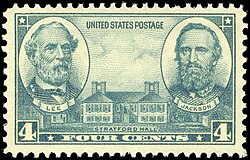 Robert E. Lee, Stonewall Jackson and Stratford Hall, Army Issue of 1936
 -
![Portrait on the 1864 Confederate $500 banknote; Jackson was the only general featured on Confederate currency[107]](//upload.wikimedia.org/wikipedia/commons/thumb/5/52/CSA-T64-%24500-1864.jpg/250px-CSA-T64-%24500-1864.jpg) Portrait on the 1864 Confederate $500 banknote; Jackson was the only general featured on Confederate currency[107]
Portrait on the 1864 Confederate $500 banknote; Jackson was the only general featured on Confederate currency[107] -
 The 1863 sheet music The Stonewall Brigade, Dedicated to the Memory of Stonewall Jackson, the Immortal Southern Hero, and His Brave Veterans
 -
 Jackson on an 1863 Confederate loan
 -
 Davis, Lee, and Jackson on Stone Mountain
 -
 The Thomas Jonathan Jackson sculpture in downtown Charlottesville, Virginia
 -
 Statue of Jackson in downtown Clarksburg, West Virginia
 -
 Bust of Jackson at the Washington-Wilkes Historical Museum
 -
 The Stonewall Jackson Monument in Richmond, Virginia being removed in 2020
 -
![Jackson reading the Bible in a Confederate camp in a stained glass window of the Washington National Cathedral. The windows were removed in 2017.[108]](//upload.wikimedia.org/wikipedia/commons/thumb/e/e8/Stonewall_Jackson_with_the_flag_of_the_Confederate_States_in_art_in_a_stained_glass_window_of_the_Washington_National_Cathedral_detail%2C_from-_Stonewall_Jackson_Stain_Glass_%28cropped%29.JPG/120px-thumbnail.jpg) Jackson reading the Bible in a Confederate camp in a stained glass window of the Washington National Cathedral. The windows were removed in 2017.[108]
Jackson reading the Bible in a Confederate camp in a stained glass window of the Washington National Cathedral. The windows were removed in 2017.[108]

![Portrait on the 1864 Confederate $500 banknote; Jackson was the only general featured on Confederate currency[107]](https://en.wikipedia.org/wiki/File:CSA-T64-$500-1864.jpg)


_in_2019,_from-_19-13-031-museum_(cropped).jpg)

![Jackson reading the Bible in a Confederate camp in a stained glass window of the Washington National Cathedral. The windows were removed in 2017.[108]](https://en.wikipedia.org/wiki/File:Stonewall_Jackson_with_the_flag_of_the_Confederate_States_in_art_in_a_stained_glass_window_of_the_Washington_National_Cathedral_detail,_from-_Stonewall_Jackson_Stain_Glass_(cropped).JPG)
See also
[edit]


- William B. Ebbert, 1st Lt., W. Virginia Infantry, Union Army. (1923 quote recalling battle of Winchester, March 1862)
- List of American Civil War generals (Confederate)
- Stonewall Jackson's Headquarters Museum
- List of memorials to Stonewall Jackson
- Stonewall Jackson's arm
- Removal of Confederate monuments and memorials
- Stonewall Brigade
Notes
[edit]- ^ Eicher, High Commands, p. 316; Robertson, p. 7. The physician, Dr. James McCally, recalls delivering baby Thomas on January 20, 1809, just before midnight, but the family has insisted since then that he was born in the first minutes of January 21. The later date is the one generally acknowledged in biographies.
- ^ James I. Robertson, Stonewall Jackson: The Man, the Soldier, the Legend (1997).
- ^ Hamner, Christopher. "The Possible Path of Barnard Bee." Teachinghistory.org. Accessed July 12, 2011.
- ^ "Stonewall Jackson Timeline". Virginia Military Institute. Retrieved December 11, 2023.
- ^ a b Wallace Hettle, Inventing Stonewall Jackson: A Civil War Hero in History and Memory (Louisiana State University Press, 2011)
- ^ Farwell, p. xi, states that the overwhelmingly common usage of the middle name Jonathan was never documented and that Jackson did not acknowledge it; he instead used the signature form "T. J. Jackson." Robertson, p. 19, states that a county document on February 28, 1841, was the first recorded instance of Jackson's using a middle initial, although "whether it stood for his father Jonathan's name is not known." All of the other references to this article cite his full name as Thomas Jonathan Jackson.
- ^ Robertson, pp. 1–2.
- ^ Robertson, pp. 2–3.
- ^ Edward's second son was David Edward Jackson. Talbot, Vivian Linford (1996). David E. Jackson: Field Captain of the Rocky Mountain Fur Trade. Jackson Hole: Jackson Hole Historical Society and Museum. p. 17.
- ^ VMI Jackson genealogy site; Robertson, p. 4.
- ^ Talbot, op. cit., p. 18
- ^ "Jackson Family Genealogy". Virginia Military Institute. Retrieved September 4, 2018.
- ^ "Was Stonewall Jackson born in Parkersburg? – NewsandSentinel.com | News, Sports, Jobs, Community Information – Parkersburg News and Sentinel". NewsandSentinel.com. Retrieved September 12, 2013.
- ^ Robertson, p. 7.
- ^ Robertson, p. 8.
- ^ Robertson, p. 10.
- ^ Robertson, pp. 9–16. Robertson refers to multiple bachelor uncles in residence at the mill, but does not name them.
- ^ Robertson, p. 17.
- ^ "Laura Jackson Arnold: Sister of General Thomas Jonathan Stonewall Jackon". Civil War Women Blog. November 29, 2010. Archived from the original on December 23, 2010. Retrieved June 24, 2015.
- ^ a b George Cullum. "Register of Officers and Graduates of the United States Military Academy Class of 1846". Retrieved November 1, 2014.
- ^ Henderson, George Francis Robert (1898). Stonewall Jackson and the American Civil War (1st ed.). Longmans, Green and Company. p. 69.
- ^ Robertson, p. 69.
- ^ Eiedson, George T. (June 13, 1993). "Before He Was 'Stonewall,' Jackson Served in Florida". Orlando Sentinel. Retrieved August 8, 2016.
- ^ Gwynne, S. C. Rebel Yell: The Violence, Passion, and Redemption of Stonewall Jackson. New York: Scribner, 2014, pp. 110–18.
- ^ Robertson, pp. 108–10. He left the Army on March 21, 1851, but stayed on the rolls, officially on furlough, for nine months. His resignation took effect formally on February 2, 1852, and he joined the VMI faculty in August 1851.
- ^ Eggleston, George Cary (1875). A Rebel's Recollections. Putnam. p. 152.
- ^ Vandiver, Frank E. (1989). Mighty Stonewall. Texas A&M University Press. p. 77. ISBN 9780890963913.
- ^ "Stonewall Jackson – Frequently Asked Questions – VMI Archives". Virginia Military Institute Archives. 2001. Archived from the original on December 31, 2006. Retrieved September 7, 2015.
- ^ Johnson, Clint (2002). In the Footsteps of Stonewall Jackson. Winston-Salem, North Carolina: John F. Blair. p. 122. ISBN 0-89587-244-7.
- ^ Chisholm, Hugh (1910). The Encyclopaedia Britannica : a dictionary of arts, sciences, literature and general information. Internet Archive. New York: Encyclopaedia Britannica. p. 110.
- ^ Graham, Chris (October 12, 2017). "Myths & Misunderstandings: Stonewall Jackson's Sunday School". American Civil War Museum. Retrieved September 20, 2025.
- ^ Jackson, Mary Anna, 1895, p. 78
- ^ Robertson, p. 169.
- ^ Knadler, Jessie (May 15, 2018). "New Research Sheds Light On Slaves Owned By Stonewall Jackson". www.wvtf.org. Retrieved July 1, 2020.
- ^ Spurgeon, pp. 4-5
- ^ Spurgeon, pp. 5-8
- ^ Robertson, pp. 191–92.
- ^ Palmer, Brian; Wessler, Seth Freed (December 2018). "The Costs of the Confederacy". Smithsonian Magazine. Retrieved December 5, 2018.
- ^ Hettle, Wallace. Inventing Stonewall Jackson. Baton Rouge: Louisiana State University Press. p. 71. ISBN 978-0-8071-3781-9.
- ^ Jackson, p. 152
- ^ Hettle, p. 85.
- ^ Robertson, p. 191.
- ^ Spurgeon, Larry (2018). "Stonewall Jackson's Slaves" (PDF). Rockbridge History. Retrieved September 20, 2025.
- ^ Hettle, pp. 83-85.
- ^ Hettle, p. 72
- ^ Spurgeon, pp. 18-20
- ^ Rossino, Alexander (2021). Their Maryland: The Army of Northern Virginia From the Potomac Crossing to Sharpsburg in September 1862. Savas Beatle. p. 274-277. ISBN 9781611215588.
- ^ Isbell, Sherman. "Archibald Alexander Travelogue". Archived from the original on September 14, 2005. Retrieved December 17, 2008.
- ^ Robertson, p. 157.
- ^ Snell, Mark A., West Virginia and the Civil War, History Press, 2011, pg.45
- ^ a b Eicher, High Commands, p. 316.
- ^ Freeman, Lee's Lieutenants, vol. 1, p. 82; Robertson, p. 264. McPherson, p. 342, reports the quotation after "stone wall" as being "Rally around the Virginians!"
- ^ See, for instance, Goldfield, David, et al., The American Journey: A History of the United States, Prentice Hall, 1999, ISBN 0-13-088243-7. There are additional controversies about what Bee said and whether he said anything at all. See Freeman, Lee's Lieutenants, vol. 1, pp. 733–34.
- ^ McPherson, p. 342.
- ^ Robertson, pp. 263, 268.
- ^ See, for instance, Freeman, R.E. Lee, vol. 2, p. 247.
- ^ Henderson, George Francis Robert (1903). Stonewall Jackson and the American Civil War. Vol. II. New York: Longmans, Green. p. 17. OCLC 793450187.
- ^ Wert, p. 206.
- ^ "Origin of the Movement Around Pope's Army of Virginia, August 1862 by Michael Collie. Retrieved September 27, 2017 [1] and Archie P. McDonald, ed., Make Me a Map of the Valley: the Civil War Journal of Jackson's Topographer, (Dallas 1973) pp. 117–18; and James I. Robertson, Jr., Stonewall Jackson: the Man, the Soldier, and the Legend, (New York 1997) p. 547, n130 p. 887
- ^ Robertson, p. 645.
- ^ Robertson, p. 630.
- ^ Foote, Shelby, The Civil War: A Narrative, Vol. 2
- ^ Apperson, p. 430.
- ^ Robertson, p. 739
- ^ McGuire, pp. 162–63.
- ^ Grieve, Taylor Nicole (2013). Objective Analysis of Toolmarks in Forensics (MS thesis thesis). Iowa State University. p. 6. hdl:20.500.12876/27203. Archived from the original on May 1, 2019.
- ^ Sorensen, James. "Stonewall Jackson's Arm Archived January 15, 2012, at the Wayback Machine" American Heritage, April/May 2005.
- ^ jackson, mary (1895). "Memoirs of Stonewall Jackson by his widow, Mary Anna Jackson".
- ^ Robertson, p. 746.
- ^ Hall, Kenneth (2005). Stonewall Jackson and religious faith in military command. McFarland. ISBN 978-0786420858.
- ^ "Death of Stonewall Jackson", Harpers Weekly, May 23, 1863
- ^ "Stonewall Jackson: Popular Questions". Virginia Military Institute. Retrieved May 6, 2009.
- ^ "Stonewall Jackson's Way". Retrieved December 24, 2011.
- ^ Gareth Atkins, review of Evangelicals in the Royal Navy, 1775–1815: Blue Lights and Psalm-Singers by Richard Blake (review no. 799). Retrieved December 24, 2011, at www.history.ac.uk/reviews/review/799
- ^ Cartmell, Donald (2001). "The Legend of Stonewall". The Civil War Book of Lists. Franklin Lakes, New Jersey: The Career Press Inc. pp. 187–92. ISBN 1-56414-504-2.
- ^ Samaritan Medical Center (September 2008). "Stonewall Jackson and the Henderson Hydropath". in Samaritan Medical Center Newsletter (PDF). Vol. 42. Archived from the original (PDF) on August 7, 2020. Retrieved December 13, 2009.
- ^ Taylor, p. 50
- ^ Robertson, p. xi.
- ^ Dabney, Robert L. "True Courage: A Memorial Sermon for General Thomas J. "Stone-wall Jackson" (PDF). Retrieved February 26, 2013.
- ^ Selby, John Millin (2000). Stonewall Jackson As Military Commander. p. 25.
- ^ Sears, Stephen W. (March 16, 1997). "Onward, Christian Soldier". The New York Times. Retrieved February 26, 2013.
- ^ White, Davin (October 15, 2010). "Stonewall Jackson biographer says religion drove Civil War general". The Charleston Gazette. Archived from the original on April 12, 2013. Retrieved February 26, 2013.
- ^ Duewel, Wesley L. (2010). Revival Fire. Zondervan. p. 128. ISBN 978-0310877097.
- ^ Summers, Mark. "The Great Harvest: Revival in the Confederate Army during the Civil War". Religion & Liberty. 21 (3). Retrieved February 26, 2013.
- ^ Robertson, James I. "Stonewall Jackson: Christian Soldier" (PDF). Virginia Center for Civil War Studies. Archived from the original (PDF) on September 28, 2013. Retrieved February 26, 2013.
- ^ Robertson, p. xiv.
- ^ Pfanz, p. 344; Eicher, Longest Night, p. 517; Sears, p. 228; Trudeau, p. 253. Both Sears and Trudeau record "if possible".
- ^ Robertson, p. 499.
- ^ Robertson, p. 230.
- ^ "Little Sorrel, Connecticut's Confederate War Horse". ConnecticutHistory.org. Retrieved September 12, 2013.
- ^ "Little Sorrel Buried at VMI July 20, 1997" Archived October 20, 2016, at the Wayback Machine; Robertson, p. 922, n. 16.
- ^ Jackson, Mary Anna, Jackson Memoirs, 1895
- ^ "Stonewall Jackson FAQ – Virginia Military Institute Archives". www.vmi.edu. Retrieved January 5, 2020.
- ^ See, for instance, Sears, Gettysburg, pp. 233–34. Alternative theories about Gettysburg are prominent ideas in the literature about the Lost Cause.
- ^ Robert H. Patton, The Pattons: A Personal History of an American Family (New York: Crown Publishers, 1994), 90.
- ^ Matthew F. Holland (2001). Eisenhower Between the Wars: The Making of a General and Statesman. Greenwood Publishing Group. pp. 98–. ISBN 978-0-275-96340-8.
- ^ Major Matthew H. Fath (2015). Eichelberger – Intrepidity, Iron Will, And Intellect: General Robert L. Eichelberger And Military Genius. Verdun Press. pp. 21–. ISBN 978-1-78625-238-8.
- ^ Major Mickey L. Quintrall USAF (2015). The Chesty Puller Paragon: Leadership Dogma Or Model Doctrine?. Lucknow Books. pp. 18–. ISBN 978-1-78625-075-9.
- ^ "Thomas Jonathan Christian Jackson Christian Jr: American Air Museum in Britain".
- ^ a b Farwell, 1993, p. 513
- ^ Horwitz, 1999, p. 232
- ^ Vozzella, Laura (January 21, 2020). "Virginia Senate votes to eliminate Lee-Jackson Day, create new Election Day holiday". Washington Post. Retrieved January 23, 2020.
- ^ Virginia General Assembly SB 601 Legal holidays; Election Day
- ^ "General Thomas J. (Stonewall) Jackson Equestrian, (sculpture)". Smithsonian Institution. Retrieved July 1, 2020.
- ^ Times-Dispatch, MARK ROBINSON Richmond (July 2020). "UPDATE: Crews on scene preparing for removal of Jackson statue on Monument Avenue". Richmond Times-Dispatch. Retrieved July 1, 2020.
- ^ "Stonewall Jackson removed from Richmond's Monument Avenue". AP NEWS. July 1, 2020. Retrieved August 22, 2020.
- ^ Levin, Kevin M. (April 21, 2016). "When Dixie Put Slaves on the Money". The Daily Beast. Retrieved August 24, 2023.
- ^ Boorstein, Michelle (September 6, 2017). "Washington National Cathedral to remove stained glass windows honoring Robert E. Lee, Stonewall Jackson". The Washington Post.
References
[edit]- Alexander, Bevin. Lost Victories: The Military Genius of Stonewall Jackson. New York: Holt, 1992, ISBN 978-0-8050-1830-1.
- Apperson, John Samuel. Repairing the "March of Mars": The Civil War diaries of John Samuel Apperson, hospital steward in the Stonewall Brigade, 1861–1865. Macon, GA: Mercer University Press, 2001. ISBN 0-86554-779-3.
- Bryson, Bill. A Walk in the Woods. New York: Broadway Books, 1998. ISBN 0-7679-0251-3.
- Cleary, Ben. Searching for Stonewall Jackson: A Quest for Legacy in a Divided America, 2019. Description and arrow-searchable & scrollable preview. Reviews at Kirkus & Publishers Weekly. Grand Central Publishing.
- Eicher, David J. The Longest Night: A Military History of the Civil War. New York: Simon & Schuster, 2001. ISBN 978-0-684-84944-7.
- Eicher, John H., and David J. Eicher. Civil War High Commands. Stanford, California: Stanford University Press, 2001. ISBN 978-0-8047-3641-1.
- Farwell, Byron. Stonewall: A Biography of General Thomas J. Jackson. New York: W. W. Norton and Co., 1993. ISBN 978-0-393-31086-3.
- Freeman, Douglas S. Lee's Lieutenants: A Study in Command. 3 vols. New York: Scribner, 1946. ISBN 978-0-684-85979-8.
- Freeman, Douglas S. R. E. Lee, A Biography. 4 vols. New York: Charles Scribner's Sons, 1934–35. ISBN 978-0-684-15485-5.
- Henderson, G. F. R. Stonewall Jackson and the American Civil War. New York: Smithmark, 1995. ISBN 0-8317-3288-1. First published in 1898 by Longman, Greens, and Co. (The 1900 version has an introduction by Field Marshal Viscount Wolseley.)
- Hettle, Wallace. Inventing Stonewall Jackson: A Civil War Hero in History and Memory (Louisiana State University Press, 2011)
- Jackson, Mary Anna (1895). Memoirs of Stonewall Jackson. Louisville, Ky. : Prentice Press, Courier-Journal job Print. Co.
- Johnson, Robert Underwood, and Clarence C. Buel, eds. Battles and Leaders of the Civil War Archived December 12, 2008, at the Wayback Machine. 4 vols. New York: Century Co., 1884–1888. OCLC 2048818.
- McGuire, Hunter. "Death of Stonewall Jackson". Southern Historical Society Papers 14 (1886).
- McPherson, James M. Battle Cry of Freedom: The Civil War Era. Oxford History of the United States. New York: Oxford University Press, 1988. ISBN 978-0-19-503863-7.
- Pfanz, Harry W. Gettysburg – The First Day. Chapel Hill: University of North Carolina Press, 2001. ISBN 978-0-8078-2624-9.
- Robertson, James I., Jr. Stonewall Jackson: The Man, The Soldier, The Legend. New York: Macmillan Publishing, 1997. ISBN 0-02-864685-1.
- Sears, Stephen W. Gettysburg. Boston: Houghton Mifflin, 2003. ISBN 978-0-395-86761-7.
- Sharlet, Jeff. "Through a Glass, Darkly: How the Christian Right is Reimagining U.S. History." Harpers, December 2006.
- Taylor, Richard. Destruction and Reconstruction: Personal Experiences of the Late War. Nashville, Tennessee: J.S. Sanders & Co., 2001. ISBN 1-879941-21-X. First published 1879 by D. Appleton.
- Trudeau, Noah Andre. Gettysburg: A Testing of Courage. New York: HarperCollins, 2002. ISBN 978-0-06-019363-8.
- Wert, Jeffry D. General James Longstreet: The Confederacy's Most Controversial Soldier: A Biography. New York: Simon & Schuster, 1993. ISBN 978-0-671-70921-1.
- Jackson genealogy site at Virginia Military Institute
Further reading
[edit]- Austin, Aurelia (1967). Georgia boys with "Stonewall" Jackson: James Thomas Thompson and the Walton Infantry. Athens: University of Georgia Press. ISBN 978-0820335230. Retrieved February 20, 2018.
- Chambers, Lenoir. Stonewall Jackson. New York: Morrow, 1959. OCLC 186539122.
- Cooke, John Esten; Hoge, Moses Drury; Jones, John William (1876). Stonewall Jackson: A Military Biography. New York: D. Appleton and Company. OCLC 299589.
- Cozzens, Peter. Shenandoah 1862: Stonewall Jackson's Valley Campaign. Chapel Hill: University of North Carolina Press, 2008. ISBN 978-0-8078-3200-4.
- Dabney, R. L. Life of Lieut.-Gen. Thomas J. Jackson (Stonewall Jackson). London: James Nisbet and Co., 1866. OCLC 457442354.
- Douglas, Henry Kyd. I Rode with Stonewall: The War Experiences of the Youngest Member of Jackson's Staff. Chapel Hill: University of North Carolina Press, 1940. ISBN 0-8078-0337-5.
- Gwynne, S. C. Rebel Yell: The Violence, Passion, and Redemption of Stonewall Jackson. New York: Simon & Schuster, 2014. ISBN 978-1-4516-7328-9.
- King, Benjamin. A Bullet for Stonewall, Pelican Publishing Company, 1990,. ISBN 0882897683.
- Lively, Mathew W. Calamity at Chancellorsville: The Wounding and Death of Confederate General Stonewall Jackson. El Dorado Hills, California: Savas Beatie, 2013. ISBN 978-1-61121-138-2.
- Mackowski, Chris, and Kristopher D. White. The Last Days of Stonewall Jackson: The Mortal Wounding of the Confederacy's Greatest Icon. El Dorado Hills, California: Savas Beatie, 2013. ISBN 978-1-61121-150-4.
- Randolph, Sarah N. (1876). The Life of General Thomas J. Jackson. Lippincott & Co.
- Robertson, James I., Jr. Stonewall Jackson's Book of Maxims. Nashville, Tennessee: Cumberland House, 2002. ISBN 1-58182-296-0.
- Shackel, Paul A. Archaeology and Created Memory: Public History in a National Park. New York: Kluwer Academic/Plenum Publishers, 2000. ISBN 978-0-306-46177-4.
- White, Henry A. Stonewall Jackson. Philadelphia: G.W. Jacobs and Co., 1909. OCLC 3911913.
- Wilkins, J. Steven. All Things for Good: The Steadfast Fidelity of Stonewall Jackson. Nashville, Tennessee: Cumberland House Publishing, 2004. ISBN 1-58182-225-1.
External links
[edit]


- Virginia Military Institute Archives Stonewall Jackson Resources
- before-death-on-maryland Stonewall Jackson Original Letter as Lieutenant General, Near Fredericksburg, 1863 Archived February 1, 2014, at the Wayback Machine Shapell Manuscript Foundation
- Jackson genealogy site
- "Death of 'Stonewall' Jackson" Archived July 20, 2011, at the Wayback Machine, Southern Confederacy, May 12, 1863. Atlanta Historic Newspapers Archive. Digital Library of Georgia.
- Fitzhugh Lee's 1879 address on Chancellorsville
- The Stonewall Jackson House
- Animated history of the campaigns of Stonewall Jackson Archived December 4, 2014, at the Wayback Machine
- Details on John Jackson's larceny trial in the Court Records of the Old Bailey
- Stonewall Jackson's Headquarters, Winchester, VA
- Guinea Station, the place where Thomas Jackson died


.jpg)

| Leadership | | |
|---|---|---|
| Mexican–American War | ||
| American Civil War raids and expeditions | ||
| American Civil War battles and campaigns | ||
| Historic items | ||
| Works about |
| |
| Related | ||


Stonewall Jackson
View on GrokipediaEarly Life and Family Background
Ancestry and Childhood Hardships
Thomas Jonathan Jackson descended from Scotch-Irish Presbyterians who emigrated from Ulster to the American colonies in the early 18th century. His great-grandfather John Jackson settled on the Virginia frontier after arriving from Ireland around 1732, establishing a lineage of farmers and attorneys in the region.[7][8] Jackson was born on January 21, 1824, in Clarksburg, Virginia (present-day West Virginia), the third child of attorney Jonathan Jackson (1790–1826) and Julia Beckwith Neale (1798–1831). His siblings included older brother Jonathan Warren Jackson (1821–1841) and younger sister Laura Ann Jackson (born March 27, 1826).[9][10][11] Jackson's father died on March 26, 1826, at age 36, likely from typhoid fever contracted while nursing a family member, leaving the family in financial distress due to Jonathan's failed investments and legal practice struggles. Thomas, then two years old, faced immediate poverty as his widowed mother relocated the children to a smaller home and attempted to sustain them through sewing and tutoring. Julia remarried Blake Baker Woodson, a widowed farmer nearly 30 years her senior, on November 4, 1830, but the union exacerbated tensions, as Woodson showed reluctance to support her children amid ongoing economic hardship.[12][10][13] Julia died on December 3, 1831, at age 33, possibly from complications related to illness or recent childbirth, orphaning seven-year-old Thomas and his siblings. Woodson, unwilling or unable to care for the children, arranged for their separation: Thomas and Laura were sent to paternal relatives, while Warren went to maternal kin. Thomas, aged seven, was placed with his half-uncle Cummins Edward Jackson (1802–1849), who operated a gristmill and farm at Jackson's Mill in present-day Lewis County, West Virginia. Cummins provided basic shelter but enforced strict discipline, requiring Thomas to perform demanding manual labor including farm work, sheep herding with the aid of a dog, and mill operations.[1][9][14] These years instilled resilience amid persistent hardships: familial instability, with separation from siblings (Warren died of tuberculosis in 1841); economic privation that limited access to formal schooling until age 13; and physical toil that built endurance but hindered early intellectual development. Largely self-taught through borrowed books and sporadic attendance at local schools taught by Cummins, young Jackson exhibited determination, compensating for educational deficits through rigorous self-discipline that foreshadowed his later military precision.[10][5][15]Education and Formative Experiences
Thomas Jonathan Jackson experienced significant family loss in his early childhood, with his father dying in 1826 when Jackson was two years old and his mother passing away in 1830 when he was six.[10] Following these tragedies, he and his siblings were raised by their uncle, Cummins E. Jackson, at Jackson's Mill near Weston in what was then Virginia.[16] There, Jackson performed demanding physical labor, including hauling heavy grain sacks up a steep hill to the mill, driving oxen teams, and herding sheep, which contributed to his robust physique and enduring stamina.[17][18] Jackson's formal education was limited and intermittent, as farm and mill duties took precedence over schooling; he did not begin attending local classes until around age thirteen and progressed slowly due to frequent absences.[1] To supplement this, he pursued self-directed study, learning to read and committing subjects to memory through intense concentration, often reading by the light of burning pine knots late into the night.[19][20] Despite his rudimentary background, by his late teens, Jackson secured a position teaching at a neighborhood school near Jackson's Mill around 1841, relying on earnest effort and borrowed textbooks to instruct pupils in basic subjects.[21][16] These formative years of hardship, manual toil, and determined self-improvement cultivated Jackson's renowned discipline, resilience, and methodical approach to learning, traits that later distinguished his academic performance at West Point and military leadership.[10][5] He also began teaching literacy to enslaved individuals during this period, reflecting an early commitment to education amid his constrained circumstances.[17]Military Education and Pre-Civil War Service
West Point and Mexican-American War
Thomas Jonathan Jackson entered the United States Military Academy at West Point in July 1842, securing an appointment as a congressional nominee after the death of the original selectee from his district. Lacking prior formal education beyond basic schooling, he initially struggled with the curriculum, relying on rote memorization of textbooks and persistent questioning of instructors despite accumulating demerits for disciplinary issues. Through determination and self-study, he improved markedly, graduating 17th in general merit out of a class of 59 on July 1, 1846—just as the Mexican-American War commenced.[22][23][10] Commissioned as a brevet second lieutenant in the 1st U.S. Artillery Regiment upon graduation, Jackson was promptly assigned to General Winfield Scott's army for the invasion of Mexico. He participated in the advance from Veracruz to Mexico City, serving as an artillery officer in engagements such as Cerro Gordo, Contreras, Churubusco, and Chapultepec. His performance under fire drew commendations for bravery and tactical acumen; at Contreras and Churubusco on August 19–20, 1847, Jackson refused orders to retreat his exposed battery, holding position until reinforced, which contributed to Union victories and earned him brevets to first lieutenant and captain. For overall gallantry in the campaign, he received a brevet promotion to major by the war's end in 1848.[23][10][16]Service in the U.S. Army and Early Recognition
Following the Mexican-American War, Thomas J. Jackson served in routine garrison duties with the 1st U.S. Artillery. Initially assigned to posts in Florida, including isolated Fort Meade east of Tampa, he encountered tensions with his commanding officer, Major William H. French, over matters of discipline and authority. From 1849 to 1851, Jackson was stationed at Fort Hamilton in New York Harbor, where he acted as quartermaster and provided instruction in artillery tactics to fellow officers and recruits.[24][25] Jackson's early military recognition stemmed primarily from his conduct during the Mexican-American War, where he demonstrated exceptional bravery under fire. At the Battles of Contreras and Churubusco on August 19–20, 1847, he commanded a section of artillery with cool determination, earning a brevet promotion to first lieutenant on August 20, 1847. During the storming of Chapultepec on September 13, 1847, Jackson positioned two cannons on an exposed causeway and maintained fire against intense Mexican resistance, supporting the infantry assault and receiving a brevet promotion to captain for his gallantry.[16][26] These battlefield brevets highlighted Jackson's competence as an artillery officer, though his peacetime service offered little further advancement or excitement, leading him to view regular army life as stagnant. Holding the regular rank of first lieutenant with brevet captain status, Jackson resigned his U.S. Army commission in early 1851, seeking greater purpose and stability in civilian instruction.[23][27]Civilian Career at VMI
Professorship and Teaching Methods
In 1851, Thomas J. Jackson resigned his commission as a first lieutenant in the U.S. Army and accepted an appointment as professor of natural and experimental philosophy—encompassing physics, astronomy, optics, and mechanics—and instructor of artillery tactics at the Virginia Military Institute (VMI) in Lexington, Virginia.[10][28] He served in this dual role continuously until April 1861, when Virginia's secession prompted his entry into Confederate service, during which time he instructed successive classes of approximately 200 cadets annually.[29] Jackson lacked prior formal teaching experience beyond his West Point education, yet VMI selected him for the position due to his military background and self-study in scientific texts acquired during his army postings.[30] Jackson's classroom pedagogy emphasized rote memorization and recitation, methods rooted in his own autodidactic habits but ill-suited to engaging cadets. He prepared lectures by committing textbook passages to memory, then delivered them verbatim in a deliberate, unvarying monotone often described as a "West Point drawl," with minimal elaboration, questioning, or adaptation to student incomprehension.[31][32] This rigidity frustrated learners; cadets frequently disrupted classes with mimicry or absenteeism, and demerits for tardiness or inattention were common under his strict enforcement of VMI's merit-demerit system, which tracked daily conduct numerically.[33] The natural philosophy curriculum, drawn from standard works like Olmsted's Natural Philosophy, proved especially demanding, covering advanced topics with scant remedial support, leading to high failure rates and cadet complaints that Jackson prioritized textual fidelity over comprehension.[34] In artillery instruction, however, Jackson excelled through hands-on application, commanding the VMI Cadet Battery—a unit of six brass field pieces manned by students—for drills on the institute's grounds and nearby fields.[28] He stressed precision in gunnery, alignment, and rapid deployment, drawing on Mexican-American War experience to simulate combat scenarios, which cadets found more palatable and effective than his philosophical lectures.[28] This practical focus foreshadowed his wartime proficiency, as evidenced by the battery's performance in early Confederate actions. Despite overall pedagogical shortcomings—VMI's superintendent reportedly contemplated his dismissal by 1860 for ineffectiveness—Jackson's unyielding discipline and personal rectitude commanded eventual respect; one cadet observed that while his teaching was intolerable, he would follow Jackson into battle without hesitation.[35][36]Involvement with Slavery and Social Views
Thomas Jonathan Jackson owned at least seven enslaved people during his residence in Lexington, Virginia, as documented in census records, estate inventories, and contemporary accounts.[37] These included individuals acquired through his 1857 marriage to Mary Anna Morrison, whose father provided Hetty (born circa 1819), her sons Cyrus (born 1843) and George (born 1845), and another named Ann, who was sold in 1859.[37] Jackson himself purchased Albert, who later self-emancipated by buying his freedom; Amy, to prevent her sale for debt; and Emma (born circa 1856), a young child acquired in 1860 as a gift for his wife.[37] He also hired out enslaved individuals, such as Albert to the Virginia Military Institute in 1860.[38] Jackson's treatment of those he enslaved emphasized religious instruction and provision of care, though within a framework of strict discipline reflective of his personal habits.[37] He required his six enslaved household members—Hetty, Cyrus, George, Albert, Amy, and Emma—to attend religious services and provided them with education in scripture.[39] Accounts from associates described him as kind yet firm, prioritizing their spiritual welfare over manumission.[30] Some enslaved individuals reportedly requested that Jackson purchase them following the deaths of prior owners, indicating perceived relative benevolence compared to alternatives in the system.[30] Jackson regarded slavery as divinely sanctioned by biblical precedent and the Creator's order, accepting it as an unchallengeable institution while advocating paternalistic Christian treatment of the enslaved.[37] He expressed a personal preference for the freedom of Black people but subordinated this to theological convictions that the Bible endorsed slavery, viewing it as God's will typical of many white Southern Presbyterians of the era.[37] This perspective aligned with proslavery theology, which emphasized white responsibility to evangelize and civilize enslaved people under racial hierarchy, rather than challenging the institution itself.[40] In 1855, Jackson established and led a Sunday school at Lexington Presbyterian Church specifically for enslaved and free Black people, attracting 80 to 100 attendees weekly in a dedicated room adjacent to the sanctuary.[39] Sessions focused on Bible study, effectively teaching literacy despite Virginia statutes prohibiting the education of enslaved individuals, which carried legal risks post-Nat Turner's 1831 rebellion.[40] Motivated by evangelical duty to fulfill the Great Commission—"make disciples of all nations"—Jackson financially supported the program even during military campaigns, sending funds after the First Battle of Manassas in 1861.[39] The initiative fit within broader Southern "missions to the slaves," such as those promoted by Charles Colcock Jones, aiming to instill obedience and reinforce slavery's moral legitimacy through supervised Christianity, not to promote emancipation or equality.[40] Postwar, former attendees credited the school with enabling them to establish independent Black congregations.[39]Response to John Brown's Raid
Following John Brown's failed attempt to seize the federal arsenal at Harpers Ferry, Virginia, on October 16–18, 1859, Virginia Governor Henry A. Wise deployed state militia units, including cadets from the Virginia Military Institute (VMI), to maintain order in the area and secure the execution of Brown and his co-conspirators.[41] As a major and professor of natural philosophy and artillery tactics at VMI, Thomas J. Jackson was assigned to command the cadet artillery section, consisting of two howitzers operated by 21 cadets, during this deployment.[42] On November 25, 1859, Jackson led a contingent of approximately 150 VMI cadets from Lexington to Harpers Ferry, where they assisted in suppressing potential unrest from abolitionist sympathizers and drilling local volunteers.[28] The cadets, under Jackson's oversight, marched an additional 18 miles to Charles Town for heightened security around Brown's trial and scheduled hanging on December 2, 1859.[43] Jackson positioned the cadet battery on a hill overlooking the gallows, ensuring artillery support amid fears of rescue attempts by Brown's supporters, while the cadets formed part of the guard detail alongside regular troops.[44] During the execution, Jackson observed Brown ascend the scaffold with composure, later writing to his aunt that Brown exhibited "unflinching firmness" throughout the proceedings and expressing hope that Brown might find divine forgiveness for his "treasonable" actions against Virginia.[45] This deployment marked one of Jackson's early commands involving VMI forces in a crisis tied to sectional tensions over slavery, highlighting his role in enforcing state authority without recorded personal commentary on the raid's ideological motivations beyond his post-execution letter.[10] Jackson's leadership emphasized discipline; he enforced strict marching order and religious observances among the cadets, including halting for prayer during the journey, consistent with his personal piety.[9] The VMI contingent's presence underscored institutional support for Virginia's pro-slavery stance, as the raid had inflamed Southern fears of servile insurrection, though Jackson's direct actions focused on logistical and tactical execution rather than public advocacy.[46] Upon return to Lexington in mid-December, Jackson resumed teaching duties, with the experience reinforcing his reputation for methodical command among VMI superiors.[43]Personal Life and Character
Marriages, Family, and Domestic Life
Thomas Jonathan Jackson married Elinor "Ellie" Junkin on August 4, 1853, in Rockbridge County, Virginia; she was the daughter of Presbyterian minister George Junkin.[47] Their courtship began through church connections in Lexington, Virginia, where Jackson visited her family. Elinor died on October 22, 1854, at age 29, from complications following the stillbirth of their child, leaving no surviving offspring.[48] [49] Jackson's second marriage occurred on July 16, 1857, to Mary Anna Morrison at her family's plantation, Cottage Home, in Lincoln County, North Carolina; she was the daughter of Presbyterian clergyman Robert Hall Morrison.[50] The couple had two daughters: Mary Graham, born in 1858 and deceased shortly thereafter, and Julia Laura, born November 23, 1862, in North Carolina, who lived until August 30, 1889.[10] Mary Anna outlived Jackson by over 50 years, dying in 1915, and managed family affairs amid wartime displacements.[51] In domestic life, Jackson maintained a highly disciplined routine in their Lexington, Virginia, home, rising around 6:00 a.m. for private prayer followed by a cold bath, emphasizing punctuality, frugality, and religious observance in family matters.[52] The household reflected his austere character, with structured mealtimes and Bible readings; he owned a brick residence on Market Street, purchased after his second marriage, where he resided until departing for Confederate service in 1861, after which Mary Anna and Julia relocated to relatives in North Carolina for safety.[10]Religious Faith and Daily Practices
Thomas Jonathan Jackson, known as Stonewall Jackson, was a devout adherent of the Presbyterian faith, joining the Lexington Presbyterian Church upon his arrival at the Virginia Military Institute in 1851 after exploring Methodist, Baptist, Episcopal, and Catholic congregations without finding spiritual satisfaction.[30] His religious commitment deepened following his marriage to Mary Anna Morrison in 1857, during which he made a public profession of faith in Christ, acknowledging prior ignorance of doctrinal truths and approaching Christianity with simplicity.[53] As a deacon in the Old School Presbyterian Church, Jackson emphasized predestination and divine sovereignty, viewing his military successes as providential outcomes rather than personal achievements.[54] He regularly attended services, tithed consistently, and distributed religious tracts to soldiers, integrating faith into his command by ordering thanksgiving services after victories and encouraging chaplains' roles in camp worship.[55][56] Jackson's daily practices reflected rigorous piety, including habitual prayer throughout the day—before meals, upon drinking water, opening or mailing letters, and entering classrooms or battlefields—as a refuge and source of strength.[30] He maintained daily Bible reading as a core discipline, often rising early for personal devotion, and participated in Wednesday prayer meetings and hymn sings when possible.[55][57] In Lexington, he founded and taught a Sunday school class for free blacks and enslaved individuals, persisting despite local opposition and potential legal risks for promoting literacy among the latter, demonstrating his commitment to evangelism across racial lines.[40][10] His observance of the Sabbath was particularly stringent; Jackson refrained from worldly activities on Sundays, such as reading secular letters or conducting non-essential travel, believing the day should be reserved solely for worship and rest to honor divine command and secure national blessings.[58][59] Even in military contexts, he prioritized halting marches or engagements if feasible to maintain this principle, though he permitted defensive actions when necessity arose, underscoring his balance of faith with duty.[54] This discipline extended to fasting and private supplications, with contemporaries noting his prayer life as pervasive, influencing decisions from personal habits to strategic maneuvers.[60][61]Physical Health and Personal Habits
Thomas Jonathan Jackson suffered from chronic dyspepsia, characterized by persistent heartburn and indigestion, which began following his service in the Mexican-American War and persisted throughout his life.[62] A medical hypothesis attributes this condition to chronic peptic ulcer disease, potentially resulting from Helicobacter pylori infection prevalent in his native West Virginia region, exacerbated by wartime exposures.[62] To manage symptoms, Jackson adhered to a variant of the Sippy diet, emphasizing milk, cream, and bland foods to neutralize stomach acids, while frequently applying cold wet towels to his abdomen for relief—a practice that contemporaries noted but which may have later contributed to his postoperative complications.[62][63] Jackson's approach to health reflected eccentric personal theories about bodily equilibrium, including a belief that excessive blood accumulated on his left side, prompting habits such as elevating his right arm during horseback rides or meals to promote balance.[10] He avoided black pepper, convinced it drained strength from his right leg, and routinely sucked on lemons, which he consumed in quantity alongside other fruits like peaches to aid digestion and counteract perceived imbalances, rather than deriving pleasure from their taste.[64][65] These regimens, combined with hydrotherapy and avoidance of stimulants, underscored his disciplined yet idiosyncratic pursuit of vitality, often prioritizing perceived physiological benefits over conventional palatability.[10] Jackson maintained a regimented daily routine that integrated exercise, study, and moderation to support his health. He rose at 6:00 a.m. for prayers and a cold bath, followed by a brisk walk around Lexington, Virginia, before breakfast and his teaching duties at the Virginia Military Institute.[52] Meals were simple and timed precisely—dinner as the main midday repast featuring meat, vegetables, and fruit—while he studied standing at a high desk to preserve posture and energy, eschewing artificial light for reading to protect his eyes.[52] Afternoon leisure included garden labor or carriage rides with his wife, promoting physical activity, and he retired early after supper, avoiding immediate post-meal exertion.[52] This Spartan discipline, rooted in temperance and routine, aligned with his broader ethos of self-control amid ongoing gastrointestinal discomfort.[65]American Civil War Campaigns
First Battle of Bull Run and Nickname Origin
Thomas J. Jackson, recently commissioned as a brigadier general on June 17, 1861, commanded the 1st Virginia Brigade, consisting of five regiments primarily recruited from the Shenandoah Valley and including Virginia Military Institute alumni, at the First Battle of Bull Run (known to Confederates as First Manassas) on July 21, 1861.[66] His approximately 2,500-man brigade arrived as reinforcements from General Joseph E. Johnston's Army of the Shenandoah via rail, bolstering General P.G.T. Beauregard's defenses near Manassas Junction after Union forces under Brigadier General Irvin McDowell had initially pushed Confederate lines back.[67] Jackson positioned his troops behind artillery batteries on the reverse slope of Henry House Hill, anchoring the Confederate left flank amid chaotic retreats by other units.[68] As Union assaults intensified around midday, Jackson's brigade maintained disciplined fire from concealed positions, repulsing multiple attacks by Federal divisions led by Brigadier Generals Ambrose Burnside and Andrew Porter, which allowed Confederate artillery to regain the hill's crest.[67] This steadfast defense contrasted with the disarray elsewhere; Brigadier General Barnard E. Bee's brigade, after breaking under Union pressure, encountered Jackson's unmoving line, prompting Bee to rally his fleeing troops by pointing toward Jackson and exclaiming, "Look, men! There is Jackson standing like a stone wall! Rally behind the Virginians!"[69] Bee's remark, delivered amid efforts to halt a potential Confederate collapse, highlighted Jackson's brigade as a rallying point, though Bee himself was mortally wounded minutes later by Union fire.[70] The phrase "stone wall" immediately caught on among Confederates, bestowing upon Jackson the nickname "Stonewall" for his brigade's immovable resolve, which contributed to the eventual Union rout by late afternoon.[71] Jackson's brigade suffered 391 casualties, roughly 15% of its strength, yet held firm without breaking, earning formal recognition when President Jefferson Davis promoted Jackson to major general on October 7, 1861, and the unit was redesignated the Stonewall Brigade.[66] While some postwar interpretations debated whether Bee's comment implied rigidity rather than praise, contemporary accounts and the rally's success indicate it functioned as motivational, cementing Jackson's reputation for resolute leadership in the Confederacy's first major victory.[68]Shenandoah Valley Campaign
In early 1862, Confederate Major General Thomas J. "Stonewall" Jackson received orders from General Joseph E. Johnston to conduct operations in the Shenandoah Valley as a diversionary effort to prevent Union reinforcements from joining Major General George B. McClellan's Peninsula Campaign against Richmond.[4] Commanding the Army of the Valley, initially numbering about 3,500 men after detachments to Johnston, Jackson advanced northward from Mount Jackson in March, surprising Union forces under Brigadier General James Shields near Winchester.[4] This maneuver exploited the Valley's geography, using interior lines to threaten multiple Union columns while avoiding decisive engagement until advantageous.[72] The campaign's first major clash occurred at the First Battle of Kernstown on March 23, 1862, where Jackson's division assaulted Shields' isolated division of about 9,000, mistaking its strength due to faulty intelligence from Jedediah Hotchkiss.[73] Despite a tactical Confederate defeat—suffering 718 casualties to the Union's 590—Jackson's aggression halted Union advances and prompted President Abraham Lincoln to retain Major General Nathaniel P. Banks' command in the Valley and redirect Irvin McDowell's corps from supporting McClellan, achieving the strategic objective.[72] Reinforced to around 17,000 by mid-April with the arrival of Richard Taylor's Louisiana brigade and other units, Jackson withdrew south to regroup amid Union pursuits by Banks and converging threats from Brigadier Generals Robert H. Milroy and John C. Frémont.[4] By early May, Jackson struck northward again, defeating a Union detachment under Robert Schenck and Robert C. Schurz at the Battle of McDowell on May 8, 1862, with about 3,000 Confederates routing 6,500 Federals in a brief but decisive action that forced Milroy and Frémont to consolidate defensively.[74] Executing his signature rapid marches—earning his troops the nickname "foot cavalry"—Jackson then pivoted east to Front Royal on May 23, surprising and capturing much of Colonel John R. Kenly's 1,000-man garrison, which opened the path to Banks' main force at Winchester.[75] On May 25, Jackson's 16,000 assaulted Banks' 6,500 rearguard in the First Battle of Winchester, inflicting 2,000 casualties while losing 400, compelling Banks to retreat northward across the Potomac River and yielding the Valley to Confederate control temporarily.[72] Facing renewed Union pressure from Frémont advancing from the west and Shields from the east, Jackson maneuvered south to Port Republic, defeating Frémont's forces at the Battle of Cross Keys on June 8, 1862, where Brigadier General Ewell's division repulsed 12,500 Federals with minimal losses, buying time to concentrate against Shields.[76] The next day, June 9, at the Battle of Port Republic, Jackson personally led attacks that destroyed Shields' division of 3,000, capturing artillery and inflicting over 1,000 casualties against 450 Confederate losses, effectively concluding the campaign as the Union threats dissipated.[72] Overall, Jackson's 17,000 men marched approximately 646 miles in 48 days of intense operations, winning five victories while inflicting about 7,000 Union casualties against 2,500 sustained, diverting over 50,000 Federal troops from other theaters and enhancing Confederate morale before Jackson joined General Robert E. Lee for the Seven Days Battles.[75] The campaign demonstrated Jackson's reliance on speed, deception, and aggressive pursuit, leveraging limited resources to achieve disproportionate strategic impact through superior operational tempo.[4]Peninsula Campaign and Seven Days Battles
Following the conclusion of his Shenandoah Valley Campaign on June 9, 1862, Lieutenant General Thomas J. "Stonewall" Jackson received orders from General Robert E. Lee to march his approximately 18,000-man force southeastward to reinforce the Confederate Army of Northern Virginia, which was defending Richmond against Major General George B. McClellan's Union Army of the Potomac during the ongoing Peninsula Campaign.[77] This transfer, covering over 100 miles in sweltering conditions, arrived amid Lee's aggressive counteroffensive known as the Seven Days Battles, fought from June 25 to July 1, 1862, aimed at driving McClellan away from the Confederate capital. Jackson's role was pivotal in Lee's plan to outflank the Union right wing under Major General Fitz John Porter north of the Chickahominy River, but his troops' exhaustion from prior relentless marching—totaling 646 miles in 48 days during the Valley operations—contributed to operational delays.[77][78] On June 26, Jackson's command reached the vicinity of Beaver Dam Creek too late to participate effectively in the Battle of Mechanicsville, where A. P. Hill's initial assaults against Porter's entrenched V Corps were repulsed with about 1,500 Confederate casualties; Lee's strategy depended on Jackson's timely arrival to envelop the Union position, but the delay allowed Porter to maintain his defenses intact.[77] The following day, June 27, at the Battle of Gaines' Mill, Jackson again approached tardily, arriving in the late afternoon after navigational errors led his forces down the wrong road to Old Cold Harbor; nonetheless, his reinforced divisions, numbering around 20,000 men including D. H. Hill's, joined the assault wave that finally breached Porter's lines after hours of fighting, inflicting roughly 9,000 Union casualties and forcing a retreat across the Chickahominy, though at the cost of over 8,700 Confederates.[77] This breakthrough marked the campaign's tactical high point for Jackson's wing, compelling McClellan to abandon his siege lines and withdraw toward the James River. Subsequent engagements highlighted further coordination issues. On June 29, confusing staff orders prevented Jackson from bridging the Chickahominy in time to support attacks at Savage's Station, where his absence allowed Union forces to destroy supplies and continue their retreat unmolested.[77] At White Oak Swamp on June 30, Jackson's artillery bombardment failed to dislodge Union rearguards, and he declined a infantry assault, missing an opportunity to sever McClellan's wagon train during the Battle of Glendale; this hesitation stemmed partly from troop fatigue and reinforced Union positions.[77] By July 1 at Malvern Hill, Jackson's corps was present on the Confederate left but played no decisive role in the disastrous frontal assaults against superior Union artillery, resulting in over 5,300 Confederate losses with minimal gains.[77] Overall, while Jackson's presence pressured McClellan's evacuation—saving Richmond—the Seven Days exposed uncharacteristic sluggishness in his command, attributed by contemporaries and analysts to physical and mental exhaustion rather than tactical incompetence, contrasting sharply with his Valley Campaign dynamism and straining Lee's synchronized offensives.[77][79]Second Bull Run, Antietam, and Fredericksburg
In the Second Battle of Bull Run, fought August 28–30, 1862, Jackson commanded the left wing of General Robert E. Lee's Army of Northern Virginia, comprising approximately 25,000 men organized into four divisions under generals Richard S. Ewell, A. P. Hill, William B. Taliaferro, and John R. Jones.[80] After rapid marches from the Peninsula to outflank Union General John Pope's Army of Virginia, Jackson's forces arrived on August 26 and seized the Union supply base at Manassas Junction, destroying over 10,000 tons of materiel before withdrawing to defensive positions along an unfinished railroad grade.[80] On August 29, Union assaults by Major General John Pope's command targeted Jackson's entrenched line at the railroad cut, where Confederate defenders repulsed attacks from Major Generals Rufus King and Fitz John Porter despite intense artillery fire and close-quarters fighting that inflicted heavy casualties on both sides—Jackson's wing suffered around 4,000 killed and wounded.[80] Jackson held his position against superior numbers until Longstreet's arrival enabled a devastating counterattack on August 30, routing Pope's army and securing a Confederate victory that cleared northern Virginia of Union forces.[80] Following the victory, Lee invaded Maryland, with Jackson's wing—now functioning as the Second Corps—capturing Harpers Ferry on September 15, 1862, compelling the surrender of over 11,000 Union troops, 73 cannon, and vast stores, the largest capitulation of U.S. forces up to that point.[81] Exhausted from forced marches, Jackson's approximately 13,000 available men reached the Antietam Creek battlefield near Sharpsburg on September 16–17, anchoring Lee's left flank against Major General George B. McClellan's Army of the Potomac.[82] The battle opened at dawn on September 17 with Brigadier General Joseph Hooker's corps assaulting Jackson's divisions in the Cornfield and woods near the Dunker Church; Jackson's troops, including brigades under Brigadier Generals John Gibbon and Maxcy Gregg, countered fiercely, shattering Hooker's advance amid volleys that left over 2,500 Union casualties in the first hours alone.[82] Later assaults by Major General Joseph K. F. Mansfield and Major General Edwin V. Sumner tested Jackson's line, but reinforcements under Brigadier General John Bell Hood stabilized the defense, contributing to the day's tactical draw despite Lee's overall strategic repulse and approximately 10,000 Confederate casualties across the army.[82] At the Battle of Fredericksburg on December 13, 1862, Jackson positioned his Second Corps of about 25,000 men on the Confederate right flank south of the town, extending Lee's line along high ground behind the Rappahannock River to counter Major General Ambrose E. Burnside's Army of the Potomac.[10] Union Major General William B. Franklin's Left Grand Division, numbering over 40,000, advanced against Jackson's thinly held front, initially piercing the forward brigades of Brigadier Generals Harry T. Hays and Andrew J. Hays under covering fire from Confederate batteries.[83] Jackson responded by massing artillery—up to 60 guns under Colonel E. Porter Alexander—and ordering countercharges from divisions led by Major Generals Jubal A. Early and D. H. Hill, which shattered the Union penetration and inflicted roughly 6,000 casualties on Franklin's command while Jackson's losses totaled around 3,500.[83] His corps' stubborn defense, bolstered by rapid reinforcement and aggressive skirmishing, prevented a Union breakthrough on Lee's vulnerable flank, contributing decisively to the Confederate triumph that saw Burnside's army suffer over 12,600 casualties overall.[83]Chancellorsville and Final Engagements
In early May 1863, Confederate General Robert E. Lee positioned his Army of Northern Virginia, numbering approximately 60,000 men, to confront the Union Army of the Potomac under Major General Joseph Hooker, which fielded around 122,000 troops near Chancellorsville, Virginia.[6] Lee, facing a numerically superior foe, divided his forces audaciously, detaching Lieutenant General Thomas "Stonewall" Jackson's Second Corps—comprising nearly 30,000 infantry and supporting artillery—to execute a bold flanking maneuver against the Union's exposed right flank held by the XI Corps.[84] On May 1, initial skirmishes tested Union positions, but Lee and Jackson recognized an opportunity for a decisive strike after Hooker concentrated most of his army east of Chancellorsville, leaving the western sector vulnerable. Jackson's corps commenced its secretive 12-mile march westward and southward on the afternoon of May 2, navigating dense thickets and narrow roads under strict orders for silence to evade Union detection; the movement, completed by late afternoon, positioned Jackson's forces undetected behind the Union right flank near Wilderness Church.[85] At approximately 6:00 p.m., Jackson unleashed a ferocious assault, shattering the surprised XI Corps in a rapid collapse that routed thousands of Union troops and captured artillery and supplies; this surprise attack, one of the most effective in Civil War history, compelled Hooker to withdraw toward his entrenchments and disrupted Union cohesion across the battlefield.[6] Confederate momentum surged, with Jackson pressing the pursuit aggressively into the evening, urging his divisions forward despite mounting darkness and fatigue, which set the stage for potential encirclement of Hooker's army.[86] As night fell around 9:00 p.m. on May 2, Jackson rode ahead with a small reconnaissance party, including staff officers and signalmen, to scout Union positions for a renewed dawn offensive; mistaking the mounted group for Union cavalry in the dim light and confusion of retreating Confederates, soldiers of the 18th North Carolina Infantry Regiment, part of A.P. Hill's division, opened fire with volleys that struck Jackson three times—twice in the left arm and once in the right hand.[87] Bleeding heavily, Jackson was evacuated on a litter amid ongoing skirmishes, with several in his party killed or wounded; the incident, a tragic case of friendly fire amid the battle's chaos, halted his immediate command and shifted operational control to A.P. Hill and later J.E.B. Stuart, as Jackson's wounding compounded Confederate losses in an otherwise triumphant engagement that inflicted over 17,000 Union casualties against 13,000 Confederate, including key officers.[88][6]Death and Immediate Aftermath
Wounding and Medical Treatment
On the evening of May 2, 1863, during the Battle of Chancellorsville, Confederate Lieutenant General Thomas J. "Stonewall" Jackson conducted a nighttime reconnaissance with his staff after leading a successful flank attack against Union forces. As Jackson and his group returned along the Plank Road, troops from the 18th North Carolina Infantry, mistaking them for Union cavalry in the darkness and confusion, opened fire with several volleys.[88][89] Jackson sustained three bullet wounds: two to his left arm, which shattered the bone, and one to his right hand; he bled profusely from a severed artery in the left arm.[89][90] Jackson was carried by litter to a nearby field hospital, though the journey took at least two hours and involved two drops from the stretcher, exacerbating his injuries. Surgeon Hunter McGuire, Jackson's chief medical officer, controlled the hemorrhage, dressed the wounds, and, recognizing the left arm's irreparable damage from compound fractures and vascular injury, performed an amputation above the elbow later that night or early the following morning.[91][90] Initially, Jackson rested at the field hospital, reporting pain but expressing optimism about recovery, with his wounds showing signs of healing by May 4.[92] On May 4, Jackson was transported by ambulance to Fairfield, the plantation home of Thomas C. Chandler near Guinea Station, Virginia, approximately eight miles from the battlefield, for better convalescence away from frontline hazards.[87] There, under continued care from McGuire and other physicians, he received standard 19th-century treatments including bandaging, pain management with opium, and monitoring for infection. However, by May 6–7, Jackson developed respiratory distress, fever, and pleuritic pain, diagnosed as pneumonia, likely secondary to his wounds, hemorrhagic shock, and possible pulmonary contusion from the trauma.[93][91] Physicians treated the pneumonia with period-specific methods such as calomel, quinine, and possibly cupping or bleeding to reduce inflammation, though these interventions offered limited efficacy given the era's medical limitations.[93] Jackson's condition deteriorated rapidly, with delirium and weakened vitality; he died on May 10, 1863, at age 39, his passing attributed primarily to pneumonia complicating the wounds and shock, though some analyses suggest contributing factors like thromboembolism or early-onset bacterial pneumonia from chest injury.[94][95][96]Funeral and Confederate Mourning
Jackson's remains arrived in Richmond, Virginia, on the evening of May 11, 1863, after being embalmed at Guinea Station following his death earlier that day from pneumonia complicating amputation of his left arm.[97] The body lay in state at the Confederate Capitol, drawing crowds of civilians and soldiers who viewed the casket, which contained Jackson dressed in his uniform with sword and gloves.[98] On May 12, a funeral procession formed at 11 a.m., departing the Governor's Mansion with the hearse drawn by six white horses; the casket, wrapped in a Confederate flag, was borne by pallbearers including Generals Richard S. Ewell, William H. C. Whiting, and John S. Winder, among others.[99] The cortege, estimated at over 5,000 participants including military units, proceeded through draped streets to the Virginia State Capitol for services led by Presbyterian ministers, with eulogies emphasizing Jackson's piety and battlefield valor; businesses closed, and muffled bells tolled throughout the city.[98][99] The remains were then transported by rail to Lexington, Virginia, Jackson's longtime home, arriving on May 14 amid local outpourings of grief with flags at half-staff and memorial services at Washington College and the Virginia Military Institute, where Jackson had taught.[100] Burial occurred on May 15, 1863, in Oak Grove Cemetery (later renamed Stonewall Jackson Memorial Cemetery), in a plot near his infant son; the simple grave, marked initially by a wooden headboard, drew family, cadets, and locals for a private service focused on scripture readings.[101][102] Confederate mourning extended across the South, with General Robert E. Lee reportedly stating, "I have lost my right arm," reflecting the strategic void left by Jackson's death at a pivotal moment after Chancellorsville; newspapers from Richmond to Atlanta published extensive obituaries portraying him as a providential figure whose loss rivaled military defeats.[103] Public rituals included prayer vigils, dirges by military bands, and resolutions from state legislatures declaring periods of mourning, underscoring perceptions of Jackson as irreplaceable in discipline and rapid maneuvers.[100][104] This collective grief, documented in period accounts, highlighted Jackson's embodiment of Southern martial and religious ideals amid the war's escalating toll.[105][103]Military Leadership and Tactical Innovations
Command Style and Discipline
Thomas J. Jackson, known as Stonewall Jackson, enforced a command style characterized by secrecy, rigorous adherence to orders, and unyielding discipline among his troops. He maintained strict confidentiality regarding operational plans, sharing details only on a need-to-know basis to prevent leaks and ensure tactical surprise, a practice that frustrated subordinates but contributed to his battlefield successes.[106][16] Jackson demanded absolute obedience, viewing laxity as a direct threat to military effectiveness; orders were to be executed precisely and without question, reflecting his belief that discipline formed the foundation of victory.[107][30] His approach to discipline was notably severe, earning him the Confederate record for initiating court-martials against officers. By May 1863, Jackson had pending trials against subordinates including A.P. Hill and Richard Garnett for perceived failures in obedience and performance during earlier engagements.[108] He relieved cavalry commander Turner Ashby of duty in March 1862 for insufficient enforcement of drill and order among his men, charging him with allowing half his force to remain unschooled in basic maneuvers.[109] In the Shenandoah Valley district, upon assuming command in November 1861, Jackson prioritized reorganization through intensive drilling and punitive measures to instill cohesion in disparate units.[30] Jackson's personal piety influenced his leadership, as he integrated religious observances into camp routines, promoting sobriety and moral rigor to bolster troop resilience. He led by example from near the front lines, demonstrating personal bravery that inspired loyalty despite his austerity, though this detachment sometimes alienated officers unaccustomed to his intensity.[110][111] Instances of indiscipline, such as the November 1861 Rockingham Rebellion where local militia mutinied over pay disputes, prompted Jackson to dispatch troops to suppress the uprising, shelling hideouts and restoring order through decisive force.[112] This combination of iron-fisted control and strategic restraint forged units capable of rapid maneuvers, though it occasionally sowed resentment among commanders like those in the Loring-Jackson incident of 1862, where disputes over winter quarters led to Loring's reassignment.[113]Strategic Approaches and Marching Tactics
Jackson's strategic approaches emphasized operational mobility, deception, and the concentration of force against isolated enemy elements, often leveraging the Shenandoah Valley's geography for interior lines that allowed quicker repositioning than Union forces operating on exterior lines. In the 1862 Shenandoah Valley Campaign, he conducted a series of rapid marches totaling approximately 646 miles over 48 days, defeating three Union commands totaling over 52,000 men while inflicting about 5,000 casualties against his own losses of around 1,000, thereby diverting reinforcements from McClellan's Peninsula Campaign and threatening Washington, D.C.[4][114] This campaign exemplified his principle of moving swiftly to strike vulnerable points, using feints and counter-marches to confuse opponents, such as the eastward thrust toward Fredericksburg followed by a swift pivot south to engage Banks at Winchester on May 25, where his 16,000 troops routed 6,500 Federals in a surprise dawn attack.[74][72] His marching tactics relied on rigorous discipline and logistical efficiency, earning his divisions the nickname "foot cavalry" for covering 20 to 30 miles per day in forced marches, often starting before dawn and forgoing heavy baggage trains to maintain pace. For instance, during the Valley Campaign's advance from Mount Jackson to Port Republic in late May to early June 1862, Jackson's corps averaged over 20 miles daily across rugged terrain, enabling convergence on Union forces at Cross Keys on June 8 and Port Republic on June 9, where combined assaults shattered Frémont and Shields' commands despite numerical inferiority.[115][116] Troops were drilled to march in light order, with officers enforcing strict formation to minimize straggling, a method Jackson refined from his pre-war experience and applied consistently to preserve combat effectiveness upon arrival.[117] Flanking maneuvers formed a core tactical innovation, prioritizing surprise over direct assaults, as seen in the May 2, 1863, attack at Chancellorsville, where Jackson led about 30,000 men on a 12-mile circuitous march through dense woods, undetected, to strike the exposed right flank of the Union XI Corps around 6 p.m., routing several divisions in a sudden volley and bayonet charge that panicked the line despite initial Union warnings being dismissed.[118][119] This approach, involving reconnaissance by subordinates like the Jedediah Hotchkiss and coordinated timing with Lee's frontal demonstrations, disrupted Hooker’s numerical advantage of over 90,000 to 50,000, though it relied on the risks of divided forces and night fighting, which later contributed to Jackson's wounding by friendly fire.[85] Overall, these tactics stemmed from Jackson's adherence to aggressive concentration—mass superior numbers locally through speed—rather than defensive attrition, influencing later Confederate operations but demanding high troop endurance and precise execution to avoid overextension.[114]Criticisms of Tactics and Decision-Making
Historians have noted that Jackson's excessive secrecy in withholding operational plans from subordinates often led to confusion and delayed executions, particularly when operating within larger commands under Robert E. Lee. This trait, which served him well in independent Valley operations by preserving surprise, fostered distrust and impaired coordination in integrated army movements, as subordinates like A.P. Hill and Richard Garnett were left to guess intentions, resulting in disciplinary actions and resentment.[120][121] During the Seven Days Battles in late June and early July 1862, Jackson's performance deviated markedly from his Shenandoah rapidity, with his corps arriving late or moving sluggishly at engagements like Mechanicsville on June 26 and Savage's Station on June 29, failing to exploit Union vulnerabilities despite Lee's flanking strategy. Attributed partly to exhaustion from prior marches—Jackson reportedly slept extensively while troops idled—and unfamiliar terrain, these delays allowed George McClellan to withdraw methodically, preventing a decisive Confederate envelopment.[122][123][124] Jackson's rigid adherence to orders and aversion to flexibility further hampered tactical adaptation; for instance, after routing Union forces at Front Royal on May 23, 1862, his failure to aggressively pursue Nathaniel Banks' retreating army—exacerbated by the temporary absence of cavalry under Turner Ashby—allowed the Federals to escape across the Potomac, squandering a chance for annihilation. Similarly, at Port Republic on June 9, 1862, piecemeal reinforcements prolonged the fight unnecessarily, incurring higher casualties than a concentrated assault might have.[125][122] Critics also point to Jackson's harsh disciplinary measures against subordinates who questioned or misinterpreted vague directives, such as the court-martial of Garnett after Gaines' Mill on June 27, 1862, for withdrawing without explicit orders amid ammunition shortages, which eroded trust and initiative within his command structure. While these flaws did not negate his overall effectiveness in maneuver warfare, they highlight limitations in scaling his independent command style to corps-level operations, where inter-unit synchronization proved challenging.[121][126]Historical Legacy and Assessments
Military Achievements and Influence
Thomas "Stonewall" Jackson's most notable military achievement was the Shenandoah Valley Campaign of 1862, conducted from March 23 to June 9, during which his force of approximately 17,000 men marched over 646 miles in 48 days, defeating three Union armies totaling more than 52,000 soldiers through a series of engagements including the Battle of Kernstown on March 23, the Battle of McDowell on May 8, the Battle of Front Royal on May 23, the First Battle of Winchester on May 25, the Battle of Cross Keys on June 8, and the Battle of Port Republic on June 9.[4][127][78] This campaign tied down Union reinforcements that might otherwise have supported Major General George B. McClellan's Peninsula Campaign against Richmond, demonstrating Jackson's effective use of interior lines and rapid maneuvers to achieve strategic deception against numerically superior foes.[116][72] In subsequent operations with General Robert E. Lee's Army of Northern Virginia, Jackson's corps played pivotal roles in major victories. At the Second Battle of Bull Run (August 28–30, 1862), Jackson anchored the Confederate left flank at the unfinished railroad, enduring heavy assaults before executing a flanking counterattack that contributed to the rout of Union Major General John Pope's army.[71] During the Maryland Campaign, his capture of Harpers Ferry on September 15, 1862, yielded over 11,000 prisoners and substantial supplies, bolstering Confederate logistics before the Battle of Antietam on September 17, where Jackson's exhausted troops defended against Union assaults on the left.[128] At Fredericksburg on December 13, 1862, Jackson's Second Corps repulsed repeated Union attacks along the Confederate right, inflicting heavy casualties and securing a decisive win that boosted Southern morale.[128] Jackson's culminating triumph occurred at Chancellorsville (April 30–May 6, 1863), where on May 2 he led a daring 12-mile flanking march with 30,000 men around Union General Joseph Hooker's right flank, launching a surprise assault at 6 p.m. that collapsed the Union XI Corps and nearly severed the Army of the Potomac.[85][119] This maneuver, executed despite Lee's divided forces, exemplified bold risk-taking and resulted in a Confederate victory against odds of two-to-one, though Jackson was mortally wounded by friendly fire that night.[6] Across these engagements, Jackson's forces consistently inflicted disproportionate casualties—such as over 5,000 Union losses in the Valley Campaign versus fewer than 3,000 Confederate—through aggressive pursuit and exploitation of enemy disarray.[127] Jackson's influence on military tactics stemmed from his emphasis on speed, surprise, and mobility, earning his troops the moniker "foot cavalry" for marches averaging 20–30 miles per day under grueling conditions, which enabled operational surprise and prevented Union concentrations.[116][129] His doctrine of converging assaults and exploitation of interior lines prefigured modern maneuver warfare principles, as analyzed in U.S. military studies of Chancellorsville, where his actions illustrated mass, surprise, and economy of force.[130] Postwar assessments by historians and tacticians, including Confederate contemporaries like Lee—who credited Jackson's Valley exploits with preserving Richmond—rank him among history's great commanders for operational art, influencing subsequent doctrines on rapid movement over set-piece battles.[117][10] While some critiques note occasional tactical rigidity, such as at Kernstown's initial defeat due to incomplete intelligence, his overall record of turning inferior numbers into victories via audacious flanking and forced marches endures as a benchmark in military education.[127][130]Views on Jackson's Character and Motivations
Thomas J. Jackson, known as Stonewall Jackson, was widely regarded by contemporaries and biographers as a man of profound religious piety, adhering strictly to Presbyterian Calvinism after his conversion in the 1840s.[30] His faith shaped his daily life and military conduct; he observed the Sabbath rigorously, refusing non-essential marches or work on Sundays, and reportedly stated that his religious beliefs made him feel as safe in battle as in bed, trusting in divine predestination for his fate.[131] This devotion earned him the nickname "Old Blue Light" among cadets at the Virginia Military Institute (VMI), reflecting his intense evangelical demeanor during prayer meetings.[132] Jackson's personal character combined eccentricity with unyielding discipline and moral resolve. Observers noted peculiar habits, such as sucking lemons, rigid postures to balance perceived bodily imbalances, and a terse communication style that could border on aloofness, leading some modern speculations about neurodivergence like autism, though these remain unverified hypotheses without clinical evidence from his era.[133] Despite such quirks, he demonstrated tenderness toward children and friends, often engaging affectionately with orphans and local youth, and maintained a reputation for integrity and self-discipline forged from his impoverished upbringing and self-taught education.[61] In command, he enforced harsh discipline without favoritism, prioritizing mission objectives over personal sentiments, which subordinates described as resolute but fair.[134] Jackson's primary motivation for joining the Confederacy stemmed from loyalty to Virginia rather than ideological zeal for secession or slavery expansion. Initially opposing disunion and favoring resolution within the Union, he chose to follow his state's April 17, 1861, ordinance of secession, viewing service to Virginia as a sacred duty akin to his religious obligations.[134] Personal correspondence reveals no fervent advocacy for national secession but a pragmatic allegiance to home soil, consistent with many Virginia officers who prioritized state over abstract Confederate nationalism.[135] Regarding slavery, Jackson accepted it as a biblically sanctioned institution prevalent in Southern society, owning a small number of slaves—acquired through inheritance, gifts, or purchase—and employing them in domestic roles or hiring them out, including to VMI.[69] He taught enslaved individuals to read the Bible in a clandestine Sunday school, motivated by evangelical outreach, though this aligned with pro-slavery interpretations emphasizing obedience and paternalism rather than emancipation.[40] No primary evidence indicates abolitionist leanings; his actions typified moderate slaveholders who viewed the system as a social and economic norm divinely ordained, without the fire-eating extremism of some secessionists.[37] Historians attribute his war service more to defensive patriotism for Virginia's sovereignty than to preserving slavery per se, though the institution underpinned the Confederacy's cause.[10]Post-War Commemorations and Honors
Following the Civil War, numerous monuments and memorials were erected to honor Thomas "Stonewall" Jackson, reflecting admiration for his military prowess among Southerners and proponents of the Lost Cause interpretation of the conflict. These commemorations peaked during the late 19th and early 20th centuries, often funded by organizations such as the United Daughters of the Confederacy.[136] A prominent early memorial is the equestrian statue at Metairie Cemetery in New Orleans, Louisiana, dedicated on May 10, 1881—the 18th anniversary of Jackson's death—atop the Army of Northern Virginia tumulus. Sculpted by Achille Perelli, it symbolizes Jackson's leadership in the Confederate army.[136] In Lexington, Virginia, where Jackson taught at the Virginia Military Institute and is buried, a bronze statue sculpted by Edward V. Valentine was dedicated at his grave in Oak Grove Cemetery in 1891. The figure depicts Jackson in uniform, standing over 7 feet tall on a granite pedestal, marking the site where his remains were interred after his 1863 death.[102][137] The equestrian statue on Richmond's Monument Avenue, created by F. William Sievers, had its cornerstone laid in 1915 and was unveiled on October 11, 1919. Standing 30 feet tall, it portrays Jackson riding his horse "Little Sorrel" and was part of a series of Confederate monuments along the avenue intended to celebrate Southern heritage.[138][139] Stonewall County in Texas, organized in 1888 from land detached from other counties in 1876, was named explicitly after Jackson to commemorate his role in the Confederacy. Similarly, Jackson County, Oklahoma, established in 1907, honors him as the Confederate general known for his defensive stand at First Bull Run.[140][141] At the Virginia Military Institute, a statue donated by alumnus Moses Ezekiel in 1912 stood on post until relocated in 2020, recognizing Jackson's tenure as a professor of natural philosophy and artillery tactics prior to the war.[142] The massive bas-relief carving on Stone Mountain in Georgia, depicting Jackson alongside Jefferson Davis and Robert E. Lee, began in 1916 under sculptor Gutzon Borglum and was completed in 1972, with a formal dedication ceremony on May 9, 1970. Measuring 190 feet long and 76 feet high, it represents one of the largest Confederate memorials ever created.[143] Additional statues include one at Manassas National Battlefield Park, erected in 1936 for the battle's 75th anniversary to mark Jackson's "Stonewall" stand, and others in locations such as Clarksburg, West Virginia, and Charlottesville, Virginia, underscoring his enduring recognition in public spaces across the former Confederacy.[144]Modern Controversies and Debates
Statue Removals and Public Memorials
Following widespread protests after the death of George Floyd on May 25, 2020, numerous Confederate monuments across the United States were removed, including several honoring Stonewall Jackson, as local governments responded to demands to eliminate public symbols associated with the Confederacy.[145] Activists and some officials contended these statues perpetuated racial division, while opponents argued they represented historical military figures whose legacies extended beyond the Confederate cause.[146] In 2020 alone, over 100 such symbols were taken down nationwide, marking a record for removals.[145] In Richmond, Virginia, the Stonewall Jackson Monument—a bronze equestrian statue sculpted by Frederick William Sievers and dedicated in 1919—was dismantled by city crews on July 1, 2020, the first day permitted under a newly enacted state law allowing local authorities to remove such memorials.[147] The statue, located on Monument Avenue, had stood for over a century as part of a series commemorating Confederate leaders.[147] It was subsequently stored, with plans for potential relocation or contextualization debated amid ongoing cultural tensions.[146] At the Virginia Military Institute (VMI) in Lexington, Virginia, a statue of Jackson depicting him on horseback was removed from its prominent position in front of the barracks on December 7, 2020, by order of the superintendent amid concerns over institutional division and reports of racial insensitivity on campus.[148] Jackson, a VMI professor and alumnus, had been portrayed as a symbol of the institute's martial tradition, but the decision followed a review prompted by national events.[142] The figure was relocated to the nearby Virginia Museum of the Civil War for preservation and public display with historical context.[148] In Charlottesville, Virginia, an equestrian statue of Jackson in Court Square Park, erected in 1921, was removed on July 10, 2021, after years of legal challenges originating from the 2017 Unite the Right rally sparked by plans to relocate it alongside a Robert E. Lee statue.[149] The city council had voted unanimously in June 2021 to proceed with removal following a Virginia Supreme Court ruling upholding local authority.[150] The statue was placed in storage, later transferred in 2021 to an art exhibit in California intended to provide historical contextualization rather than destruction.[151]| Location | Date Removed | Details |
|---|---|---|
| Richmond, VA | July 1, 2020 | Equestrian statue on Monument Avenue; stored post-removal.[147] |
| VMI, Lexington, VA | December 7, 2020 | Campus statue relocated to Virginia Museum of the Civil War.[148] |
| Charlottesville, VA | July 10, 2021 | Court Square Park statue; moved to storage then art exhibit.[149] |