Hubbry Logo
RosecombRosecombMain
Open search
Rosecomb
Community hub
Rosecomb
logo
8 pages, 0 posts
0 subscribers
Be the first to start a discussion here.
Rosecomb
Rosecomb
from Wikipedia

Rosecomb
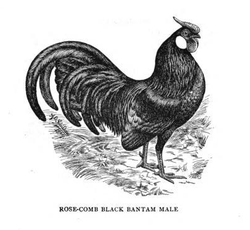
Illustration of the ideal Black Rosecomb male in the American Standard of Perfection, 1905
Conservation statusat risk
Country of originUnited Kingdom
StandardRosecomb Bantam Federation (USA)
Traits
Weight
  • Male:
    620 grams
  • Female:
    510 grams
Comb typeRose
Classification
APARose comb clean legged[1]
PCGBTrue bantam[2]

The Rosecomb is a breed of chicken named for its distinctive comb. Rosecombs are bantam chickens, and are among those known as true bantams, meaning they are not a miniaturised version of a large fowl. Rosecombs are one of the oldest and most popular bantam breeds in showing, and thus have numerous variations within the breed. An ornamental chicken, they are poor egg layers and not suited for meat production.

History

[edit]

The Rosecomb is one of the oldest bantam breeds of chicken. The earliest surviving records of the breed are from the 14th century in Britain, though it may have another point of origin.[3]: 142  Their popularity as an ornamental breed first took flight after King Richard III began to raise them.[4]: 149  Their popularity among poultry enthusiasts continued in to the 19th century, and Rosecombs were shown at the first North American poultry exhibition in 1849, as well as being admitted in to the first edition of American Standard of Perfection in 1874. Today their widespread keeping by breeders persists.[4]: 149 

Characteristics

[edit]

Rosecombs are almost exclusively kept for competitive poultry showing, and their characteristics reflect this. Males generally weigh 570–620 g (20–22 oz) and females 450–510 g (16–18 oz).[3]: 142  The breed's eponymous trait is its rose comb, which is large compared to its overall body size. They also sport relatively substantial white earlobes, prodigious tails, and a compact body shape. In addition to these general characteristics, Rosecombs appear in 25 different colour variations,[4]: 150-151  though black, blue, and white are the most common.[3]: 142 

Selective breeding solely for appearance has produced birds with striking appearances, but poor egg laying ability, carcasses unsuitable for eating, and some reproductive problems. Due to a genetic trait tied to rose combed chickens, roosters may have low fertility. Hens rarely are inclined to brood their own clutches, and chicks have high mortality rates. However, adult birds are generally hardy and active. Unlike the majority of chickens, Rosecombs are good fliers. They are also usually friendly birds, but cocks may be aggressive.[4]: 150 

[edit]

References

[edit]
Revisions and contributorsEdit on WikipediaRead on Wikipedia
from Grokipedia
The Rosecomb bantam is a true bantam of domestic , meaning it exists only in miniature form with no standard-sized counterpart, and is distinguished by its namesake large, rose-shaped that features a square front, small points, and a long tapering spike. Originating in , it is an ornamental breed prized for its elegant, upright carriage, compact body, and refined proportions, making it a favorite in poultry exhibitions. Historical records trace the Rosecomb's origins to at least the late , with the earliest documented mention in 1483 when John Buckton, owner of the Angel Inn in , , raised black Rosecombs. The breed gained royal attention under King Richard III and was first exhibited in the United States in 1849 at the Poultry Show, where it was presented as "Africans," before being officially recognized in the American Standard of Perfection in 1874. Despite disputed exact origins—possibly descending from ancient bantams or influenced by breeds like Hamburgs—the Rosecomb has long been celebrated for achieving exceptional standards of artificial perfection in show birds. Key characteristics include large, round, velvety white earlobes free of red markings, slate-blue legs, and a short, arched back with the carried at approximately 40 degrees in males and 35 degrees in females. Males exhibit long, sickle-shaped feathers, contributing to their proud and stately appearance, while the overall is smooth and glossy in recognized varieties such as black, white, blue, birchen, columbian, and black-breasted red. The breed weighs 570–620 grams for cocks and 450–510 grams for hens, and it lays 120–180 small, white to cream-colored eggs annually, though production drops in winter and it is seldom broody. Rosecombs are active, flighty, and spirited birds that thrive in free-range settings but require experienced handling due to lower fertility rates from historical and sensitivity to high humidity. Primarily an breed rather than one for or prolific egg-laying, it remains popular among fanciers for its ornamental charm and competitive potential in shows, with the variety being the most common and highest quality.

History

Origins in Britain

The Rosecomb bantam is recognized as one of the oldest breeds in Britain, with historical indicating its presence as early as the late , though the specific documented evidence emerges in the late 15th century. The earliest surviving written reference dates to 1483, when John Buckton, proprietor of the Angel Inn in , , inherited and raised a flock of black Rosecomb bantams, suggesting the breed's established existence prior to that time. This record highlights the breed's early integration into British rural life, likely originating from native small-fowl populations rather than imported stock. The breed gained prominence among the during the reign of King Richard III (1483–1485), who reportedly encountered the birds during stays at Buckton's inn and subsequently acquired his own flock, elevating their status as ornamental in royal and gardens. This royal endorsement spurred their popularity across English estates, where they were valued for their distinctive appearance and compact size. As a true bantam—meaning it developed independently without from larger breeds—the Rosecomb underwent primarily for aesthetic and exhibition qualities rather than utility, distinguishing it from other domestic chickens of the era. During the 16th to 18th centuries, English landowners and breeders refined the Rosecomb through targeted selection on English estates, emphasizing traits like the signature rose comb and elegant carriage to enhance its role as an ornamental bird in formal gardens and aviaries. By the 19th century, the breed's characteristics were documented in influential poultry literature, including Charles Darwin's The Variation of Animals and Plants under Domestication (1868), where he referenced rose-combed bantam varieties in discussions of inheritance patterns and breed diversity. These early treatises underscored the Rosecomb's longstanding cultural significance in Britain as a symbol of refined poultry fancy.

Introduction and Development in North America

The Rosecomb bantam, originating from Britain, was brought to by early 19th-century British settlers, establishing its presence ahead of formal exhibitions. The breed appeared at the inaugural major poultry show in the United States, the 1849 Boston Poultry Exhibition, where it was displayed as "Africans" among imported varieties, marking its introduction to American audiences. Amid the mid-19th-century surge in American fancy—a period driven by growing interest in ornamental and exhibition birds—the Rosecomb rapidly ascended in popularity among U.S. breeders and hobbyists. This era saw increased importation and of fancy breeds, with Rosecombs valued for their elegant appearance and suitability for shows, contributing to the broader enthusiasm that led to the founding of specialized poultry organizations. By the 1860s, dedicated breeders had begun forming informal networks and early clubs focused on refining Rosecomb lines, laying the groundwork for standardized development. The American Poultry Association (APA), established in 1873, formalized the breed's status by admitting the Black and White varieties of clean-legged Rosecomb bantams to its inaugural Standard of Perfection in 1874, emphasizing traits like the distinctive rose comb and compact form for exhibition quality. Early American breeders played a pivotal role in adapting and improving the breed to meet these standards, enhancing its show-worthiness through while preserving its British heritage. This recognition solidified the Rosecomb's place in American poultry culture, spurring further growth in dedicated fanciers.

Physical Characteristics

General Appearance and Size

The Rosecomb is classified as a true , meaning it has no large counterpart and was developed exclusively in miniature form. This compact variety exhibits a short, broad body with a horizontal carriage and an upright posture, giving it a distinctive, alert suited for ornamental exhibition. The overall structure emphasizes proportionality and grace, with the back forming a continuous sweeping curve from the neck to the tail, enhancing its sprightly appearance. Standard weights for the breed are precisely defined to maintain its bantam scale: ideal weights are 26 ounces (740 grams) for cocks and 22 ounces (625 grams) for hens, with cockerels at 22 ounces (625 grams) and pullets at 20 ounces (570 grams). Birds significantly exceeding or falling short of these ideals are penalized or disqualified in breed standards, ensuring the preservation of the breed's diminutive proportions. The body itself is short and deep, featuring a flat, broad, and thick sternum that supports a rounded, prominent breast; the fluff is short yet abundant, contributing to a neat, tidy form. Key structural elements include short, well-set legs that are parallel when viewed from behind, with round, smooth shanks and straight, well-scaled four-toed feet, all of which underscore the breed's compact and balanced stance. is apparent in and feathering: males display a more arched back with abundant feathers for a bolder profile, whereas females exhibit a slightly lower, graceful complemented by a full of feathers at the rear. These traits collectively define the Rosecomb's ornamental appeal, distinguishing it as a elegant show with refined proportions.

Comb, Plumage, and Color Varieties

The Rosecomb bantam's defining feature is its large , which is solid and broad-based at the front, tapering evenly to a long, rounded spike that points slightly upward and backward, set firmly on the head without hollows or folds, and covered in small, even points for a firm texture. The comb is in color across varieties. Complementing the comb are prominent, flat, round, smooth earlobes, along with firm, rounded wattles of hue. The legs and feet are clean and free of feathering, with shank colors varying by variety: for the black variety, bluish for blue, and tinged with for white; four well-spread toes are required, with the rear toe straight and the others parallel. The of the Rosecomb is characterized by short, tight feathers that lie flat against the body, producing a smooth outline and a glossy, lustrous sheen that accentuates the breed's elegant . The American Poultry Association recognizes three color varieties: , featuring solid jet- feathers throughout with a sheen in males; , displaying pure, snow- plumage free of shafting or smokiness; and , a steel- dilution of with subtle silver penciling, particularly evident in the and saddle. The American Bantam Association acknowledges additional varieties, expanding to 26, including laced patterns like white-laced . Breeding Rosecombs for color purity presents challenges, particularly in maintaining even, crisp lacing in varieties such as white-laced black, where inconsistent edging or leakage of ground color can occur due to genetic dilution effects. Non-standard colors like buff, a warm golden variety developed through selective crossing in the mid-20th century by American breeders, require careful linebreeding to preserve uniformity and avoid dilution to lighter shades.

Temperament and Behavior

Personality Traits

Rosecomb chickens are known for their generally friendly and curious temperament, which renders them approachable and suitable for handling, especially in ornamental or settings. This sociable nature allows them to bond with humans when handled regularly from a young age, making them popular among enthusiasts who value interactive pets. Their active and alert disposition is accentuated by a lightweight build that enables strong flying capabilities, often requiring secure enclosures to prevent escape. This agility fosters an exploratory behavior, with birds frequently perching high or investigating their surroundings, contributing to their lively presence in flocks. Male Rosecombs, or roosters, often exhibit toward other males to assert dominance, employing crowing and posturing as primary displays, while females remain more docile overall but demonstrate protectiveness toward their . In , these birds establish clear pecking orders within tight-knit flocks, showing reduced tolerance for mixing with larger breeds owing to vulnerability from their small stature.

Environmental Suitability

Rosecomb bantams exhibit strong hardiness, attributed to their compact body size and the rose comb structure, which minimizes exposure to freezing temperatures and reduces the risk of compared to breeds with larger single combs. This adaptability makes them suitable for temperate to climates, where they can thrive with basic shelter from wind and precipitation. However, they show lower tolerance for extreme , necessitating provision of ample shade, ventilation, and access to cool to mitigate heat stress during high temperatures. In terms of housing, Rosecombs are best accommodated in free-range systems or spacious aviaries that allow for their active foraging and flying behaviors, promoting overall well-being and reducing stress. While they can tolerate confinement in coops, overly restrictive small enclosures may limit their movement and lead to behavioral issues, making larger setups preferable for long-term health. Regarding flock dynamics, Rosecombs integrate well into all-bantam groups, where their size parity supports harmonious interactions. They can also coexist with larger breeds in mixed flocks, though vigilant monitoring is recommended to prevent potential from bigger birds due to size differences. For urban environments, they are viable options provided enclosures are securely predator-proofed to protect against common threats like foxes or hawks. Rosecombs demonstrate general resilience to common , owing to their robust adult constitution, which supports effective adaptation in varied settings. Nonetheless, as with many bantam breeds, they require regular checks for issues like scaly leg mites, which can affect leg health if not addressed promptly through treatment such as oil dips.

Breeding and Husbandry

Reproduction and Fertility

Rosecomb hens exhibit poor egg production, laying approximately 120–150 small white or cream-tinted eggs annually, with the laying season primarily limited to spring and summer. These eggs are notably small, reflecting the breed's bantam classification and ornamental focus rather than utility. Roosters in the Rosecomb breed demonstrate low rates, with fertility percentages typically ranging from 40% to 55%. This reduced is primarily attributed to the homozygous rose comb (RR), which causes structural changes in the , including a 7.4 Mb inversion on that impairs in males. Additionally, genetic bottlenecks arising from selective ornamental breeding contribute to , further compromising reproductive viability. Hens occasionally exhibit but are inconsistent mothers, often requiring supplementation for successful rearing. Chick mortality can be high due to weak hatchlings and limited experience. Artificial incubation is recommended, following the standard 21-day period for bantam chickens, to mitigate these challenges and improve overall hatch success.

Care and Management Practices

Rosecomb chicks require a high-protein starter feed containing 18–20% protein to support rapid growth during the first 6–8 weeks of life. As they mature, transition to a maintenance diet with 16% protein, incorporating grains such as corn and along with fresh greens like or to provide essential vitamins and fiber. To ensure strong quality, supplement the diet with free-choice calcium sources, such as crushed shells, particularly for laying hens. Housing for Rosecombs should allow at least 1–2 square feet of space per in the coop to prevent and stress. Install perches 2–3 feet above the , providing 4–6 inches of roosting space per to accommodate their moderate flying ability while promoting natural behaviors. Maintain by removing droppings and soiled bedding daily or weekly, as accumulated waste can lead to buildup and respiratory problems in confined . Effective health management includes vaccinating chicks against at one day of age or prior to exposure, with annual monitoring and revaccination of new additions to the flock as needed to sustain immunity. Implement every 3–6 months using approved anthelmintics like , based on fecal egg counts to target internal parasites without overuse. Regularly groom the distinctive rose comb by gently cleaning it with a soft cloth or mild solution to remove debris, dirt, or potential irritants that could cause infections. Year-round provision of dust baths, using a mix of , , and in a dedicated 2x2-foot area, enables Rosecombs to control external parasites like mites and lice through natural behaviors. In winter, add extra bedding such as 4–6 inches of straw or pine shavings to the coop floor for insulation and absorption, helping maintain warmth without lamps. Rosecombs exhibit good environmental hardiness, tolerating moderate when properly managed.

Recognition and Conservation

Breed Standards

The Rosecomb bantam is recognized by the American Poultry Association (APA) in the Rose Comb Clean Legged Bantam class, with standards that have emphasized the breed's distinctive symmetry, high-quality rose comb, and proud carriage since its inclusion in the first edition of the American Standard of Perfection in 1874. The ideal conformation features a continuous sweeping curve from neck to tail, an upright posture with the tail carried at approximately 40 degrees above horizontal in males and 35 degrees in females, and balanced proportions without abrupt breaks. Standard weights are set at 26 ounces (740 grams) for cocks and 22 ounces (625 grams) for hens, though exhibition birds are often judged closer to the lower end for a refined appearance. In the , the Poultry Club of Great Britain (PCGB) classifies the Rosecomb as a true bantam in its British Poultry Standards, requiring the same core traits of symmetry, integrity, and carriage as the APA but with adjusted weight scales to reflect British preferences: cocks up to 620 grams and hens up to 510 grams. The must be square-fronted, evenly covered with fine points, and terminate in a firm, rounded spike without lopping or following the head's contour, while the plumage should exhibit a glossy, tight feathering suited to . Show judging for Rosecombs prioritizes type and carriage (allocated 25 points in aggregated APA scales, encompassing back, breast, and overall symmetry), color and markings (20 points, varying by variety such as , or ), and comb and wattles (15 points, focusing on and even red coloration). Common disqualifications include feathered legs, which violate the clean-legged requirement, or a single comb instead of the characteristic rose form, as these deviate from the breed's class specifications.

Conservation Status

The Rosecomb bantam is classified as "Watch" by as of 2021, indicating fewer than 5,000 breeding birds in the United States with 10 or fewer primary breeding flocks (50 birds or more) and an estimated global population of less than 10,000. This status reflects data from the organization's 2021 poultry census, which reported approximately 200 Rosecombs in U.S. mail-order hatcheries, underscoring the breed's vulnerability despite its historical popularity in exhibition circles. No comprehensive post-2021 surveys are available as of 2025. Earlier assessments by the American Livestock Breeds Conservancy (the predecessor organization) similarly identified the breed as "At Risk" starting around 2007, highlighting persistent low numbers. Key threats to the Rosecomb include declining interest in ornamental bantams amid the rise of commercial poultry production, which prioritizes utility over . Additionally, small sizes have led to , resulting in reduced genetic vigor, poor rates, and challenges with hatchability, such as high embryo mortality during incubation. These issues are exacerbated by the breed's emphasis on show quality, which often limits through practices. Conservation efforts focus on breeder networks and breed clubs dedicated to preserving pure lines. In the United States, the American Poultry Association and the Rosecomb Bantam Federation support maintenance of breed standards and encourage to mitigate while upholding type. In the , The Rosecomb Bantam Club, active since the late , promotes the breed through , shows, and recovery initiatives aligned with the Rare Poultry Society's broader goals for heritage . These organizations facilitate genetic monitoring and distribution of breeding stock to hobbyists and exhibitors. The future outlook for the Rosecomb shows potential for stabilization through increased participation in poultry shows and the growing interest in heritage farming, which values diverse, non-commercial breeds for . However, ongoing challenges like limited post-2010 population surveys and the need for studies highlight the importance of continued monitoring to prevent further decline.

References

Add your contribution
Related Hubs
User Avatar
No comments yet.