Hubbry Logo
search
logo
Rostra
Rostra
current hub
2192570

Rostra

logo
Community Hub0 Subscribers
Read side by side
from Wikipedia

41°53′33.5″N 12°29′04.6″E / 41.892639°N 12.484611°E / 41.892639; 12.484611

Rostra, Rostra Vetera
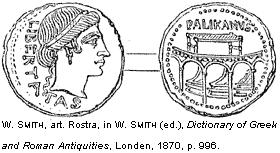
The Rostra of the early Republican era, as depicted on a Roman coin
Lapis Niger
Comitium
Julius Caesar
Roman GovernmentPolitical institutions
Social classesPatrician, Senatorial class, equestrian class, plebeian, freedman
The Rostra was a specific platform for oration in ancient Rome.

The Rostra (Italian: Rostri) was a large platform built in the city of Rome that stood during the republican and imperial periods.[1] Speakers would stand on the rostra and face the north side of the Comitium towards the senate house and deliver orations to those assembled in between. It is often referred to as a suggestus or tribunal,[2] the first form of which dates back to the Roman Kingdom, the Vulcanal.[3][4]

It derives its name from the six rostra (plural of rostrum, a warship's ram) which were captured following the victory which ended the Latin War in the Battle of Antium in 338 BC and mounted to its side.[5] Originally, the term meant a single structure located within the Comitium space near the Roman Forum and usually associated with the Senate Curia. It began to be referred to as the Rostra Vetera ("Elder Rostra") in the imperial age to distinguish it from other later platforms designed for similar purposes which took the name "Rostra" along with its builder's name or the person it honored.

History

[edit]

Magistrates, politicians, advocates and other orators spoke to the assembled people of Rome from this highly honored, and elevated spot.[6] Consecrated by the Augurs as a templum, the original Rostra was built as early as the 6th century BC. This Rostra was replaced and enlarged a number of times but remained in the same site for centuries.

In 338 BC the Rostra got its name when, following the defeat of Antium by the consul Gaius Maenius, the Antiate fleet was confiscated by Rome, of which the prows (literally rostra in Latin) of six ships were set upon the Rostra. Maenius paid for it out of his share of war booty. He also erected a victory column, the Columna Maenia, close to the Rostra.[7]

Julius Caesar rearranged the Comitium and Forum spaces and repositioned the Senate Curia at the end of the republican period. He moved the Rostra out of the Comitium.[8] This took away the commanding position the curia had held within the whole of the forum, having advanced extremely close to the Rostra during its last restoration. Augustus, his grand-nephew and first Roman emperor, finished what Caesar had begun, as well as expanded on it. This "New Rostra" became known as the Rostra Augusti. What remains in the excavated forum today, next to the Arch of Septimius Severus, has endured several restorations and alterations throughout its historical use. While a few different honorary names are attributed to those restorations, scholars, archeologists and the government of Italy recognise this platform as the "Rostra Vetera" encased inside the "Rostra Augusti".

The term rostrum, referring to a podium for a speaker is directly derived from the use of the term "Rostra". One stands in front of a Rostrum and one stands upon the Rostra. While, eventually, there were many rostra within the city of Rome and its republic and empire, then, as now, "Rostra" alone refers to a specific structure. Before the Forum Romanum, the Comitium was the first designated spot for all political and judicial activity and the earliest place of public assembly in the city. A succession of earlier shrines and altars is mentioned in early Roman writings as the first suggestum. It consisted of a shrine to the god Vulcan, that had two separate altars built at different periods. This early Etruscan mundus altar originally sat in front of a temple that would later be converted into the Curia Hostilia.

During the late Republic the rostra was used as a place to display the heads of defeated political enemies. Gaius Marius and consul Lucius Cornelius Cinna captured Rome in 87 BC and placed the head of the defeated consul, Gnaeus Octavius, on the Rostra.[9] The practice was continued by Sulla[10] and Mark Antony, who ordered that Cicero's hands and head be displayed on Caesar's Rostra after the orator's execution as part of the Proscription of 43 BC.[10]

Caesar spoke from the Rostra in 67 BC in a successful effort to pass, over the opposition of the Senate, a bill proposed by the tribune Aulus Gabinius (the lex Gabinia) creating an extraordinary command for Pompey to eliminate piracy in the Mediterranean.[11] Brutus and Cassius spoke from the Rostra to an unenthusiastic crowd in the Forum after the assassination of Caesar in 44 BC.[12] Millar comments that during the late Republic, when violence became a regular feature of public meetings, physical control and occupation of the Rostra became a crucial political objective.[13]

Tribal assemblies and tribunals

[edit]

Until about 145 BC, the Comitium was the site for tribal assemblies (comitia tributa) at which important decisions were taken, magistrates were elected and criminal prosecutions were presented and resolved by tribal voting. Before an assembly, the convening magistrate, acting as augur, had to take the auspices in the inaugurated area (templum) on the Rostra from which he was to conduct the proceedings. If the omens were favorable and no other magistrate announced unfavorable omens, the magistrate summoned other magistrates and senators and directed a herald to summon the people. Heralds did so from the Rostra and from the City walls. During an assembly, magistrates, senators and private citizens spoke on pending legislation or for or against candidates for office. Before bills were presented for voting, a herald read them to the crowd from the Rostra. At the culmination of the process, the tribes were each called up to the templum on the Rostra to deliver their votes. After about 145 BC, the voting population of Rome grew too large for the Comitium, and tribal assemblies were then held at the opposite end of the Forum around the Temple of Castor, the steps of which served as an informal Rostra.[14][15][16]

The Rostra was also used for meetings of courts.[17] In Republican Rome, criminal prosecutions took place in the Forum either before a tribal assembly with a magistrate prosecuting (a procedure specified in the Twelve Tables and the normal mode of prosecution in the middle Republic) or in a jury-court (quaestio de repetundis) established by statute and presided over by a magistrate with a jury (after 70 BC) of about 50-75 jurors.[18] For trials held in the Comitium, the Rostra served as the tribunal upon which the magistrate sat in his curule chair with a small number of attendants. "This was enough in itself to establish a court, though it was supplemented by benches (subsellia) for the jurors, the parties to the case, and their supporters." The circle of onlookers (corona) either stood or sat on nearby steps.[19][20]

The original structure was built during the middle years of the Roman Republic in approximately 500 BC[10] It subsequently became known as the "Rostra" after the end of the Latin War in 338 BC when it was adorned by Gaius Maenius with naval rams (rostra) of ships captured at Antium as war trophies.[21]

The Rostra was located on the south side of the Comitium opposite the Curia Hostilia (the original Senate house), overlooking both the Comitium and the Roman Forum. In addition to the prows of captured ships, the Rostra bore a sundial[22] and, at various times, statues of such important political figures as Camillus, Sulla and Pompey.[13][23] Private citizens also erected a number of honorary columns and monuments on the Rostra and throughout the forum. At one point, the Senate threatened to have them removed if the donors did not do so themselves.[24]

Rostra Vetera

[edit]
The Rostra Vetera as reconstructed by Einar Gjerstad

In form, the original Rostra may have been a simple raised platform made of wood, similar to the Roman tribunal.[25] The Rostra had a curved form, possibly along the outer south rim of an amphitheatre. The structure was described by Christian Charles Josias Bunsen, based on his examination of two Roman coins depicting the Rostra, as "a circular building, raised on arches, with a stand or platform on the top bordered by a parapet; the access to it being by two flights of steps, one on each side. It fronted towards the Comitium, but later speakers often faced in the opposite direction to address larger audiences in the Forum. The Rostra Vetera's form has been in all the main points preserved in the ambones, or circular pulpits, of the most ancient churches, which also had two flights of steps leading up to them, one on the east side, by which the preacher ascended, and another on the west side, for his descent. Specimens of these old churches are still to be seen at Rome in the churches of San Clemente al Laterano and San Lorenzo fuori le Mura.[26]

As part of his reconstruction of the Roman Forum in 44 BC, Julius Caesar is believed to have moved the republican Rostra Vetera.[27] This Rostra, referred to as the "Rostra Nova" or "Caesarian Rostra", reused and incorporated nearly all of the original Rostra. Located on the southwest side of the new Julian Forum (Forum Iulium), the new Rostra was no longer subordinated to his new Senate House, the Curia Julia (still standing); Caesar had it placed on the central axis of the Forum, facing toward the open space. Left uncompleted at Caesar's death, Augustus finished and extended the new Rostra into a rectangle at the front, the dimensions being 28.8 metres (94 ft) long, 10 metres (33 ft) broad and 3.4 metres (11 ft) above the level of the forum pavement.[28] Traces of this Rostra can be seen today.

At the opposite end of the open Forum, the Temple of Caesar, completed by Augustus in 29 BC, included another Rostra at the front of its elevated base, facing the Caesarian Rostra. This Rostra was decorated with the rams from the Battle of Actium. John E. Stambaugh, professor of classics at Williams College, described the new arrangement as "a reflection of contemporary taste and the relentless Augustan desire for order."[23][29]

In contemporary news

[edit]

In November 2008 heavy rain damaged the concrete covering that has been protecting the Vulcanal and its monuments located in the Imperial comitium space since the 1950s. This includes the stele accorded the name of "The Black Rock" or Lapis Niger. The marble and cement covering is a mix of the original black marble, said to have been used to cover the site by Sulla, and modern cement used to create the covering and keeping the marble in place.

Professor Angelo Bottini, Superintendent of Archeology in Rome, stated that an awning or tent covering is in place to protect the ancient relics until the covering is repaired, giving tourists of this millennium a look at the original suggestum for the first time in 50 years.[30]

Other known Rostra

[edit]

In 29 BC Augustus ordered the construction of another Rostra in front of the Temple of Caesar, at the opposite end of the Forum Iulium from Caesar's Rostra. This was used as a tribunal and was adorned with the prows of galleys captured at the Battle of Actium.[23][31]

See also

[edit]

References

[edit]

Sources

[edit]
[edit]
Revisions and contributorsEdit on WikipediaRead on Wikipedia
from Grokipedia
The Rostra was a prominent elevated platform in the Roman Forum, serving as the primary stage for public speeches and oratory from the Republican era through the Imperial period.[1][2] Named after the Latin word for the beaks or prows of ships (rostra), it was adorned with bronze rams taken from defeated enemy vessels, symbolizing Roman naval victories, particularly those from the Latin War in 338 BC against Antium.[3][4] Originally constructed in the Comitium area during the 4th-3rd centuries BCE, the platform stood approximately 5 meters high and facilitated addresses to the Senate and populace, embodying the democratic and rhetorical traditions of early Rome.[1][5] Julius Caesar relocated and redesigned it in the late Republic, incorporating elements from earlier structures, while Augustus further expanded it into the Imperial Rostra, aligning it with his architectural program to evoke continuity with republican virtues.[2] Subsequent emperors, including Septimius Severus, rebuilt it to accommodate new monuments like triumphal arches, ensuring its enduring role in civic life until late antiquity.[6] The Rostra's significance extended beyond oratory; it hosted imperial proclamations, funerals of notable figures, and displays of war spoils, reinforcing Rome's martial prowess and political authority.[7] Its curved design and strategic positioning opposite the Curia Julia optimized visibility and acoustics for mass assemblies, underscoring the platform's function as a nexus of public discourse and power projection in the heart of the empire.[6][3]

Etymology and Terminology

Origin of the Name

The term "Rostra" derives from the Latin plural of rostrum, meaning "beak" or the projecting ram fitted to the prow of a warship, which resembled a bird's beak in shape.[8][3] This naval ram was a bronze-reinforced spur used to puncture enemy hulls during ramming maneuvers in ancient Mediterranean warfare.[5] The platform earned its name from being adorned with such captured rostra, beginning with six bronze examples salvaged from the Volscian fleet defeated at Antium in 338 BCE during the Latin War.[4][9] These trophies, affixed to the speaker's platform in the Roman Forum's Comitium area, symbolized Roman naval dominance and marked the site's transformation into a monumental emblem of victory, with the name "Rostra" applied retroactively or contemporaneously to denote the decorated structure.[10] Subsequent additions, such as prows from Carthaginian ships after the First Punic War (264–241 BCE), reinforced this association but did not originate the nomenclature.[7]

Linguistic and Symbolic Evolution

The Latin term rostrum (plural rostra) originally signified the beak of a bird or the bronze ram affixed to the prow of a warship, reflecting its sharp, projecting form designed for piercing enemy vessels.[5] This nautical connotation extended to the speaker's platform in the Roman Forum after Gaius Maenius, consul in 338 BC, adorned it with six bronze prows captured from Antiate ships during Rome's victory in the Latin War, marking the structure's inaugural association with the term.[11] [12] Linguistically, rostra transitioned from a descriptive label for the decorative elements to a metonym for the entire platform by the mid-Republic, as evidenced in Ciceronian texts where it denotes the site of oratory without explicit reference to the prows. This evolution paralleled broader Latin semantic shifts, where concrete objects symbolized abstract functions, influencing later English adoption of "rostrum" for any elevated speaking dais by the Renaissance, detached from its martial origins.[13] Symbolically, the prows embodied Rome's naval supremacy and the causal link between military conquest and civic authority, transforming the platform into a tangible emblem of imperium—the power to command both seas and assemblies.[7] Initially commemorating the 338 BC triumph over Latin foes, which secured Roman hegemony in central Italy, the adornments accrued layers of meaning with subsequent additions, such as those from the Punic Wars, reinforcing oratory as an extension of victorious virtus.[11] Under Augustus, prows from the 31 BC Battle of Actium—captured from Antony and Cleopatra's fleet—recast the rostra as icons of imperial restoration, shifting symbolism from republican tribal assemblies to monarchical propaganda while preserving the core trope of dominion through destruction.[7] This enduring motif extended to rostral columns, like those honoring Duilius's 260 BC victory at Mylae, perpetuating the prows' role in visualizing naval res gestae across Rome's monumental landscape.[14]

Architectural Design and Location

Physical Structure and Materials

The Rostra, in its most prominent Augustan reconstruction, consisted of a rectangular platform elevated approximately 5 meters above the level of the Roman Forum, supported by a series of steps on its rear and sides for access by speakers. The structure measured roughly 22.5 meters in length and 17 meters in width, forming an elongated stage oriented toward the Comitium.[1] Its front facade extended about 23.7 meters (80 Roman feet), designed to project oratorical addresses across the open space of the Forum. Construction employed opus quadratum masonry, with walls built from large blocks of tufa quarried locally, providing a durable volcanic stone core resistant to the marshy subsoil of the Forum valley. These tufa blocks were precisely faced with slabs of fine white marble, enhancing aesthetic appeal and weather resistance, while the upper edges featured a marble cornice supporting a balustrade likely of marble and bronze elements. [2] Bronze fixtures, including the iconic ship prows (rostra), were embedded directly into the marble veneer, with sockets and reinforcements integrated into the stonework to secure these metallic trophies from naval victories. Earlier Republican iterations of the Rostra, dating to the fourth and third centuries BCE, likely utilized timber frameworks for the platform base, supplemented by rudimentary stone revetments, though surviving archaeological traces indicate a transition to more permanent tufa and travertine elements by the late Republic.[6] This evolution from perishable wood to enduring stone reflected Rome's growing engineering prowess and the platform's increasing centrality in public life, with materials sourced from regional quarries such as those at Fidenae for tufa and Carrara for later marble veneers.

Decoration with Ship Prows

The Rostra derived its name from the bronze ship prows (rostra navium) affixed to its facade, symbolizing Roman naval victories. These decorations originated in 338 BC following Rome's defeat of Antium during the Latin War, when consul Gaius Maenius dedicated the rams from six captured Latin ships to the speaker's platform in the Comitium.[15] The prows, crafted from bronze, projected outward from the front, serving as both ornamental elements and emblems of military dominance over former allies.[10] Subsequent additions enhanced the symbolic array. In 260 BC, after Gaius Duilius's victory at the Battle of Mylae against Carthage in the First Punic War, prows from captured enemy vessels supplemented the original Antiate rams, expanding the display to underscore Rome's emerging maritime power.[16] Archaeological remnants, including mounting sockets in the tufa blocks of the Republican-era structure, confirm the prows' placement along the curved front, typically numbering around a dozen by the late Republic.[6] During Julius Caesar's reconstruction circa 44 BC, the platform was relocated westward in the Forum and rebuilt in marble, preserving the tradition of prow decoration while integrating statues of victorious commanders. The historic bronze rams, valued for their trophy status, were likely retained or replicated, though some accounts suggest civil war spoils influenced later imperial phases under Augustus, who commemorated the Battle of Actium (31 BC) through related naval monuments rather than direct prow additions to the Rostra.[15] By the imperial period, the prows had eroded or been removed, but their legacy persisted in Roman iconography as markers of imperial might.[7]

Integration with the Roman Forum

The Rostra was situated at the northwestern extremity of the Roman Forum, functioning as the demarcation between the Comitium to the north and the main forum square to the south, thereby bridging the assembly area with the commercial and judicial heart of the city.[17] [16] This positioning allowed orators to address crowds assembled in either space, integrating the platform into the Forum's multifunctional layout from its early Republican phases. Adjacent to structures such as the Curia Hostilia and Basilica Aemilia, it formed part of a cohesive ensemble that facilitated public deliberation amid surrounding temples and basilicas.[17] Julius Caesar's reforms around 44 BC relocated and reoriented the Rostra to face southward into the expanded Forum, aligning it axially with the Basilica Julia to the south and enhancing visibility toward the Temple of Divus Iulius and the Temple of Vesta.[15] [16] Augustus completed the reconstruction by 42 BC, adding curved steps and a drainage canal that harmonized with the Forum's monumental symmetry and urban flow.[17] These changes detached it more distinctly from the Comitium while embedding it as the Forum's northwest boundary, from which speakers could oversee the entire square extending eastward to the Palatine Hill.[16] The platform's elevation of approximately 5 meters provided dominance over the Forum's open expanse, with its facade—adorned with bronze ship prows captured from Antium in 338 BC—projecting naval victories as a visual anchor amid nearby landmarks like the Umbilicus Romae and Milliarium Aureum.[1] [15] This architectural prominence reinforced the Rostra's integration as both a functional rostrum for oratory and a symbolic nexus tying military commemoration to the administrative core of Rome.[17]

Historical Development

Early Republican Origins

The Rostra originated as a speakers' platform within the Comitium, the assembly area in the Roman Forum, during the early Republic, with possible roots in the preceding monarchical period.[18] In 338 BCE, following Rome's victory over Antium in the Latin War, the platform was adorned with six bronze ship prows (rostra) captured from the defeated fleet, which gave the structure its name and established its symbolism of naval triumph.[16] [19] These prows, affixed to the front, commemorated the first significant Roman naval success and transformed the tribunal into a monument of military prowess.[4] Positioned on the south side of the Comitium, the Rostra Vetera served as the focal point for public oratory, where magistrates, consuls, and tribunes addressed assemblies of citizens on legislative and judicial matters.[10] Early Republican usage emphasized its role in comitial voting and contiones, or public deliberations, integrating it into the political fabric of the res publica. By the mid-second century BCE, shifts in oratorical practice emerged; in 145 BCE, the tribune Gaius Licinius Crassus became the first to speak from the Rostra facing the broader Forum rather than the traditional Comitium audience, signaling an evolution toward larger public engagement.[20] This early phase underscored the Rostra's function as a nexus of republican governance, blending utilitarian speaking space with triumphal decoration to reinforce Rome's expanding dominance.[21] Archaeological evidence and literary accounts, such as those from Livy, confirm the platform's modest initial construction using local materials like tufa, predating later marble enhancements.[22]

Tribal Assemblies and Judicial Functions

The Rostra, integrated into the Comitium during the early Republic, functioned as the primary speakers' platform for the comitia tributa, the tribal assembly where Roman citizens voted by tribe on elections and legislation. Orators and magistrates addressed assembled voters from this elevated structure during contiones, informal gatherings preceding formal votes, to persuade or inform the populace.[23] The assembly elected lower magistrates, including tribunes of the plebs, quaestors, and aediles, with voting organized into 35 tribes, each casting a single vote after internal tallying. Until circa 145 BC, when tribune C. Licinius Crassus shifted legislative sessions to the adjacent Forum, the Comitium and Rostra hosted these proceedings, accommodating hundreds of citizens grouped by tribal affiliation. In its judicial capacity, the comitia tributa exercised limited authority, primarily over minor, noncapital offenses such as fines for petty crimes, serving as an appellate body or for certain popular trials. Magistrates presided from the Rostra, seated in curule chairs, while jurors and observers gathered in the Comitium, enabling public scrutiny of proceedings.[24] This setup facilitated oratory in criminal accusations and defenses, with speakers like Cicero later invoking similar Forum platforms for high-profile cases, though early Republican trials emphasized tribal consensus over elite adjudication.[25] The platform's visibility underscored the assemblies' role in balancing patrician oversight with plebeian participation in justice.

Rostra Maenia and Pre-Augustan Phases

The Rostra Maenia originated in 338 BC when Roman consul Gaius Maenius, following his victory over the Volscian city of Antium and its Latin allies, affixed the bronze prows (rostra) of six captured Antiate ships to the front of an existing speakers' platform (tribunal) in the Comitium adjacent to the Roman Forum.[26][15] This decoration not only named the structure "Rostra" but also symbolized Rome's emerging naval dominance, transforming a functional tribunal into a monument of triumph.[27] The platform, elevated approximately 2-3 meters and constructed from tufa and wood, facilitated oratory addressing assemblies in the open Comitium space.[15] Throughout the mid-Republic, the Rostra continued as the central venue for contiones—public meetings where magistrates and senators delivered speeches to influence legislation or rally support—and occasionally for judicial orations, such as Cicero's defenses in the 1st century BC.[15] In 260 BC, during the First Punic War, consul Gaius Duilius added prows from eleven Carthaginian quinqueremes captured at the Battle of Mylae, expanding the decorative array to twelve beaks and reinforcing the platform's role as a repository of victory trophies.[15] These additions, sourced from ancient accounts like Livy and Pliny the Elder, underscore incremental enhancements rather than wholesale redesigns, maintaining the structure's Republican character amid growing Forum congestion.[15] Pre-Augustan phases saw no major relocations or overhauls until the late Republic, though repairs likely addressed wear from frequent use and exposure; the platform remained oriented toward the Comitium, integrating with nearby structures like the Curia Hostilia for senatorial proceedings.[15] By the 2nd century BC, as the Forum expanded eastward, the Rostra's prominence persisted for key events, including triumphs and executions, exemplifying its dual civic and punitive functions without altering its core footprint of roughly 20 by 10 meters.[1] Archaeological remnants, including fragmentary bases and inscriptions, confirm this stability, with later Republican orators like the Gracchi leveraging its acoustics for mass persuasion.[15]

Caesarian and Augustan Reconstructions

Julius Caesar undertook the reconstruction of the Rostra as part of his extensive renovation of the Roman Forum, detaching the existing republican platform from its position adjacent to the Comitium and repositioning it along the Forum's main northwest-southeast axis.[15] This work, initiated around 44 BC, aligned the Rostra with the new Basilica Julia and the planned Temple of Divus Julius, transforming it from a semi-circular structure integrated with assembly spaces into a more prominent, independent speaker's platform facing the central Forum basin. The relocation emphasized its role in public oratory while accommodating Caesar's urban redesign, which included straightening the Forum's layout and enhancing monumental visibility.[28] Augustus completed and expanded Caesar's project after his victory at Actium in 31 BC, extending the platform forward by approximately 10 meters to create a larger stage-like structure capable of accommodating dignitaries, senators, and performers during addresses.[6] Constructed primarily in opus quadratum using Aniene tuff, the Augustan Rostra measured roughly 22 meters in length, 10 meters in depth, and stood about 5 meters high, with its facade adorned with bronze ship prows (rostra) captured from Antony and Cleopatra's fleet, symbolizing naval triumph and imperial authority. Augustus further enhanced the platform by erecting statues atop it, including equestrian figures of himself, Julius Caesar, Sulla, and Pompey, which reinforced dynastic legitimacy and historical continuity.[6] These additions, finalized by the early 20s BC, marked the Rostra's evolution into the "Rostra Augusti," a key imperial monument dedicated on September 18, 29 BC, alongside other Forum dedications.[15]

Role in Roman Politics and Oratory

Assemblies and Public Deliberation

The Rostra functioned as the elevated platform from which Roman magistrates and orators addressed contiones, non-voting public assemblies held in the adjacent Forum and Comitium for political deliberation, information sharing, and persuasion of the populace.[15] These gatherings, convened by consuls, praetors, or tribunes of the plebs, allowed speakers to explain proposed legislation, rally support for candidates, or debate state matters before formal votes in the comitia tributa or concilium plebis.[23] Unlike voting assemblies, contiones emphasized rhetorical engagement over balloting, serving as the primary venue for public discourse where elite speakers shaped opinion among assembled citizens grouped by tribes.[25] Positioned facing northward toward the Curia Julia and the Senate house, the Rostra enabled orators to deliver speeches to crowds gathered in the open space of the Forum, fostering direct interaction between political leaders and the plebeian and equestrian orders.[15] Magistrates used these addresses to demoralize opponents, invigorate supporters, and impress neutrals, as evidenced in late Republican practices where contiones influenced subsequent tribal assembly outcomes without incorporating deliberation into the voting process itself.[29] Tribunes, in particular, leveraged the platform to advocate for plebeian interests, such as land reforms or opposition to senatorial policies, amplifying their veto power through public advocacy.[30] Historical records document key instances of its deliberative use, including Cicero's speeches from the Rostra praising the Gracchi to align himself with popular traditions and appeal to the assembly's sentiment.[25] In 44 BC, Mark Antony mounted the platform to deliver Julius Caesar's funeral oration, manipulating crowd emotions to sway public opinion amid political turmoil following the assassination.[15] Such events underscored the Rostra's centrality in Republican politics, where oratory from this site could precipitate mob reactions or policy shifts, though constrained by the aristocracy's control over assembly convocation and the absence of structured debate mechanisms.[31] By the late Republic, as contiones grew more contentious, the platform symbolized both democratic participation and elite dominance in guiding deliberation.[32]

Notable Orators and Speeches

The Rostra was the central stage for contiones, public assemblies where Roman magistrates and orators addressed the populace on legislative proposals, foreign policy, and political crises. Marcus Tullius Cicero, recognized as ancient Rome's preeminent orator, frequently utilized the platform during his career, including speeches against agrarian reforms proposed by tribune P. Servilius Rullus in 63 BC, where he argued the bill concealed dictatorial ambitions under the guise of land distribution to veterans and the poor.[33] Cicero's De Lege Agraria addresses, delivered before assembled citizens, exemplified his mastery of rhetoric to defend senatorial interests while appealing to popular sentiments.[34] In the late Republic, the Rostra witnessed Mark Antony's funeral oration for Julius Caesar on March 20, 44 BC. Standing on the platform after displaying Caesar's bloodied toga and will, Antony incited the crowd against the assassins, leading to riots and the desecration of their properties; Cassius Dio records that Antony's words, interspersed with readings from the will bequeathing gifts to the Roman people, shifted public opinion dramatically. This event underscored the platform's potency in mobilizing mass sentiment amid civil discord. A rare instance of female oratory occurred in 42 BC when Hortensia, daughter of the advocate Quintus Hortensius Hortalus, spoke from the Rostra against the Second Triumvirate's proposed taxation of 1,400 wealthy women to fund wars. Appian recounts how Hortensia and her cohort ascended the speakers' platform during a triumviral assembly in the Forum, protesting the measure as unjust since women lacked political voice yet bore the financial burden; her eloquence prompted the triumvirs to reduce the tax to 400 women. Under the Empire, emperors continued using the reconstructed Rostra for addresses, such as Septimius Severus' eulogy for Pertinax in 193 AD, which Dio notes was interrupted by public acclaim, reflecting lingering republican traditions of popular acclamation. These orations, though fewer in number due to centralized imperial authority, maintained the Rostra's role as a site of public persuasion and symbolic power.

Symbolism of Power and Victory

The Rostra's name and primary symbolism derive from the bronze rostra—the reinforced prows or rams of captured enemy warships—affixed to its facade, serving as tangible trophies of Roman naval supremacy.[15] These elements originated with the six prows taken from Antiate ships during the victory at the Battle of Antium in 338 BCE, which concluded the Latin War and marked Rome's consolidation of control over central Italy.[11] By displaying such spoils in the heart of the Forum, the platform embodied Rome's martial dominance and the transformative power of conquest, visually linking oratorical authority to battlefield success.[7] This symbolism extended beyond decoration to reinforce the ideological narrative of Roman exceptionalism, where naval victories signified not only territorial expansion but also the subjugation of maritime threats, crucial for securing trade routes and projecting power across the Mediterranean.[35] The prows, often gilded and inscribed, evoked the chaos of ramming tactics in ancient galley warfare, transforming instruments of destruction into emblems of state power and collective triumph.[36] Orators addressing assemblies from the Rostra stood before these relics, implicitly invoking the legacy of commanders like Gaius Maenius, who captured the original Antiate prows, to legitimize their rhetoric and policies.[37] Subsequent reconstructions amplified this motif: Julius Caesar adorned the platform with ten additional rostra from his Gallic campaigns against the Veneti in 56 BCE, associating his dictatorship with ancestral victories and personal conquests.[15] Augustus further enhanced it by adding prows from the Battle of Actium in 31 BCE, symbolizing the restoration of republican virtues through his defeat of Antony and Cleopatra, thereby merging imperial ideology with the Rostra's republican origins.[7] Collectively, these accretions positioned the Rostra as a monumental archive of victory, where the physical remnants of defeated foes underscored Rome's unyielding ascent and the symbiotic relationship between military prowess and political eloquence.[11]

Decline, Preservation, and Rediscovery

Imperial Period Usage and Abandonment

The Rostra Augusti, constructed under Julius Caesar and completed by Augustus following the Battle of Actium in 31 BCE, featured bronze ship prows (rostra) captured from Mark Antony's fleet, symbolizing imperial victory and placed at the northwest end of the Forum Romanum. In the early imperial period, it served primarily for official proclamations, eulogies, and controlled public addresses by emperors or magistrates, shifting from the republican era's contentious debates to vehicles for imperial policy announcements and ceremonial oratory.[2] This usage reflected the centralization of authority under the principate, where popular assemblies (comitia) retained formal existence but lost independent legislative and electoral functions, with emperors increasingly nominating candidates and directing outcomes through senatorial intermediaries.[1] By the 2nd century CE, the platform's role further diminished as the Senate convened routinely in the adjacent Curia Julia for deliberations, reducing the need for mass gatherings in the Forum, while imperial edicts and prefectural announcements supplanted open oratory.[1] Septimius Severus rebuilt the Rostra around 203 CE, incorporating modifications to accommodate the adjacent Arch of Severus, suggesting lingering ceremonial importance amid efforts to restore traditional Roman prestige after the Severan dynasty's consolidation of power. [38] However, the Crisis of the Third Century (235–284 CE) accelerated institutional decay, with military emperors prioritizing provincial legions over urban rituals, leading to sporadic rather than routine use of the Rostra for speeches. Functional abandonment as a speaking platform occurred gradually by the late 3rd to early 4th centuries CE, coinciding with Diocletian's Tetrarchy (284–305 CE) and Constantine's administrative reforms, which formalized the empire's eastern orientation and diminished Rome's political centrality.[14] The transfer of the imperial capital to Constantinople in 330 CE marked a causal turning point, as administrative and ceremonial activities shifted eastward, rendering the Forum—and the Rostra—obsolete for public discourse.[39] Physical neglect followed the Visigothic sack of Rome in 410 CE, which damaged Forum structures through fire and looting, though the Rostra remained a recognizable landmark as evidenced by the erection of the Column of Phocas before it in 608 CE by Byzantine authorities. [40] By the early medieval period, the site transitioned into disrepair, quarried for building materials, with no recorded imperial-era political usage persisting beyond late antiquity.[39]

Medieval and Renaissance Interpretations

In the medieval period, the Rostra lay buried under meters of alluvial deposits and debris in the Roman Forum, which had devolved into the Campo Vaccino, a marshy pastureland exploited for agriculture and lime production from ancient marbles. Physical remnants, if visible at all, were misinterpreted amid scattered ruins often attributed to biblical or legendary figures in pilgrim guides like the Mirabilia Urbis Romae (c. 1143), which emphasized Rome's wonders through a Christian lens but omitted specific reference to the speakers' platform, reflecting a disconnection from its classical republican function. Knowledge persisted indirectly via preserved texts such as Livy's Ab Urbe Condita, which detailed its adornment with ship prows from the 338 BCE victory over Antium, though medieval commentators prioritized moral or allegorical readings over historical topography.[41][28] The Renaissance marked a shift toward empirical antiquarianism, as humanists integrated literary sources with on-site observations to reconstruct ancient sites. Flavio Biondo's De Roma Instaurata (1444–1446), the pioneering topographical survey of Rome's ruins, identified the Rostra's position in the Forum, distinguishing the republican Rostra Vetera from the Caesarian and Augustan iterations (Rostri Caesaris), and linked it to oratorical traditions via citations from Varro and Cicero. Biondo's methodology, blending textual exegesis with rudimentary fieldwork, portrayed the Rostra not merely as a structure but as emblematic of Rome's lost civic eloquence, influencing subsequent scholars like Pomponio Leto in the Roman Academy. This textual-physical synthesis elevated the Rostra's status in humanist narratives of republican virtue, though interpretations remained conjectural absent full excavation.[42]

Modern Archaeological Excavations

The remains of the Rostra Augusti were initially exposed during road construction across the Roman Forum between 1831 and 1834, which connected Via Bonella to Via della Consolazione and uncovered portions of the structure previously buried under debris.[43] This early 19th-century intervention marked the first modern revelation of the platform's marble facing and associated elements, though systematic documentation was limited at the time.[44] Full-scale archaeological excavations commenced under Giacomo Boni, appointed director of Forum digs by the Italian government in 1898, who cleared overburden from the area over the subsequent six years, exposing the Rostra's concrete core—measuring approximately 3.5 meters in height—and confirming its alignment with Julius Caesar's planned reconstruction atop the earlier republican platform.[15] Boni's stratigraphic approach revealed multiple building phases, including Augustan-era additions like the attachment of ships' prows (rostra) from Actium, though some elements had been repurposed or damaged in antiquity.[14] His work integrated the Rostra into broader Forum restorations, with the visible marble revetment and curved facade restored in the early 20th century based on these findings.[15] Subsequent investigations in 1959 targeted the rear of the Rostra Augusti, uncovering five column bases likely supporting honorific statues or dedications, which were re-examined to refine understandings of imperial modifications.[45] For the Rostra Vetera, located near the Comitium, early modern digs in the 19th century misidentified parts as medieval structures, leading to partial destruction, but Boni's efforts clarified its republican origins, including 4th-century BCE ship prows from Antium.[46] These excavations, constrained by urban development and preservation priorities, have yielded no major post-1950s campaigns specific to the Rostra, with ongoing studies relying on geophysical surveys and 3D modeling for non-invasive analysis.[47]

Comparative and Derivative Rostra

Rostra in Roman Provinces

In Roman provinces, civic centers such as colonies and municipalities frequently replicated elements of the metropolitan Forum Romanum, including elevated speaker's platforms analogous to the central Rostra, often termed rostra (Latin) or bema (Greek) to denote their function in public oratory, judicial proceedings, and assemblies. These structures, typically positioned prominently within the forum, underscored Roman administrative control and cultural dissemination, with construction peaking in the 1st and 2nd centuries AD during the expansion of imperial colonization.[48][49] A well-documented instance occurs in Corinth (Colonia Iulia Corinthiensis), refounded as a Roman colony in 44 BC following its destruction in 146 BC, and situated in the province of Achaea. The Corinthian rostra, erected in the mid-1st century AD, comprised a complex marble platform dominating the terrace of the Upper Forum, south of the central shops and near the Temple of Hermes, designed to accommodate orators addressing crowds below. Measuring roughly 11 meters wide and elevated for visibility, it hosted legal tribunals and public deliberations, reflecting the platform's role in enforcing Roman law and fostering civic participation in provincial governance.[50][48][51] Excavations by the American School of Classical Studies at Athens since 1896 have confirmed the rostra's layout, including steps for access and a balustrade, with remnants indicating repairs into the 2nd century AD under Hadrian. This platform likely served as the venue for the trial of the Apostle Paul before proconsul Gallio around 51–52 AD, as referenced in contemporary accounts, highlighting its judicial prominence in provincial administration.[49][52][53] Similar platforms appear in other provincial forums, such as those in Roman Macedonia, where archaeologists identify raised tribunals in urban centers like Philippi or Beroea as rostra by analogy to the Roman model, dominating forum middles for speeches and decrees, though fewer are explicitly named as such in inscriptions. These provincial variants, often less ornate than their Roman counterpart due to local materials and scale, nonetheless propagated Roman oratorical traditions and imperial symbolism across the empire, from Greece to North Africa.

Later Historical Analogues

The Rostra's function as an elevated platform for public oratory in democratic assemblies influenced later legislative designs, particularly in republics drawing from classical Roman models. In the United States Capitol, completed in phases through the 19th century, the House of Representatives chamber features a multi-tiered rostrum from which the Speaker presides over debates and votes, directly evoking the Roman structure's role in addressing assembled citizens.[54] This walnut rostrum, installed during the 1857 redesign of the chamber, replaced an earlier marble version and includes symbolic low-relief carvings, providing a raised vantage for oversight akin to the suggestus used by Roman magistrates.[54] Similarly, the U.S. Senate chamber incorporates a rostrum for the presiding officer, remodeled in the late 1850s with marble elements to enhance visibility and authority during proceedings.[55] These features reflect the Roman Republic's emphasis on oratory as a mechanism of governance, adapted to modern parliamentary needs without the original naval trophy decorations. The persistence of the term "rostrum" in English for such platforms underscores the Rostra's conceptual legacy, though later iterations prioritize functional acoustics and symbolism of representative authority over martial emblems.[56] Ecclesiastical structures provide functional parallels, as early Christian basilicas adopted raised platforms called ambones or rostra for scriptural readings and exhortations to congregations, mirroring the Rostra's role in public address amid communal gatherings. By the medieval period, these evolved into paired or single pulpits in cathedrals, facilitating elevated discourse in large assemblies, though shifted toward religious rather than political rhetoric. This adaptation highlights causal continuity in the need for audible, authoritative speaking in crowds, independent of the Rostra's specific victory symbolism.

References

User Avatar
No comments yet.