Hubbry Logo
Ruth SimmonsRuth SimmonsMain
Open search
Ruth Simmons
Community hub
Ruth Simmons
logo
8 pages, 0 posts
0 subscribers
Be the first to start a discussion here.
Ruth Simmons
Ruth Simmons
from Wikipedia

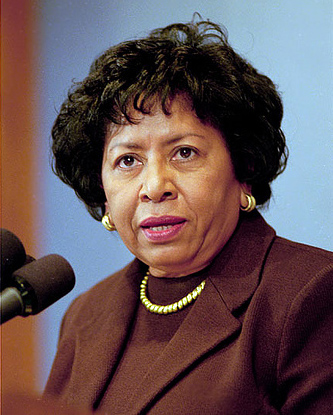
Ruth Simmons (born Ruth Jean Stubblefield,[1] July 3, 1945) is an American professor and academic administrator. Simmons served as the eighth president of Prairie View A&M University, a historically Black university (HBCU), from 2017 until 2023.[2][3][4] From 2001 to 2012, she served as the 18th president of Brown University, where she was the first African-American president of an Ivy League institution. During her time at Brown, Simmons was named the best college president by Time magazine. Prior to Brown University, she headed Smith College, one of the Seven Sisters and the largest women's college in the United States, beginning in 1995. During her tenure, Smith College launched the first accredited engineering program at an all-women's college.

Key Information

Simmons is a professor of literature specializing in the Romance languages. As of 2017, Simmons is a fellow of the American Academy of Arts and Sciences, the American Philosophical Society (1997), an honorary fellow of Selwyn College, Cambridge, and a Chevalier of the French Legion of Honor.

In February 2023, Simmons announced her plans to advise Harvard University on fostering relationships with historically black universities (HBCUs).[5] As of April 2023, Simmons serves as a President's Distinguished Fellow at Rice University.[6]

Early life and education

[edit]

Simmons was born in Grapeland, Texas. She is the last of 12 children of Fanny (née Campbell) and Isaac Stubblefield.[7][8] Her father was a sharecropper[9] up until the family moved to Houston during her school years. Her paternal grandfather descends partly from the Benza and Kota people, enslaved people from Gabon,[10][11] while her maternal line is traced back to the indigenous peoples of America.[12]

While in school, one of her teachers, Vernell Lillie, talked to her about attending college, something she had never considered before.[13] She earned her bachelor's degree, on scholarship, from Dillard University in New Orleans, Louisiana, in 1967. She earned her master's and a doctorate in Romance literature from Harvard University in 1970 and 1973, respectively.[14]

Career

[edit]

Early academic positions

[edit]

Simmons was an assistant professor of French at the University of New Orleans (UNO) from 1973 to 1976 and assistant dean of UNO's College of Liberal Arts from 1975 to 1976. She moved to California State University, Northridge in 1977 as administrative coordinator of its NEH Liberal Studies Project. From 1978 to 1979, she was acting director of California State University, Northridge's International Programs and visiting associate professor of Pan-African Studies.[15]

Simmons moved to the University of Southern California in 1979 as assistant dean of graduate studies and later as associate dean of graduate studies.[16] In 1983, she moved to Princeton University and served as assistant dean of faculty, and later as associate dean of faculty from 1986 to 1990. Simmons served as provost at Spelman College from 1990 to 1991 and returned to Princeton, where she served as vice provost from 1992 to 1995.[15]

Smith College presidency

[edit]

In 1995, Simmons was selected as president of Smith College, which she led until 2001. As president of Smith College, Simmons started the first engineering program at a U.S. woman's college.[17]

Brown University presidency

[edit]
Ruth Simmons at Brown's 2006 Commencement. David Cicilline, then mayor of Providence, behind her.
Simmons in 2008 during her tenure as President of Brown University

In November 2000, Simmons was named as the first African-American woman to head an Ivy League school.[18][19] She officially assumed office in October 2001, succeeding Gordon Gee. She also held appointments as a professor in the departments of Comparative Literature and Africana Studies. In 2002, Ms. magazine named her a Woman of the Year; in 2001, Time named her as America's best college president.[20]

At Brown, she launched a $1.4 billion initiative known as Boldly Brown: The Campaign for Academic Enrichment to enhance Brown's academic programs. The campaign would surpass its original goal, raising $1.61 billion.[21] In 2004, former Brown student Sidney E. Frank made the largest aggregate monetary contribution to Brown in its history in the amount of $120 million.[22]

In 2007, philanthropist Warren Alpert made a similar contribution to strengthen the programs of The Warren Alpert Medical School of Brown University in the amount of $100 million. As reported in a May 22, 2009 press release, Brown Chancellor Thomas J. Tisch announced the early attainment of the $1.6 billion fundraising campaign and the continued pursuit of specific subsidiary goals in support of endowments for student scholarships of the Brown faculty and internationalization programs through the originally planned campaign to be continued through December 31, 2010.[23]

In 2006, during an orientation meeting with parents, Simmons denied interest in the presidency of Harvard University, headed at the time by interim president Derek Bok. Nevertheless, a 2007 New York Times article, featuring a photograph of Simmons, reported that the Harvard Corporation, responsible for selecting the university's replacement for former president Lawrence Summers, had been given a list of "potential candidates" that included her name.[24]

In August 2007, Simmons was invited to deliver the 60th Annual Reading of the historic 1790 George Washington Letter to Touro Synagogue at the Synagogue in Newport, Rhode Island, in response to Moses Seixas on religious pluralism.[25] According to a March 2009 poll by The Brown Daily Herald, Simmons had more than an 80% approval rating among Brown undergraduates.[26]

In September 2011, Simmons announced that she would step down from her position as President of Brown at the end of the 2011–12 academic year, initially saying she would remain at Brown as a professor of comparative literature and Africana studies. She was succeeded as the President of Brown on June 30, 2012, by Christina Paxson.[27]

Goldman Sachs role and compensation

[edit]

Simmons earned annual compensations of more than $300,000 from Goldman Sachs (on top of her annual salary from Brown of more than $500,000), while serving on the Goldman board of directors during the 2008 financial crisis; in addition, she left the Goldman board (which she had joined in 2000) in 2009 with more than $4.3 million in Goldman stock.[28][29] During her term on Goldman's board, she also served on the compensation committee of Goldman's ten-person board, which decided how large Goldman executives' post-crash bonuses would be: these bonuses included a $68 million bonus for the company's chairman and CEO, Lloyd C. Blankfein, in 2007, and a $9 million bonus in 2009, after Goldman received money in the federal TARP bailout.[28][29] The revelations of Simmons's role received intense criticism from both alumni and students with a then-sophomore stating that Simmons's actions "brought shame on the university."[28] Simmons was cited in the 2010 film Inside Job, as an example of the conflicts of interest between university economics departments and deregulation of financial institutions.[30]

Transnational initiatives at Brown

[edit]

In 2003, Simmons established the University Steering Committee on Slavery and Justice. In 2006, the Report of the Brown University Steering Committee on Slavery and Justice was published, examining the university's complex history with the transatlantic slave trade.[31][32][33] On February 16, 2007, at an event celebrating the 200th anniversary of the passage of the Slave Trade Act 1807 and the involvement of Cambridge University alumni William Wilberforce, Thomas Clarkson and William Pitt the Younger, Simmons delivered a lecture at St. John's College, Cambridge, entitled Hidden in Plain Sight: Slavery and Justice in Rhode Island.[34] Also in February 2007, Brown University published its official Response to the Report of the Steering Committee on Slavery and Justice following the completion of the inquiry undertaken by the committee appointed by Simmons.[35]

In October 2007, Simmons appointed David W. Kennedy, as vice president for international affairs.[36] Brown and Banco Santander of Spain inaugurated an annual series of International Advanced Research Institutes to convene younger scholars from emerging and developing countries at Brown in a signing ceremony on November 13, 2008, at the John Hay Library between Brown provost David Kertzer and Emilio Botin, chairman of Banco Santander.[37] In March 2010, Simmons traveled to India as part of a program called the Year of India, dedicated to improving the understanding of Indian history, politics, education, and culture among Brown students and faculty.[38][39]

On September 15, 2011, Simmons announced that she would retire from the Brown presidency at the end of the academic year, June 30, 2012.[40]

Prairie View A&M University presidency

[edit]

In 2017, after five years of retirement, Simmons accepted an offer to serve as the interim president of Prairie View A&M University, an HBCU in her home state of Texas. She served as interim president from July 1, 2017 to December 3, 2017.[41] On December 4, 2017, she was selected as the eighth president of Prairie View A&M University, becoming the first woman to do so.[42][43]

At Prairie View A&M, Simmons focused her efforts on improving the university's financial stability, particularly on fundraising through an anonymous donor for the Panther Success Grants for undergraduates. Her vision for the university was to "ensure that Prairie View A&M University sustains excellence in teaching, research, and service for another 140-plus years...we will raise funds in a new and vital way so that the University will have the flexibility it needs to advance and make more visible its reach."[9][44] On March 11, 2022, Simmons announced that she would retire from her role as president when the university named her successor.[2]

In 2022, Prairie View A&M announced that scholarships had increased and donations to the university had grown by 40% during Simmons’ 5-year presidency.[4]

Civic activities and honors

[edit]

Works

[edit]
  • Simmons, Ruth J. (September 5, 2023). Up Home. Random House. ISBN 978-0-593-44600-3. [60][61][62][63][64]

See also

[edit]

References

[edit]

Further reading

[edit]
[edit]
Revisions and contributorsEdit on WikipediaRead on Wikipedia
from Grokipedia
Ruth J. Simmons (born 1945) is an American academic administrator recognized for her pioneering leadership in higher education, notably as the first African American president of an Ivy League institution during her tenure as the 18th president of Brown University from 2001 to 2012. Born into poverty as one of twelve children of sharecroppers in segregated Texas, Simmons rose through determination and academic excellence to earn a Ph.D. from Harvard University in 1973, subsequently holding faculty and administrative roles at institutions including the University of Southern California and Princeton University before ascending to college presidencies. She served as the ninth president of Smith College from 1995 to 2001, where she emphasized liberal arts education and institutional growth, and later as the eighth president of Prairie View A&M University, a historically Black institution, from 2017 to 2023, during which she advocated for increased resources amid criticisms of systemic neglect by the Texas A&M University System. At Brown, Simmons implemented need-blind financial aid policies to broaden access, launched a $1.4 billion capital campaign—the largest for any Ivy League at the time—and commissioned the university's groundbreaking Steering Committee on Slavery and Justice report in 2006, which examined institutional complicity in the slave trade and influenced subsequent reparative initiatives. Named "America's best college president" by Time magazine in 2001, she has received over forty honorary degrees and continues to influence education as a senior adviser to Harvard University on historically Black college partnerships and as a distinguished fellow at Rice University.

Early Life and Education

Childhood and Family Origins

Ruth Simmons was born Ruth Jean Stubblefield on July 3, 1945, near Grapeland in Houston County, , as the youngest of twelve children to Fanny Campbell and Isaac Stubblefield. Her parents were sharecroppers, part of a family lineage tied to agricultural labor in the segregated South, where economic hardship defined daily existence amid . The Stubblefield family resided in a modest sharecropper shack on a farm, embodying the poverty prevalent among rural families in mid-20th-century . Simmons' involved assisting with work alongside her siblings, reflecting the intergenerational cycle of manual labor and limited opportunities for formal during planting and harvest seasons. In 1952, the family relocated to , a move prompted by the search for better prospects, which enabled Simmons to attend segregated public schools consistently, as law then mandated school attendance for children. This urban shift marked a transition from rural isolation to expanded, though still constrained, access to resources in a larger .

Academic Preparation and Degrees

Simmons, born Ruth Jean Stubblefield on July 3, 1945, in , to sharecropper parents, grew up as the fourth of twelve children in a family that relocated to in 1952. She attended segregated public schools in , where dedicated teachers fostered her academic ambitions despite resource limitations, graduating at the top of her class from High School in 1963. As the first in her family to pursue postsecondary education, she drew on strong familial and communal support to secure a scholarship to , a historically Black institution in New Orleans. At Dillard, Simmons majored in French and earned a degree summa cum laude in 1967. She then advanced to for graduate training in , receiving a in 1970 and a in Romance Languages and Literatures in 1973. During this period, she held Danforth and Fulbright fellowships, which supported her scholarly focus on French and .

Academic and Administrative Career

Initial Faculty Positions

Simmons commenced her academic career following the completion of her Ph.D. in Romance Languages and Literatures from Harvard University in 1973, securing her first faculty position as an assistant professor of French at the University of New Orleans, where she taught from 1973 to 1976. In this role, she focused on French language and literature, while also assuming administrative duties as assistant dean of the College of Liberal Arts from 1975 to 1976, which involved oversight of curriculum and faculty development in the humanities. In 1977, Simmons transitioned to , serving initially as administrative coordinator for a National Endowment for the Humanities-funded Liberal Studies Program, and subsequently as visiting associate professor of Pan-African Studies from 1978 to 1979, alongside acting as director of international programs during that period. These positions allowed her to integrate her expertise in with interdisciplinary work on studies, emphasizing educational initiatives. From 1979 to 1983, she held administrative roles at the , beginning as assistant dean of graduate studies and advancing to associate dean, where her responsibilities included graduate program coordination and faculty support, though without a primary teaching load documented in these years. This phase bridged her early faculty experience toward more prominent academic leadership. Her initial faculty trajectory culminated in 1983 with an appointment at as a professor of , a tenure-track position that combined scholarly research in French and with administrative duties as dean of students until 1986. At Princeton, Simmons contributed to curricula and , laying groundwork for her subsequent deanships and provost roles.

Deanship and Early Leadership at Princeton

Simmons joined in 1983 as the inaugural Director of Studies at Butler College, a newly established aimed at enhancing undergraduate academic and residential life. In this role, which she held until 1985, she oversaw curriculum integration and student advising in a context marked by racial tensions, including incidents of profiling targeting Black students. From 1985 to 1987, she concurrently served as Acting Director of the Afro-American Studies Program, helping to stabilize and guide its operations during a transitional period. In 1986, Simmons was appointed Assistant Dean of the Faculty, a position she held through 1987 while advancing administrative responsibilities in faculty recruitment, development, and policy. She was promoted to Associate Dean of the Faculty in 1987, serving until 1990, during which she contributed to efforts in academic governance and diversity initiatives amid Princeton's evolving demographic landscape. These deanships positioned her as a key figure in faculty affairs, marking pioneering administrative service for an African American woman at the . After a brief tenure as Provost at from 1990 to 1991, Simmons returned to Princeton in 1992 as Vice Provost, a role she maintained until 1995. In this capacity, she supported the provost in overseeing academic programs, faculty appointments, and interdisciplinary efforts, building on her prior experience to foster institutional improvements in and minority inclusion. Her leadership during this period emphasized collaborative problem-solving in a selective academic environment, though specific quantifiable outcomes such as policy changes or enrollment shifts attributable to her directly remain undocumented in primary records.

Presidency of Smith College

Ruth Simmons was appointed the ninth president of Smith College in December 1994 and assumed office in 1995, serving until 2001. Her selection marked a historic milestone, as she became the first African American to lead the institution and one of the first African American women to preside over a major U.S. college or university. During her tenure, Simmons emphasized academic innovation and institutional strengthening at the nation's largest women's . A of Simmons's presidency was the launch of Smith's first engineering program, the inaugural accredited engineering curriculum at any U.S. , aimed at expanding STEM opportunities for female students. This initiative addressed the underrepresentation of fields by integrating rigorous technical training with the college's liberal arts foundation, including partnerships for advanced degrees. She also established Meridians: , race, , a peer-reviewed journal dedicated to scholarship on women of color and transnational feminist perspectives, fostering interdisciplinary discourse on marginalized voices. Additionally, Simmons oversaw the creation of a center that hosted prominent poets and enhanced the college's literary offerings, alongside other programs to broaden curricular diversity and faculty recruitment. Simmons's leadership focused on strategic academic enhancements without reported major controversies during her time at Smith. In 2001, she departed to become president of , concluding her tenure amid recognition for advancing Smith's profile in higher education.

Presidency of Brown University

Ruth Simmons assumed the presidency of on July 1, 2001, becoming the first African American to lead an institution. Her appointment followed her successful tenure at Smith College and was approved unanimously by Brown's Corporation. During her 11-year term, which ended in 2012, Simmons focused on enhancing the university's financial stability, academic excellence, and historical accountability. A cornerstone of her presidency was aggressive fundraising, culminating in the "Boldly Brown" campaign, which raised $1.4 billion by January 2011, exceeding its goals with $573 million in current-use funds and significant endowments for faculty chairs and financial aid. Overall, Simmons secured $1.6 billion in donations, bolstering 's endowment and enabling expanded support for undergraduate financial aid, including $311 million dedicated to need-based aid and the establishment of the $100 million Endowed Scholarship Fund. These efforts helped transition toward need-blind admissions for domestic applicants, reducing financial barriers for low-income students. Simmons also prioritized academic and institutional reforms, appointing a Steering Committee on and in 2003 to examine Brown's historical ties to the transatlantic slave trade and its enduring legacies. The committee's 2006 report prompted public acknowledgment of the university's founders' involvement in and led to initiatives like reparative scholarships for descendants of slaves and the creation of the Center for the Study of and , later renamed in her honor in 2023. Under her leadership, Brown invested in interdisciplinary programs, faculty recruitment, and global engagement, fostering a more diverse and research-oriented campus. Her presidency drew praise for strengthening Brown's financial position and international profile amid economic challenges, though some critics noted tensions over and campus . Simmons announced her resignation on September 15, 2011, effective at the end of the academic year, citing a desire to pursue new opportunities after guiding the university through a transformative decade. Her legacy includes a revitalized with enhanced and a commitment to confronting historical injustices unflinchingly.

Presidency of Prairie View A&M University

Ruth Simmons was appointed interim president of (PVAMU), a historically land-grant institution within the , on June 21, 2017. She was confirmed as the eighth permanent president on January 9, 2018, and inaugurated in April of that year. Her tenure emphasized enrollment expansion, financial enhancement, and infrastructure development amid ongoing systemic funding inequities for HBCUs. Under Simmons, PVAMU achieved record freshman enrollment in 2019, with a nearly 15% increase in incoming freshmen and total enrollment trending 8% above the prior year's 8,762 students. By fall 2021, enrollment reached 9,353 students. She secured $50 million from philanthropist , including $40 million for the endowment to bolster faculty and research investments. Additional initiatives included the Panther Success Grant to alleviate student financial burdens and an African American studies program. Infrastructure progress featured a 2019 student housing groundbreaking and a $70 million building. In April 2022, Simmons announced an expanded partnership with to facilitate joint research, faculty collaborations, and student opportunities, leveraging the institutions' proximity. Simmons repeatedly highlighted chronic underfunding of PVAMU's land-grant mission, with historically allocating disproportionately less compared to other system campuses, contributing to endowment disparities—PVAMU's $77 million versus Texas A&M's $13.6 billion. She prioritized affordability as a core strategy, arguing it essential for HBCU competitiveness. Her presidency ended prematurely on February 28, 2023, four months before her planned June 1 retirement, after Texas A&M John Sharp denied her request to hire senior staff as an outgoing president, citing a system policy against such actions to preserve incoming leaders' . Simmons described this as emblematic of "limited presidential ," prompting her . Subsequently, she accused the system of neglecting PVAMU through inadequate HBCU support and . System officials rebutted that PVAMU received $341 million in construction projects over 11 years, $36 million in targeted funding, and other investments, framing her departure as a reaction to a single policy enforcement after nearly six years.

Financial and Ethical Controversies

Goldman Sachs Compensation and Conflicts of Interest

Ruth Simmons joined the board of directors of in January 2000 and served until announcing in February 2010 that she would not stand for re-election at the annual , citing increasing time requirements associated with her presidential duties at . During her tenure, she sat on the firm's Compensation Committee, which oversaw executive pay decisions, including approvals for multimillion-dollar bonuses amid the when Goldman had received $10 billion in TARP funds before repaying them with interest. Simmons's compensation as a Goldman director included an annual retainer of approximately $323,000, comprising cash, awards, and other benefits, with total director pay at the firm averaging over $600,000 in some years during her service. Upon departing the board in 2010, she retained a portfolio of valued at $4.3 million, accumulated through and grants. These earnings supplemented her presidential salary, which ranged from $300,000 to over $800,000 annually during the same period, raising questions about the alignment of her dual roles. Critics, including Brown students and alumni, highlighted perceived conflicts of interest, arguing that Simmons's oversight of Goldman —totaling $16.2 billion firm-wide in 2009, or about $498,000 per employee—clashed with her leadership of a nonprofit university reliant on endowments potentially exposed to volatility. Concerns extended to whether her board position influenced 's investment decisions or softened institutional scrutiny of Goldman, though no evidence of direct or improper transactions emerged, and 's governing maintained that her service posed no conflicts. The timing of her exit, shortly after heightened public backlash against pay practices, fueled speculation, despite her insistence that campus or external pressures played no role. Simmons publicly defended her Goldman involvement in subsequent interviews, emphasizing her independence in committee deliberations and rejecting claims that it compromised her university leadership, while noting the value of corporate board experience for nonprofit governance. In a 2011 reflection, she described media portrayals of campus outrage as exaggerated, attributing much criticism to broader anti-Wall Street sentiment rather than specific ethical lapses. No formal investigations or regulatory actions targeted her service, though it exemplified post-crisis scrutiny of academic leaders holding corporate directorships at bailed-out firms.

Responses to Institutional Criticisms

Simmons addressed criticisms of her decade-long tenure on the board of directors (2000–2010), which overlapped with her presidency at , by asserting that it posed no detriment to the institution. She stated she "can’t imagine" any negative impact and would have resigned sooner if her role embarrassed . Amid post-2008 scrutiny over ' federal bailout and executive bonuses—including a $68 million payout to CEO that she voted to approve—Simmons expressed comfort with public judgment of her decisions, noting the board's role had evolved to demand more time, prompting her February 2010 departure. Campus detractors, including students who accused her of "selling out" to , highlighted perceived conflicts, such as potential influence on Brown's recruiting ties to Goldman (where over 300 worked). Simmons countered that her service neither hindered nor altered the firm's longstanding recruitment at , and her exit was self-initiated due to presidential duties, not swayed by input from Brown's governing body, though she consulted a senior leadership committee. Tisch corroborated the absence of conflicts. In her 2023 early resignation from —four months ahead of schedule—Simmons rebuffed the System's policy curtailing hiring authority for outgoing presidents, refusing to continue as "president in name only" and declaring that "no enduring good can arise from subservience to low standards and expectations." She later lambasted the system for chronic neglect of the historically Black institution, dismissing their account of her tenure as "rubbish" given her record of stabilizing enrollment and finances. System Chancellor John Sharp upheld the decade-old policy as uniformly enforced without exceptions, expressing regret over her choice but affirming the need for new leadership to select its team.

Intellectual Contributions and Public Views

Educational Philosophy and Reforms

Ruth Simmons' educational philosophy centers on the transformative potential of higher education to foster and personal growth, drawing from her own ascent from through rigorous academic pursuit. She emphasizes exposure to diverse perspectives as essential for intellectual development, arguing that encountering difference prompts deeper reflection and counters bias, rather than relying solely on standardized metrics like test scores. Simmons advocates merit-based access without quotas, prioritizing individual potential to enrich learning environments and prepare students for a globalized society marked by persistent divisions. She views , including like and , as vital for broadening worldviews and enabling adaptation, informed by her experiences at historically Black colleges and abroad. At , where she served as president from 1995 to 2001, Simmons implemented reforms to expand curricular offerings, notably establishing the first engineering program at any to address gender gaps in STEM fields. She also funded the Center to enhance engagement with , aligning with her belief in accessible arts to cultivate well-rounded scholars. During her presidency at from 2001 to 2012, Simmons advanced equity in admissions by overseeing the shift to need-blind policies, decoupling financial need from acceptance decisions to broaden access for underrepresented students. A landmark initiative was her 2003 formation of the Steering Committee on and , the first such university-led probe into institutional ties to the slave trade, culminating in a 2006 report that spurred global self-examinations and led to the creation of for the Study of and (later renamed in her honor). This effort modeled transparent historical reckoning as integral to educational integrity, raising over $1.6 billion for Brown's initiatives. As president of Prairie View A&M University from 2017 to 2023, Simmons launched the Ruth J. Simmons Center for Race and Justice in 2021, focusing on research into race relations, policy recommendations, and projects like the Epa Committee—a multi-year study of the institution's slavery and segregation legacy, set for completion by 2026. Additional center efforts included the HBCU Voting Rights Lab to document student activism against suppression and an Implicit Bias Training and Equity Project partnering with local entities for cross-sector education. She also initiated a Toni Morrison Writing Program to strengthen humanities amid post-2020 racial reckonings. These reforms aimed to elevate academic programs and faculty quality at the historically Black institution, reflecting her commitment to equity without compromising standards.

Positions on Affirmative Action and DEI

Ruth Simmons testified in support of race-conscious admissions during the 2018 federal trial Students for Fair Admissions v. Harvard, defending Harvard's practices as beneficial for institutional diversity based on her experience in higher education . After the U.S. Supreme Court's June 29, 2023, ruling in Students for Fair Admissions v. Harvard and , which barred public and private universities from using race as a factor in admissions, Simmons cautioned against simplistic or "lazy" approaches to enrollment. She argued that institutions must intensify recruitment efforts and holistic evaluations—beyond rote reliance on grades and scores—to achieve diverse classes without racial classifications, drawing from her prior admissions work at Harvard and Princeton. On (DEI) initiatives, Simmons has positioned herself as an advocate for expanding access and fairness in , viewing diversity as essential to preparing students for global challenges. She has promoted DEI as a means to foster inclusion and academic excellence, as in her 2021 Princeton baccalaureate address urging graduates to let diversity "inform and shape" their professional lives. Simmons has critiqued aspects of DEI implementation, noting in 2023 that such efforts "are not perfect" amid anticipation of the ban, and called for innovative replacements emphasizing merit and outreach over quotas. In an August 2024 discussion, she highlighted the need for systemic changes to improve diversity amid affordability pressures. In a May 2024 Berkeley lecture, she framed equal access as at a "critical ," asserting that enables "smoothing out" birth-related inequalities but requires renewed institutional commitment post-affirmative action. She joined a May 2025 Institute panel on the future of DEI, underscoring ongoing adaptation in higher education equity strategies.

Memoir and Personal Reflections

In her 2023 memoir Up Home: One Girl's Journey, Ruth J. Simmons recounts her early life as the youngest of twelve children born to parents in , in 1945, amid the harsh realities of Jim Crow segregation and . The book details the family's rudimentary living conditions in a small shack lacking running water, electricity, or indoor plumbing, where survival depended on tenant farming and vegetables under exploitative landowner contracts that often left them in debt. Simmons reflects on the intellectual curiosity fostered by her mother, Fannie, who emphasized education despite her own illiteracy, instilling values of resilience, hard work, and moral integrity amid constant economic precarity and racial threats, such as nearby lynchings that underscored the mortal dangers of Black life in the 1940s South. Simmons describes a pivotal family relocation at age six to Houston's Fifth Ward in , transitioning from isolated rural fields to an urban environment of tenement housing, where her mother took on domestic work to support the after her father's health declined from years of manual labor. In personal reflections within the and related interviews, she credits her mother's example of and authenticity—drawn from an earlier essay titled "My Mother's Daughter: Lessons I Learned in and Authenticity"—as foundational to her own , portraying Fannie as a figure of quiet who navigated white employers' demands without , teaching Simmons to prioritize self-respect over . These accounts emphasize causal factors like familial discipline and community networks over abstract narratives of systemic victimhood, highlighting how small acts of perseverance, such as Simmons's early reading habits fueled by donated books, propelled her escape from . Beyond childhood, Simmons's reflections extend to broader life lessons on authenticity and institutional truth-seeking, as shared in post- discussions, where she advocates living "faithful to who you think you are" amid professional pressures, drawing from her ascent through academia without compromising personal integrity. She portrays her trajectory not as predestined triumph but as improbable outcomes of deliberate choices, including rejecting defeatist attitudes toward racial barriers, and underscores the role of mentors and in overcoming them, as evidenced in her accounts of navigating desegregated schools and early career hurdles. The serves as a to overlooked enablers—family, teachers, and neighbors—whose grounded support, rather than external interventions, shaped her worldview, reinforcing her public stance on education as a merit-based ladder requiring individual agency.

Later Roles, Honors, and Legacy

Post-Presidency Positions and Boards

After resigning as president of Prairie View A&M University in February 2023, Simmons retained ties to the institution as president emerita and university professor, focusing on fundraising, leadership development, and faculty responsibilities. In the same month, Harvard University appointed her senior adviser to the president, tasked with strengthening partnerships with historically black colleges and universities (HBCUs) and supporting the Harvard & the Legacy of Slavery Initiative. Effective April 1, 2023, she began serving as President's Distinguished Fellow at Rice University, where she advises on strategic initiatives in higher education leadership and equity. Simmons holds several board positions reflecting her expertise in education, finance, and philanthropy. In January 2025, the Federal Reserve Board of Governors appointed her to the board of directors of the Federal Reserve Bank of Dallas for a three-year term, building on her prior service on the bank's Houston Branch board. She joined the board of trustees of , contributing to governance at the historically black men's institution. In June 2023, she was elected to the board of directors of the John D. and Catherine T. MacArthur Foundation, which supports creative solutions to global challenges. Additionally, she serves on the board of The Holdsworth Center, a Texas-based organization dedicated to developing education leaders.

Awards and Recognitions

Simmons has received over 40 honorary degrees from universities worldwide, including Oxford University, in , (, 2024), and (, 2025). In recognition of her educational leadership, she was named America's best college president by Time magazine in 2001. She received the President's Award from the United Negro College Fund in 2001, the Fulbright Lifetime Achievement Medal in 2002, and the in 2004. The Foreign Policy Association awarded her its medal for contributions to international understanding. Simmons was honored with the BET Honors Award on January 16, 2010, for her accomplishments in education during her presidency, alongside the and American Foreign Policy Association Medal that year. In 2011, she received the Susan Colver Rosenberger Medal, the highest honor from the faculty. The named her a Chevalier of the Legion of Honor in 2012, later promoting her to Officier in 2025, the highest decoration for contributions to French interests abroad. More recently, she delivered the ' Jefferson Lecture in 2023 and was awarded the by President in 2024 for advancing scholarship and civic education.

Enduring Impact and Assessments

Simmons' leadership at (2001–2012) catalyzed a sustained institutional reckoning with historical ties to , commissioning the 2006 Slavery and Justice Report that documented the university's founders' involvement in the slave trade and recommended reparative measures, influencing subsequent programs like the Center for the Study of Slavery and Justice, renamed in her honor in 2024 for its role in ongoing research and public engagement on slavery's legacies. This initiative set a for elite institutions addressing complicity in historical injustices, with Simmons advocating unflinching confrontation of such histories to foster truthful education rather than evasion. Her presidencies elevated underrepresented institutions, including turning around (2017–2023) by boosting enrollment from under 8,000 to over 9,500 students and securing $100 million in state funding for infrastructure, while at (1995–2001) she expanded access for low-income and first-generation students through need-based aid reforms that increased diversity without diluting academic standards. Assessments from peers highlight her as a model for merit-based inclusion, emphasizing universities' role as "guardians of truth" amid ideological pressures, with her remarks underscoring the need for evidence-driven discourse over performative activism. In broader evaluations, Simmons is credited with bridging HBCU strengths to predominantly white institutions, as seen in her 2023 Harvard appointment to advise on legacies and HBCU partnerships, aiming to integrate rigorous historical analysis into curriculum reforms across sectors. Her 2022 caution against abruptly eliminating legacy admissions—arguing it could undermine diversity at selective colleges reliant on support for financial aid—reflects a pragmatic assessment prioritizing sustained access over symbolic changes, drawing from empirical enrollment data post-affirmative action shifts. Recent 2025 discussions position her views on DEI as favoring institutional neutrality to resolve societal tensions through scholarship, rather than alignment with transient politics. Critics within progressive academia have occasionally faulted her for insufficient emphasis on systemic overhaul in favor of individual achievement narratives, as inferred from reflections prioritizing personal resilience over collective grievance, though such assessments lack empirical backing against her documented outcomes in student success metrics. Overall, her legacy endures as a to ideological conformity in higher education, evidenced by continued board roles at and , where she advocates for education's transformative power grounded in factual inquiry.

References

Add your contribution
Related Hubs
User Avatar
No comments yet.