


Community hub
Recent from talks
Contribute something
Nothing was collected or created yet.
3rd SS Panzer Division Totenkopf
View on Wikipedia
| 3rd SS Panzer Division Totenkopf | |
|---|---|
| 3. SS-Panzerdivision "Totenkopf" | |
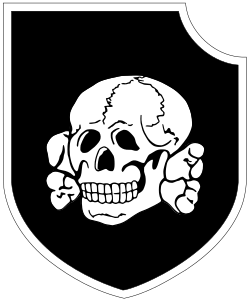
 Divisional insignia | |
| Active | 1939–45 |
| Country |  Nazi Germany Nazi Germany |
| Branch |  Waffen-SS Waffen-SS |
| Type | Panzer |
| Role | Armoured warfare |
| Size | Division |
| Nickname | Death's Head Division |
| Engagements | |
| Commanders | |
| Notable commanders | |
The 3rd SS Panzer Division "Totenkopf" (German: 3. SS-Panzerdivision "Totenkopf")[1] was an elite division of the Waffen-SS of Nazi Germany during World War II, formed from the Standarten of the SS-TV. Its name, Totenkopf, is German for "death's head" – the skull and crossbones symbol – and it is thus sometimes referred to as the Death's Head Division.[2]
The division was formed through the expansion of Kampfgruppe Eicke, a battle group named – in keeping with German military practice – after its commander, Theodor Eicke. Most of the battle group's personnel had been transferred to the Waffen-SS from concentration camp guard units, which were known collectively as SS-Totenkopfverbände; others were former members of Selbstschutz: ethnic German militias that had committed war crimes in Poland.
The division became notorious for its brutality, and committed numerous war crimes, including the Le Paradis and Chasselay massacres. The remnants of the division surrendered on 9 May 1945 to American forces in Czechoslovakia.
Formation
[edit]The SS Division Totenkopf was formed in October 1939.[3] The division had close ties to the camp service and its members. When it was first formed a total of 6,500 men from the SS-Totenkopfverbände (SS-TV) were transferred into the Totenkopf Division.[4] The Totenkopf was initially formed from concentration camp guards of the 1st ("Oberbayern"), 2nd ("Brandenburg") and 3rd ("Thüringen") Standarten (regiments) of the SS-Totenkopfverbände and men from the SS Heimwehr Danzig. Members of other SS militias were also transferred into the division in early 1940; these units had been involved in multiple massacres of Polish civilians, political leaders and prisoners of war.[5] The division had officers from the SS-Verfügungstruppe (SS-VT), of whom many had already seen action in Poland. The division was commanded by SS-Obergruppenführer Theodor Eicke.[6] At the time of the Battle of France, the division was equipped with ex-Czech weapons.[7]
Battle of France
[edit]Totenkopf was initially held in reserve during the Battle of France and invasion of the Low Countries in May 1940.[8] The division was committed on 16 May to the front in Belgium. Later, it was decided that Totenkopf would reinforce the breakthrough of Erwin Rommel's 7th Panzer Division in the Cambrai area. Reaching the Bazuel area straddling both sides of the river it arrived on the front on 19 May, facing elements of the French 1st Moroccan Infantry Division, 5th North African Infantry Division, and 9th Motorized Division. Totenkopf suffered 16 dead and 53 wounded while killing 200 Moroccan soldiers in its first day in action.[9] In its first major battle it captured the town of Catillon-sur-Sambre and its associated canal in fierce house-to-house fighting, blocking the exits of the town and trapping the Moroccan force in the center around the market square, eventually captured thousands of remaining troops. Soldiers from Totenkopf executed many captured Moroccans, due to Arabs being considered "racially inferior".[10] On the morning of the next day, May 20 it contained a major Moroccan counter attack near Ribeauville, driving it back with its own counter attack, before crossing the Selle river and linking up with Rommel's division in the outskirts of Cambrai.[11] Overall in the actions around the Cambrai/Sambre area the division captured 16,000 troops.
Whilst subsequently trying to drive through to the coast, Totenkopf was involved in the Battle of Arras. On 21 May units of the 1st Army Tank Brigade, supported by the 50th (Northumbrian) Infantry Division, overran some of Totenkopf's positions, their standard anti-tank gun, the 3.7 cm PaK 36, being no match for the British Matilda tank[12] although they quickly halted the British. In the following days, the unit committed several large-scale massacres of French civilians, most notable the Berles-Monchel and Aubigny-en-Artois massacres.[13] On 27 May, the 4 Company of the Totenkopf under the command of Hauptsturmführer Fritz Knöchlein, committed the Le Paradis massacre, where 97 soldiers of the 2nd Battalion, Royal Norfolk Regiment were machine-gunned after surrendering, with survivors killed with bayonets. Only two men survived.[14][15]
Invasion of the Soviet Union
[edit]

In April 1941, the division was ordered East to join Field Marshal Wilhelm von Leeb's Army Group North. Leeb's force was tasked with advancing on Leningrad and formed the northern wing of Operation Barbarossa. It soon moved into a staging area near Insterburg and was assigned to Panzer Group 4. Totenkopf took part in the advance through Lithuania and Latvia, and by July had breached the Stalin Line. The division then advanced past Demyansk to Leningrad where it was involved in heavy fighting in August.
During Soviet winter counter-offensive, the division was encircled for several months near Demyansk in what became known as the Demyansk Pocket. During the fighting in the pocket, it was re-designated "Kampfgruppe Eicke" due to its reduced size. In April 1942, the division broke out of the pocket. At Demyansk, about 80% of its men were killed, wounded or missing in action. The division was sent to France to be refitted in late October 1942. While there, the division took part in Case Anton, the takeover of Vichy France in November 1942. For this operation, the division was supplied with a tank battalion and redesignated 3rd SS Panzergrenadier Division Totenkopf. The division remained in France until February 1943, when its previous commander, Theodor Eicke, resumed control.
Battle of Kursk and retreat on the Eastern Front
[edit]In February 1943 the division was moved back to the Eastern Front as part of Erich von Manstein's Army Group South. The division, as a part of SS-Obergruppenführer Paul Hausser's II SS Panzer Corps, took part in the Third Battle of Kharkov, blunting the Soviet offensive. During this campaign, Theodor Eicke was killed when his spotter aircraft was shot down. Hermann Priess succeeded Eicke as commander. The SS Panzer Corps, including the division, was then shifted north to take part in Operation Citadel, the offensive aimed at reducing the Kursk salient. It was during February 1943 that the 3rd SS Panzer Regiment received a company of Tiger I heavy tanks.
The attack was launched on 5 July 1943 with the II SS Panzer Corps attacking the southern flank of the salient as the spearhead for Generaloberst Hermann Hoth's 4th Panzer Army. The division covered the advance on the left flank of the II SS Panzer Corps, with the SS Division Leibstandarte forming the spearhead. With the advance slower than had been planned, Hausser ordered his II SS Panzer Corps to split in two, with the Totenkopf crossing the Psel River northwards and then continuing on towards the town of Prokhorovka. In the early morning of 9 July, 6th SS Motorised Regiment Theodor Eicke attacked northwards, crossing the Psel and attempted to seize the strategic Hill 226.6, but failed to do so until the afternoon. This meant that the northern advance slowed and the majority of the division was still south of the Psel, where elements of 5th SS Motorised Regiment 5 Thule continued to advance towards Prokhorovka and cover the flank of the Leibstandarte.
By 11 July, elements of the division crossed the Psel and secured Kliuchi. In the afternoon of 12 July, near the village of Andreyevka on the south bank of the Psel, the Soviet forces launched a major counterattack against Regiment Thule and the division's battalion of assault guns during the Battle of Prokhorovka.[16] Elements of the division engaged lead units of the 5th Guards Tank Army, halting the Soviet advance and inflicting severe damage to the Soviet forces, but at the cost of the majority of the division's remaining operational tanks. While the II SS Panzer Corps had halted the Soviet counteroffensive, it had exhausted itself. Citadel was called off on 14 July.
Along with the SS Division Das Reich, the division was reassigned to General Karl-Adolf Hollidt's reformed 6th Army in southern Ukraine. The 6th Army was tasked with eliminating the Soviet bridgehead over the Mius River. The division was involved in heavy fighting over the next several weeks. During the July–August battles for Hill 213 and the town of Stepanovka, the division suffered heavy losses, and over the course of the campaign on the Mius-Front, it suffered more casualties than it had during Operation Citadel. By the time the Soviet bridgehead was eliminated, the division had lost 1,500 troops; the Panzer regiment was reduced to 20 tanks.
The division was then moved north, back to Kharkov. Along with Das Reich, Totenkopf took part in the battles to halt Operation Rumyantsev and to prevent the Soviet capture of the city. The city was abandoned on 23 August due to the threats on the German flanks. In October 1943, the division was reformed as a Panzer division. The Panzer battalion was officially upgraded to a regiment, and the two motorised regiments were given the titles "Theodor Eicke" and "Totenkopf". The division, along with other Axis formations, continued its retreat towards the Romanian border. By November, the division was engaged in fighting against Red Army's attacks over the vital town of Krivoi Rog to the west of the Dniepr.
Warsaw
[edit]In January 1944, Totenkopf was still engaged in heavy defensive fighting east of the Dniepr near Krivoi Rog. In February 1944, Totenkopf took part in the relief attempt of German troops encircled in the Korsun Pocket. In the second week of March, after a fierce battle near Kirovograd, Totenkopf fell back behind the Bug River. Totenkopf took up new defensive positions. After two weeks of heavy fighting, again alongside the Panzer-Grenadier-Division Grossdeutschland, the Axis forces retreated to the Dniestr on the Romanian border near Iaşi. In the first week of April, the division received replacements and new equipment, including Panther tanks. In the second week of April, Totenkopf took part in fighting against a heavy Soviet Army attacks towards Second Battle of Târgu Frumos. By 7 May, the front had quieted and Totenkopf resumed its reorganizing.
In the Second Battle of Târgu Frumos, elements of the division, together with elements of the Großdeutschland, managed to halt an armoured assault by the Red Army. The assault, which in many aspects bore similarities to those of the later British Operation Goodwood, was carried out by approximately 500 tanks.[17][need quotation to verify] In early July, the division was ordered to the area near Grodno in Poland, where it formed a part of SS-Obergruppenführer Herbert Gille's IV SS Panzer Corps, covering the approaches to Warsaw near the Modlin Fortress.
After the Soviet Operation Bagration and the destruction of Army Group Centre the German lines had been pushed back over 480 kilometres, to the outskirts of the Polish capital. The division arrived at the Warsaw front in late July 1944. After the collapse of the German Army Group Centre, the IV SS Panzer Corps was one of the few functioning formations on the central section of the Eastern Front. On 1 August 1944, the Armia Krajowa (the Polish Home Army) launched the Warsaw Uprising. A column of Totenkopf Tiger tanks were caught up in the fighting, and several were lost. The Totenkopf itself was not involved in the suppression of the uprising, instead guarding the front lines, and fighting off several Red Army probe attacks into the city's eastern suburbs.
In several battles near the town of Modlin in mid-August, the Totenkopf, fighting alongside the SS Division Wiking and the Hermann Göring Division destroyed the Soviet 3rd Tank Corps. The terrain around Modlin is excellent for armour, and Totenkopf's panzers exploited this to their advantage, engaging Soviet tanks from a range where the superiority of the German optics and the 75 mm high-velocity gun gave the Panthers an edge over the T-34s.
Budapest relief attempts
[edit]The efforts of the Totenkopf, "Wiking" and "Hermann Göring" divisions allowed the Germans to hold the Vistula line and establish Army Group Vistula. In December 1944, the IX SS Mountain Corps (Alpine Corps-Croatia) was encircled in Budapest. Hitler ordered the IV SS Panzer Corps to redeploy south to relieve the 95,000 Germans and Hungarians trapped in the city. The corps arrived just before New Year's Eve. The relief attempts were to be codenamed Operation Konrad. The first attack was Konrad I. The plan was for a joint attack by the Wiking and Totenkopf from the town of Tata attacking along the Bicske-Budapest line. The attack was launched on New Year's Day, 1945.
Despite initial gains, Konrad I ran into heavy Red Army opposition near Bicske and during the battle the 1st Battalion, 3rd SS Panzer Regiment's commander, SS-Sturmbannführer Erwin Meierdress was killed. After the failure of the first operation, Totenkopf and Wiking launched an assault aimed at reaching the city centre. Named Operation Konrad II, the attack was launched on 7 January from just south of Esztergom. It reached as far as Budapest's northern suburbs, by 12 January motorised infantry of the Wiking division spotted the Hungarian capital's skyline. However, Gille's corps was overextended and vulnerable, so it was ordered to fall back.
Operation Konrad III got underway on 20 January 1945. Attacking from the south of Budapest, it aimed at encircling 10 Red Army divisions. However, the relief forces could not achieve their goal, despite making a 24-kilometre bulge in the Soviet forces line and destroying the 135th Rifle Corps. The encircled troops capitulated in mid-February. The division was pulled back to the west, executing a fighting withdrawal from Budapest to the area near Lake Balaton, where the 6th SS Panzer Army under SS-Oberstgruppenführer Josef Dietrich was massing for the upcoming Operation Spring Awakening.
Gille's corps was too depleted to take part in the assault, instead it provided flank support to assaulting divisions during the beginning of the operation. Totenkopf, together with Wiking, performed a holding action on the left flank of the offensive, in the area between Lake Velence-Székesfehérvár. Dietrich's army made "good progress" at first, but as they drew near the Danube, the combination of the muddy terrain and strong Soviet resistance ground them to a halt.[18] As the offensive stalled, the Soviets forces counterattacked in strength on 16 March. The Germans were driven back to the positions they had held before Operation Spring Awakening began.[19] Attacking the line between the Totenkopf and the Hungarian 2nd Armoured Division, contact was lost between the two formations. The 6th Army commander, General der Panzertruppe Hermann Balck, recommended moving the I SS Panzer Corps north to plug the gap and prevent the encirclement of the IV SS Panzer Corps, however, by the time the divisions finally began moving, it was too late.
On 22 March, the Red Army encirclement of the Totenkopf and Wiking was almost complete. The 9th SS Panzer Division Hohenstaufen held open a route which could be used to withdraw – the Berhida Corridor – and Gille's corps escaped the encirclement. The Red Army then launched the Vienna Offensive which destroyed any resemblance of an organised German line of defence. The remnants of the division retreated into Czechoslovakia where it surrendered to the American forces on 9 May.
War crimes
[edit]Poland
[edit]
With the invasion of Poland, Theodor Eicke – who was the commandant of the Dachau concentration camp, inspector of the camps, and murderer of Ernst Röhm – joined the fray with one cavalry and four infantry regiments. Three of his regiments, "Oberbayern", "Brandenburg" and "Thuringen", formed the basis of the first Einsatzgruppen; the Oberbayern and Thuringen (EG II and EG z. B.V) followed the Tenth Army in Upper Silesia; the Brandenburg (EG III) followed the Eight Army across Warthegau.[20] His Totenkopfverbände troops were called on to carry out "police and security measures" in the rear areas. What these measures involved is demonstrated by the record of SS Totenkopf Standarte "Brandenburg". It arrived in Włocławek on 22 September 1939 and embarked on a four-day "Jewish action" that included the burning of synagogues and the execution en masse of the leaders of the Jewish community. On 29 September the Standarte travelled to Bydgoszcz to conduct an "intelligentsia action".[21] The German Intelligenzaktion resulting in the mass murder of approximately 100,000 Poles, was a major step in the implementation of Sonderaktion Tannenberg (Operation Tannenberg a.k.a. Unternehmen Tannenberg) of installing Nazi officials from SiPo, Kripo, Gestapo and SD to head an administrative machine in occupied Poland, leading to the Generalplan Ost colonization programme.[22] In October 1939, these Totenkopfverbände troops formed the core of the 3 Totenkopf Division, of which Eicke became the commander.[3] In April and May 1943, the training battalion of the 3rd Panzer Division Totenkopf took part in the suppression of the Warsaw Ghetto Uprising.
France
[edit]Le Paradis Massacre
[edit]
While the Totenkopf Division committed numerous massacres of French Arab and African troops, the most infamous remains the murders at Le Paradis. The Le Paradis massacre was a war crime committed by members of the 14th Company, SS Division Totenkopf, under the command of Hauptsturmführer Fritz Knöchlein. It took place on 27 May 1940, during the Battle of France, at a time when the British Expeditionary Force (BEF) was attempting to retreat through the Pas-de-Calais region during the Battle of Dunkirk.
Soldiers of the 2nd Battalion, the Royal Norfolk Regiment, had become isolated from their regiment. They occupied and defended a farmhouse against an attack by Waffen-SS forces in the village of Le Paradis. After running out of ammunition, the defenders surrendered to the German troops. The Germans machine-gunned the men after they surrendered, with survivors killed with bayonets. Two men survived with injuries, and were hidden by locals until they were captured by German forces several days later. After the war, Knöchlein was tried for war crimes by a British military court. He was found guilty, sentenced to death, and executed in 1949.[14]
Chasselay massacre
[edit]Thereafter, the division worked together with Großdeutschland Division to carry out racially motivated murders of hundreds of captured black African members of the French Army. They murdered captured black soldiers on account of their race, which they believed to merit their separation and execution. For example, on 19 and 20 June 1940, Totenkopf and Großdeutschland together carried out a series of massacres of captured African soldiers in the Chasselay area, murdering about 100 captured Senegalese Tirailleurs.[23] They are today buried in the Tata of Chasselay.
Commanders
[edit]| No. | Portrait | Commander | Took office | Left office | Time in office |
|---|---|---|---|---|---|
| 1 | SS-Gruppenführer Theodor Eicke (1892–1943) | 1 November 1939 | 7 July 1941 | 1 year, 248 days | |
| 2 | SS-Oberführer Matthias Kleinheisterkamp (1893–1945) | 7 July 1941 | 18 July 1941 | 11 days | |
| 3 | SS-Brigadeführer Georg Keppler (1894–1966) | 18 July 1941 | 19 September 1941 | 63 days | |
| 1 | SS-Obergruppenführer Theodor Eicke (1892–1943) | 19 September 1941 | 26 February 1943 † | 1 year, 160 days | |
| 4 | SS-Gruppenführer Hermann Priess (1901–1985) [24] | 26 February 1943 | 27 April 1943 | 60 days | |
| 5 | SS-Gruppenführer Heinz Lammerding (1905–1971) | 27 April 1943 | 1 May 1943 | 4 days | |
| 4 | SS-Gruppenführer Hermann Priess (1901–1985) | 1 May 1943 | 20 June 1944 | 1 year, 50 days | |
| 6 | SS-Standartenführer Karl Ullrich (1910–1996) Acting [25] | 20 June 1944 | 13 July 1944 | 23 days | |
| 7 | SS-Brigadeführer Hellmuth Becker (1902–1953) | 13 July 1944 | 8 May 1945 | 311 days |

.jpg)


Organisation
[edit]The main organisation structure of this SS formation was as follows:[26]
| Designation (English)[27] | Designation (German)[28] |
|---|---|
|
See also
[edit]References
[edit]Notes
[edit]- ^ Official designation in German language as to "Bundesarchiv-Militärarchiv* in Freiburg im Breisgau, stores of the Wehrmacht and Waffen-SS.
- ^ Mann, Chris (2015). SS-Totenkopf: The History of the 'Death's Head' Division, 1940–45 (Waffen-SS Divisional Histories). MBI Publishing Company. ISBN 978-0760310151.
- ^ a b Stein 1984, pp. 32–35.
- ^ Stein 1984, p. 259.
- ^ Sydnor 1990, pp. 37, 44.
- ^ Stein 1984, p. 34.
- ^ Niehorster, Leo W. G. German World War II Organizational Series, Vol. 2/II: Mechanized GHQ units and Waffen-SS Formations (10 May 1940), 1990
- ^ Flaherty 2004, p. 152.
- ^ "Soldiers of Destruction: The SS Death's Head Division, 1933–1945" p. 93
- ^ "Hitler's Elite: The SS 1939–45" p. 170
- ^ Afiero, Massimiliano (19 June 2020). The Axis Forces 14. Soldiershop Publishing. pp. 30–45. ISBN 978-88-9327-612-2. Retrieved 6 September 2022.
- ^ Harman 1980, p. 100.
- ^ Leleu, Jean-Luc (2001). "La division SS-Totenkopf face à la population civile du Nord de la France en mai 1940". Revue du Nord. 342 (4): 821–840. doi:10.3917/rdn.342.0821.
- ^ a b Cooper 2004.
- ^ Jackson 2001, pp. 285–288.
- ^ Schranck, David (19 January 2014). Thunder at Prokhorovka: A Combat History of Operation Citadel, Kursk, July 1943. Helion and Company. ISBN 9781909384545.
- ^ Tamelander M, Zetterling, N, Avgörandets Ögonblick, p. 279.
- ^ Stein 1984, p. 238.
- ^ Dollinger 1967, p. 182.
- ^ Sydnor, Charles (1990) [1977]. Soldiers of Destruction: The SS Death's Head Division, 1933–1945. Princeton, NJ: Princeton University Press. pp. 37–38. ISBN 0691008531.
- ^ Maria Wardzyńska (2009). Był rok 1939. Operacja niemieckiej policji bezpieczeństwa w Polsce. Intelligenzaktion [The year was 1939. Operation of German security police in Poland. Intelligenzaktion] (PDF) (in Polish). Institute of National Remembrance, IPN (Portal edukacyjny Instytutu Pamięci Narodowej). 8-10/356. ISBN 978-83-7629-063-8. Archived from the original (PDF) on 29 November 2014. Retrieved 23 March 2016.
Oblicza się, że akcja "Inteligencja" pochłonęła ponad 100 tys. ofiar. Translation: It is estimated that Intelligenzaktion took the lives of 100,000 Poles.
- ^ Prof. Dietrich Eichholtz (2004), »Generalplan Ost« zur Versklavung osteuropäischer Völker. Archived 24 June 2008 at the Wayback Machine PDF file, direct download 74.5 KB.
- ^ Raffael Scheck: Hitler's African victims. The German Army massacres of Black French soldiers in 1940. Cambridge UP 2006, ISBN 978-0-521-85799-4, hier besonders S. 124–126 und 154–157; deutsch: Hitlers afrikanische Opfer. Die Massaker der Wehrmacht an schwarzen französischen Soldaten. Assoziation A, Berlin 2009. Rezension von Bernhard Schmid, in Dschungel, Beilage zu jungle world 14. Jan. 2010, S. 2–6 (Inhalt englisch).
- ^ SS-Oberführer Max Simon was the "official" commander (on paper) of the 3rd SS-Panzer Division from 26 February 1943 to 22 October 1943, but in reality it was SS-Oberführer Hermann Priess who commanded the division in the field during those dates.
- ^ Ullrich, Karl "Wie Ein Fels Im Meer" pg. 13
- ^ GORDON WILLIAMSON: "The SS Hitler's Instrument of the power"; published by KAISER; appendix, page 244, "Schlachtordnung der Waffen-SS / Waffen-SS order of battle"; copyright 1994 by Brown Packaging Books Ltd., London.
- ^ MILITÄRISCHES STUDIENGLOSAR ENGLISCH Teil II/ Teil III, Deutsch – Englisch, Abkürzung Begriff, Bundessprachenamt (Stand Januar 2001).
- ^ Official designation as to "Bundesarchiv-Militärarchiv" in Freiburg im Breisgau, stores of the Wehrmacht and Waffen-SS.
Bibliography
[edit]- Cooper, D. (22 February 2004). "WW2 People's War: Le Paradis: The murder of 97 soldiers in a French field on the 26/27th May 1940". BBC History. Retrieved 22 March 2016.
- Dollinger, Hans (1967) [1965]. The Decline and Fall of Nazi Germany and Imperial Japan. New York: Bonanza. ISBN 978-0-517-01313-7.
- Flaherty, T. H. (2004) [1988]. The Third Reich: The SS. Time-Life Books. ISBN 1-84447-073-3.
- Harman, Nicholas (1980). Dunkirk: The Necessary Myth. Hodder and Stoughton. ISBN 0-340-24299-X.
- Jackson, Julian (2001). The Fall of France: The Nazi Invasion of 1940. Oxford University Press. ISBN 0-19-280550-9.
- Tamelander M, Zetterling N; Niklas Zetterling (2003). Avgörandes ögonblick. Stockholm: Norstets Förlag. ISBN 978-91-7001-203-7.
- Stein, George (1984) [1966]. The Waffen-SS: Hitler's Elite Guard at War 1939–1945. Ithaca, N.Y.: Cornell University Press. ISBN 978-0-8014-9275-4.
- Sydnor, Charles (December 1973). "The History of the SS Totenkopfdivision and the Postwar Mythology of the Waffen SS". Central European History. 6 (4): 339–362. doi:10.1017/s0008938900000960. JSTOR 4545684. S2CID 144835004.
- Sydnor, Charles (1 May 1990). Soldiers of Destruction: The SS Death's Head Division, 1933–1945. Princeton University Press. ISBN 978-0-691-00853-0.
External links
[edit]
- Pride of the Fatherland: The Impact of Nazi Ideology on SS Division Totenkopf, Penn State baccalureate thesis
Waffen-SS divisions | |||
|---|---|---|---|
| Panzer | |||
| Panzer- grenadier | |||
| Mountain | |||
| Cavalry |
| ||
| Infantry | |||
| Police | |||
| Deception "Panzer" | |||
| Lists | |||
Units marked in bold were officially named "volunteer". See also: SS heavy Panzer battalions | |||

| International | |
|---|---|
| National | |

3rd SS Panzer Division Totenkopf
View on GrokipediaOrigins and Formation
Roots in Concentration Camp Guard Units
The SS-Totenkopfverbände (SS-TV), or Death's Head Units, originated as the paramilitary organization responsible for guarding Nazi concentration camps, established in 1934 under SS-Oberführer Theodor Eicke following his appointment as Inspector of Concentration Camps and commander of the SS-TV on April 4, 1934.[3][6] Eicke, previously commandant of Dachau since June 1934, implemented rigorous standards for guard selection, emphasizing ideological loyalty and physical fitness among SS personnel drawn from various party formations.[3] These units manned early camps like Dachau (opened March 1933), Sachsenhausen (1936), Buchenwald (1937), and Flossenbürg (1938), with guards totaling several thousand by the late 1930s, focused on internal security and prisoner suppression rather than frontline combat.[6] Expansion of the SS-TV into regiment-sized SS-Totenkopfstandarten began in 1938, as Heinrich Himmler ordered the formation of dedicated units from camp guards to bolster SS border defenses and reserves amid escalating tensions.[7] Standarten such as the 1st (from Dachau), 2nd (Sachsenhausen), 3rd (Buchenwald), and others were organized, comprising experienced guards hardened by camp service, with an emphasis on Eicke's disciplinary code that prioritized absolute obedience and ruthlessness.[7] These formations participated in limited pre-war actions, including the occupation of the Sudetenland in 1938 and the invasion of Poland in September 1939, where SS-TV regiments committed documented atrocities against civilians and prisoners, revealing their combat inexperience but ideological fervor.[8] In October 1939, shortly after the Polish campaign, Adolf Hitler authorized the consolidation of these Totenkopfstandarten, along with SS-Heimwehr "Danzig" personnel and new recruits, into the SS-Division Totenkopf, initially structured as a motorized division under Eicke's direct command.[2][9] The division's core—approximately 18,000 men at formation—derived from concentration camp guards, retaining the Death's Head insignia and Eicke's punitive ethos, which translated camp guard brutality into military conduct marked by reprisals and no-quarter policies from its inception.[2] This origin distinguished Totenkopf from other Waffen-SS units, embedding a legacy of camp-derived personnel selected for their willingness to enforce Nazi racial and security doctrines without hesitation.[6]Establishment as a Field Division in 1939
The SS-Totenkopfverbände, established to guard Nazi concentration camps under the direction of Theodor Eicke since 1934, served as the primary manpower source for the new field division.[3] These units, comprising personnel hardened by camp duties, were mobilized for combat roles in anticipation of expanded warfare following the Anschluss and Munich Agreement. During the September 1939 invasion of Poland, three motorized Totenkopf-Standarten (infantry regiments) participated in fighting as ad hoc formations under the SS-V Division, gaining initial battlefield experience while committing documented atrocities against civilians and prisoners.[10] This combat baptism underscored the transition from internal security to frontline military service, aligning with Heinrich Himmler's vision to integrate SS elements into the Wehrmacht's order of battle as elite, ideologically committed forces.[1] In October 1939, shortly after the Polish campaign concluded, the Totenkopf Division was formally established as the third Waffen-SS field division, distinct from the earlier Verfügungstruppe units.[2] Eicke, holding the rank of SS-Obergruppenführer and serving as Inspector of Concentration Camps, was appointed commander, leveraging his authority over the Totenkopfverbände to consolidate recruits from camp guards, SS-Heimwehr Danzig volunteers, and replacement depots.[9] The division's initial structure emphasized motorized infantry, with regiments drawn from existing Standarten, supported by artillery, reconnaissance, and pioneer battalions, totaling approximately 18,000 personnel equipped for rapid deployment.[11] This formation reflected Nazi leadership's strategic decision to bolster SS combat capabilities independently of the regular army, prioritizing loyalty and ruthlessness over conventional training standards.[12] The establishment prioritized ideological indoctrination alongside basic military preparation, with Eicke enforcing strict discipline modeled on camp protocols to forge a unit capable of executing orders without hesitation. Replacement personnel continued to arrive from concentration camp detachments, maintaining the division's character as an extension of the SS's repressive apparatus into expeditionary warfare. By late 1939, the Totenkopf was stationed in Germany for further organization and training, preparing for deployment to the Western Front in 1940.[1]Western Theater Operations
Invasion of France and the Low Countries
The SS Division Totenkopf, a motorized infantry formation under the command of SS-Obergruppenführer Theodor Eicke, was held in reserve during the initial phases of the German invasion of the Low Countries and France (Operation Fall Gelb) on 10 May 1940.[1] It was committed to combat on 16 May, advancing into Belgium as part of the broader push by Army Group B, and was subsequently attached to the 7th Panzer Division around 18 May to support operations in northern France.[5] The division's regiments, primarily composed of former concentration camp guards, encountered resistance from Allied forces withdrawing through Belgium and the Ardennes sector, capturing significant numbers of prisoners during rapid motorized advances toward key canal lines and urban centers.[1] On 21 May, Totenkopf played a central role in the Battle of Arras, where it helped blunt a British counterattack by the 1st Army Tank Brigade and supporting infantry from the 50th (Northumbrian) Division, including Matilda II heavy tanks that initially overran German positions.[5] Elements of the division, particularly from its infantry regiments, conducted defensive stands and counterthrusts around Mercatel and the Arras outskirts, contributing to the eventual repulsion of the assault despite suffering heavy casualties—approximately 4 officers and 150 men killed, plus 18 officers and 480 wounded in the day's fighting.[2] These losses highlighted the division's inexperience in conventional warfare, as its troops, untested beyond guard duties, faced coordinated armor-infantry tactics for the first time.[13] As the division pursued retreating Allied forces toward the English Channel in late May, it was implicated in multiple atrocities against civilians and prisoners. On 27 May near Le Paradis, the 4th Company of the II Battalion, Totenkopf Infantry Regiment 2, under SS-Obersturmführer Fritz Knöchlein, machine-gunned approximately 97 British prisoners from the 2nd Battalion, Royal Norfolk Regiment, after their surrender; two survivors were later found wounded in a pigsty.[5] [1] Similar executions occurred in villages like Aubigny-en-Artois (92 civilians killed on 22 May) and Beuvry (48 civilians on 24 May), often in reprisal for partisan activity or as punitive measures against local populations harboring Allied troops.[1] By early June, Totenkopf reached the coast near Dunkirk, securing flanks for the encirclement of Allied forces while continuing to take thousands of prisoners, though its manpower was depleted from combat and disciplinary issues inherent to its origins.[5]Key Engagements and Reorganization
The 3rd SS Division Totenkopf, commanded by Theodor Eicke, entered the Battle of France on 10 May 1940 as a motorized infantry division in reserve under Army Group A. On 18 May, it was temporarily attached to Erwin Rommel's 7th Panzer Division to bolster the spearhead advance through northern France toward the Channel ports. The division's order of battle included three infantry regiments (SS-Totenkopf-Infanterie-Regimenter 1-3), artillery, reconnaissance, and support units, totaling approximately 17,000 men equipped with trucks and limited armored vehicles.[5][11] Advancing through the Artois region on 20 May, Totenkopf elements passed through Bourlon, Inchy-en-Artois, and Mercatel, where troops executed six civilians, shot five others, and burned 24 farms at Simencourt; similar reprisals occurred at Hermaville, with four civilians killed and multiple structures destroyed. These actions reflected a pattern of punitive measures against perceived resistance, resulting in over 100 civilian deaths attributed to the division during the campaign. On 21 May south of Arras, the division encountered a British counterattack by the 1st Army Tank Brigade, featuring 16 Matilda II heavy tanks and lighter models, which inflicted heavy casualties on exposed German infantry, including Totenkopf units lacking effective anti-tank capabilities at the time; German reports indicated up to 400 total losses across affected divisions from the tank assault.[5][14] By late May, Totenkopf shifted to the Béthune sector as part of XVI Panzer Corps, engaging British rearguard actions during the Dunkirk pocket encirclement. On 27 May near Le Paradis (Lestrem), the 14th Company, II Battalion, SS-Totenkopf Infantry Regiment 2, under Hauptsturmführer Fritz Knöchlein, captured C Company of the 2nd Battalion, Royal Norfolk Regiment (approximately 100 men). After surrender, 97 prisoners were lined up against a barn wall and executed by two heavy machine guns; the two survivors, Privates Albert Pooley and William O'Callaghan, hid among the bodies and later provided testimony confirming the deliberate nature of the killings, constituting a documented war crime. Knöchlein was convicted and executed in 1948 based on this evidence.[15][16] In early June, during southward pursuits post-Dunkirk, Totenkopf participated in securing central France. On 19-20 June near Chasselay (Rhône), division elements, alongside the Großdeutschland Regiment attached to 10th Panzer Division, killed approximately 50 surrendering Senegalese Tirailleurs Sénégalais out of 100 captured African colonial troops, machine-gunning them after they discarded weapons; this incident exemplified broader atrocities against non-white Allied forces, with victims buried in mass graves. Overall campaign losses for Totenkopf exceeded 1,000 killed or wounded, primarily from Arras and rearguard clashes.[17] Following the French armistice on 22 June 1940, the division returned to Germany for rest and refit, absorbing replacements to restore combat strength to about 16,000 men. Minor structural adjustments included enhancing reconnaissance and anti-tank elements with captured French equipment, though it remained a motorized infantry formation without full panzer conversion until 1943; this reorganization addressed infantry vulnerabilities exposed at Arras and prepared units for Eastern Front deployment in 1941.[10]Eastern Front Deployment
Operation Barbarossa and Early Advances
The 3rd SS Division Totenkopf participated in Operation Barbarossa, the Axis invasion of the Soviet Union launched on 22 June 1941, as part of Army Group North commanded by Field Marshal Wilhelm von Leeb.[9] Initially subordinated to General Ernst Busch's 16th Army, the division crossed into Lithuania shortly after the operation's commencement, advancing rapidly through the Baltic states amid the initial phase of surprise that characterized the German offensive.[11] Under SS-Obergruppenführer Theodor Eicke, Totenkopf's motorized elements exploited breakthroughs achieved by leading panzer units, covering significant distances in the first weeks while encountering disorganized Soviet resistance from the Northwestern Front.[18] By late June 1941, the division integrated into the operations of General Erich Hoepner's Panzer Group 4, supporting the drive toward Leningrad by securing flanks and engaging rear guards.[18] Totenkopf captured key junctions including Pskov in early July, then pressed onward to the Luga River line, where Soviet forces under the Luga Operational Group had hastily fortified positions to halt the German momentum.[19] In July, the division breached elements of the Stalin Line fortifications in coordination with the LVI Panzer Corps, advancing to positions southeast of Lake Ilmen and contributing to the isolation of Leningrad by early August.[9] Heavy fighting ensued from 31 July to 25 August 1941 near Leningrad, with Totenkopf's infantry regiments and artillery repelling Soviet counterattacks and securing bridgeheads across water obstacles.[9] The division's early advances covered over 600 kilometers from the border in less than two months, inflicting substantial losses on Soviet units while sustaining relatively light casualties due to the rapidity of the offensive and Luftwaffe support.[20] This phase positioned Totenkopf for subsequent defensive roles, though logistical strains and stiffening resistance began to slow the overall Army Group North advance by September.[11]Siege and Relief of Demjansk Pocket
The SS Division Totenkopf, under the command of SS-Gruppenführer Theodor Eicke, formed part of II Army Corps encircled by Soviet forces on 8 January 1942 near Demyansk, creating the Demyansk Pocket south of Leningrad. The division, alongside other German units totaling around 100,000 men, faced encirclement by approximately 300,000 Soviet troops during the harsh Russian winter, with supplies maintained primarily via Luftwaffe airlift delivering up to 265 tons daily by February. Totenkopf held defensive positions in the pocket's southern sector, enduring temperatures as low as -40°C and combating frostbite, malnutrition, and disease alongside combat losses.[21] During the siege from January to April 1942, Totenkopf repelled multiple Soviet assaults aimed at collapsing the pocket, including intensified attacks in February that led to widespread enemy infiltration and temporary loss of contact with adjacent German formations. Despite numerical inferiority—Soviet forces outnumbered the encircled Germans roughly 3:1 in the sector—the division conducted local counterattacks to restore lines, leveraging limited armor such as Panzer III tanks for mobile defense amid forested and swampy terrain. Soviet operations inflicted heavy attrition, but German tenacity, supported by air resupply, prevented a breakthrough until spring thaws hampered mobility on both sides.[21][22] Casualties mounted severely for Totenkopf, with approximately 7,000 men killed, wounded, or missing between February and mid-March 1942 alone, contributing to the division's overall encirclement losses estimated at 80% of its strength. Total German casualties in the pocket reached 55,000, including 14,516 dead or missing, while Soviet losses exceeded 245,000, with Russian sources reporting 88,908 killed or missing from February to May. These figures reflect the grueling attritional nature of the fighting, where defensive depth and air support offset Soviet manpower advantages but at prohibitive cost.[21] Relief efforts culminated on 21 April 1942 when XXXIX Motorized Corps from outside the pocket linked up with II Corps at Ramushevo, establishing a tenuous 5-kilometer corridor after Totenkopf and other units fought eastward through the Rasputitsa mud. Totenkopf's regiments, including SS-Totenkopf Infantry Regiment 1, played a key role in securing the linkage by clearing Soviet positions along the Lovat River approaches, enabling evacuation of wounded and reinforcement. The operation succeeded due to coordinated panzer thrusts and infantry assaults, though the corridor remained under constant Soviet pressure, narrowing to under 2 kilometers by summer. This relief preserved the pocket as a staging area for subsequent offensives but highlighted the strategic diversion of German resources from other fronts.[22][21]Major Offensive and Defensive Battles
Third Battle of Kharkov and Counteroffensives
In late February 1943, following Soviet advances after the Battle of Stalingrad, the 3rd SS Panzer Division Totenkopf, part of the II SS Panzer Corps under Obergruppenführer Paul Hausser, was deployed for Field Marshal Erich von Manstein's counteroffensive aimed at recapturing Kharkov.[23] The division, arriving from refitting after heavy losses at Demjansk, initially focused on mopping up remnants of the encircled Soviet 15th Tank Corps before shifting to the left flank of the corps to support advances north of the Samara River.[23][24] On 20 February, the SS Panzer Corps attacked the rear areas of the Soviet 6th Army, with Totenkopf advancing parallel to the 2nd SS Panzer Division Das Reich, contributing to the disruption of Soviet lines extended by prior offensives.[25] Division commander SS-Obergruppenführer Theodor Eicke was killed on 26 February 1943 when his Fieseler Storch observation aircraft was shot down by Soviet fighters near Artelnoje while he surveyed the battlefield.[26] Totenkopf personnel launched an immediate assault through enemy lines to recover Eicke's body, which was then buried with full military honors, reflecting the division's emphasis on leadership continuity amid intense combat.[27] Despite the loss and rasputitsa mud hampering mobility, the division pressed forward, engaging Soviet forces in defensive positions and aiding in the encirclement of elements of the Soviet 3rd Tank Army and 69th Army.[23][28] By early March, the II SS Panzer Corps, including Totenkopf, had blunted Soviet momentum, enabling the recapture of Kharkov on 15 March primarily by the 1st SS Panzer Division Leibstandarte SS Adolf Hitler, with Totenkopf securing flanks and pursuing retreating units.[23][28] The operation resulted in the destruction or heavy attrition of several Soviet formations, including up to 45,000 prisoners and significant armor losses, though Totenkopf itself incurred substantial casualties from prior weakening and ongoing attrition, reducing its combat effectiveness.[23] Following the fall of Kharkov, Soviet forces mounted counteroffensives in March and April 1943, targeting German salients around Izium and the Donets River to regain initiative. Totenkopf, now under interim command, participated in defensive actions as part of Army Group South, repelling probes and stabilizing the front through counterattacks that exploited Soviet overextension and logistical strains.[23] These engagements, fought in thawing conditions, involved Totenkopf's panzer grenadiers and remaining armor in holding key terrain, preventing deeper penetrations until the front quieted in May ahead of larger operations.[12] The division's resilience in these phases underscored its role in Manstein's elastic defense strategy, though at the cost of further irreplaceable personnel and equipment losses.[23]Battle of Kursk and Subsequent Retreats
The 3rd SS Panzer Division Totenkopf participated in Operation Citadel, the German offensive against the Kursk salient, as part of the II SS Panzer Corps on the southern pincer, commencing on 5 July 1943.[29] Positioned on the corps' left flank, the division advanced toward the salient's defenses, engaging Soviet forces in intense fighting that included crossing the Psel River and repelling counterattacks.[29] Entering the battle with 139 panzers on 4 July 1943, Totenkopf sustained only 7 tank losses between 5 and 10 July, maintaining 132 operational panzers by 20 July after shifting to defensive operations under the XXXXVIII Panzer Corps.[29] Following the halt of the German offensive around 16 July, Soviet counteroffensives compelled a series of retreats, with Totenkopf conducting defensive actions until its transfer to the Mius Front on 30 July, where it incurred 15 additional panzer losses by 2 August.[29] The division then reinforced the defense of Kharkov against the Soviet Belgorod-Kharkov offensive, suffering up to 51 panzer losses from 1 August to 1 September 1943, including 11 Panzer IIIs, 35 Panzer IVs, 4 Tigers, and 1 command vehicle, as Soviet forces captured the city on 23 August.[29] This marked the beginning of a fighting withdrawal across Ukraine, with Totenkopf absorbing reinforcements such as 42 panzers transferred from the Leibstandarte SS Adolf Hitler division by early August.[29] Amid the broader Soviet push during the Battle of the Dnieper (August–December 1943), the division engaged in heavy defensive fighting east of the river, contributing to efforts to hold bridgeheads and delay advances while elements of Army Group South retreated to the Dnieper line.[9] By October 1943, amid ongoing attrition, Totenkopf was withdrawn for reorganization into a full panzer division, receiving upgraded equipment including additional Tigers and self-propelled guns to bolster its armored capabilities for continued eastern front operations.[9] These retreats reflected the strategic shift from offensive initiatives to positional defense, as German forces yielded ground to preserve combat effectiveness against superior Soviet numbers and materiel.[29]Late-War Engagements
Warsaw Uprising Suppression
Elements of the 3rd SS Panzer Division Totenkopf, primarily the SS-Panzergrenadier-Ausbildung-und-Ersatz-Bataillon 3 (formed in April 1943 from the division's infantry replacement battalion), participated in the suppression of the Warsaw Uprising, which commenced on August 1, 1944, and concluded with the Polish Home Army's capitulation on October 2, 1944.[30][31] This battalion, tasked with training and replacements, was redeployed from garrison duties to combat zones within Warsaw, reflecting the ad hoc reinforcement of German forces amid the unexpected scale of the revolt.[1] The unit operated in the Praga district on Warsaw's eastern bank, where it engaged Polish insurgents alongside other formations such as the Hermann Göring Parachute Panzer Division, contributing to the clearance of resistance pockets through combined infantry and armored assaults.[32] A column of Totenkopf Tiger tanks, likely detached from the division's heavy tank battalion, became embroiled in urban fighting, providing fire support against barricades and fortified positions during the early phases of the uprising. The battalion's actions aligned with the broader German strategy under SS-Obergruppenführer Erich von dem Bach-Zelewski, emphasizing rapid pacification via overwhelming force and reprisals against civilians suspected of aiding rebels. Totenkopf elements were implicated in atrocities during the mop-up operations, particularly in the Mokotów district. Following the Home Army's surrender in southern Warsaw on September 27, 1944, SS personnel from the Ersatz-Bataillon 3 executed around 600 Polish prisoners, including soldiers and civilians, at Mokotów Prison on Rakowiecka Street; SS-Obersturmführer Martin Patz, a subunit commander within the battalion, directed aspects of these killings, which involved systematic shootings in prison courtyards and cells.[33] Such reprisals were part of a pattern of collective punishment, with eyewitness accounts describing machine-gun executions and bodies left unburied, exacerbating the uprising's toll of over 200,000 Polish civilian deaths. The division's involvement, though limited to detached subunits rather than the full panzer formation (which was primarily committed elsewhere on the Eastern Front), underscored its doctrinal emphasis on uncompromising suppression of partisan activity, leading to protests from even Wehrmacht and higher SS officers over the extent of barbarity employed.[34]Budapest Pocket and Final Collapse
In December 1944, the Budapest Pocket formed when Soviet forces encircled the Hungarian capital on 26 December, trapping approximately 188,000 Axis troops, including Hungarian and German units.[35] The 3rd SS Panzer Division Totenkopf, part of the IV SS Panzer Corps under SS-Obergruppenführer Herbert Otto Gille, was deployed for relief operations despite being understrength with around 12,000 men and limited armor following prior engagements.[36] On 1 January 1945, Operation Konrad I commenced with Totenkopf's Kampfgruppe advancing from the southwest, capturing Székesfehérvár by 6 January and pushing toward the Danube River, but Soviet reinforcements from the 4th Ukrainian Front halted the thrust short of the pocket after inflicting heavy casualties, including the loss of over 50 tanks. [35] Subsequent efforts, Operations Konrad II (7–10 January) and III (17–25 January), involved Totenkopf in flanking maneuvers north and south of Budapest, achieving temporary penetrations up to 20 kilometers but failing to link with the garrison due to overwhelming Soviet numerical superiority—over 400,000 troops and 800 tanks opposing the relief force—and adverse weather hampering Luftwaffe support.[36] By late January, the division had suffered approximately 4,000 casualties and lost most of its Panther and Panzer IV tanks, reducing its combat effectiveness to battalion strength in key regiments like the 6th SS Panzergrenadier Regiment "Theodor Eicke."[35] These failures stemmed from logistical strains, including fuel shortages and the inability to concentrate forces against Soviet defenses fortified with anti-tank obstacles and massed artillery.[37] With Budapest's garrison surrendering on 13 February 1945 after prolonged urban fighting that claimed over 38,000 German-Hungarian dead or missing, Totenkopf withdrew to defensive lines around Lake Balaton.[36] In March, the division participated in Operation Spring Awakening (6–16 March), a final German offensive in Hungary where it committed its remaining 30-40 operational tanks against Soviet positions, but counteroffensives by the 3rd Ukrainian Front shattered the assault, encircling elements and forcing a retreat with further losses exceeding 2,000 men.[35] Relocating to Austria, Totenkopf defended Vienna during the Soviet Vienna Offensive (April 1945), holding sectors against the 3rd and 4th Guards Tank Armies until 13 April, after which fragmented remnants conducted rearguard actions amid collapsing supply lines and desertions.[36] By early May 1945, with the division reduced to under 5,000 effectives and minimal heavy equipment, it retreated westward to avoid Soviet capture.[37] The final collapse occurred on 8-9 May 1945, when surviving units, including armored Kampfgruppen, surrendered to U.S. forces near the Czech border in the Linz-Steinamanger area, averting handover to the Red Army; post-surrender, some personnel faced internment and later extradition controversies.[38] [35]Organizational Evolution
Initial Infantry Structure
The SS Division Totenkopf was formed in October 1939 as a motorized infantry division under the command of SS-Obergruppenführer Theodor Eicke, with its core infantry elements drawn from approximately 6,500 guards of the SS-Totenkopfverbände assigned to concentration camps such as Dachau, Sachsenhausen, and Buchenwald.[39] These personnel, supplemented by recruits from the SS-Heimwehr Danzig and other SS units, underwent initial organization and training at Dachau from October to mid-December 1939 before relocating to the Ludwigsburg-Heilbronn area for further preparation.[9] The division's infantry structure centered on three regiments, each typically comprising three battalions of motorized grenadier companies equipped with light machine guns, mortars, and anti-tank weapons, reflecting the standard Waffen-SS motorized division template adapted from Wehrmacht infantry formations but with SS-specific ideological indoctrination emphasizing fanatical discipline.[39] The regiments lacked permanent numerical designations initially and were instead rooted in the pre-existing SS-Totenkopfstandarten, with Standarte 1 "Oberbayern" (Dachau-based) forming the basis of one regiment, Standarte 2 "Brandenburg" (linked to Sachsenhausen and Oranienburg) another, and Standarte 3 "Sachsen" (associated with Buchenwald and Weimar) the third; this integration preserved the guards' prior experience in internal security roles while transitioning them to field combat units.[7] By May 1940, during the division's combat debut in the invasion of France and the Low Countries, these regiments demonstrated cohesion in motorized assaults but suffered high casualties—over 4,000 in the first weeks—due to inexperience in open warfare compared to regular army units, prompting reinforcements from replacement battalions and further training emphases on tactical mobility.[9] Each battalion followed a company structure of nine rifle platoons, supported by heavy weapons companies, totaling around 2,500-3,000 men per regiment at full strength, though actual establishment varied with ongoing expansions.[39] This initial setup prioritized rapid deployment over heavy armament, with infantry regiments relying on divisional support from a single artillery regiment (SS-Artillerie-Regiment Totenkopf), reconnaissance, and pioneer battalions, enabling the division's role in breakthrough operations during the 1940 Western Campaign.[9] The structure's reliance on ex-guard personnel, hardened by camp service yet untested in conventional combat, contributed to both resolute defensive stands and instances of excessive retaliation, as evidenced in early engagements like the Le Paradis incident on May 27, 1940, where elements of the 2nd Battalion, SS-Totenkopf-Infanterie-Regiment (later formalized) executed British prisoners.[2] By late 1940, the regiments began receiving upgrades toward panzergrenadier status, but the foundational infantry organization remained oriented toward motorized infantry tactics until the 1941 Eastern Front transfer.[39]Transition to Panzer Division
Following its entrapment and relief in the Demjansk Pocket during the winter of 1941–1942, the SS-Totenkopf Division suffered severe attrition, with over 10,000 casualties reported by early 1942, necessitating a major overhaul to restore combat effectiveness.[9] In late October 1942, the division was withdrawn from the Eastern Front and transferred to France for refitting, coinciding with Operation Anton, the occupation of Vichy France.[1] This relocation allowed for the integration of armored elements, marking the initial step toward mechanization; by November 1942, a Panzer Abteilung (tank battalion) was attached, redesignating the unit as the SS-Panzergrenadier-Division "Totenkopf" and providing it with approximately 50 tanks, primarily Panzer III and IV variants, to bolster its mobile infantry capabilities.[9] The refit continued through early 1943, emphasizing expansion of reconnaissance, artillery, and anti-tank units, while the division absorbed replacements from SS training facilities and concentration camp guard detachments, maintaining its core personnel from the Totenkopfverbände.[1] Under interim command of SS-Gruppenführer Max Simon from February to April 1943, the division prepared for redeployment to the East, where escalating Soviet armored threats demanded greater panzer strength across Waffen-SS formations.[1] By October 1943, the Panzer Abteilung was upgraded to a full SS-Panzer-Regiment 3, incorporating heavier tanks such as Panzer IVs and early Panthers, alongside the existing SS-Sturmgeschütz-Abteilung 3 for assault gun support; this restructuring officially redesignated the unit as the 3. SS-Panzer-Division "Totenkopf," aligning it with elite armored divisions like Leibstandarte SS Adolf Hitler and Das Reich.[9][1] SS-Obergruppenführer Hermann Priess assumed command in May 1943, overseeing the final integration of these elements before the division's return to the Eastern Front for operations like the Battle of Kursk, where its enhanced panzer assets proved critical in counteroffensives despite ongoing shortages in fuel and spares.[1] The transition reflected broader Wehrmacht and SS efforts to prioritize armored mobility amid mounting attrition, though Totenkopf's reliance on conscripted personnel and ideological indoctrination often strained unit cohesion during rapid up-armoring.[9]Leadership
Division Commanders and Tenures
The 3rd SS Panzer Division Totenkopf was led by a succession of Waffen-SS officers, with command changes frequently resulting from combat wounds, deaths, or reassignments to higher echelons. Theodor Eicke, the division's founder and initial commander, shaped its early identity drawing from concentration camp guard units before its deployment in combat.[1] Subsequent leaders navigated the division through intense Eastern Front operations and later defensive battles.| Commander | Rank | Tenure | Notes |
|---|---|---|---|
| Theodor Eicke | SS-Obergruppenführer | 1 November 1939 – 26 February 1943 | Killed when his Fieseler Storch was shot down near Michailowka.[1] |
| Matthias Kleinheisterkamp | SS-Obergruppenführer | 7 July 1941 – 18 July 1941 | Temporary command during Eicke's wounding recovery.[1] [9] |
| Georg Keppler | SS-Obergruppenführer | 18 July 1941 – 19 September 1941 | Interim leadership post-Kleinheisterkamp.[1] [9] |
| Max Simon | SS-Gruppenführer | 26 February 1943 – 27 April 1943 | Assumed command after Eicke's death.[1] |
| Heinz Lammerding | SS-Gruppenführer | 27 April 1943 – 1 May 1943 | Acting commander.[1] [9] |
| Hermann Priess | SS-Obergruppenführer | 1 May 1943 – 20 June 1944 | Led during key battles including Kursk; later commanded I SS Panzer Corps.[1] [9] |
| Karl Ullrich | SS-Oberführer | 20 June 1944 – 13 July 1944 | Brief tenure amid late-war disruptions; authored postwar division history.[1] |
| Hellmuth Becker | SS-Brigadeführer | 13 July 1944 – 8 May 1945 | Final commander through Budapest and Halbe; captured by Soviets.[1] [9] |