


Community hub
Recent from talks
Contribute something
Nothing was collected or created yet.
SS Atlantus
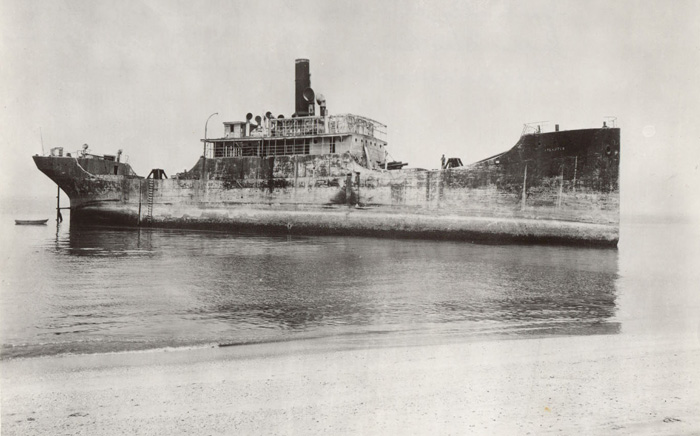
View on Wikipedia SS Atlantus the day she ran aground, 8 June 1926
| |
| History | |
|---|---|
 United States United States | |
| Name | SS Atlantus |
| Builder | Liberty Ship Building Company, Brunswick, Georgia |
| Laid down | March 1918[1] |
| Launched | 5 December 1918 |
| In service | 1919 |
| Out of service | 1920 |
| Fate | Wrecked, 8 June 1926 |
| General characteristics | |
| Type | Concrete cargo ship |
| Tonnage | 2,391 GRT |
| Length | 79.2 m (259 ft 10 in) p/p |
| Beam | 13.3 m (43 ft 8 in) |
| Draft | 6.7 m (22 ft) |
| Installed power | 1,520 ihp (1,133 kW) |
| Propulsion |
|
| Speed | 10.5 knots (19.4 km/h; 12.1 mph) |
.jpg)
.jpg)
SS Atlantus is the most famous of the twelve concrete ships built by the Liberty Ship Building Company[2] in Brunswick, Georgia, United States, during and after World War I.
The steamer was launched on 5 December 1918, and was the second concrete ship constructed in the World War I Emergency Fleet. The war had ended a month earlier, and so work on completing her was put on slow. She completed her sea trials (a 400-500 mile trip) and sailed to Wilmington, Delaware on her maiden voyage on 26 May 1919 for final touches, prior to sailing for New York. The Liberty Ship Building Company had their headquarters in Wilmington. She was built for service between New York and the West Indies.[2]
The Atlantus was primarily used to transport coal from Norfolk to New England.[3] After seventeen sailings, the ship was laid up at Norfolk.[4]
In 1926, Colonel Jesse Rosenfeld purchased the Atlantus for use in the creation of a ferry dock (for a route now served by the Cape May – Lewes Ferry) out of her and two of her sister ships. The plan was to dig a channel to the shore where the Atlantus would be placed, and the other two ships would be placed in a Y formation, creating a slip for a ferry to dock. In March 1926, the groundbreaking ceremonies were held for the construction of the ferry dock. The Atlantus was repaired and towed to Cape May. On June 8 of the same year, a storm hit and the ship broke free of her moorings and ran aground 150 feet off the coast of Sunset Beach.[5] Several attempts were made to free the ship, but none were successful.[6] The wreck was used for a time by the United States Coast Guard base at nearby Sewell Point for breeches buoy training.[7]
At one time there was a billboard painted on the side of the ship advertising boat insurance. Since her sinking, her slowly deteriorating hull has drawn tourists, although little of her is left visible above the water line. The wreckage is currently split in three pieces. The stern is the most visible section, the middle is completely submerged, and the bow can only be viewed at low tide.
Gallery
[edit]-
 Postcard c.1940
 -
 Atlantus in July 2015


References
[edit] | This article needs additional citations for verification. (June 2025) |
- ^ "Ten Thousand Ton Concrete Ships Be Built In Brunswick". Orlando Evening Star (Orlando, Florida). 18 Mar 1918. p. 1. Retrieved 30 August 2018.
- ^ a b "First Concrete Vessel Built on the Atlantic On Initial Trip Monday". No. 25 May 1919. The Atlanta Constitution (Atlanta, Georgia). 24 May 1919. p. 5. Retrieved 30 August 2018.
The steamship Atlantus the first concrete vessel ever to be built on the Atlantic coast and the first under the supervision of the United States shipping board will leave Brunswick Monday on her initial trip to Wilmington, Delaware. N. C. the headquarters of the Liberty Shipbuilding company builders of the Atlantus. The contract for installing the machinery was then awarded to the American Ship building company in this city (Brunswick).
- ^ Proceedings of the American Concrete Institute 1922: Vol 18. Internet Archive. 1922.
{{cite book}}: CS1 maint: others (link) - ^ Proceedings of the American Concrete Institute 1921: Vol 17. Internet Archive. 1921.
{{cite book}}: CS1 maint: others (link) - ^ Sutton, Patricia; Sutton, Clay (2006). Birds and Birding at Cape May. Stackpole Books. p. 241. ISBN 9780811731348.
- ^ Steele, Randy (February 2006). "Durable Goods". Boating: 26.
- ^ "FOR THOSE IN PERIL". British Pathé. Retrieved 2025-04-21.
External links
[edit]
- "S.S. Atlantus". concreteships.org.
38°56′40″N 74°58′19″W / 38.94444°N 74.97194°W
Shipwrecks and maritime incidents in 1926 | |
|---|---|
| Shipwrecks |
|
| Other incidents |
|


SS Atlantus
View on GrokipediaDesign and Construction
Development of Concrete Ships
During World War I, the United States faced acute shortages of steel for shipbuilding, as the material was prioritized for military hardware and merchant vessels were being sunk at an alarming rate by German U-boats. To address this crisis and rapidly expand the merchant fleet, the U.S. Shipping Board established the Emergency Fleet Corporation in April 1917, which initiated an experimental program for constructing ships from alternative materials, including reinforced concrete.[7][8] The program was formalized in 1918, with President Woodrow Wilson approving the construction of 24 concrete vessels, though only 12 were ultimately completed at a cost of approximately $50 million. These efforts drew on prior European experiments with ferrocement but adapted designs for ocean-going cargo ships to meet wartime demands.[9] Brunswick, Georgia, was selected as a key construction site by the Liberty Ship Building Company due to the abundance of local cement production and available labor in the region, facilitating efficient assembly without relying on distant steel supplies. The Emergency Fleet Corporation contracted the company to build several vessels there, leveraging the area's proximity to raw materials like sand and gravel essential for concrete production. This choice allowed for quicker mobilization compared to traditional steel yards strained by the war effort.[3] The SS Atlantus was the second concrete ship constructed under Emergency Fleet Design 1040 and the only vessel completed to this experimental standardized plan for 3,000-deadweight-ton freighters. Laid down in March 1918 at the Liberty Ship Building Company's yard in Brunswick, she was launched on December 5, 1918, shortly after the Armistice ended hostilities on November 11. Engineers addressed key challenges in concrete shipbuilding, such as vulnerability to cracking under stress and seawater exposure, by employing reinforced concrete hulls with embedded steel rods forming a dense mesh for tensile strength. The concrete mixture typically followed ratios like 1:2:4 (cement:sand:gravel) to achieve durability and watertightness, with the material vibrated and rammed around the reinforcement to eliminate voids and ensure structural integrity.[1][10][11]Specifications and Features
The SS Atlantus was a concrete-hulled cargo steamer with a gross register tonnage of 2,391 and a net register tonnage of 1,435, offering a deadweight capacity of approximately 3,000 tons.[2] Her design prioritized maximizing cargo while conserving steel under the U.S. Emergency Fleet Corporation's concrete ship program.[2] Key dimensions included a length of 250 feet between perpendiculars, a beam of 43 feet 6 inches, a draft of 22 feet 6 inches, and a molded depth of 26 feet 9 inches.[2] These proportions supported two cargo holds suited for bulk transport, with the hull divided into watertight compartments to enhance safety despite the material's limitations.[2] Propulsion was provided by a single triple-expansion steam engine developing 1,520 indicated horsepower, fed by two coal-fired boilers and driving a single screw propeller for a maximum speed of 10.5 knots.[2] This setup prioritized reliability over high performance, aligning with the ship's role in coastal and short-haul operations. The hull was constructed from reinforced concrete, incorporating steel rebar for tensile strength and featuring a 5-inch-thick shell of special aggregate mix to withstand marine stresses.[12] A concrete deck covered the structure, contributing to the vessel's overall deadweight capacity of 3,000 tons without requiring extensive steel plating.[12] Compared to contemporary steel ships, the Atlantus' concrete design offered significant advantages, including lower construction costs—around $100 to $125 per deadweight ton—due to abundant local materials like sand and reduced steel usage.[8] It also provided superior corrosion resistance, as concrete does not rust like steel, potentially extending service life with minimal maintenance.[13] However, drawbacks included a heavier hull that increased fuel consumption from greater skin friction and limited top speeds to around 10 knots, making concrete vessels less suitable for long ocean voyages.[13]| Specification | Details |
|---|---|
| Tonnage | Gross: 2,391 GRT; Net: 1,435 NRT; Deadweight: ~3,000 tons |
| Dimensions | Length: 250 ft (bp); Beam: 43 ft 6 in; Draft: 22 ft 6 in; Depth: 26 ft 9 in |
| Propulsion | Triple-expansion steam engine, 1,520 ihp; 2 coal-fired boilers; Single screw; Speed: 10.5 knots |
| Hull | Reinforced concrete with steel rebar; Thickness: 5 in; Watertight compartments; Concrete deck |