Hubbry Logo
SabaziosSabaziosMain
Open search
Sabazios
Community hub
Sabazios
logo
8 pages, 0 posts
0 subscribers
Be the first to start a discussion here.
Sabazios
Sabazios
from Wikipedia
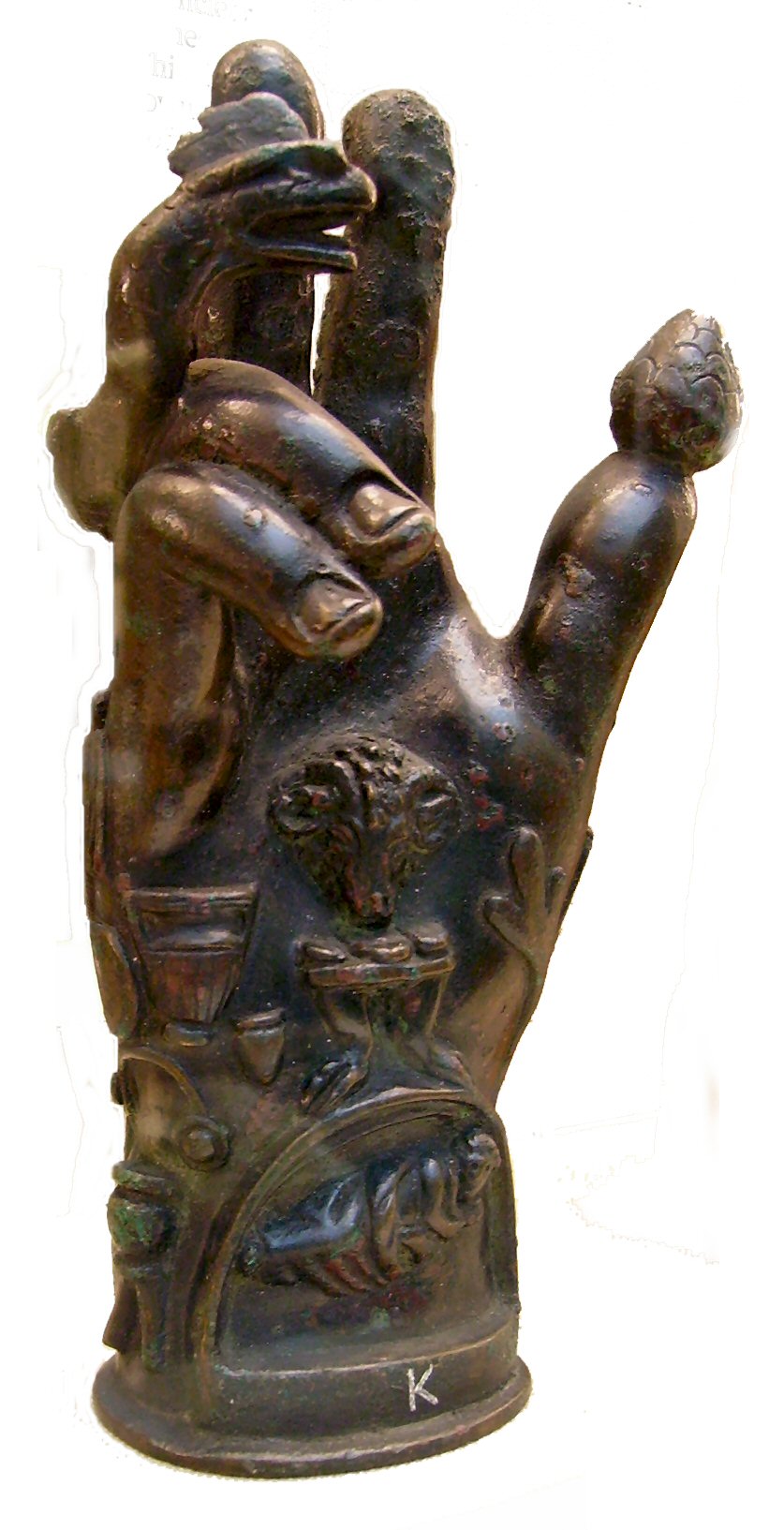
Bronze hand used in the worship of Sabazios (British Museum).[1] Roman 1st–2nd century CE. Hands decorated with religious symbols were designed to stand in sanctuaries or, like this one, were attached to poles for processional use. Another similar bronze hand found in the 16th/17th century in Tournai, Belgium, is also in the British Museum.[2]

Sabazios (Ancient Greek: Σαβάζιος, romanizedSabázios, modern pronunciation Savázios; alternatively, Sabadios[3]) is a deity originating in Asia Minor.[4] He is the horseman and sky father god of the Phrygians and Thracians.[5]

Sabazios gained prominence across the Roman Empire, particularly favored in the Central Balkans due to Thracian influence. Scholars have long debated Sabazios' origins, with current consensus leaning towards his Phrygian roots.[4]

Though the Greeks interpreted Phrygian Sabazios[6] as both Zeus and Dionysus,[7] representations of him, even into Roman times, show him always on horseback, wielding his characteristic staff of power.

Epigraphic evidence

[edit]

According to scholars, the deity's name is variously written in epigraphy: Σεβάζιος, Σαβάζοις, Sabazius, Sabadius, Σαβασεἷος.[8]

Thracian/Phrygian Sabazios

[edit]

It seems likely that the migrating Phrygians brought Sabazios with them when they settled in Anatolia in the early first millennium BCE, and that the god's origins are to be looked for in Macedonia and Thrace. The ancient sanctuary of Perperikon in modern-day Bulgaria, uncovered in 2000,[9] is believed to be that of Sabazios.[citation needed]

Possible early conflict between Sabazios and his followers and the indigenous mother goddess of Phrygia (Cybele) may be reflected in Homer's brief reference to the youthful feats of Priam, who aided the Phrygians in their battles with Amazons. An aspect of the compromise religious settlement, similar to the other such mythic adjustments throughout Aegean culture, can be read in the later Phrygian King Gordias' adoption "with Cybele"[10] of Midas.

One of the native religion's creatures was the Lunar Bull. Sabazios' relations with the goddess may be surmised in the way that his horse places a hoof on the head of the bull, in a Roman marble relief at the Boston Museum of Fine Arts.[11] Though Roman in date, the iconic image appears to be much earlier.

This copper alloy Roman hand of Sabazios was used in ritual worship. Few hands remain in collections today. Walters Art Museum, Baltimore.

God on horseback

[edit]
Thracian horseman, National Museum of Romanian History

More "rider god" steles are at the Burdur Museum, in Turkey. Under the Roman Emperor Gordian III the god on horseback appears on coins minted at Tlos, in neighboring Lycia, and at Istrus, in the province of Lower Moesia, between Thrace and the Danube. It is generally thought that the young emperor's grandfather came from an Anatolian family, because of his unusual cognomen, Gordianus.[12] The iconic image of the god or hero on horseback battling the chthonic serpent, on which his horse tramples, appears on Celtic votive columns, and with the coming of Christianity it was easily transformed into the image of Saint George and the Dragon, whose earliest known depictions are from tenth- and eleventh-century Cappadocia and eleventh-century Georgia and Armenia.[13]

Iconography, depictions, and Hellenistic associations

[edit]
View from various angles.

Among Roman inscriptions from Nicopolis ad Istrum, Sabazios is generally equated with Jove and mentioned alongside Mercury.[14] Similarly in Hellenistic monuments, Sabazios is either explicitly (via inscriptions) or implicitly (via iconography) associated with Zeus. On a marble slab from Philippopolis, Sabazios is depicted as a curly-haired and bearded central deity among several gods and goddesses. Under his left foot is a ram's head, and he holds in his left hand a sceptre tipped with a hand in the benedictio latina gesture.[15] Sabazios is accompanied by busts on his right depicting Luna, Pan, and Mercury, and on his left by Sol, Fortuna, and Daphne.[14] According to Macrobius, Liber and Helios were worshipped among the Thracians as Sabazios;[14] this description fits other Classical accounts that identify Sabazios with Dionysos. Sabazios is also associated with a number of archeological finds depicting a bronze, right hand in the benedictio latina gesture. The hand appears to have had ritual significance and may have been affixed to a sceptre (as the one carried by Sabazios on the Philippopolis slab). Although there are many variations, the hand of Sabazios is typically depicted with a pinecone on the thumb and with a serpent or pair of serpents encircling the wrist and surmounting the bent ring and pinky fingers. Additional symbols occasionally included on the hands of Sabazios include a lightning bolt over the index and middle fingers, a turtle and lizard on the back of the hand, an eagle, a ram, a leafless branch, the thyrsos, and the Mounted Heros.[14]

Sabazios in Athens

[edit]

The ecstatic Eastern rites practiced largely by women in Athens were thrown together for rhetorical purposes by Demosthenes in undermining his opponent Aeschines for participating in his mother's cultic associations:

On attaining manhood you abetted your mother in her initiations and the other rituals, and read aloud from the cultic writings ... You rubbed the fat-cheeked snakes and swung them above your head, crying Euoi saboi and hues attes, attes hues.[16]

Transformation to Sabazius

[edit]
Ivory figurine of Sabazios from the tomb of Alexander IV of Macedon, Museum of the Royal Tombs of Aegae.

Transference of Sabazios to the Roman world appears to have been mediated in large part through Pergamum.[17] The naturally syncretic approach of Greek religion blurred distinctions. Later Greek writers, like Strabo in the first century CE, linked Sabazios with Zagreus, among Phrygian ministers and attendants of the sacred rites of Rhea and Dionysos.[18] Strabo's Sicilian contemporary, Diodorus Siculus, conflated Sabazios with the secret 'second' Dionysus, born of Zeus and Persephone,[19] a connection that is not borne out by surviving inscriptions, which are entirely to Zeus Sabazios.[20][21] The Christian Clement of Alexandria had been informed that the secret mysteries of Sabazius, as practiced among the Romans, involved a serpent, a chthonic creature unconnected with the mounted skygod of Phrygia: "'God in the bosom' is a countersign of the mysteries of Sabazius to the adepts". Clement reports: "This is a snake, passed through the bosom of the initiates".[22]

Much later, the Byzantine Greek encyclopedia, Suda (c. 10th century), flatly states

Sabazios ... is the same as Dionysos. He acquired this form of address from the rite pertaining to him; for the barbarians call the bacchic cry "sabazein". Hence some of the Greeks too follow suit and call the cry "sabasmos"; thereby Dionysos [becomes] Sabazios. They also used to call "saboi" those places that had been dedicated to him and his Bacchantes ... Demosthenes [in the speech] "On Behalf of Ktesiphon" [mentions them]. Some say that Saboi is the term for those who are dedicated to Sabazios, that is to Dionysos, just as those [dedicated] to Bakkhos [are] Bakkhoi. They say that Sabazios and Dionysos are the same. Thus some also say that the Greeks call the Bakkhoi Saboi.[23]

In Roman sites, though an inscription built into the wall of the abbey church of San Venanzio at Ceperana suggested to a Renaissance humanist[24] it had been built upon the foundations of a temple to Jupiter Sabazius, according to modern scholars not a single temple consecrated to Sabazius, the rider god of the open air, has been located.[21] Small votive hands, typically made of copper or bronze, are often associated with the cult of Sabazios. Many of these hands have a small perforation at the base which suggests they may have been attached to wooden poles and carried in processions. The symbolism of these objects is not well known.[21]

Judean connection

[edit]

The first Jews who settled in Rome were expelled in 139 BCE, along with Chaldaean astrologers by Cornelius Hispalus under a law which proscribed the propagation of the "corrupting" cult of "Jupiter Sabazius", according to the epitome of a lost book of Valerius Maximus:

Gnaeus Cornelius Hispalus, praetor peregrinus in the year of the consulate of Marcus Popilius Laenas and Lucius Calpurnius, ordered the astrologers by an edict to leave Rome and Italy within ten days, since by a fallacious interpretation of the stars they perturbed fickle and silly minds, thereby making profit out of their lies. The same praetor compelled the Judeans, who attempted to infect the Roman custom with the cult of Jupiter Sabazius, to return to their homes.[25]

By this it is conjectured that the Romans identified the Judean YHVH Tzevaot ("sa-ba-oth", "of the Hosts") as Jove Sabazius.

This possibly mistaken connection of Sabazios and Sabaot was often repeated. In a similar vein, Plutarch maintained that the Judeans worshipped Dionysus, and that the day of Sabbath was a festival of Sabazius.[26] Plutarch also discusses the identification of the Judean God with the "Egyptian" Typhon, an identification which he later rejects, however. The monotheistic Hypsistarians worshipped the Most High under this name, which may have been a form of the Jewish God.

References

[edit]

Further reading

[edit]
[edit]
Revisions and contributorsEdit on WikipediaRead on Wikipedia
from Grokipedia
Sabazios (: Σαβάζιος) was an ancient of and Phrygian origin, revered as a sky god, nomadic horseman, and father figure in Indo-European traditions, with worship centered in mystery cults that emphasized initiation rites, , and protection against evil. His cult originated in around the 5th century BCE and spread through Phrygian migrations to , the North Black Sea region, , and the broader by the Hellenistic and Roman periods (4th century BCE to 3rd century CE). In , particularly western regions like and , Sabazios was prominently syncretized with as Zeus Sabazios, appearing in civic inscriptions and sanctuaries from the mid-4th century BCE, such as the inscription, and involving sacrifices, processions, and private vows during the Roman era (1st–3rd centuries CE). Archaeological evidence includes fewer than 30 inscriptions, mostly from western , and reliefs depicting him as a mature, bearded male in Greek or Phrygian attire, often holding a phiale ( bowl), without strong Dionysiac associations in this context. He was linked to local Anatolian deities like Angdistis and Ma, positioning him as a principal male divinity in regional pantheons. The cult's iconography is best known from bronze votive hands (manus Sabazii), Hellenistic and Roman artifacts (1st–3rd centuries CE) featuring the benedictio Latina —thumb, index, and middle fingers extended, ring and little fingers bent—symbolizing or knowledge. These hands, found across the empire including in the North (e.g., Ekaterinoslav example) and (e.g., hairpin from Sais, 1982), are adorned with symbols of rebirth and protection: coiled snakes, pine cones (strobile), , crescent moons, rams' heads, , , frogs, and sometimes agricultural tools like sickles or whips. Sabazios' Thracian roots tied him to Orphic doctrines and the Thracian Rider , with solar and chthonic elements; reliefs from sites like Philippopolis show him in Phrygian guise as a world ruler with a , often on horseback wearing a . In the Greco-Roman world, he was frequently equated with due to ecstatic rites and vegetation themes, though Anatolian evidence lacks this link, and with for his sky-father role; Roman soldiers and households propagated the , as seen in unofficial 4th-century BCE references by and later texts by and . In , syncretism with and appears in artifacts like a 3rd-century CE Oxyrhynchus papyrus mentioning a temple and a bread stamp from Tell Atrib, indicating household without official state recognition.

Name and Etymology

Name Variations

The name of the deity Sabazios exhibits significant orthographic variation across ancient epigraphic and literary sources, reflecting regional phonetic adaptations and scribal conventions. Primary Greek forms include Σαβάζιος (Sabázios), attested in inscriptions from and , as well as literary references such as scholia on . Another common Greek variant is Σεβάζιος (Sebáazios), appearing in epigraphic contexts from and , while Σαβάζοις (Sabázois) is found in dedicatory texts from . Latin renditions frequently use Sabazius, documented in altars from Superior such as Timacum Minus (241 CE), and Sabadius, seen in a Pentelic from the Peiraeus (IG II² 1325). In Anatolian contexts, particularly Phrygian and Lydian inscriptions, the name shows local influences like Sauazios and Saouazios, as in a 4th-century BCE dedication from recarved in the 2nd century CE, where the "au" diphthong suggests a softened of the medial . Thracian from regions like Serdica (modern ) employs Σαβάζιος (Sabazios) on limestone altars, indicating continuity with Phrygian forms but adapted to local scripts. Rarer variants include Sabadio from ad Istrum in Moesia Inferior (Mihailov, IG Bulg II 677) and Sebadius in Roman literary sources like (1.3.2, 139 BCE). A further uncommon form, Σαβαζεὖς (Sabazeus), appears sporadically in Greek inscriptions from western . Scholarly analysis of these orthographic differences highlights debates over potential Semitic influences on the "z" sound in some forms or Indo-European vocalic shifts in Anatolian variants, though such discussions emphasize empirical attestation over speculative origins. These variations underscore the deity's widespread , with forms like Sabases noted rarely in peripheral sources but lacking robust epigraphic support.
RegionPrimary FormsExample Inscription/Context
Anatolian (Phrygian/Lydian)Sauazios, SaouaziosSardis dedication (CCIS II, no. 30), 4th c. BCE/2nd c. CE
ThracianΣαβάζιος (Sabazios)Serdica altar (AEM 14, 1891, no. 25)
GreekΣαβάζιος (Sabázios), Σεβάζιος (Sebáazios) and Peiraeus stelae (IG II² 1325)
Latin/RomanSabazius, SabadiusTimacum Minus (Spomenik 98, no. 173, 241 CE); ad Istrum (IG Bulg II 677)

Linguistic Origins

The name Sabazios derives from the *dyēus, denoting the sky or heaven god, which forms the basis for related deities such as Greek Zeus, Roman , and the Vedic Dyeus Pater; the Phrygian -zios functions as a divine , akin to the Greek -theos or Latin -, emphasizing the god's celestial and paternal attributes. This linguistic structure underscores Sabazios's role as a in Phrygian and Thracian contexts, where the name encapsulates Indo-European theonymic patterns adapted to Anatolian substrates. Thracian influences on the name suggest possible links to regional terms for "" or concepts of liberation, with the initial sab- element potentially echoing or Sarmatian roots associated with fluidity or , as seen in Indo-European *sabh- (to pour or flow) or *swo- (one's own, implying ). These connections highlight how Thracian migrations may have infused the name with connotations of unbound celestial power, aligning Sabazios with nomadic traditions. The Greek rendering Σεβάζιος preserves this form, illustrating phonetic adaptations in Hellenistic contexts. Scholarly interpretations further explore these origins, including theories tracing the name to Indo-European storm god roots, as proposed by Hermann Usener, alongside the more common *dyēus derivation. Comparative theories also propose affinities with Semitic Sabaoth (Lord of Hosts), based on ancient Roman identifications that syncretized Sabazios with Yahweh during cultic expansions in the empire.

Historical Origins

Phrygian Roots

Sabazios is identified as a in early Greek sources, such as in the late 5th century BCE, though direct archaeological evidence in Phrygia is scarce. While the Phrygian kingdom reached its height in the 8th to 7th centuries BCE centered at , the cult of Sabazios does not appear in the until the mid-4th century BCE, such as in the Sardis inscription. As a and horseman god, he represented celestial authority, often equated with , but without early depictions of him wielding thunderbolts or riding a in Phrygian contexts. Phrygians are believed to have migrated from the to around 1200 BCE following the collapse, contributing to Indo-European linguistic and cultural elements in the region, as noted by who described them (or Bryges) as originating from the European side of the Hellespont. However, there is no direct evidence linking this migration to the introduction of the Sabazios cult, which emerges later. In Phrygian contexts, Sabazios was associated with local deities like the mother goddess , potentially as a sky counterpart, though specific mythological narratives tying him directly to figures like or lack attestation. Only a few inscriptions mention Sabazios in western from the BCE onward, portraying him more as a protector in civic and private cults rather than a nomadic or deity in early .

Thracian Connections and Migration

The cult of Sabazios shows connections to through shared Indo-European heritage and iconographic elements, likely resulting from migrations and cultural exchanges in the BCE. , originating from the including , migrated to , potentially carrying aspects of the cult eastward, while elements persisted or evolved in . Linguistic affinities between Phrygian and Thracian support this transmission of religious practices. The horseman motif common in Thracian art from the BCE onward mirrors later depictions associated with Sabazios, though direct links to the Thracian Rider god are primarily from Hellenistic and Roman periods. In , Sabazios was syncretized with local rider deities linked to and , appearing in reliefs as a mounted figure, sometimes with chthonic symbols like snakes. However, archaeological evidence for the cult in before the 1st century BCE is limited, with earlier claims of Thracian origins debated among scholars. Rituals may have included ecstatic elements akin to Dionysian worship, evident in later votive offerings with wine symbols. Sabazios appears in Thracian-influenced inscriptions from the 1st century BCE, sometimes linked to supreme deities like Theos Hypsistos, possibly patronized by rulers for legitimacy. Literary references include Strabo's Geography (10.3.15), describing Sabazios as a Phrygian deity with rites spreading to neighboring areas, and Herodotus (5.7) on Thracian migrations paralleling shared mythologies. Scholarly debate persists on whether the cult originated in Thrace and spread to Phrygia or vice versa, with Greek sources emphasizing Phrygian identity.

Evidence and Sources

Epigraphic Evidence

Epigraphic evidence for the worship of Sabazios primarily consists of dedicatory inscriptions from , the , and the Roman provinces, spanning from the mid-4th century BCE to the 3rd century CE. These texts often equate the deity with or Iuppiter, reflecting processes of , and include formulas typical of votive offerings, such as vows for health, safety, or prosperity. Scholarly corpora like the Corpus Cultus Iovis Sabazii (CCIS) compile numerous such inscriptions, revealing the god's integration into civic and mystery cults. In , early Greek dedications from the highlight Sabazios's association with . A notable example is the altar from , from the mid-4th century BCE (recarved in the 2nd century CE), where the priest Menophilos of the tribe Eumeneis dedicates to Sauazios (a variant of Sabazios) on behalf of King , marking one of the earliest attestations of the . At , royal letters from Attalos III (135 BCE) document the introduction of the cult of Sabazios by Queen Stratonike in the BCE, describing mystery rites and the god's installation as a synnaos (fellow-temple-sharing) with Polias. These inscriptions employ standard dedicatory language, such as "to Sabazios for the salvation of the king and the city," underscoring civic patronage and ritual obligations. Recent epigraphic studies continue to identify new dedicatory texts, expanding the corpus beyond traditional compilations (as of 2025). Thracian and Balkan votives provide evidence of Sabazios's horseman aspect and regional adaptations. In (modern ), an altar from Apulum (), dated to the 2nd–3rd century CE and published as Année Épigraphique 1956, no. 267, reads "Iovi Sabazio Aur(elius) Mar[cel(linus?)] v(otum) s(olvit) l(ibens) m(erito)," a standard Latin vow formula indicating personal devotion. Similar Thracian relief inscriptions from sites like ad Istrum equate Sabazios with Iuppiter and pair him with Mercury, often in contexts suggesting mystery initiations for . These texts, typically brief and formulaic (e.g., "to Sabazios the horseman"), date from the 1st to 3rd century CE and reflect the god's migration via Thracian networks. Latin inscriptions from the Roman period further illustrate Sabazios's assimilation as Iuppiter Sabazius, particularly in and the . In , CIL VI 430 records "C(aius) Nunn[ius] / Alexander / donum dedit / Iovi Sabazio," a 2nd-century CE dedication by a private individual, possibly linked to mystery practices. Balkan examples include altars from Inferior, such as one under (238–244 CE) invoking "Iovi Sabazio," using imperial-era formulas to seek protection amid military campaigns. Variations like "Sabazius" appear in Italian contexts, as in CIL XI 1323, emphasizing vows (v.s.l.m.) for family welfare. Interpretations of these inscriptions reveal Sabazios's role in mystery cults, with evidence of initiations from the 4th century BCE edict (recarved 2nd century CE), which prohibits neokoroi from participating in Sabazios's mysteries alongside those of and Ma, indicating ecstatic rites and secrecy. Dedicatory formulas across the corpus, such as vows by mystai (initiates), span 4th century BCE to 3rd century CE, showing evolution from Anatolian civic worship to Roman private and syncretic practices. Scholarly analysis emphasizes the texts' role in tracing the god's spread, with numerous Roman-era examples attesting widespread adoption.

Archaeological Sites and Artifacts

Archaeological evidence for the cult of Sabazios remains limited, with no confirmed dedicated temples identified in his primary regions of origin, as noted in recent studies of Roman Oriental religions in the central , where the god's worship is primarily attested through scattered votives rather than monumental structures. In , the megalithic site of in , excavated since the early 2000s, represents a and complex with altars associated with oracular and ecstatic rituals, potentially linked to Sabazios through with , though direct attribution remains speculative. In , ruins such as those at near provide broader context for the region's religious practices, including possible traces of Sabazios worship amid tumuli and rock-cut monuments, but no specific has been conclusively tied to the god. Key artifacts include coins from the Roman era depicting Sabazios as a horseman, such as those minted at Istrus in Lower under Emperor (c. 238–244 CE), illustrating the god's enduring in provincial contexts. Similar coinage from in during the same period shows the horseman motif, reflecting the cult's spread to Anatolian peripheries. representations, including statues and votive hands from the 2nd–3rd centuries CE, have been found across and the , with examples from attesting to local epigraphic labels invoking Sabazios independently of Olympian deities. In , ivory figurines from Aegae (modern ) provide early evidence, notably a gold-inlaid miniature from the tomb of Alexander IV (c. 311 BCE) in Tomb III, portraying the god in a hybrid form that underscores his Thracian-Macedonian connections. Post-2020 analyses of Balkan votives, including those in Nadežda Gavrilović Vitas's study, highlight the prevalence of such portable offerings over fixed sites, emphasizing the cult's itinerant and syncretic character in Roman territories.

Iconography and Depictions

God on Horseback Motif

The god on horseback motif constitutes the primary visual representation of , depicting the deity as a dynamic mounted figure typically riding to the right, often engaged in spearing a beast or brandishing a staff to assert divine authority. This is prominently featured in Thracian reliefs from the BCE, such as those illustrating the in a confrontational pose that underscores his role as a triumphant warrior deity. The motif persisted into the Roman period, appearing on coins struck in regions influenced by Phrygian and Thracian traditions, where the horseman image symbolized enduring celestial and protective powers. Symbolically, the horse embodies mobility across earthly and divine realms, facilitating and the oversight of vast territories, a theme resonant with nomadic and warrior cultures of the and . This equestrian imagery parallels the Thracian Heros, a rider god associated with heroic feats and underworld transitions, as well as Scythian rider deities who similarly connoted speed, warfare, and nomadic sovereignty in traditions. Such parallels highlight shared Indo-European motifs of the mounted sovereign, adapted to local contexts in Phrygian and Thracian worship. The evolution of the god on horseback motif emerged in around the 3rd-2nd century BCE, evolving through adaptations that incorporated more fluid, Greco-Roman stylistic elements like draped clothing and idealized proportions. A from the Ampurias site in features the horseman in processional scenes that blend local Hellenistic aesthetics with broader Mediterranean influences. This progression reflects the deity's migration and across , the , and the western Mediterranean.

Votive Hands and Symbolic Elements

One of the most distinctive artifacts associated with the of Sabazios is the "hand of Sabazios," a type of typically depicting a right hand in the benedictio Latina gesture, with the thumb, index, and middle fingers extended upward while the ring and little fingers are folded toward the palm. These hands, numbering around 80 known examples, date primarily to the 2nd and 3rd centuries CE and were often adorned with a variety of symbolic elements attached via or , including serpents coiled around the wrist, pinecones perched on the thumb, ' heads, and occasionally bolts. A well-preserved specimen in the (inventory no. 1895,0621.4), discovered in , , and dating to the 2nd-3rd century CE, exemplifies this form, featuring a serpent, pinecone, and other cult symbols on its surface, likely intended for processional use when attached to a pole. The symbols on these votive hands carry layered ritual significance tied to Sabazios's attributes as a chthonic and . The serpent, frequently shown with a crested head and coiled around the arm, represents chthonic aspects of renewal and connection to the , evoking themes of rebirth and protection in mystery initiations. The pinecone, often positioned atop the thumb, symbolizes Dionysian and the generative forces of nature, linking Sabazios to ecstatic and vegetative cults. Rams' heads and bolts appear less consistently but underscore sacrificial and celestial power, with the ram evoking offerings and the denoting divine authority over weather and thunder. Another example from the Walters Art Museum (no. 54.2453), originating from , , in the 2nd-3rd century CE, includes rams' heads alongside serpents and pinecones, highlighting regional variations in symbolic emphasis. These artifacts were primarily distributed in Roman domestic contexts across and the , suggesting personal devotion within household shrines rather than large public sanctuaries, and their spread likely occurred through the Roman military from and during the Early Imperial period. Scholarly debate centers on the origins of the benedictio Latina gesture, with evidence pointing to pre-Roman precedents in Greek and Apulian art, possibly transmitted via soldiers from or , rather than Semitic or Jewish influences as once proposed. Similar symbolic motifs, such as serpents and pinecones, also appear in larger depictions of Sabazios as a horseman, reinforcing the hand's role in portable mystery rites.

Cult Practices

Worship in Athens

The cult of Sabazios reached by the mid-fifth century BCE, but its practices became particularly notable in the fourth century BCE as a foreign import from and , primarily observed among metics, slaves, and lower social strata in private household settings rather than public civic spaces. This marginal status reflected the god's origins among immigrant communities, including Phrygian slaves who formed a significant portion of ' servile population, and the rites were often conducted discreetly to avoid scrutiny from traditional Athenian religious authorities. The most detailed literary testimony for these practices appears in Demosthenes' oration On the Crown (330 BCE), where he accuses his rival of participating in the cult during his youth, around the mid-fourth century. Demosthenes describes nocturnal initiations led by Aeschines' mother, involving the reading of sacred texts, preparation of libations, dressing initiates in fawn-skins, with and , and ecstatic ululations; participants reportedly recited phrases symbolizing moral renewal, such as "Here I leave my sins behind, Here the better way I find." These accounts portray the rites as secretive and performative, emphasizing personal transformation through ecstasy. Socially, the was derided as a "" mystery tradition, appealing to non-citizens seeking spiritual liberation from earthly burdens, with Sabazios embodying a role as divine liberator akin to figures in other ecstatic . While primarily private, epigraphic evidence hints at more organized activity in the , including a dedication by two hieropoioi (sacred officials) of Sabazios in 342/1 BCE, suggesting the possible existence of an altar or modest sanctuary there for worshippers.

Ecstatic Rites and Mystery Elements

The cult of Sabazios featured initiation ceremonies that incorporated symbolic acts emphasizing fertility and chthonic renewal, including the ritual passing of a serpent through the clothing of initiates across their bosom, a practice interpreted as phallic in nature. This rite, described by the early Christian writer Clement of Alexandria in the 2nd century CE, symbolized the god's vital forces and the initiate's union with divine power, marking entry into the mysteries. Wine libations accompanied these ceremonies, serving as offerings to invoke the deity's favor and to induce ecstatic states among participants, while nocturnal processions heightened the secretive and immersive atmosphere of the rituals. Central to the mystery elements of Sabazios's worship were secret doctrines promising and spiritual rebirth, echoing themes found in contemporaneous ecstatic cults through promises of protection and renewal. Votive "hand" amulets, often artifacts depicting the god's open palm adorned with symbols like serpents, pine cones, and rams' heads, were used by initiates for apotropaic purposes, believed to ward off evil and ensure safe passage in the . These amulets, prevalent in Roman-period finds, underscored the cult's focus on esoteric knowledge of cosmic cycles and personal , with the hand gesture—known as the benedictio Latina—representing enlightenment gained through . Ritual practices during the Sabazia festivals, inferred from iconography and evidence such as a 3rd-century CE , included animal sacrifices, particularly of as symbols of and the god's sky-father attributes, alongside music from flutes and cymbals to induce trance-like states. Ecstatic dances formed a core component, allowing devotees to embody the god's liberating energy through frenzied movement, often under torchlight in night-time gatherings that blurred boundaries between human and divine. These elements collectively fostered a of transcendence, where participants experienced rebirth through communal ecstasy and offerings.

Syncretism and Associations

In the Hellenistic period, Sabazios underwent significant syncretism with Olympian deities, particularly , reflecting his sky god attributes and role as a supreme divine authority. Hellenistic inscriptions from Asia Minor frequently identify him as Sabazios, portraying him as a localized form of the chief Olympian god. For instance, dedications from sites like Ormeleis in , dated to 207/208 CE, refer to the "initiates of Sabazios," emphasizing his integration into Greek religious practices as a powerful, protective . At , archaeological evidence, including temple associations and altars, underscores Sabazios as a distinct yet prominent manifestation of , coexisting with the city's primary cult but adapted to local Anatolian traditions. Inscriptions from rural sanctuaries in and further illustrate this equation, where Sabazios aligns with 's universal sovereignty. Sabazios also merged with , especially due to shared ecstatic and mystery cult elements, and occasionally with , the Orphic variant of associated with rebirth and frenzy. Literary and epigraphic sources highlight this linkage through ritual parallels, such as nocturnal processions and initiations involving intoxication, which blurred distinctions between the two gods in Greek contexts. Chthonic aspects of Sabazios, including his underworld connections via snake symbolism and , led to associations with Hermes as a and guide of souls, evident in votive offerings where Hermetic attributes like caducei appear alongside Sabazian . This is attested in bronze hands from Asia Minor, where symbols of Hermes reinforce Sabazios's role in guiding initiates through mystical transitions. In Roman adaptations, Sabazios was equated with Jove (). Votive inscriptions and artifacts from the empire invoke him in forms integrating into Roman religious practices. Associations with Mercury emerged in Gallo-Roman contexts, where votive hands bearing Mercurial symbols like pinecones and serpents fused the gods' roles in , travel, and mystery initiation. During the imperial period, under Emperor (238–244 CE), Sabazios's cult gained official traction, appearing on coins from in and Istros in Inferior as a mounted god with fused attributes, such as the (Jovian) and (Dionysiac), symbolizing his assimilation into the imperial framework. These numismatic depictions, often alongside imperial portraits, highlight Sabazios's role in promoting unity across diverse provinces.

Judean and Eastern Connections

In 139 BCE, the Roman praetor peregrinus Cornelius Hispalus expelled from , accusing them of attempting to corrupt Roman religious practices by introducing the cult of Sabazius and erecting private altars in their homes. This account, preserved in Valerius Maximus's Factorum et dictorum memorabilium (1.3.3), reflects Roman perceptions of Jewish worship as foreign and subversive, with "Jupiter Sabazius" likely representing a Latinized conflation of the Phrygian-Thracian god Sabazios with Sabaoth, the Hebrew "Lord of Hosts." further noted in his Quaestiones conviviales (4.6.2) that invoked their deity with cries of "Sabo" or "Sabai," which he interpreted as references to Sabazios or , and equated the with a honoring the god. Sabazios's Eastern connections extend to Anatolian and Semitic traditions, where his attributes as a and parallel Hittite gods like Tarhunna, suggesting possible cultural exchanges in ancient Asia Minor. Scholars emphasize that parallels to South Arabian deities stem more from phonetic similarity than direct influence, as Sabazios remains rooted in Indo-European storm-god archetypes. The god's , particularly the serpents coiled around votive bronze hands used in his cult, evokes Near Eastern ophiolatry, where snakes symbolized renewal, protection, and chthonic powers akin to those in Mesopotamian and Canaanite traditions. Scholarly debates highlight Sabazios-Dionysus syncretism as a potential conduit for "Bacchic Judaism," where Roman and Greek observers misinterpreted Jewish rituals—such as sabbatical gatherings and ecstatic praise—as Dionysiac, fostering perceptions of the as a variant of Sabazios. Recent analyses of artifacts from , including bronze hands and reliefs blending Phrygian horseman motifs with Egyptian regeneration symbols like the uroboros, underscore hybrid iconographies that emphasize themes of rebirth and divine power, as explored in studies of the cult's spread along the . These Eastern hybridizations distinguish Sabazios's Judean ties from his Greco-Roman integrations, illustrating broader intercultural dynamics in the Hellenistic world.

Roman Period and Legacy

Transformation to Sabazius

The cult of Sabazios underwent a significant transformation during the , evolving into the Roman mystery religion of Sabazius, with key mediation occurring through Pergamum in the 2nd century BCE, where the Anatolian was introduced by Queen Stratonike and integrated into local Attalid worship as Sabazios. This shift marked a Latinization of rites, adapting earlier ecstatic and chthonic elements from Hellenistic forms into mystery practices that emphasized personal liberation from earthly bonds and the promise of , often symbolized by pine cones in representing hopes. A pivotal development was the introduction of bronze "Sabazius hands"—ornate votive objects depicting the benedictio Latina gesture (thumb, index, and middle fingers extended)—which served as initiatory , likely displayed in homes or carried in processions to signify knowledge gained through the mysteries and protection against forces, with the earliest examples dating to around 15 BCE from military sites like Dangstetten. By the Roman Imperial era, these adaptations drew critiques from early as idolatrous pagan practices. The cult reached its peak in the 2nd and 3rd centuries CE, evidenced by widespread household shrines in urban centers like and provincial , where small hands and figurines were installed for private devotion, reflecting its appeal as a mystery religion offering esoteric amid social upheaval. Following Constantine's conversion and the in 313 CE, the cult experienced a marked decline as Christian suppression targeted pagan mysteries, leading to the abandonment of such shrines by the late 4th century.

Imperial Spread and Later Influences

The cult of Sabazios disseminated widely across the from its core regions in the and between the 1st and 4th centuries CE, primarily through the mobility of and trade networks. In , the cult gained traction in urban centers like , evidenced by numerous bronze votive hands unearthed in sites such as the Tiber River and private homes, suggesting household worship among diverse social groups including freedmen and merchants. shows similar adoption, with inscriptions from other Gallic provinces indicating dedications by Roman legionaries and local elites, who syncretized Sabazios with . In , archaeological finds including an ivory hairpin from Sais bearing Sabazios's symbols point to localized practices, possibly in modest chapels integrated with Greco-Egyptian cults, spread via trade routes. The provinces of and exhibited particularly dense concentrations, where Thracian heritage facilitated the cult's entrenchment; reliefs and altars from sites like Sarmizegetusa and along the frontier attest to military garrisons honoring Sabazios as a protector . Following the decline of organized pagan worship in , Sabazios's equestrian iconography exerted lasting influence on , notably evolving into the 10th-11th century depictions of Saint George as a dragon-slaying horseman in Balkan frescoes and icons. This transformation repurposed the Thracian rider motif—common in Sabazios reliefs—for hagiographic narratives, blending pre-Christian heroism with Christian triumph over evil, as seen in Cappadocian rock-cut churches and Serbian monasteries. Elements of the cult may have persisted in regional folk customs, such as Bulgarian and Romanian rituals involving serpentine symbols and spring , though scholarly consensus views these as indirect echoes rather than direct continuations. Contemporary research underscores persistent evidential challenges, including the scarcity of monumental temple remains, with the cult's footprint mainly preserved in ephemeral artifacts like inscribed hands and portable shrines rather than fixed architecture. Post-2020 excavations in the Central Balkans, including sites in modern Serbia and Bulgaria, have illuminated Sabazios's role within broader Oriental religious networks in Roman provinces, revealing diverse dedicants from soldiers to civilians. Nadežda Gavrilović Vitas's 2021 monograph, Ex Asia et Syria: Oriental Religions in the Roman Central Balkans, drawing on epigraphic and iconographic data, includes a dedicated chapter on Sabazius, demonstrating how the cult adapted across ethnic and social lines in Moesia Superior and Dacia, filling gaps in our understanding of imperial religious pluralism. Ongoing studies as of 2024, such as those in the Études Préliminaires aux Religions Orientales du Monde Romain (EPRO) series, continue to explore Sabazios's paradigmatic role in Roman religion.

References

  1. https://commons.wikimedia.org/wiki/File:Ivory_with_gold_miniature_of_Sabazios_from_the_tomb_of_Alexander_IV_at_Aigai%2C_311_BCE.jpg
Add your contribution
Related Hubs
User Avatar
No comments yet.