Recent from talks
Nothing was collected or created yet.
Dacianism
View on Wikipedia
| Part of a series on the |
| Socialist Republic of Romania |
|---|
Dacianism is a Romanian term describing the tendency to ascribe, largely relying on questionable data and subjective interpretation, an idealised past to the country as a whole. While particularly prevalent during the regime of Nicolae Ceaușescu, its origin in Romanian scholarship dates back more than a century.
The term refers to perceived aggrandising of Dacian and earlier roots of today's Romanians. This phenomenon is also pejoratively labelled "Dacomania" or "Dacopathy" or sometimes "Thracomania", while its proponents prefer "Dacology". The term protochronism (anglicised from the Romanian: protocronism, from the Ancient Greek terms for "first in time"), originally coined to refer to the supposed pioneering character of the Romanian culture, is sometimes used as a synonym.
Overview
[edit]In this context, the term makes reference to the trend (noticed in several versions of Romanian nationalism) to ascribe a unique quality to the Dacians and their civilisation.[1] Dacianists attempt to prove either that Dacians had a major part to play in ancient history or even that they had the ascendancy over all cultures (with a particular focus on Ancient Rome, which, in a complete reversal of the founding myth, would have been created by Dacian migrants).[2] Also noted are the exploitation of the Tărtăria tablets as certain proof that writing originated on proto-Dacian territory, and the belief that the Dacian language survived all the way to the Middle Ages.[2]
An additional, but not universal, feature is the attempted connection between the supposed monotheism of the Zalmoxis cult and Christianity,[3] in the belief that Dacians easily adopted and subsequently influenced the religion. Also, Christianity is argued to have been preached to the Daco-Romans by Saint Andrew, who is considered doubtfully as the clear origin of modern-day Romanian Orthodoxy. Despite the lack of supporting evidence, it is the official church stance, being found in history textbooks used in Romanian Orthodox seminaries and theology institutes.[4]
History
[edit]The ideas have been explained as part of an inferiority complex present in Romanian nationalism,[5] one which also manifested itself in works not connected with Dacianism, mainly as a rejection of the ideas that Romanian territories only served as a colony of Rome, voided of initiative, and subject to an influx of Latins which would have completely wiped out a Dacian presence.[6]
Dacianism most likely came about with the views professed in the 1870s by Bogdan Petriceicu Hasdeu,[7] one of the main points of the dispute between him and the conservative Junimea. For example, Hasdeu's Etymologicum magnum Romaniae not only claimed that Dacians gave Rome many of her emperors (an idea supported in recent times by Iosif Constantin Drăgan),[8] but also that the ruling dynasties of early medieval Wallachia and Moldavia were descendants of a caste of Dacians established with "King" (chieftain) Burebista.[9] Other advocates of the idea before World War I included the amateur archaeologist Cezar Bolliac,[10] as well as Teohari Antonescu and Nicolae Densușianu. The latter composed an intricate and unsupported theory on Dacia as the center of European prehistory,[11] authoring a complete parallel to Romanian official history, which included among the Dacians such diverse figures as those of the Asen dynasty, and Horea.[11] The main volume of his writings is Dacia Preistorică ("Prehistoric Dacia").
After World War I and throughout Greater Romania's existence, the ideology increased its appeal. The Iron Guard flirted with the concept, making considerable parallels between its projects and interpretations of what would have been Zalmoxis' message.[12] Mircea Eliade was notably preoccupied with Zalmoxis' cult, arguing in favour of its structural links with Christianity;[13] his theory on Dacian history, viewing Romanisation as a limited phenomenon, is celebrated by contemporary partisans of Dacianism.[14]
In a neutral context, the Romanian archaeology school led by Vasile Pârvan investigated scores of previously ignored Dacian sites, which indirectly contributed to the idea's appeal at the time.[15]
In 1974 Edgar Papu published in the mainstream cultural monthly Secolul XX an essay titled "The Romanian Protochronism", arguing for Romanian chronological priority for some European achievements.[16] The idea was promptly adopted by the nationalist Ceaușescu regime, which subsequently encouraged and amplified a cultural and historical discourse claiming the prevalence of autochthony over any foreign influence.[17] Ceaușescu's ideologues developed a singular concept after the 1974 11th Congress of the Communist Party of Romania, when they attached Dacianism to official Marxism, arguing that the Dacians had produced a permanent and "unorganised state".[18] The Dacians had been favoured by several communist generations as autochthonous insurgents against an "imperialist" Rome (with the Stalinist leadership of the 1950s proclaiming them to be closely linked with the Slavic peoples);[19] however, Ceaușescu's was an interpretation with a distinct motivation, making a connection with the opinions of previous Dacianists.[20]
The regime started a partnership with Italian resident, former Iron Guard member and millionaire Iosif Constantin Drăgan, who continued championing the Dacian cause even after the fall of Ceaușescu.[21] Critics regard these excesses as the expression of an economic nationalist course, amalgamating provincial frustrations and persistent nationalist rhetoric, as autarky and cultural isolation of the late Ceaușescu's regime came along with an increase in Dacianist messages.[22]
Vladimir Tismăneanu wrote:
"Protochronism" was the party-sponsored ideology that claimed Romanian precedence in major scientific and cultural discoveries. It was actually the underpinning of Ceaușescu's nationalist tyranny.[23]
While no longer backed by a totalitarian state structure after the 1989 revolution, the interpretation still enjoys popularity in several circles.[24] The main representative of current Protochronism was still Drăgan (now deceased), but the New York City-based physician Napoleon Săvescu took over after Drăgan's death. Together, they issued the magazine Noi, Dacii ("We, the Dacians") and organised a yearly "International Congress of Dacology".[25] Săvescu still does those.
Săvescu's most famous theory says that the Romanians are not descendants of the Roman colonists and assimilated Dacians, as mainstream historians say, but that they are the descendants of only the Dacians, who spoke a language close to Latin.
Other controversial theories of his include the Dacians (or their ancestors) having developed the first writing system in the world (see the Tărtăria tablets), the first set of laws or having conquered Western Europe, India, Iraq, Japan and the Americas.
"If the Harappa culture did not disappear after the Carpatho-Danubian invasion, how come the invaders themselves vanished, leaving no traces behind, or leaving, as Sir Wheeler put it, "nothing but a name?" How could the nomad Carpatho-Danubians, mainly a people of breeders, give birth not only to a new religion, but found splendid cities that outlived them to this day? How could the greatest and most complex literature in the world have come from these Carpatho-Danubian people? Actually, the whole Vedic literature is based on four texts (the oldest being Rig-Veda, Yajur-Veda and Sama-Veda, the later Athara-Veda and two poems resembling the Iliad and the Odyssey only two thousand years older; Ramnayana and Mahabharata have preserved a toponymy echoing that of the Aryan Carpatho-Danubians' homeland and share the same main theme – the enmity and rancor between two families fighting over the throne of Bahataral (according to some, today's Banat-Romania).
— The Conquest of India by the Carpatho-Danubian People
His theories are, however, disregarded by historical journals and most historians, e.g. Mircea Babeș, Lucian Boia and Alexandra Tomiță,[26][27][28] who label these theories as pseudoscience and anachronistic and consider that there is not enough scientific evidence to support them.[29] Dacia, journal of the Vasile Pârvan Institute of Archaeology, and the history journal Saeculum did not speak highly of him, either.[30][31]
Dacian script
[edit]
"Dacian alphabet" is a term used in Romanian protochronism and Dacianism for pseudohistorical claims of a supposed alphabet of the Dacians prior to the conquest of Dacia and its absorption into the Roman Empire. Its existence was first proposed in the late 19th century by Romanian nationalists, but has been completely rejected by mainstream modern scholarship.
In the opinion of Sorin Olteanu, a modern expert at the Vasile Pârvan Institute of Archaeology, Bucharest, "[Dacian script] is pure fabrication [...] purely and simply Dacian writing does not exist", adding that many scholars believe that the use of writing may have been subject to a religious taboo among the Dacians.[32] It is known that the ancient Dacians used the Greek and Latin alphabets,[33] though possibly not as early as in neighbouring Thrace where the Ezerovo ring in Greek script has been dated to the 5th century BC. A vase fragment from the La Tène period (see illustration above), a probable illiterate imitation of Greek letters, indicates visual knowledge of the Greek alphabet[34] during the La Tène period prior to the Roman invasion. Some Romanian writers writing at the end of the 19th century and later identified as protochronists, particularly the Romanian poet and journalist Cezar Bolliac, an enthusiast amateur archaeologist,[35] claimed to have discovered a Dacian alphabet. They were immediately criticized for archaeological[36] and linguistic[37][38] reasons. Alexandru Odobescu, criticized some of Bolliac's conclusions.[39] In 1871 Odobescu, along with Henric Trenk, inventoried the Fundul Peșterii cave, one of the Ialomiței caves (See the Romanian Wikipedia article) near Buzău. Odobescu was the first to be fascinated by its writings, which were later dated to the 3rd or 4th century.[40] In 2002, the controversial[41] Romanian historian, Viorica Enăchiuc, stated that the Codex Rohonczi is written in a Dacian alphabet.[42] The equally controversial[43] linguist Aurora Petan (2005) claims that some Sinaia lead plates could contain unique Dacian scripts.[44]
The linguist George Pruteanu called protochronism as "the barren and paranoid nationalism", because protochronism claims that the Dacian language was the origin of Latin and all other languages, including Hindi and Babylonian.[45]
See also
[edit]Notes
[edit]- ^ Boia, p.160-161
- ^ a b Boia, p.149-151
- ^ Boia, p.169
- ^ Lavinia Stan, Lucian Turcescu, Religion and Politics in Post-Communist Romania, Oxford University Press, 2007, p.48
- ^ Verdery, p.177
- ^ Boia, p.85, 127-147
- ^ Boia, 138-139, 140, 147; Verdery, p.326
- ^ Boia, p.268
- ^ Boia, p.82
- ^ Boia, p.139-140
- ^ a b Boia, p.147-148
- ^ Boia, p.320
- ^ Boia, p.152; Eliade, "Zalmoxis, The Vanishing God", in Slavic Review, Vol. 33, No. 4 (December 1974), p.807-809
- ^ Boia, p.152; Șimonca
- ^ Boia, p.145-146
- ^ Boia, p.122-123; Martin
- ^ Boia, p.117-126
- ^ Boia, p.120
- ^ Boia, p.154-155, 156
- ^ Boia, p.155-157; 330-331
- ^ Verdary, p.343
- ^ Boia, p.338
- ^ Tismăneanu, Vladimir (15 October 2003). Stalinism for All Seasons: A Political History of Romanian Communism. University of California Press. p. 319. ISBN 978-0-520-23747-6.
- ^ Babeș; Boia, p.356
- ^ "Ca și cînd precedentele reuniuni n-ar fi fost de ajuns, dacologii bat cîmpii in centrul Capitalei"[permanent dead link], in Evenimentul Zilei, 22 June 2002
- ^ Manea, Irina-Maria (22 March 2017). "Dacomania sau cum mai falsificãm istoria". historia.ro (in Romanian). Retrieved 1 August 2019.
- ^ Petre, Zoe (28 August 2001). "Burebista, contemporanul nostru". Observator Cultural (in Romanian) (79). Archived from the original on 16 October 2007. Retrieved 1 August 2019.
- ^ Babeș, Mircea (9 September 2003). "Renașterea Daciei?". Observator Cultural (in Romanian) (185). Archived from the original on 30 September 2007. Retrieved 1 August 2019.
- ^ Corbea, Andrei (12 May 2003). "Herodot si "Todoreh"". Observator Cultural (in Romanian) (168). Retrieved 1 August 2019.
- ^ Niculescu, Gheorghe Alexandru (2005). "Archaeology, Nationalism and "The History of the Romanians" (2001)". Dacia: Revue d'archéologie et d'histoire ancienne. 48–49. Institutul de Arheologie (București): 101. ISSN 0070-251X.
- ^ Arens, Meinolf; Bein, Daniel (2003). "Katholische Ungarn in der Moldau". Saeculum. 54 (2). Böhlau Verlag: 252. doi:10.7788/saeculum.2003.54.2.213. ISSN 0080-5319. S2CID 201277080.
- ^ Gherasim, Gabriel Teodor (4 March 2007). ""Scrierea daca" este pura inventie". Noi, NU!. Archived from the original on 7 January 2011. Retrieved 9 January 2011.
Este un bun prilej să demontăm un alt mit drag tracomanilor, anume cel al 'scrierii dacice' si al vechimii ei 'imemorabile'. 'Scrierea dacă' este pură inventie. Nu este nici măcar vorba de incertitudini, de chestiuni de interpretare (din ce punct de vedere privim) s.a.m.d., ci pur si simplu nu există nici o scriere dacă [...] Asa cum cred multi dintre învătati, este foarte posibil ca la daci, întocmai ca si la celti până la un anumit moment, scrierea să fi fost supusă unui tabu religios.
- ^ Daicoviciu, Hadrian (1972). Dacii. Editura Enciclopedică Română.
- ^ Vulpe, Radu; Vulpe, Ecaterina (1933). "Les fouilles de Poiana". Dacia: Revue d'archéologie et d'histoire ancienne (in French). 3–4: 342. Retrieved January 9, 2011.
On ne possède malheureusement pas de plus grand fragment pour établir s'il s'agit d'une inscription en langue latine ou grecque, éventullement gète, ou plutôt d'une ornementation grossière en forme d'alphabet, oeuvre probable d'un potier illetré. Ce tesson présente dans tous les cas un grand intérêt au point de vue de l'influence méridionale sur les artisans de notre station de Poiana, à la fin de l'époque Latène, à laquelle il appartient. Même s'il ne s'agit que d'un jeu d'imitation de quelque potier gète, sa connaissance approximative des lettres grecques ou romaines prouve que les relations entre les Gètes de la Moldavie et le monde gréco-romain d'outre Danube étaient devenues extrêmement étroites à la veille de la directe expansion romaine en Dacie.
- ^ Măndescu, Dragoș. "DESCOPERIREA SITULUI ARHEOLOGIC DE LA ZIMNICEA ȘI PRIMA ETAPĂ A CERCETĂRII SALE: 'EXPLORAȚIUNILE' LUI CEZAR BOLLIAC (1845, 1858?, 1869, 1871–1873)" (PDF). Muzeul Județean Teleorman (in Romanian). Archived from the original (PDF) on September 15, 2024. Retrieved January 9, 2011.
- ^ Boia, p.92
- ^ Hovelacque, Abel (1877). The science of language: linguistics, philology, etymology. Chapmanand Hall. p. 292. Retrieved January 9, 2011.
The Rumanian writer Eajden... fancies he has lighted upon the old Dacian alphabet, in an alphabet surviving till the last century amongst the Szeklers of Transylvania. But he has altogether overlooked the preliminary question, to what group of languages Dacian may belong.
- ^ Le Moyen âge (in French). Champion. 1888. p. 258.
La théorie d'un alphabet dace est une fable; les caractères cyrilliques sont d'origine slave, non roumaine. Ce n'est que depuis le XV^ siècle que le peuple roumain les a admis dans son idiome national.
Cf. Moldovan G. А latin, cyrill, (ШК es székely irasjegyek kérdése a. románoknál. (A Bp. Szernle 1887. évi oklób. sz.) Bpest, 1887. - ^ Oișteanu, Andrei (April 30, 2008). "Scriitorii romani si narcoticele (1) De la Scavinski la Odobescu". 22 Revista Grupului Pentru Dialog Social (in Romanian). Archived from the original on January 5, 2011. Retrieved January 9, 2011.
- ^ Popescu, Florentin. "Les ermitages des Monts de Buzau". Le site des monuments rupestres (in French). Archived from the original on 2011-07-20. Retrieved January 9, 2011.
- ^ Ungureanu, Dan (May 6, 2003). "Nu trageti in ambulanta". Oservator Cultural (in Romanian). Archived from the original on March 27, 2004. Retrieved January 8, 2011.
- ^ Enăchiuc, Vioroca (2002). Rohonczi Codex: descifrare, transcriere si traducere (Déchiffrement, transcription et traduction) (in Romanian and French). Editura Alcor. ISBN 973-8160-07-3.
- ^ Olteanu, Sorin. "Raspuns Petan". Thraco-Daco-Moesian Languages Project (in Romanian). Retrieved January 9, 2011.
- ^ Pețan, Aurora. "A possible Dacian royal archive on lead plates". Antiquity. Retrieved January 8, 2011.
- ^ "Doar o vorbă SĂȚ-I mai spun". George Pruteanu (in Romanian). 26 March 1996. Retrieved 21 January 2020.
References
[edit]- Lucian Boia, Istorie și mit în conștiința românească, Bucharest, Humanitas, 1997
- B. P. Hasdeu, Ethymologicum Magnum Romaniae. Dicționarul limbei istorice și poporane a românilor (Pagini alese), Bucharest, Minerva, 1970
- (in Romanian) Mircea Martin, "Cultura română între comunism și naționalism" (II), in Revista 22, 44 (660)/XIII, October–November 2002
- (in Romanian) Ovidiu Șimonca, "Mircea Eliade și 'căderea în lume'", review of Florin Țurcanu, Mircea Eliade. Le prisonnier de l'histoire, in Observatorul Cultural
- Katherine Verdery, National Ideology under Socialism. Identity and Cultural Politics in Ceaușescu's Romania, University of California Press, 1991. ISBN 0-520-20358-5
External links
[edit]- www.dacii.ro: A site displaying prominent characteristics of Romanian Protochronism.
- www.dacia.org: A site connected with Săvescu.
- Monica Spiridon's essay on the intellectual origins of Romanian Protochronism.
- Historical myths, legitimating discourses, and identity politics in Ceaușescu's Romania (Part 1), (Part 2)
- Tracologie și Tracomanie (Thracology and Thracomania) at Sorin Olteanu's LTDM Project (SOLTDM.COM) Archived 2007-11-13 at the Wayback Machine
- Teme tracomanice (Thracomaniacal Themes) at Sorin Olteanu's LTDM Project (SOLTDM.COM) Archived 2007-11-13 at the Wayback Machine
Dacianism
View on GrokipediaDefinition and Origins
Core Tenets
Dacianism asserts the unbroken ethnic, linguistic, and cultural continuity of the Romanian people from the ancient Dacians, inhabitants of the region encompassing modern Romania prior to the Roman conquest in 106 AD. Proponents emphasize a pure Dacian lineage, often minimizing or rejecting the role of Roman colonization and Latinization in shaping Romanian identity, positing instead that Dacians formed the foundational population with limited external genetic or cultural input.[1] This narrative frames the Dacians as an independent, powerful pre-Roman civilization capable of regional dominance, including exacting tribute from neighboring groups, thereby underpinning claims of inherent national sovereignty and resilience.[3] Central to Dacianist ideology is the promotion of Dacian cultural superiority, portraying the ancient Dacians as originators of advanced societal elements, such as proto-writing systems or architectural feats like fortified hill settlements, which are interpreted as evidence of a sophisticated, autochthonous heritage predating Greco-Roman influences. Adherents often invoke folkloric traditions, spiritual practices, and archaeological artifacts—selectively interpreted—to substantiate a homogenous national essence rooted in Dacian authenticity, rejecting hybrid Daco-Roman models in favor of an unadulterated ancestral continuity.[1] This extends to linguistic claims, where some Dacianists deny the predominant Romance character of Romanian, proposing instead a fictive persistence of Dacian substrates or even a deciphered "Dacian script" from disputed sources like the Sinaia lead plates.[4] In its modern neo-nationalist form, Dacianism functions as a right-wing populist framework, fostering ethnic distinction and cultural autarky against perceived Western or external dilutions of identity. It constructs narratives of historical victimhood and revival, using Dacian symbolism to advocate for political independence and resistance to globalization, often commodifying heritage through memorials, media, and virtual communities since the 2010s.[1] These tenets align with broader protochronist tendencies, attributing priority in cultural innovations to Dacians to assert Romania's primordial status among European peoples.[5]Emergence in 19th-Century Romanian Intellectual Circles
Dacianism emerged amid the Romantic nationalist fervor of 19th-century Romania, as intellectuals grappled with ethnogenesis amid efforts to forge a unified national identity following the 1848 revolutions and the push for independence from Ottoman suzerainty. While the dominant Latinist paradigm, rooted in the theory of continuous Romanization from Trajan's conquest in 106 AD, posited Romanians as direct descendants of Latin-speaking colonists blended with locals, a countercurrent emphasized the pre-Roman Dacian substrate to underscore indigenous continuity and resilience against external narratives of migration or foreign imposition. This Dacian focus served to counterbalance Latin philhellenism and assert autochthony, particularly in debates over Transylvanian origins where Hungarian historiography downplayed Romanian precedence.[4][6] A foundational figure was philologist and historian Bogdan Petriceicu Hașdeu (1838–1907), whose works in the 1870s challenged strict Latin primacy by positing a robust Dacian linguistic legacy in Romanian. In publications like his studies on Thracian-Dacian etymology, Hașdeu derived key Romanian terms from ancient Dacian roots, arguing for a substrate that predated and shaped Latin overlays, as detailed in his expansive but unfinished Etymologicum magnum Romaniae. This approach, opposing the era's latinist historiography, highlighted Dacian cultural and lexical persistence, influencing later claims of ethnic continuity despite lacking empirical corroboration from contemporary archaeology.[7][8] Romantic poet Mihai Eminescu (1850–1889), Romania's national bard, amplified Dacian motifs in verse, portraying ancient Dacians as noble, spiritual ancestors embodying resilience and mysticism, as in his 1880 poem "Doina" and invocations of Zalmoxis-inspired philosophy. Eminescu's works romanticized Dacian resistance to Roman invasion, framing it as a metaphor for modern Romanian endurance, though his emphasis remained more symbolic than systematic historiography. This literary infusion helped embed Dacian imagery in popular consciousness, bridging scholarly inquiry with cultural revival.[4] The trend intensified post-1877–1878 independence, with syntheses like the 1880 historical overview of Dacian civilization marking the first comprehensive Romanian-language treatment, integrating archaeological finds from sites such as Sarmizegetusa Regia to bolster claims of civilizational precedence. These efforts reflected a pragmatic nationalism, leveraging Dacian heritage to justify irredentist aspirations in multi-ethnic regions, yet they often prioritized ideological coherence over rigorous source criticism, as Dacian evidence derived primarily from classical authors like Herodotus and Strabo rather than indigenous records.[4][3]Historical Evolution
Interwar Nationalist Expansion
In the aftermath of World War I, the formation of Greater Romania in 1918, encompassing Transylvania, Bessarabia, and Bukovina, fueled a surge in nationalist ideologies seeking to consolidate ethnic Romanian dominance and refute territorial revisionism from neighboring states like Hungary and the Soviet Union. Dacianism expanded within this context as an autochthonist framework, asserting unbroken ethnic continuity from ancient Dacians—indigenous to the Carpatho-Danubian region—while downplaying Roman colonization's demographic impact to emphasize pre-Roman indigeneity and blood purity. Intellectuals and radical groups invoked Dacian origins to claim historical primacy over non-Romanian minorities, portraying Romanians as the sole legitimate heirs to the land's ancient substratum, often through reinterpretations of archaeological finds and linguistic theories that prioritized Dacian substrates in Romanian vocabulary.[3][9] Anthropological and biopolitical discourses further propelled this expansion, with scholars conducting serological studies to quantify "Dacian blood" as a marker of national essence, aligning it with eugenic and racial hygiene efforts amid perceived threats from Jewish, Hungarian, and German minorities in the enlarged state. Figures like historian and philosopher Nae Ionescu influenced protochronist views that romanticized Dacian spirituality—drawing on Zalmoxis myths—as a counter to Western rationalism and Latinist historiography, which had dominated since the 19th century by stressing Roman linguistic and cultural imprint. This shift reflected broader interwar tensions between Latin-oriented European integration and insular, mystical autochthonism, with Dacianism serving as ideological ammunition for irredentist narratives in cultural journals and academic treatises published between 1920 and 1939.[10][11] The Legion of the Archangel Michael (Iron Guard), established by Corneliu Zelea Codreanu on June 24, 1927, integrated Dacianist motifs into its ultranationalist program, framing Dacian ancestry as a spiritual wellspring for anti-communist, anti-Semitic, and anti-liberal mobilization. Legionary rhetoric exalted "Dacian blood" as awakening national vitality, evident in publications and rituals that merged Orthodox Christianity with pagan Dacian symbolism, attracting youth amid economic instability and the 1929 Great Depression. By the mid-1930s, this fusion permeated radical right-wing circles, influencing over 500,000 adherents by 1937, though it clashed with official state historiography under King Carol II, which balanced Latinism with selective Dacian elements for unity. Dacianism's nationalist appeal waned post-1938 amid authoritarian crackdowns but laid groundwork for later appropriations.[12][9]Suppression and Adaptation Under Communism
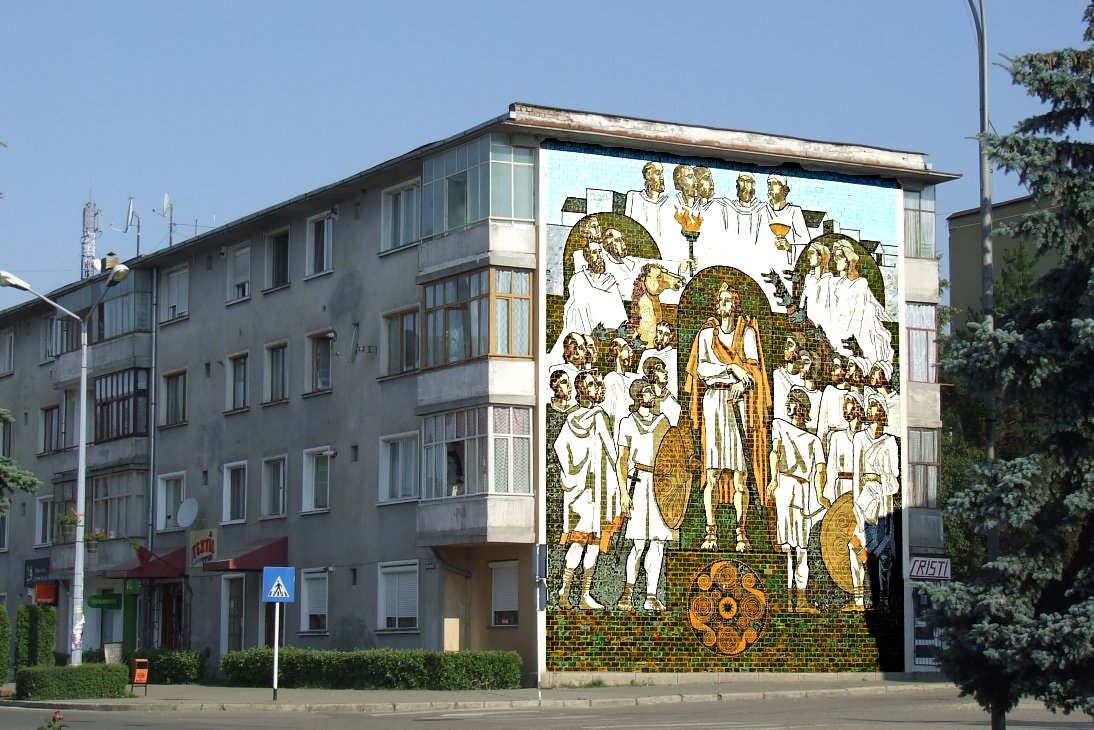
Following the imposition of communist rule in Romania on December 30, 1947, Dacianist ideologies encountered systematic suppression as authorities targeted interwar nationalist currents viewed as incompatible with Marxist-Leninist principles of class struggle and proletarian internationalism.[13] Early regime historiography reframed Dacian history through a materialist lens, emphasizing internal social conflicts and downplaying ethnic continuity claims to counter perceived bourgeois chauvinism, aligning with Soviet directives that questioned Romanian autochthonous narratives.[14] [15] By the late 1950s, under Gheorghe Gheorghiu-Dej's leadership, initial adaptations surfaced amid Romania's assertion of autonomy from Moscow, including a closed 1958 scholarly debate that reaffirmed Daco-Roman ethnogenesis against external Slavic-origin theories promoted by Soviet historiography.[15] This marked a pivot from outright repression toward selective integration, subordinating nationalist elements to communist ideology while preserving core assertions of ancient continuity.[16] Nicolae Ceaușescu's ascension in 1965 accelerated this evolution into full-scale adaptation via "national communism" and protochronism, a doctrine positing Romanian precedence in global cultural developments from 1971 onward.[17] Dacians were recast as progenitors of advanced proto-socialist achievements—such as metallurgy, urbanism, and resistance to imperial conquest—evident in state-sponsored propaganda like murals in Orăștie depicting Dacian warriors and archaeological campaigns prioritizing sites linked to Burebista's kingdom (circa 82–44 BCE) and Decebalus (87–106 CE).[18] [14] These efforts, peaking in the 1970s–1980s, fused Dacian glorification with regime legitimacy, portraying ancient Thracian-Dacians as non-Christian exemplars of ethnic resilience and innovation superior to Roman influences.[19] Despite this rehabilitation, mystical Dacianist claims—like a supposed pre-Roman script—remained marginalized or co-opted selectively, subordinated to official narratives that instrumentalized history for autarkic nationalism while maintaining Marxist orthodoxy.[14] Protochronist historiography, disseminated through academia and media, claimed Dacian contributions anticipated European milestones, such as early state formation by 200 BCE, though reliant on interpretive stretches of sparse evidence.[17] This adaptation reflected Ceaușescu's post-1964 rift with the USSR, leveraging Dacianism to foster domestic unity amid economic isolation, yet it distorted empirical data to serve political ends.[18]Post-Communist Resurgence
Following the Romanian Revolution of December 1989, which ended the Ceaușescu regime's state-sponsored promotion of Dacianist narratives, these ideas persisted without institutional support, evolving into a grassroots and online phenomenon among nationalist enthusiasts. Proponents, drawing on pre-communist protochronist traditions, emphasized unadulterated Dacian ethnic continuity and cultural primacy over Roman influences, often rejecting mainstream Daco-Roman synthesis theories. Key figures like Napoleon Săvescu, a New York-based physician and author, advanced such views through publications and organizations; his 2003 book Noi nu suntem urmaşii Romei (We Are Not Descendants of Rome) argued that Dacians predated and influenced Roman civilization, positioning Romanians as heirs to an ancient, superior Thracian-Dacian lineage rather than Latinized provincials. Săvescu founded the Dacia Revival International Society around 2008 to propagate these claims, including assertions of a pre-Roman Dacian alphabet and spiritual legacy, attracting followers via books, music, and international conferences.[20][21] By the 2010s, Dacianism experienced a digital resurgence, manifesting as neo-nationalist populism in virtual communities and public discourse, often commodified through media and cultural products. Online content, such as the video series "Dacians: The Incredible Truth" launched in 2012, amassed millions of views by promoting unsubstantiated claims of Dacian technological and spiritual superiority, fueling xenophobic narratives against Western cultural integration amid Romania's EU accession in 2007. Memorial reconstructions idealized Dacian sites and folklore, while commodification appeared in tourism, folkloric events, and merchandise emphasizing ethnic homogeneity and anti-globalist sentiments. Scholars note this revival rejects empirical linguistic and archaeological evidence for Daco-Roman fusion, instead privileging mythic continuity to construct a homogenized national identity.[1] In politics, Dacianist motifs intertwined with far-right mobilization, blending communist-era sovereignty rhetoric with interwar nationalist mysticism. The Alliance for the Union of Romanians (AUR), founded in 2019, invoked ancient Dacian resilience and ethnic purity in campaigns, achieving 9% in the 2020 parliamentary elections and 46.4% for leader George Simion in the 2025 presidential run-off, appealing to disillusionment with post-communist transitions. Symbols like the draco (Dacian wolf standard) gained visibility, as in the controversial 2019 Romanian EU Council Presidency logo designed by a teenager, selected via public vote but criticized by historians for evoking unproven superiority myths and risking nationalist escalation. Experts, including archaeologist Tudor Roșu, attribute this trend to online conspiracy amplification post-1989, warning it perpetuates misinformation over verifiable historiography, though it remains marginal outside digital and populist fringes.[22][2]Central Claims and Evidence
Assertions of Dacian Ethnic Continuity
Assertions of Dacian ethnic continuity form a cornerstone of Dacianist ideology, positing that modern Romanians derive primarily from ancient Dacians who endured Roman conquest, colonization, and later migrations with minimal genetic or cultural rupture. Proponents contend that Trajan's campaigns of 101–106 AD, while deporting an estimated 100,000–500,000 Dacians into slavery as recorded by Cassius Dio, spared the bulk of the population—potentially exceeding 1 million in the core territories—allowing survivors to integrate with Roman settlers and form a hybrid Daco-Roman group that retained dominant indigenous traits. This narrative draws on ancient accounts of persistent Dacian elements within the Roman province, including non-romanized groups in mountainous refugia and free Dacians beyond the Danube who maintained tribal structures.[23][7] Key figures like Nicolae Densușianu, in his 1913 treatise Dacia Preistorică, amplified these claims by tracing Dacian roots to prehistoric Pelasgian migrations, asserting an unbroken ethnogenesis where Dacians spoke an archaic proto-Latin dialect predating Roman arrival and embodying a conservative national essence preserved through millennia. Dacianists argue that post-Aurelian withdrawal in 271 AD, this core population retreated temporarily south of the Danube before resettling northward, assimilating invaders like Goths and Slavs while preserving Dacian substrate in language (e.g., over 160 substrate terms in Romanian such as brânză for cheese) and toponymy (e.g., river names like Argeș from Dacian arg- meaning white). Archaeological sequences of fortified settlements (davae) evolving into early medieval castrum are cited as material proof of demographic persistence amid flux.[24][25] In broader nationalist historiography, including interwar and communist-era variants, continuity assertions underscore autochthony to legitimize territorial claims, positing Dacians as resilient highlanders whose spiritual and genetic legacy—evident in folklore motifs of immortality via Zalmoxis cult—outlasted superficial Latin overlays, with Romanization affecting elites more than rural masses. Such views, while invoking Herodotus's descriptions of Dacian-Getic unity (c. 440 BC) and Strabo's notes on their numbers, often prioritize indigenous agency over empirical disruption from migrations documented in Jordanes's Getica (6th century).[26][27]The Dacian Script and Sinaia Lead Plates
The Sinaia lead plates, numbering around 200 rectangular sheets of thin lead measuring between 93 x 98 mm and 354 x 255 mm, were presented in 1875 by Romanian scholar Bogdan Petriceicu-Hasdeu to the Museum of Antiquities in Bucharest as copies of supposed ancient gold originals discovered during construction related to Peleș Castle.[28] Proponents of Dacianism assert these plates constitute a royal Dacian archive chronicling events from the reign of King Burebista (circa 82–44 BCE), including genealogies of Dacian rulers, descriptions of fortresses like Sarmizegetusa, military campaigns, temples, and deities, purportedly written in a native Dacian script alongside Greek and Latin elements.[28] Advocates claim the inscriptions reveal an advanced Indo-European language distinct from Thracian, supporting theories of Dacian cultural sophistication and ethnic continuity in Romania, with some details—such as depictions of specific Dacian sites—later corroborated by archaeology.[28] The alleged Dacian script on the plates features unfamiliar symbols interpreted by supporters as a pre-Romanian alphabet, potentially deriving from earlier Balkan systems, which Dacianists cite as primary evidence for indigenous Dacian literacy predating Roman influence.[28] However, only about 35 plates survive today in the Romanian Academy's collection, with the rest lost or destroyed, limiting comprehensive analysis; the plates' provenance traces to an oral tradition of copying at Sinaia's nail factory, stored initially at Sinaia Monastery before transfer to state archives.[29] Scientific examination undermines these claims: a 2004 study by Bucharest's Institute of Nuclear Physics identified the lead as consistent with 19th-century printing material, lacking patina or corrosion expected of ancient artifacts.[28] Anachronisms abound, including illustrations of cannons (absent in Dacian era) and flags resembling those of 15th-century Moldavian ruler Stephen III, alongside spelling inconsistencies like "Comidava" for the attested "Cumidava."[28] Scholars attribute the plates to modern forgery, likely by Hasdeu himself— a nationalist philologist with motive to fabricate evidence for Romanian antiquity—using mixed scripts that blend authentic ancient terms with inventions, rendering them unreliable for reconstructing any genuine Dacian writing system.[28] [29] No independently verified ancient Dacian inscriptions employ a unique script; the few attested texts, such as personal names on pottery or coins, use adapted Greek letters, aligning with broader Thracian-Dacian cultural patterns of limited literacy reliant on external systems.[28] Thus, the plates fail as empirical support for Dacianist assertions of a distinct script, instead exemplifying 19th-century proto-nationalist fabrication amid Romania's quest for historical legitimacy.[29]Scholarly and Scientific Evaluation
Arguments from Proponents
Proponents of Dacianism, such as Napoleon Săvescu, argue that the Romanian people represent a direct ethnic and cultural continuation of the ancient Dacians, rejecting the mainstream Daco-Roman synthesis as a fabricated narrative imposed by external influences to diminish indigenous heritage.[30] They contend that Roman colonization involved limited settlement and assimilation, with Dacian populations persisting largely intact through the province's abandonment in 271–275 CE, supported by interpretations of archaeological continuity in Geto-Dacian material culture and the absence of evidence for wholesale depopulation or replacement. Săvescu and affiliated groups like Dacia Revival maintain that Dacians possessed an advanced civilization predating and surpassing Roman achievements, including an indigenous script evidenced by artifacts like the Sinaia lead plates, which they interpret as documenting a pre-Roman Dacian writing system and historical records.[20] This purported script, along with solar symbolism and metallurgical expertise, is cited as proof of Dacian technological and spiritual superiority, positioning them as progenitors of broader Indo-European innovations rather than peripheral barbarians. Linguistic arguments emphasize a Dacian substrate in Romanian vocabulary—such as terms for flora, fauna, and hydrology—outweighing Latin overlays, which proponents attribute to superficial adoption rather than deep ethnic fusion; they claim this substrate reflects unbroken autochthonous presence north of the Danube, countering migrationist theories with toponymic persistence like "Dacia" derivatives in medieval sources.[32] Earlier figures like A. D. Xenopol bolstered continuity claims by compiling historical proofs, including Roman inscriptions attesting Dacian names and presence in post-conquest Dacia, arguing for gradual Romanization without eradicating the native substrate, thus framing Romanians as primarily indigenous heirs to Burebista's kingdom rather than Latin transplants.[4] Such arguments, revived in neo-nationalist circles via documentaries like "Dacians: The Incredible Truth" (2012), invoke Zalmoxis's cult as a philosophical precursor to monotheism, linking Dacian spirituality to Romanian resilience and identity independent of Roman or Slavic intermixtures.[1]Empirical Critiques and Lack of Verifiable Support
Critiques of Dacianism's core assertions of unbroken ethnic continuity from ancient Dacians to modern Romanians center on the paucity of archaeological evidence supporting persistent Daco-Roman settlements north of the Danube after the Roman withdrawal in 275 AD under Emperor Aurelian. Excavations in former Dacia Traiana reveal a sharp decline in Roman-style material culture, including villas, fortifications, and inscriptions, following this evacuation, with the region subsequently occupied by migrating groups such as Gepids, Lombards, and Sarmatians, as indicated by burial sites and artifacts from the 4th to 6th centuries. This discontinuity challenges claims of in situ Latinization and Dacian survival in the Carpathian heartland, as no substantial Daco-Roman communities are attested archaeologically in Transylvania during the early medieval period.[33][23] Genetic analyses further undermine notions of predominant Dacian ancestry, revealing modern Romanian paternal lineages dominated by haplogroups like I2a and R1a (associated with Slavic expansions) comprising up to 50-60% of the Y-DNA pool, alongside R1b and other markers linked to broader Balkan and Western admixtures, rather than a direct, unmixed descent from inferred Thracian-Dacian profiles (primarily E-V13 and J2). Autosomal studies confirm significant Slavic genetic input from 6th-10th century migrations, aligning Romanians more closely with neighboring populations in Bulgaria and Croatia than with isolated ancient Dacian remnants. No ancient DNA from securely identified Dacian burials has been sequenced to validate continuity, leaving claims reliant on extrapolation from sparse Thracian proxies south of the Danube.[34][35] The alleged Dacian script, exemplified by the Sinaia lead plates discovered around 1875, lacks authentication as an ancient writing system, with plates exhibiting modern manufacturing techniques, absence of corrosion patina, and script blending Greek, Latin, and invented characters inconsistent with the handful of verified Dacian glosses (fewer than 30 words preserved in classical sources). Paleographic and metallurgical examinations indicate fabrication in the 19th century, possibly as copies from unverified "originals" at Sinaia monastery, rendering them unverifiable as evidence of a lost Dacian literature or administrative records predating Roman influence. Mainstream epigraphers dismiss the plates as forgeries, noting their anachronistic historical narratives that project medieval events onto antiquity.[29][36] Linguistically, Romanian's Romance structure derives primarily from Vulgar Latin with heavy Slavic lexical borrowing (about 20% of vocabulary), while the posited Dacian substrate contributes only disputed loanwords like brânză (cheese) or vatră (hearth), insufficient to support claims of a dominant pre-Roman linguistic continuum or independent script. Absence of indigenous Dacian texts or inscriptions beyond proper names in Roman contexts precludes empirical verification of a sophisticated writing tradition, with continuity theories resting on toponymy that could equally reflect later migrations. These evidential gaps highlight Dacianism's divergence from interdisciplinary consensus, prioritizing nationalist inference over testable data.[23]Cultural and Political Dimensions
Influence on Romanian Identity and Folklore
Dacianism has profoundly influenced Romanian national identity by emphasizing the ancient Dacians as a resilient, autochthonous precursor to the modern Romanian people, often portrayed as bearers of a superior pre-Roman civilization that survived assimilation and invasions. This narrative, central to 19th-century romantic nationalism, positioned Dacians—united under kings like Burebista and Decebalus—as symbols of independence and martial valor, countering perceptions of Romanians as peripheral to Latin Europe.[11] During the communist era, protochronism—a related ideological strain—adapted Dacianism to claim Romanian cultural precedence over Western developments, portraying Dacia as a cradle of advanced proto-European achievements to bolster national self-sufficiency and Ceaușescu's cult of personality.[37] Post-1989, Dacian motifs persist in education and public discourse, with textbooks reinforcing an unbroken Daco-Roman lineage to cultivate ethnic cohesion amid globalization.[38] In Romanian folklore, Dacianism draws connections to archaic elements, attributing motifs of immortality, shamanistic rituals, and animal totems to Getae-Dacian heritage preserved through oral traditions. The supreme deity Zalmoxis, described by Herodotus as teaching soul immortality via underground seclusion, echoes in legends of eternal life, mountain sanctuaries, and heroic ascents, as explored in comparative studies linking Dacian beliefs to folk narratives of the undead and afterlife journeys.[39] Ritual practices, such as masked dances (e.g., the Dance of the Bear and She-Goat ceremonies), are interpreted as survivals of Dacian festivals honoring animal spirits and fertility, with the wolf—symbolized in the draco military standard—recurring as a guardian archetype in tales of shapeshifters and protective wilderness beings.[40] Traditional embroidery and costumes incorporate geometric and solar patterns reminiscent of Dacian pottery and metalwork, reinforcing a cultural continuum in rural festivals and epic ballads like Miorița, where pastoral endurance evokes Dacian highland resilience.[41] These interpretations, while influential in folk revival movements, often rely on speculative etymologies and selective archaeology to affirm ethnic purity against Slavic or migratory overlays.[4]Role in Contemporary Nationalism and Media
In post-communist Romania, Dacianism has reemerged within neo-nationalist circles as a vehicle for asserting cultural exceptionalism, often prioritizing Dacian ethnic continuity over established Roman contributions to Romanian ethnogenesis. This manifestation, termed neo-Dacianism, gained traction in virtual spaces and public debates since the early 2000s, framing ancient Dacians as progenitors of a superior, unbroken lineage resistant to external influences.[1] Proponents leverage it to reconstruct national memory through commodified cultural products, including Dacian-themed tourism sites and festivals that idealize pre-Roman heritage, thereby fostering a vernacular modernity amid European integration pressures.[42] Such narratives align with right-wing populist tendencies, appearing in discussions of sovereignty and identity that echo protochronist legacies while adapting to contemporary grievances like globalization and EU policies.[1] For instance, symbols evoking Dacian motifs, such as the proposed Dacian wolf emblem in national iconography, have sparked debate for promoting unsubstantiated theories of indigenous primacy, with critics warning they reinforce isolationist nationalism rather than historical accuracy.[2] In media landscapes, Dacianism proliferates through alternative outlets and social platforms, where it intersects with disinformation ecosystems monetizing content on Dacian "secrets" and apocalyptic prophecies tied to Romanian exceptionalism. A 2020 analysis identified over 100 such Romanian sites, with a subset analyzed revealing Dacian myths as staples in ad-driven narratives that blend pseudohistory with anti-Western sentiment.[43] These channels, often operating outside mainstream verification, amplify neo-nationalist voices but remain marginal compared to institutional media, though their viral reach influences public perceptions of heritage amid declining trust in academic historiography.[44] Scholars observe that this persistence reflects a post-1989 vacuum in authoritative narratives, allowing fringe reinterpretations to fill gaps in popular identity discourse without empirical validation.[7]Controversies and Debates
Accusations of Pseudohistory
Critics of Dacianism, including historians and archaeologists, have characterized it as pseudohistory for promoting unsubstantiated claims of an advanced, continuous Dacian civilization that allegedly influenced European history far beyond archaeological or textual evidence, often relying on selective or fabricated data to construct a narrative of ethnic purity and precedence.[18] This approach mirrors broader patterns in protochronism, a related ideological framework in late socialist Romania that asserted Romanian cultural superiority through distorted historical interpretations, prioritizing nationalist exceptionalism over empirical verification.[5] A central element in these accusations involves the Sinaia lead plates, discovered in the late 19th century and claimed by proponents to represent an ancient Dacian archive with a native script detailing royal genealogies and historical events from the 1st millennium BCE. Scholars reject the plates as forgeries, citing their pristine condition lacking corrosion or patina indicative of great age, the use of modern lead alloys, and inscriptions mixing authentic ancient symbols with invented characters in a constructed language that includes anachronistic references to later historical figures and events.[29][28] Linguistic analysis further undermines authenticity, as the purported Dacian text fails to align with known Thracian-Dacian onomastics or grammar reconstructed from Greek and Roman sources, instead exhibiting patterns suggestive of 19th-century fabrication by figures like Bogdan Petriceicu Hasdeu to bolster romantic nationalist myths.[45] These critiques extend to Dacianism's broader dismissal of interdisciplinary evidence, such as genetic studies indicating significant population admixture in ancient Dacia rather than unbroken ethnic continuity, and archaeological records showing limited Dacian literacy or technological sophistication compared to contemporaneous cultures.[46] During the Ceaușescu era (1965–1989), state-sponsored promotion of Dacianist narratives amplified pseudohistorical elements to foster autarchic identity, suppressing scholarly debate and fabricating precedence in scientific achievements, which mainstream academics later condemned as ideologically driven distortion rather than rigorous historiography.[15] Proponents' insistence on Dacian origins for Romanian language and folklore, downplaying Latin Romanization, contradicts phonetic and lexical evidence linking Romanian to Vulgar Latin evolution, rendering such assertions methodologically akin to pseudoscholarship.[5]Interplay with Broader Ethnogenetic Theories
Dacianism engages with broader ethnogenetic frameworks by amplifying claims of indigenous continuity from the Dacians—a Thracian-related Indo-European group inhabiting the Carpatho-Danubian region circa 100 BCE to 106 CE—while frequently undervaluing the Roman imperial synthesis that forms the cornerstone of mainstream Romanian origin theories. The dominant Daco-Roman continuity model, advanced in Romanian scholarship since the 19th century, asserts that after Emperor Trajan's conquest in 106 CE, Dacian survivors intermingled with Roman colonists, fostering Vulgar Latin romanization north of the Danube and yielding proto-Romanian ethnogenesis by the 4th-6th centuries CE, evidenced by linguistic substrate words (e.g., over 150 Dacian terms in Romanian like brânză for cheese) and toponymic persistence.[4] Dacianism, however, often reframes this as a predominantly pre-Roman Dacian substrate dominating outcomes, positing an essentialized ethnic purity that echoes 18th-century autochthonist ideas but diverges from causal processes of demographic replacement and cultural assimilation documented in Roman historical accounts by Cassius Dio and Eutropius.[47] This interplay reveals tensions with migrationist paradigms in Balkan prehistory, where Dacianism resists integrating Slavic incursions from the 6th century CE onward, which genetic analyses quantify as contributing 20-50% autosomal ancestry in modern Romanians via haplogroups like R1a-Z280 (peaking at 15-20% in eastern Romania) and I2a, indicative of Avar-Slavic expansions disrupting any purported unbroken Dacian lineage.[35] A 2017 study of Romanian provincial genetics underscores affinities with southern Europeans but highlights heterogeneous Balkan clusters incorporating post-Dacian inputs, contradicting Dacianist narratives of minimal admixture by privileging empirical allele frequencies over ideological continuity.[35] Similarly, Y-chromosome data reveal elevated R1b-DF27 (Italic-linked, 10-15%) aligning with Roman military colonization estimates of 100,000-500,000 settlers, a scale that Dacianism marginalizes to preserve claims of Dacian primacy, despite archaeological voids in Latin epigraphy north of the Danube after Aurelian's 271 CE withdrawal.[48] In comparative terms, Dacianism parallels other regional ethnogenetic assertions, such as Albanian-Illyrian or Bulgarian-Thracian links, by invoking material culture (e.g., Dacian fortresses at Sarmizegetusa) as proxies for ethnic persistence, yet it falters against interdisciplinary critiques favoring hybrid models. Hungarian historiography, for instance, challenges Daco-Roman continuity by citing 10th-century absence of Romance speakers in Transylvanian records and prioritizing Magyar settlement evidence from 895 CE, exposing how Dacianist overreliance on selective archaeology—often from state-influenced Romanian institutions—reflects nationalistic biases rather than falsifiable data.[49] Internationally, the theory's evidential gaps, including sparse Dacian linguistic attestation (fewer than 50 glosses), limit its integration with first-principles reconstructions of ethnogenesis as iterative admixture events, as modeled in population genetics simulations showing Balkan groups' 40-60% steppe-derived ancestry post-Bronze Age.[50] Thus, while Dacianism contributes to debates on substrate resilience, its minimization of verifiable Roman-Latin and Slavic vectors undermines alignment with causal, data-driven theories of Romanian formation as a Latinized Balkan composite emerging amid 1st-millennium migrations.References
- https://rationalwiki.org/wiki/Protochronism
- https://www.[reddit](/page/Reddit).com/r/AskBalkans/comments/wpui02/i_just_found_the_wildest_theory_apparently_there/