Hubbry Logo
Erector spinae musclesErector spinae musclesMain
Open search
Erector spinae muscles
Community hub
Erector spinae muscles
logo
8 pages, 0 posts
0 subscribers
Be the first to start a discussion here.
Erector spinae muscles
from Wikipedia
Erector spinae
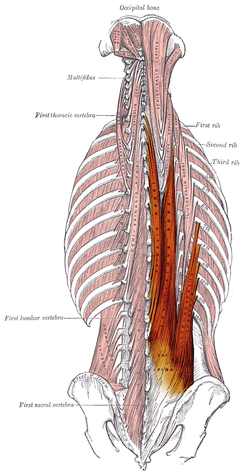
The erector spinae muscle group
Details
OriginSpinous processes of T9-T12 thoracic vertebrae, medial slope of the dorsal segment of iliac crest
InsertionSpinous processes of T1 and T2 thoracic vertebrae and the cervical vertebrae
ArteryLateral sacral artery
NervePosterior branch of spinal nerve
ActionsExtends the vertebral column
AntagonistRectus abdominis muscle
Identifiers
Latinmusculus erector spinae
TA98A04.3.02.002
TA22254
FMA71302
Anatomical terms of muscle

The erector spinae (/ɪˈrɛktər ˈspni/ irr-EK-tər SPY-nee)[1] or spinal erectors is a set of muscles that straighten and rotate the back. The spinal erectors work together with the glutes (gluteus maximus, gluteus medius and gluteus minimus) to maintain stable posture standing or sitting.

Structure

[edit]

The erector spinae is not just one muscle, but a group of muscles and tendons which run more or less the length of the spine on the left and the right, from the sacrum, or sacral region, and hips to the base of the skull. They are also known as the sacrospinalis group of muscles. These muscles lie on either side of the spinous processes of the vertebrae and extend throughout the lumbar, thoracic, and cervical regions. The erector spinae is covered in the lumbar and thoracic regions by the thoracolumbar fascia, and in the cervical region by the nuchal ligament.

This large muscular and tendinous mass varies in size and structure at different parts of the vertebral column. In the sacral region, it is narrow and pointed, and at its origin chiefly tendinous in structure. In the lumbar region, it is larger, and forms a thick fleshy mass. Further up, it is subdivided into three columns. They gradually diminish in size as they ascend to be inserted into the vertebrae and ribs.

The erector spinae is attached to the medial crest of the sacrum (a slightly raised feature of the sacrum closer towards the midline of the body as opposed to the "lateral" crest which is further away from the midline of the body), to the spinous processes of the lumbar, and the eleventh and twelfth thoracic vertebrae and the supraspinous ligament, to the back part of the inner lip of the iliac crests (the top border of the hips), and to the lateral crests of the sacrum, where it blends with the sacrotuberous and posterior sacroiliac ligaments.

Some of its fibers are continuous with the fibers of origin of the gluteus maximus.

The muscular fibers form a large fleshy mass that splits, in the upper lumbar region, into three columns, viz., a lateral (iliocostalis), an intermediate (longissimus), and a medial (spinalis). Each of these consists of three parts, inferior to superior, as follows:

Iliocostalis

[edit]

The iliocostalis originates from the sacrum, erector spinae aponeurosis, and iliac crest. The iliocostalis has three different insertions according to the parts:

Longissimus

[edit]

The longissimus muscle is the intermediate and the largest of the three columns. It has three parts with different origin and insertion:

  • longissimus thoracis originates from the sacrum, spinous processes of the lumbar vertebrae, and transverse process of the last thoracic vertebra and inserts in the transverse processes of the lumbar vertebrae, erector spinae aponeurosis, ribs, and costal processes of the thoracic vertebrae.
  • longissimus cervicis originates from the transverse processes of T6-T1 and inserts in the transverse processes of C7-C2.
  • longissimus capitis originates from the transverse processes of T3-T1, runs through C7-C3, and inserts in the mastoid process of the temporal bone.

Spinalis

[edit]

The spinalis muscle is the smallest and most medial column. It has three parts:

  • spinalis thoracis which originates from the spinous process of L3-T10 and inserts in the spinous process of T8-T2.
  • spinalis cervicis originates from the spinous process of T2-C6 and inserts in the spinous process of C4-C2.
  • spinalis capitis is an inconstant muscle fiber that runs from the cervical and upper thoracic and then inserts in the external occipital protuberance.
Insertion Lateral column
Iliocostalis
Intermediate column
Longissimus
Medial column
Spinalis
Lower thoracic vertebrae and ribs I. lumborum
Upper thoracic vertebrae and ribs I. thoracis L. thoracis S. thoracis
Cervical vertebrae I. cervicis L. cervicis S. cervicis
Skull L. capitis S. capitis

From lateral to medial, the erector spinae muscles can be remembered using the mnemonic, I Love Spine. I Iliocostalis, Love Longissimus and Spine Spinalis.[2]

Training

[edit]

Below are examples of exercises by which the erector spinae can be strengthened for therapeutic or athletic purposes. Additionally, exercises of the glutes may also be beneficial to lower back health. Care should be taken to avoid injury to the lower back when targeting spinal erectors directly. Exercises include, but are not limited to:

Additional images

[edit]

References

[edit]
[edit]
Revisions and contributorsEdit on WikipediaRead on Wikipedia
from Grokipedia
The erector spinae muscles form a large, superficial group of intrinsic back muscles that run bilaterally along the length of the vertebral column, extending from the and to the , and are crucial for spinal extension and posture maintenance. This muscle group is divided into three parallel columns—iliocostalis (lateral), longissimus (intermediate), and spinalis (medial)—which collectively stabilize the spine during movement and counteract gravitational forces in upright positions. Structurally, the erector spinae originate from a common broad tendon attached to the posterior iliac crest, sacrum, and thoracolumbar fascia, with each column branching into regional segments: iliocostalis lumborum, thoracis, and cervicis; longissimus thoracis, cervicis, and capitis; and spinalis thoracis, cervicis, and capitis. Insertions vary by subgroup, including the angles of the ribs for iliocostalis, transverse processes of vertebrae and the mastoid process for longissimus, and spinous processes or the occipital bone for spinalis, allowing for precise control over thoracic, lumbar, and cervical regions. The muscles are enveloped in the thoracolumbar fascia and form an aponeurosis that enhances their mechanical efficiency in load-bearing activities. In terms of function, bilateral contraction of the erector spinae extends the vertebral column and head, while unilateral activation produces ipsilateral lateral flexion and, in the case of longissimus capitis, head rotation; these actions are vital for maintaining erect posture, controlling trunk flexion, and stabilizing the during dynamic movements like walking or lifting. The group also contributes to spinal stability by resisting shear forces and compressing vertebrae, with increased activity often observed in conditions like to compensate for deeper muscle weaknesses. Innervation is provided by the dorsal rami of the spinal nerves from C1 to L5, ensuring segmental control that aligns with the muscles' dermatomal distribution along the spine. Blood supply arises from regional arteries, including the vertebral, deep cervical, intercostal, lumbar, and sacral arteries, which support the muscles' endurance in prolonged postural tasks.

Overview

Definition and composition

The erector spinae muscles constitute an intermediate paraspinal muscle group forming part of the intrinsic (deep) back muscles that extends parallel to the vertebral column on both sides of the body. This group is characterized by its large, elongated structure, lying deep to the and contributing to the overall mass of the back muscles. As part of the epaxial musculature, they are derived from the dorsal myotomes during embryogenesis. It comprises three primary vertical columns arranged from lateral to medial: the , the , and the , each further subdivided into regional segments that span from the to the . Historically, in the 20th edition of (1918), the erector spinae—referred to as the sacrospinalis—is described as a broad muscular and tendinous mass arising from the and extending upward, primarily serving to straighten and support the back through its combined muscle fibers and tendons. This depiction underscores its role as an integrated system of muscular and tendinous elements rather than isolated muscles. A common educational mnemonic for recalling the lateral-to-medial order of the columns is "I Love Spine," standing for , , and . In terms of superficial coverage, the erector spinae muscles are enveloped by the thoracolumbar fascia in the lumbar and thoracic regions, providing structural support and protection, while the cervical portions are covered by the nuchal ligament. This fascial arrangement helps integrate the muscle group with surrounding tissues for efficient force transmission along the spine.

Location and extent

The erector spinae muscles form a longitudinal muscle group positioned bilaterally along the vertebral column, extending from the sacrum and iliac crest inferiorly to the base of the skull superiorly, including attachments to the occipital bone and mastoid process. They span the entire posterior aspect of the trunk and neck, running vertically in the groove lateral to the spinous processes and medial to the angle of the ribs. At their inferior origin near the , the erector spinae appears as a narrow, pointed that thickens progressively through the region before dividing into three parallel columns—the (lateral), (intermediate), and (medial)—beginning in the upper and thoracic areas. The column is the thickest and longest overall, while the is the narrowest and often underdeveloped in the cervical region. The erector spinae lies deep to the superficial back muscles, including the and latissimus dorsi, as well as the and intermediate layers such as the rhomboids and serratus posterior inferior. Superficially, it relates to these overlying structures, while deep to it are the transversospinalis muscles, including the multifidus. This muscle group exhibits regional segmentation across the , thoracic, and cervical levels, with the three columns becoming distinctly separated superior to the upper and no dedicated sacral column present.

Anatomy

Iliocostalis

The forms the most lateral column of the erector spinae muscle group. It is divided into three distinct subdivisions: the iliocostalis lumborum, iliocostalis thoracis, and iliocostalis cervicis, each spanning different regions of the back with attachments primarily to the and vertebral transverse processes. The iliocostalis lumborum constitutes the inferior portion, originating from the lateral crest of the , the medial end of the , and the . Its fibers insert into the angles of 5 through 12, the transverse processes of the L1-L4 vertebrae, and the adjacent . Superior to this, the iliocostalis thoracis arises as a narrow, muscle from the angles of 7 through 12. It inserts into the angles of 1 through 6 and the transverse process of the C7 vertebra. The uppermost subdivision, the iliocostalis cervicis, originates from the angles of 3 through 6. Its tendons insert onto the posterior tubercles of the transverse processes of vertebrae C4 through C6.

Longissimus

The muscle constitutes the intermediate and largest column of the erector spinae group, positioned between the more lateral and the medial columns. As the most extensive component, it spans from the to the , providing structural support along the vertebral column through its elongated fibers. This subdivision into longissimus thoracis, longissimus cervicis, and longissimus capitis allows for segmented attachments that contribute to the overall continuity of the erector spinae. The longissimus thoracis, the broadest and most prominent part, originates from the posterior surface of the (between the sacral foramina and along the median sacral crest), the posterior aspect of the (extending from the posterior superior to posterior inferior iliac spine), the , and the transverse processes of the (L1-L5). Its fibers ascend and insert primarily into the transverse processes of the superior lumbar and all (T1-T12), as well as the accessory processes of the lumbar vertebrae and the angles of the lower (ribs 7-12). This extensive attachment pattern underscores its role in bridging the lumbosacral and thoracolumbar regions. Superiorly, the longissimus cervicis arises from the transverse processes of the upper thoracic vertebrae (T1-T6). These fibers course upward to insert onto the posterior tubercles of the transverse processes of the upper and middle (C2-C7). This configuration links the thoracic spine to the cervical region, facilitating continuity within the intermediate column. The longissimus capitis, the uppermost extension, originates from the transverse processes of the upper (primarily T1-T3, with occasional contributions from transverse processes of C4-T5). It ascends laterally to the semispinalis capitis and inserts into the posterior margin of the mastoid process of the . This superior attachment integrates the longissimus into the cranial base, completing its reach from the lower back to the head.

Spinalis

The spinalis is the medialmost and smallest column of the erector spinae muscle group, forming the innermost layer and often appearing underdeveloped or absent in some individuals due to its rudimentary development. It is typically divided into three parts: thoracis, spinalis cervicis, and capitis, with the upper portions exhibiting a more tendinous than muscular character. The spinalis thoracis, the most prominent and well-organized segment, originates from the spinous processes of the T11 to L2 vertebrae and inserts onto the spinous processes of the T2 to T8 vertebrae, often blending laterally with the longissimus thoracis. This portion contributes to the medial continuity of the erector spinae in the thoracic region. The spinalis cervicis arises from the spinous processes of C6 or C7 to T2 vertebrae, as well as the , and inserts on the spinous processes of C2 to C4 vertebrae; it is irregularly formed and frequently poorly developed or absent. In cases where present, it may blend with the semispinalis cervicis muscle. The spinalis capitis is the least consistent part, originating from the spinous processes of C7 to T1 vertebrae and inserting on the in the midline of the ; it is often inconstant, underdeveloped, or represented merely by tendinous fibers that blend with the semispinalis capitis. This segment rarely forms a distinct muscle belly and may be absent in many individuals.

Function

Spinal extension

The erector spinae muscles, comprising the , , and columns, serve as primary agonists for spinal extension through bilateral contraction, which straightens the vertebral column and head by counteracting gravitational forces during recovery from flexed positions. This coordinated activation across all three columns produces hyperextension of the spine, enabling upright alignment and facilitating movements such as rising from a seated or bent posture. In maintaining upright posture, the erector spinae continuously engage bilaterally to resist gravitational pull on the trunk, ensuring spinal stability during static standing and dynamic activities like walking. During , these muscles steady the spine relative to the by modulating activity throughout the stride cycle, with phasic peaks that support forward propulsion and prevent excessive trunk sway. This function is complemented by interaction with the , particularly the and medius, which together enhance overall postural support by stabilizing the and core during weight-bearing tasks. A key aspect of erector spinae function during spinal flexion is the flexion-relaxation phenomenon, observed in healthy individuals where muscle electromyographic activity abruptly ceases at full forward trunk flexion to minimize compressive loads on the spine. This electrical silence allows passive ligamentous structures to bear the load, reducing active muscular effort and promoting efficient biomechanics in the lumbar and thoracic regions.

Lateral flexion and rotation

The erector spinae muscles contribute to lateral flexion and of the spine through unilateral contraction, which bends the vertebral column toward the same side (ipsilateral) while also producing , particularly in the cervical and thoracic regions. This action is most pronounced in the portion, where unilateral activation of the capitis specifically rotates the head to the ipsilateral side alongside lateral flexion. Among the three columns, the and serve as primary drivers of side-bending, with the facilitating ipsilateral lateral flexion of the lumbar and thoracic spine due to its attachments to the ribs and , and the enhancing this motion across multiple spinal levels through its transverse process connections. The provides minor support in lateral flexion, acting more as a stabilizer with limited rotational influence compared to the other components, owing to its medial position connecting spinous processes. In addition to active lateral movements, the erector spinae muscles play a key role in controlling forward flexion via eccentric contraction, lengthening under tension to resist and maintain spinal stability during bending tasks. This eccentric function helps prevent excessive forward tilt of the trunk. Biomechanically, these muscles stabilize the spine during unilateral loading, such as when carrying objects on one side, by increasing activation to counter lateral and preserve postural alignment.

Innervation and blood supply

Innervation

The erector spinae muscles receive their primary innervation from the dorsal (posterior) rami of the cervical, thoracic, and spinal , with lateral branches contributing to this supply. This innervation pattern ensures segmental control corresponding to the spinal levels, including C1–C8 for the cervical region, T1–T12 for the thoracic region, and L1–L5 for the region. Among the subgroups, the muscle is innervated by the lateral branches of the dorsal rami, the muscle by the intermediate branches, and the muscle by the lateral branches, reflecting their relative positions from lateral to medial within the muscle group. This differential branching allows for targeted neural input to each component, facilitating coordinated extension and stabilization of the vertebral column. The muscles also integrate into reflex arcs that support posture maintenance, where proprioceptive feedback from muscle spindles detects stretch and triggers myotatic reflexes through the same dorsal rami pathways. These reflexes provide rapid adjustments to in response to postural demands, contributing to overall spinal stability.

Blood supply

The erector spinae muscles receive their primary blood supply from segmental arteries that correspond to their longitudinal extent across the cervical, thoracic, , and sacral regions. In the and sacral portions, the lateral sacral artery provides key contributions, while the thoracic region is supplied by the posterior intercostal and subcostal arteries, and the cervical region by the vertebral and deep cervical arteries. The muscle, the most lateral component, derives its vascular supply from multiple sources tailored to its segments: the occipital, deep cervical, vertebral, posterior intercostal, subcostal, , and lateral sacral arteries. The longissimus muscle, positioned intermediately, shares many of these vessels but additionally receives branches from the transverse cervical artery in the cervical region and sacral arteries in the lower portions. The spinalis muscle, the medialmost and least continuous component, is supplied primarily by the posterior intercostal and arteries in its thoracic and parts, with the vertebral, deep cervical, and occipital arteries nourishing its cervical extensions. These segmental arteries form anastomoses along the paravertebral gutter, creating a redundant vascular network that ensures continuous even if individual branches are compromised. This interconnected supply supports the muscles' role in maintaining endurance during prolonged upright posture by facilitating sustained oxygenation and nutrient delivery under static loading conditions.

Clinical significance

Association with low back pain

Individuals with (LBP) often exhibit and decreased activity in the erector spinae muscles, characterized by increased fat infiltration and a shift toward slower muscle fiber types. studies have shown greater fat deposition in the lumbar erector spinae of patients with sway-back posture and LBP compared to controls, indicating muscle degeneration and reduced functional cross-sectional area. analyses further reveal a significant reduction in type IIx glycolytic fibers in the erector spinae of those with nonspecific chronic LBP, with no differences in overall cross-sectional area but a trend toward higher proportions of type I slow-twitch fibers, suggesting diminished capacity for rapid force generation. This contributes to spinal by impairing the muscles' ability to maintain segmental alignment and control intervertebral motion during dynamic activities. In response to multifidus weakness, a common feature in chronic LBP, the lumbar erector spinae often displays compensatory increased to stabilize the spine, which can lead to overuse and further . Electromyographic studies during dynamic tasks demonstrate higher amplitudes in the erector spinae among individuals with low back extensor strength and LBP, particularly in those with recurrent symptoms, as a mechanism to offset reduced deep stabilizer function. This heightened recruitment helps preserve task performance but risks exacerbating pain through sustained loading on the superficial extensors. A hallmark dysfunction in LBP is the absence of the flexion-relaxation phenomenon (FRP) in the erector spinae, resulting in persistent muscle tension during forward trunk flexion. Normally, erector spinae activity ceases at full flexion as passive tissues take over, but in chronic LBP, shows continued high-level activation, with flexion-relaxation ratios significantly elevated compared to healthy individuals. This absence correlates with restricted and increased lumbar extensor activity, contributing to ongoing discomfort and altered . The erector spinae is implicated in nonspecific LBP arising from repetitive motions or poor posture, where sustained or awkward positions overload the muscles and promote chronic adaptations. Repetitive occupational microtrauma and prolonged suboptimal postures, such as slouching, increase mechanical stress on the extensors, fostering higher activation levels during forward-bending tasks in chronic cases. These patterns underscore the role of erector spinae dysfunction in perpetuating pain cycles without identifiable structural .

Injuries and treatment

The erector spinae muscles are susceptible to strains, which commonly arise from overuse during repetitive activities, sudden hyperextension movements, or improper lifting techniques that overload the muscle fibers. These strains often manifest as microtears in the muscle tissue, particularly in the region, and can be exacerbated by poor posture or biomechanical imbalances during physical exertion. Additionally, erector spinae injuries frequently occur in conjunction with rib fractures, where the muscles overlying the become strained or contribute to secondary pain from compensatory movements. In the context of management, imbalances in the erector spinae can lead to strains and spasms on the convex side of the curve, complicating postural correction efforts. Symptoms of acute erector spinae injuries typically include sharp, localized that worsens with spinal extension or , accompanied by involuntary muscle spasms, , and reduced range of mobility in the affected area. These manifestations can significantly impair daily activities, such as bending or standing, and may persist if untreated. In chronic scenarios, persistent erector spinae dysfunction has been associated with , where correlates with disease severity and may exacerbate symptoms like . Diagnosis of erector spinae injuries begins with manual muscle testing to evaluate strength deficits and to identify tender points or spasms. Imaging modalities like (MRI) are essential for visualizing , fatty infiltration, or associated soft tissue damage, providing quantitative measures of cross-sectional area and degeneration. The flexion-relaxation phenomenon, characterized by electromyographic silence in the erector spinae during full flexion in healthy individuals, serves as a functional assessment tool; its absence or alteration in injured patients indicates impaired muscle coordination and can guide therapeutic planning. Treatment strategies for erector spinae injuries emphasize and functional restoration. The erector spinae plane block, an ultrasound-guided regional technique, provides significant relief in cases of acute and chronic involvement and is particularly beneficial for fracture-related injuries by enhancing respiratory function and reducing needs. As of 2025, ESPB has gained prominence in managing chronic thoracolumbar associated with erector spinae dysfunction. therapy addresses fascial restrictions and trigger points in the erector spinae, leading to normalized myoelectric activity, decreased intensity, and improved scores when combined with standard . Lumbar stabilization exercises, focusing on core and controlled movements, promote muscle and spinal alignment to facilitate recovery from strains and prevent recurrence.

Training

Strengthening exercises

Strengthening the erector spinae muscles through targeted exercises enhances spinal stability and supports rehabilitation efforts for (LBP) by countering and promoting controlled extension. Recent evidence from a 2025 randomized controlled trial confirms that isolated extension training effectively reduces nonspecific LBP symptoms. These exercises emphasize proper technique, such as avoiding momentum and initiating with bodyweight variations for beginners to build foundational strength without excessive strain. Conventional deadlifts involve lifting a from the ground to a standing position with a neutral spine, heavily activating the erector spinae to maintain posture during the lift. Romanian deadlifts, a variation focusing on hinge with slightly bent , further target the erector spinae through eccentric control while minimizing knee flexion. Both forms improve lower back endurance when performed with controlled reps of 8-12, starting at lighter loads to prioritize form. Back extensions on a or stability ball isolate the erector spinae by extending the from a flexed position while keeping the hips fixed; these exercises, particularly on the Roman chair, should be performed with proper technique under professional guidance, avoiding end-range hyperextension, and are not recommended for individuals with pre-existing spinal conditions without medical clearance. The version allows for weighted progression, increasing muscle strength over 10-week programs, whereas the stability ball adds instability to engage core stabilizers alongside the erectors. Perform 10-15 repetitions slowly, focusing on full extension without hyperextension to avoid overload. The bird-dog pose, performed in a quadruped position by extending opposite and while maintaining a level spine, activates the erector spinae to resist and stabilize the region. This bodyweight exercise is ideal for beginners, with holds of 5-10 seconds per side for 8-10 reps, enhancing overall spinal control. The Superman exercise involves lying face down with arms extended forward. Lift arms, chest, and legs off the ground simultaneously while squeezing the back muscles. Hold briefly, then lower. Perform 2–3 sets of 8–12 reps. This low-impact movement strengthens the lower back for daily posture maintenance and engages the erector spinae in isometric contraction. Integrating glute bridges supports erector spinae function by strengthening the and trunk muscles, which share load during spinal extension tasks. From a , lift the hips toward the ceiling while squeezing the glutes, performing 10-15 reps to bolster lower back health without isolating the erectors alone.

Injury prevention strategies

Maintaining a neutral spine during lifting activities is essential to prevent strain on the erector spinae muscles. Proper technique involves bending at the knees and hips rather than the , engaging muscles to stabilize the spine, and avoiding twisting motions while holding loads close to the body. These practices distribute the load away from the back extensors, reducing the risk of acute injuries such as muscle strains. Ergonomic adjustments in daily environments help minimize prolonged spinal flexion that can overload the erector spinae. Setting up a with the height adjusted so feet rest flat on the floor, monitor at , and keyboard positioned to keep elbows at a 90-degree promotes neutral posture and reduces forward bending. Incorporating regular posture breaks, such as standing and walking every 30-60 minutes, further prevents and compensatory tension in the back extensors. Dynamic warm-up routines prior to activate the erector spinae and improve spinal mobility. Exercises like the cat-cow stretch, performed on by alternating between arching and rounding the back, gently mobilize the spine and surrounding muscles without static holding. To address potential imbalances, monitoring for tightness in components like the through targeted stretching—such as side bends away from the tight side—can prevent compensatory movements, including altered hip mechanics during gait. Balancing this with antagonist strengthening, particularly of the abdominal muscles, helps maintain overall spinal stability and avoids patterns like lower crossed syndrome, where tight erector spinae contribute to and hip dysfunction.

References

Add your contribution
Related Hubs
User Avatar
No comments yet.