Hubbry Logo
Said bin SultanSaid bin SultanMain
Open search
Said bin Sultan
Community hub
Said bin Sultan
logo
8 pages, 0 posts
0 subscribers
Be the first to start a discussion here.
Said bin Sultan
Said bin Sultan
from Wikipedia

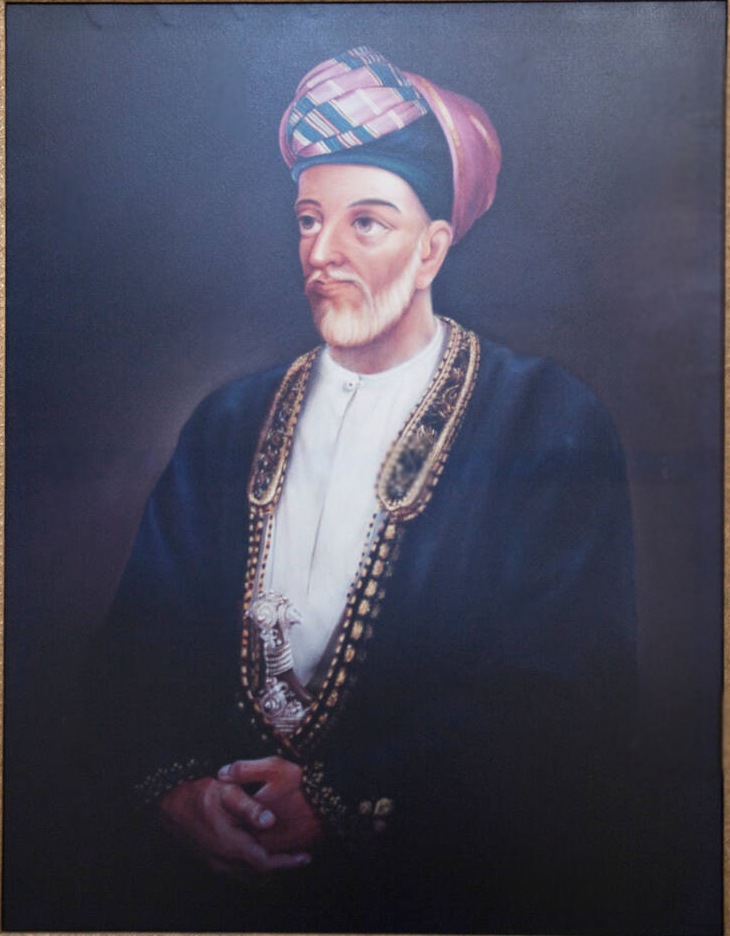
Sayyid Saïd bin Sultan al-Busaidi (Arabic: سعيد بن سلطان, Saʿīd bin Sulṭān, Swahili: Saïd bin Sultani) (5 June 1791 – 19 October 1856) was Sultan of Muscat and Oman, the fifth ruler of the Al Bu Said dynasty from 1804 to 4 June 1856. His rule began after a period of conflict and internecine rivalry of succession that followed the death of his father, Sultan bin Ahmad, in November 1804. He is often referred to as the Lion of Oman (أسد عمان), as one of the greatest Omani sultans.[2]

Key Information

Said's uncle Qais bin Ahmad finally agreed to Said's primacy after Said had killed his cousin, Badr bin Saif, a pretender to the throne. Said is noted for moving his capital to Zanzibar, where it remained during the time when the Omani Empire reached the zenith of its power and wealth.[3][4]

Early years

[edit]

Said bin Sultan was son of Sultan bin Ahmed, who ruled Oman from 1791 to 1804. Sultan bin Ahmed died in 1804 on an expedition to Basra. He appointed Mohammed bin Nasir bin Mohammed al-Jabry as the Regent and guardian of his two sons, Salim bin Sultan and Said bin Sultan.[5] Sultan's brother Qais bin Ahmad, the ruler of Sohar, decided to attempt to seize power. Early in 1805 Qais and his brother Mohammed marched south along the coast to Muttrah, which he easily captured. Qais then started to besiege Muscat. Mohammed bin Nasir tried to bribe Qais to leave, but did not succeed.[5]

Mohammed bin Nasir called on Badr bin Saif for help.[5] After a series of engagements, Qais was forced to retire to Sohar. Badr bin Saif became the effective ruler.[6] Allied with the Wahhabis, Badr bin Saif became increasingly unpopular.[7] To get his wards out of the way, Badr bin Saif made Salim bin Sultan governor of al Maṣna'ah on the Batinah coast and Said bin Sultan governor of Barka.[8]

In 1806, Said bin Sultan lured Badr bin Saif to Barka and murdered him nearby. There are different accounts of what happened, but it seems clear that Said struck the first blow and his supporters finished the job. Said was acclaimed by the people as a liberator from the Wahhabis, who left the country. Qais bin Ahmad at once gave his support to Said. Nervous of the Wahhabi reaction, Said blamed Mohammed bin Nasir for the murder.[1]

On 31st July 1806 Sayyida Aisha bint Sultan Al-Imam Ahmad bin Sa’id Al-Busaidi, a daughter of Sultan bin Ahmed, assumed the regency on behalf of her younger brother Said bin Sultan. She was a formidable woman, who conducted the affairs of government and frequently commanded her troops dressed in male clothing.[9]

Sultan

[edit]

Said bin Sultan became the sole ruler of Oman, apparently with the consent of his brother. Their aunt, the daughter of the Imam Ahmad bin Said al-Busaidi, seems to have influenced this decision.[10]

In 1820, he launched a punitive expedition against the Bani Bu Ali with the assistance of the East India Company. It was defeated, but the following year a larger Company force returned and defeated the tribe.[11]

In 1822, he signed the Moresby Treaty, restricting the Zanzibar slave trade.[12]

In 1835, he ratified a treaty with the United States on very favorable terms, that had been negotiated by Edmund Roberts at Muscat on 21 September 1833,[13] and returned by USS Peacock.[14]

In 1837, he conquered Mombasa (now in Kenya). In 1840, Said moved his capital from Muscat to Stone Town in Zanzibar, where Richard Waters was American Consul,[15] and sent a ship to the United States to try to further a trading relationship.[16]

In 1843 he nominated a nominal representative in Mogadishu and was forced to pay tribute to Sultan Yusuf Mahamud Ibrahim of the Sultanate of the Geledi.[17]

In 1845, he signed the Hamerton Treaty, further restricting the Zanzibar slave trade.[18]

Upon Said's death in 1856, his realm was divided. His third son, Thuwaini bin Said, became the Sultan of Muscat and Oman, and his sixth son, Majid bin Said, became the Sultan of Zanzibar.

The National Museum in Muscat houses numerous items of silverware and other possessions that belonged to Said.

Children

[edit]

Said had 36 children:

  1. Sayyid Sultan bin Said al-Busaidi (c. 1815–1851): an alcoholic, according to Ruete (Ch. 15), he left three sons, Saud, Faisal, and Muhammed
  2. Sayyid Khalid bin Said al-Busaidi (c. 1819–1854)
  3. Sayyid Thuwaini bin Said al-busaidi (also called Tueni) (−1866): Sultan of Muscat and Oman, 1856–1866
  4. Sayyid Muhammad bin Said al-Busaidi (1826–1863): he "...was considered the most pious of our entire family.... cared little for the world and worldly goods.... possessed by... antipathy against Zanzibar" (Ch. 14, Ruete); he lived most of his life in Oman; father of Hamoud bin Mohammed, Sultan of Zanzibar.
  5. Sayyid Turki bin Said (1832–1888): Sultan of Muscat and Oman, 1871–1888
  6. Sayyid Majid bin Said Al-Busaid (1834/5-1870): 1st Sultan of Zanzibar, 1856–1870
  7. Sayyid Ali bin Said al-Busaidi (?-1893)
  8. Sayyid Barghash bin Said Al-Busaid (1837–1888): 2nd Sultan of Zanzibar, 1870–1888
  9. Sayyid Abdu'l-Wahhab bin Said al-Busaidi (1840–1866)
  10. Sayyid Jamshid bin Said al-Busaidi (1842–1870)
  11. Sayyid Hamdan bin Said al-Busaidi (1843–1858)
  12. Sayyid Ghalib bin Said al-Busaidi
  13. Sayyid Sawedan bin Said al-Busaidi (1845–?)
  14. Sayyid Abdu'l-Aziz bin Said al-Busaidi (1850–1907)
  15. Sayyid Khalifah bin Said Al-Busaid, 3rd Sultan of Zanzibar (1852–1890): Sultan of Zanzibar, 1888–1890
  16. Sayyid Hamad bin Said al-Busaidi
  17. Sayyid Shuwaid bin Said al-Busaidi
  18. Sayyid Abbas bin Said al-Busaidi
  19. Sayyid Manin bin Said al-Busaidi
  20. Sayyid Ali bin Said Al-Busaid, 4th Sultan of Zanzibar (1854–1893): Sultan of Zanzibar, 1890–1893
  21. Sayyid Badran bin Said al-Busaidi (?-1887)
  22. Sayyid Nasir bin Said al-Busaidi (also called Nasor) (?-1887) went to Mecca with his older sister Chadudj: died in his twenties
  23. Sayyid Abdu'l-Rab bin Said al-Busaidi (?-1888)
  24. Sayyid Ahmad bin Said al-Busaidi
  25. Sayyid Talib bin Said al-Busaidi
  26. Sayyid Abdullah bin Said al-Busaidi
  27. Sayyida Sharîfe of Zanzibar and Oman: the daughter of a Circassian woman, she was "a dazzling beauty with the complexion of a German blonde. Besides, she possessed a sharp intellect, which made her into a faithful advisor of my father's" (described in Ruete, Ch. 15)
  28. Sayyida Chole (or Khwala) of Zanzibar and Oman (died 1875): the daughter of a Mesopotamian woman, she "was particularly close to our father; her enchanting personality, her cheerfulness and charm won him over completely" (Ruete, Ch. 15)
  29. Sayyida Aashe of Zanzibar and Oman: full sister of Chole; after the death of their brother Hilal (1851), she "took motherly care of his eldest son Suud" (Ruete)
  30. Sayyida Chadudj of Zanzibar and Oman: full sister of Majid; after his death (1870), she went with her younger brother Nasir to Mecca and died not long afterward (Ruete)
  31. Sayyida Shewâne of Zanzibar and Oman: the daughter of an Abyssinian woman; "a classical beauty ... endowed with a keen mind", she died early (Ruete)
  32. Sayyida Mettle of Zanzibar and Oman: the daughter of an Abyssinian woman, she married a "distant cousin" in Stonetown and had "two charming twin boys" (Ruete)
  33. Sayyida Zeyâne of Zanzibar and Oman: the daughter of an Abyssinian woman (Ruete)
  34. Sayyida Semsem of Zanzibar and Oman: full sister of Zeyâne, she was married "rather late in life [to] our distant cousin Humud" (Ruete)
  35. Sayyida Nunu of Zanzibar and Oman: the daughter of a Circassian woman, she was born blind; after the deaths of her parents, she lived with her sister Aashe (Ruete)
  36. Sayyida Salme of Zanzibar and Oman (1844–1924): she became known as Emily Ruete[19]

References

[edit]

Further reading

[edit]
[edit]
Revisions and contributorsEdit on WikipediaRead on Wikipedia
from Grokipedia

Sayyid (c. 1790 – 1856) was of from 1806 until his death, during which he consolidated power by eliminating rivals and expanded the realm into a maritime empire encompassing the East African coast. In 1840, he relocated the capital from to , transforming it into the empire's economic center through plantations and intensified slave trading networks. His reign marked the zenith of Omani naval influence in the and , fostering trade ties with European powers and the via treaties such as the 1833 Treaty of Amity and Commerce with America.
Said ascended amid familial strife following his father's death in 1804, securing control in 1807 by orchestrating the killing of claimant Badr bin Saif. He subdued rebellions, notably defeating the Mazrui rulers of in 1837, thereby extending Omani dominance over key ports. Economically, his policies promoted a fleet of merchant vessels trading spices, , and slaves, with Zanzibar's industry—introduced around 1828—becoming a cornerstone reliant on imported labor from . Despite British diplomatic pressure to curb the slave trade through agreements in 1822, 1839, and 1845, Said balanced European influences while prioritizing Omani commercial interests. Upon Said's death on 19 October 1856, succession disputes among his sons led to the empire's partition, with British mediation in 1861 assigning to and to Majid bin Said, effectively severing the unified domains. This division reflected the empire's overextension and external interventions, though Said's era endures as a period of Omani prosperity and transoceanic reach.

Early Life

Birth and Family Background

Said bin Sultan al-Busaidi was born circa 1791 in , , as the son of al-Busaidi, of from 1792 until his death in 1804, and Sayyida Ghanneyeh bint Saif al-Busaidi (1774–1866). His father had ascended following the deposition of his uncle, Hamad bin Said, amid internal dynastic struggles and external threats from Persian and Wahhabi forces. Said belonged to the Al Bu Sa'id dynasty, an Arab lineage of the tribe that had established itself as rulers of after , Said's paternal grandfather, expelled Persian occupiers and was elected in 1744, founding the dynasty's stable rule over interior and coastal . The family traced its origins to Yemenite settlers in , emphasizing tribal alliances and religious legitimacy through Ibadi Islam, which underpinned their governance amid rivalries with Sunni powers like the Wahhabis of . He had at least one full brother, Salim bin Sultan, with whom he would later contest succession upon their father's death, reflecting the intra-familial power dynamics common in tradition where rule was often shared or seized by capable kin rather than strictly primogenital. This fraternal rivalry, exacerbated by cousin Badr bin Saif's brief usurpation in , highlighted the precariousness of Al Bu Sa'id authority at the time of Said's birth, dependent on military prowess and tribal loyalties rather than formalized inheritance.

Upbringing and Early Influences

Said bin Sultan, born circa 1791 in , was the son of al-Busaidi, who ruled from 1792 until his death in 1804, and Sayyida Ghanneyeh bint Saif al-Busaidi. As a scion of the Al Bu Said dynasty, which had established control over in the mid-18th century following the expulsion of forces, his early environment was steeped in the maritime and tribal dynamics of the region, including rivalries with Persian and Wahhabi forces. Said received a private education suited to a royal heir, emphasizing skills in , Islamic , and preparedness amid the dynasty's of naval prowess and intertribal alliances. His upbringing occurred against a backdrop of internal instability, as his father's reign involved efforts to reclaim coastal territories lost to regional adversaries, fostering in Said an early awareness of the need for strong familial loyalty and strategic maneuvering within i clans. The death of on expedition in 1804, when Said was approximately 13 years old, thrust him into political contention; he and his brother Salim were proclaimed joint rulers on 20 November 1804 under the regency of their maternal uncle, Sayyid Badr bin Saif, until 31 July 1806. This period of regency, followed briefly by oversight from his sister Sayyida Aisha starting 14 September 1806, exposed Said to the intricacies of succession disputes and power-sharing, key influences that honed his resolve to centralize authority and navigate kinship-based challenges.

Ascension and Consolidation of Power

Succession and Regency

Sultan bin Ahmad, Said's father, died in November 1804 while on an expedition to , leaving his sons Salim and Said—aged approximately 16 and 14, respectively—as intended joint successors under the regency of Mohammed bin Nasir bin Mohammed al-Jabry, whom he had appointed as guardian prior to his death. This arrangement aimed to preserve stability amid 's internal rivalries and external threats, but it quickly unraveled as the brothers' cousin, Badr bin Saif, seized control in , effectively usurping the regency and marginalizing both Mohammed bin Nasir and the young heirs. Badr's rule, backed by tribal alliances, lasted until mid-1806, during which Said was appointed governor of Barka, a coastal town near , positioning him to challenge the usurper. In July 1806, Said lured Badr to Barka under the pretense of negotiations and orchestrated his , thereby eliminating the primary obstacle to his claim and ending the brief regency. This act, supported by loyalists including elements of the Omani military and tribes dissatisfied with Badr's dominance, allowed Said to rally forces and march on . By September 1806, he had deposed his brother Salim from joint rule, assuming sole authority as Sultan of without further immediate challengers. Salim, who posed no ongoing threat, retired to and died in April 1821, leaving Said to consolidate power amid lingering factional tensions. Said's ascension marked the end of the internecine strife that had plagued the Al Bu Said dynasty since the late , though it relied on decisive violence rather than institutional succession norms. During this period, he began fortifying his position by securing coastal forts, negotiating with tribal sheikhs, and leveraging 's maritime trade networks to build economic and naval resources essential for long-term rule. These early moves laid the groundwork for his 50-year reign, transforming from a fragmented into a .

Wars Against Wahhabis and Rivals

Following the death of his father, , in November 1804, Said bin Sultan faced immediate challenges from family rivals amid a . His cousin Badr bin Saif, supported by elements in , seized control of the port city and imprisoned Said. Said escaped captivity and, acting as governor of nearby Barka, lured Badr to the area under pretext of negotiation. There, in 1806, Said orchestrated Badr's assassination, eliminating a primary contender and securing his position as ruler of Muscat. This internal consolidation coincided with external threats from the Wahhabis of the First Saudi State, who had expanded into Omani territories since the late 1790s, occupying the strategic Buraimi oasis in 1800 and exerting influence over northern coastal enclaves like through alliances with local tribes. The Wahhabis, driven by religious zeal and territorial ambition from , conducted raids that disrupted Omani trade and sovereignty, including a major assault on in 1809 alongside Qasimi allies. Said repelled the attack with naval support from British vessels, which bombarded Wahhabi positions and prevented a . Said's campaigns against the Wahhabis intensified in the , leveraging British diplomatic pressure and his own forces to reclaim coastal holdings. By aligning with Ottoman efforts against the Saudi-Wahhabi core in , Said exploited the weakening of Wahhabi power following Egyptian-Ottoman victories in , enabling him to push back incursions and restore Omani authority in disputed interior regions. These efforts, though protracted due to the Wahhabis' guerrilla tactics and tribal networks, diminished their foothold in by the early 1820s, allowing Said to focus on broader expansion.

Rule in Oman

Military and Naval Reforms

Said bin Sultan emphasized naval expansion to protect Omani trade routes and project power across the , assembling a fleet that represented the largest in Omani history at the time. This included four principal ships, each armed with 40 guns, supplemented by 25 smaller, locally built vessels suited for coastal and regional operations. The fleet's dual -mercantile role allowed officers to conduct trade on his behalf while enforcing against pirates and rivals. Land-based military organization remained limited, with Said maintaining a small standing force of —primarily Baluchi guards—rather than developing a large professional . This mercenary core, augmented by tribal levies during conflicts, sufficed for defensive operations and campaigns against Wahhabi forces that had occupied parts of the Omani coast in the early . Such an approach prioritized fiscal efficiency and naval priorities over extensive ground force reforms, reflecting Oman's reliance on maritime revenue and alliances, including with Britain, for broader security. These measures enabled Said to consolidate control over Omani ports like and Suhar by the , repelling Wahhabi incursions without committing to structural army modernization. The navy's growth, in particular, supported subsequent expansions into , underscoring its strategic centrality to his rule.

Internal Governance and Economy

Said bin Sultan governed Oman through absolute personal authority, personally adjudicating disputes and complaints in daily public audiences, which characterized his patriarchal style of rule. The administrative system lacked a centralized , relying instead on appointed provincial governors (walis) and family members to manage local affairs and enforce loyalty among tribes. was extended to non-Ibadi subjects, as evidenced by the appointment of a special for Sunnite amid the Ibadi majority. Internal stability was achieved after suppressing family and tribal quarrels by the 1820s, though ongoing reliance on tribal alliances limited formal centralization. The economy of Oman under Said bin Sultan centered on Muscat as a vital entrepôt for Persian Gulf and Indian Ocean trade, exporting dates from interior oases irrigated by traditional falaj systems, dried fish, and pearls from coastal waters. He actively encouraged Indian merchants to settle in Muscat, where they provided capital, financed ventures, and dominated commercial activities, contributing to booming trade volumes in goods like textiles, spices, and metals. Naval protection facilitated mercantile interests, with fleet officers often trading on the sultan's behalf, though the domestic economy remained largely subsistence-based in agriculture and fishing beyond coastal hubs. As Said shifted focus to East Africa after 1832—delegating Omani administration to sons like Salim bin Sultan—the internal economy sustained steady, if traditional, growth without major structural reforms.

Expansion into East Africa

Establishment of Control in Zanzibar

Said bin Sultan, having ascended as Sultan of Muscat and Oman in 1806, inherited Omani claims over Zanzibar, which had been incorporated into Omani holdings since 1698 following the expulsion of Portuguese forces from the island. Omani garrisons had been maintained there since the mid-17th century, establishing nominal suzerainty, though local governors often exercised de facto autonomy under tribute obligations. Said initially extended influence through trade concessions and naval presence, but direct control was consolidated via personal intervention starting in 1827, when he traveled to the East African coast to enforce authority and boost revenue remittances from Zanzibar, which rose significantly thereafter. In 1828, Said's flagship arrived at Zanzibar for his first extended visit as reigning sultan, allowing him to assess and reorganize local administration amid growing commercial opportunities in ivory, slaves, and emerging clove cultivation. He confiscated key clove plantations from semi-independent operators, such as those held by Saleh bin Haramil al Abray since 1812, centralizing economic control under royal oversight to prevent rival power bases. This move, justified by claims of overdue tribute and disloyalty, effectively subordinated island elites and integrated Zanzibar more firmly into Omani fiscal structures without major military conflict, leveraging existing Arab settler networks and Omani naval superiority. By 1832, Said relocated his primary court from to on Island, marking the formal establishment of as the administrative hub of his expanding domain and shifting the empire's focus toward East African trade routes. This relocation, later reinforced by moving his full household around , entrenched Arab ruling elites, fostered infrastructure like palaces and ports, and elevated 's status as the principal power in the region, overseeing nominal control over coastal settlements from to . Pemba Island's integration followed suit, overcoming lingering Mazrui family resistance through and , solidifying unified governance under Said's direct oversight until his death in 1856.

Relocation of Capital and Imperial Zenith

In the , Sultan Said bin Sultan increasingly focused on his East African territories, prompted by the growing economic significance of as a hub for , spice, and slave trades. By 1840, he effectively relocated his capital from to on Island, leaving a to govern , due to 's superior strategic position for controlling commerce routes. This shift capitalized on the island's natural harbor and proximity to productive plantations, transforming it into the administrative and economic center of his realm. The relocation coincided with the Omani Empire's imperial zenith during the first half of the 19th century, when Said's rule extended authority over a vast maritime domain spanning from the across to the . From , Said consolidated control over key ports, including the conquest of in 1837, which secured lucrative trade monopolies and fortified naval dominance in the region. His fleet, bolstered by Omani expertise, facilitated annual clove exports from and Pemba plantations—introduced around 1818—that generated immense wealth, with production reaching thousands of tons by mid-century and supporting a influx of Arab settlers and enslaved laborers. At its peak under Said, the empire's prosperity stemmed from diversified commerce, including ivory from the African interior, spices, and textiles exchanged with India and Europe, positioning Zanzibar as East Africa's principal entrepôt. Said's policies fostered a cosmopolitan trading network, with Omani merchants establishing factors in ports like Lamu and Kilwa, while diplomatic engagements with powers such as Britain ensured protection of these interests amid rising European abolitionist pressures. This era represented the height of Omani influence, blending Arabian governance with African economic integration, until Said's death in 1856 precipitated the empire's partition.

Economic Policies

Trade Expansion in Indian Ocean

Said bin Sultan expanded Omani commerce across the by consolidating control over key ports and developing as a pivotal after his first visit there in 1828. He introduced clove cultivation to the island during this period, leveraging its fertile soils to initiate plantations that rapidly scaled production. By relocating the sultanate's capital to in 1840, Said positioned himself to supervise maritime operations directly, shifting focus from Omani coastal trade to broader oceanic networks linking , the , , and Persia. Under his direction, Zanzibar's clove exports surged fifteenfold between 1839 and 1856, establishing it as a dominant supplier in global circuits that extended to European buyers via Indian intermediaries. Said augmented the sultanate's merchant fleet with around twenty European-style vessels by the early , supplementing traditional dhows to facilitate faster, more reliable voyages along routes carrying and spices eastward to Bombay for exchange with textiles, , and timber, while importing dates and from ports. These expansions integrated disparate regional markets, with Zanzibar handling the bulk of transactions in commodities like gum copal and cowries routed to and . To underpin this growth, Said invited Gujarati Bania merchants to settle in , where they financed caravans and dominated credit networks essential for long-distance commerce. He pursued diplomatic treaties to safeguard routes, including a 1833 agreement with the that formalized access to American markets for Omani exports, bypassing European monopolies. This policy not only diversified revenue streams beyond local levies but also elevated Omani shipping's competitiveness against British and interests in the western .

Development of Clove Plantations

Said bin Sultan acquired the initial plantations in Zanzibar during his first visit to the island in 1828, seizing the two existing properties established by the French merchant Saleh bin Haramil al Abray, who had introduced cultivation around 1812 from and . Recognizing the crop's potential profitability due to Zanzibar's tropical climate and fertile soils, Said expanded production by distributing seedlings exclusively to Omani and loyal elites, thereby concentrating ownership among a ruling Arab class. By 1835, Said's personal estate at Kizimbani featured approximately 4,000 trees, yielding an average annual harvest that underscored the viability of large-scale . He promoted further planting across and Pemba, leveraging imported slave labor from to clear forests, plant, and maintain orchards, as trees required intensive hand-picking during biannual flowering seasons. This labor-intensive system, reliant on enslaved Africans, enabled rapid scaling; by the , plantations covered thousands of acres, transforming former into export-oriented . Said's relocation of the Omani capital to in 1840 intensified these efforts, integrating production into the sultanate's economy alongside and slave trades. , dried flower buds valued for preservation and flavoring in European and Asian markets, generated substantial revenue, with emerging as a dominant supplier by the , exporting tens of thousands of pounds annually and eclipsing other commodities in fiscal importance during his later reign. This development solidified 's role as a spice hub, though it entrenched dependency on coerced labor and vulnerability to climatic risks like cyclones that periodically devastated yields.

Slave Trade Involvement

Role in East African Slave Economy

Under Said bin Sultan's rule, the East African slave economy expanded significantly as emerged as the principal for exporting enslaved Africans captured in the interior to markets in Arabia, Persia, and the rim. By relocating the Omani capital to in , Said centralized control over coastal trade networks, where slaves served dual roles as porters transporting from inland regions like the Mrima coast and as commodities themselves, with annual exports from the reaching estimates of 6,500 individuals by the mid-1830s to support these operations. This trade, facilitated by Omani dhows and Arab-Swahili caravans, generated substantial revenue for Said's administration, underpinning fiscal stability amid military campaigns and commercial ventures. Slavery became the backbone of Zanzibar's system, particularly after Said introduced cultivation in the 1820s, a labor-intensive crop that demanded large-scale coerced workforce importation from regions such as Kilwa, , and the Rufiji Delta. Enslaved individuals cleared forests, planted, harvested, and processed cloves, driving export volumes from roughly 9,000 frasilas (a local weight measure equivalent to about 35 pounds each) in 1839 to 142,857 frasilas by 1856—a fifteenfold increase that enriched Omani elites and Indian merchant financiers aligned with Said. While Said personally owned hundreds of slaves, including domestic sarari used in his households, the economy's scale reflected systemic reliance on bondage rather than free labor, with Zanzibar's markets handling thousands of sales annually despite growing European scrutiny. Diplomatic pressures from Britain prompted partial restrictions, yet Said balanced suppression with economic pragmatism; the 1822 Moresby Treaty prohibited slave exports to European or American possessions in the but permitted shipments to Muslim territories, allowing the trade to persist toward Arabian destinations. The 1845 Hamerton Treaty extended bans on exports from African ports to Arabia (excluding "domestic" slaves), yet enforcement remained lax, as Said's navy protected dhow convoys carrying up to 4,000 slaves yearly through alone in the , sustaining Omani wealth until British naval patrols intensified post-1856. These measures, often attributed to Said's negotiations as a pragmatic rather than moral conviction, highlight how the slave economy's profitability delayed full abolition, with exporting an estimated 50,000 slaves annually at its peak under his successors but rooted in expansions during his reign.

Diplomatic Treaties and British Pressures

In 1822, Said bin Sultan signed the Moresby Treaty with Captain Fairfax Moresby of the British Royal Navy, which prohibited the of slaves from Omani territories to Christian countries and restricted shipments to areas north of Cape Delgado and west of , aiming to curb the traffic to British colonies like and . This agreement reflected British diplomatic pressure following the 1807 abolition of the slave in the , with Said seeking naval protection against regional rivals such as the Qawasim in the . Enforcement remained , as the permitted internal African and did not dismantle the coastal networks that supplied Omani plantations. British authorities continued exerting influence through naval patrols and direct negotiations, viewing Said's growing Zanzibar-based commerce—including slave exports to the Mascarenes—as a to their suppression efforts. In 1845, under from British agent Atkins Hamerton, Said concluded the Hamerton Treaty, which banned the export of slaves from his African possessions and their import into Asian territories, while allowing limited between African ports. Hamerton, leveraging Said's dependence on British goodwill for trade privileges and security, framed the accord as essential for maintaining Omani-British amity, though Said resisted broader prohibitions that would undermine Zanzibar's economy reliant on enslaved labor. These treaties marked incremental concessions amid escalating British coercion, including threats of blockades and exclusion from preferential tariffs, yet Said prioritized economic viability, often interpreting clauses narrowly to sustain intra-African shipments. By the , persistent highlighted the treaties' ineffectiveness, as Omani dhows evaded patrols, prompting further British demands that outlasted Said's reign until 1873.

Foreign Relations

Interactions with European Powers

Said bin Sultan sought to balance British dominance in the Indian Ocean by fostering relations with , signing a Treaty of Amity and Commerce on November 20, 1844, which granted French merchants preferential access to Zanzibar ports while affirming mutual protection against external aggression. This accord reflected his strategy of leveraging European rivalries to preserve Omani autonomy amid expanding imperial interests. British influence proved more pervasive, with Said bin Sultan relying on the and for maritime security and expeditionary support, including against regional threats that indirectly countered European encroachments. In response to persistent British anti-slavery campaigns, he concluded the Hamerton Treaty on October 2, 1845, with British consul Atkins Hamerton, prohibiting slave exports from his East African territories to Arabia or and authorizing patrols for enforcement effective January 1, 1847. This pact curtailed a core revenue source—estimated at over 20,000 slaves annually shipped northward—while securing British recognition of his sovereignty. Said bin Sultan permitted European merchants, particularly British and French, to establish factories in from the , facilitating , , and trades that generated annual revenues exceeding 2 million dollars by the . These concessions, however, invited escalating interventions; British agents monitored compliance with trade restrictions, and French overtures aimed to erode London's monopoly, though Said's deference to British naval power limited French gains. His diplomacy thus prioritized commercial pragmatism over outright resistance, acknowledging Britain's capacity to enforce demands through or alliance shifts.

Treaties and Alliances

Said bin Sultan sought to expand commercial opportunities and legitimize his expanding domain through treaties with Western powers, particularly to facilitate in cloves, , and other goods while countering remnants and balancing European influences. These agreements, often negotiated amid British naval presence, prioritized economic access over military alliances, though they increasingly incorporated anti-slavery stipulations demanded by Britain to curb the export of enslaved Africans from . On September 21, 1833, Said signed the with the in , granting American vessels reciprocal trading rights in Omani ports and , which became the first such bilateral pact between the U.S. and an Arab state. This was followed by the Anglo-Omani on May 31, 1839, which similarly opened ports to British ships and laid groundwork for later slave trade restrictions, reflecting Britain's strategic interest in the . To offset growing British dominance, Said ratified a with on November 20, 1844, allowing French traders equivalent privileges and supporting missionary activities in . British pressure intensified thereafter, leading to the Hamerton Treaty of October 2, 1845, whereby Said prohibited the export or import of slaves from his African territories to foreign destinations, effective January 1, 1847, and consented to British naval seizures of violating vessels. This accord, negotiated by British consul Atkins Hamerton, extended prior restrictions but focused on overseas shipments, preserving internal while enabling patrols; non-compliance risked bombardment, underscoring the coercive element in these "alliances." No formal military pacts emerged, as Said maintained pragmatic neutrality to safeguard his amid European rivalries.

Later Years and Death

Final Expeditions and Challenges

In the 1850s, Sayyid Said bin Sultan confronted mounting external threats, including Wahhabi incursions from the region and Persian encroachments on , which strained Omani resources and heightened his reliance on British naval support to safeguard maritime trade routes. These pressures compounded internal challenges, such as ongoing Ibadi unrest in Oman's interior and the economic disruptions from British-dictated slave trade restrictions under the 1845 Hamerton Treaty, which limited exports beyond Omani territories and forced adaptations in Zanzibar's clove-based economy. Said's final journeys between and underscored his efforts to balance dual realms amid deteriorating health and succession uncertainties among his sons. His last documented visit to occurred in 1854, aimed at reinforcing authority against tribal dissent, before he returned to . In September 1856, he departed on September 15 aboard his ship, expressing a premonition of to his , to resume governance in ; en route, he succumbed to and severe leg pains on October 19, aged 67, with his body arriving in on October 25. These late travels, devoid of large-scale military campaigns but marked by diplomatic maneuvering for British aid, highlighted the empire's vulnerabilities: overextended supply lines across the , familial rivalries foreshadowing partition, and Said's physical frailty, which precluded decisive action against peripheral rebellions in East African ports like . His death at sea symbolized the culmination of these strains, transitioning the sultanate toward fragmentation without a unified succession plan.

Death and Immediate Aftermath

Said bin Sultan died at sea on October 19, 1856, aboard his Victoria while returning from to , at the age of 65. His death occurred amid a voyage that had passed near the Islands, and his body was subsequently transported to for burial. The immediate aftermath saw a power struggle among his numerous sons for control of the unified Omani-Zanzibari realm. Initial claims were asserted by several heirs, including Salim bin Sultan, who briefly positioned himself as successor in , but British diplomatic intervention, led by agents in and , mediated to prevent prolonged conflict and protect British commercial interests in the region. Provisional recognition favored , the third son, as ruler of , while Majid bin Said, the sixth son, was installed as Sultan of ; Majid was required to remit an annual tribute to his brother in to acknowledge Omani . This partition, formalized later by the 1861 Canning Award from British authorities, effectively dissolved the transoceanic empire Said had consolidated, with emerging as the economically dominant but tributary entity. The division reflected British preferences for separate, manageable principalities amenable to anti-slavery pressures and concessions, though it sowed seeds for future tensions between the branches.

Succession and Family

Division of the Empire

Upon the death of Said bin Sultan on 19 October 1856 aboard his ship Victoria en route from Muscat to Zanzibar, a succession dispute erupted among his sons, primarily between Thuwaini bin Said, who was in Muscat, and Majid bin Said, who was administering Zanzibar. Thuwaini, as the senior son present in Oman, quickly asserted control over Muscat and Oman, claiming the entire inheritance, while Majid, supported by local forces in Zanzibar, proclaimed himself ruler of the African possessions and dependencies. This rivalry threatened civil war, as Thuwaini dispatched forces toward Zanzibar in 1859 to enforce his claim, prompting British intervention due to prior treaties with Said that emphasized stability in the region's trade routes. The British government, under Governor-General Lord Canning, mediated the conflict through arbitration known as the Canning Award of 6 April 1861, which formalized the division of the empire into two independent principalities: Thuwaini recognized as Sultan of , and Majid as Sultan of with its East African territories. Under the award's terms, was required to pay an annual subsidy of 40,000 dollars to as compensation for relinquishing claims to the Omani heartland, a provision intended to balance the economic disparity given 's clove plantations and slave trade revenues. The agreement bound both parties and their successors permanently, averting further hostilities while reflecting British strategic interests in maintaining influence over commerce without direct annexation. This partition marked the effective end of the unified Omani Empire, with Oman reverting to a more insular Arabian focus under Thuwaini (r. 1856–1866), while Zanzibar evolved into a cosmopolitan entrepôt under Majid (r. 1856–1870), though intermittent tensions persisted, including Majid's occasional delays in tribute payments. Other sons, such as Barghash bin Said, initially contested Majid's rule in Zanzibar but were sidelined, with British naval presence enforcing the settlement. The division underscored the empire's overextension and reliance on external arbitration, as Said had not formally designated a successor despite his extensive family of over 40 children.

Marriages and Children

Said bin Sultan entered into three legal marriages, none of which produced surviving male heirs or significant issue. His first wife, Sayyida Azza bint Saif Al-Busaidiyah, bore one daughter who died in infancy. He married his second wife, Shahzadi Shahzada Khanum, on 19 July 1827, but divorced her in 1833 without children. His third marriage, to Shahzadi Shahruzad Khanum (who died in 1849), also yielded no offspring. The bulk of his progeny resulted from a harem exceeding 75 sarari (concubines or secondary wives under slave status), sourced mainly from , , Georgia, and other regions via the . These women, including named figures such as Sara (Circassian, mother of Majid and ), Jilfidan (Circassian, mother of Salama), and Fatala (Ethiopian, mother of Barghash and others), collectively bore 22 sons and 22 daughters, with 36 children surviving him at his death on 19 October 1856. Among the sons were (born 1821, later Sultan of ), Majid bin Said (Sultan of from 1856), Barghash bin Said (Sultan of from 1870), and Hilal bin Said (died 1851). Daughters included Salama bint Said (1844–1924), who converted to , married a Prussian diplomat, and published Memoirs of an Arabian Princess from in 1888, providing firsthand accounts of life and family dynamics. Under Omani Ibadi custom, children from acknowledged concubines held legitimate status as potential heirs, contributing to the succession disputes following his death.

Legacy

Long-Term Impact on Oman and Zanzibar

Said bin Sultan's relocation of the Omani capital to Zanzibar in 1840 shifted the empire's economic gravity eastward, depriving Muscat and Oman of substantial revenues from East African trade, including clove exports and customs duties that had previously flowed to the central treasury. Following his death in 1856, the empire's partition—arbitrated by Britain in 1861, with Thuwaini bin Said assuming rule in Oman and Majid bin Said in Zanzibar—exacerbated this fiscal strain, confining Omani sultans to coastal enclaves amid persistent interior tribal resistance from Ibadi imams. This bifurcation fostered Oman's long-term political fragmentation, culminating in cycles of civil strife, such as the 1913–1920 Oman Civil War, and deepened dependence on British military and financial backing through treaties like the 1891 Anglo-Omani agreement, which curtailed Omani sovereignty in foreign affairs. In , Said's emphasis on maritime commerce over inland left a legacy of economic underdevelopment in the hinterlands, where cultivation and trade persisted but failed to offset the loss of African plantation profits; by the early , Oman's lagged behind regional peers, prompting subsistence-level governance until oil revenues emerged post-1967. The Al Bu Said dynasty, stabilized by British interventions, retained nominal rule but grappled with challenges until Sultan Qaboos bin Said's 1970 coup unified the coast and interior, building on Said's earlier maritime orientation to pivot toward modernization while suppressing separatist tendencies rooted in the post-1856 divide. Conversely, Said's introduction of clove cultivation to around , sourced from French and , engendered a monocultural that propelled the island's prosperity, with and Pemba supplying over 80% of global by the 1870s and generating annual exports valued at up to 1 million dollars by the late . This system, reliant on coerced labor from an estimated 50,000–100,000 imported slaves annually during peak trade years under Said, entrenched social hierarchies dominated by Omani Arab elites and Bantu-speaking African underclasses, fostering ethnic tensions that persisted beyond the 1873 Anglo-Zanzibar treaty curbing external slave exports. Post-partition, 's revenues—bolstered by clove duties funding palace expansions and urban —sustained opulence under sultans like Barghash bin Said (r. 1870–1888), but vulnerability to commodity price fluctuations and British consular pressures culminated in the 1890 protectorate declaration, eroding Arab autonomy. Zanzibar's clove-dependent model endured into the , comprising 90% of earnings by and shaping a landscape with over 100,000 acres under cultivation by mid-century, yet it perpetuated inequalities that fueled the , where African nationalists overthrew the and executed much of the Arab aristocracy, dissolving the sultanate and merging with Tanganyika to form . Said's foundational networks, including Indian merchant financing of ventures, diversified commerce in and but locked Zanzibar into export-oriented underdevelopment, with limited industrialization and persistent poverty among former slave descendants, contrasting Oman's later resource-driven resurgence.

Historical Evaluations and Controversies

Historians regard Said bin Sultan as a shrewd commercial leader who transformed the Omani sultanate into a maritime trading power, relocating the capital to in to capitalize on East African commerce in , , and slaves, thereby achieving peak economic influence in the . His naval expansions and alliances with Indian financiers supported this growth, with plantations under his rule generating substantial revenue that sustained the empire's operations. A primary controversy surrounds his perpetuation of the East African slave trade, which supplied labor for Zanzibar's plantations despite British pressure; the 1822 Moresby Treaty prohibited exports to Christian territories but permitted internal and regional trade, while the 1845 Hamerton Treaty further restricted coastal exports yet allowed smuggling and transfers to , enabling the trade's expansion under his oversight. Said manumitted thousands of domestic slaves, concubines, and soldiers in his 1856 will but exempted plantation workers, indicating selective pragmatism driven by economic necessity rather than abolitionist principles. His ascent to power involved the controversial killing of rival Badr bin Saif al-Masqari in 1806, consolidating control amid familial and tribal strife in Oman. The succession after his death on October 19, 1856, aboard the ship Victoria en route from Muscat to Zanzibar, sparked bitter conflict between sons Thuwaini bin Said, designated for Oman, and Majid bin Said, for Zanzibar, as outlined in his will; British naval intervention, including bombardment of Omani positions, favored Majid and formalized the empire's division in 1861, undermining Omani unity. This outcome is critiqued as a failure of clear succession planning, exacerbated by his numerous progeny from multiple wives, which fragmented authority and invited foreign meddling.

References

Add your contribution
Related Hubs
User Avatar
No comments yet.