
Recent from talks
Science in the medieval Islamic world
Knowledge base stats:
Talk channels stats:
Members stats:
Science in the medieval Islamic world
Science in the medieval Islamic world was the science developed and practised during the Islamic Golden Age under the Abbasid Caliphate of Baghdad, the Umayyads of Córdoba, the Abbadids of Seville, the Samanids, the Ziyarids and the Buyids in Persia and beyond, spanning the period roughly between 786 and 1258. Islamic scientific achievements encompassed a wide range of subject areas, especially astronomy, mathematics, and medicine. Other subjects of scientific inquiry included alchemy and chemistry, botany and agronomy, geography and cartography, ophthalmology, pharmacology, physics, and zoology.
Medieval Islamic science had practical purposes as well as the goal of understanding. For example, astronomy was useful for determining the Qibla, the direction in which to pray, botany had practical application in agriculture, as in the works of Ibn Bassal and Ibn al-'Awwam, and geography enabled Abu Zayd al-Balkhi to make accurate maps. Islamic mathematicians such as Al-Khwarizmi, Avicenna and Jamshīd al-Kāshī made advances in algebra, trigonometry, geometry and Arabic numerals. Islamic doctors described diseases like smallpox and measles, and challenged classical Greek medical theory. Al-Biruni, Avicenna and others described the preparation of hundreds of drugs made from medicinal plants and chemical compounds. Islamic physicists such as Ibn Al-Haytham, Al-Bīrūnī and others studied optics and mechanics as well as astronomy, and criticised Aristotle's view of motion.
During the Middle Ages, Islamic science flourished across a wide area around the Mediterranean Sea and further afield, for several centuries, in a wide range of institutions.
The Islamic era began in 622. Islamic armies eventually conquered Arabia, Egypt and Mesopotamia, and successfully displaced the Persian and Byzantine Empires from the region within a few decades. Within a century, Islam had reached the area of present-day Portugal in the west and Central Asia in the east. The Islamic Golden Age (roughly between 786 and 1258) spanned the period of the Abbasid Caliphate (750–1258), with stable political structures and flourishing trade. Major religious and cultural works of the Islamic empire were translated into Arabic and occasionally Persian. Islamic culture inherited Greek, Indic, Assyrian and Persian influences. A new common civilisation formed, based on Islam. An era of high culture and innovation ensued, with rapid growth in population and cities. The Arab Agricultural Revolution in the countryside brought more crops and improved agricultural technology, especially irrigation. This supported the larger population and enabled culture to flourish. From the 9th century onwards, scholars such as Al-Kindi translated Indian, Assyrian, Sasanian (Persian) and Greek knowledge, including the works of Aristotle, into Arabic. These translations supported advances by scientists across the Islamic world.
Islamic science survived the initial Christian reconquest of Spain, including the fall of Seville in 1248, as work continued in the eastern centres (such as in Persia). After the completion of the Spanish reconquest in 1492, the Islamic world went into an economic and cultural decline. The Abbasid caliphate was followed by the Ottoman Empire (c. 1299–1922), centred in Turkey, and the Safavid Empire (1501–1736), centred in Persia, where work in the arts and sciences continued.
Medieval Islamic scientific achievements encompassed a wide range of subject areas, especially mathematics, astronomy, and medicine. Other subjects of scientific inquiry included physics, alchemy and chemistry, ophthalmology, and geography and cartography.
The early Islamic period saw the development of theoretical frameworks in alchemy and chemistry, laying the foundation for later advancements in both fields. The sulfur-mercury theory of metals, first found in Sirr al-khalīqa ("The Secret of Creation", c. 750–850, falsely attributed to Apollonius of Tyana), and in the writings attributed to Jabir ibn Hayyan (written c. 850–950), remained the basis of theories of metallic composition until the 18th century. The Emerald Tablet, a cryptic text that all later alchemists up to and including Isaac Newton saw as the foundation of their art, first occurs in the Sirr al-khalīqa and in one of the works attributed to Jabir. In practical chemistry, the works of Jabir, and those of the Persian alchemist and physician Abu Bakr al-Razi (c. 865–925), contain the earliest systematic classifications of chemical substances. Alchemists were also interested in artificially creating such substances. Jabir describes the synthesis of ammonium chloride (sal ammoniac) from organic substances, and Abu Bakr al-Razi experimented with the heating of ammonium chloride, vitriol, and other salts, which would eventually lead to the discovery of the mineral acids by 13th-century Latin alchemists such as pseudo-Geber.
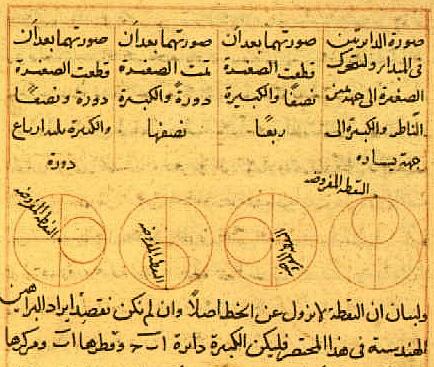
Astronomy became a major discipline within Islamic science. Astronomers devoted effort both towards understanding the nature of the cosmos and to practical purposes. One application involved determining the Qibla, the direction to face during prayer. Another was astrology, predicting events affecting human life and selecting suitable times for actions such as going to war or founding a city. Al-Battani (850–922) accurately determined the length of the solar year. He contributed to the Tables of Toledo, used by astronomers to predict the movements of the sun, moon and planets across the sky. Copernicus (1473–1543) later used some of Al-Battani's astronomic tables.
Hub AI
Science in the medieval Islamic world AI simulator
(@Science in the medieval Islamic world_simulator)
Science in the medieval Islamic world
Science in the medieval Islamic world was the science developed and practised during the Islamic Golden Age under the Abbasid Caliphate of Baghdad, the Umayyads of Córdoba, the Abbadids of Seville, the Samanids, the Ziyarids and the Buyids in Persia and beyond, spanning the period roughly between 786 and 1258. Islamic scientific achievements encompassed a wide range of subject areas, especially astronomy, mathematics, and medicine. Other subjects of scientific inquiry included alchemy and chemistry, botany and agronomy, geography and cartography, ophthalmology, pharmacology, physics, and zoology.
Medieval Islamic science had practical purposes as well as the goal of understanding. For example, astronomy was useful for determining the Qibla, the direction in which to pray, botany had practical application in agriculture, as in the works of Ibn Bassal and Ibn al-'Awwam, and geography enabled Abu Zayd al-Balkhi to make accurate maps. Islamic mathematicians such as Al-Khwarizmi, Avicenna and Jamshīd al-Kāshī made advances in algebra, trigonometry, geometry and Arabic numerals. Islamic doctors described diseases like smallpox and measles, and challenged classical Greek medical theory. Al-Biruni, Avicenna and others described the preparation of hundreds of drugs made from medicinal plants and chemical compounds. Islamic physicists such as Ibn Al-Haytham, Al-Bīrūnī and others studied optics and mechanics as well as astronomy, and criticised Aristotle's view of motion.
During the Middle Ages, Islamic science flourished across a wide area around the Mediterranean Sea and further afield, for several centuries, in a wide range of institutions.
The Islamic era began in 622. Islamic armies eventually conquered Arabia, Egypt and Mesopotamia, and successfully displaced the Persian and Byzantine Empires from the region within a few decades. Within a century, Islam had reached the area of present-day Portugal in the west and Central Asia in the east. The Islamic Golden Age (roughly between 786 and 1258) spanned the period of the Abbasid Caliphate (750–1258), with stable political structures and flourishing trade. Major religious and cultural works of the Islamic empire were translated into Arabic and occasionally Persian. Islamic culture inherited Greek, Indic, Assyrian and Persian influences. A new common civilisation formed, based on Islam. An era of high culture and innovation ensued, with rapid growth in population and cities. The Arab Agricultural Revolution in the countryside brought more crops and improved agricultural technology, especially irrigation. This supported the larger population and enabled culture to flourish. From the 9th century onwards, scholars such as Al-Kindi translated Indian, Assyrian, Sasanian (Persian) and Greek knowledge, including the works of Aristotle, into Arabic. These translations supported advances by scientists across the Islamic world.
Islamic science survived the initial Christian reconquest of Spain, including the fall of Seville in 1248, as work continued in the eastern centres (such as in Persia). After the completion of the Spanish reconquest in 1492, the Islamic world went into an economic and cultural decline. The Abbasid caliphate was followed by the Ottoman Empire (c. 1299–1922), centred in Turkey, and the Safavid Empire (1501–1736), centred in Persia, where work in the arts and sciences continued.
Medieval Islamic scientific achievements encompassed a wide range of subject areas, especially mathematics, astronomy, and medicine. Other subjects of scientific inquiry included physics, alchemy and chemistry, ophthalmology, and geography and cartography.
The early Islamic period saw the development of theoretical frameworks in alchemy and chemistry, laying the foundation for later advancements in both fields. The sulfur-mercury theory of metals, first found in Sirr al-khalīqa ("The Secret of Creation", c. 750–850, falsely attributed to Apollonius of Tyana), and in the writings attributed to Jabir ibn Hayyan (written c. 850–950), remained the basis of theories of metallic composition until the 18th century. The Emerald Tablet, a cryptic text that all later alchemists up to and including Isaac Newton saw as the foundation of their art, first occurs in the Sirr al-khalīqa and in one of the works attributed to Jabir. In practical chemistry, the works of Jabir, and those of the Persian alchemist and physician Abu Bakr al-Razi (c. 865–925), contain the earliest systematic classifications of chemical substances. Alchemists were also interested in artificially creating such substances. Jabir describes the synthesis of ammonium chloride (sal ammoniac) from organic substances, and Abu Bakr al-Razi experimented with the heating of ammonium chloride, vitriol, and other salts, which would eventually lead to the discovery of the mineral acids by 13th-century Latin alchemists such as pseudo-Geber.
Astronomy became a major discipline within Islamic science. Astronomers devoted effort both towards understanding the nature of the cosmos and to practical purposes. One application involved determining the Qibla, the direction to face during prayer. Another was astrology, predicting events affecting human life and selecting suitable times for actions such as going to war or founding a city. Al-Battani (850–922) accurately determined the length of the solar year. He contributed to the Tables of Toledo, used by astronomers to predict the movements of the sun, moon and planets across the sky. Copernicus (1473–1543) later used some of Al-Battani's astronomic tables.
Recent media