Hubbry Logo
Sefer Raziel HaMalakhSefer Raziel HaMalakhMain
Open search
Sefer Raziel HaMalakh
Community hub
Sefer Raziel HaMalakh
logo
8 pages, 0 posts
0 subscribers
Be the first to start a discussion here.
Sefer Raziel HaMalakh
from Wikipedia

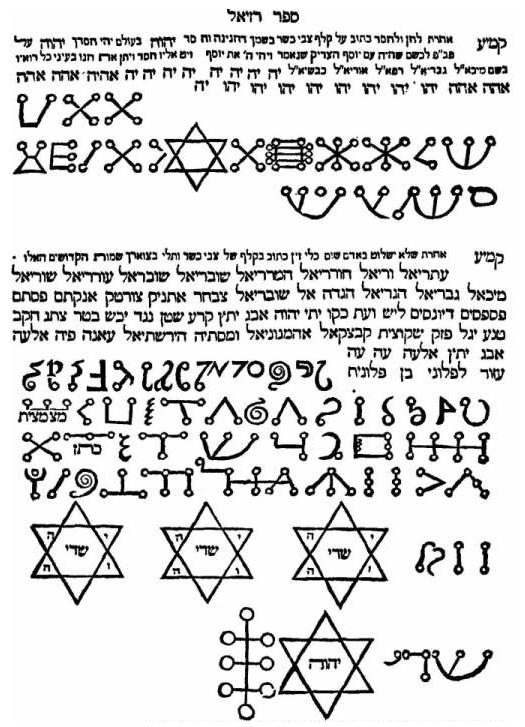
Page 44b in the 1701 edition of Sefer Raziel HaMalakh, featuring various magical sigils (or סגולות, seguloth, in Hebrew).

Sefer Raziel HaMalakh (Hebrew: ספר רזיאל המלאך, "the book of Raziel the angel") is a grimoire of Practical Kabbalah from the Middle Ages written primarily in Hebrew and Aramaic. Liber Razielis Archangeli, its 13th-century Latin translation produced under Alfonso X of Castile, survives.

Textual history

[edit]

Like other obscure ancient texts such as the Bahir and Sefer Yetzirah, Sefer HaRaziel has been extant in a number of versions. The book cannot be shown to predate the 13th century, but may in parts date back to late antiquity insofar as its title is mentioned in another magical work of late antiquity: The Sword of Moses.

The book claims to have been revealed to Adam by the angel Raziel. Critical historians regard it as a medieval work, most probably originating among the Ashkenazi Hasidim, as citations reliant on the main body content of the work as we receive it begin to appear only in the 12th century. At least one section was available to Ibn Ezra before 1153, when he finished his commentary to Exodus.[1] The likely compiler of the medieval version is Eleazar of Worms, as Sefer Galei Razia, which developed into what we have now as Sefer Raziel, including more writings written by people of various theological opinions.[2] According to Jacob Emden, it was compiled by Abraham Abulafia.

Contents

[edit]

Sefer Raziel HaMalakh draws heavily on Sefer Yetzirah and Sefer HaRazim "Book of Secrets". There are multiple manuscript versions, containing up to seven tractates. The printed version of Sefer Raziel is divided into five books, some of it in the form of a mystical midrash on Creation. It features an elaborate angelology, magical uses of the zodiac, gematria, names of God, protective spells, and a method of writing magical healing amulets.

Book six of the Liber Razielis is based on Sefer haRazim, with various additions, including the "Prayer of Adam" of Sefer Adam.

The book became notorious in German Renaissance magic, named together with Picatrix as among the most abominable works of necromancy by Johannes Hartlieb. The prayer of Adam is paraphrased by Nicholas of Cusa in two sermons (Sermo I, 4, 16.25; Sermo XX, 8, 10-13) and further made use of by Johann Reuchlin in his De Arte Cabalistica.[3] Konrad Bollstatter in the 15th century also shows awareness of the Latin version of the "Prayer of Adam" an interpolation in Cgm 252, although he replaces Raziel with Raphael and Seth with Sem.[4]

Tree of Knowledge

[edit]

Adam, in his prayer to God, apologized for listening to his wife Eve, who was deceived by the snake into eating from the Tree of Knowledge. According to the Book of Raziel, God sent the highest of the angels, Raziel, to teach Adam the spiritual laws of nature and life on Earth, including the knowledge of the planets, stars and the spiritual laws of creation.

The angel Raziel also taught Adam the knowledge of the power of speech, the power of thoughts and the power of a person's soul within the confines of the physical body and this physical world, basically teaching the knowledge with which one can harmonize physical and spiritual existence in this physical world.

The angel Raziel teaches the power of speech, the energy contained within the 22 letters of the Hebrew alphabet, their combinations and meanings of names.

Adam and Abraham

[edit]

According to Jewish traditions, the angel Raziel was sent to Earth to teach Adam as he prayed for guidance after the fall, and then returned to teach Abraham spiritual knowledge and laws because he had an elevated soul. The Book of Raziel explains everything from astrology to how the creative life energy starts with a thought from the spiritual realms, prior to manifestation as speech and action in this physical world. The eternal divine creative life energy of this earth is love, the book explains the spiritual laws of birth, death, reincarnation of the soul, and many spiritual laws of "change".

Heptameron

[edit]

The Heptameron, ascribed to Petrus de Apono, is based on the Book of Raziel.[5]

Editions

[edit]
  • רזיאל המלאך. Amsterdam (1701) Chabad-Lubavitch Library. Full-text PDF version, in Hebrew, from HebrewBooks.org
  • Steve Savedow (trans.), Sepher Rezial Hemelach: The Book of the Angel Rezial, Red Wheel/Weiser (2000), ISBN 978-1-57863-193-3.
  • The Book of the Angel Raziel. Volume I / Transl. from Hebrew and Aramaic and comm. by E. V. Kuzmin; editorship and foreword by B. K. Dvinyaninov. — St. Petersburg: Academy Of Culture's Research, 2020. — 264 pp.: illustrated, — (Code Grimoire Series). ISBN 978-5-6045100-3-2 (на русском языке)
  • The Book of the Angel Raziel. Volume II / Transl. from Hebrew and Aramaic, afterword and comm. by E. V. Kuzmin; editorship and foreword by B. K. Dvinyaninov. — St. Petersburg: Academy Of Culture’s Research, 2021. — 512 pp.: illustrated, — (Code Grimoire Series). ISBN 978-5-6045100-4-9 (на русском языке)

See also

[edit]

References

[edit]

Further reading

[edit]
[edit]
Revisions and contributorsEdit on WikipediaRead on Wikipedia
from Grokipedia
Sefer Raziel HaMalakh (Hebrew: ספר רזיאל המלאך, "the book of the angel") is a Jewish of , attributed to the , who is said to have revealed its contents to as divine secrets of the , cosmology, and . This text serves as a compilation of esoteric Hebrew and works focused on magical practices, angelic invocations, and spiritual enlightenment, drawing from ancient traditions to provide instructions for interacting with supernatural forces. The book emerged from a synthesis of earlier Jewish mystical sources, including elements of Heikhalot and Merkabah literature—such as Sefer ha-Malbush, the baraita of Ma’aseh Bereshit, and Sefer ha-Razim—alongside 13th-century writings from the Hasidei Ashkenaz movement, like ' Sod Ma’aseh Bereshit, and pre-Lurianic Kabbalistic materials on the and exegeses of Holy Names. Manuscripts of its components date back to the , but the full compilation was not printed until the , with the first edition published in in 1701; subsequent reprints were popular due to beliefs that possessing the book could protect homes from fire and other perils. Key contents encompass an elaborate angelology detailing hierarchies and roles of celestial beings, magical uses of the zodiac for astrological influences, for interpreting numerical values of Hebrew letters, invocations of divine names for power, protective spells against harm, and practical methods for crafting healing amulets, including those for and general . These elements position Sefer Raziel HaMalakh as a foundational text in Jewish esotericism, bridging ancient lore with medieval magical traditions while emphasizing ethical and ritualistic approaches to the divine.

Origins and Attribution

Legendary Origins

In , the Sefer Raziel HaMalakh is pseudepigraphically attributed to the , known as the "Keeper of Secrets" and the "Angel of Mysteries," whose name derives from the Hebrew raz, meaning "secret," signifying his role as the guardian of divine esoteric knowledge. is depicted as the celestial scribe who, standing closest to the divine throne, compiles and transmits the profound mysteries inaccessible to other angels, embodying the conduit between the infinite and creation. This attribution establishes the text's foundational status in Kabbalistic lore as a direct revelation from the divine, predating all human-authored esoteric works and serving as the primordial repository of heavenly wisdom. The legendary origins portray as receiving from a comprehensive of cosmic , encompassing the secrets of creation, the of the heavens, the hierarchies of angels, and the governing forces of nature, all unified within a single, sacred volume. This book is said to reveal the underlying principles of the , including the mystical potencies of divine names and the esoteric wisdom of the 72-letter name of , offering insights into the spiritual and realms that enable mastery over and phenomena. According to tradition, inscribed this in heavenly script, symbolizing its transcendent and immutable nature, thus marking it as an otherworldly artifact untainted by earthly limitations. A prominent legend describes Raziel writing the book on a sapphire tablet, a material evoking purity and , to underscore its celestial provenance and role as the inaugural text of esoteric lore following humanity's expulsion ; this revelation is echoed in the (1:55a). This sapphire inscription highlights the book's function as a luminous guide to , illuminating paths to redemption and spiritual elevation for the first humans. As the earliest compendium of such secrets, it precedes all subsequent mystical traditions, positioning itself as the archetypal source from which later Jewish esoteric texts draw their inspiration.

Transmission Narrative

According to Jewish esoteric legend, the angel bestowed the Sefer Raziel HaMalakh upon shortly after his expulsion from the , as a divine to impart of , celestial mysteries, and God's will following Adam's through and fasting. This transmission occurred on the third day after the expulsion, while Adam prayed by a river, with the book serving as a comprehensive guide to earthly and heavenly secrets, including prophecies of future events. In some variants, the book was initially given in Paradise but lost, only to be recovered through divine intervention, underscoring its role in restoring Adam's wisdom after the Fall. The text was then passed down through Adam's righteous to , who received it as part of the divine instructions for building the ark, carried in a form within a to ensure its preservation during the . Legends emphasize the book's protective power, safeguarding and his family from the deluge's perils and enabling him to navigate the catastrophe using its prophetic guidance as a timepiece and survival manual. From , it was transmitted to his son and subsequent generations, including Abraham, who drew upon its wisdom during his trials and spiritual journey. The narrative highlights its continuity in Jewish esoteric tradition, linking pivotal biblical figures through this sacred lineage. Further legends recount episodes of loss and recovery that tested the book's custodians, such as when jealous angels stole it from and cast it into the sea, only for it to be retrieved through heavenly aid, or when it was hidden by 's descendants after his death to protect it from misuse. Revealed to in a dream, who memorized its contents before re-hiding it, the book eventually reached via intermediaries like , , and , empowering the king with unparalleled insight and authority over demons. Throughout these transmissions, the Sefer Raziel HaMalakh is portrayed as a potent amulet against forces, promising serenity in life and deliverance from harm when approached with purity, thus reinforcing its central place in tales of divine protection during existential crises like the .

Textual History

Manuscripts and Dating

The text of Sefer Raziel HaMalakh was composed around the 13th century, with surviving Hebrew manuscripts dating to the and later, preserved in major European libraries. A 13th-century Latin translation, known as Liber Razielis Archangeli, produced under , represents the earliest surviving version of the text. These artifacts represent the primary physical evidence of the text's transmission, with the earliest fragments indicating an initial compilation phase in medieval Jewish scribal traditions. Scholarly consensus places the core compilation of the text around 1200–1300 CE within Ashkenazi Jewish circles in , likely under the influence of figures like (c. 1176–1238), who is attributed with shaping an earlier form known as Sefer Galei Razia. Later additions, including expansions and revisions, continued through the 16th century, reflecting ongoing adaptations in Kabbalistic and magical practices. Linguistically, the work is composed mainly in Hebrew, interspersed with sections that draw on ancient Jewish esoteric traditions while incorporating medieval Kabbalistic terminology and structures. This bilingual character underscores its roots in earlier Talmudic and Geonic sources, adapted for a 13th-century audience. Interpolations are evident in elements like astrological charts added after the 13th century, which show adaptations from astrological traditions, integrating planetary influences and zodiacal diagrams into the original framework. These later insertions highlight the text's evolution as a living , blending indigenous with external scientific and magical knowledge.

Compilation Process

Sefer Raziel HaMalakh was compiled as a synthesis of diverse pre-existing Jewish mystical traditions, prominently incorporating elements from ancient texts such as Sefer Yetzirah and Merkabah (Heikhalot) literature, which provided foundational cosmological and angelic frameworks. These early sources, dating back to late antiquity, supplied the text's core esoteric knowledge on creation, divine names, and heavenly hierarchies, adapted into a cohesive grimoire format. Scholarly analysis identifies this integration as a deliberate effort to consolidate fragmented mystical lore into a practical manual for Kabbalistic use. Medieval compilers, active in Ashkenazi Jewish communities possibly in during the 13th century, played a pivotal role in assembling the work, while later editors in Sefardi or Byzantine contexts added layers in the 14th and 15th centuries. These compilers drew upon not only Jewish sources but also practical magical elements from Islamic traditions, evident in the inclusion of protective spells, amulets, and zodiacal invocations that reflect cross-cultural exchanges. For instance, the text's astro-magical components partly derive from late antique manuals like Sefer ha-Razim, blending them with Kabbalistic innovations to create a multifunctional esoteric compendium. The book's layered structure underscores its evolutionary compilation: a 13th-century core focused on cosmology and angelology, attributed to Ashkenazi figures such as and Nehemiah ben Shlomo, forms the foundational narrative, with subsequent appendices of magical recipes and seals appended in later centuries by anonymous hands. An introductory proem by the late 17th-century editor Isaac ben Abraham further frames the text as a prophetic tool, emphasizing its role in divine revelation. This accretive process highlights the work's development as a rather than a static composition. Scholarly debates on authorship emphasize the contributions of anonymous Kabbalists over any singular figure, rejecting legendary attributions to the angel or biblical patriarchs in favor of collective medieval authorship. While some trace influences to specific Ashkenazi mystics, the consensus views Sefer Raziel HaMalakh as a collaborative product of evolving Kabbalistic circles, reflecting broader trends in practical . These discussions underscore the text's role as a conduit for transmitting esoteric across Jewish diasporic communities.

Contents

Sefer Raziel HaMalakh is structured as a compilation divided into five main books: "" (focusing on the mystical aspects of creation), "Great ," "Holy Names," "Mysteries," and "Signs of the Zodiac," which together encompass its esoteric teachings.

Cosmological Framework

The cosmological framework of Sefer Raziel HaMalakh presents a hierarchical model of the universe derived from ancient Jewish mystical traditions, integrating divine emanations, , and spiritual forces to explain the structure of creation. At its core is the (Etz Chaim), depicted as a schematic diagram that maps the ten —the divine attributes or emanations through which God manifests reality—onto planetary influences and angelic orders, illustrating how the upper worlds connect to the material realm. This tree symbolizes the foundational blueprint of existence, where the such as (Crown) and Chokhmah (Wisdom) correspond to higher angelic realms and cosmic principles, facilitating the flow of divine energy downward. Central to this cosmology are the 72 divine names, derived from Exodus 14:19-21, which serve as keys to , governing the movements of and that influence earthly events and human destiny. These names, often arranged in permutated forms, embody the creative power of speech used by God in the Genesis account, linking the act of creation to ongoing cosmic order and allowing for mystical of heavenly forces. The book weaves these into a of primordial creation, where the unfolding of the mirrors the biblical days, with each phase governed by specific angelic interventions. The seven heavens form a key structural element, described in the section known as Samaim, each layer populated by distinct angelic choirs responsible for natural phenomena, , and protection of the world below. For instance, the first heaven (Vilon) veils the with atmospheric elements, while higher levels like Arabot house the of glory and storehouses of souls, overseen by archangels such as and . This layered ascent reflects a progressive purification, with angels acting as intermediaries between the divine and human domains. The framework emphasizes the correspondence between macrocosm and microcosm, portraying the human soul as a miniature aligned with cosmic patterns, where on angelic names and sefirotic paths enables alignment of personal will with divine harmony. Textual diagrams, such as wheels of interconnected letters and trees branching into planetary nodes, visually represent this unity, underscoring knowledge as a pathway to transcending material limitations.

Magical and Protective Elements

The Sefer Raziel HaMalakh incorporates through recipes for amulets, or kameot, which employ divine names, angelic hierarchies, and astrological timings to offer protection against demons, illness, and malevolent forces. These amulets are constructed using specific materials and inscribed with permutations of sacred names, often aligned with to maximize their efficacy in warding off harm. A notable example is the protective amulet on page 44b of the 1701 Amsterdam edition, attributed to the medieval kabbalist Eleazar ben Judah of Worms, which invokes angelic guardianship for and deliverance from peril, blending scriptural verses with mystical seals. Similar talismans in the text feature seals designed for prosperity or love, such as those harnessing angelic intermediaries to influence human affairs, sometimes incorporating herbal infusions for ritual activation. Invocations form a core component, with detailed procedures for calling upon angels like through repetitive chants of holy names derived via calculations, ensuring the practitioner's alignment with celestial powers. The work integrates numerological systems, where letter values yield incantatory formulas, and planetary influences dictate optimal ritual moments, such as invoking solar angels under favorable zodiacal configurations for healing or abundance. Ethical considerations permeate these elements, with explicit warnings against misuse of the secrets, which could invite ; the text stresses that true efficacy demands piety, , and moral purity to avoid profaning the sacred knowledge.

Narrative Traditions

The narrative traditions surrounding Sefer Raziel HaMalakh center on its divine bestowal upon following his expulsion from the , portraying the text as a tool for personal redemption and familial guidance. According to the introductory in the book, underwent 130 years of for his transgression, during which the angel descended to deliver the volume directly to him. This act provided with comprehensive knowledge of creation's secrets, angelic orders, and protective incantations, enabling him to comprehend the and apply its wisdom practically in his life outside paradise. Specifically, the book instructed on child-rearing practices infused with spiritual safeguards, such as amulets and prayers to shield offspring from harm, transforming his post-Eden existence from one of isolation into a structured path of moral recovery and legacy-building. The traditions extend the book's transmission through biblical patriarchs, highlighting its role in preserving esoteric wisdom amid existential threats. Noah is depicted as inheriting the text from Adam's lineage, using its cosmological insights to construct the ark and ensure the survival not only of humanity but also of divine knowledge during the deluge. This vignette employs the ark as a for safeguarding sacred lore, underscoring the book's function as an enduring repository against chaos and oblivion. From Noah, the volume passed to his son and subsequently to Abraham, who engaged deeply with its contents while facing trials of faith. Abraham's study reportedly invoked visions of angelic guidance, reinforcing his covenantal relationship with the divine and equipping him to transmit the teachings to , thus embedding the book within the foundational narrative of Jewish ancestry. Further legends link the book to King , whose unparalleled wisdom and authority over spirits are attributed to his possession of Sefer Raziel HaMalakh. In this account, the text augmented Solomon's innate gifts, allowing him to derive ethical and practical rulings from its mystical frameworks, as seen in his judgments and temple-building endeavors. These stories collectively position the book beyond mere esoteric utility, framing it as a didactic instrument that integrates moral instruction with spiritual insight, guiding figures like , , Abraham, and toward righteous living and communal preservation.

Heptameron Adaptation

The Heptameron, or Elementa Magica, is a Latin pseudonymously attributed to the medieval Italian philosopher and physician (c. 1257–1316), though scholarly analysis indicates the text was compiled later, likely in the 15th or early . This work derives from the Sefer Raziel HaMalakh via its 13th-century Latin translation, the Liber Razielis Archangeli, by reorganizing the source's angelic hierarchies and cosmological elements into a practical system of conjurations structured around the seven planetary days of the week. The adaptation extracts and repurposes sections on planetary angels and spirits, transforming the original's broader mystical framework into focused rituals for . A primary distinction from the Sefer Raziel HaMalakh lies in the Heptameron's shift toward goetic practices, emphasizing the of angels alongside their subordinate aerial demons or spirits for tangible outcomes, such as acquiring or influence, while excising the Jewish text's ethical guidelines, protective amulets, and imperatives tied to observance. Printed versions further modify earlier manuscripts by substituting terms like "daemon kings" with "angels" to emphasize benevolent celestial forces, aligning the content more with Christian-compatible despite underlying evocatory techniques that evoke demonic hierarchies under angelic oversight. The Heptameron circulated in manuscripts during the late medieval and periods, with its earliest known printed edition appearing in in 1496. It gained traction in 16th-century magical circles, complementing and extending the planetary magic outlined in Heinrich Cornelius Agrippa's De Occulta Philosophia (1533), thereby bridging medieval Jewish esotericism with emerging Western ceremonial traditions. The text's structure divides rituals by weekday and planetary ruler, prescribing specific times (e.g., the first hour after sunrise), consecrated tools, incenses (such as for ), protective circles inscribed with , and sequential conjurations to compel obedience from the day's spirits. For instance, 's rite summons Michael and his ministers under the Sun's influence for purposes of honor and , progressing through layered invocations that escalate from general calls to binding commands if spirits resist.

Distinctions from Sefer HaRazim

Sefer HaRazim, an ancient Jewish mystical text dated to the 6th-7th century CE, represents an early Merkabah work centered on detailed angelic hierarchies and rituals for heavenly ascents, emphasizing invocations to engage divine powers through liturgical means rather than everyday practical applications. In contrast, Sefer Raziel HaMalakh, a medieval from the 13th century, shifts focus toward by prioritizing the creation of amulets, protective charms, and cosmological knowledge adapted for earthly concerns such as healing, protection, and prosperity. This distinction highlights Raziel's orientation as a handbook for tangible magical operations, drawing on but expanding beyond HaRazim's more abstract, ascent-oriented . While both texts share the figure of as the angelic revealer—transmitting esoteric secrets to humanity— attributes its revelation to before the , framing it as a guide for mystical communion with celestial realms, whereas presents the transmission to as a foundational gift encompassing all creation's secrets for human use. integrates later Kabbalistic elements, such as interpretations from , which are absent in HaRazim, thereby blending cosmology with operational magic to address medieval Jewish needs. Scholars regard Sefer Raziel HaMalakh as a medieval expansion of earlier traditions like , incorporating substantial portions of its angelic lore and rituals while recontextualizing them within an emerging Kabbalistic framework, rather than serving as a direct linear descendant. This evolution reflects broader shifts in Jewish esotericism from late antique to practical, user-oriented grimoires in the Ashkenazi milieu.

Editions and Influence

Historical Editions

The first printed edition of Sefer Raziel HaMalakh appeared in in 1701, compiled and published in Hebrew and directly from manuscripts by Jewish printers, including Moshe Mendes Coutinho, targeting Kabbalistic scholars and those interested in practical . This edition included elaborate Kabbalistic diagrams and charts, establishing the standard textual structure divided into five books that influenced later versions. Subsequent printings in the 18th and 19th centuries followed in various European locations, such as the second edition in Horodna in 1793, often incorporating additional commentaries and illustrations to enhance its mystical and protective applications. Printing Sefer Raziel HaMalakh encountered significant challenges due to its magical elements, with rabbinic authorities in some European regions advocating suppression or burning of copies to prevent misuse of divine names and spells, resulting in variant texts where sensitive passages were omitted or altered. Such reflected broader tensions over , leading publishers to sometimes anonymize their work or frame the book primarily as a protective charm rather than a study text. The book circulated mainly among Hasidic and Sephardic Jewish communities in and the , valued for its reputed segulot (protective charms) against fire, demons, and misfortune, which drove demand for multiple reprints despite the risks.

Modern Editions and Significance

In the , several Hebrew facsimiles and reprints of Sefer Raziel HaMalakh emerged, particularly from publishers, preserving the text's traditional structure and diagrams for scholarly and devotional use. A notable example is the 1926 limited edition of 500 copies printed in , which included excerpts and adaptations while maintaining the original's mystical elements. These editions built on earlier prints but emphasized accessibility within Jewish communities, often distributed through Judaica presses. The most prominent English translation appeared in 2000 with Steve Savedow's Sepher Rezial Hemelach: The Book of the Angel Rezial, rendered from the rare 1701 Hebrew edition and including explanatory notes on its magical and cosmological content. This work marked the first complete English version, facilitating broader study among non-Hebrew speakers. Post-2000, digital archives enhanced availability, such as the University of Southern 's Judaica Collection hosting a scanned Hebrew copy and the providing Savedow's translation as a free resource. Reprints continue to be published by Judaica presses as of 2025, maintaining its availability for devotional and scholarly use. Annotated scholarly editions, like those referenced in academic theses, further contextualize the text's historical layers without altering its core. Sefer Raziel HaMalakh remains foundational to , serving as a for amulet creation, invocation, and protective rituals that continue in esoteric Jewish traditions. Its influence extends to spirituality and revivals, where elements like divine names and zodiacal magic inspire modern amulet-making and grimoires, often adapted in non-Jewish contexts. In contemporary esoteric studies, it is cited for its blend of cosmology and praxis, shaping practices in Wiccan and magical communities. Within , the book's magical elements spark ethical debates, viewed by some as bordering on forbidden sorcery despite its protective intent, leading to restrictions on and study to avoid anxieties. Conversely, in broader esoteric scholarship, it appeals as a bridge between ancient and modern spiritual exploration, highlighting tensions between and .

References

Add your contribution
Related Hubs
User Avatar
No comments yet.