Hubbry Logo
Semmering railwaySemmering railwayMain
Open search
Semmering railway
Community hub
Semmering railway
logo
8 pages, 0 posts
0 subscribers
Be the first to start a discussion here.
Semmering railway
Semmering railway
from Wikipedia
Semmeringbahn
Semmering railway with
surrounding mountain scenery
Overview
OwnerAustrian Federal Railways
Service
Operator(s)Austrian Federal Railways
Technical
Line length41 km (25.5 mi)
Track gauge1,435 mm (4 ft 8+12 in) standard gauge
Minimum radius190 m (623 ft)
Electrification15 kV, 16+23 Hz Overhead line
Maximum incline2.5 %
Map
Interactive map of Semmering railway
CriteriaCultural: ii, iv
Reference785
Inscription1998 (22nd Session)
Area156.18 ha
Buffer zone8,581.21 ha
Route map
elev (M)
or length (m)
in metres
74.902
Gloggnitz
439 M
Semmering Base Tunnel
(under construction)
27,300 m
77.694
Schlöglmühl
458 M
81.961
Payerbach-Reichenau
493 M
Schwarzatal viaduct
228 m
H: 25 m
Payerbachgraben viaduct
61 m
H: 15 m
84.798
Küb
543 M
Kübgraben viaduct
42 m
H: 17 m
85.773
Pettenbach tunnel
185.25 m
Höllgraben viaduct
82 m
H: 28 m
86.663
Steinbauer tunnel
87.66 m
Abfaltersbachgraben viaduct
93 m
H: 30 m
88.222
Eichberg
609 M
89.185
Eichberg tunnel
88.80 m
89.400
Geyregger tunnel
80.95 m
91.027
Rumpler tunnel
52.36 m
92.284
Klamm-Schottwien
699 M
92.400
Eichberg 3 crossover
92.779
Klamm tunnel
190.83 m
Wagnergraben viaduct
142 m
H: 39 m
Gamperlgraben viaduct
111 m
H: 37 m
94.499
Gamperl tunnel
78.2 m
Rumplergraben viaduct
41 m
H: 19 m
95.906
Weinzettelwand tunnel
3 tunnels & 2 galeries
688 m
96.696
Weinzettelfeld tunnel
238.96 m
97.574
Breitenstein
791 M
Semmering Base Tunnel
(under construction)
98.125
Kleiner Krausel tunnel
13.82 m
Krausel-Klause viaduct
87 m
H: 36 m
98.332
Polleros tunnel
337 m
Kalte-Rinne viaduct
184 m
H: 46 m
Adlitzgraben viaduct
151 m
H: 24 m
100.715
Weberkogel tunnel
406.91 m
101.577
Wolfsberg tunnel
439.53 m
102.098
Wolfsbergkogel
883 M
Kartnerkogel viaduct
44 m
H: 16 m
102.391
Kartnerkogel tunnel
201.16 m
103.412
Semmering
896 M
Old Semmering Tunnel
1,434 m
898 m
New Semmering Tunnel
1,512 m
Steinhaus viaduct
71 m
H: 17 m
107.685
Steinhaus
838 M
Holzergraben viaduct
82 m
H: 13 m
Viaduct near Jauern
30 m
H: 11 m
110.486
Spital am Semmering
789 M
Fröschnitzbach viaduct
25 m
H: 11 m
Semmering Base Tunnel
(under construction)
116.727
Mürzzuschlag
681 M
elev (M)
or length (m)
in metres

H: = height of viaducts

The Semmering railway (German: Semmeringbahn) in Austria, which starts at Gloggnitz and leads over the Semmering to Mürzzuschlag, was the first mountain railway in Europe built with a standard gauge track. It is commonly referred to as the world's first true mountain railway, given the very difficult terrain and the considerable altitude difference that was mastered during its construction. It is still fully functional as a part of the Southern Railway which is operated by the Austrian Federal Railways.

History

[edit]
Semmering railway at Mürzzuschlag, around 1900

The Semmering railway was constructed between 1848 and 1854 by some 20,000 workers under the project's designer and director Carl von Ghega born in Venice as Carlo Ghega in an Albanian family. The construction features 14 tunnels (among them the 1,431 m summit tunnel), 16 viaducts (several two-storey) and over 100 stone arch bridges and 11 small iron bridges. The stations and the buildings for the supervisors were often built directly from the waste rock dug out when making the tunnels.

Across an overall track length of 41 km the Semmering railway overcomes an altitude difference of 460 m; on 60% of its length the gradient is 2.0-2.5% (equivalent to a 1-meter difference in altitude on a 40 m route distance) and 16% exhibit a curvature radius of only 190 m. This was an entirely new technical dimension of railway construction, and new instruments and methods of surveying had to be developed to handle the resulting challenges. Also, new technologies were employed for the Engerth locomotives because the types in general use at this time could not handle the extreme gradients and turning radii.

Even while being built, the Semmering railway was perceived as an effort of "landscape gardening", i.e. it attempted a harmonious combination of technology and nature. The unique travel experience which the Semmering railway offered contributed significantly to the original opening of the Semmering region for tourism. Numerous hotels and mansions are witnesses of this epoch. This enormous upswing to the turn of the century and the re-evaluation of the region as a winter sports area in the first third of the 20th Century were interrupted first by World War I and then by the changed recreational needs of the population. Therefore, this unique culture landscape could be preserved with little change. A trip on the Semmering railway, which is in full use 160 years after its building, still impresses the traveller as a special experience by its varied landscape, the typical style of its mansions and the characteristic sequence of viaducts and tunnels.

In 1998 the Semmering railway was added to the list of the UNESCO World Heritage sites.

Locomotives

[edit]

The Semmering trials

[edit]

A competition was held in 1851 to decide which locomotives would be bought for operation on the Semmering Railway. One stretch of the line had gradients of 1 in 40 (2.5%) and curves with a minimum radius of 190 metres (210 yd) and a maximum radius of 285 metres (312 yd). A speed of 11.5 kilometres per hour (7.1 mph) was required to be maintained and a maximum axle loading of 14 tonnes (13.8 long tons; 15.4 short tons), with a boiler pressure not exceeding 8.5 kgf/cm2 (830 kPa; 121 psi).

Entrants

[edit]

There were four entrants, Bavaria, built by Maffei; Neustadt built by Wiener Neustädter Lokomotivfabrik; Seraing built by Société anonyme John Cockerill in Belgium; and Vindobona built by the Locomotive Factory of Wien-Gloggnitzer Bahn in Vienna. All four locomotives fulfilled the conditions of the trial, but did not prove reliable in practice.[1]

Developments

[edit]

The Semmering Trials led to a number of developments in locomotive design: Fairlie's Patent of 1863, the Meyer locomotive and the Mallet locomotive.[2]

Engerth design

[edit]
International express on the Semmeringbahn, pulled by 1044 274-7 (2004)

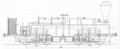
The Engerth design articulated the tender with the main locomotive frame, allowing some of the weight of the fuel and water to be carried on the driving wheels to improve adhesion. Because the tender was articulated, rather than directly attached to the frame, the locomotive could traverse relatively sharp curves, while still enjoying the advantage of the additional adhesive weight gain. The original design also included an indirect drive from the main driving wheels to the wheels under the tender. This arrangement proved too complex to maintain and was dropped from the design.[3]

Sixteen locomotives were supplied to the Semmering Railway between November 1853 and May 1854. They proved capable of 19 kilometres per hour (12 mph) uphill on gradients of 1 in 40 (2.5%). An Engerth locomotive was featured on an Austrian stamp commemorating the 150th anniversary of the Semmering Railway in 2004.[4] The Engerth locomotive also appeared on a 25 Euro coin issued by Austria in 2004.

Present day

[edit]

Currently, the Semmering railway uses the well-known Siemens ES64U2 locomotives for this route as the main workhorse of the ÖBB. Starting with 1963 it also uses ÖBB class 1142 locomotives, now used as banking engines on the line, and also the ÖBB Class 1144 since 1977 as banking engines and also freight/passenger engines. In 1971 this is where a SJ Rc locomotive conducted trials that put the basis of the ÖBB Class 1043.

For local trains the Bombardier Talent (ÖBB Class 4024) and Siemens Desiro ML (ÖBB Class 4744) are used.

Semmering Base Tunnel

[edit]

On April 25, 2012, ground was broken for the construction of the 27.3 km Semmering base tunnel. This tunnel will bypass 41 km of the Semmeringbahn.[5] The tunnel is expected to open in 2030, with a total cost of €3.9b.[6]

The Railway in numismatics

[edit]
150 Years Semmering Alpine Railway Coin

The Semmering alpine railway has been the main motive for many collector coins and medals. One of the most famous and recent ones is the 150 Years Semmering Alpine Railway Coin. The obverse shows two locomotives: a historical and a modern one. The reverse of the coin shows a typical Semmering view. An Engerth steam locomotive just emerged from a tunnel crossing one of the distinctive viaducts.

The 1967 Austrian schilling note features the engineer on one side, and a Semmering scene (including one of the distinctive two-tier bridges) on the other.

See also

[edit]

References

[edit]
[edit]
Revisions and contributorsEdit on WikipediaRead on Wikipedia
from Grokipedia
The is a pioneering 41-kilometre in that traverses the Semmering Pass in the , connecting the Lower Austrian town of Gloggnitz at 436 metres to the Styrian town of Mürzzuschlag at 677 metres, while reaching a summit height of 895 metres. Constructed between 1848 and 1854 by approximately 20,000 workers under the direction of von Ghega, it overcame a total elevation gain of about 460 metres through innovative use of curves, viaducts, and tunnels, without relying on rack-and-pinion or inclined plane systems, making it the first alpine transversal railway in Europe suitable for standard steam locomotives. Inscribed on the World Heritage List on 2 December 1998 as the world's first railway to receive this distinction, it exemplifies early 19th-century engineering excellence and continues to operate as a vital transport link. Ghega, born in in 1802 and trained in and other European , designed the line to handle gradients of up to 26 (2.6%) across its 41-kilometre route, incorporating 16 major viaducts (totaling 1,477 metres in length), 14 tunnels (also 1,477 metres combined), 118 smaller stone arch bridges, and 11 iron bridges, all constructed primarily from local stone and brick for durability and aesthetic integration with the landscape. The project's most notable structures include the 1,431-metre Semmering Tunnel and the elegant Schwarza Viaduct, which together highlight Ghega's emphasis on powerful locomotives and precise alignment to conquer the challenging topography without compromising operational efficiency. Construction faced immense difficulties, including harsh alpine conditions and Ghega's own health struggles with , yet it was completed on schedule, earning him a knighthood in 1851 and establishing him as Austria's preeminent railway engineer. Beyond its technical achievements, the Semmering Railway transformed regional connectivity, facilitating trade between Vienna and the industrial areas of Styria while catalyzing tourism and residential development in the previously inaccessible Semmering region, which became a popular Alpine resort destination. Electrified between 1957 and 1959, the line has maintained uninterrupted service since its opening on 17 July 1854, now managed by the Austrian Federal Railways (ÖBB) for both passenger and freight operations, with 57 attendant houses and other support structures underscoring its ongoing cultural and functional value. Protected under Austrian heritage law since 1923, the site spans 156 hectares within a 8,581-hectare buffer zone, ensuring the preservation of its architectural harmony with the natural environment for future generations.

Introduction and Overview

Route Description

The Semmering railway spans 41 km from Gloggnitz in to Mürzzuschlag in , traversing the Semmering Pass in the as part of the historic Southern Railway line. The route follows the Schwarza initially, crossing over deep gorges and climbing steep gradients through forested slopes and rugged before descending into the Mürz . The line rises from an elevation of 436 m at Gloggnitz station to a maximum of 895 m at the Semmering Pass, then drops to 677 m at Mürzzuschlag station, with a total elevation gain of approximately 460 m. Key stations along the path include Payerbach, Eichberg, Klamm-Schottwien, Breitenstein, Semmering, and Paltendorf, providing access to alpine landscapes and facilitating both passenger and freight transport. Built to standard gauge of 1,435 mm, the railway incorporates 14 major tunnels totaling 1,477 m in length and 16 major viaducts of equivalent total length, along with 118 smaller stone arch bridges and 11 iron bridges to navigate the challenging topography. The entire route has been electrified since 1959 with 15 kV, 16.7 Hz AC overhead catenary, enabling modern electric locomotive operations while preserving its UNESCO World Heritage status.

Historical and Cultural Significance

The Semmering Railway is recognized as the world's first true , engineered to navigate steep gradients of 25 (2.5%) through the using standard-gauge track without rack or cog systems, marking a breakthrough in overcoming topographical barriers in . This pioneering , completed in 1854, demonstrated innovative solutions for high-altitude during the early industrial , influencing subsequent mountain rail projects across . In 1998, the Semmering Railway became the first railway in the world to be inscribed on the UNESCO World Heritage List, honoring its exceptional universal value under criteria (ii) for representing an outstanding technological advancement in early railway engineering and (iv) for its role in integrating human-made infrastructure with the natural landscape, thereby fostering new patterns of tourism and settlement. The site's inscription highlights how the railway's viaducts, tunnels, and bridges harmoniously blend with the alpine environment, preserving a cultural landscape that exemplifies 19th-century industrial ambition. The railway played a pivotal role in 19th-century European industrialization by linking with southern regions like , facilitating trade, resource transport, and economic expansion within the Habsburg domains. It also catalyzed Alpine tourism, transforming remote highland areas into accessible resorts through improved connectivity, which spurred the development of hotels, villas, and recreational facilities, artists, poets, and the Viennese to the region's scenic . As a landmark of Austrian engineering prowess under the Habsburg Empire, the Semmering Railway symbolized imperial innovation and connectivity, embodying the era's drive to conquer natural obstacles and unify diverse territories through advanced infrastructure. This achievement not only advanced technical knowledge but also reinforced Austria's reputation as a hub of civil engineering excellence in the mid-19th century.

Historical Development

Planning and Construction

The Semmering railway's and were initiated in 1848 by the Austrian state under the direction of the General Authority for State Railways, following an imperial decree aimed at extending the Southern Railway line to connect with for strategic and economic benefits. von Ghega, an Albanian-Austrian born in , was appointed chief engineer, on his prior studies of railway systems across , , and the to develop the project's design. Ghega's emphasized integrating the line seamlessly with the existing Austrian network, opting for standard gauge track (1,435 mm) despite the challenging alpine terrain—a pioneering decision that made it 's first mountain railway built to this specification. This choice facilitated interoperability but required innovative adaptations to handle steep gradients up to 2.5%. Ghega employed advanced surveying techniques, including custom-designed instruments that precision in and mapping, accurate plotting of the 41 km route across the Semmering Pass with its elevation gain of 460 meters. Construction spanned from 1848 to 1854, involving up to 20,000 laborers who tackled the demanding mountainous landscape through hand excavation and masonry work. The project was financed through public bonds issued by the state, with total costs estimated at 19.6 to 25 million Conventionsthaler florins, equivalent to approximately €264 to €303 million in 2004 values, reflecting significant overruns due to the terrain's complexity. The build faced formidable engineering and environmental obstacles, including the need to navigate unstable rock formations and steep inclines that necessitated 14 tunnels and 16 viaducts. Harsh alpine weather and geological hazards like rockfalls compounded the difficulties, contributing to a high human toll among the workforce; historical estimates suggest approximately 1,000 deaths, primarily from outbreaks of typhus and cholera as well as work-related accidents. Despite these adversities, Ghega's meticulous oversight ensured the line's completion as a testament to mid-19th-century civil engineering prowess.

Opening and Early Operations

The Semmering Railway officially opened to passenger traffic on July 17, 1854, marking a pivotal moment in European transportation history. Emperor Franz Joseph I, accompanied by chief engineer Carl Ritter von Ghega, was among the first to traverse the line, participating in an inaugural journey that highlighted the railway's completion after six years of intensive construction. This ceremonial event underscored the imperial support for the project, which connected Vienna to southern regions via the challenging Alpine terrain. In its early years, the railway facilitated regular services linking to , enabling smoother connectivity across the and reducing overall journey times to southern destinations like and beyond. Freight operations commenced shortly after the launch, with initial trains carrying goods to support growing trade demands, though volumes expanded gradually as the proved reliable. These services transformed regional mobility, allowing for more efficient movement of and commodities through the previously inaccessible Semmering Pass. The railway's advent had profound economic repercussions, significantly shortening travel durations—such as halving the time from to Graz compared to pre-rail alternatives—and catalyzing the rise of Alpine . The of the scenic pass spurred the development of resorts, villas, and hotels in the Semmering area, establishing it as one of Europe's earliest purpose-built mountain holiday destinations and boosting local economies through visitor influxes. Early operations, however, encountered challenges including seasonal disruptions from heavy snowfall, which occasionally halted services until subsequent enhancements in maintenance and snow management were implemented.

Engineering Achievements

Key Infrastructure Elements

The Semmering railway's exemplifies 19th-century prowess, with 14 collectively measuring 1,477 meters in length. The longest of these is the 1,431-meter Semmering , also known as the vertex , which pierces the highest point of the line and was crucial for navigating the alpine . These tunnels were constructed using for facings and coursed , ensuring structural amid the challenging geological conditions. Complementing the tunnels are 16 major viaducts, totaling another 1,477 meters in length, designed to span deep valleys and ravines while maintaining the railway's gradient. Notable examples include the Schwarza Viaduct and the two-storey Kalte Rinne Viaduct, the latter curving elegantly with five arches on the lower level and ten on the upper, reaching a height of 46 meters and a length of 184 meters. The viaducts primarily employ stone masonry for their arches and supports, with brick elements for added precision and durability in the seismic-prone alpine region. Beyond these prominent features, the railway incorporates over 100 smaller structures, including 118 arched stone bridges and 11 iron bridges, seamlessly integrated into the mountainous landscape via embankments that follow natural contours. These elements, built predominantly from local stone to withstand environmental stresses, highlight the line's harmonious blend of functionality and aesthetic integration with the Semmering Pass environment.

Technical Challenges and Innovations

The construction of the Semmering railway confronted engineers with formidable challenges posed by the Alpine terrain, including steep inclines and tight curvatures that tested the capabilities of mid-19th-century . The line features a maximum of 26‰ (2.6%), with approximately 60% of its 41 km length exhibiting slopes between 20‰ and 25‰, significantly steeper than typical European railways of the , which rarely exceeded 10‰. Similarly, the minimum curve radius is 190 m across 16% of the route, a bold departure from typical radii exceeding m on contemporary railways. To address the elevation gain of 460 m from Gloggnitz (436 m) to the Semmering Pass summit (895 m), engineers employed innovative routing strategies such as horseshoe bends, which allowed the track to loop back on itself within confined valleys, effectively reducing the effective gradient while navigating the rugged topography over the 29 km ascent. These configurations, combined with 14 tunnels totaling 1,477 m and numerous viaducts like the multi-tiered Kalte Rinne structure, enabled the railway to traverse deep gorges and sheer cliffs without excessive earthworks. Stabilizing the route against landslides and required extensive use of retaining walls, spanning several kilometers in unstable areas, constructed primarily through manual labor and black powder blasting, as more powerful explosives like were not yet available until 1867. protection incorporated elevated viaducts and gallery-like overhangs to the track from snow slides, drawing on empirical observations of local hazards rather than advanced modeling. A key innovation was the introduction of drills for tunneling, the first such application in , powered by hydraulic rams utilizing nearby waterfalls to drive pneumatic tools, which accelerated rock excavation compared to hand-held methods and marked a precursor to mechanized techniques.

Locomotive Development

Semmering Trials

The Semmering Trials were an international organized by the Austrian in to identify designs capable of handling the steep gradients of the Semmering Railway without relying on cogwheels or rack systems. Held from 20 August to 16 September on a 4 km near Payerbach simulating the route's conditions, underscored the feasibility of adhesion-based traction for mountain railways, drawing entries from leading European manufacturers. The primary criterion required locomotives to haul 140 tonnes up a 22‰ at 11.5 km/h over a sufficient distance to demonstrate reliability, with additional constraints on (not exceeding 8.5 kg/sq cm) and (not exceeding 14 tonnes). Although multiple designs were proposed, four locomotives—representing manufacturers from , , and —were ultimately constructed and , highlighting the challenges of powering standard-gauge on inclines up to 26‰ as found on the Semmering line. As a precursor to the railway's operations, the trials advanced steam locomotive innovation by emphasizing power, stability, and efficiency for alpine terrain, influencing subsequent developments in articulated and high-traction designs across Europe.

Major Entrants and Outcomes

The Semmering Trials of 1851 featured four major locomotive entrants from leading European builders, each tasked with demonstrating the ability to haul a 140-tonne load at 11.5 km/h on a 22‰ gradient, as per the competition criteria outlined for the challenging mountain route. These machines represented innovative attempts to address the demands of steep inclines, with rankings determined by overall performance in load-hauling capacity, speed maintenance, and reliability during the tests conducted from August 20 to September 16 near Payerbach. The winning entry was the Bavaria, a German locomotive built by the Maffei firm in Munich. This double-bogie (0-4-4-0) design incorporated a novel chain-drive mechanism to power the tender's axles, enabling it to meet the load and speed requirements effectively during the trials. Despite its success, the chain system proved prone to failure in practical use, leading to the locomotive's eventual scrapping after brief service on the Semmering line. Second place went to the Neustadt, constructed by the Wiener Neustädter Lokomotivfabrik in Austria. This 0-4-4-0 successfully hauled the required load but encountered issues with on curved sections of the , highlighting limitations in stability for mountain operations. Its influenced later articulated types, such as the Meyer . The Belgian entrant, Seraing, built by Société Anonyme John Cockerill, secured . Featuring a double- 0-4-4-0 arrangement with inside cylinders and an experimental dual-boiler setup for production, it achieved the trial's load and speed benchmarks but suffered from persistent leaks and insufficient in extended runs. This innovative but impractical configuration underscored the complexities of scaling up output for prolonged work. Fourth was the Vindobona, an Austrian entry designed by Scottish engineer John Haswell for the Vienna and Gloggnitz Railway's workshops (now part of StEG). This 2-4-0 locomotive, influenced by British engineering practices, met the basic criteria but lagged in overall efficiency and reliability compared to the leaders. Although not the outright winner, the Vindobona's articulated tender concept—where the tender wheels supported part of the locomotive's weight—served as a direct prototype for the Engerth design, which was ultimately adopted for regular service on the Semmering Railway. Haswell's contributions emphasized British-inspired advancements in weight distribution for improved traction on inclines. The trials revealed critical insights into locomotive engineering for mountainous terrain, particularly the necessity for expanded firebox capacity to sustain steam under low-oxygen conditions and trailing wheels to enhance stability and prevent derailment on uneven gradients. These learnings spurred widespread adoption of articulated tenders and larger boilers, influencing global designs like the Fairlie and Mallet types, and confirming the feasibility of standard-gauge mountain rail operations. None of the entrants proved fully reliable for daily use, prompting the development of purpose-built machines for the line's 1854 opening.

Engerth Locomotive Design

The Engerth locomotive, designed by Austrian engineer Wilhelm Freiherr von Engerth, represented a pioneering advancement in articulated steam technology tailored for steep gradients and sharp curves on railways like the Semmering line. Introduced following the trials, it featured a unique supporting tender system where the tender was rigidly attached to the 's main frame, allowing partial transfer of the tender's weight—typically 10 to 15 tons—to the wheels for enhanced traction without exceeding limits. This configuration, often denoted in as 0-6-4T for early variants, with no leading wheels, three coupled axles (six wheels), and two trailing axles (four trailing wheels) on the tender, enabling the to negotiate tight radii down to 190 meters while maintaining stability. Key features of the Engerth design emphasized efficiency on demanding terrain: fuel (coal or wood) and water were stored on the trailing bogie to optimize weight distribution, with the boiler positioned to direct more mass onto the drivers, achieving adhesion ratios up to 25% higher than conventional tender locomotives. The boiler operated at pressures around 7 to 8 bar (approximately 100-115 psi), sufficient for generating tractive efforts of 10,000 to 12,000 kg on 25‰ grades, while the articulated tender pivot allowed flexibility on curves without derailing risks. Safety and performance were further supported by sand domes over the drivers and independent suspension on the trailing wheels, making it suitable for mixed passenger and freight services. Production of Engerth locomotives commenced in 1854, with initial batches built by firms like the Belgian Cockerill works for the Austrian Southern State Railway, totaling 16 units for Semmering operations by 1855. Over the subsequent decades until the 1890s, more than 300 examples were constructed across Europe, including variants such as the Imperial-Royal State Railways Series 102 (0-8-4T configuration with extended driving wheelsets for heavier freight). These were produced by major builders including Wiener Neustadt and StEG, with adaptations for lines in France (e.g., Nord Railway's 36 units), Switzerland, and Hungary, often featuring enlarged boilers or compound cylinders in later models. The Engerth design's impact extended far beyond the Semmering Railway, establishing it as a foundational model for mountain rail operations worldwide and influencing subsequent articulated types like the Fairlie and Garratt. Its traction-enhancing tender integration proved vital for routes with sustained inclines, leading to widespread adoption in the Alps, Pyrenees, and even exported designs to South America by the 1870s; by the early 20th century, it had shaped over a dozen national railway classes, prioritizing reliability over speed in rugged environments.

Modern Developments

Current Operations and Preservation

The Semmering railway continues to serve as a vital link in Austria's rail network, operated by the Austrian Federal Railways (ÖBB). The line handles approximately 180 trains per day, including regional, long-distance passenger services, and freight traffic, making it one of the busiest routes in the country. Modern electric locomotives, such as the Siemens ES64U2 series introduced in the early 2000s, power these operations, ensuring reliable service across the challenging mountainous terrain. Due to the line's steep gradients and tight curves, speed limits are restricted to a maximum of around 70 km/h, prioritizing safety while accommodating ongoing modernization efforts. Preservation of the Semmering railway has been a priority since its designation as a UNESCO World Heritage Site in 1998, recognizing its pioneering engineering and cultural significance. ÖBB, in collaboration with heritage authorities, undertakes regular restoration projects mandated by UNESCO to maintain the integrity of its 16 viaducts, 14 tunnels, and over 100 bridges, ensuring the line's structural stability for continued use. These efforts include comprehensive refurbishments of the track systems and stations, with a new management plan implemented in 2014 to align conservation with operational needs. Annual maintenance, which addresses wear from heavy traffic and environmental factors, underscores the commitment to sustaining this historic infrastructure. The railway's heritage status has boosted , visitors to its scenic and . Special heritage excursions operate periodically, allowing passengers to the original route while learning about its . Complementing these rides, extensive hiking trails parallel the line, such as the Railway Hiking Trail from Semmering to Breitenstein, offering panoramic views of viaducts and tunnels amid the Austrian Alps. At Semmering station, a dedicated information center provides free exhibits on the railway's construction and legacy, attracting over 12,000 visitors annually and serving as a gateway for exploring the surrounding heritage region. With the forthcoming Semmering Base Tunnel set to divert high-speed and freight traffic starting in 2030, the original line is expected to focus more on regional services and .

Semmering Base Tunnel Project

The project involves the construction of a 27.3 km twin-tube running from Gloggnitz in to Mürzzuschlag in , designed to parallel and relieve the historic Semmering line. for the was initiated in the 1990s, with environmental compatibility confirmed by Austria's supreme in May 2011, leading to the start of construction on April 25, 2012. The initiative addresses longstanding limitations of the original route's steep gradients by providing a flatter alignment suitable for high-speed rail. The primary goals of the tunnel are to shorten travel times along the Vienna-Graz corridor to under two hours, significantly boosting connectivity in the Baltic-Adriatic axis, while increasing line capacity to approximately trains per day for both passenger and freight services. This upgrade will enable train speeds of up to km/h, reducing journey durations by up to 30 minutes compared to the existing line and facilitating more efficient cross-Alpine rail traffic. By bypassing the challenging Semmering Pass, the project aims to enhance reliability, lower operational costs, and support modal shift from road to . As of November 2025, excavation work on the twin tubes has been fully completed, with the final breakthrough achieved on November 29, 2024, marking the end of over a decade of tunneling efforts. Installation of track, signaling, and other equipment is scheduled to commence in the summer of 2025, following the successful boring phase that involved multiple tunnel boring machines and conventional excavation methods. Full operational service has been delayed to 2030 due to complexities in outfitting and integration with the broader southern rail corridor, though test runs are anticipated in advance. The project is budgeted at approximately €3.9 billion, reflecting adjustments from initial estimates amid construction challenges and scope expansions. To mitigate environmental impacts, an extensive was conducted prior to approval, incorporating measures such as noise barriers along access routes, wildlife corridors to preserve local ecosystems, and groundwater monitoring to protect hydrological balance in the sensitive Alpine . These efforts ensure compliance with EU directives while minimizing disruption to the surrounding UNESCO-listed Semmering .

Cultural and Commemorative Aspects

Numismatic Representations

The Semmering railway has been commemorated through various numismatic items, reflecting its status as a pioneering engineering achievement and a symbol of Austrian ingenuity. One prominent example is the 2004 Austrian 25-euro silver-niobium coin, issued to mark the 150th anniversary of the railway's opening. This bimetallic coin features an obverse design depicting a modern electric locomotive and a historical steam locomotive, underscoring the railway's evolution from 19th-century innovation to contemporary infrastructure. The reverse depicts a 19th-century steam locomotive traversing a viaduct in mountainous terrain with a tunnel in the background, along with "150 JAHRE" and "SEMMERINGBAHN". The coin has a mintage limited to 50,000 pieces, making it a sought-after item among collectors. Earlier numismatic tributes include the 1904 bronze plaquette crafted by engraver Rudolf Marschall to honor the 50th anniversary of the railway's completion. The obverse bears a laureated bust of , the railway's , inscribed with "Dem Andenken Ghegas" to evoke his enduring legacy in overcoming the Alpine challenges. The reverse illustrates key engineering elements such as viaducts and tunnels, emphasizing the project's technical triumphs. Produced as a square plaquette approximately 54 mm in size, this item serves as a tangible reminder of the railway's foundational role in European rail history. Beyond coins and plaquettes, the railway's cultural significance extends to philatelic representations, such as its inclusion in Austria's 2001 stamp commemorating the 1998 UNESCO World Heritage inscription. This stamp depicts the iconic viaducts against the Alpine landscape to highlight its global heritage value. No major additional coins have been issued since 2004, though collector variants of the silver-niobium piece, including proof finishes, continue to circulate in numismatic markets. These numismatic representations underscore the Semmering railway's integral place in Austrian national identity, celebrating its technical heritage as a bridge between industrial progress and natural splendor. By immortalizing figures like Ghega and motifs of innovation on durable metals and stamps, they reinforce the railway's legacy as a source of pride and a benchmark for civil engineering worldwide.

Broader Legacy and Recognition

The Semmering railway, as the world's first built on standard gauge, profoundly influenced global rail development by demonstrating feasible techniques for navigating steep terrains and high altitudes, paving the way for later Alpine lines such as the in , constructed between 1872 and with transfers from Semmering's approaches. Its also inspired projects in regions like , where lines such as the Himalayan and Nilgiri railways adopted similar principles of and structural during the late . These advancements elevated standards worldwide, integrating Semmering's methods into educational curricula as a foundational for teaching complex in challenging landscapes. Culturally, the Semmering railway captured the imagination of 19th-century travelers, featuring prominently in travelogues and literature from the 1850s onward, which praised its dramatic viaducts and tunnels as symbols of human triumph over nature. It has appeared in films, serving as a backdrop in productions like The Strange Vice of Mrs. Wardh (1971), which was filmed at a Semmering train station, highlighting its enduring aesthetic appeal. Postage stamps issued by Austria, such as the one in 2001, have commemorated its heritage, reinforcing its icon status. By enabling easier access to the Alps, the railway catalyzed a boom in resort development, fostering "summer architecture" with villas and hotels that transformed the region into a premier tourist destination. In modern times, the Semmering railway's legacy is upheld through its 1998 designation as a , recognizing its pioneering role in sustainable rail engineering. Preservation efforts have benefited from EU funding under the during the 2007–2013 period, supporting management plans and infrastructure maintenance to ensure long-term viability. Annual heritage events, including special steam train excursions and exhibitions at the Südbahn , have occurred since the 150th anniversary celebrations in , promoting public engagement with its history; these continued with events marking the 170th anniversary in 2024. Environmentally, the line exemplifies early sustainable practices, with limited ecological disruption and integration into a biosphere reserve under the Alpine Convention, emphasizing rail's role in low-impact transport.

References

Add your contribution
Related Hubs
User Avatar
No comments yet.