Hubbry Logo
Sepp BlatterSepp BlatterMain
Open search
Sepp Blatter
Community hub
Sepp Blatter
logo
8 pages, 0 posts
0 subscribers
Be the first to start a discussion here.
Sepp Blatter
Sepp Blatter
from Wikipedia

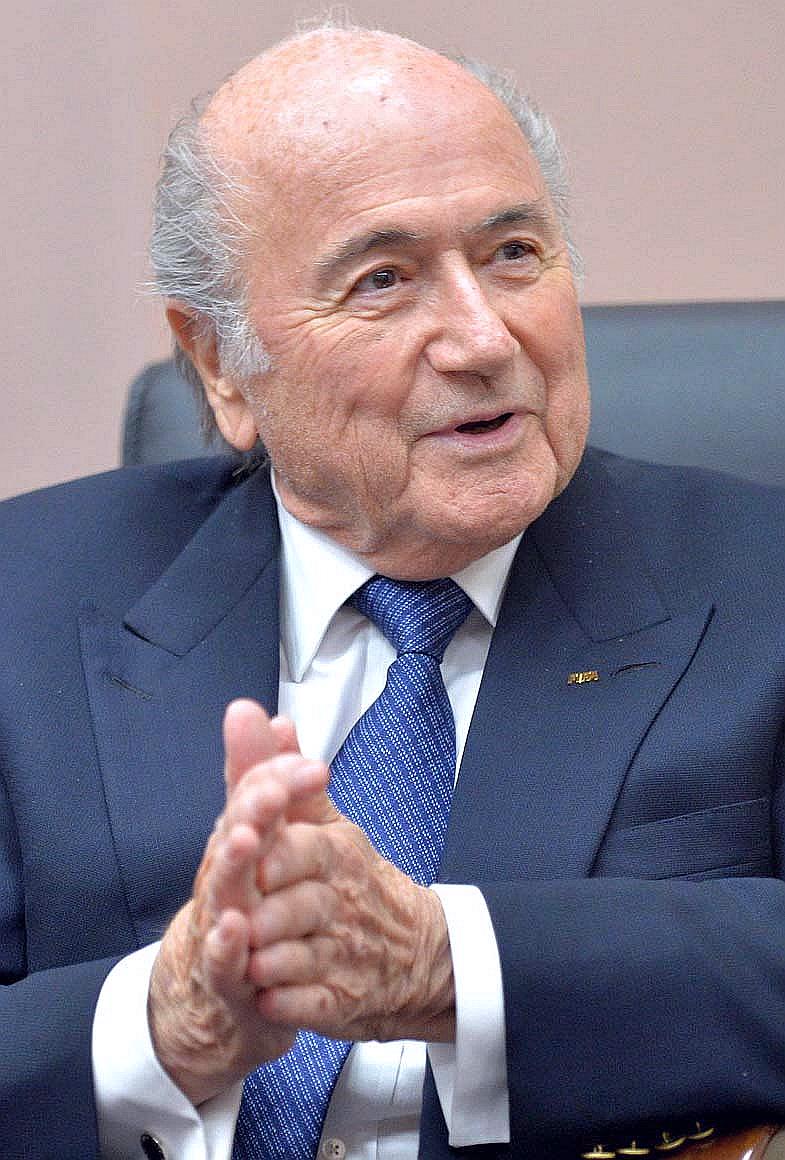
Joseph Sepp Blatter (born Josef Blatter; 10 March 1936) is a Swiss former football administrator who served as the eighth president of FIFA from 1998 to 2015. He has been suspended from participating in FIFA activities since 2015 as a result of the FIFA corruption case made public that year, which remains in place until 2027.

Key Information

From a background in business, public relations, and sports administration, Blatter became general secretary of FIFA in 1981 and was then elected president at the 51st FIFA Congress on 8 June 1998, succeeding João Havelange, who had headed the organization since 1974. Blatter was re-elected in 2002, 2007, 2011, and 2015. Like his predecessor Havelange, Blatter built his power base in FIFA by increasing the influence of numerous African and Asian countries in world football through the expansion of participating teams in various FIFA tournaments, culminating in the highly controversial awarding of the 2022 World Cup to Qatar. Although he has persistently been dogged by claims of corruption and financial mismanagement, Blatter's reign oversaw a vast expansion in revenues generated by the FIFA World Cup.

On 2 June 2015, six days after the United States government indicted several current and former FIFA officials and sports marketing companies for bribery and money laundering,[1] Blatter announced that he would call for elections to choose a new president of FIFA and that he would not stand in these elections, but he also said he would remain in his position until an extraordinary FIFA Congress could be held for his successor to be elected.[2] Criminal proceedings were announced against Blatter by the Swiss Attorney General's office on 25 September 2015, regarding "criminal mismanagement... and misappropriation".[3][4]

In October 2015, Blatter and other top FIFA officials were suspended amid the investigation,[5] and in December the independent FIFA Ethics Committee ejected Blatter from office and banned him from taking part in any FIFA activities over the following eight years.[6] On 24 February 2016, a FIFA appeals committee upheld the suspension but reduced it from eight years to six.[7] On 24 March 2021, he received a second ban for six years and was fined the amount of CHF 1,000,000 by the body's Ethics Committee after a probe into massive bonus payments.[8] Issa Hayatou served as the acting President of FIFA until an extraordinary FIFA Congress was held in late February 2016, electing Gianni Infantino as the 9th president of FIFA.[9]

Early life

[edit]

Blatter was born in Visp in the Swiss canton of Valais with the given name of Josef. He studied in Saint Maurice, before getting a degree in business and economics from the University of Lausanne in 1959. Blatter has had a long and varied career, including posts such as head of public relations for the tourist board of his native canton, as well as general secretary of the Swiss Ice Hockey Federation.

Blatter was Director of Sports Timing and Relations of Longines S.A., and was involved in the organization of the 1972 and 1976 Olympic Games.[10][11][12]

FIFA

[edit]
Blatter (left) with João Havelange, President of FIFA (April 1982).

From 1975 onwards, Blatter worked at FIFA, first as technical director (1975–1981), then general secretary (1981–1998), before his election as FIFA president in 1998.[13] He was re-elected as head of FIFA in 2002, and was re-elected unopposed for another four years on 31 May 2007, even though only 66 of 207 FIFA members nominated him.[14]

Blatter and FIFA were often dogged by controversy and allegations of corruption.[1][15][16] His tenure saw controversy over allegations of financial mismanagement and the acceptance of bribes resulting in Qatar's successful 2022 World Cup bid.

Blatter has attracted criticism from the media, senior football figures and players,[17] due to controversial statements. These include the claim that Latin American countries would applaud John Terry for having an extramarital affair, and that on-field racism could be corrected with a handshake, among others.[18] He also drew criticism at the 2014 FIFA World Cup seeding, when he interrupted a "one-minute silence" for former South-African president Nelson Mandela, who died the day before, after eleven seconds. Michael van Praag, the chairman of the Royal Dutch Football Association, called his behavior "preposterous" and expressed the hope Blatter would not be reelected in 2015.[19]

Blatter has been publicly heckled, at the World Cup in Seoul and the Confederations Cup in Frankfurt, both in 2002 and 2005,[20] in his home town of Visp in 2011,[21] at the 2012 Women's Olympic Football Final Medal Ceremony,[22] and at the opening of Confederations Cup match in 2013.[23] In order to avoid protest, no speeches were given at the 2014 FIFA World Cup.[24]

1998 election

[edit]

Blatter's 1998 election to the presidency of FIFA over UEFA President Lennart Johansson occurred amidst much controversy.[25][26] Blatter's 2002 candidacy was marked with rumours of financial irregularities and backroom dealings,[27] culminating with direct accusations of bribery, by a third party, made in the British press by Farra Ado, vice-president of the Confederation of African Football and president of the Somali Football Federation, who claimed to have been offered $100,000 to vote for Blatter in 1998.[28]

2004 comments on women's football

[edit]

In 2004, Blatter said during an interview in the Swiss newspaper Sonntagsblick, when asked how to increase the popularity of women's football, "Let the women play in more feminine clothes like they do in volleyball. They could, for example, have tighter shorts. Female players are pretty, if you excuse me for saying so, and they already have some different rules to men - such as playing with a lighter ball. That decision was taken to create a more female aesthetic, so why not do it in fashion?" His comments resulted in heated responses.[29][30]

2006 FIFA World Cup

[edit]

In the 2006 FIFA World Cup, after a controversial second-round match between Portugal and the Netherlands, which saw referee Valentin Ivanov issue a record 16 yellow cards and four red cards, Blatter was said to have lambasted the officiating referee, and said that Ivanov should have given himself a yellow card for his poor performance as a referee.[31] He later said he regretted his words and promised to officially apologise to Ivanov.[32] The apology was never given, and the referee was removed from further officiating.[32]

Blatter at Zürich Hauptbahnhof in November 2013

Foreign 'over-representation' on club teams

[edit]

Blatter was criticized in 2007 and 2008 for trying to change European Union employment law regarding the number of foreign players that football clubs could field at any one time. His plans were to set a restriction of five foreign players and having six players from the said team's own nationality. Blatter believed this would help the countries' national sides by having more national players playing in their leagues.

Blatter has often referred to the English Premier League as one of the major problems in football and used it as an example, due to the influence of foreign players, coaches and owners in the top teams.[33][34][35][36][37]

World Cup's chosen sites

[edit]
Blatter with Barack Obama and Jack Warner. In the vote for the 2018 and 2022 FIFA World Cups, U.S. President Obama said that FIFA made "the wrong decision" in awarding Qatar the tournament in 2022.[38]

It was reported that Blatter had "cut an unofficial deal with UEFA head Michel Platini" to ensure Europe would receive the 2018 World Cup, such that if the non-European bids did not withdraw from 2018 "they will find themselves frozen out and not given any backing by the FIFA High Command, damaging their chances of being serious contenders for the second tournament."[39]

Eleven bids were submitted in March 2009 covering 13 nations. Mexico and Indonesia withdrew. Five of the remaining nine bids—South Korea, Qatar, Japan, Australia and the United States—were only for the 2022 World Cup, while all the others were bidding for both the 2018 and 2022 World Cups.[40] Because all of the bids for the 2018 World Cup were from European nations, and FIFA's rules dictate that countries belonging to confederations that hosted either of the two preceding tournaments are not eligible to host,[41] the bids of England, Russia, Netherlands/Belgium and Spain/Portugal were forced to be for 2018 only.

Technological assistance

[edit]

The criticism attracted by Blatter's refusal to allow goal-line technology or video replays intensified following the controversial Frank Lampard disallowed goal in the match between England and Germany on 27 June 2010.[42]

Two days later, Blatter stated that he deplored the "evident referee mistakes" in the England v Germany and Mexico v Argentina matches, and apologised to the English Football Association and the Mexican Football Federation (the two organizations directly concerned by the referees' mistakes), acknowledging that Lampard had indeed scored against Germany and that Tévez's goal against Mexico had been scored from an offside position.

He added: "It is obvious that after the experiences so far at this World Cup it would be a nonsense not to re-open the file on goal-line technology. […] We will come out with a new model in November on how to improve high level referees. […] I cannot disclose more of what we are doing but something has to be changed."[43][44]

2011 FIFA presidential election

[edit]
Blatter (right) with Luis Suárez, the Player of the Tournament of the 2011 Copa América.

In 2011, elections were scheduled for the FIFA presidency, in which Blatter was again the incumbent candidate, running for a fourth consecutive term. The ChangeFIFA organisation, on 29 March 2011, endorsed former Chilean defender and for three years running South American Footballer of the Year Elías Figueroa as candidate for the presidency, urging national federations to nominate him,[45] but, subsequently, Figueroa decided not to accept the nomination, stating that "in such a short period of time" he could not develop a case "worthy of the magnitude and importance of such a distinguished job"[45]

The vote took place at the 61st FIFA Congress in Zurich.[46] The only other candidate, Mohammed bin Hammam of Qatar, withdrew from the presidential race on 28 May, just before the vote.[46] Bin Hammam had supported Blatter's 1998 and 2002 presidential campaigns, but admitted that he had fallen out with Blatter over issues within the FIFA Executive Committee.[47] The FIFA ethics committee that investigated bribery claims against Bin Hammam and CONCACAF head Jack Warner announced that Blatter will not face an investigation into claims that he knew of the bribery and did nothing about it, because of a lack of evidence.[48]

Blatter criticised the International Olympic Committee (IOC), stating FIFA manage their finances "like a housewife", after the IOC announced it would look into allegations of corruption against Issa Hayatou, president of the Confederation of African Football.[49]

There being no other nominations, Blatter ran unopposed in the ensuing presidential election and was re-elected for a fourth term, with 186 of the 203 votes cast. In his campaign, Blatter had stipulated that, if re-elected in 2011, he would not run again for president.[50][51] Blatter received criticism for not postponing his 2011 election in which his term as FIFA President was extended through 2015, despite the fact that all other candidates for the role had been suspended or withdrew.

Allegations of financial mismanagement

[edit]

Amidst internal divisions, FIFA's secretary-general Blatter's deputy and former protégé Michel Zen-Ruffinen drew up a 30-page dossier outlining allegations of financial mismanagement within the organisation.[52][53] The dossier alleged that the collapse of FIFA's marketing partner ISL had led to losses of up to 100 million US dollars under Blatter's management.

The allegations were backed by Johansson,[54] and the dossier was handed to the Swiss authorities, but they cleared Blatter of any wrongdoing and FIFA had to pay all the costs.[55] An internal investigation within FIFA was halted by Blatter because members of it broke confidentiality agreements.[56] This questionable behaviour led him to remove Zen-Ruffinen from office immediately before the 2002 FIFA World Cup.

In April 2012 the Council of Europe published a report which stated it would be "difficult to imagine" that Blatter would have been unaware of "significant sums" paid to unnamed FIFA officials by ISSM/ISL in connection with lucrative contracts for World Cup television rights and the subsequent bankruptcy and collapse of ISL in 2001.[57] The Council of Europe report will be considered by over 300 parliamentarians from the 47 Council of Europe member states in Strasbourg.[58]

Awarding of 2018 and 2022 World Cup

[edit]

Controversy came in the British press when Russia was awarded the 2018 event, with England receiving just two of their "promised" votes; this controversy was dismissed by Blatter as the English showing themselves to be "bad losers".[59] The awarding of the 2022 games to Qatar was also controversial. The illegality of homosexuality in the nation caused Blatter to joke that "I would say they [gay fans] should refrain from any sexual activities",[60] which brought criticism from retired basketball player John Amaechi and gay rights groups.[61]

2013 FIFA Ethics Committee investigation

[edit]

On 29 April 2013, FIFA's Ethics Committee concluded its investigation into allegations of illegal payments to FIFA officials from the organisation's former marketing partner International Sports and Leisure (ISL), which went bankrupt in 2001,[62] and published its report.[63]

FIFA president Sepp Blatter was cleared of any misconduct, but his predecessor, Brazilian João Havelange, resigned as FIFA's honorary president[64] over his part in the scandal, since Havelange along with former FIFA Executive Committee members Ricardo Teixeira and Dr. Nicolás Leoz were found to have accepted illegal payments between 1992 and May 2000. A week before FIFA's ethics committee announced its findings, 84-year-old Leoz had resigned from his post as president of the South American Football Confederation, citing "health reasons".[65]

Blatter, in a statement, "note[d] with satisfaction" that the report "confirms that 'President Blatter's conduct could not be classified in any way as misconduct with regard to any ethics rules'." He added he has "no doubt that FIFA, thanks to the governance reform process that [Blatter] proposed now has the mechanisms and means to ensure that such an issue does not happen again", though admitting that the scandal "has caused untold damage to the reputation of [FIFA]."[66]

2015 FIFA presidential election, controversy and resignation

[edit]
Blatter in a press conference with Presidents of Asian Football Confederation Salman Bin Ibrahim Al-Khalifa and Football Federation Islamic Republic of Iran Ali Kafashian in Tehran

In 2015, elections were scheduled for the FIFA presidency, in which Blatter was again the incumbent candidate, running for a fifth consecutive term. Prince Ali bin Hussein was his opponent in the election.

The vote took place at the 65th FIFA Congress in Zürich on 29 May 2015. Neither party received the necessary two-thirds majority of votes from the first round with Blatter receiving 133 to Prince Ali's 73. According to FIFA rules, a second round should have been held for the two candidates, with a simple majority being sufficient for victory. However, before the second round of voting commenced, Prince Ali announced his withdrawal, handing Blatter victory by default.[67]

On 2 June 2015, FIFA abruptly called a press conference at their Zürich headquarters, where Blatter announced that he would resign from the post of FIFA president amid the ongoing corruption scandal.[68][69]

During the news conference he said: "My mandate does not appear to be supported by everybody" and announced an extraordinary congress scheduled "as soon as possible" to elect his successor.[70] Blatter announced that he would remain in office until his successor could be elected at the extraordinary congress, likely to be held some time between December 2015 and March 2016.[71] He continued with the words: "While I have a mandate from the membership of FIFA, I do not feel that I have a mandate from the entire world of football—the fans, the players, the clubs, the people who live, breathe, and love football as much as we all do at FIFA".[72]

Subsequently, on 26 June Blatter prompted speculation that he might be preparing to renege on this resignation, when he was quoted as saying that "I have not resigned, I put my mandate in the hands of an extraordinary congress". This seemed to contradict his comments from 2 June 2015.[73] He was further quoted as saying that he resigned "to take away the pressure from FIFA and my employees, including [pressure] from the sponsors". Reports speculated that it appears that Blatter will step down at the "extraordinary congress" though the situation remains vague.[74]

On 25 September, Swiss investigators announced that they were investigating Blatter in relation to payments made to UEFA president Michel Platini.[75] While Blatter and Platini denied any impropriety around the payments,[76] major FIFA sponsors Coca-Cola, Visa Inc., McDonald's, and Budweiser issued public statements requesting that he resign for the good of FIFA.[77]

On 8 October 2015, he was suspended from FIFA for 90 days while investigations into payments made to Michel Platini were conducted. FIFA said in a statement: "The grounds for these decisions are the investigations that are being carried out by the investigatory chamber of the ethics committee."[78] On 21 December, FIFA's ethics committee banned both Blatter and Platini from football for eight years.[79] In February 2016, a FIFA appeals committee upheld the suspension but reduced it from eight years to six.[7] Platini appealed to the European Court of Human Rights, which rejected his appeal.[80]

On 22 December 2020, FIFA filed a criminal complaint against Blatter relating to his role in the FIFA Museum project.[81]

On 24 March 2021, he received a second ban for six years and was fined the amount of CHF 1,000,000 by the body's Ethics Committee after a probe into massive bonus payments.[8]

On 2 November 2021, Blatter was formally charged by Swiss authorities for fraud and falsifying documents in connection with the improper payments to Platini.[82] Blatter and Platini were cleared of the charges eight months later.[83] Despite the verdict having been appealed by Swiss federal prosecutors, Blatter and Platini were acquitted a second time in March 2025.[84]

Post FIFA

[edit]

Blatter has been critical of football's leadership since his departure from FIFA, specifically criticising FIFA president Gianni Infantino and UEFA president Aleksander Čeferin. Blatter noted that when he had started working in FIFA, the organization was poor and was not the powerhouse it is today and admits he played a major role in the commercialisation of football, which has led to an increase in non-sports sponsors. Blatter stated that awarding the 2022 FIFA World Cup to Qatar was a mistake.[85] Blatter has been critical of the expansion and creation of tournaments like the FIFA World Cup, UEFA Champions League, UEFA Europa League, UEFA Conference League, FIFA Club World Cup, and UEFA Nations League and has warned that oversaturation, rising costs, and fan violence could cause interest in football to drop. Blatter also criticised the awarding of the 2030 FIFA World Cup to six countries in three continents (Argentina, Morocco, Paraguay, Portugal, Spain, and Uruguay), stating the tournament would lose its identity. Blatter also criticised the 2034 FIFA World Cup in Saudi Arabia, saying that it would go against the human rights and democracy that make up FIFA's values while giving Saudi Arabia increasing influence in football as well as the bidding process for both 2030 and 2034 that was designed to favor Saudi Arabia.[86][87][88][89]

Sexual assault allegation

[edit]

In November 2017, American goalkeeper Hope Solo accused Blatter of sexual assault at the FIFA Ballon d'Or awards in 2013. During an interview with the Portuguese newspaper Expresso, Solo stated she "had Sepp Blatter grab my ass" just before the two presented an award together to Abby Wambach.[90] She stated she "was in shock and completely thrown off. I had to quickly pull myself together to present my team-mate with the biggest award of her career and celebrate with her in that moment, so I completely shifted my focus to Abby."[91] Blatter's spokesman Thomas Renggli stated "This allegation is ridiculous."[92]

Honours

[edit]

Blatter has been the recipient of numerous awards, medals, honorary degrees, and citizenships from nation states, sport governing bodies, special interest groups, universities and cities.[93]

Blatter's honorary degree from De Montfort University was revoked by the institution in October 2015, as it had previously been given in recognition of his ethical conduct.[94]

Personal life

[edit]

In 1981, Blatter changed the spelling of his first name from Josef to Joseph.[95] He later adopted his nickname, Sepp, as his middle name.[95]

Blatter's first wife was Liliane Biner. The couple had a daughter,[96] shortly after which they divorced. In 1981, Blatter married Barbara Käser, the daughter of Helmut Käser, Blatter's predecessor as secretary general of FIFA. Their marriage lasted ten years until Barbara died from complications after an operation. In 1995, Blatter began dating Ilona Boguska, a Polish friend of his daughter Corinne, before they separated in 2002.[97]

Blatter married for a third time on 23 December 2002, to Graziella Bianca, a dolphin trainer who was a friend of his daughter.[98] Their marriage ended in divorce in 2004.[99][better source needed] Since 2014, he has been in a domestic partnership with Linda Barras.

Blatter was raised as a Catholic.[100][101]

See also

[edit]

References

[edit]
[edit]
Revisions and contributorsEdit on WikipediaRead on Wikipedia
from Grokipedia
Joseph "Sepp" Blatter (born 10 March 1936) is a Swiss sports executive who served as the eighth president of , the global governing body for , from 8 June 1998 until his resignation on 21 December 2015. Blatter's tenure saw FIFA's membership expand to 211 associations and revenues surge from around $2.7 billion in 1998 to over $5.8 billion by 2014, fueled by broadcasting deals and commercialization of the sport. He prioritized development in emerging markets, launching the programme in 1999 to fund in smaller nations, which disbursed hundreds of millions in grants and helped stage World Cups in (2002) and (2010) for the first time. These initiatives, while credited with globalizing football, drew criticism for concentrating influence among voting confederations in the developing world, enabling Blatter's repeated re-elections despite internal dissent. His leadership ended amid a sweeping probe triggered by U.S. and Swiss authorities in 2015, which exposed and among officials tied to media and hosting . Blatter resigned four days after securing a fifth term, denying personal involvement but acknowledging 's reputational damage; he was subsequently banned for eight years (later reduced) by 's ethics committee for authorizing an irregular $2 million payment to UEFA president , though a Swiss criminal acquitted both men of in that case in 2022 and on appeal in 2025. A separate 2021 ban of six years followed findings of mismanagement in a migrant worker compensation fund for the 2022 , reflecting ongoing scrutiny of governance under his era.

Early Life and Education

Family Background and Upbringing

Josef "Sepp" Blatter was born on March 10, 1936, in , a remote alpine town in the Swiss canton of near the , into a modest working-class family. His family's roots traced back to Ulrichen, a village in Upper , where Blatter later maintained ties by hosting annual events. Blatter grew up with siblings including brothers Peter and Marco, as well as a sister named Ruth who predeceased him; the household was supported by his father's employment at a local chemical . His early years in were unremarkable, shaped by the town's industrial and mountainous setting, with local accounts portraying him as dominant in playground activities during . This modest upbringing contrasted with his later prominence in international sports administration.

Academic and Early Professional Experience

Joseph Blatter, known as Sepp, completed his at the colleges of Sion and St. Maurice in . He subsequently earned a and degree from the , graduating with a focus on economics in 1958. Following graduation, Blatter entered and marketing roles, initially serving as head of for the tourism board of , his home canton. He later advanced to director of sports timing and at the Swiss watchmaker , where he managed timing operations for international sporting events. In parallel, he held administrative positions in Swiss sports organizations, including service with the Swiss Ice Hockey Federation. These experiences built his expertise in sports management and commercial aspects of athletics prior to his entry into international football administration.

Pre-FIFA Career in Sports Administration

Roles in Swiss and International Sports Bodies

Blatter began his involvement in Swiss sports administration in 1964 when he was appointed General Secretary of the Swiss Ice Hockey Federation, a position he held until 1966. In this role, he managed operational and administrative aspects of the federation during a period when Swiss ice hockey was establishing its competitive structure post-World War II. From 1970 to 1975, Blatter served on the board of directors of Neuchâtel Xamax, a Swiss first-division football club based in . This involvement provided him early exposure to professional football governance in , including strategic decision-making for club operations and league participation amid the growth of domestic competitions. In parallel with these roles, Blatter worked as Director of Sports Timing and for the Swiss watchmaker from around 1968 onward, which extended his reach into international events. Through this position, he contributed to the timing operations and organizational logistics for the 1972 Olympics and the 1976 Olympics, handling synchronization of events and for timekeeping systems. These engagements marked his initial foray into coordinating large-scale international sporting spectacles, though primarily through corporate rather than channels.

Involvement with the International Olympic Committee

Prior to joining , Blatter served as Director of Sports Timing and for S.A., the Swiss watchmaker that acted as the official timekeeper for multiple . In this capacity, he contributed to the technical organization and timing operations for the in , , where provided chronometric services for events, , and other timed competitions. His role involved coordinating equipment deployment, data recording, and liaison with Olympic organizers to ensure accurate results dissemination, supporting the 's standards for precision in athletic performance measurement. Blatter extended this involvement to the in , , again managing ' timing infrastructure amid logistical challenges such as the Games' budget overruns and boycotts by over 20 nations. This work honed his expertise in international sports , facilitating real-time scoring systems that influenced subsequent Olympic technical protocols. Although not holding a formal position within the IOC itself, these contributions through corporate partnership exposed him to the committee's operational framework and global stakeholder coordination, predating his administrative roles in football .

Entry and Rise in FIFA

Joining FIFA and Administrative Positions

Sepp Blatter joined in 1975 as its , a position focused on overseeing development programs and technical aspects of the sport. In this role, he contributed to initiatives aimed at promoting football globally, drawing on his prior experience in Swiss sports administration. His appointment came amid 's efforts to expand its international footprint under President , who had assumed leadership in 1974. In 1981, Blatter was promoted to general secretary by the Executive Committee, succeeding Käser and becoming the organization's . This position entailed managing daily operations, coordinating with member associations, and implementing policies set by the president, roles he held for 17 years until 1998. During this period, Blatter worked closely with Havelange, facilitating the growth of 's membership and commercial activities while navigating internal governance structures. Blatter's administrative tenure positioned him as a key insider, building alliances across confederations and enhancing his influence within FIFA's hierarchical framework. By the late 1990s, these roles had established him as Havelange's protégé, setting the stage for his presidential candidacy.

1998 FIFA Presidential Election

The 1998 FIFA presidential election occurred on June 8 during the 51st in , , to select a successor to João Havelange, who had led the organization since 1974. , FIFA's general secretary since 1981 and a close associate of Havelange, emerged as the establishment candidate, emphasizing continuity in global development programs for football in underrepresented regions. His main challenger was , president of , who advocated for greater European influence and reforms to FIFA's governance structure. In the election, which required an absolute majority of votes from FIFA's 191 member associations, Blatter secured 111 votes to Johansson's 80 in the ballot, achieving victory without a runoff. Blatter's support was strongest among confederations from , , and , where FIFA's financial assistance programs under Havelange had built loyalty through infrastructure investments and expanded slots. Johansson, backed primarily by European federations, conceded immediately after the results, stating "the game is over." The campaign was marked by tensions, with Johansson criticizing FIFA's opaque finances and Blatter's close ties to Havelange. Post-election, Johansson alleged irregularities, including claims that envelopes containing cash were distributed to African delegates the night before voting, purportedly to sway support toward Blatter. Blatter rejected the accusations, attributing his win to genuine backing from developing nations appreciative of FIFA's growth initiatives, though no formal investigation or charges resulted from these claims at the time. These allegations later resurfaced amid broader FIFA corruption probes, highlighting patterns of vote influence through rather than outright .

FIFA Presidency: Policies and Achievements

Expansion of Football Development Programs

Under Sepp Blatter's presidency from 1998 to 2015, FIFA markedly increased investments in football development, redirecting substantial revenues toward infrastructure, training, and operational support for its 209 member associations, with a focus on underrepresented regions in , , and . This shift built on Blatter's earlier role as FIFA's director of development programs starting in 1975, where he negotiated sponsorships like Coca-Cola's for initiatives, but accelerated post-election through structured funding mechanisms that prioritized smaller nations receiving the highest allocations. The flagship FIFA GOAL Programme, ratified at the 1999 Extraordinary Congress and initiated under Blatter's direct oversight, allocated grants for technical, administrative, and infrastructural enhancements tailored to each association's needs. By , it had funded over 700 projects, primarily association headquarters, training facilities, and pitches, with expenditures reaching approximately US$284 million by 2014 across 206 member organizations. This initiative facilitated tangible expansions, such as new sports complexes in inaugurated by Blatter in 2009, enabling broader participation in youth and women's programs in developing confederations. Complementing GOAL, the Financial Assistance Programme (FAP) provided annual disbursements—totaling US$209 million in 2014 alone—for day-to-day operations, coaching education, and referee training, ensuring sustained growth beyond capital projects. Overall, FIFA's development outlays under Blatter surpassed US$2 billion from 1999 onward, including US$778 million to associations and US$331 million to confederations by early 2014, fostering increased global match participation and professionalization in non-traditional markets. These efforts correlated with football's infrastructural footprint expanding in regions like Africa, where Blatter's targeted aid built loyalty among voting members by addressing chronic underfunding.

Financial Growth and Commercialization

During Sepp Blatter's presidency from 1998 to 2015, FIFA's annual revenue expanded dramatically from approximately $560 million in 1998 to $5.7 billion by 2014, reflecting aggressive commercialization strategies centered on the World Cup and global broadcasting rights. This growth was fueled by escalating media deals, with television rights fees rising due to the sport's increasing appeal in emerging markets and the proliferation of satellite and digital broadcasting platforms. For instance, the 2010-2014 World Cup cycle alone generated $4.8 billion from qualifying rounds and the tournament, underscoring FIFA's shift toward treating major events as high-value media properties. Blatter's administration prioritized sponsorship revenue through exclusive, multi-year partnerships with global brands, establishing tiered categories that maximized exclusivity and visibility. Key deals with longstanding partners like (extended through 2038 in later negotiations influenced by Blatter-era foundations) and provided baseline funding, while new agreements with entities such as Emirates and boosted inflows by tying sponsor branding to tournament broadcasts and stadium advertising. These efforts professionalized FIFA's marketing, with sponsorships contributing a stable portion of the budget amid volatile TV markets, though critics later noted that such commercialization prioritized revenue over development. By , overall revenue had reached $1.059 billion, with profits at 18% of that figure, enabling expanded reserves and reinvestments. The expansion of the to 32 teams starting in , a policy Blatter championed and implemented during his first term, directly enhanced by increasing matches from 52 to 64, thereby extending broadcast windows and slots. This structural change amplified revenue potential, as longer tournaments attracted higher bids from broadcasters seeking comprehensive coverage and sponsors targeting prolonged exposure. FIFA's four-year commercial cycles, aligned with World Cups, saw cumulative revenues climb steadily—reaching around $3.4 billion for 2007-2010—through bundled rights packages that bundled TV, digital, and hospitality elements. Blatter attributed this trajectory to football's , though internal audits later revealed that unchecked executive bonuses strained the model's sustainability.

World Cup and Tournament Innovations

During Sepp Blatter's presidency from 1998 to 2015, launched the Club World Championship, later renamed the , as a new annual intercontinental club tournament to crown a global champion among continental winners. The inaugural edition occurred in January 2000 in , featuring seven teams including European, South American, North/Central American, African, Asian, Oceanian, and host representatives, with Corinthians defeating 4–3 in the final. Blatter had advocated for the concept since the early to rival emerging club competitions and promote football's worldwide appeal, though he later described its creation as a "mistake" due to fixture congestion and commercialization pressures on players. Blatter oversaw the expansion of the from 16 to 24 teams, implemented for the edition in , to broaden participation and development in women's football. This change, approved by the , added eight more nations and introduced an additional knockout round, increasing the tournament's competitiveness and global reach, with the defeating 5–2 in the final before a record 53,341 spectators. Earlier expansions under his tenure, from 12 teams in 1991 to 16 by 1999–2007, aligned with Blatter's stated goal of growing the women's game, though critics noted uneven infrastructure support in emerging regions. In response to officiating controversies, such as the disputed non-goal by England's against in the 2010 round of 16, Blatter reversed his prior opposition to technological aids and supported the approval of systems. The (IFAB), influenced by , greenlit and GoalRef in July 2012 after rigorous testing; these were first deployed at the December 2012 Club in and subsequently at the 2014 men's in , where they assisted referees in eight decisions across 64 matches. This marked a causal shift from human judgment alone to empirical verification, reducing errors in goal determinations while preserving the game's flow, as Blatter emphasized post-2010 that evidence from high-profile incidents necessitated adaptation. Blatter's era also featured hosting the men's in unprecedented regions, with the 2002 tournament co-hosted by and —the first in —drawing 2.7 million attendees and boosting viewership in populous markets, and the 2010 event in , Africa's debut, which generated $3.9 billion in revenue despite logistical challenges. These selections aimed to innovate by prioritizing geographic rotation over traditional European dominance, increasing qualification slots for African (to five) and (to four) confederations from prior norms, though they sparked debates on readiness and in bidding.

FIFA Presidency: Governance and Reforms

Electoral Processes and Term Extensions

The FIFA presidential election process during Sepp Blatter's tenure involved a secret conducted at the , where each of the 209 member associations held one vote, regardless of national population or federation size. To secure victory in the first round, a required a two-thirds majority of valid votes cast; absent that, a runoff occurred between the top two candidates, with a simple majority sufficient for election. Terms were set at four years, with no age restrictions or mandatory retirement provisions, and candidates needed endorsements from at least five member associations to qualify. Blatter's initial election in 1998 followed this framework, defeating UEFA president Lennart Johansson with 111 votes to 80 in a single round at the Paris Congress. He faced no opponent in 2002, receiving unanimous support from 139 attending delegates amid internal divisions. In 2007, Blatter prevailed over Qatari challenger Mohammed bin Hammam, securing 139 votes to 56 in Zurich, exceeding the two-thirds threshold. The 2011 contest saw bin Hammam disqualified by FIFA's ethics committee over bribery allegations in Trinidad and Tobago, leaving Blatter unopposed and elected with 186 votes from 203 present members. Blatter's 2015 re-election bid for a fifth term proceeded under the same rules despite ongoing U.S. and Swiss investigations into corruption; he garnered 133 endorsements from 209 members pre-vote and won after Jordan's Prince Ali bin al-Hussein conceded following a first-round tally of 133-73, avoiding a runoff. The one-association-one-vote system concentrated influence among smaller or developing nations, which Blatter courted through and hosting perks, though critics argued it facilitated over merit-based . No term limits existed during Blatter's , enabling his 17-year incumbency across four full terms and a partial fifth, as statutes permitted indefinite re-election provided approval. Blatter publicly affirmed his intent for a fifth term in September 2014, citing unfinished reforms, without proposing restrictions on tenure length. Post-resignation reforms in 2016, under interim leadership, introduced a maximum of three four-year terms (12 years total) for presidents and council members, retroactively inapplicable to Blatter's era. This absence of limits during his rule contrasted with calls from figures like for earlier constraints, which Blatter resisted amid accusations of entrenching power through electoral dominance.

Technological and Rule Changes

Blatter long maintained that technological interventions, such as video replays or (GLT), would undermine football's human element and disrupt its rhythm, emphasizing the sport's universality across professional and amateur levels. He argued that referees' errors were inherent to the game and that would lead to excessive interruptions and costs prohibitive for lower tiers. High-profile officiating controversies during his presidency shifted this stance. The disallowed "ghost goal" by England's Frank Lampard against in the 2010 World Cup round of 16—where television replays clearly showed the ball crossing the line—drew widespread criticism and prompted Blatter to reconsider GLT. In June 2010, he announced would revisit the technology after previously rejecting it in 2008 trials. FIFA approved GLT in July 2011 at an IFAB meeting, certifying systems like and GoalRef following independent tests. The technology, using cameras and sensors to detect ball position, debuted at the , was employed at the 2013 Confederations Cup, and featured at the 2014 World Cup, where it confirmed three goals without halting play. Blatter later endorsed its reliability, stating post-Euro 2012 that it had become "no longer an alternative but a necessity" after another disputed call. On rule adjustments, Blatter's era saw IFAB trials and adoptions influenced by , including the 2004 abolition of the extra-time format—replacing it with two full 15-minute periods—for major tournaments to reduce . also pushed for stricter enforcement of existing laws, such as the six-second limit on goalkeepers holding the ball, amid ongoing debates over time-wasting. In 2014, Blatter advocated limited "video challenges" for coaches to review key decisions, akin to other s, though this was not formalized before his departure.

Relations with Confederations and Global Representation

Sepp Blatter maintained power through alliances with leaders of non-European confederations, including the (CAF), (AFC), and (CONMEBOL), which provided crucial voting blocs in presidential elections. In the 1998 election, Blatter secured support from African delegates amid allegations of cash distributions to CAF officials on the eve of voting. These ties persisted, with CAF pledging unanimous backing in subsequent contests and AFC initially supporting his 1998 and 2002 campaigns before tensions arose with challenger Mohamed Bin Hammam. By 2015, Blatter had endorsements from AFC, CAF, , and (OFC) leaders, ensuring near-automatic votes from their member associations. Blatter's relations with these bodies were reinforced by FIFA's allocation of development funds, totaling over $2 billion since , directed toward and programs in developing nations, fostering a patron-client dynamic that critics described as vote-buying but which Blatter framed as equitable global investment. Africa's bond was particularly strong, exemplified by Blatter's delivery of the 2010 to , the first hosted on the , which solidified loyalty despite uneven on-field benefits from such expenditures. In contrast, relations with soured over time, marked by Blatter's recruitment of for European support in followed by public feuds, including Blatter's 2015 accusations of Platini's envy and role in Qatar's 2022 bid controversy. On global representation, Blatter pursued policies to elevate non-European voices, including the 2000 adoption of a hosting rotation system to cycle among confederations post-2010, intended to counter European dominance and promote worldwide engagement. This was reversed in 2007 amid bids for 2018 and 2022, shifting to competitive selection. He also pushed for expanded qualification slots, advocating in 2013 for additional places for African and Asian teams to reflect football's growth in those regions, building on prior increases like Africa's rise to five slots for the 2010 tournament. These efforts, while enhancing FIFA's inclusivity claims, were intertwined with electoral strategies, as development aid and representational gestures secured bloc support from the 140-plus associations outside .

Controversies and Criticisms

Public Statements on Social Issues

In November 2011, Blatter stated that racism was not a significant problem on the football pitch and suggested that players involved in racial disputes should resolve them with a handshake rather than walking off the field, emphasizing personal responsibility over institutional sanctions. These remarks drew widespread criticism from players like Rio Ferdinand and organizations such as Kick It Out, who argued they minimized the severity of on-field abuse, prompting Blatter to express regret for causing offense but maintain that dialogue was key to resolution. Earlier, in 2013, Blatter outlined FIFA's anti-racism initiatives, including education campaigns and sanctions, during a speech at the Oxford Union, positioning the organization as proactive despite ongoing incidents. Regarding women's football, Blatter in January 2004 proposed that female players adopt "more feminine" attire, such as tighter shorts, to enhance the sport's appeal and attract larger audiences, commenting that "let the women play in more feminine clothes like they do in ." This suggestion, made during a on growing the women's game, was condemned by figures like Faye Watt of the Scottish Women's Football Association as objectifying athletes and prioritizing aesthetics over merit. Blatter later described himself as the "godfather" of women's football in , crediting his leadership for its expansion, including dedicated World Cups since 1991, though critics highlighted persistent gender disparities in funding and visibility. On , Blatter in December 2010 advised gay fans attending the 2022 in —where same-sex relations are illegal—to "refrain from any sexual activities" during their stay, framing it as respect for local laws rather than endorsement of . He subsequently apologized for the phrasing causing distress but upheld the guidance, and in June 2013 described 's anti- stance as a " and ethical" matter without advocating change. These comments aligned with FIFA's host selection prioritizing cultural norms over universal rights standards at the time. Blatter initially defended Qatar's 2022 World Cup hosting against critiques, including migrant worker conditions, asserting in various statements that FIFA focused on football's global development over political interference. By November 2022, however, he conceded the decision was a "mistake" due to extreme summer heat complicating matches—later mitigated by air-conditioned stadiums—without referencing labor abuses or rights violations as factors, noting had since incorporated social considerations into bidding criteria. This retrospective admission contrasted with his earlier dismissal of boycotts or relocations, prioritizing tournament execution.

World Cup Bidding and Hosting Decisions

Under Sepp Blatter's presidency, FIFA's executive committee awarded the to on May 15, 2004, marking the first time the tournament was hosted on the African continent, a decision Blatter publicly championed as fulfilling a long-standing continental rotation promise. Blatter emphasized the developmental benefits for African football infrastructure, though subsequent investigations revealed that South African bid officials facilitated a $10 million payment to the (CAF) president , ostensibly for development programs but later scrutinized as potential vote influence in the 2010 and 2011 bidding cycles. U.S. Department of Justice indictments in 2015 linked this payment to broader schemes involving FIFA officials, though Blatter was not directly charged in relation to the 2010 bid. The most contentious decisions occurred on December 2, 2010, when separately awarded the 2018 to and the 2022 edition to , both under Blatter's oversight of the executive committee vote in . 's selection overcame bids from , /, /, and the U.S., amid allegations of state-backed inducements to voters; defeated the U.S., , , and , despite 's own technical evaluation deeming its summer climate unsuitable due to temperatures exceeding 40°C (104°F), inadequate stadium infrastructure, and limited fan capacity. Blatter later acknowledged in 2014 that staging the tournament in 's summer heat was "a mistake," citing risks to players and fans, and supported shifting it to November-December 2022, which disrupted global club schedules. Corruption probes, including a 2014 FIFA-commissioned report by Michael Garcia and U.S. indictments, uncovered evidence of totaling millions to sway votes for both bids, with unnamed officials admitting to accepting payments from Russian and interests. Blatter dismissed specific claims against the process in 2023, insisting the decisions stood despite irregularities in voter conduct, but in 2022 he personally admitted the award was "a bad choice" for which he bore responsibility as president, pointing to political pressures including French President Nicolas Sarkozy's influence on votes. These awards prioritized geopolitical expansion over logistical feasibility, as evidenced by 's subsequent $200 billion infrastructure spend and reports of thousands of deaths under harsh conditions, though FIFA maintained the selections were final.

Allegations of Cronyism and Internal Dissent

During his tenure as FIFA president, Sepp Blatter faced repeated allegations of , particularly in the distribution of development funds and appointments to secure loyalty from national association leaders, especially in and . Critics, including former FIFA secretary general Michel Zen-Ruffinen, accused Blatter in of fostering a system that funneled millions to allied confederations while sidelining internal oversight, contributing to estimated financial losses of up to $500 million through mismanagement and favoritism. Zen-Ruffinen's 30-page internal dossier portrayed Blatter's leadership as dictatorial, prioritizing personal alliances over transparent , though Blatter dismissed these claims as politically motivated by European rivals. Blatter's electoral strategies exemplified these charges, as he cultivated support from over 200 national associations by promising financial incentives, such as increased grants to smaller federations, which allegedly bought votes in presidential elections. In the contest against Mohamed bin Hammam, Blatter's campaign involved direct payments to and Asian officials—later ruled as bribes by FIFA's —highlighting a pattern of rewarding cronies to maintain power. This approach exacerbated perceptions of favoritism, with Blatter appointing loyalists like Jérôme Valcke as secretary general despite earlier controversies, prioritizing allegiance over merit. Internal dissent within intensified under Blatter, manifesting in high-profile rifts with and key executives. Zen-Ruffinen's 2002 rebellion, which included threats to release damaging financial audits, forced Blatter to restructure the executive committee to dilute European influence and bolster support from and AFC. A major fracture emerged with , Blatter's former protégé and president, whose relationship soured over succession ambitions; a 2011 payment of 2 million Swiss francs from to Platini—authorized by Blatter without a formal —was later deemed a by 's ethics committee, leading to both men's eight-year bans in 2015. Platini's opposition reflected broader European discontent with Blatter's globalist policies, which prioritized emerging markets and allegedly marginalized UEFA's voice in decision-making, such as allocations. Dissent peaked in 2015 when arrests of officials exposed vote-buying networks, yet Blatter secured re-election with 133 votes to Prince Ali's 73, underscoring entrenched divisions between his base in developing regions and Western critics who viewed his rule as corrupt and insular. Despite acquittals in some Swiss fraud cases by 2025, these allegations persisted, with investigations revealing systemic favoritism that undermined 's institutional integrity.

2015 Scandal and Resignation

Corruption Investigations and Arrests

On May 27, 2015, Swiss federal police arrested seven senior officials at a hotel, acting on a U.S. request from the Department of Justice, which charged them with , wire , and tied to a 24-year scheme generating over $150 million in bribes for media rights, marketing deals, and hosting bids. The detained executives included Vice President Jeffrey Webb, President Jack Warner, and others from confederations like and , with the U.S. probe originating from a 2010 investigation into Warner's activities. Concurrently, Swiss authorities launched a parallel criminal probe into 's awarding of the 2018 and 2022 hosting rights to and , respectively, examining potential criminal mismanagement. Sepp Blatter, FIFA's president at the time, was not arrested or indicted in the initial U.S. action, despite the engulfing the he led for 17 years, but he faced immediate scrutiny for presiding over a culture of alleged graft. U.S. authorities later expanded probes to include Blatter's potential role in a separate involving (ISL), FIFA's former marketing partner, where over $100 million in bribes were paid to officials between 1992 and 2000, with documents implicating Blatter's knowledge or involvement. The specifically examined Blatter's handling of restitution demands from ISL amid João Havelange's resignation as FIFA president in 2005. Swiss prosecutors opened a dedicated against Blatter on September 24, 2015, focusing on suspected mismanagement and unauthorized payments, including a 2 million transfer to in 2011 for alleged consulting work from 1998–2002 lacking proper documentation. Blatter was questioned for 15 hours at but not detained, with the probe centered on breaches of fiduciary duty rather than direct . No was issued for Blatter, distinguishing his case from the detained officials, though the inquiries contributed to FIFA's suspending him provisionally on October 8, 2015.

Presidential Election and Immediate Aftermath

On May 29, 2015, at the 65th in , , incumbent president Sepp Blatter secured a fifth term by defeating challenger Prince Ali bin al-Hussein of . In the first round of voting among 's 209 member associations, Blatter received 133 votes, Prince Ali obtained 73, and three ballots were invalid, falling short of the required two-thirds majority (140 votes) for an immediate win. Prince Ali conceded before a second round, allowing Blatter's re-election without further balloting, amid ongoing fallout from U.S. and Swiss indictments and arrests of FIFA officials on corruption charges two days earlier. Blatter, aged 79, framed his victory as a mandate for continuity, stating in his acceptance speech that "we are moving forward" despite criticisms, with strong support from African, Asian, and some European confederations reflecting entrenched alliances built during his 17-year tenure. The proceeded under heightened scrutiny, as U.S. authorities had charged 14 individuals, including FIFA vice presidents, with and related to marketing and , though Blatter was not directly implicated at the time. Four days later, on June 2, 2015, Blatter unexpectedly announced his resignation during a media conference at , citing the need for the organization to have "a new president elected by an with a new congress" to restore stability amid the scandal's escalation. He emphasized that while he had no involvement in the alleged wrongdoing, the "events of the last few days" had created an untenable situation, and he intended to remain in office provisionally until an extraordinary congress could convene, targeted within 90 to 120 days. The decision followed reported pressure from sponsors and internal stakeholders, though Blatter denied any single trigger beyond the broader crisis. In the immediate aftermath, FIFA's executive committee accepted the resignation on , 2015, accelerating reforms and ethics probes, while Swiss authorities opened a criminal investigation into Blatter personally regarding a 2 million payment to president in 2011. The announcement prompted calls for systemic overhaul, with critics like U.S. Soccer Federation president hailing it as a step toward addressing "deep-rooted" governance issues, though Blatter's interim role drew accusations of delaying . Membership defections, such as CONCACAF's temporary withdrawal, underscored fracturing alliances, setting the stage for the February 2016 election won by .

Resignation and Interim Leadership

On June 2, 2015, four days after securing re-election for a fifth term as president with 133 votes to 73 against Jordan's Prince Ali bin Al-Hussein, Sepp Blatter announced his intention to resign amid escalating fallout from U.S. and Swiss corruption investigations targeting officials. Blatter cited the need for to have a fresh mandate from its 209 member associations, stating in a that "while I have been elected as president of on 29th of May, it is the will of that I step down," and called for an extraordinary to elect a successor within four months as required by statutes. His decision followed the of seven executives in on May 27, 2015, at U.S. request, on charges including and wire , which intensified global scrutiny despite Blatter not being charged at the time. Blatter continued to perform presidential duties during the transition period, overseeing organizational reforms and preparations for the successor election scheduled for February 26, 2016, while an independent committee reviewed FIFA's governance structure. However, on October 8, 2015, FIFA's provisionally suspended Blatter for 90 days—later extended—over a suspected unethical payment of 2 million Swiss francs to president in 2011, prompting FIFA to appoint Issa Hayatou, the longest-serving vice-president from the (CAF), as acting president. Hayatou, who had previously served briefly as interim president in 2006 during Blatter's knee surgery, led through the remainder of 2015 and into early 2016, managing the process until Gianni Infantino's victory on February 26, 2016. This interim arrangement under Hayatou ensured continuity amid ongoing probes, with Blatter's formal taking effect upon Infantino's , though his subsequent ethics ban prevented any return. The transition highlighted internal pressures for leadership change, as sponsors like and had demanded Blatter's immediate departure in early October 2015 due to from the scandals.

FIFA Ethics Committee Proceedings

The FIFA Ethics Committee's Investigatory Chamber provisionally suspended Sepp Blatter from all football-related activities for 90 days on October 8, 2015, amid investigations into a 2 million (CHF) payment authorized by Blatter to in February 2011. The payment was described by Blatter as compensation for advisory work Platini performed for between 1998 and 2002, but it lacked a contemporaneous written , formal documentation, or disclosure to relevant FIFA bodies, raising concerns over transparency and potential conflicts of interest given Platini's subsequent bid for . Formal ethics proceedings against Blatter commenced in November 2015, focusing on alleged breaches of the FIFA Code of Ethics, including Article 13 (general rules of conduct), Article 15 (loyalty), Article 19 (conflicts of interest), and Article 20 (bribery and corruption). The Adjudicatory Chamber of the Ethics Committee issued its decision on December 21, 2015, finding Blatter guilty of unethical conduct for authorizing the "disloyal payment" without proper justification or oversight, as it violated FIFA's principles of fair play and fiduciary duty despite Blatter's claim of a verbal "gentleman's agreement." This resulted in an initial 8-year ban from football activities and a fine of CHF 50,000, with the committee emphasizing that the absence of evidence for the payment's legitimacy undermined Blatter's presidential integrity. Blatter appealed the decision to the FIFA Appeal Committee, which in February 2016 reduced the ban to 6 years while upholding the core findings of ethical violations. He further appealed to the (CAS), which in December 2016 dismissed the case (CAS 2016/A/4501), confirming the 6-year ban and noting that Blatter had "unlawfully awarded contributions" under FIFA's retirement scheme without adhering to required procedures, though acknowledging no direct evidence of personal financial gain. In a separate proceeding, the Ethics Committee's Investigatory Chamber examined Blatter's involvement in bonus payment schemes with former FIFA Secretary General Jérôme Valcke, particularly non-transparent allocations tied to successes between 2011 and 2014. On March 24, 2021, the Adjudicatory Chamber imposed a second 6-year ban and a CHF 1 million fine, ruling that Blatter breached Articles 13, 15, 20, and 25 (abuse of position) by approving excessive and undocumented bonuses exceeding CHF 10 million without executive committee approval or contractual basis, prioritizing personal alliances over organizational governance. Blatter publicly likened the Committee's processes to an "inquisition," arguing they lacked and were influenced by external pressures from U.S. and Swiss authorities, though these internal sanctions persisted independently of his 2022 acquittal in Swiss criminal court on related fraud charges, where prosecutors failed to prove criminal intent beyond .

Swiss and International Probes

Swiss authorities launched a into Sepp Blatter on September 25, 2015, suspecting him of criminal mismanagement and misappropriation of FIFA funds during his tenure as president. The probe centered on Blatter's authorization of a 2 million payment to , then president, in February 2011, ostensibly for consulting services Platini provided to from 1998 to 2002. Prosecutors alleged the transaction constituted a "disloyal payment" lacking a written or proper justification, with Blatter failing to ensure adequate oversight as FIFA's top executive. As part of the inquiry, Swiss federal police searched Blatter's FIFA office in , seizing electronic data and documents. The Swiss Office of the Attorney General expanded its FIFA-related probes to encompass broader allegations, including potential irregularities in a 2005 television rights deal with (ISL), where Blatter had approved a secret 1 million to a official amid the company's . These investigations operated under Swiss , given FIFA's headquarters in , and scrutinized Blatter's decision-making for breaches of duty. By 2023, the probe extended internationally, with Swiss authorities coordinating a raid on the French Football Federation's headquarters in linked to the Blatter-Platini , examining potential complicity in financial misconduct. Internationally, the U.S. Department of Justice's Racketeer Influenced and Corrupt Organizations (RICO) investigation into , underway since at least 2010, exposed systemic corruption in bidding processes, , and marketing deals, indicting 14 officials and executives in May 2015 for wire fraud, , and . Although Blatter avoided U.S. , the probe implicated FIFA's leadership structure under his 17-year presidency, with federal agents interviewing associates and uncovering bribes totaling over $150 million tied to South African and Russian bids. The U.S. efforts, contrasting with slower Swiss progress, prompted global scrutiny and FIFA reforms, while highlighting jurisdictional challenges in prosecuting cross-border sports governance violations.

Recent Acquittals and Case Closures

In March 2025, a Swiss criminal court acquitted Sepp Blatter and Michel Platini of corruption charges related to a 2 million Swiss francs (approximately $2.05 million USD) payment approved by Blatter from FIFA to Platini in February 2011. The payment was ostensibly for advisory work Platini performed for FIFA from 1998 to 2002, though Swiss prosecutors alleged it constituted fraud, forgery, mismanagement, and misappropriation of FIFA funds, arguing the loyalty oath signed by Platini undermined its legitimacy. This marked the second acquittal for the duo in the case; an initial 2022 trial had cleared them on similar grounds, but prosecutors appealed, leading to the retrial. Swiss federal prosecutors confirmed on August 28, 2025, that they would not appeal the March ruling, effectively closing the decade-long investigation into the after failing to prove criminal or breach of trust despite extensive evidence review. Blatter maintained throughout that the settled a legitimate, long-overdue claim, supported by the court's findings that no or personal enrichment occurred. The closure resolved one of the central threads of the 2015 scandal probes, though it did not overturn separate Ethics Committee sanctions imposed on both men in 2015 for ethics violations. Separately, on October 20, 2025, Swiss prosecutors announced plans to terminate another investigation into Blatter's financial dealings with football associations, part of broader inquiries into FIFA's third-party payments and development fund allocations during his presidency. This decision followed insufficient evidence to sustain charges of criminal mismanagement, marking the dismissal of what remained a key unresolved probe from the post-2015 crackdown. As of late October 2025, formal closure of this case was pending final procedural steps, but it represented a significant de-escalation in long-standing legal scrutiny of Blatter's tenure.

Post-Presidency

Bans and Restrictions

In October 2015, the provisionally suspended Sepp Blatter from all football-related activities for 90 days amid investigations into a 2 million payment he authorized to in 2011 for consultancy work allegedly performed between 1998 and 2002. On December 21, 2015, the committee imposed an eight-year ban on Blatter, citing violations of the Code of for breaching his duties to by making the "disloyal payment," which was deemed unfavorable to the organization and lacking proper documentation. Blatter appealed the decision, and on , 2016, FIFA's Appeal Committee reduced the ban to six years, acknowledging his prior contributions to football while upholding the violations. He further appealed to the (CAS), which in December 2016 rejected the challenge and confirmed the six-year duration, stating that Blatter had breached articles on , , and conflicts of interest in the Code. The ban's original expiration was set for October 2021, but on March 24, 2021, FIFA's added a new six-year-and-eight-month suspension for Blatter's role in approving a detrimental television rights deal with in 2014, where rights were sold for $500,000 below , violating duties and causing financial damage to . This extended his ineligibility from activities until 2028. As of 2025, the restrictions remain in effect, prohibiting Blatter from any involvement in football governance, despite separate acquittals in Swiss criminal proceedings unrelated to the ethics sanctions.

Public Commentary on FIFA Developments

Following his resignation from the on June 2, 2015, Sepp Blatter has frequently commented on the organization's subsequent developments, often portraying them as detrimental to the sport's integrity and traditions. In interviews and public statements, Blatter has argued that under successor has prioritized financial gains and geopolitical alliances over football's core principles, leading to excessive and player overburden. He has specifically criticized the expansion of tournaments, claiming they undermine player welfare by scheduling too many matches without adequate rest periods. Blatter has repeatedly targeted FIFA's alignment with Saudi Arabia, particularly after the kingdom's unopposed selection as host for the on December 11, 2024. In a July 2025 , he stated that "football has been lost to ," asserting that "offered it, and they took it," with no significant resistance from member associations. He linked this to broader decisions like the lucrative broadcasting rights deal for the expanded Club World Cup awarded to Saudi-backed in a non-competitive process, which he viewed as evidence of eroding competitive bidding standards. On tournament formats, Blatter has dismissed Infantino's proposals as shortsighted, including the 48-team starting in across six host nations, which he called an "imbecility without name" in January 2022 for logistical impracticality and dilution of the event's prestige. He extended this critique to the 2025 Club expansion to 32 teams, warning in July 2025 that "there's too much football," with elite players and clubs facing repeated strain akin to a grueling extension. Blatter contrasted this with his own tenure, maintaining that such changes reflect poor , as echoed in a May 2025 signed by stakeholders claiming is "more poorly governed today than 10 years ago" due to unaddressed structural flaws in . Blatter has also personally faulted Infantino's leadership style, describing him in December 2016 as "rude and disrespectful" toward predecessors and, by 2022, as "not a good president" for pursuing agendas detached from football's global membership base. In a September 2024 podcast, Blatter alleged persistent corruption, including Qatar's bribery of officials and French President to secure the 2022 World Cup—a decision he later deemed a "mistake" in November 2022—while insisting his own efforts curbed deeper systemic issues during his time in office. These remarks, often delivered in Swiss media or European outlets, position Blatter as a defender of 's original ethos against what he sees as accelerated ethical lapses post-2015 reforms.

Recent Activities and Statements

In November 2024, Blatter stated in an that he had "created a monster" at by fostering excessive commercialization, expressing regret that football was "going in the wrong direction" due to over-reliance on revenue streams like sponsorships and broadcasting deals. He elaborated on this theme days later, questioning " football?" and criticizing 's awarding of hosting rights for the 2030 and 2034 World Cups as prioritizing financial gain over the sport's integrity, describing it as "selling-out the game." In a September 2024 podcast interview, Blatter alleged widespread corruption within , claiming that the organization and the French presidency had been bribed by to secure the 2022 World Cup hosting rights, while detailing his own unsuccessful attempts to dissuade Russian President from invading in 2022 by leveraging FIFA's influence. These disclosures, drawn from his personal recollections, contrast with FIFA's official narratives but align with prior investigations into bidding irregularities, though Blatter provided no new documentary evidence. By July 2025, Blatter publicly asserted that "football has been lost to ," attributing this to 's strategic partnerships and hosting decisions that favored Saudi interests, such as the 2034 bid, which he viewed as an irreversible shift in the sport's geopolitical orientation. Despite his ongoing ban, extended to 2028 for governance violations, Blatter has maintained a low public profile limited to such media commentary, with no reported involvement in official football events or administrative roles.

Personal Life and Other Allegations

Family, Health, and Residences

Blatter was born on March 10, 1936, in , , and has one daughter, Corinne Blatter Andenmatten, from his first marriage to Liliane Biner; the couple divorced shortly after their child's birth. His second wife was Barbara Käser, daughter of former general secretary Helmut Käser, whom he married in the early 1980s; she was approximately 30 years his junior. Blatter later entered a relationship with Polish tennis player Ilona Boguska, who is significantly younger than him. Corinne has publicly defended her father amid scandals and provided updates on his condition, including during his 2021 hospitalization. Blatter has experienced multiple serious health episodes, primarily related to stress and cardiac issues. In November 2015, at age 79, he was hospitalized for six days with a stress-related "body breakdown" that brought him close to death, amid ongoing investigations. He faced another health scare in July 2016. In December 2020, following heart , Blatter spent over a week in an and tested positive for , though he recovered from the virus; his daughter described it as the hardest week of her life, with a long recovery ahead. In June 2022, at age 86, ongoing health problems interrupted his testimony in a Swiss corruption trial involving . Blatter maintains residences in Switzerland, with his primary home in Zürich, where FIFA is headquartered. He frequently returns to his hometown of Visp in the Valais region for respite, a small mountain town that has served as a personal sanctuary amid professional controversies.

Sexual Assault Allegation

In November 2017, American soccer goalkeeper Hope Solo publicly accused Sepp Blatter, then former FIFA president, of sexually assaulting her by grabbing her buttocks during a photo opportunity at the 2013 Ballon d'Or awards ceremony in Zurich, Switzerland. Solo, a World Cup winner and two-time Olympic gold medalist, made the claim in an interview with Portuguese newspaper Expresso, stating the incident occurred seconds after posing for pictures and describing sexual harassment as "rampant" and "normalized" in sports, particularly amid the emerging #MeToo movement. She emphasized that Blatter's position as "the most powerful man in football at the time" contributed to the inappropriate behavior going unchallenged. Blatter categorically denied the allegation, labeling it "ridiculous" and "absurd" in statements to media outlets. He responded by questioning Solo's credibility, advising observers to "look at this lady's CV," a reference to her arrest in a incident involving her half-sister and nephew, for which charges were ultimately dropped. No formal legal charges or investigations into the claim were reported, and it did not result in any disciplinary action against Blatter beyond his existing FIFA-related bans. The accusation surfaced four years after the alleged event and has not been corroborated by additional witnesses or evidence in public records.

Honours and Legacy Assessments

Awards and Recognitions

Blatter was awarded the silver Olympic Order by the International Olympic Committee in 1993 for his contributions to the Olympic Movement. In 2006, Nelson Mandela Metropolitan University (later renamed Nelson Mandela University) conferred upon him an honorary Doctor of Philosophy degree, recognizing his role in South Africa's reintegration into FIFA in 1992 and support for its successful 2010 FIFA World Cup bid, which advanced football development, employment, national unity, and international tourism. De Montfort University granted Blatter an honorary and Humanities in 2005, but revoked it on December 22, 2015, citing concerns over corruption allegations surrounding his presidency. On June 7, 2010, President presented Blatter with the Order of the Companions of O. R. Tambo at a gala dinner in , honoring his efforts in securing Africa's first hosting rights for in 2010. Other distinctions cited in institutional records include the "International Humanitarian of the Year" title and the award, reflecting recognition for his global sports diplomacy, though specific dates and issuers for these remain less documented in primary sources.

Balanced Evaluations of Impact

Blatter's presidency from 1998 to 2015 coincided with FIFA's transformation into a financial powerhouse, with revenues increasing from approximately $2.7 billion in the 1998-2002 cycle to over $5.8 billion by , enabling expanded investments in global football infrastructure. He initiated the Goal Programme in 1999, which allocated funds primarily to smaller and developing nations for building stadiums, training facilities, and youth academies, directing disproportionate support to these regions to foster growth. Under his , FIFA's development spending saw a reported 57-fold increase from the 1995-1998 period to 2007-2010, totaling over $2 billion by 2015, which supporters credit with professionalizing football in Africa, , and other emerging markets. These efforts culminated in milestones like the 2010 World Cup in , the first hosted on the continent, which Blatter highlighted as a symbol of football's inclusive global expansion. Critics argue that Blatter's emphasis on and vote-securing through development disbursements entrenched rather than merit-based growth, with little that funds leveled the playing field for poorer nations despite FIFA's earmarking of billions. His administration tolerated a culture of and self-enrichment, exemplified by the 2015 U.S. Department of Justice indictments revealing over $150 million in bribes for media rights and tournament hosting decisions during his tenure. Blatter's consolidation of power, often likened to Machiavellian tactics learned from predecessor , prioritized loyalty from confederations in and over reforms, leading to his resignation amid scandals and subsequent bans. In a 2024 reflection, Blatter himself conceded he "created a monster" by commercializing football excessively, acknowledging the organization's shift toward profit-driven excesses under his watch. Assessments of Blatter's legacy remain polarized: proponents view him as a visionary who democratized football by redirecting wealth to the Global South and staging events that boosted participation worldwide, while detractors contend his autocratic style and oversight failures precipitated FIFA's deepest crisis, necessitating post-2015 reforms like independent committees and transparency mandates that have yet to fully eradicate entrenched issues. Empirical data on development outcomes shows infrastructure gains but persistent inequalities in competitive success, suggesting Blatter's model achieved scale at the expense of sustainability and integrity.

References

Add your contribution
Related Hubs
User Avatar
No comments yet.