


Community hub
Recent from talks
Contribute something
Nothing was collected or created yet.
Serifos
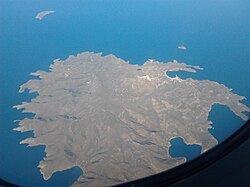
View on WikipediaSerifos (Greek: Σέριφος) is a Greek island in the Aegean Sea, located in the western Cyclades, south of Kythnos and northwest of Sifnos. It is part of the Milos regional unit. The area is 75.207 square kilometres (29.038 sq mi)[3] and the population was 1,241 at the 2021 census. It is located about 170 kilometres (92 nautical miles) ESE of the Athenian port of Piraeus.
Key Information


In Greek mythology, Serifos is where Danaë and her infant son Perseus washed ashore after her father Acrisius, in response to an oracle that his own grandson would kill him, set them adrift at sea in a wooden chest. When Perseus returned to Serifos with the head of the Gorgon Medusa, he turned Polydektes, the king of Serifos, and his retainers into stone as punishment for the king's attempt to marry his mother by force.
In antiquity, the island was proverbial for the alleged muteness of its frogs.[4] During the Roman imperial period, Serifos was a place of exile. After 1204 it became a minor dependency of the Venetian dukes of the Archipelago. In the late 19th century Serifos experienced a modest economic boom from the exploitation of the island's extensive iron ore deposits. The mines closed in the 1960s, and Serifos now depends on tourism and small-scale agriculture.
Antiquities
[edit]
Worked blocks of island marble built into the walls of the medieval castle crowning Chora, the hilltop main town of Serifos, show that the ancient capital was there as well. Chance finds, primarily marble funerary sculpture, are displayed in the Archaeological Collection in Chora (open Tues.-Sun.).
The most impressive ancient monument is the Aspros Pýrgos (Άσπρος Πύργος)[citation needed], a Hellenistic marble watchtower (c. 300 BC[citation needed]) with walls preserved to 2 m. and an interior staircase, standing on a hilltop just east of the road from Chora to Mega Livadi, near Mega Chorio. Work began in 2011 to study the fallen blocks for an eventual reconstruction[citation needed].
At least four other ancient towers have been located, including the megalithic Psaros Pyrgos (Ψαρός Πύργος) or "Couch of the Cyclops" in the SW corner of the island. The so-called "Castle of the Old Lady" (Κάστρο της Γριάς) above Ganema and Koutalas preserves scant remains of a collapsed dry-stone construction in a notch below the twin rocky summits. Rough fragments of white marble and rooftile, and archaic fine-ware potsherds on the SE terraces of the hillside suggest the existence of an ancient sanctuary.[5]
The fortified Monastery of the Taxiarchs, dedicated to the Archangels Michael and Gabriel, was built in 1572 just outside the village of Galani. The sole monk is Archimandrite Makarios, who entered the monastery as a youth in 1958 and continues to maintain it.
Churches gallery
[edit]-
 St Athanasius, Piatsa
 -
 Church of Christ
 -
 Evangelistria church, Kato Chora
 -
 Evangelistria, Kato Chora
 -
 Agios Konstantinos church
 -
 Agia Varvara church, Chora
 -
 Agia Theodora, Koutalas
 -
 Monastery of Taxiarches


History
[edit]Antiquity
[edit]Serifos was colonized by Ionians from Athens[citation needed], and it was one of the few islands which refused submission to Xerxes I.[6] By subsequent writers, Serifos is almost always mentioned with contempt on account of its poverty and insignificance[7] and it was for this reason employed by the Roman emperors as a place of banishment for state criminals.[8][9] It is curious that the ancient writers make no mention of the iron and copper mines of Serifos[citation needed], which were, however, worked in antiquity, as is evident from existing traces[citation needed], and which, one might have supposed, would have bestowed some prosperity upon the island. But though the ancient writers are silent about the mines, they are careful to relate that the frogs of Serifos differ from the rest of their fraternity by being mute.[10]
Middle ages
[edit]Serifos was part of the Byzantine Empire until 1204 ,[11] when the island came under Venetian rule.[12] During this time the mines reopened, after about 1,000 years of inactivity.[13] In 1394, a strike of the miners against the Nikolaos Adoldos occurred.[14]
19th and 20th centuries
[edit]

British travellers Theodore and Mabel Bent visited the island in December 1883. Bent opens his 1885 travelogue on the Cyclades with Serifos, although the couple visited Syros first.[15]
In the 20th century, the mines of Serifos were exploited by the mining company "Société des mines de Seriphos-Spiliazeza," under the direction of German mineralogist A. Grohmann (died 1905). In the summer of 1916, in response to low pay, excessive working hours, unsafe conditions, and the company's refusal to rehire workers who had been drafted into the Greek army and recently demobilized, the 460 miners formed a union and organized a strike. Their leader was Constantinos Speras, a Serifos native educated in Egypt, who was an anarcho-syndicalist with long experience of labor struggles on the Greek mainland. In response to the strike, Grohman asked for the help of Greek authorities, who sent a 30-man gendarmerie (Χωροφυλακή) detachment from nearby Kea. After detaining Speras and the strike committee, the gendarmerie lieutenant ordered his men to fire on the workers, who had gathered at the ore loading dock at Megalo Livadi and refused to permit a cargo ship to be loaded. Four workers were killed and a dozen wounded. The workers, supported by their wives, attacked the gendarmes with stones, killing three of them and routing the others. The freed leadership took control of island institutions and sent a message placing Serifos under protection of the French fleet at Milos. This effort at collective self-organisation was cut short by the refusal of the French navy to intervene, and by the arrival of a Greek warship. Speras was arrested and charged with high treason, but released a few months later when the royalist government was ousted. Grohmann was given once again the control of the mines, after granting improved working conditions and an 8-hour workday.[16]

Historical population
[edit]| Year | Island population |
|---|---|
| 1981 | 1,133 |
| 1991 | 1,095 |
| 2001 | 1,414 |
| 2011 | 1,420 |
| 2021 | 1,241 |
Communities
[edit]- Galani
- Kallitsos
- Koutalas
- Livadi Serifou
- Mega Chorio
- Mega Livadi
- Panagia
- Sykamia
- Serifos (town) or Chora
See also
[edit]Notes
[edit]References
[edit]- ^ Municipality of Serifos, Municipal elections – October 2023, Ministry of Interior
- ^ "Αποτελέσματα Απογραφής Πληθυσμού - Κατοικιών 2021, Μόνιμος Πληθυσμός κατά οικισμό" [Results of the 2021 Population - Housing Census, Permanent population by settlement] (in Greek). Hellenic Statistical Authority. 29 March 2024.
- ^ "Population & housing census 2001 (incl. area and average elevation)" (PDF) (in Greek). National Statistical Service of Greece.
- ^ Aelian, De natura animalium 3.37
- ^ Serifos Archaeological Collection, wall displays (June 2012)
- ^ Herodotus. Histories. Vol. 8.46, 8.48.
- ^ Aristophanes, Ach. 542; Plato Rep. i. p. 329; Plutarch de Exsil. 7. p. 602; Cicero de Nat. Deor. 1.3. 1, de Senect. 3.
- ^ Tacitus. Annals. Vol. 2.85, 4.21.
- ^ Juvenal 6.564, 10.170; Seneca ad Consol. 6.
- ^ Aristotle Mir. Ausc. 70; Aelian, NA 3.37; Suda, s.v. Βάτραχος ἐκ Σερίφου; Pliny. Naturalis Historia. Book 8.58.83.
- ^ "Serifos History".
- ^ "The history of Serifos through ages". e-serifos. Retrieved 2022-12-04.
- ^ "History of Serifos island | Greeka". Greekacom. Retrieved 2022-12-04.
- ^ "21η Αυγούστου 1916: H αιματηρή απεργία στη Σέριφο και η πρώτη εφαρμογή του οχτάωρου στην Ελλάδα". www.ertnews.gr (in Greek). 2022-08-21. Retrieved 2022-12-04.
- ^ “We landed in a little harbour called 'Green' (πράσινο) from the rocks which surround it…” Theodore Bent, The Cyclades, or Life Among the Insular Greeks. London, 1885, p. 41.
- ^ Vradis, Antonios; Dalakoglou, Dimitrios K. (2009). "Anarchism, Greece". In Ness, Immanuel (ed.). The International Encyclopedia of Revolution and Protest: 1500 to the Present. Wiley-Blackwell. pp. 126–127. doi:10.1002/9781405198073.wbierp0057. ISBN 978-1-4051-8464-9.
 This article incorporates text from a publication now in the public domain: Smith, William, ed. (1854–1857). "Seriphos". Dictionary of Greek and Roman Geography. London: John Murray.
External links
[edit]
 Serifos travel guide from Wikivoyage
- Official website(in Greek)


| Regional unit of Andros |  | |
|---|---|---|
| Regional unit of Kalymnos | ||
| Regional unit of Karpathos-Kasos | ||
| Regional unit of Kea-Kythnos | ||
| Regional unit of Kos | ||
| Regional unit of Milos | ||
| Regional unit of Mykonos | ||
| Regional unit of Naxos | ||
| Regional unit of Paros | ||
| Regional unit of Rhodes | ||
| Regional unit of Syros | ||
| Regional unit of Thira | ||
| Regional unit of Tinos | ||
| ||
| International | |
|---|---|
| National | |
| Geographic | |

Serifos
View on GrokipediaGeography
Physical Characteristics
Serifos, an island in the western Cyclades group of the Aegean Sea, spans an area of 75.207 square kilometers and features a predominantly hilly and rocky terrain with scattered small valleys.[1][7] The landscape is characterized by barren hills rising from the sea, contributing to its rugged and arid appearance typical of many Cycladic islands.[8][9] The island's highest elevation is Mount Troulos (also spelled Tourlos), reaching 585 meters, which dominates the central region and exceeds the altitudes of most neighboring Cycladic islands.[10][8] Other notable peaks include Petrias, slightly lower in height, underscoring the island's relief as moderately mountainous rather than steeply precipitous.[11][8] This topography results in a wild inland with limited flat expanses, shaping the island's accessibility and settlement patterns. Serifos possesses a coastline extending approximately 83 kilometers, indented with bays and coves that provide natural harbors, particularly along the southern shores where beaches such as Livadi and Megalo Livadi are located.[7] The overall form is irregular and elongated in a north-south orientation, with rocky outcrops and minimal sandy stretches dominating the littoral features.[12][10]Geology and Natural Resources
Serifos constitutes a metamorphic core complex within the Cyclades archipelago, characterized by a dominant I-type granodiorite pluton occupying the central and southeastern portions of the island.[13] This pluton, emplaced syn- to post-tectonically during the Late Miocene (approximately 11.6–9.5 million years ago), intruded into metamorphic rocks amid extensional tectonics associated with Aegean back-arc spreading.[14] Northern areas feature calcareous slates interbedded with marble lenses, while southern regions exhibit schists and gneisses altered by contact metamorphism near the pluton margins.[15] The island hosts multiple mineralization styles, including skarn, porphyry, carbonate-replacement, and vein-type deposits, primarily linked to the pluton's emplacement and subsequent detachment faulting.[16] High-temperature skarns, developed in the contact aureole around marble xenoliths, contain magnetite-rich iron oxide ores, often with hematite, formed through metasomatic reactions between intrusive fluids and carbonate host rocks.[17] Accessory minerals include actinolite inclusions in green quartz (prase) crystals, alongside barite and sulfide phases like chalcopyrite in vein systems.[18] Principal natural resources derive from these iron ore deposits, concentrated at sites such as Megalo Livadi and Koutalas, where magnetite and hematite occur in near-surface skarn bodies amenable to open-pit extraction.[15] Copper sulfides and barite accompany the iron mineralization, contributing to the island's polymetallic potential, though iron dominated historical exploitation due to deposit scale and accessibility.[14] No significant current mining occurs, with resources now valued for geoheritage rather than active extraction.[18]History
Ancient and Mythological Foundations
In Greek mythology, Serifos is prominently associated with the hero Perseus, son of Zeus and Danaë. According to the legend, Danaë and her infant son were cast adrift in a chest by her father, King Acrisius of Argos, fearing a prophecy that Perseus would kill him; they washed ashore on Serifos, where they were sheltered by the fisherman Dictys, brother of King Polydectes.[19] Polydectes, desiring Danaë and viewing Perseus as an obstacle, tricked the young hero into a quest to slay Medusa and retrieve her head, providing gifts including winged sandals, Hades' helmet of invisibility, and a reflective shield from the gods.[20] Upon returning victorious, Perseus used Medusa's petrifying gaze to transform Polydectes and his court into stone, sparing only the loyal Dictys, whom he installed as king before departing with his mother.[21] This event cemented Serifos' role in the myth, with the island's rocky landscape sometimes interpreted as the petrified remnants of the king's entourage, though such etiological explanations lack independent corroboration beyond literary tradition.[19] The myth, preserved in ancient texts like Ovid's Metamorphoses and Apollodorus' Library, underscores themes of divine intervention and heroism but reflects no verifiable historical events.[22] Archaeological evidence indicates human presence on Serifos from the Early Cycladic period (circa 3rd millennium BCE), with settlements at sites like Plakalona near Mega Livadi yielding pottery and tools consistent with broader Aegean prehistoric cultures.[6] Successive waves of inhabitants followed, including Minyans (Aeolians) from Thessaly, Phoenicians, and Mycenaeans, leaving traces such as tombs and fortifications; the island's ancient city may have been located near modern Chora, with its harbor at Livadi.[23] Hellenistic-era remains include the Aspros Pyrgos, a marble watchtower dated to approximately 300 BCE, featuring preserved walls up to 2 meters high and an interior staircase, likely used for defense amid the island's strategic Aegean position.[24] Iron and copper mining, referenced in ancient sources like Strabo, contributed to early economic activity, though systematic exploitation intensified later; artifacts from these periods, including funerary stelai, vases, and armor fragments, are housed in the island's Archaeological Collection.[25] No evidence supports a continuous urban center through classical antiquity, with habitation patterns suggesting sporadic, resource-driven occupation rather than dense polis development.[26]Medieval and Ottoman Periods
Following the division of the Byzantine Empire after the Fourth Crusade in 1204, Serifos came under Latin and Venetian control as part of the Duchy of the Archipelago, established around 1207 under Marco Sanudo.[27] Portions of the island were allocated to the Ghisi family, who governed until 1334, while further Venetian consolidation occurred in 1296 with aid from Giorgio I Ghisi.[28] In 1220, the island saw occupation by Domenico Michiel and Pietro Giustiniani, and by 1433, Alvise Michiel had established sole lordship after the exile of Niccolò Adoldo.[28] During Venetian rule, Serifos experienced economic revival through the reopening of ancient iron mines, dormant for roughly 1,000 years since antiquity, which spurred commercial activity but relied heavily on slave labor.[23][29] This prosperity, however, was undermined by frequent pirate raids and instances of tyrannical local governance, contributing to instability despite the island's strategic position in Aegean trade routes.[28] Ottoman influence began encroaching in the mid-16th century, with a devastating raid by the corsair Hayreddin Barbarossa in 1538 causing near-total depopulation and signaling the effective start of Ottoman overlordship, though direct occupation remained limited.[28] By 1566, after the fall of the Duchy of Naxos, Serifos was formally conquered and administratively ceded to Joseph Nasi, a Sephardic Jewish financier appointed as Duke of Naxos by Sultan Selim II.[30] Under Ottoman rule until 1830, the island endured profound decline, as mines were abandoned amid relentless piracy, burdensome taxation, and involvement in Venetian-Ottoman wars, reducing the economy to subsistence agriculture with a sparse, struggling population.[29][23][28]19th-Century Mining Revival and Economic Expansion
Following Greek independence, mining activities on Serifos resumed on a large scale after 1830, primarily targeting surface iron ore deposits and contributing to an initial economic upturn.[3] A royal decree in 1861 formalized the reopening of operations, marking the onset of renewed exploitation in the late 1860s.[31] The Hellenic Mining Company initiated efforts in 1869, operating until 1875, while the Serifos Mining Company was established in 1870 to oversee concessions.[31] Systematic mining intensified in 1885 under the management of German metallurgist Emil Grohmann, who contracted with the Serifos-Spiliazeza company to exploit iron ores such as hematite and magnetite, alongside minor copper deposits.[31] [32] Key sites included Megalo Livadi, where company headquarters were relocated in 1890, Koutalas, Avessalos, Vagia, and Tsilipaki, featuring loading bridges for ore export to Western Europe via railways and ships.[32] [3] The revival spurred modest economic expansion, particularly from 1890 to 1905, with ore production rising sharply under Grohmann's oversight and Germany as a primary market.[32] [31] Influx of approximately 2,000 workers from Aegean islands like Paros and Karpathos, as well as the Peloponnese, swelled the population, reaching about 4,400 by 1912.[3] [31] Infrastructure developments in Megalo Livadi, established around 1880, encompassed worker housing, a chemical laboratory, primary school (opened 1900), police station, and commercial facilities, transforming the bay into a functional mining hub.[3] [31]20th-Century Developments and Industrial Decline
In the early 20th century, the Société des Mines de Seriphos-Spiliazeza, operating under French interests and managed by the Grohmann family, continued intensive exploitation of Serifos's iron ore deposits, achieving peak production of 172,000 tons in 1910.[31] Output declined sharply during World War I, falling to 110,000 tons in 1914 and just 27,700 tons in 1915 amid global disruptions.[31] Ore transport relied on conveyor systems, rails, and wagons, particularly in the Megalo Livadi area.[31] A pivotal labor event occurred on August 7, 1916, when approximately 300 miners, led by Konstantinos Speras of the newly founded Miners Association, struck against excessive work hours, low wages, and hazardous conditions, refusing to load a ship bound for export.[31] [3] Demanding an eight-hour workday—the first such action in Greece—along with wage increases and safety improvements, the strikers clashed with authorities on August 21, resulting in eight deaths, including four miners and three gendarmes.[31] [33] The strike, which lasted two weeks and temporarily gave workers control of parts of the island, marked a milestone in Greek labor history and gradually led to reduced working hours in the mines.[34] [3] The interwar period brought economic recession in the 1920s, exacerbated by the 1929 global crash, though production recovered to around 500,000 tons exported by 1934 under renewed management.[31] World War II interrupted operations, and post-war resumption faced mounting challenges from depleting reserves and rising costs.[34] The Société des Mines de Seriphos-Spiliazeza ceased activities in 1951, with all remaining mines closing by 1965 due to exhausted high-grade ores, escalating extraction expenses, and falling international metal prices.[31] [34] The industrial decline triggered severe economic contraction and depopulation, as miners—many lacking transferable skills—migrated elsewhere for employment, leaving behind abandoned facilities and a shift away from mining-dependent livelihoods.[34] Small associated businesses collapsed, underscoring the island's overreliance on the sector without diversified alternatives at the time.[34]Economy
Historical Mining Operations
Mining operations on Serifos primarily focused on iron ore extraction, with deposits of magnetite-rich skarns and hematite-limonite bodies exploited since antiquity, though systematic modern efforts began in the mid-19th century.[18] The island's mineral wealth, including iron, copper, lignite, and emery, supported early economies, with evidence of Minoan and Mycenaean activities continuing through Roman and Venetian periods until cessation around the 16th century.[35] Resumption occurred post-Greek independence, with the first official mining permit issued in 1867 to the Greek Mining Company, which initiated organized iron ore extraction in 1869 at sites like Koutalas and Megalo Livadi.[27][36] In 1885, the French-owned Spiliazeza company, managed by Emilios Grohman, assumed control, marking the peak of industrial-scale operations characterized by surface and underground mining techniques.[15] Labor-intensive methods involved manual drilling, blasting with explosives, and ore transport via mules or narrow-gauge railways to coastal processing facilities at Megalo Livadi, where crushing, washing, and concentration occurred before export.[32] Production escalated rapidly; annual output reached approximately 172,000 tons of iron ore by 1910, fueling economic growth but under grueling conditions with long shifts and minimal safety measures.[15] Grohman's tight oversight from 1890 to 1905 expanded shafts and infrastructure, including loading bridges and worker housing, though exploitation drew criticism for debt bondage and hazardous work environments.[32][37] Operations persisted under George Grohman after 1916, shifting to two 8-hour daily shifts from 1925 amid declining yields and competition, with output falling to 110,000 tons annually by the mid-20th century.[15][6] The Serifos-Spiliazeza enterprise dominated until nationalization pressures and resource depletion led to closures, with the last mines shutting in the 1960s, leaving behind extensive industrial remnants like adits, tailings, and machinery.[15] Copper mining occurred sporadically alongside iron, but iron dominated, contributing to Serifos's role in Greece's early industrial era through ore shipments to European smelters.[3]Modern Tourism and Economic Shifts
Following the closure of iron mines in 1963, Serifos experienced an initial economic downturn as mining, the island's primary industry since the mid-19th century, ceased operations due to resource depletion and rising costs.[5] This shift prompted a gradual transition toward tourism as the dominant economic sector, leveraging the island's rugged landscapes, beaches, and preserved mining heritage to attract visitors seeking less commercialized Cycladic experiences.[3] Unlike neighboring islands such as Santorini or Mykonos, Serifos has maintained relatively low development intensity, with much of its terrain remaining undeveloped to preserve natural and cultural assets.[38] Tourism arrivals have shown steady growth, with 19,329 passengers recorded by August 18, 2025, compared to 27,926 for the full previous year, indicating an upward trend for the fourth consecutive year.[39] The island's economy now relies heavily on seasonal tourism, featuring eco-friendly accommodations, seaside tavernas, and attractions like former mining sites repurposed for industrial archaeology tours, which highlight the intangible cultural heritage of labor and extraction processes.[3] With a resident population of approximately 1,300, Serifos avoids mass tourism overcrowding, appealing to those desiring serenity over high-volume development.[40] Local stakeholders emphasize sustainable practices amid rising pressures, as spatial planning efforts address the interplay between tourism expansion and environmental preservation on this rapidly transforming Cycladic island.[41] Economic activity remains modest relative to other Cyclades destinations, fostering a balance that locals actively pursue to mitigate overdevelopment risks observed elsewhere in Greece.[38] This model supports year-round viability through niche appeals, including hiking, beach access, and cultural sites, though challenges persist in integrating tourism with heritage conservation.[42]Demographics
Population Dynamics
The population of Serifos has experienced notable fluctuations driven primarily by economic shifts, particularly the rise and fall of iron ore mining operations. In the late 19th and early 20th centuries, mining attracted approximately 2,000 workers and their families from other Aegean islands, substantially expanding the resident base from levels around 2,134 in 1880.[37] The complete closure of mines by 1965 prompted widespread emigration, resulting in a sharp depopulation as former miners and descendants sought opportunities elsewhere.[15] Census data from the Hellenic Statistical Authority (ELSTAT) illustrate the post-mining trajectory:| Year | Population |
|---|---|
| 1981 | 1,133 |
| 1991 | 1,095 |
| 2001 | 1,414 |
| 2011 | 1,420 |
| 2021 | 1,241 |