Hubbry Logo
AntiparosAntiparosMain
Open search
Antiparos
Community hub
Antiparos
logo
8 pages, 0 posts
0 subscribers
Be the first to start a discussion here.
Antiparos
Antiparos
from Wikipedia

Antiparos (Greek: Αντίπαρος; Ancient Greek: Ὠλίαρος, romanizedOliaros; Latin: Oliarus; is a small island in the southern Aegean, at the heart of the Cyclades, which is less than one nautical mile (1.9 km) from Paros, the port to which it is connected with a local ferry. Saliagos island is the most ancient settlement in the Cyclades, and Despotiko, an uninhabited island in the southwest of Antiparos, is a place of great archaeological importance.

Key Information

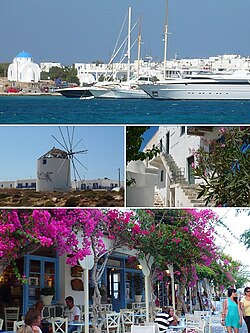
The Community of Antiparos was founded in 1914 and was promoted to a municipality in 2010 with the implementation of the Kallikratis Programme, under the principle of "each island a municipality". It occupies an area of 45.182 square km,[2] including the island of Antiparos and Despotiko. It has, according to the 2021 census, 1,265 permanent residents and a density of 28 inhabitants per km². The island's economy is based on tourism, fishing, farming and less on agriculture in the plains. It is known for its white houses, cobbled streets and the flowers that thrive in the yards of the houses. It is a tourist resort in the summer for Greeks and European visitors, as well as land investors from the United States.

The main settlement lies at the northeastern tip of the island, opposite Pounda on the main island of Paros, whence a ferry sails for Antiparos harbour. The historical center is located in the Venetian castle of Antiparos, which is connected through the shopping streets in the picturesque coastal street. Other settlements are the resort of St. George in the southwest edge, Soros and Kampos. Beaches in the wider area of the center are Psaralyki, the Sifneiko, Ag Spiridon and the camping beach. Other beaches include: Soros, Glyfa, Apantima, Monastiria.

Etymology

[edit]

The ancient name of the island was "Oliaros",[3] a word probably of Phoenician origin meaning "wooded mountain".[citation needed] Later the island was named "Antiparos", because of its geographical position, being situated opposite (αντί) the nearby island of Paros.

Geography and topography

[edit]
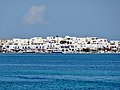
eastern coast of Antiparos

The island of Antiparos is located 0.8 nautical mi (1.5 km) southwest of Paros, separated by the Strait of Antiparos, known as Amfigeio. It lies 8 kilometres (5.0 miles) from the port of Parikia from which the passenger ferry runs. The maximum length of the island is 11 kilometres (6.8 miles) from north to south, while the maximum width reaches 4.5 kilometres (2.8 miles). The total area is estimated at 37 to 38 km (23 to 24 mi). And the highest peak, St. Elias, in the middle of the island, is at 308 m. The main town is called simply Antiparos. Antiparos is a volcanic rock and dry climate with high moisture, and morphology favors the development of strong winds. The flowers thrive in the region are mainly bougainvillea that adorn the gardens, houses and shops. The morphology of Antiparos is characterised essentially flat, with many small hilly peaks, while the vegetation of the island is low. The island of Antiparos is surrounded by many small uninhabited islands with great historical and archaeological interest, such as Tsimintiri the Round, the Double, snow, Revmatonisi, the Red and Black Tourlos. Particularly well known in the international community is Despotiko, an uninhabited island west of Antiparos, where in recent years excavations of great archaeological importance have been carried out.

Economy

[edit]
Antiparos stores

The island economy is based largely on tourism: the income from visits to the Cave of Antiparos form a very big part of the budget of the municipality. Most people work in the shops, restaurants and accommodation on the island during the tourist season from Easter to October, with the remainder funded by the Employment Service, or undertaking technical and manual jobs. The island's economy is also helped by agriculture and animal husbandry, and fisheries. Since the 1970s and 1980s, Antiparos has become a popular holiday destination, particularly for nudists, attracted by the remote and sandy beaches. The best known is the Camping, or Theologians beach, at the north of the island, opposite the uninhabited island of Diplo. The far end of the town beach is also nudist, as is the Perigiali beach. However most of the other beaches on Antiparos are textile. Since the 1990s there has been a steady development due to its proximity to Paros, and the infrastructure has been improved to accommodate the growing influx of tourists.

Archaeology

[edit]
Exhibits at the local museum

There are extensive Neolithic remains on the island. It seems the first excavations were those made by the traveller Theodore Bent, with his wife Mabel, in early 1884, opening up some 40 graves in two cemeteries.[4] In 1889 Christos Tsountas excavated in Despotiko, revealing Cycladic cemeteries. From 1964-5 a Neolithic settlement was excavated on the island of Saliagos by Colin Renfrew and J D Evans for the British School at Athens. Stone foundations of buildings, obsidian arrowheads and pottery were found, together with a marble figurine known as the Fat lady of Saliagos.

Classical remains are concentrated on the island of Despotiko. The Isle of Antiparos was identified with ancient Prepesintho, according to the extant writings of Strabo and Pliny.

In 1959 Nikos Zafiropoulos began excavations at Zoumparia and Mantra, on the northeast coast, where there were architecturally Doric temples from the ancient times, dating to 500 BC.

In 1997, the archaeologist Yiannos Kourayos began new excavations at Mantra, bringing to light some of the ancillary buildings of a sanctuary. The temple itself has not so far been discovered, though a number of architectural elements from an early Doric temple have been discovered built into later walls. The main finding so far has been an elongated building, consisting of five consecutive parallel rooms. In the southern room archaic materials of Eastern Aegean, Rhodian, Cypriot and Egyptian origin have been discovered.

Many marble sculptures were found, including two archaic kouros heads, a naked male statue, part of the Archaic period perirrantiriou inscribed with the inscription "Marda anethiken". Among the significant findings include the built-square marble altar dedicated to Hestia Isthmus of classical times and which is testimony to one of the deities worshiped in the Cyclades.

History

[edit]
The "Camara" (entrance to the Kastro)

The island, under the name Oliarus or Oliaros, was noted by several ancient authors including Pliny the Elder,[5] Strabo,[6] Virgil,[7] and Stephanus of Byzantium.[3] According to Heraclides Ponticus, it was colonised by Sidonians.[3]

During Byzantine times and down to the 13th century, information about the history of Antiparos is scarce. However, in 1207, Antiparos was seized by the Venetian nobleman Marco I Sanudo, and it remained under the house of Sanudo down to the second half of the 14th century, when it passed to the House of Sommaripa. It then passed to the House of Loredan, with Giovanni Loredan building the Castle of Antiparos in 1440 and bringing inhabitants to the island at his own expense. In 1480 it passed to the Venetian house of Pisani.

The Venetian episode came to an end in 1537, during the reign of lady Adriana Crispo, when Antiparos and the rest of the Cyclades fell to the Ottomans, and it remained under Ottoman rule until the Greek War of Independence in 1821, apart from a period of the Orlov Revolt in 1770–74 when it was ruled by the Russians, who removed many of the magnificent stalactites from the cave to the Hermitage Museum in Russia.

The "Ksopyrga"

The major catastrophe was in 1794, when Kefalonians and Mani pirates arrived on the island and plundered, and kidnapped the daughter of the Venetian vice-Consul.

The Antiparians were among the first in the Cyclades to take part in the War of Independence and in 1832 officially became part of the Greek state.

During World War II, the southwestern tip of the island near the Agios George, was used as a secret submarine base, but after the war it became once more a tranquil place, though now growing as a tourist village.

Antiparos was known to the wider Greek public in 1960 and through the Greek cinema, where workshops hosted by Finos Films in the heart of the movie Madalena by helping to enhance its natural beauty and historical landscape.[citation needed] Since then, the island became a tourist destination for Greek and foreign tourists in the summer and the economy of the town started oriented tourism development.

Architecture

[edit]
Kastro architecture

The architecture, like all the Cycladic islands, requires strict regulations to preserve the uniformity of the Cyclades, which is composed of the typical white houses with blue doors and windows, yard and gardens decorated with bougainvillea and other flowers. Often these characteristics are consistent with the existence of stone or alleys of the neighborhood or the fences of the churchyard.

The castle was built in 1440 by Giovanni Loredan and seems to have a very specific and unique style of architecture. The houses form a compact complex with 24 two-story houses forming the outer zone, while at the centre there is a motte or mound, till recently occupied by a water reservoir. Among the houses there are three churches and the old aqueduct. The houses have mostly been turned round to face outwards where they act as shops.

Sights

[edit]
The church of Saint John, "O Spiliotis"

In the center of the island is the cave of Antiparos, one of the most beautiful and mysterious caves in the world.[tone] The cave has been used as a natural shelter from the Neolithic period onwards. The area was also used for pottery, and for the worship of the goddess Artemis, while at the entrance to the site is the church of Agios Ioannis Spiliotis.

The Antiparos cavern

Signs and scratches on the stalactites and stalagmites attest to the passers, as the inscription on the altar of the generals of Alexander the Great and King Otto.

The cave of Antiparos

[edit]

The cave is very extensive, and extends at several levels. The lyric poet Archilochus of Paros is said to have left an inscription in the cave. In 1673, marquis de Nointel, French ambassador to the Ottoman Empire, visited the cave for three days with numerous companions and celebrated mass on Christmas Day in it. Later visitors who carved their names include Lord Byron and the first modern King of Greece, Otto. During the German occupation, part of the cave was destroyed. The cave was renovated extensively in the second half of the 20th century, using funds from the EU by erecting barriers, building adequate steps, installing lighting, security cameras and loudspeakers to inform visitors.

Castle (Kastro) of Antiparos

[edit]
The castle tower

The Venetian Castle of Antiparos is a typical example of the fortified settlements established in the Cyclades during the period of the Latins in 13th-16th century. Its construction dates to the mid-15th century when the Venetian Giovanni Loredano decided to marry Mary Sommaripa of Antiparos.

The original version had a ‘motte’ (mound) at the centre and houses round the perimeter. The houses were built as one continuous block construction, the outer walls providing both the defensive wall of the fortified settlement. The only entrance was at the south wing. Inside the main settlement the houses developed as three-storey structures, each having a separate entrance which leads to an external staircase. In the course of the settlement was extended outside the south wing to form a rectangular ring called "Xopyrga" and within the original enclosure around the base of the circular tower.

Castle house blocks and the church of Christ

In modern times, the original architectural style of the castle has altered, with the church of Christ being inserted as a religious element, while the central mound was used as a water tank tower. Today, the homes retain a satisfactory level of their original features, despite the collapse of the upper floors, and any intervention required permission from the archaeological department. Today most homes are developed in one with two floors and have a maximum ground-like trapdoor. Many now face outwards and have become shops facing onto the main street. An integral part of the castle of Antiparos are the small bats that come with dusk and fly around the tower to the east.

Infrastructure

[edit]
Antiparos Municipality Hall

The town hall of Antiparos lies with the Multi-alley clinic in a commercial road just in front of the castle, near the Plaza Roussos which took its name from the writer of the film Madalena.

Any waste transported to the island a special place in Paros and sewerage and biological treatment have been included in the NSRF to sponsor the Egnatia Odos.

The island has a modern road construction and rehabilitation of the coastal road. The focus of artistic and political events is the stone square of Agia Marina.

The elementary school has a youth club for young people.

Church

[edit]

The Antiparos church belongs to the Bishopric Paronaxia.

Cinema

[edit]

American actor Tom Hanks owns a property on Antiparos.[8]

[edit]

Notes

[edit]

References

[edit]
[edit]
Revisions and contributorsEdit on WikipediaRead on Wikipedia
from Grokipedia
Antiparos is a small island in the archipelago of the , , situated about 1 km southwest of and separated from it by a narrow strait known as the Steno of Antiparos.
The island covers an area of approximately 35 square kilometers, features a 57-kilometer coastline, and has a of 1,265 as recorded in the 2021 Greek census.
Renowned for its serene, unspoiled environment, Antiparos attracts visitors with its crystal-clear beaches, traditional Cycladic villages, and the iconic Antiparos Cave—a natural wonder containing stalactites and stalagmites, including one estimated at 45 million years old, believed to be among the oldest in .
Geographically, Antiparos is an oblong stretching 12.5 km from north to , with a maximum width of 5.5 km; its northern section is relatively gentle and fertile, supporting , while the central and southern areas are rocky and wild, rising to the island's highest point, Profitis Ilias peak, at 299 meters.
Surrounded by smaller uninhabited islets such as Despotiko and Strogylo, the island's includes sedimentary, metamorphic, and volcanic rocks, contributing to its diverse terrain of barren hills, wildflowers, and natural features like a near Psaralyki beach.
The is typically Mediterranean, with mild winters and hot, dry summers, ideal for outdoor activities and .
Historically, Antiparos—originally known as Oliaros—was first inhabited by Phoenicians from in antiquity and is referenced in ancient texts by authors including Heraclides the Critic, , and .
The island experienced successive occupations, including Venetian rule from the 13th century, during which the fortified settlement of Antiparos town (Chora) and its castle were established in the to defend against pirates; it later fell under Ottoman control in 1537, a brief Russian protectorate in the 1770s, and joined the independent Greek state in 1832 following the Greek War of Independence.
Archaeological evidence, including remains nearby on Saliagos , underscores its long human presence, while the Antiparos Cave itself holds artifacts and ancient inscriptions, highlighting its cultural significance.
In modern times, Antiparos has evolved into a low-key tourist destination since the 1960s, emphasizing amid its natural beauty and relaxed vibe, with the local economy centered on —accounting for over 70% of GDP—alongside traditional , (including olives, figs, and cereals), and .
The island's main port and capital, Chora, with its whitewashed buildings, narrow streets, and vibrant waterfront, serves as a hub for ferries from and nearby islands, fostering a cosmopolitan yet authentic Cycladic experience.

Geography and Environment

Physical Features

Antiparos is situated in the archipelago within the southern , approximately 0.8 nautical miles southwest of , from which it is separated by the narrow Strait of Antiparos. The island's central coordinates are roughly 37°02′N 25°04′E. The main island covers approximately 35 km², with the municipality total of 45.182 km² including Despotiko; it stretches 12.5 km north to south with a maximum width of 5.5 km. The island has a 57 km coastline. Its topography features flat coastal plains and gentle, fertile hills in the north supporting agriculture, while the central and southern areas are rocky and wild, rising to the island's highest point, Profitis Ilias peak, at 299 m above sea level. Geologically, Antiparos is composed primarily of metamorphic rocks such as gneisses and schists, overlaid in parts by volcanic formations including acidic lavas, tuffs, , and , particularly in the southern regions extending toward Despotiko to the west. Limestone formations contribute to the variable lime content in the bedrock, influencing the island's features. The of Despotiko lies just off the western coast and shares similar geological traits. The island's natural vegetation is sparse and adapted to the arid , consisting mainly of wildflowers, brushwood, and short herbaceous plants across its largely barren terrain. In drier inland areas, groves and introduced provide pockets of greenery, though the overall landscape remains essentially treeless.

Climate and Ecology

Antiparos exhibits a typical , featuring hot, dry summers and mild, wet winters. Average temperatures in July, the warmest month, range from 25°C to 30°C, while averages 10°C to 15°C, with highs around 13-14°C. Annual totals approximately 386-400 mm, concentrated primarily during the winter months from to March, supporting seasonal vegetation growth but contributing to summer aridity. The island experiences strong northerly winds known as meltemi, particularly from May to , which typically reach speeds of 15-25 mph and influence coastal ecosystems by enhancing and shaping dune formations while challenging through and reduced crop viability in exposed areas. These winds also promote marine , benefiting populations that rely on nutrient-rich waters. Year-round windiness, averaging 11-14 mph, underscores the island's exposure in the archipelago. Ecologically, Antiparos hosts a diverse array of drought-resistant , including maquis shrubs and species like Chrysanthemum coronarium in coastal meadows, adapted to the low rainfall and saline soils. Fauna includes endemic reptiles such as the Cycladic wall lizard (Podarcis erhardii), which thrives in rocky habitats, alongside seabirds like shearwaters and that nest on cliffs and benefit from the island's isolated coves. Limited natural freshwater sources, primarily from sporadic rainfall and small aquifers, exacerbate ecological stress by concentrating in fringes and forcing reliance on alternative water supplies. Environmental challenges on Antiparos center on , intensified by the boom, which has seen a significant increase in building permits in the neighboring municipality, pressuring habitats through and increased demand. Overdevelopment from mass has raised concerns about , including threats to endemic reptiles and coastal , prompting calls for eco-friendly practices following record visitor numbers in 2024. Sustainability efforts include the Region's €37 million infrastructure plan launched in September 2025, targeting modernization and across small Cycladic islands like Antiparos to mitigate these pressures.

History and Archaeology

Prehistoric and Ancient Periods

The earliest evidence of human presence on Antiparos dates to the period, with significant settlements uncovered on the nearby islet of Saliagos, located between Antiparos and . Excavations conducted in 1964–1965 by J.D. Evans and revealed a maritime Neolithic community dating to the mid-5th millennium BCE (approximately 4500–4000 BCE), characterized by stone-built houses, pottery, and obsidian tools indicative of early farming and maritime activities. Among the notable finds was the "Fat Lady of Saliagos," a depicting a seated female figure, representing one of the oldest known anthropomorphic sculptures in the and providing insight into early symbolic practices. In antiquity, the island was known as Oliaros, a name possibly of Phoenician origin meaning "wooded mountain," suggesting initial settlement or influence by Phoenician traders from as early as the Late . By around 1000 BCE, the island saw colonization by Ionian Greeks, likely extending from nearby , marking the transition to more structured Greek habitation amid the broader Ionian migrations in the Aegean. Key archaeological insights into this period come from 19th- and 20th-century excavations, including Theodore Bent's 1884 digs on Antiparos and Despotiko, which uncovered over 40 Early Cycladic graves containing pottery and tools from 3000–2500 BCE. In 1889, Christos Tsountas further explored Despotiko, revealing extensive Cycladic cemeteries with burial goods that highlight the island's role in early networks. During the Classical period (5th–4th centuries BCE), Antiparos (Oliaros) played a limited role in major conflicts such as the Persian Wars and the , functioning primarily as a small dependency of , as evidenced by archaeological ties including shared use on Despotiko. Herodotus references Paros' involvement in regional events, implying subordinate islands like Oliaros followed suit without independent prominence. Ongoing excavations led by Yiannos Kourayos since 1997 on Despotiko have unearthed an Archaic-to-Classical complex, including Doric-style temple foundations and over 85 marble sculptures—such as kouroi statues from —indicating ritual continuity under Parian influence. The transition to the Hellenistic era (late 4th–1st centuries BCE) is marked by sparse archaeological remains, suggesting continuity of small-scale habitation rather than major development, with scattered and structural fragments on Despotiko pointing to ongoing but modest cultic and residential activity linked to .

Medieval, Ottoman, and Modern Eras

The island, known in antiquity as Oliaros, underwent a significant etymological shift during the Venetian period in the 13th century, adopting the name Antiparos, derived from "anti" meaning "opposite" and referencing its position relative to the nearby island of . In the medieval era, Antiparos fell under Venetian control following the , with Marco Sanudo conquering the in 1207 and establishing the Duchy of Naxos, which included the island as a . The island passed through the hands of prominent Venetian families, including the Sommaripa starting around the early , followed by the Loredan in the mid-15th century, during which Giovanni Loredan constructed the Kastro castle in 1440 as a fortified settlement to protect against threats and encourage repopulation. Rule continued under the Loredan until 1480, when it transferred to the Pisani family as a , maintaining Venetian oversight until the Ottoman conquest in 1537. The Ottoman period from 1537 to 1821 marked a time of decline for Antiparos, characterized by a sharp drop in population due to frequent pirate raids from and other regions, as well as destruction from Ottoman forces, which left much of the island depopulated and economically stagnant. Despite these challenges, the island played a supportive role in the Greek War of Independence starting in 1821, with local inhabitants contributing to the broader revolutionary efforts against Ottoman rule. In the , Antiparos was formally integrated into the independent Greek state in 1832 following the war's conclusion. The island remained sparsely populated, with limited development until the 1960s, when a surge in began, popularized through Greek cinema and attracting visitors to its serene landscapes. During , the southwestern tip near Agios Georgios served as a secret base for Allied submarines conducting operations in the Aegean. Post-1970s growth accelerated with the establishment of nudist beaches, such as the official one at Camping Beach, and the influx of celebrity visitors; notably, actor acquired a property on the island in the , boosting its profile as a discreet luxury destination. Recent milestones include population growth linked to , rising from 635 residents in 1981 to 1,265 in 2021, reflecting expanded and economic vitality. In 2023, a statue dating to approximately 480 BCE was unearthed at the Despotiko , crafted from and highlighting the site's enduring ritual significance. In 2025, the island benefits from the Region's €37 million EU-funded plan, aimed at modernizing facilities and promoting sustainability across small Cycladic islands like Antiparos.

Economy and Demographics

Economic Activities

Tourism dominates the economy of Antiparos, serving as the primary sector and contributing over 70% to the island's GDP through services such as guesthouses, tavernas, and boat rentals. The influx of visitors is highly seasonal, peaking in summer when tourist numbers double or triple the resident of 1,265, driven by the island's appeal as a serene Cycladic destination. This growth aligns with broader trends in the region, where saw a 10% rise in revenues during the third quarter of 2024, reflecting increased spending by international arrivals. Forecasts for Greek in 2025 indicate further expansion, with early data showing a 4.4% revenue increase in the first quarter and projections for record-breaking arrivals nationwide. Traditional economic activities persist on a smaller scale, including that supplies local markets with fresh catches like grilled , and focused on olives and figs cultivated in the island's plains. , primarily involving goats and sheep, also plays a role, though these sectors remain limited by the dry and poor soil quality that constrain broader agricultural output across . Recent developments include a property boom fueled by rising demand, with nearby issuing 349 new building permits in 2024—third highest nationwide—and Antiparos maintaining strict codes to preserve its character amid increasing interest. To address the pressures of mass , which saw host 36 million international visitors in 2024, sustainable initiatives on Antiparos promote separation, , and low-carbon models through the South Aegean Initiative. Employment on the island is heavily skewed toward , with an estimated 90% of the active engaged directly or indirectly in hospitality-related roles, including hotels and restaurants. This concentration creates challenges such as seasonal , as the swells during peak months but contracts sharply in winter, mirroring national trends where accounts for about 25% of GDP and drives temporary hiring of over 80,000 workers annually. In the broader , Antiparos contributes as an "untouched gem," emphasizing eco-tourism in 2025 reports to balance growth with environmental preservation and differentiate from in larger islands. 's modern prominence traces back to the 1960s, when initial developments began attracting international visitors to the .

Population and Infrastructure

As of the 2021 census, Antiparos has a permanent of 1,265 residents, with a of approximately 36 inhabitants per square kilometer across its 35 square kilometers. The population has experienced modest growth of 4.5% since 2011, largely driven by migration linked to opportunities. During the summer tourist season, the island's population triples due to visitors and seasonal workers, reaching over 3,800 people. The demographic profile is predominantly Greek, with the vast majority adhering to the Greek Orthodox faith, consistent with national patterns where over 90% of the population identifies as Orthodox. A small expat community has emerged, attracted by the island's tranquility, including high-profile figures like actor , who owns property there. While permanent residents show an aging trend typical of rural Greek islands, this is balanced by an influx of younger seasonal workers in and . Infrastructure supports the island's connectivity and daily needs, with frequent ferry services linking Antiparos to Paros in about 10 minutes, facilitating easy access for residents and visitors. Paros also hosts a small regional airport serving domestic flights, enhancing broader travel options. Recent improvements to the road network are underway through the South Aegean Region's €37 million program, aimed at modernizing infrastructure on 28 small Cycladic and Dodecanese islands, including Antiparos, to promote sustainability and accessibility. Waste management is handled via shared facilities on Paros, while water supply relies on desalination plants, primarily those serving the Paros-Antiparos complex to address seasonal demand. Community services cater to local needs effectively. An elementary operates on the , offering youth programs including educational and recreational activities during summer months. The town hall is situated in the main village near the historic Kastro area, serving as the central administrative hub. Healthcare is provided through a regional medical office in Antiparos for basic care, with more advanced services available at clinics on , such as the IASIS Medical Clinic. Energy needs are met by a combination of the mainland grid and growing solar installations, with initiatives promoting renewable systems to reduce reliance on generators. In recent years, broadband infrastructure has expanded to support , aligning with Greece's digital nomad visa program and attracting an influx of professionals since 2024. This development has bolstered the island's appeal for flexible lifestyles amid tourism-driven spikes.

Culture and Attractions

Architecture and Settlements

The architecture of Antiparos exemplifies the quintessential Cycladic style, characterized by whitewashed cubic houses featuring flat roofs, often accented with vibrant blue doors and windows, narrow cobbled streets, and cascading that add splashes of color to the otherwise minimalist facades. This aesthetic, rooted in practicality for the island's windy, arid environment, evolved from medieval defensive needs, particularly under Venetian rule, where clustered buildings provided protection against pirate raids. The Venetian influence is evident in the compact, fortified layouts that prioritize communal security over individual ostentation. The main settlement, known as Chora or Antiparos Town, serves as the island's population center with approximately 1,077 residents (2021 census) and revolves around the 15th-century Kastro, a walled village that functions as a compact fortress. Constructed in the 1440s, the Kastro comprises 24 two-story houses arranged in a dense ring around a central mound, their outer walls doubling as defensive barriers with minimal external openings. This labyrinthine core, blending residential and protective elements, remains the heart of Chora, where pedestrians navigate arched passages and flower-draped alleys leading to tavernas and shops. Beyond Chora, Antiparos features smaller rural hamlets such as Soros and Danos, which consist of scattered farmhouses and traditional outbuildings adapted for agriculture and pastoral life. These settlements maintain the island's low-density pattern, with simple stone-and-lime structures that harmonize with the landscape, often including courtyards for livestock and storage. integrates seamlessly into this fabric, exemplified by the 17th-century Agios Nikolaos within the Kastro, a modest Orthodox structure with vaulted interiors that reflects the Bishopric of Paronaxia's influence over the . In recent years, modern adaptations have emphasized eco-friendly construction while preserving traditional aesthetics. Projects such as subterranean residences blend into hillsides using and native vegetation, reducing environmental impact on the island's fragile . As of 2025, initiatives like the Tetris House continue this trend, reusing existing structures for sustainability. The island boasts over 50 chapels and churches, underscoring strong Orthodox traditions through their white-domed silhouettes and icon-laden interiors, which dot the countryside and serve as communal focal points without dominating the horizontal building lines.

Notable Sights and Landmarks

One of the most iconic natural landmarks on Antiparos is the Antiparos Cave, located on the southeastern side of the island at an elevation of 171 meters above sea level. Archaeological evidence, including potsherds and human bones, indicates its use as a during the period, with further findings from the I and II eras confirming prehistoric occupation. Known in antiquity as a site of worship for the goddess , the cave features impressive stalactites and s, including a 45-million-year-old known as the "Huge Central Column" in its central chamber. Its modern exploration began in the with a detailed description by French mineralogist Guillaume Le Gun in 1767, following earlier visits by explorers like in 1700. The cave gained fame through royal visits, notably by King in 1840, who descended into its depths. Renovated multiple times in the 20th and 21st centuries— including the addition of stairs in the , electric lighting and railings in 1995, and a full modernization with LED lights in 2009—visitors today access it via a 411-step concrete staircase leading to three main chambers spanning 5,600 square meters at a maximum depth of 85 meters. In the heart of Antiparos Town (Chora), the Venetian , known as Kastro, stands as a prime historical landmark built in 1440 by Giovanni Loredan during the Venetian rule over the . This fortified settlement exemplifies 15th-century Cycladic defenses, featuring a central tower—its base still visible today—surrounded by a continuous block of three-story houses that formed defensive walls up to 3 meters thick, with external staircases for access. Later expansions included the "Xopyrga" quarter with 24 two-story residences and a Gothic southern gate. Now fully integrated into the residential fabric of Chora, the structures house local homes and shops along the main street, while preserving original architectural elements like basements and a converted tower used as a . Adjacent to the Kastro is the small Historical and Museum, which displays archaeological artifacts, traditional tools, and utensils reflecting , offering visitors insight into Antiparos's heritage. Antiparos boasts several appealing beaches that draw visitors for their scenic beauty and accessibility. Soros Beach, on the southern coast, is a long stretch of fine sand and pebbles with crystal-clear waters that deepen gradually, making it particularly with available sunbeds, umbrellas, and nearby taverns serving fresh . Coastal paths from Soros lead southeast to secluded coves, ideal for and exploring the rugged shoreline. In contrast, Psaralyki Beach, just a 10-minute walk south from Antiparos Town, offers a more relaxed vibe; its second section, Psaralyki II, is designated for nudism, though it accommodates mixed visitors, providing a naturist-friendly option amid pebbly shores and calm seas. A short boat ride from Antiparos brings visitors to the uninhabited islet of Despotiko, renowned for its ancient temple ruins at the Mantra sanctuary, in use from the through Roman times and identified as the ancient site of Presepinthos. Excavations since have uncovered a Doric temple from around , an oblong sanctuary complex, and Protocycladic cemeteries, with the site opening to the public in 2018 for guided exploration. Daily boat tours or private charters depart from Antiparos ports like Agios Georgios, allowing access to the ruins alongside the islet's silver-sand beaches and tranquil coves. Enhancing the cave's cultural significance, the annual Ai Yiannis Spiliotis Festival takes place on May 7-8 at the in the cave's forecourt, featuring traditional dances, local dishes, and springtime celebrations that highlight Antiparos's blend of ancient heritage and modern tourism.

References

Add your contribution
Related Hubs
User Avatar
No comments yet.