


Community hub
Recent from talks
Contribute something
Nothing was collected or created yet.
Spetses
View on Wikipedia
Spetses (Greek: Σπέτσες, Ancient Greek: Πιτυοῦσσα "Pityussa") is an island in Attica, Greece.[3] It is counted among the Saronic Islands group. Until 1948, it was part of the Argolis and Corinthia Prefecture, which is now split into Argolis and Corinthia. In ancient times, it was known as Pityussa.
Key Information


The island is now an independent municipality, with no internal boundaries within the municipality. The town of Spetses is the only large settlement on the island. The other settlements on the island are Moní Ayíon Pánton, Ligonéri, Ágioi Anárgyroi, Kouzoúnos. Also part of the Municipality of Spetses are the islands of Spetsopoula, Falkonera, and Velopoula (all uninhabited). The municipality has an area of 27.121 km2.[4]
An unusual aspect of Spetses is that no private automobiles are allowed within the town limits. The most common modes of transport are walking, horse-drawn carriages, bicycles, mopeds, and motorcycles. Only taxis and delivery vehicles are allowed in the downtown area. Ferries and high-speed hydrofoils arrive regularly from the Athenian port of Piraeus.
Trails encircle the island and total about 25 to 30 km. Beaches closest to the town of Spetses include Ayios Mamas in the town centre; and Kaíki (previously College) beach 1 kilometre (0.6 miles) to the northwest and Ayia Marina 2 kilometres (1 mile) to the south, both of which offer water-sports. Public buses serve beaches further outside town, including Zogeria, Ayioi Anaryiroi, and Ayia Paraskevi.
Etymology
[edit]The name of the island derives from the Medieval and Modern Greek noun σπέτσες, spétses 'spices, herbs', which in turn derives from the Italian and Venetian spezie 'spices'.[5] The Ancient Greek name for the island Πιτυοῦσσα describes its forested nature 'abounding in pine trees'.[6]
History
[edit]The island of Spetses, located in the Mediterranean Sea, was first occupied during the Mesolithic Age, in around 8000 BC. During that period the island was connected by an isthmus to the mainland of Argolida, at the point now named Kosta. Pieces of flint from that time were found near the part of the island named Zogeria, containing a water source probably available since the same period. Other archaeological finds were located in the area of Saint Marina, the site of the first Hellenic settlement to be found on the island, dating to the 3rd millennium BC. At least three natural harbours of Spetses (Saint Marina, Saint Paraskevi, and Zogeria) served as a refuge for ships carrying goods to and from the Argolis Gulf during the peak of the State of Lerna (about 2300 BC).
After the collapse of the State of Lerna, Spetses suffered a period of decline. Artefacts in the areas of Saint Marina and Saint Anargyroi are characteristic of the existing settlements belonging the late Mycenaean period; the 12th to 13th century BC. At the time of the Peloponnesian War, stone observatories were built at the sites of Prophet Elias and Zogeria.
Mention of the island of Spetses was made both by Strabo in the 1st century BC and Pausanias in the 2nd century AD, referring to the island as Pitiousa. The raid by the Goths in the Eastern Roman empire caused a wave of refugees to flee to Spetses, resulting in the re-settlement of the island. They were concentrated in the Old Port, which became one of the three largest cities of Argolis (including Argos and Hermione).
Venetian and Ottoman rule
[edit]In the 15th century, the Venetians, who had ruled the island since 1220, named it Spezia ("Spice") for its position on a major traderoute that dealt in spices. Over time the name was Hellenised to Spetsai (Spetse/Spetses).

During the 18th century, after the conquest of the Peloponnese by the Ottomans and the Venetian expulsion, many Arvanites took refuge in Spetses in order to escape Ottoman persecution. These refugees created the old village of Spetses, in the area of Kastelli; it is fortified by a wall that reinforces the natural protection provided by the terrain. Over the years the island developed a significant naval power. The Greek Coalition[clarification needed], in cooperation with the Russians in the Russo-Turkish War of 1768–1774, turned the powerful merchant fleet of Spetses to a significant power against the Ottoman Empire during the so-called Orlov Revolt, also known as the Orlofika. In response to these events, in 1770 the Turks destroyed the only village on the island.
For some years after the destruction of the village, the island was deserted. It was re-occupied in 1774 by new settlers from the opposite coast of the Peloponnese after the Treaty of Küçük Kaynarca. This allowed the Russians free movement of ships in the Mediterranean. A powerful commercial fleet was recreated by using the Russian flag to establish trade routes with neighbouring countries. Merchant seafaring was the only source of livelihood for men of many of the rocky, non-arable Greek islands, and the brisk Mediterranean and Black Sea trade of the 18th and 19th centuries allowed them to prosper. They did especially and spectacularly so during the trade embargoes that were imposed during the Napoleonic Wars; Greek merchantmen and crews were willing and able to work with, or against, both belligerent sides at tremendous profit.
After the re-occupation of Spetses, the settlement began to expand beyond the Kastelli region. This growth stimulated a corresponding increase in the maritime economic activities of the island.
An Arvanite community still inhabits the island.[7]
War of Independence
[edit]From 1821, the island played an important role in the Greek War of Independence, and it was the home of celebrated war heroine Laskarina Bouboulina. Her life sized statue can be seen in the main dock. Spetses was the first of the Greek islands to raise the flag of Revolution on the morning of 3 April (O.S.) 1821. Its fleet, consisting of merchant ships, played a key role in the struggle, both by participating in raids against the Turkish coast and the siege of fortresses in the Peloponnese. Particularly important is the involvement of the Spetsiote fleet in sieges of the fortresses of Nafplion and Monemvasia and naval battles of Samos (1824) and Kafireas (1825). Along with their counterparts in nearby Hydra, Spetsiote captains were so wealthy they had been hoarding their gold in wells, a wealth that they tapped to fund the war of liberation.
.jpg)
Several ships have been named after the island, including modern Hydra class frigate F 453 Spetsai, the World War 2-era Greek destroyer Spetsai (D83), and the historic Greek battleship Spetsai.
Modern
[edit].jpg)
The Poseidonion Hotel was built by Sotirios Anargyros, descendant of a great 18th-century Spetsiot shipping family. His branch of the family had fallen on hard times, and he emigrated to the United States as a young man in 1868, when Spetses was declining as a maritime center. In 1899 he returned from the US, now a wealthy tobacco tycoon and started to transform the island of his youth. He built a mansion and met with rich Athenians who visited Spetses from August to October, in order to hunt the turtledoves and quail migrating between Africa and Europe. Anagyros had pine seedlings planted in the hills. In the early 21st century, the island is one of the most wooded in the southern Aegean.
He saw the need for a comfortable hotel and built the Poseidonion in the style of its French Mediterranean models, the Carlton in Cannes (1911) and the Negresco in Nice (1912). The hunters could bring along their wives and children to enjoy the comfort of the hotel, the spa, donkey rides, dancing to the orchestra in the evening, and mixed bathing on the beaches across the channel. The Poseidonion rapidly became the favorite vacation spot for high society, royalty, and the rich Athenians who came to enjoy a small slice of the grand life.[8]

In the 1960s and 1970s, the island attracted a number of wealthy Greek vacationers from Athens and elsewhere, who owned second villas or lived on their large yachts in the port. Some had children who became students of the Anargirios School. Although some hotels had been constructed, tourists often stayed in purpose-built holiday homes. From the 1980s, the Greek vacationers were often supplanted by north European tourists, especially from Britain, who were attracted by the low cost of a holiday.
Package tours to Spetses declined and eventually ceased during the 1990s. In the early 21st century, the island's holiday clientele is of a higher economic class and largely Greek.[9]


The main Athenian tourist season lasts for only two months of the year, although most hotels and restaurants are open from Easter until October.[citation needed] Efforts are being made by officials to extend the season, by adding major events to attract visitors:
- The Spetses Classic Yacht Regatta[10]
- In June a weekend of sailing races, starting/finishing in the strait between Spetses and Kosta. A record number of 75 yachts took part in the 2015 Regatta, which celebrated its 5th anniversary; categories were Vintage (built prior to 1947), Classic (built between 1948–1974), Spirit of Tradition (built after 1976), Traditional Caiques and Open Boats.[citation needed]
- The main event is an international 26 km (16 mi) marathon around the island. A 10 km (6 mi) race was added to the program in 2014.[citation needed] The mini marathon has been held since 2011. Swimming races of 2.5 km (1.6 mi) and 5 km (3 mi) have been added, as well as a children’s 1000 m. Running and swimming races are also part of the three-day program. More than 2,000 men and women participate in the running events, while over 3,000 athletes in total take part in all sports. According to the Greek press, this has become the biggest annual sporting event in Greece outside of Athens.
In September 2013, Dr Marina Lyda Coutarelli, President of the Organizing Committee and CEO of Communication Lab, was named "Honorary Citizen" of Spetses island. She was honored for her work and effort, with regard to the island's development.[citation needed]
In the early 21st century, there was a distinct shift away from package tourism on Spetses and the island once again became fashionable among wealthier Greeks.[citation needed] Nowadays, the majority of visitors are Greek or independent travellers from around the world. Whilst it is still possible to find traditional lower cost rooms to rent and tavernas to eat in on the island there are now many higher priced restaurants and 'boutique' hotels around the town.
The Armáta Festival
[edit]

On 8 September (O.S.) 1822 the Ottoman fleet, coming from Monemvasia, endeavoured to supply the town of Nafplion, which was at the time besieged by Greek forces since the spring of 1821. Sailing between Trikeri and Spetsopoula, the Turkish force confronted the combined fleets of the three nautical islands, Spetses, Hydra and Psara. The admiral of the Greek fleet, Andreas Miaoulis, gave orders to withdraw to the Gulf of Argolis, in order to outmanoeuvre the more numerous and powerful Ottoman fleet.
According to general descriptions, the battle consisted in distant and ineffectual cannonade between the two fleets.[11] An Algerian brig was damaged by fire, having boarded by mistake a Greek fireship.
According to Spetsiot local historian Anastasios Orlandos, however, the retreat of the Ottoman fleet was the result of an attack by the fireship of Kosmas Barbatsis (1792–1887) against the Ottoman flagship. The latter fled to avoid it, followed by the other Ottoman ships.[12] The besieged castles of Nafplion could not be relieved, and fell to the Greeks two and a half months later.
Each year, the second weekend of September is dedicated to celebratory events aimed at commemorating the events of the battle of 8 September 1822, in combination with the feast of the chapel of Panagiá Armáta (the Madonna-in-arms), near the lighthouse. The events culminate with a fictionalized re-enactment of the battle, including the torching of the Turkish flagship in the harbour, an incident not mentioned in historical depictions of the battle.
Spetses is one of nine European cities that participates in the European Network of Historical Reconstructions (Brussels, Belgium; Dublin and Cork, Ireland; Bailen, Spain; Slavkov, Czech Republic; Tewkesbury, UK; and Hydra and Spetses in Greece).[citation needed]
In wider culture
[edit]Spetses was the basis for the island of Phraxos in John Fowles' 1965 novel The Magus. Many locations described in the book actually existed, including the "Lord Byron School" (the private Anargyrios and Korgialenios School of Spetses) and the "Villa Bourani" (located on the south side of the island above a popular public beach). Both the school and villa still exist, although the house is under private ownership. Fowles himself taught English at the school between the years 1951 and 1953.
Spetses is the setting of Richard H. White's 2013 novel Miro's Knot. The book describes real locations on Spetses in extensive detail, with a portion of the book set on Spetsopoula. As of 2024, Miro's Knot is in development to be adapted into a feature film.[13][14]
Spetses is also the basis for Catherine Lind’s 2014 novel Unexpected Journeys. Both the apartment hotel and the tavern described exist on Spetses, though under different names. All the other locations described in the book are also actual, many under their real names. The tavern sits at the corner of the old harbour, while the hotel resides just above the small pebbled beach at the end of the new harbour. In the book, one of the main characters tells the island's history through the memories of his grandparents, and the novel's historical descriptions are fairly accurate, amongst other things recounting the story of Laskarina Bouboulina.
Maggie Gyllenhaal's 2021 drama The Lost Daughter and Rian Johnson's 2022 mystery-comedy Glass Onion: A Knives Out Mystery were shot on Spetses.[15]
Demographic evolution
[edit]| Year | Population | Municipal/Island population |
|---|---|---|
| 1981 | 3,729 | – |
| 1991 | 3,509 | 3,603 |
| 2001 | 3,846 | 3,916 |
| 2011 | 4,001 | 4,027 |
| 2021 | 3,661 | 3,748 |
Notable residents
[edit]
Gallery
[edit]-
 Spetses
 -
 Spetses seaside street
 -
 Spetses from the sea
 -
 Old port on Spetses island
 -
 New port of Spetses, water taxis
 -
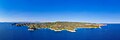 Spetses island panorama
 -
 Door
Door -
 Carriage
 -
 Laskarina Bouboulina
 -
 Zogeria
 -
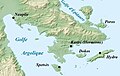 Argolic gulf and islands map


.jpg)

.jpg)


.jpg)
.jpg)

See also
[edit]- List of settlements in Attica
- Fishtales – The island appears in the children's film.
- Free-diving – World record free-diving attempts frequently take place around the island.
References
[edit]- ^ "Municipality of Spetses, Municipal elections – October 2023". Ministry of Interior.
- ^ "Αποτελέσματα Απογραφής Πληθυσμού - Κατοικιών 2021, Μόνιμος Πληθυσμός κατά οικισμό" [Results of the 2021 Population - Housing Census, Permanent population by settlement] (in Greek). Hellenic Statistical Authority. 29 March 2024.
- ^ "ΦΕΚ A 87/2010, Kallikratis reform law text" (in Greek). Government Gazette. Archived from the original on 18 July 2010. Retrieved 7 September 2021.
- ^ "Population & housing census 2001 (incl. area and average elevation)" (PDF) (in Greek). National Statistical Service of Greece. Archived (PDF) from the original on 21 September 2015. Retrieved 10 November 2016.
- ^ Symeonides, Charalampos P. (2010). Ετυμολογικό Λεξικό των Νεοελληνικών Οικωνυμίων (in Greek). Vol. 2. Kykkos Monastery Research Centre. p. 1303. ISBN 978-960-92762-2-1. Archived from the original on 12 May 2023. Retrieved 11 July 2023.
- ^ "Πιτυούσσα". Academic Dictionaries and Encyclopedias. Archived from the original on 27 October 2023. Retrieved 27 October 2023.
- ^ Modern Greece. Elaine Cotsirilos Thomopoulos. Santa Barbara, California. 2022. ISBN 978-1-4408-5492-7. OCLC 1252736820.
{{cite book}}: CS1 maint: location missing publisher (link) CS1 maint: others (link) - ^ Haritatos, Petros. Poseidonion and Spetses. Poseidonion Hotel re-opening brochure, 2009, p. 1.
- ^ Lance Chilton, Marc Dubin, Mark Ellingham. The Rough Guide to the Greek Islands. Rough Guides, 2004. p.106.
- ^ The Spetses Classic Yacht Regatta Archived 18 November 2015 at the Wayback Machine.
- ^ Anderson, R. C. (1952). Naval Wars in the Levant 1559–1853. Princeton: Princeton University Press. pp. 488–489. OCLC 1015099422.
- ^ A Orlandos, Ναυτικά, ήτοι Ιστορία των κατά τον υπέρ ανεξαρτησίας της Ελλάδος αγώνα πεπραγμένων υπό των τριών ναυτικών νήσων, ιδίως δε των Σπετσών, t. 1 p 310
- ^ White, Richard H. (5 February 2013). "Miro's Knot: An Essay in Love". Retrieved 20 June 2024.
- ^ "Miro's Knot". IMDb. Retrieved 20 June 2024.
- ^ "Stewart/Whitley (@stewartwhitley) on Instagram | Ghostarchive".
External links
[edit]Administrative divisions of the Attica Region | ||
|---|---|---|
| Regional unit of Central Athens |  | |
| Regional unit of North Athens | ||
| Regional unit of West Athens | ||
| Regional unit of South Athens | ||
| Regional unit of Piraeus | ||
| Regional unit of East Attica | ||
| Regional unit of West Attica | ||
| Regional unit of Islands | ||
| ||


Stato da Màr of the Republic of Venice | ||
|---|---|---|
| Adriatic Sea |
|  |
| Ionian Islands and dependencies |
| |
| Mainland Greece |
| |
| Aegean Islands |
| |
| Other |
| |
| Related articles | ||

Spetses
View on GrokipediaGeography and Environment
Location and Physical Features
Spetses is situated in the southeastern part of the Saronic Gulf within the Aegean Sea, approximately 51 nautical miles southwest of Piraeus and off the northeastern coast of the Peloponnese peninsula.[3] The island lies at coordinates roughly 37°15′N 23°08′E and is the southernmost of the Saronic Islands group, separated from the mainland near Porto Cheli by a channel as narrow as 2 kilometers.[4][10] The island covers an area of approximately 20 square kilometers, with a curved, ellipsoidal shape resembling a turtle shell and a total coastline length of about 43 kilometers featuring numerous indented bays and coves.[4] Its terrain is predominantly hilly and semi-mountainous, dominated by the low Prophet Elias ridge that occupies much of the interior, reaching a maximum elevation of 245 meters.[4][11] The landscape includes rocky shores interspersed with pebbly and sandy beaches backed by Aleppo pine forests, with limited arable land and no significant rivers or lakes.[4]Climate
Spetses has a Mediterranean climate, marked by hot, dry summers and mild, wetter winters, with low overall annual precipitation concentrated in the cooler months. The island's weather supports tourism in summer but can feature occasional winter storms and rare snowfall. Average annual temperatures hover around 18°C (64°F), with minimal frost and comfortable conditions year-round due to its southerly Aegean location.[12][13] Summer (June to September) brings clear skies and highs exceeding 26°C (79°F), peaking at 29.7°C (85.5°F) in August, with lows rarely below 20°C (68°F); rainfall is negligible, averaging under 10 mm per month, fostering arid conditions ideal for maritime activities. Winters (December to February) are cooler, with January highs of 12.6°C (54.7°F) and lows of 8.6°C (47.5°F), alongside stronger winds up to 14.6 km/h (9.1 mph) and higher humidity around 72%; precipitation peaks in December at 36 mm (1.4 in) over 10.5 days, though totals remain modest compared to mainland Greece. Spring and autumn serve as transitional periods with moderate temperatures (15–22°C or 59–72°F) and increasing rain chances from October onward.[14][13]| Month | Avg. High (°C) | Avg. Low (°C) | Precipitation (mm) | Rainy Days |
|---|---|---|---|---|
| January | 12.6 | 8.6 | 32 | 9.5 |
| February | 13.4 | 9.3 | 25 | 8.3 |
| March | 15.7 | 10.8 | 22 | 7.5 |
| April | 18.4 | 12.8 | 16 | 5.8 |
| May | 22.7 | 16.8 | 11 | 4.2 |
| June | 26.8 | 20.8 | 7 | 3.3 |
| July | 29.3 | 23.7 | 6 | 1.8 |
| August | 29.7 | 24.2 | 6 | 1.8 |
| September | 26.3 | 21.2 | 12 | 3.3 |
| October | 21.6 | 17.6 | 25 | 6.7 |
| November | 18.3 | 14.3 | 32 | 8.3 |
| December | 14.4 | 10.4 | 36 | 10.5 |
Ecology and Environmental Issues
Spetses features Mediterranean maquis shrubland interspersed with Aleppo pine (Pinus halepensis) forests that dominate the island's hilly interior, contributing to its verdant appearance and supporting typical regional flora such as cyclamen and aromatic herbs adapted to dry summers and mild winters.[4] These forests, while protected, represent regrowth rather than the original ancient woodland, with pines providing habitat for birds, reptiles, and small mammals common to Saronic islands.[4] Marine ecology centers on extensive Posidonia oceanica (Neptune grass) seagrass meadows around the island and nearby Velopoula, forming biodiversity hotspots that host over 500 fish and invertebrate species, including seahorses and serving as nurseries for juvenile fish.[15] These meadows, endemic to the Mediterranean and reaching depths of up to 40 meters with densities of 10,000 shoots per square meter, sequester carbon at rates 15 times higher than tropical rainforests and mitigate coastal erosion.[16]  originates from the Venetian designation Isola di Spezie or Isola delle Spezzie, meaning "Island of Spices" or "Island of Aromas," applied during Venetian rule from the 13th to 15th centuries due to the abundance of aromatic herbs growing on the island's hillsides.[22][6] This name reflected either the local flora, including wild thyme, oregano, and sage, or the island's strategic position along ancient maritime trade routes for spices and aromatics originating from the East.[10] Over time, the Venetian term was Hellenized to Spetsai (Σπέτσαι) and eventually shortened to Spetses, with some linguistic influence from Arvanite (Albanian-Greek) dialects spoken by early settlers.[3] In antiquity, during the Mycenaean period around 1050 BCE, the island was known as Pityoussa or Pitiousa (Πιτυούσσα), derived from the Greek pitys meaning "pine tree," alluding to its dense pine forests that covered much of the landscape.[5] Archaeological evidence, including ancient tombs and coins, supports continuous habitation from this era, though the island's name evolved with successive rulers, including brief Roman and Byzantine references that retained the pine-related connotation before the Venetian era supplanted it.[23] Alternative theories, such as a link to flax cultivation (sparta in Greek), lack strong primary evidence and are considered secondary to the spice and pine derivations.[24]Ancient and Early Settlement
Archaeological evidence from excavations, particularly at Aghia Marina, indicates that Spetses was first settled during the Early Bronze Age, around 2500 BC, during what is termed the First Hellenic Era.[25][5] These findings include artifacts consistent with early Aegean prehistoric cultures, suggesting initial habitation by proto-Hellenic or related groups exploiting the island's pine forests and coastal resources.[26] The island's ancient name, Pityoussa (Πιτυοῦσσα), derived from pitys meaning pine tree, reflects its dense coniferous cover, which likely facilitated early maritime activities in the Saronic Gulf.[27][28] Settlement appears to have been intermittent and small-scale through the Bronze Age and into the Archaic period, with the island's exposed position making it susceptible to piracy and invasions, leading to population fluctuations.[23] Discoveries of ancient tombs and coins attest to continuity into classical antiquity, though no major urban centers or inscriptions have been identified, implying a primarily agrarian and seafaring community under broader Attic or Argolic influence.[23][29] By the Hellenistic era, references to Pityoussa in periploi (ancient sailing guides) highlight its role as a navigational landmark rather than a political entity.[30] Early historical records are sparse, but the island's strategic location near the Argolic Gulf supported limited trade and fishing settlements, with evidence of Mycenaean-era pottery shards indicating cultural ties to mainland Peloponnesian sites.[31] Population likely remained low until later migrations, as the terrain—rocky hills and thin soil—limited large-scale agriculture, favoring transient or seasonal use over dense colonization.[6]History
Medieval Period and Venetian Rule
Following the decline of ancient settlements, Spetses saw renewed habitation in the medieval period, with the establishment of fortified living quarters at Kastelli in the northeast, serving as an early defensive site against piracy and invasions.[31] This settlement marked a shift toward more organized communities amid the broader instability of the late Byzantine era, though the island remained relatively sparsely populated due to frequent raids and its peripheral position in the empire.[23] After the Fourth Crusade and the fragmentation of the Byzantine Empire in 1204, Spetses fell under Venetian dominion around 1220, as part of Venice's expansion into Aegean outposts to secure maritime trade routes.[32] Venetian administrators renamed the island Isola di Spezie (Island of Spices), likely alluding to its strategic location on spice trading paths from the East or the abundance of aromatic herbs and pines in its terrain.[6] [5] Under Venetian rule, which lasted until the Ottoman conquest in 1460, Spetses benefited from relative stability and integration into Venice's commercial network, fostering gradual population growth and early maritime activities by the 15th century.[33] Local inhabitants, primarily Greek Orthodox, navigated Venetian Catholic governance through a system of feudal obligations and trade privileges, though detailed records of administration or events specific to the island are scarce, reflecting its minor role compared to larger Venetian holdings like Crete or the Cyclades.[5] This period laid foundational patterns for the island's seafaring economy, with shipbuilding and commerce emerging as key pursuits amid the Venetian emphasis on naval power projection in the eastern Mediterranean.[32]Ottoman Domination and Local Autonomy
Spetses fell under Ottoman control in the 16th century, following the broader conquest of the Aegean islands by the empire's forces.[6] The island's population during this period primarily consisted of Arvanites—Greek-speaking communities of Albanian origin from northern regions—and refugees from the mainland Peloponnese, who settled there amid ongoing conflicts and migrations.[6] These settlers engaged in intensive shipbuilding and maritime trade, transforming Spetses into a key node in Ottoman-dominated Mediterranean commerce by the 17th century.[34] The island's economic vitality, particularly its merchant fleet and shipyards, secured relative autonomy within the Ottoman system. Similar to neighboring Hydra and Psara, Spetses operated with minimal direct Turkish administration, featuring few if any resident Ottoman officials or garrisons, which allowed local communities to manage internal affairs through customary councils of ship captains and elders.[35] In exchange for tribute payments and occasional naval support to the Porte, such as provisioning or transport services, inhabitants received privileges that preserved their self-governance and exempted them from heavier impositions like the devshirme system.[35] This arrangement stemmed from the practical necessities of Ottoman rule over distant islands, where enforcing full control would have disrupted profitable trade networks reliant on Greek mariners.[5] By the 18th century, Spetses' fleet had amassed significant wealth through Black Sea grain transport and Levantine commerce, further entrenching its de facto independence.[36] Local autonomy manifested in the absence of centralized Ottoman interference, enabling the development of a proto-nationalist ethos among the seafaring elite, who maintained Orthodox institutions and armed vessels capable of resisting piracy or imperial overreach.[34] This maritime prowess not only sustained economic prosperity—evidenced by the island's population growth to several thousand by the late 1700s—but also positioned Spetses as a resilient outpost, where Ottoman suzerainty was nominal rather than absolute.[37]Role in the Greek War of Independence
Spetses was the first island to declare independence from Ottoman rule on April 3, 1821, preceding the revolts on Hydra and Psara, with local shipowners rapidly converting their merchant vessels into a warships fleet that guarded Aegean coasts and disrupted Ottoman supply lines.[6][5] The island's maritime prowess, derived from its hydriote and psariote merchant traditions, enabled Spetsiots to form squadrons that transported arms, ammunition, and provisions to mainland revolutionaries while engaging in hit-and-run tactics against superior Ottoman naval forces.[23][38] Laskarina Bouboulina, a prominent Spetsiot shipowner, played a pivotal role by financing and commanding a personal fleet, including the construction of the Agamemnon, the largest Greek warship of the era at the time, which she outfitted with her fortune to support independence efforts.[7][39] Bouboulina's squadron participated in key operations, such as the April 1821 capture of Nafplio, where Spetsiot ships blockaded the port and bombarded Ottoman positions, facilitating its surrender to Greek forces by late May.[7] Her leadership exemplified the island's contribution of over 20 armed vessels by mid-1821, which bolstered the revolutionary navy's ability to contest Ottoman dominance in the Saronic Gulf.[5] In September 1822, Spetses faced a direct Ottoman assault when an Egyptian-Turkish fleet of approximately 87 ships attempted to invade the island to sever Greek naval support to the Peloponnese; local captains, using fireships launched on September 8, ignited chaos among the invaders, forcing their retreat after days of skirmishes from September 8 to 13 and preserving Spetses as a revolutionary stronghold.[40][41] This defensive victory, commemorated annually as the Armata festival, underscored Spetses' strategic value in sustaining the irregular Greek fleet's guerrilla operations until the decisive Battle of Navarino in 1827.[42]Post-Independence Decline and Revival
Following Greek independence in 1830, Spetses initially sustained its maritime prosperity, with the island's merchant fleet continuing to thrive for approximately two decades through trade and shipping activities that had been bolstered during the revolutionary period.[43] However, this momentum waned by the mid-19th century as technological advancements, particularly the advent of steam-powered vessels around the 1840s, rendered traditional sail-based merchant shipping less competitive, eroding the economic foundation reliant on wooden shipbuilding and sail trade.[6] The relocation of Greece's capital from Nafplion to Athens in 1834 further diminished Spetses' strategic and administrative prominence, contributing to reduced commercial traffic and local investment.[6] The ensuing economic contraction led to depopulation and stagnation, as many seafaring families emigrated in search of opportunities elsewhere, mirroring broader challenges faced by other hydriot and psariotic islands whose fleets similarly declined amid global shifts toward industrialized navigation.[43] By the late 19th century, Spetses transitioned from a bustling naval hub to a quieter settlement, with diminished shipyards and trade volumes reflecting the obsolescence of its core industries.[5] Revival began in the late 19th and early 20th centuries through private philanthropy and infrastructure development, notably driven by Spetsiot expatriate Sotirios Anargyros, who amassed wealth in tobacco trading abroad before returning to invest in the island around the 1890s.[44] Anargyros funded the construction of the Anargyrios and Korgialenios School in 1908, an elite boarding institution that attracted students and educators, fostering cultural and educational growth while enhancing Spetses' appeal as a refined destination for affluent Athenians.[44] His mansion and other endowments symbolized this resurgence, laying groundwork for emerging tourism by promoting the island's natural beauty and historical legacy prior to broader 20th-century expansions.[45]20th Century to Present
At the turn of the 20th century, Spetses experienced economic depression following the decline of its merchant shipping fleet, exacerbated by the two World Wars, which led to widespread poverty and emigration of residents seeking opportunities elsewhere.[31] The island's traditional maritime economy faltered as steamships replaced sail-powered vessels, diminishing the role of local shipowners.[5] Revival began through the initiatives of Sotirios Anargyros, a Spetsiot expatriate who amassed wealth in the tobacco trade in Egypt and returned to invest in infrastructure, including roads encircling the island, schools, hotels, and water systems, explicitly to foster tourism as the path to prosperity.[43] These developments, starting around 1900, attracted visitors and marked the onset of tourism as a dominant sector, restoring the island's fortunes by the interwar period.[5] During World War II, Spetses fell under Axis occupation, with German forces using structures like the Anargyros Mansion for administrative purposes and interrogations.[46] From March to June 1944, the island saw heightened tensions, including kidnappings and executions carried out by communist-led resistance groups, followed by reprisals from occupying forces that resulted in further violence and terror.[47] The subsequent Greek Civil War (1946–1949) largely spared Spetses direct conflict, allowing relative stability amid national turmoil.[43] Postwar recovery accelerated with tourism's expansion, as affluent Athenians and foreigners purchased and restored 18th- and 19th-century mansions, transforming the island into a cosmopolitan retreat while preserving its car-free character enforced by local regulations.[37] By the late 20th century, Spetses had evolved into a premier summer destination, drawing hundreds of thousands of visitors annually for its pine-shaded beaches, yachting facilities, and cultural events commemorating its revolutionary heritage.[31] In the early 21st century, the island shifted from mass package tourism toward upscale appeal among wealthier Greeks and international elites, emphasizing exclusivity through luxury accommodations and water-based transport, though challenges like seasonal economic dependence and environmental pressures from visitor influx persist.[6] Administrative changes, including its incorporation into the Islands regional unit in 2011, have supported modernization efforts such as port expansions, while maintaining strict vehicle restrictions to protect the island's pedestrian-friendly layout and ecological balance.[5]Governance and Infrastructure
Administrative Structure
Spetses forms a unitary municipality, the Municipality of Spetses (Δήμος Σπετσών), established under Greece's Kallikratis administrative reform in 2011, which consolidated local government units into self-governing entities responsible for services such as urban planning, waste management, and cultural affairs.[48] This structure places it within the Islands regional unit of the Attica region, with authority devolved from central government while adhering to national oversight on fiscal and regulatory matters.[48] The municipality's governing bodies include a directly elected mayor, a municipal council comprising 13 members (including the mayor), and supporting committees for specialized functions like finance and public works, all elected for five-year terms via proportional representation.[48] As of 2023, Evgenia Frangia serves as mayor, leading the council in managing island-wide policies without internal subdivisions, as the municipality covers the entirety of Spetses island (approximately 27 km²) as its sole administrative domain.[49] Local decisions require alignment with regional and national frameworks, including EU directives on environmental and maritime regulations pertinent to island governance.[1] Administrative operations are centralized in the municipal headquarters in Spetses town, handling resident registration, taxation, and infrastructure maintenance, with contact facilitated through official channels such as the central telephone line (22983 20010). This setup reflects Greece's two-tier local government model, where first-level municipalities like Spetses exercise autonomy in daily affairs but coordinate with second-level regional authorities for broader development projects.[48]Transportation and Urban Development
Spetses is accessible exclusively by sea, with regular ferry services departing from the port of Piraeus in Athens, as well as from nearby Saronic Gulf islands such as Hydra and Poros.[50] These include conventional ferries, high-speed vessels like the Spetses Express, and sea taxis, with travel times from Piraeus ranging from 2 to 3 hours depending on the vessel type.[51] There is no airport on the island, reinforcing its reliance on maritime connections.[50] The island enforces a strict car-free policy in its main town and much of its settled areas to preserve its historical character and pedestrian-friendly environment, prohibiting private vehicles for visitors and limiting them for residents.[52] [53] Internal mobility instead emphasizes non-motorized and low-impact options, including walking along the 24 km main road network, bicycles, mopeds, horse-drawn carriages, and limited local buses or taxis corresponding to the permanent population size of approximately 3,000-4,000.[54] [52] Water taxis and traditional boats serve coastal routes, particularly useful for accessing beaches and remote areas.[55] Urban development on Spetses prioritizes sustainability and infrastructure compatible with its car-restricted status, including networks of footpaths and cycle paths connecting settlements and tourist sites.[56] Recent initiatives, such as a 2025 government crackdown on unauthorized vehicles via a public online registry, aim to enhance transparency and compliance with vehicle limits, primarily allowing licensed taxis, supply vans, and tourist minibuses.[57] Municipal programs under Attica's development framework involve replacing urban amenities, installing new public infrastructure, and conducting paving works in intervention zones to support pedestrian and low-emission mobility.[58] A qualitative analysis of mobility practices indicates that while logistical needs drive some motorcycle and van use, the regime favors eco-friendly transport to mitigate environmental pressures from tourism.[59] This approach has sustained the island's appeal but faces challenges from excessive two-wheeled vehicles threatening further development.[60]Economy
Traditional Maritime Economy
The traditional maritime economy of Spetses relied predominantly on merchant shipping and shipbuilding from the mid-18th century onward, as the island's rocky terrain limited agriculture and made seafaring the principal livelihood for its male population.[23] Spetsiot vessels, often sailing under Russian flags during the Russo-Turkish Wars ending in 1774, engaged in grain trade from the Black Sea to Mediterranean ports, capitalizing on Ottoman regulations and illicit opportunities in this vital commodity.[61][62] This commerce extended to Europe, Africa, and Asia, with ships transporting goods to France, Spain, and England, including blockade-running during the Napoleonic Wars.[61][23] By 1808, the Spetses fleet included approximately 90 merchant ships, employing over 5,000 crewmen and armed with more than 1,000 cannons, reflecting both commercial and defensive capabilities.[61] In 1813, records indicate 60 vessels totaling 19,500 tons, manned by 2,700 seamen and equipped with 900 cannons, underscoring the island's status among the wealthiest Greek communities through ship-owning families.[23] Local shipyards, known as karnagia, constructed two-masted brigs of 200-400 tons using pine wood, supporting the fleet's expansion and primarily trading wheat across the Mediterranean.[8][61] This prosperity manifested in grand captains' mansions (kapetonospita) furnished with European imports, symbols of accumulated maritime wealth.[8] Pre-independence estimates place the fleet at 64 ships, convertible to warships that bolstered the Greek Revolution of 1821.[63] The sector peaked in the 18th century's "Golden Era" but declined post-Crimean War (1853-1856) due to wartime destruction, competition from steamships, and shifts to smaller coastal vessels like trehandiria and caiques.[61][23] By 1868, Spetses ranked second in Greece for ship production after Syros, though focused on local types amid fading long-haul dominance.[8]Shift to Tourism-Dominated Economy
Following the decline of its shipping fleet in the late 19th century, Spetses transitioned toward tourism in the early 20th century through initiatives led by Sotirios Anargyros, a native islander who had amassed wealth in the United States tobacco trade.[44] Anargyros recognized the obsolescence of traditional maritime activities and invested in infrastructure to attract affluent visitors, including the construction of the Poseidonion Grand Hotel, which opened on August 23, 1914, and hosted European royalty, prime ministers, and intellectuals.[64][44] These efforts established Spetses as an upscale resort destination, with Anargyros also funding roads, schools, and water systems to support growing visitor numbers.[43] The interwar period saw initial tourism growth among Greece's elite, but the sector expanded significantly after World War II, particularly in the 1960s and 1970s, as Athens-based professionals and shipowners acquired villas and properties on the island.[5] This influx shifted economic reliance from shipping—once employing thousands in shipbuilding and trade—to hospitality and services, with tourism becoming the dominant sector by the late 20th century.[65] Unlike mass-market islands, Spetses maintained exclusivity; brief experiments with budget package tours in the 1980s and 1990s ended with the withdrawal of British operators amid economic downturns, reinforcing its appeal to high-net-worth individuals.[66] Today, tourism accounts for the majority of economic activity, driven by yachting, cultural events like the Armata Festival, and luxury accommodations, though seasonal fluctuations and infrastructure limitations pose ongoing challenges.[67] The island's car-free policy, enforced since the 1970s except for horses and service vehicles, preserves its traditional charm while catering to visitors seeking authentic experiences over mass development.[37]Contemporary Economic Dynamics and Challenges
The economy of Spetses remains heavily reliant on tourism, which has evolved since the 1990s to cater primarily to higher-income visitors, including affluent Greeks and yacht owners, rather than mass package tours. This shift has positioned the island as a premium destination within the Saronic Gulf, with economic activity peaking during the summer season when visitor influx supports hospitality, retail, and maritime services. Local officials noted that tourism growth exceeded expectations in 2021, contributing to resilience amid national economic pressures.[68][69] Maritime activities, including ferry operations and water taxis at the New Port, complement tourism by facilitating access from the mainland, though recent regulatory decisions have introduced tensions. In February 2025, the Harbor Master ordered the closure of the Old Harbor to all vessel docking, citing safety and operational concerns, which elicited backlash from residents and businesses reliant on traditional port functions for commerce and tourism logistics. This move highlights ongoing debates over balancing preservation of historical infrastructure with modern economic needs.[70] Seasonal dependency poses inherent challenges, as the island's 4,000 permanent residents experience economic contraction outside peak months, mirroring broader patterns in Greek island economies where tourism accounts for a disproportionate share of employment and revenue. Stricter enforcement of vehicle bans in 2025, aimed at maintaining the island's car-free character and protected status, has prompted efforts to enhance sustainable mobility options like carriages and electric alternatives, yet logistical constraints persist in supporting year-round activity.[71][53] Infrastructure strains from tourism growth, including proposals for large retail outlets, have raised concerns about overburdening limited resources and displacing small local businesses, as seen in September 2025 backlash against a supermarket chain's expansion plans in historic areas. Water scarcity, exacerbated by seasonal demand and climate variability affecting Greek islands broadly, further complicates sustainability, with national initiatives allocating €18 million in March 2025 for supply improvements across affected regions, though specific impacts on Spetses remain tied to broader Aegean challenges. Vulnerability to external factors, such as global economic fluctuations or environmental risks, underscores the need for diversification beyond tourism to mitigate off-season downturns and ensure long-term stability.[72][73][74]Demographics and Society
Population Trends and Statistics
The permanent population of the Municipality of Spetses stood at 3,748 inhabitants according to the 2021 Population-Housing Census conducted by the Hellenic Statistical Authority (ELSTAT).[75] This represented a 6.9% decline from the 4,027 residents enumerated in the 2011 census.[75] In 2021, males comprised 1,833 individuals (48.9%) and females 1,915 (51.1%).[75] Historical census data indicate modest fluctuations prior to the recent downturn, with the population at 3,916 in 2001. The following table summarizes key census figures for the municipality:| Census Year | Population |
|---|---|
| 2001 | 3,916 |
| 2011 | 4,027 |
| 2021 | 3,748 |