Hubbry Logo
SextortionSextortionMain
Open search
Sextortion
Community hub
Sextortion
logo
8 pages, 0 posts
0 subscribers
Be the first to start a discussion here.
Sextortion
Sextortion
from Wikipedia
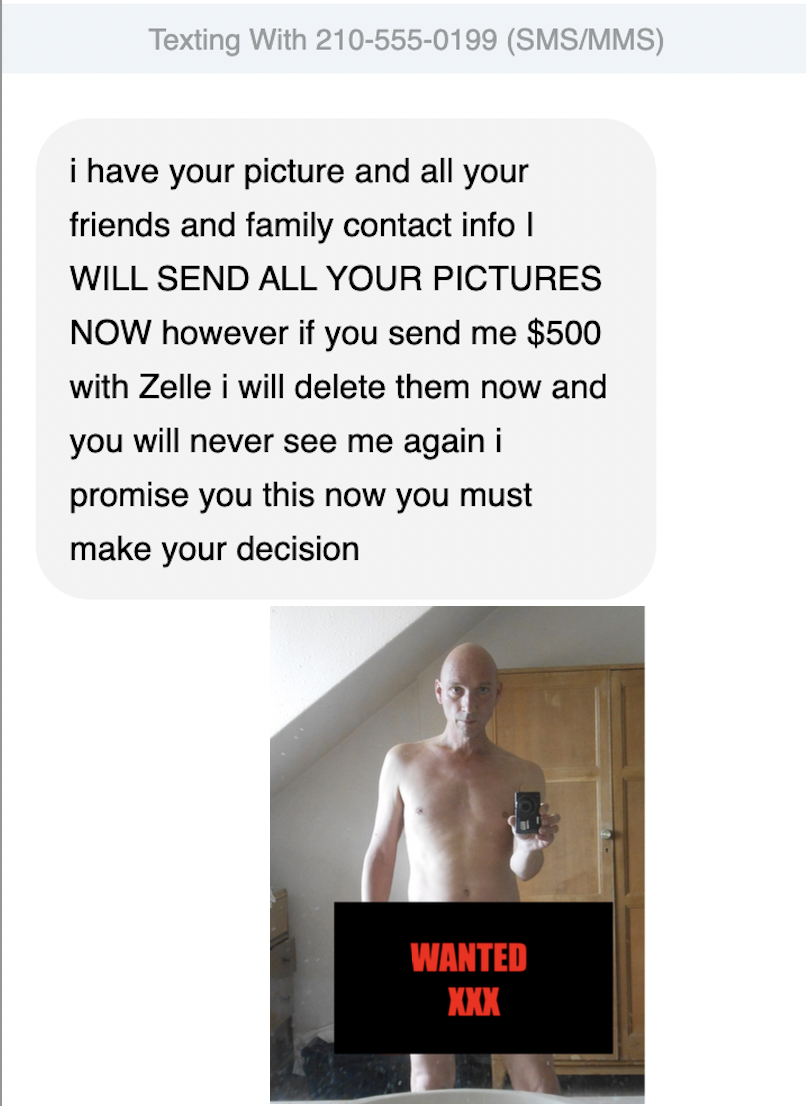
A mockup example of a sextortion text message. After obtaining naked photographs or videos of the victim, the scammer then threatens the publication of these pictures or to send them to close friends and family members. A demand of money is then made, though usually the scam is either a bluff (e.g. the scammer never intended to publish them) or the pictures/videos are published regardless even if the money is sent.[1]

Sextortion (a portmanteau of sex and extortion) employs non-physical forms of coercion to extort sexual favors from the victim. Sextortion refers to the broad category of sexual exploitation in which abuse of power is the means of coercion, as well as to the category of sexual exploitation in which threatened release of sexual images or information is the means of coercion.[2]

As used to describe an abuse of power, sextortion is a form of corruption[3] in which people entrusted with power – such as government officials, judges, educators, law enforcement personnel, and employers – seek to extort sexual favors in exchange for something within their authority to grant or withhold.[4][5][6][7][8] Examples of such abuses of power include: government officials who request sexual favors to obtain licenses or permits,[9][10] teachers who trade good grades for sex with students,[11][12] and employers who make providing sexual favors a condition of obtaining a job or getting promoted.[citation needed]. A Transparency International report on sextortion noted some challenges in prosecuting sextortion under existing anti-corruption and gender-based violence legal frameworks.[13]

Sextortion also refers to a form of blackmail in which sexual information or images are used to extort money or sexual favors from the victim.[14][15] Social media and text messages are often the source of the sexual material and the threatened means of sharing it with others. An example of this type of sextortion is where people are extorted with a nude image of themselves they shared on the Internet through sexting. They are later coerced into giving money, or performing sexual acts with the person doing the extorting or are coerced into posing or performing sexually on camera, thus producing hardcore pornography.[16][15] This method of blackmail is also frequently used to out LGBT people who keep their true sexual orientation private.[17]

A video highlighting the dangers of sextortion has been released by the National Crime Agency[18] in the UK to educate people, especially given the fact that blackmail of a sexual nature may cause humiliation to a sufficient extent to cause the victim to take their own life,[19] in addition to other efforts to educate the public on the risks of sextortion.[20]

Webcam blackmail

[edit]

Sextortion using webcam content often involves a cybercriminal posing as someone else – such as an attractive person – initiating communication of a sexual nature with the victim (about 95% of victims are male).[19] Often, the cybercriminal simply shows the victim a pre-recorded video of a performer from a cybersex webcam site which they are sufficiently familiar with, then messages the victim at points in the video where the performer appears to be typing on the keyboard, to give the illusion that the performer in the video is messaging them.[21] The victim is then persuaded to undress in front of a webcam, and may also be persuaded to engage in sexual behaviour, such as masturbation.[21] The video is recorded by the cybercriminal, who then reveals their true intent and demands money or other services (such as more explicit images of the victim, in cases of online predation), and threatening to publicly release the video to video services like YouTube and send it to family members and friends of the victim if they do not comply. Sometimes threats to make false allegations of paedophilia against the victim are made as well.[21] This is known as webcam blackmail.[22] An increase in webcam blackmails have been reported, and it affects both young and old, male and female alike.[23][24]

History

[edit]

An early use of the term appears in print in 1950 in California.[25]

Since early 2009, The Institute for Responsible Online and Cell-Phone Communication (iroc2.org) began warning the public about the trend of "Sextortion" via live events and websites including www.sextortion.org. This is a trend that grew based on the birth and growth of the trend known as "sexting" whereby compromising images and videos were being shared by individuals without a real understanding of the short and long term consequences of sharing "private" content on digital tools designed for sharing.

In 2009, the International Association of Women Judges (IAWJ), in partnership with the Association of Women Judges in Bosnia and Herzegovina, the Philippine Women Judges Association, and the Tanzania Women Judges Association, and with funding from the Government of the Netherlands, launched a three-year program on "Stopping the Abuse of Power through Sexual Exploitation: Naming, Shaming, and Ending Sextortion."[26] Presentations on sextortion were made to judges attending the 2010[27] and 2012 Biennial World Conferences of the IAWJ[28][29] and to NGOs attending the 2011[30] and 2012 meetings of the UN Commission on the Status of Women.[4]

There are also scientific studies describing the prevalence of sextortion in Europe, etc. in the Czech Republic (2017).[31]

In China, there are cases of sextortion as part of predatory lending to students.[32]

In 2022, the Canadian Centre for Child Protection noted a tripling of cases compared to previous years and a change away from female victims being sextorted for images towards young male victims being sextorted for money.[15]

Between 2021 and 2023, the U.S. saw a 7,200% rise in sextortion attempts according to data by the National Center for Missing and Exploited Children (NCMEC).[33][34]

Incidents

[edit]

Incidents of sextortion have been prosecuted under various criminal statutes, including as extortion,[35][36][37] bribery,[38] breach of trust,[39] corruption,[40] sexual coercion,[36][41] sexual exploitation,[16] sexual assault,[37] child pornography,[37][42] and computer hacking and wiretapping.[43]

  • Anthony Stancl of Wisconsin, then 18, received 15 years in prison in February 2010 after he posed as a girl on Facebook to trick male high school classmates into sending him nude cell phone photos, which he then used to extort them for homosexual sex.[37]
  • Jonathan Vance of Auburn, Alabama, was sentenced to 18 years in prison in April 2010 after sending threatening e-mails on Facebook and MySpace extorting nude photos from more than 50 women in three states.[16]
  • Luis Mijangos was sentenced to six years in prison in September 2011 for hacking into dozens of computers, stealing personal information and demanding naked images from female victims in exchange for not releasing the stolen information. Forty-four of the victims were under age 18.[44]
  • Isaac Baichu, a federal immigration officer in New York, was sentenced to 1+12 to 4+12 years in prison in July 2010 after demanding sex from a 22-year-old Colombian woman in exchange for a green card.[41]
  • Steve Ellis, an immigration adjudicator in Toronto, was sentenced to 18 months in jail in July 2010 after telling a South Korean woman he would approve her refugee claim in exchange for sex.[39]
  • Michael Ngilangwa, a secondary school teacher in Tanzania, was sentenced to pay a fine or serve one year in prison in June 2011 after demanding sexual favors from his student in exchange for favorable exam results.[40]
  • Christopher Patrick Gunn, 31, of Montgomery, Alabama was indicted for using fake Facebook profiles to extort nude photos and videos from underage girls in numerous states.[42] He got 35 years in federal prison after being convicted.[45]
  • In May 2010, the police of the Basque Country in Spain arrested a 24-year-old man accused of blackmailing a woman he met on an online chatroom and threatening to distribute nude photographs of her from her webcam.[46]
  • A video of the former Chinese Communist Party official Lei Zhengfu having sex with a woman was a part of a sextortion plot by a criminal gang.[47][48]He was dismissed from his position as Chinese Communist Party Committee Secretary of Beibei, Chongqing and detained by the police a few days after. Additionally, the Party expelled him in early May. Subsequently, he was given a 13-year prison sentence for bribery.[49]
  • Aydin Coban was jailed for 6 years for the suicide of Amanda Todd.[50]
  • In 2013, Daniel Perry committed suicide hours after falling victim to webcam blackmail.[51]
  • Anton Martynenko was sentenced to 38 years in a federal prison, after victimizing over 155 teenage boys by making around 50 fake accounts on Facebook, often those of young women, to convince the victims to send him nude photos.[52] The accounts were also used to spread the explicit photos and videos of the victims to their high school classmates, with one boy's photos being sold on the dark web. In addition, three boys were blackmailed into meeting up with Martynenko and performing sex acts with him; two of the victims later committed suicide. Martynenko is considered the largest producer of child pornography in Minnesota history.[53]
  • Jared Abrahams was sentenced to 18 months in jail[54] after using Google Dorking[55] to commit sextortion crimes against Miss Teen USA Cassidy Wolf along with around 150 other women.
  • Samuel Ogoshi, 22, Samson Ogoshi, 20, and Ezekiel Ejehem Robert, 19, who are residents of Lagos, Nigeria reportedly targeted hundreds of teenagers and adults in the United States posing as young women whose accounts had been hacked on Instagram. The three men would reportedly ask for nude pictures and then threaten to release the photos unless the victim paid them money. One victim, Jordan DeMay, 17, of Michigan, committed suicide after they threatened to release a nude photo of him if he failed to pay them $1,000 US, prompting the United States to file the proper motions to extradite them. Their cases are pending and they face over thirty years in prison if convicted.[56][57] It was reported in August 2023 that Samuel and Samson Ogoshi, brothers, had been extradited to the United States and had gone before a federal judge in Grand Rapids, Michigan.[58] The Ogoshi brothers pled guilty to sexually extorting teenage boys and young men in April 2024, and were sentenced to 17.5 years in prison in September 2024.[59][60] U.S. attorney for the Western District of Michigan Mark Totten stated: “[The] guilty pleas represent an extraordinary success in the prosecution of international sextortion. These convictions will send a message to criminals in Nigeria and every corner of the globe: working with our partners both here and overseas, we can find you and we can bring you to justice.”[61]
  • Rubén Oswaldo Yeverino Rosales was sentenced to 34 years for extorting over 100 victims.[62]
  • In 2025, police in Stony Point, New York arrested a Fieldstone Middle School student who they said had targeted at least six victims but "potentially several hundred". The male student, who was not named due to his age, had allegedly posed as a female online and obtained nude pictures of other boys, which he then used to extort them into sending him gift cards or additional pictures.[63][64]

See also

[edit]

References

[edit]
[edit]
Revisions and contributorsEdit on WikipediaRead on Wikipedia
from Grokipedia
Sextortion is a criminal form of in which perpetrators threaten to distribute victims' intimate images, videos, or personal sexual information unless demands for money, additional explicit content, or sexual acts are fulfilled. Predominantly conducted via online platforms such as and gaming apps, it exploits digital communication to coerce compliance, often beginning with grooming or to obtain initial compromising material. Reports of sextortion have escalated sharply, particularly among minors, with the FBI documenting an explosion in incidents involving children and teens coerced into sending explicit images. The National Center for Missing & Exploited Children (NCMEC) recorded thousands of financial sextortion cases in recent years, many targeting adolescent boys for payments and leading to severe psychological distress, including suicides. Perpetrators, frequently organized groups abroad, distinguish between traditional sextortion seeking further sexual material (more common against girls) and financial variants prioritizing for profit. Victim shame and fear of exposure contribute to underreporting, complicating efforts, though federal agencies emphasize prevention through education on risks and immediate reporting.30423-8/abstract) Scholarly analyses highlight sextortion's overlap with other exploitations, such as nonconsensual , underscoring its role as a technology-facilitated sexual offense with enduring harms beyond immediate threats.

Definition and Forms

Sextortion constitutes a form of wherein perpetrators coerce victims by threatening to disclose or distribute sexually explicit images, videos, or other intimate material unless the victim complies with demands, which may include providing additional , performing sexual acts, or paying . This crime frequently exploits online interactions, such as or platforms, and has escalated with digital technologies enabling rapid dissemination of compromising material. Perpetrators often target minors, who reported over 3,000 cases to the FBI in 2021 alone, though adults are also victims, particularly in financial sextortion schemes where demands focus on payments rather than further imagery. In the United States, sextortion lacks a dedicated federal statute for cases involving adults, but federal prosecutors apply existing laws such as 18 U.S.C. § 875 (interstate ), 18 U.S.C. § 2422 ( and enticement), and wire provisions under 18 U.S.C. § 1343 when threats cross state lines or involve electronic communications. For minors, offenses trigger child sexual exploitation statutes like 18 U.S.C. § 2251 (sexual exploitation of children), which carry penalties up to depending on severity. At the state level, over a dozen jurisdictions, including (Md. Code Ann., Crim. Law § 3-709) and New York, have enacted specific sextortion prohibitions, often classifying them as felonies with sentences ranging from 5 to 20 years. challenges persist due to perpetrators frequently operating from like or the , complicating and prosecution. Internationally, legal responses vary widely, with many nations addressing sextortion under general , , or laws rather than specialized statutes. For instance, the European Union's directives on (e.g., 2013/40/EU) enable prosecution for online , while countries like and have integrated sextortion into child exploitation frameworks. Global , including joint FBI alerts since 2023, highlights cross-border financial sextortion as a crisis, yet gaps in uniform legislation hinder consistent victim protections and offender accountability.

Types and Motivations

Sextortion primarily occurs in two overlapping forms distinguished by the nature of demands: sexual and financial. In sexual sextortion, perpetrators coerce victims into producing or sharing additional explicit images, videos, or performing live sexual acts, leveraging threats to distribute previously obtained material to the victim's , friends, or online networks. This type often involves minors, with offenders using grooming tactics to build trust before escalating to , as documented in analyses of offender techniques that emphasize manipulation for ongoing exploitation. Financial sextortion, by contrast, focuses on extracting monetary payments—typically via gift cards, wire transfers, or —while retaining the explicit material as leverage for compliance or further demands. This variant has surged among cases targeting teenage boys, with perpetrators often operating in organized networks from regions like or , prompting public alerts from U.S. on schemes that have led to victim suicides. Perpetrator motivations are multifaceted but cluster around sexual gratification, financial profit, , and dominance. Sexual motivations drive offenders to seek personal arousal or collection of material for resale or personal use, frequently involving strangers or disguised personas who exploit victims' vulnerabilities for repeated . Financial incentives predominate in transnational operations, where low-risk extortion yields quick gains, as evidenced by law disruptions of groups demanding thousands of dollars per victim. motivates ex-partners or acquaintances, who use obtained images to punish perceived wrongs, such as relationship betrayals, resulting in targeted rather than broad dissemination. Exerting power and control forms a core psychological driver across types, with offenders deriving satisfaction from the victim's fear and submission, independent of material rewards. Less commonly, motives include pranks or curiosity among peers, though these rarely escalate to sustained extortion. Empirical reviews indicate perpetrators outnumber females and are more prone to admit involvement, often rationalizing actions through victim-blaming or entitlement.

Historical Development

Pre-Digital Era and Early Online Cases

Sexual blackmail, the analog precursor to modern sextortion, emerged prominently in the late eighteenth century in Britain, where perpetrators exploited stringent anti-sodomy laws to threaten victims—often men engaging in homosexual acts—with public exposure, prosecution, or social ostracism unless payments or silence were secured. This form of targeted elites whose reputations hinged on to heteronormative standards, with cases frequently involving anonymous letters detailing alleged indiscretions to demand . By the nineteenth century, the practice proliferated across and the , fueled by Victorian-era moral panics over illicit sexuality, including and ; blackmailers posed as scorned lovers or informants to extract concessions, sometimes escalating to threats of violence or fabricated evidence. The mid-nineteenth-century advent of enabled more tangible leverage, as extortionists acquired compromising nude or intimate images through surreptitious means—such as hiring photographers to document illicit encounters or stealing personal albums—and used them to coerce payments, sexual favors, or reputational cover-ups. In the U.S., puritanical legal and social frameworks amplified vulnerabilities, with cases often intersecting with racial or class dynamics; for example, threats involving interracial liaisons carried heightened extortion value due to taboos and potential legal penalties under miscegenation laws persisting until the . These pre-digital tactics relied on and personal networks, limiting scale but ensuring intimate terror, as victims faced irreversible damage from circulated prints or testimony in an era without digital anonymity. Early online sextortion cases surfaced in the late and early , paralleling the expansion of dial-up , chat rooms, and platforms like and Yahoo, which facilitated anonymous grooming. Perpetrators, often posing as romantic interests, solicited explicit images from minors or vulnerable adults via or file-sharing, then demanded compliance—financial or further —under threats of dissemination to contacts or public forums. Documented incidents remained sporadic due to underreporting and nascent focus on cybercrimes, but by the mid-, patterns solidified; Lucas Michael Chansler, for instance, exploited social networking sites starting in 2007 to coerce nearly 350 teenage girls into sending nude photos, subsequently blackmailing them for more material or money before his 2015 conviction and 105-year sentence. These cases marked a shift from physical to digital reproducibility, amplifying perpetrators' reach while complicating victim recourse amid evolving technologies like .

Expansion with Social Media and Webcams (2000s–2010s)

The proliferation of broadband internet and affordable in the early 2000s enabled predators to conduct live video interactions, shifting sextortion from static image exchanges to real-time where victims were manipulated into performing sexual acts on camera, which were then recorded and used for . Platforms like MySpace, launched in 2003, and , expanding publicly in 2006, lowered barriers to initiating contact by allowing anonymous or deceptive profiles to target minors and young adults through friend requests, chat features, and shared interests. This era marked a surge in cases where perpetrators posed as peers to build trust, escalating to demands for nude webcam performances under promises of reciprocity or secrecy. By the late , U.S. authorities observed a rapid increase in reported sextortion incidents involving teenagers, often originating in social media chats or webcam-enabled rooms. For instance, in 2007–2010, Lucas Michael Chansler, operating from , impersonated teenage girls on social networking sites to befriend over 350 victims aged 13–17, coercing them into sending explicit webcam videos before threatening distribution unless they produced more. He was sentenced to 105 years in prison in 2015, highlighting how individual actors exploited platform algorithms and privacy gaps for mass targeting. data from 2010 indicated that such webcam-based schemes frequently began with innocuous online parties or dares in chatrooms, where groups of teens were dared to expose themselves, leading to perpetual cycles. Organized networks emerged internationally, particularly in the , where syndicates used social media like to lure victims into webcam sessions, recording compromising footage for financial or further sexual demands. A INTERPOL-coordinated operation dismantled one such ring, arresting 58 suspects linked to hundreds of victims across six countries, with operations tracing back to the mid-2000s amid rising cybersex tourism infrastructure. These groups often employed scripts for grooming—flattery followed by escalation—and evaded detection by operating from low-regulation areas with high English proficiency and internet cafes. High-profile cases underscored the period's risks, such as the 2012 extortion of 15-year-old Amanda Todd in , where a perpetrator coerced her into a topless show at age 12 via live chat sites, then distributed the image and pursued her across platforms despite relocations, contributing to her . The convict, Aydin Coban, was sentenced in 2022 after evidence showed persistent demands for more material over years, illustrating cross-border challenges in prosecution. By the early , law enforcement noted sextortion's evolution into a scalable crime, with access turning isolated incidents into widespread threats, prompting FBI public warnings on the deceptions inherent in online personas.

Financial Sextortion Surge (2020s Onward)

In the early 2020s, sextortion evolved prominently toward financial motivations, with perpetrators coercing victims—primarily minors—into paying money to prevent the distribution of explicit images or videos obtained through deception. Unlike earlier variants focused on acquiring more sexual content, these schemes demand immediate and escalating payments via accessible methods such as gift cards, , wire transfers, or apps like . The National Center for Missing & Exploited Children (NCMEC) documented 10,731 financial sextortion reports in 2022, surging to 26,718 in 2023, reflecting a more than twofold increase amid broader online enticement reports that rose 82% from 2021 to 2022. The (FBI) reported over 13,000 financially motivated sextortion complaints from October 2021 to March 2023, with a 20% year-over-year increase by March 2023, affecting at least 12,600 identified victims. By 2024, total sextortion and reports reached nearly 55,000, a 59% rise from 2023, resulting in $33.5 million in losses. Victims are overwhelmingly teenage boys, comprising 90% of cases and typically aged 14–17, targeted via platforms like and where initial contact occurs through —perpetrators posing as attractive peers to solicit explicit material. Even after initial payments, demands often continue, exacerbating victim distress. Perpetrators frequently operate from organized networks abroad, with 47% of analyzed reports linked to and Côte d'Ivoire, leveraging for scale and employing threats of reputational ruin or harm to family. Since April 2023, the use of AI-generated deepfakes—fabricated from victims' or provided content—has amplified tactics, enabling broader without direct image capture. This surge correlates with heightened minor online activity during the and the professionalization of groups, though exact causal links remain under investigation by law enforcement. Tragically, financial sextortion has been associated with at least 14 confirmed suicides among teen victims, with over 20 total deaths reported to the FBI, and NCMEC citing at least 36 teen suicides linked to such schemes since 2021. U.S. agencies, including the FBI and FinCEN, have issued alerts emphasizing reporting to platforms and authorities, as compliance rarely ends threats and may fund further operations.

Mechanisms and Tactics

Initial Grooming and Deception

Perpetrators of sextortion typically initiate contact on platforms, gaming applications, or messaging services, often through unsolicited friend requests or direct messages, masquerading as peers with similar ages, interests, or backgrounds to lower the victim's defenses. This tactic involves creating fabricated profiles using stolen or generated images of attractive individuals, frequently of when targeting adolescent males aged 14 to 17, to exploit natural curiosities about romance or sexuality. In financial sextortion schemes, which surged with over 13,000 reported U.S. cases involving minors between October 2021 and March 2023, offenders prioritize rapid rapport-building via compliments, flattery, or feigned shared experiences to transition conversations toward intimate topics. Deception escalates as perpetrators normalize explicit exchanges by first sharing seemingly reciprocal nude or suggestive images—often fabricated or sourced from elsewhere—to encourage victims to reciprocate, a method evident in approximately 70% of detailed financial sextortion reports analyzed from the National Center for Missing & Exploited Children (NCMEC) CyberTipline data. Organized actors, commonly operating from regions like or , employ scripted dialogues that mimic casual flirtation while probing for vulnerabilities such as isolation or low self-esteem, avoiding overt initially to prevent disengagement. Once trust is established, they steer interactions to private channels like encrypted apps, isolating the victim from potential oversight by parents or friends. These tactics exploit the anonymity of online environments, where offenders can iterate failed attempts across thousands of targets with minimal risk. In cases blending sexual and financial motives, initial grooming may include enticements like promises of modeling opportunities, , or gifts in exchange for photos, further embedding under the guise of mutual benefit. Empirical from underscores the efficiency of these methods: victims often comply within hours or days due to the psychological pressure of perceived reciprocity or urgency, with perpetrators using timers or feigned emotional urgency in early messages to accelerate compliance. This phase concludes with the acquisition of compromising material, setting the stage for , though not all schemes require prolonged grooming—some leverage hacked accounts or pre-existing for immediate threats.

Escalation and Demands

Once perpetrators obtain compromising explicit images or videos through initial or grooming, they typically escalate by abruptly shifting to , threatening to distribute the material to the victim's , friends, , or online networks unless specific demands are met. This transition often occurs rapidly, with threats commencing within 24 hours in 17% of cases and within one week in 37% of reported incidents among aged 13-20. Common threats include public dissemination of the material (72% of cases), or physical violence (37%), or interference with , , or (30%), frequently amplified by fabricated claims of device hacking, accomplice involvement, or irreversible consequences like viral spread or legal charges. Demands vary by perpetrator and victim demographics but center on extracting further compliance to perpetuate control. In cases prioritizing sexual gratification, perpetrators commonly require additional explicit images or videos (39% prevalence), live online sexual performances (19%), or in-person meetings (31%), with such demands disproportionately targeting girls and LGBTQ+ youth—who face twice the likelihood of threats being acted upon compared to others. Financially motivated schemes, increasingly prevalent since the early and often linked to organized groups in regions like or Côte d'Ivoire, demand monetary payments (22% overall, but higher among boys), typically via untraceable methods such as gift cards, transfers, or , with initial sums ranging from hundreds to thousands of dollars. Less frequent but documented demands include coerced (10%) or maintaining contact to enable ongoing exploitation. Escalation intensifies post-compliance, forming a coercive cycle where initial concessions prompt heightened demands; for instance, in financially driven cases, 27% of payers encounter repeated requests for more funds, accompanied by escalated threats despite prior payments. Tactics to enforce urgency include imposing deadlines or countdowns, insisting on continuous communication, and occasionally releasing partial material as proof of capability, thereby exploiting victims' fear to extract escalating concessions without resolution. This pattern underscores the low cessation rate, as perpetrators rarely honor promises of deletion, instead leveraging obtained material for prolonged or renewed extortion.

Technological Tools and Evasion Techniques

Perpetrators leverage social media platforms, including and , as primary vectors for initial victim contact and grooming in sextortion schemes, with these apps cited in over 576 reports analyzed from the National Center for Missing & Exploited Children (NCMEC) CyberTipline. Secondary communications often shift to private messaging services such as , , , Telegram, and to escalate and demand explicit material, enabling real-time video chats that facilitate the capture of compromising content. Third-party advertised "Telegram video call services," typically promoted via dating apps or social media, are frequently scams involving payments for "demo" calls that lead to sextortion through recorded compromising content or additional demands, as indicated by discussions in Reddit's r/Scams; these differ from Telegram's official legitimate built-in video calling feature. Online gaming platforms and dating apps like , Wizz, and also serve as entry points, particularly for targeting minors aged 14-17, who comprise the majority of victims in financial sextortion cases. Advancements in have introduced technology as a tool for fabricating explicit images or videos, allowing perpetrators to manipulate benign photographs into synthetic compromising material without direct victim involvement, as warned by the FBI in cases observed since 2023. This method amplifies threats by creating realistic evidence of purported misconduct, with FinCEN noting its integration into schemes targeting both minors and adults, often originating from overseas actors in countries like and Côte d’Ivoire. Such AI-driven tactics lower barriers for by enabling scalable production of personalized material, contributing to the FBI's report of over 55,000 sextortion-related complaints in 2024 alone. To evade detection, perpetrators employ anonymous or catfished profiles to impersonate age-appropriate peers, bypassing platform in approximately 70% of analyzed grooming instances. Virtual private networks (VPNs) are utilized to mask IP addresses and operational locations, complicating tracing, particularly for actors based in jurisdictions with limited cooperation. Payments are demanded via untraceable channels, including through exchanges or kiosks, alongside digital wallets like and gift cards, which facilitate rapid fund extraction and laundering via money mules across borders. Encrypted apps like Telegram further shield communications, while innocuous transaction memos (e.g., "for orphans") disguise illicit transfers from financial scrutiny.

Victims and Vulnerabilities

Demographic Profiles

Sextortion predominantly victimizes minors, with the majority of reported cases involving adolescents aged 14 to 17. According to analysis of National Center for Missing & Exploited Children (NCMEC) CyberTipline data from 2020 to 2023, approximately 90% of financial sextortion victims fall within this age range. These cases represent a sharp escalation, with NCMEC receiving over 80,000 online enticement reports in 2022 alone, an 82% increase from the prior year. Gender profiles vary significantly by sextortion type. In financial sextortion, which has dominated reports since 2022 and often originates from perpetrators in countries like and Côte d'Ivoire targeting U.S. victims via platforms such as and , over 90% of victims are male teenagers. Boys face demands for cryptocurrency payments, gift cards, or wire transfers, with threats escalating even after compliance. In contrast, non-financial sextortion—focused on coercing additional sexual imagery or acts—disproportionately affects girls and LGBTQ+ , who comprise the majority of such cases per Thorn's 2025 survey of young people. Adult victims, while less frequently reported, include both genders and span broader age groups, often in contexts of romantic or hacked accounts. However, empirical data emphasizes minors as the core demographic, with underreporting prevalent among male victims due to stigma around sharing explicit images. Geographically, victims are concentrated in Western nations like the and , reflecting reporting biases in hotlines such as NCMEC and the , where child sextortion reports rose eightfold in 2023, primarily involving boys.

Risk Factors and Psychological Predispositions

Sextortion victimization disproportionately affects adolescents and young adults, with studies indicating that 1 in 5 teens aged 13-20 have experienced it, and 46% of reported cases involving minors under 18 years old. Males, particularly adolescent boys, represent a significant portion of victims in financial sextortion schemes, where perpetrators demand money after obtaining explicit images. Sexual minorities, including LGBTQ+ , face elevated risks, with nonheterosexual individuals showing victimization rates up to 9.0% compared to 3.4% among heterosexuals, and 28% of affected LGBTQ+ reporting versus 1 in 7 overall. Racial and ethnic minorities, such as Indigenous and , also exhibit higher vulnerability in certain populations. Behavioral risk factors include frequent engagement with online platforms conducive to rapid stranger contact, such as , gaming apps, and dating sites, where 81% of threats occur exclusively online and 30% escalate to demands within 24 hours of initial interaction. Participation in behaviors heightens exposure, as victims who share intimate images initially are more likely to be targeted for . addiction correlates with increased risk through patterns like excessive and diminished caution in online disclosures. Conversely, stable family structures, such as living with both biological parents, serve as a against victimization. Psychological predispositions contributing to vulnerability encompass traits that impair judgment or heighten compliance under pressure. High attachment-related anxiety positively predicts victimization, as it may foster eagerness to form connections with deceptive online contacts. A strong need for sexual fulfillment similarly increases susceptibility, often leading to initial image-sharing that perpetrators exploit. Lower conscientiousness and emotional stability (emotionality) are associated with higher risk, reflecting reduced impulse control and emotional resilience in navigating manipulative tactics. Pre-existing mental health conditions, including depression and anxiety, show correlations with victimization, potentially exacerbating self-blame and isolation post-exposure, though causality remains understudied. Low body self-esteem further compounds risks by encouraging validation-seeking behaviors online. These factors, drawn from exploratory models classifying 76.1% of cases accurately, underscore how internal traits interact with external grooming to facilitate extortion.

Perpetrators and Operations

Individual vs. Organized Actors

Sextortion perpetrators encompass both solitary individuals and structured criminal syndicates, differentiated by their methods, scale, and primary objectives. Individual actors frequently conduct traditional sextortion, coercing victims—often minors or known contacts—for additional explicit images or sexual acts rather than monetary payment, typically through personalized grooming or leveraging existing relationships such as former romantic partners. These offenders operate independently, with motivations rooted in sexual gratification, and are more likely to be domestic or regionally based, enabling direct interpersonal manipulation. Organized groups, by contrast, specialize in financially motivated sextortion, running high-volume operations from overseas hubs including West African countries like and , as well as Southeast Asian locations such as the . These networks use coordinated scripts, mass-deployed fake profiles on and gaming platforms to impersonate attractive peers, and rapid escalation to threats of image distribution unless victims pay via , gift cards, or wire transfers. Even after compliance, demands often intensify, reflecting a profit-driven model indifferent to individual victim outcomes. The FBI documented over 13,000 such reports from October 2021 to March 2023, marking a 20% increase from the prior period, with victims predominantly adolescent boys and at least 20 linked suicides. Law enforcement data highlights the organized threat's dominance in recent surges, with NCMEC analysis indicating that 79% of sextortion cases now involve financial demands, a shift from earlier patterns favoring sexual coercion. Joint international efforts, such as FBI collaborations with Nigeria's , have dismantled elements of these syndicates, including the 2024 sentencing of Nigerian brothers and Ogoshi for a scheme that prompted a U.S. teenager's . Individual cases persist but lack the global reach and efficiency of organized operations, which exploit jurisdictional barriers and anonymous payment systems for impunity.

Motivations: Sexual vs. Financial Gain

Sextortion perpetrators are driven by either sexual gratification, involving demands for additional explicit images, sexual acts, or compliance to fulfill personal desires for control and , or financial profit, where threats coerce monetary payments through methods like , gift cards, or wire transfers. In cases motivated by sexual gain, offenders often seek to exploit victims for ongoing production of material or personal satisfaction, with studies indicating that approximately 51% of minor victims in analyzed cases faced demands for more sexual images rather than . These motivations are typically associated with individual actors who derive psychological benefits from power imbalances and the victim's humiliation, escalating threats to maintain even without economic incentives. Financially motivated sextortion, by contrast, treats victims as revenue sources in scalable operations, with perpetrators prioritizing profit over , often discarding images after while demanding further sums. This form has surged in prevalence, particularly since the early 2020s, with the National Center for Missing & Exploited Children reporting 10,731 financial sextortion incidents in 2022 rising to 26,718 in 2023, predominantly targeting teenage boys via and gaming platforms. The documented a 20% increase in such reports over six months ending March 2023 compared to the prior year, attributing over 13,000 complaints from October 2021 to March 2023 to overseas organized groups, mainly in , who pose as peers to obtain initial compromising material before shifting to . While sexual motivations historically dominated sextortion schemes focused on direct exploitation, the shift toward financial gain reflects adaptations by transnational criminal networks exploiting digital and victim vulnerabilities for higher yields, though dual motives can occur when initial sexual demands evolve into monetary ones. This evolution underscores a pragmatic among perpetrators, where financial returns often supersede sexual interests due to lower risks and broader in anonymous online environments.

Impacts and Consequences

Individual Victim Outcomes

Victims of sextortion frequently endure profound , including acute fear, humiliation, shame, self-blame, anxiety (which can trigger panic attacks manifesting as chest tightness or pain, shortness of breath, rapid heartbeat, sweating, and intense fear), depression, and symptoms, with these effects persisting long after the extortion ends; there is no evidence from victim reports or studies that coerced acts provide higher levels of pleasure to perpetrators, as accounts consistently describe experiences dominated by fear, shame, coercion, and trauma rather than enhanced sexual performance. Empirical studies link such image-based to elevated and attempts, as the threat of nonconsensual distribution amplifies feelings of isolation and helplessness. In financially motivated cases, which surged 20% in reports to the FBI from 2021 to 2023, victims often experience compounded distress from repeated demands even after initial compliance, leading to eroded and avoidance of social or romantic interactions. Suicide represents a severe outcome, particularly among adolescent male victims targeted for monetary gain; the FBI has identified at least 20 confirmed cases of minors dying by amid sextortion schemes between late 2021 and mid-2024, with perpetrators exploiting victims' fears of familial discovery or reputational . Surveys of over 1,200 U.S. indicate that 8% encountered sextortion, with boys facing higher risks of financial demands and subsequent despair, though underreporting due to stigma likely conceals the full scope. These incidents underscore causal pathways from initial to irreversible , where perceived irreversibility of exposure overrides rational coping. Financial repercussions compound emotional tolls, as victims—often coerced via untraceable methods like or gift cards—incur losses ranging from hundreds to thousands of dollars per case, with no guarantee of cessation; FBI data from 2023-2024 reveals patterns where payments escalate demands rather than resolve threats. Long-term, survivors report disrupted education, employment challenges from ongoing anxiety, and relational distrust, though targeted interventions like show promise in mitigating PTSD-like symptoms in peer-reviewed cohorts. Recovery varies by victim agency and support access, but systemic underestimation in non-peer-reviewed advocacy reports may inflate perceived universality of catastrophic outcomes without disaggregating by perpetrator type or victim demographics.

Familial and Societal Ramifications

Sextortion frequently results in profound familial distress, particularly through victims' suicides, which impose irreversible trauma on relatives. The FBI documented at least 20 suicides among minors targeted by financially motivated sextortion schemes between October 2021 and March 2023, with over 12,600 underage victims identified, predominantly boys. Families of victims, such as those of 17-year-old Murray Dowey in the UK (who died by in 2021 after extortion) and 17-year-old James Woods in (2022), have reported overwhelming grief compounded by the stigma of the incident, often leading to advocacy for stricter online regulations. Beyond immediate loss, sextortion erodes family bonds, with 46% of minor victims experiencing severed relationships with family members or friends due to and of discovery. Parents and guardians often face secondary victimization through helpline reports; for instance, the UK's received over 150 concerns from adults about child sextortion cases in the year ending September 2024. Financial demands can burden households, as perpetrators escalate threats even after initial payments, isolating victims further from familial support networks. On a societal level, the surge in sextortion reports—26,718 financial cases to NCMEC in 2023 alone, doubling from 10,731 in 2022—strains and resources, while contributing to the proliferation of material online. This has prompted heightened public awareness campaigns by agencies like the FBI and nonprofits such as Thorn, which found 1 in 5 teens affected and 15% engaging in , underscoring demands for enhanced platform accountability and education to mitigate widespread psychological fallout. Empirical reviews indicate short- and long-term socio-environmental harms, including potential of victims for possessing coerced material, exacerbating trust erosion in digital interactions.

Domestic and International Laws

In the , sextortion lacks a dedicated federal statute, leading prosecutors to rely on existing laws such as 18 U.S.C. § 2251, which criminalizes the sexual exploitation of children through coercion for explicit imagery, carrying penalties up to 30 years imprisonment for first offenses involving minors. For cases involving adults or financial demands, charges are often brought under general provisions like 18 U.S.C. § 875 (interstate communications threats) or wire statutes (18 U.S.C. § 1343), with sentences varying based on factors like victim age and harm caused, as seen in FBI investigations where perpetrators face up to 20 years for extortionate threats transmitted online. This patchwork approach has prompted advocacy for a specific federal sextortion law to standardize prosecutions and address jurisdictional gaps in cross-state or international cases, though no such passed by October 2025. At the state level, responses vary, with some jurisdictions enacting targeted prohibitions. Maryland's § 3-709, effective as of 2023, explicitly bans sextortion by defining it as coercing intimate images or acts through threats of distribution, punishable by up to 10 years in prison and fines. North Carolina's HB 591, signed in 2024, criminalizes sextortion involving minors or adults, expanding penalties for nonconsensual of explicit materials to include charges with sentences of up to 2 years. Other states like advanced bills in 2023 to classify sextortion as a distinct , often incorporating elements of hacking or , but implementation remains inconsistent nationwide, complicating enforcement against perpetrators operating across borders. Internationally, no binding convention specifically targets sextortion, though provisions in broader frameworks apply. The Council of Europe's Budapest Convention on Cybercrime (2001), ratified by over 60 countries including the , addresses related offenses like illegal access to data (Article 2) and computer-related forgery (Article 7), enabling cross-border cooperation for sextortion cases involving online , but it does not explicitly cover sexual dynamics. In the absence of dedicated treaties, countries prosecute under national analogs—such as the UK's , which imposes duties on platforms to prevent sharing intimate images without consent, with fines up to 18 million pounds—or corruption laws when public officials are involved, as noted in UNODC analyses of abuse-of-power sextortion. Efforts like Interpol's operations and calls from bodies such as the highlight the need for harmonized laws to tackle transnational networks, yet dual criminality requirements in treaties often hinder accountability for offenders in jurisdictions with weaker enforcement.

Prosecution Challenges and Successes

Prosecuting sextortion cases presents significant hurdles due to the crime's transnational nature, with perpetrators often operating from countries like or the , complicating and jurisdictional authority under varying national laws. Digital anonymity tools, including encrypted platforms and disposable accounts, frequently obscure offender identities and forensic traces, impeding evidence gathering despite subpoenas to tech companies. Victim underreporting exacerbates these issues, as shame and fear of image dissemination deter cooperation with investigators, while the psychological involved can yield inconsistent testimony. The absence of uniform federal statutes tailored to sextortion in some jurisdictions further delays charges, often requiring reliance on broader laws like those for or child exploitation, which may not fully capture online-specific elements. Despite these obstacles, law enforcement has achieved notable successes through targeted operations and international collaboration. In 2024, two Nigerian brothers, and Ogoshi, pleaded guilty to sextortion charges in the U.S. District Court for the Western District of , receiving sentences of 17 and 20 years, respectively, for schemes that victimized over 100 minors, including one leading to a teen's . Similarly, in August 2023, resident Brandon Huu Le was sentenced to 70 months in prison for receiving via a nationwide sextortion plot. U.S. agencies like the FBI and DOJ have leveraged joint warnings with global partners since 2023 to disrupt networks, resulting in arrests such as four men charged in September 2024 for an international scheme targeting thousands. International efforts, including INTERPOL's 2025 pan-African operation arresting 260 suspects for cybercrimes like sextortion and an Australian-led initiative detaining 22 Nigerian offenders in June 2025, demonstrate growing efficacy in cross-border takedowns. These prosecutions underscore the value of financial tracking in schemes demanding or wire transfers, enabling asset seizures and perpetrator location.

Prevention and Mitigation

Personal and Educational Strategies

Individuals seeking to mitigate the risk of sextortion should exercise caution in online interactions by verifying the identities of contacts through multiple trusted channels before sharing personal or intimate information, as predators often impersonate peers using stolen images or fabricated profiles. Privacy settings on and messaging platforms must be configured to limit visibility to verified friends only, reducing the opportunities for predators to gather targeting data. Refusing to produce or send explicit images, even under pressure, is a core preventive measure, given that sextortion frequently begins with coerced initial sharing followed by threats to distribute obtained material. Upon encountering extortion demands, victims should immediately cease all communication with the perpetrator, block them across platforms, secure personal accounts to prevent further access, and avoid sharing additional information, while preserving evidence such as screenshots of messages, profiles, and any shared content for investigative purposes. Payment or compliance with demands should be avoided, as this typically escalates the extortion rather than resolving the threat, according to observations of recurring patterns in cases. Reports must be filed promptly with local authorities—for example, in Germany, via the emergency line 110 or non-emergency local stations/online portals—and organizations like the National Center for Missing & Exploited Children (NCMEC) via their CyberTipline, which facilitates coordination and image hashing to prevent redistribution; victim support hotlines, such as the Weisser Ring in Germany at 116 006 (daily 7:00–22:00, free and anonymous) or, for minors' sexual abuse cases, the Sexual Abuse Helpline at 0800 22 55 530, provide additional assistance. Seeking emotional support from trusted family, friends, or crisis hotlines, such as texting "Thorn" to 741741 for anonymous counseling, aids in overcoming shame that predators exploit to prolong victimization. Educational strategies emphasize early, ongoing dialogue between parents or guardians and about digital , the permanence of shared images, and recognition of grooming tactics and warning signs of sextortion, such as rapid escalation from online contact to requests for nude photos/videos or sexual acts on webcam, threats to share intimate material unless demands (often money) are met, suspicious profiles, or quick pressure for private/intimate interactions, fostering environments where victims feel safe disclosing incidents without fear of judgment. Caregivers can utilize structured guides from organizations like Thorn to initiate discussions on refusing image requests and the legal risks of non-consensual sharing, which affects approximately one in five children aged 9-17 who encounter unsolicited explicit content. School-based programs, such as those supported by the Internet Crimes Against Children (ICAC) Task Force, train educators and students on identifying sextortion indicators through workshops and multimedia resources, having reached over 46,000 professionals by 2023 to enhance detection and response capabilities. Public awareness campaigns, including the FBI's Stop Sextortion initiative launched in 2019 and Meta's 2024 Instagram-focused effort, disseminate targeted messaging via videos and tip sheets to teach teens about common scam profiles—often originating from overseas organized groups—and immediate reporting protocols, aiming to reduce underreporting driven by embarrassment. Programs like NetSmartz from NCMEC provide age-appropriate activities and videos for children to learn safe online behaviors, emphasizing boundary-setting and adult involvement in monitoring without invasive . These initiatives prioritize empirical risk factors, such as the surge in financially motivated cases targeting adolescent males, over generalized narratives to ensure relevance and efficacy in prevention.

Technological and Policy Interventions

Technological interventions against sextortion primarily involve AI-driven detection and moderation tools deployed by platforms and nonprofits. Meta announced in April 2024 the testing of AI features on to identify and block sextortion attempts, including classifiers that scan for nude s in private messages and flag suspicious accounts engaging in patterns. Similarly, Thorn's Safer Predict AI model, launched in July 2024, analyzes online content to detect sexual exploitation, including sextortion indicators like grooming and demands, enabling platforms to proactively remove threats before escalation. These tools rely on trained on vast datasets of known abuse patterns, though their efficacy remains limited by evolving perpetrator tactics, such as AI-generated deepfakes, which Thorn reported as a rising vector in August 2025. Policy interventions emphasize regulatory frameworks and interagency coordination to disrupt sextortion networks. The U.S. Department of Justice's 2023 National Strategy for Child Exploitation Prevention and Interdiction explicitly addresses sextortion through enhanced detection of crowdsourcing and coercion tactics, prioritizing international cooperation to trace cross-border actors. In September 2025, the Financial Crimes Enforcement Network (FinCEN) issued a notice urging financial institutions to monitor transactions linked to financially motivated sextortion, which often involves cryptocurrency or wire transfers from victims, aiming to identify red flags like rapid small payments from minors. The TAKE IT DOWN Act, enacted in 2025, mandates platforms to remove nonconsensual intimate images within 48 hours of verified reports, extending liability for sextortion-related content distribution. These measures build on Department of Homeland Security initiatives, which reported disrupting over 1,000 child exploitation networks annually as of April 2025, though challenges persist in attributing success rates specifically to sextortion due to underreporting.

Controversies and Critiques

Data Reliability and Overhyping Claims

Reports of sextortion predominantly derive from tip lines such as the National Center for Missing & Exploited Children (NCMEC) CyberTipline, which received 32 million reports of suspected child sexual exploitation in 2023, including categories encompassing sextortion like online enticement. However, these figures consist of unverified submissions from the public, electronic service providers, and automated detection tools, with many involving duplicates or non-criminal content; NCMEC processes only a fraction for referral, and historical data indicate that approximately 0.01% of raw reports typically warrant full investigation. In 2021, NCMEC categorized 44,155 reports as online enticement—a broader category that includes but is not limited to sextortion—rather than millions of confirmed sextortion incidents as sometimes implied in advocacy materials. Critics have highlighted overhyped claims in media and campaigns, such as the 2023 documentary Sextortion: The Hidden Pandemic, which asserted sextortion affects "one in seven children " and is "1,000 times more prevalent than ," statistics disputed by originating organizations like Thorn and lacking empirical backing for their scale. The film's portrayal of sextortion as targeting potentially millions of minors daily has been faulted for conflating tip volume with verified prevalence, potentially exaggerating risks and eroding public trust in efforts, according to experts like researcher Erin Albright. Federal data provide a more grounded estimate: the FBI identified around 3,000 U.S. minors as victims of financial sextortion in 2021, a serious but not epidemic-level figure relative to broader online child exploitation reports. Data reliability is further compromised by incentives in advocacy and law enforcement ecosystems, where organizations dependent on and campaigns may emphasize rising tip numbers—often driven by improved automated reporting rather than proportional surges—to secure , without always distinguishing between suspicions and substantiated cases. While sextortion constitutes a verifiable threat, particularly financial variants targeting adolescent males via platforms like and , unsubstantiated amplifications risk fostering disproportionate fear, diverting resources from empirically prioritized interventions, and desensitizing audiences to genuine statistics like the FBI's documented uptick from 1,000 complaints in 2019 to over 12,600 by 2023. Peer-reviewed scoping reviews confirm sextortion's existence across demographics but underscore the need for rigorous verification over anecdotal or tip-based extrapolations to avoid narrative biases favoring alarmism.

Gender Dynamics and Narrative Biases

Empirical data from reports of financial sextortion, a prevalent form targeting minors, indicate that victims are predominantly male teenagers. Analysis of National Center for Missing & Exploited Children (NCMEC) CyberTipline data by Thorn in 2024 revealed that 90% of detected victims in such cases were male, primarily aged 14-17, often coerced via fake female profiles into sending explicit images before facing demands for money or further material. Perpetrators in these schemes are frequently adult males operating from regions like West Africa, exploiting victims' trust through social media platforms such as Instagram and Snapchat. In contrast, adult sextortion cases show higher proportions of female victims, with threats more commonly involving additional sexual content rather than financial gain, though overall reporting remains skewed by underreporting among males due to stigma associated with perceived vulnerability. Gender differences extend to reporting and outcomes: male victims, especially boys, exhibit lower disclosure rates attributable to cultural expectations of stoicism and fears of emasculation, leading to higher suicide risks in documented cases—FBI alerts from 2023 noted at least 20 U.S. teen suicides linked to such extortion, nearly all male. Female victims, while facing significant trauma, benefit from greater societal sympathy and support structures framed around gender-based violence, potentially amplifying their visibility in data. A scoping review of studies confirms that while some sextortion subtypes affect females more, minors in image-based coercion are disproportionately male, challenging assumptions of uniform female vulnerability. Narrative biases in coverage often prioritize female victims, aligning with institutional emphases in media and advocacy on women's experiences in technology-facilitated abuse, despite empirical evidence highlighting male minors as primary targets in surging financial schemes. For instance, while outlets frequently frame sextortion within broader "violence against women" discourses, underreporting of male cases—exacerbated by gender stigma—results in skewed public perception, as noted in analyses of victim reluctance. This discrepancy reflects systemic tendencies in mainstream reporting and academia, where left-leaning orientations may favor narratives emphasizing female disadvantage, sidelining data-driven accounts of male victimization; official sources like FBI and NCMEC provide more balanced, incident-based insights less prone to such filtering. Consequently, prevention efforts risk misalignment if guided by incomplete portrayals rather than comprehensive statistics.

References

Add your contribution
Related Hubs
User Avatar
No comments yet.