Hubbry Logo
Shaoxing wineShaoxing wineMain
Open search
Shaoxing wine
Community hub
Shaoxing wine
logo
8 pages, 0 posts
0 subscribers
Be the first to start a discussion here.
Contribute something
Shaoxing wine
Shaoxing wine
from Wikipedia
Shaoxing wine
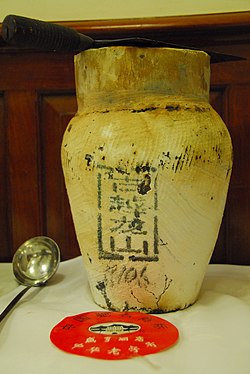
A smaller scaled version of the classic Shaoxing wine container
Simplified Chinese绍兴酒
Traditional Chinese紹興酒
Transcriptions
Standard Mandarin
Hanyu PinyinShàoxīng jiǔ
Yue: Cantonese
Jyutpingsiu6 hing1 zau2
Southern Min
Hokkien POJsiāu-heng-chiú

Shaoxing wine (alternatively spelled Shaohsing, Hsiaohsing, or Shaoshing) is a variety of Chinese Huangjiu ("yellow wine") made by fermenting glutinous rice, water, and wheat-based yeast.

It is produced in Shaoxing, in the Zhejiang province of eastern China, and is widely used as both a beverage and a cooking wine in Chinese cuisine. It is internationally well known and renowned throughout mainland China, as well as in Taiwan and Southeast Asia.[1][2]

The content of peptides in Shaoxing wine is high; however, their potential taste properties have not yet been studied.[3]

Production

[edit]

The traditional method involves manually stirring rice mash with a type of wooden hoe every four hours, in order to help the yeast break down the sugars evenly. Known as kāi pá (Chinese: 開耙), it is an essential skill to produce wine neither bitter nor sour. Another important skill of the winemaker is to assess the fermentation by listening to the vat for the sound of bubbling.[4]

In addition to glutinous rice, Shaoxing wine can also be produced with sorghum or millet.[5]

It is also bottled for domestic consumption and for shipping internationally. Aged wines are referred to by year of brewing, similar to grape vintage year (Chinese: 陳年; pinyin: chén nián).

Wines sold overseas are generally used in cooking, and can contain spices and extra salt.[6] Mislabeling wines from regions other than Shaoxing as "Shaoxing wine" is a "common fraudulent practice".[2]

Prominent producers

[edit]
  • Zhejiang Gu Yue Long Shan Shaoxing Wine Co., Ltd. (Chinese: 古越龍山) of Shaoxing, Zhejiang.[7][4]

In 2020, a revenue of 4.3 billion yuan ($664 million) was reported by 80 rice wine makers in Shaoxing.[5]

History

[edit]

Rice wine has been produced in China since around 770 to 221 BC and was generally for ceremonial use. During the late Qing dynasty, educated councilors from Shaoxing spread the popularity of wine consumption throughout the country and was an essential part of Chinese banquets.[5] Large quantities are made and stored in clay jars over long periods of time.[1]

In 1980s, Hong Kong, interest in Nü Er Hong, a brand of Shaoxing wine, grew due to nostalgic interest in mainland Chinese traditions, as well as references in popular martial arts novels of the time. Tung Chee-hwa celebrated his appointment as first Chief Executive of Hong Kong with Nü Er Hong.[4]

In China, the beverage's popularity has waned in favor of other types of alcohol, and it has a reputation for being "old-fashioned," although it is still used for cooking. Outside of Asia it is mostly regarded as a cooking wine.[5]

Classification

[edit]
Classification[8]
Name Sugar content
(g/L)
Type Ethanol
by vol. (%)
Yuanhong Jiu (Chinese: 元紅酒; lit. 'primary red alcohol') < 5 Dry wine > 14.5
Jiafan Jiu (Chinese: 加飯酒; lit. 'alcohol with added rice') 5–30 Semi-dry wine > 16.0
Huadiao Jiu (Chinese: 花雕酒; lit. 'alcohol in jars engraved with flowers'[6])
Shanniang Jiu Chinese: 善酿酒; lit. 'well-fermented alcohol' 30–100 Sweet wine (moelleux) > 15.0
Xiangxue Jiu (Chinese: 香雪酒; lit. 'snow-flavored alcohol') 200 Sweet wine (doux) > 13.0
Fenggang Jiu (Chinese: 封缸酒; lit. 'jug alcohol')

Usage

[edit]
A glass of Shaoxing wine

Better quality Shaoxing wine can be drunk as a beverage and in place of rice at the beginning of a meal. This type of Shaoxing wine is generally of higher quality and is more expensive than the cooking grades seen in the supermarkets, which contain added salt. When at home, some families will drink their wine out of rice bowls, which is also the serving style at Xian Heng Inn. If not served at a meal, Shaoxing wine can also accompany peanuts or other common snacks.

Nǚ Ér Hong (Chinese: 女兒紅; lit. 'daughter's red (wine)') is a tradition in Shaoxing when a girl is born into the family. A jar of wine is brewed and stored underground on the day of the daughter's birth, and dug out and opened for consumption on her wedding day as celebration.[4]

Huang jiu (Chinese: 黄酒; pinyin: huáng jiǔ; lit. 'Yellow Alcohol'), as it is known locally, is also well known for its use in meat dishes, in addition to being an ingredient in many dishes of Chinese cuisine. It is a key ingredient of Mao Zedong's favourite dish of braised pork belly with scallion greens – what he called his "brain food" that helped him defeat his enemies.[9] The following is a sample list of other common Shaoxing wine-marinated dishes. It is not limited to the following:[1]

References

[edit]
[edit]
Revisions and contributorsEdit on WikipediaRead on Wikipedia
from Grokipedia
Shaoxing wine, a renowned variety of Chinese (yellow wine), is a traditional fermented produced exclusively in , Province, using , wheat-based yeast, and water sourced from Jian Lake. With a brewing history spanning over 2,500 years—dating back to the (770–476 BCE)—it represents one of China's oldest alcoholic beverages and is celebrated for its mellow taste, amber hue, and complex aroma derived from a unique microbial process influenced by the region's mild, humid climate. The production of Shaoxing wine follows a meticulous, seasonal that begins around the Beginning of Winter in late autumn and extends over 80 days into spring, involving steps such as soaking and steaming the , natural cooling, inoculation with in sealed jars for initial , periodic stirring and , pressing to extract the liquid, by , and extended aging in vessels to enhance flavor depth. This labor-intensive method, recognized as a national by in 2006, underscores its artisanal roots and contributes to its distinctive sensory profile, including notes of nutty and subtle oxidation. Shaoxing wine is categorized into several types based on aging duration and additives, such as Yuanhong (raw red, unadulterated and aged for purity), Jiafan (made by adding steamed during ), Shanniang (double-fermented for intensity), and Xiangxue (fragrant snow, sweetly flavored), each suited for drinking, cooking, or medicinal uses in and . As China's first product to receive protection in 2000 and one of the inaugural items under the 2021 China-EU Agreement on Geographical Indications, Shaoxing wine exemplifies the interplay of , , and craftsmanship, with annual production of over 600,000 tons (as of 2021) from about 74 producers while preserving time-honored techniques amid modern innovations. Its cultural significance extends beyond consumption, symbolizing and festivity in Chinese society, and it continues to gain international acclaim for its role in elevating dishes like red-braised and as a sipping wine served warm.

Overview

Definition and characteristics

Shaoxing wine is a traditional variety of , known as yellow rice wine in English, which is a fermented alcoholic beverage originating from the region in Province, . It is produced through the and of , distinguishing it from distilled spirits such as and from grape-based Western wines that rely on fruit . Unlike those, Shaoxing wine undergoes no , preserving a natural profile derived solely from microbial action on rice starches. The wine exhibits a characteristic to deep brown color, resulting from the prolonged and aging processes that allow oxidative changes and Maillard reactions to develop. Its aroma is typically nutty and mildly sweet, with notes of , , and subtle earthiness, while the flavor profile emphasizes , balanced by a mellow sweetness, slight acidity, and a dry to semi-sweet finish depending on the aging duration. Alcohol content generally ranges from 14% to 20% ABV, contributing to its warming sensation when consumed. The texture is thicker and more viscous than many table wines, owing to residual sugars, proteins, and from the base. At its core, Shaoxing wine is crafted from , water, and qu—a wheat-based mold starter (similar to koji in Japanese sake production) that facilitates starch conversion to fermentable sugars through enzymes from and other molds. This raw material simplicity, without added preservatives or , yields a beverage rich in , organic acids, and volatile compounds that define its complex sensory attributes. While premium, unsalted Shaoxing wine is suitable for —often served warm to enhance its aromas—commercial cooking variants include added salt (typically 1.5%) to classify them as condiments rather than beverages, exempting them from alcohol regulations and preventing direct consumption due to the . These salted versions retain the wine's foundational flavors but are optimized for culinary applications like marinating or deglazing.

Geographical and cultural context

Shaoxing wine originates from the city of in province, eastern , where production is geographically limited to this region to maintain its unique qualities. The area's mild, , with abundant rainfall and moderate temperatures, fosters ideal conditions for cultivation and microbial fermentation essential to the wine's development. Local water sources, particularly from Jianhu Lake—fed by pristine mountain springs—contribute to the wine's distinct mineral profile and purity. Shaoxing holds a protected geographical indication (GI) status, making it the first Chinese product to receive such designation in 2000, ensuring that only wines produced within the specified area can bear the name. In 2006, the traditional brewing techniques of were inscribed on China's first national list of , recognizing their enduring craftsmanship and cultural value. This protection underscores the wine's deep ties to the region's and historical practices. As a historic in the Yangtze River Delta, is renowned for its heritage, epitomized by the "three great vats" tradition encompassing , , and dye production, which highlight its role as a center of artisanal . is concentrated around natural features like the Kuaiji Mountains, whose streams supply vital water and influence the local ecosystem supporting . The wine embodies Shaoxing's local identity as a symbol of heritage and continuity, traditionally stored in sealed earthen jars that may be buried or aged for years to enhance flavor through slow maturation. This practice reflects broader Chinese cultural emphases on patience and preservation of ancestral traditions.

History

Ancient origins

The legendary origins of Chinese wine, from which Shaoxing wine as a variant descends, are attributed to the figure of Du Kang during the around 2000 BC, often mythologized as the inventor of brewing techniques that transformed grains into alcohol. This underscores the deep cultural reverence for in ancient , though it applies broadly to early grain-based beverages rather than specifically to Shaoxing productions. Complementing these myths, archaeological evidence reveals practical fermentation practices in the region much earlier; analysis of residues from the Shangshan site in the Lower Yangzi River valley has identified a 10,000-year-old rice beer, produced using rice, other cereals, acorn, and lily with a qu starter containing Monascus mold and , marking the earliest known in . Historical documentation of wine in the area first appears during the (770–476 BC) and (475–221 BC), tied to the Kingdom of Yue in what is now Zhejiang Province. According to the ancient text (compiled around 239 BC), King Goujian of Yue (r. 496–465 BC) employed yellow wine to rally and reward his soldiers, enhancing morale during prolonged sieges and battles against the rival state of Wu, which contributed to Yue's eventual victory. These records highlight wine's role in military and state affairs within the Yue cultural sphere, predating more refined brewing localized to . In its nascent forms, the wine resembled unstrained, cloudy ales with dregs, brewed seasonally from local rice and other grains through natural fermentation processes involving molded starters, and it was primarily consumed in sacrificial rituals to honor ancestors and deities as well as for medicinal purposes to strengthen the body and treat ailments. This beverage emerged within the wider tradition of eastern China, where grain fermentation had long been practiced across regions for communal and ceremonial needs, well before emerged as a specialized hub.

Historical evolution

During the (206 BCE–220 CE), Shaoxing wine evolved from earlier crude ferments into a more refined product, with advancements in techniques leading to sweeter and strained varieties that improved clarity and flavor balance. The Eastern Han period (25–220 CE) particularly marked a turning point, as methods inherited from the Western Han refined the use of and wheat-based starters (qu), enhancing the wine's quality and distinguishing it as a staple in regional . By the (618–907 CE), Shaoxing wine gained widespread popularity, celebrated in poetry by figures like for its warming depth and cultural resonance, often evoking canal-side gatherings in . This era saw its expansion beyond local consumption, integrating into broader imperial culture amid economic prosperity. The subsequent (960–1279 CE) represented a key milestone, with the first detailed written brewing recipes appearing in texts like the Beishan Jiujing (11th–12th centuries), which documented qu-fermentation processes and contributed to standardized production of yellow wines, including Shaoxing variants. In the Ming and Qing dynasties (1368–1912 CE), wine solidified its status as an elite beverage, frequently featured in state rituals, imperial banquets, and upper-class social events, symbolizing refinement and hospitality. Innovations during this period included improved jar-sealing techniques using mud and lotus leaves to promote anaerobic aging in clay vessels, allowing wines to develop complex amber hues and nutty profiles over years. emerged as the "capital of ," with literary figures like extolling its role in creative and ritualistic life. The 20th century brought significant shifts, as wars and political upheavals, including the Sino-Japanese War and Civil War, led to production declines through disrupted supply chains and resource shortages. Post-1949 industrialization under state policies introduced mechanized elements to boost output, yet traditional methods were preserved through cooperatives and protected designations, ensuring cultural continuity amid modernization. By the , recovery efforts with government support revived production, while the 1980s economic reforms spurred further growth. In the early 1900s, the wine's cultural significance was highlighted by writer , a native, who referenced it in essays depicting childhood feasts and local traditions, embedding it in modern literary narratives of regional identity.

Production

Ingredients and preparation

Shaoxing wine, a traditional Chinese yellow rice wine (), is primarily produced using as the base ingredient, which provides the essential starches for . Premium varieties often employ locally sourced strains valued for their high content and low levels, which facilitate superior and microbial activity during . serves as the key material for preparing the koji-like known as "qu" (specifically mai qu or wheat qu), introducing enzymes such as and essential for breaking down starches into fermentable sugars. The water used is typically sourced from Jian Lake (Jianhu Lake) in , renowned for its purity from mountain springs and low mineral content, which contributes to the wine's clarity and subtle flavor profile without introducing off-notes. Quality standards for these ingredients are stringent to ensure authenticity and consistency. must be selected for its plump grains and optimal moisture absorption potential, avoiding varieties with excessive that could hinder even . Wheat for qu is chosen for full, uniform kernels with thin husks, promoting robust mold growth and production; authentic production eschews chemical additives, relying instead on natural microbial . For premium wines, or organically grown rice may be used to enhance terroir-specific aromas, though all raw materials undergo rigorous testing for contaminants to maintain the wine's protected status. The preparation begins with rice processing to ready the starches for enzymatic action. The rice is first rinsed thoroughly and subjected to a prolonged soaking—traditionally lasting 2–3 days or shortened to 6–10 hours in modern methods—to achieve full hydration and initiate subtle enzymatic softening. This is often a double-soaking technique, where the rice is soaked, drained, and resoaked to maximize release and remove impurities. Following soaking, the rice is steamed at high temperatures to gelatinize the starches, transforming them into a form accessible to the qu's enzymes; this step typically lasts until the grains are fully cooked yet firm, preventing mushiness. The steamed rice is then rapidly cooled to approximately 30°C to preserve microbial viability and prevent premature souring before mixing with the prepared qu. Meanwhile, the qu is prepared separately through a labor-intensive process. High-quality is moistened with 19–22% , mixed, and shaped into blocks or bricks, which are then placed in open areas near doors or windows to capture airborne microbes ly, fostering a diverse culture of molds, yeasts, and . These blocks incubate at 30–40°C for 1–2 days to initiate growth, followed by 40–50°C for 2–3 days to develop enzymes, and finally mature in a controlled qu room for 30–40 days, allowing moisture evaporation and aroma formation. This winter-timed process leverages cooler ambient conditions for stable microbial development in traditional settings. Authentic qu avoids synthetic inoculants, emphasizing airborne selection for unique flavor precursors.

Fermentation and aging process

The fermentation of Shaoxing wine begins with the initial stage, where steamed is cooled and inoculated with qu (a traditional starter culture containing for starch conversion and for yeast activity), allowing molds to break down starches into fermentable sugars over 3-5 days at 28-32°C. This process creates a saccharified mash rich in glucose, setting the foundation for subsequent alcohol production. A distinctive double-fermentation technique, unique to Shaoxing wine production, follows, involving sequential additions of to the mash, which promotes layered flavor complexity through staggered microbial activity; natural yeasts from the qu and ambient air contribute to spontaneous without added commercial strains. The main alcoholic then occurs over 7-10 days at 18-22°C, where yeasts convert s to , typically reaching 14-18% , while from the qu introduce subtle acidity. A post-fermentation phase extends up to one month at cooler temperatures around 15°C, allowing further flavor maturation through formation and residual before the mash is considered complete. Once concludes, the wine is pressed to separate the liquid from the solid lees (rice solids), followed by natural clarification through , avoiding mechanical to preserve authenticity and subtle particulates that enhance . The clarified wine is then transferred for aging, traditionally stored in jars buried underground or in cool cellars, sealed with a mixture of and lotus leaves to prevent oxidation while permitting minimal ; production typically starts in winter for optimal low-temperature conditions that slow microbial activity and promote gradual flavor integration. New wine requires a minimum of three months' aging to develop its characteristic hue and nutty profile, though premium vintages may age 20 years or more, resulting in deeper tones and intensified oxidative notes like soy and .

Notable producers

Shaoxing wine production is dominated by a handful of major brands that have played pivotal roles in preserving and commercializing traditional methods. Zhejiang Guyuelongshan Shaoxing Wine Co., Ltd., one of the oldest and largest producers, traces its origins to the late 19th century and operates as part of the China Shaoxing Yellow Rice Wine Group, which emphasizes large-scale traditional brewing and exports. The company produces a range of huangjiu varieties, including aged huadiao, and maintains cellars for long-term fermentation to uphold authentic flavors. Kuaijishan Shaoxing Wine Co., Ltd., founded in 1743 as the Yunji Wine Workshop, is renowned for its premium huadiao wines, crafted from selected glutinous rice and adhering to centuries-old family techniques. This producer focuses on high-quality, handcrafted batches that highlight the nuanced amber color and nutty profile of aged Shaoxing wine. Pagoda Brand, under Zhejiang Pagoda Wine Co., Ltd., emerged as an export pioneer in the 1950s and remains focused on international markets, with approximately 15% of its output shipped overseas to regions like Southeast Asia and North America. Historical producers have contributed to the wine's cultural legacy through family-run operations and specialized styles. Tapai Shaoxing Winery, a longstanding family enterprise in , specializes in huadiao and lao jiu varieties, maintaining small-batch production that echoes ancient brewing practices from the region's workshops. Nuerhong specialists, such as the iconic Nü Er Hong brand now under the Shaoxing Yellow Rice Wine Group, originated from 19th-century family traditions where the wine was buried for daughters' future weddings, symbolizing ceremonial use and long aging in clay jars. In modern times, hosts around 80 registered rice wine producers that sustain artisanal methods amid industrialization. These operations adhere to (GI) standards under GB/T 17946-2008, ensuring use of local , Jian Lake water, and qu within province. Innovations include sustainable sourcing of to reduce environmental impact and preservation of handmade qu through controlled microbial culturing, balancing with efficiency. The annual production across is approximately 600,000 tons (as of 2017), with top producers like Guyuelongshan exporting 15-20% of their output internationally to meet global demand.

Varieties

Classification by sweetness

Shaoxing wine is classified into four categories based on residual sugar levels following , a system that highlights how impacts the wine's flavor balance, , and suitability for consumption. This classification adheres to China's (GI) standards for Shaoxing wine, ensuring authenticity and in production. The dry type, known as yuanhong, features ≤ 10 g/L of residual sugar, yielding a nutty, acidic profile with pronounced dryness and minimal that emphasizes savory, notes. It is particularly suited for sipping neat to appreciate its refreshing, complex character. The semi-dry variety, or jiafan, contains 10–30 g/L residual sugar, providing a harmonious integration of subtle sweetness with the wine's inherent richness and smoothness. This balance softens the acidity while preserving a clean finish, making it a staple for daily enjoyment. In contrast, semi-sweet shanniang registers 30–100 g/L sugar, introducing fruitier undertones derived from additional incorporated during , which enhances its approachable, mildly indulgent profile. Its versatility stems from this moderate sweetness, allowing it to pair well with lighter fare or stand alone. Sweet xiangxue exceeds 200 g/L in residual , resulting in a pronounced, honeyed taste that evokes wines, with a viscous texture and lingering sweetness. This category is less common, frequently achieved through blending concentrated elements, and appeals to those seeking an overtly indulgent experience. Overall, these sweetness levels not only define the wine's sensory attributes but also guide its role in traditional and modern contexts, with drier styles often favored for their elegance in beverage form.

Classification by aging and style

Shaoxing wine is classified primarily by the duration of its aging process, which determines its sensory qualities, from freshness to complex depth. Wines aged for approximately one year, often referred to as new or young Shaoxing, exhibit a , fresh profile suitable for immediate use. Standard varieties, matured for 3 to 5 years, develop a mellow aroma and balanced flavor, making them ideal for typical drinking and cooking applications; this aligns with the minimum aging requirement of 3 years for superior-grade products under national standards. Longer-aged vintages, typically 8 to 10 years or more, acquire a deep hue and nuanced notes of , with some exceeding 20 years for enhanced complexity. Distinct stylistic variations further define Shaoxing wine beyond basic aging. Huadiao, meaning "flower carving," is stored in traditional painted jars for at least 5 years, allowing subtle oxidation that contributes to its elegant, slightly floral character while preserving the jar's decorative motifs. Nuerhong, or "daughter red," features a reddish tint from its production and is aged 10 to 18 years, often in sealed jars to promote gradual maturation and richer undertones. Special editions cater to culinary needs, distinguishing pure Shaoxing wine from salted cooking versions, the latter incorporating 1-2% salt to inhibit during high-heat cooking and to classify it outside beverage regulations. Production can yield either single-batch wines, derived from one cycle for purity, or blended styles combining multiple batches, where the labeled age reflects a weighted average to ensure consistency. Regulations for the (GI) label, protected since 2000, mandate production in the region and adherence to aging minima, such as 3 years for superior designations, to guarantee authenticity. Wines with extended aging, like 20-year vintages, command premium prices, often 5 to 10 times higher than standard 3-year options due to their scarcity and refined profiles.

Uses

Culinary applications

Shaoxing wine enhances flavors in Chinese cooking by imparting and depth, primarily through its and byproducts that amplify savory notes in dishes. The alcohol content evaporates during cooking, carrying away off-odors from ingredients like meat and seafood while leaving behind nutty, caramelized aromas. Its mild acidity also tenderizes proteins in marinades by breaking down muscle fibers, resulting in succulent textures for meats and seafood. In common applications, Shaoxing wine is integral to red-braising (hong shao), where it combines with and sugar to create a glossy, savory braising liquid that infuses proteins with balanced sweetness and saltiness. It features prominently in stir-fries, often added after aromatics like ginger and to deglaze the pan and integrate into vegetable and protein combinations. For marinades, it tenderizes , , and , as seen in techniques that coat proteins in a slurry including 1-2 teaspoons of wine per pound to protect against overcooking. Notable recipe examples include , a Shanghai-style cold dish where poached chicken is marinated in chilled Shaoxing wine, yielding a tender, aromatic result with pronounced from the wine's infusion. In braised (hong shao rou), about 2 tablespoons of wine per pound of pork adds complexity to the soy-sugar base, enhancing the melt-in-the-mouth texture during slow simmering. involves live or fresh briefly marinated in Shaoxing wine with ginger, allowing the wine to lightly "cook" the for a fresh, subtly boozy flavor profile. Salted versions of Shaoxing wine, formulated for cooking with added salt (typically 1.5%), are preferred to mitigate any residual raw alcohol taste in quick-cook methods like stir-fries, where full evaporation may not occur. Quantities generally range from 1-2 tablespoons per serving to avoid overpowering other flavors, though adjustments depend on the dish's scale. If unavailable, dry serves as a close substitute, providing similar dry, nutty notes without sweetness.

Beverage consumption

Shaoxing wine is traditionally served warmed to enhance its aromatic profile and mellow its flavors, often heated to around body temperature before being poured into small cups for slow sipping. This method allows the drinker to appreciate the wine's nutty, caramel-like notes without overwhelming intensity. It is commonly enjoyed alongside light snacks such as nuts or preserved meats, which complement its subtle sweetness and provide a balanced tasting experience. As a beverage, Shaoxing wine pairs well with fatty or rich foods, where its acidity and help cut through heaviness; for instance, it balances the oiliness of dishes or preparations. Aged varieties, such as five-year huadiao, are particularly suited for drinking and harmonize with lighter fare like or , enhancing their delicate textures without overpowering them. In modern contexts, Shaoxing wine has gained prominence on high-end menus, appearing neat or in innovative cocktails at Michelin-starred restaurants, such as the MSG Martini that incorporates it for savory depth. Its export has expanded notably in and the West since the 2000s, driven by growing interest in authentic Chinese beverages and a projected market CAGR of around 4.4% from 2024 to 2032 (as of 2024). Consumption etiquette emphasizes respect in social settings, particularly during banquets where it features in toasts, often consumed in one go to honor the occasion. With an (ABV) typically ranging from 15% to 18%, its moderate strength permits multiple servings over an evening without rapid intoxication, fostering prolonged enjoyment.

Medicinal uses

In traditional Chinese medicine (TCM), Shaoxing wine is valued for its warming and invigorating properties, often used to promote blood circulation and as a base for medicinal tonics. It is believed to aid , improve quality through neurotransmitters like and , and support heart health with moderate consumption. Certain varieties, such as those sweetened with , are incorporated into remedies for their purported benefits in enhancing vitality and treating minor ailments.

Cultural significance

Role in Chinese traditions

Shaoxing wine holds a profound ceremonial role in Chinese traditions, particularly within the cultural fabric of , where it symbolizes and familial bonds. A notable custom is the Nuerhong tradition, in which families brew and bury jars of the wine upon the birth of a daughter, unearthing them at her to share during the feast, representing blessings for a fortunate marriage and future abundance. This practice underscores the wine's integration into life milestones, evoking communal joy and continuity. Additionally, Shaoxing wine is offered in ancestral worship and festival rituals, such as during family gatherings and moon veneration, where it accompanies tributes to deities and forebears for harmony and good fortune. In social and literary contexts, Shaoxing wine embodies cultural essence, appearing in as a motif of inspiration and reflection, with odes often celebrating rice wines akin to it for evoking poetic reverie under the moon. It features in Confucian rituals to foster social harmony, where libations of yellow wine like Shaoxing are poured in ceremonies to honor ethical order and interpersonal balance, aligning with the tradition's emphasis on ritual propriety. In , the wine is valued for its warming properties, believed to dispel cold, promote circulation, soothe energy channels, and aid digestion, often incorporated into herbal preparations to enhance their efficacy. Local customs in Shaoxing further highlight its communal significance, with "wine villages" serving as hubs where families historically gathered for seasonal brewing, preserving shared techniques passed through generations. The wine's ties to literary heritage are evident in the writings of Lu Xun, the renowned Shaoxing-born author, who evoked it in essays depicting childhood feasts and local customs as emblems of regional identity and nostalgia. As a family heirloom, Shaoxing wine is stored in clay jars that age over decades, symbolizing longevity and transmitted across generations, with the vessels themselves often retained as cherished artifacts representing enduring legacy.

Modern recognition and economy

In recent years, Shaoxing wine has experienced a resurgence in global recognition, particularly within fine dining scenes outside China. Since the 2010s, it has transitioned from primarily a cooking ingredient to a featured beverage on high-end menus, including those in Michelin-starred establishments. For instance, in December 2024, reports highlighted its inclusion as a refined drink option in Michelin-starred restaurants worldwide, marking a revival after decades of decline. Specific examples include its pairing at EHB, a one-Michelin-star restaurant in Shanghai, and in a Japanese Michelin Guide selection featuring foie gras pickled in the wine. The brewing techniques for Shaoxing wine were inscribed as a national in in 2006, providing a foundation for its cultural preservation and international promotion, though it has not yet received direct listing. This status underscores its role in Chinese heritage, supporting efforts to elevate its profile globally through cultural exchanges and protections. In 2023, promotional events in further highlighted its heritage, linking it to broader national . Economically, the Shaoxing wine industry plays a vital role in province, contributing to local output within China's broader sector, which was valued at approximately USD 4.9 billion globally in 2023, with holding over 75% market share. varieties dominate Chinese production, driving exports protected under the 2021 China-EU Geographical Indications Agreement, which safeguards it against counterfeits in the market alongside 99 other Chinese products. This agreement has facilitated expanded trade, with wine benefiting from enhanced enforcement to combat fakes, a persistent challenge in the sector. further bolsters the , as attractions like the Rice Wine Museum and Yellow Wine City draw visitors, supporting related services and cultural experiences in the region. Amid pressures on , the industry is adopting innovations for and appeal to younger consumers. Producers are experimenting with modern fermentation techniques, such as additions to streamline processes without compromising quality, while young brewers introduce flavored variants like fruit-infused options to blend tradition with contemporary tastes. These efforts, led by companies like Gu Yue Long Shan, aim to revive interest among Gen Z through health-focused and creative products, with 2025 trends emphasizing R&D for sustainable practices and innovative flavors to attract eco-conscious youth.

References

Add your contribution
Related Hubs
Contribute something
User Avatar
No comments yet.