Recent from talks
Nothing was collected or created yet.
Sikhye
View on WikipediaThis article needs additional citations for verification. (August 2011) |
| Sikhye | |
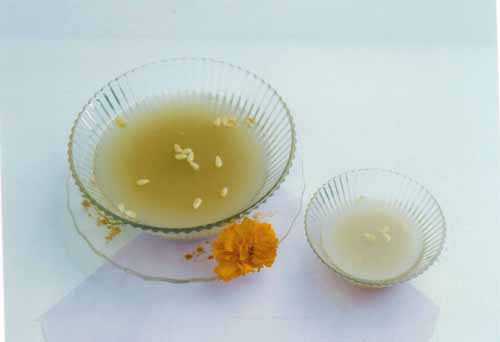
Sikhye served in a bowl | |
| Korean name | |
|---|---|
| Hangul | 식혜 |
| Hanja | 食醯 |
| RR | sikhye |
| MR | sikhye |
| This article is part of a series on |
| Korean cuisine 한국 요리 조선 료리 |
|---|
Sikhye (Korean: 식혜, also spelled shikhye or shikeh; also occasionally termed dansul or gamju) is a traditional sweet Korean rice beverage, usually served as a dessert. It is a popular beverage in South Korea, often found in the beverage sections of convenience stores. It is a drink made by fermenting rice with malt to give it a sweet taste.[1] In addition to its liquid ingredients, sikhye contains grains of cooked rice and in some cases pine nuts.[2] It is similar to the Chinese jiuniang and Japanese amazake.
Preparation
[edit]Sikhye is made by pouring malt water onto cooked rice. The malt water steeps in the rice at typically 62 degrees Celsius until grains of rice appear on the surface. The liquid is filtered and boiled until it gets sweet enough (no sugar is added to this drink).
In South Korea and in overseas Korean grocery stores, sikhye is readily available in cans or plastic bottles.[2] One of the largest South Korean producers of sikhye is the Vilac company of Busan. Most canned sikhye typically have a residue of cooked rice at the bottom. Homemade sikhye is often served after a meal in a Korean restaurant.
The method of making sikhye is to first measure the malt properly, put the skin in warm water, wash it, strain it through a fine sieve, and then let the water settle. Grow it in the ground and water it occasionally.[1]
Regional variations
[edit]There are several regional variations of sikhye. These include Andong sikhye and yeonyeop sikhye or yeonyeopju, a variety of sikhye made in Gangwon province. Andong sikhye differs in that it includes radishes, carrots, and powdered red pepper. Also, it is fermented for several days as opposed to being boiled.[3] The crunchy texture of the radish is kept despite the longer fermentation process; a soft texture would indicate an inferior product. Whereas the sweet canned or restaurant sikhye is enjoyed as a dessert beverage, Andong sikhye is appreciated as a digestive aid, containing lactobacillus.
Names
[edit]Sikhye is also referred to by the names dansul (단술) and gamju (감주; 甘酒). Both of these names mean "sweet wine" and are also used to refer to a sweet, slightly alcoholic rice wine.[2]
Hobak-sikhye
[edit]Hobak-sikhye (pumpkin sikhye) is a water-boiled broth with pumpkin, steamed rice, and malt. It is fermented for several days at a proper temperature. Some sugar is added to taste sweet.
Andong sikhye
[edit]
It is original sikhye in Andong, South Korea. It is a little bit different from other Sikhyes. This Sikhye's color is light red with red pepper added.
Though also made with rice, it is left to ferment naturally rather than rushed through the process using the boiling method. Sikhye, especially the type enjoyed in this city but also the most common variety, is high in probiotic bacteria.[4]
Yeonyeop-sikhye
[edit]Yeonyeop-sikhye is made by wrapping the hot glutinous rice, sake, and honey in a lotus leaf. Before drinking, put up a few pieces of pine nuts.
-
Hobak Sikhye
-
Andong Sikhye with gotgam-mari and strawberries
Effects
[edit]Sikhye is believed to aid digestion, as it contains dietary fiber and anti-oxidants. It was regularly served to royalty after meals to help digestion.[5]
Sikhye is said to help people who have a "cold" constitution to be warm and also helps those who have too "warm" constitution to be less warm.[5] It is also believed to be very helpful for relieving hangovers.[5]
Origin of the word
[edit]Sikhye is a word that does not exist in China or Japan, but rather a Korean word similar to "shikhye" with similar pronunciation and meaning. Sik (or Sak) is related with mature and Hye is making alcohol or sweet juice. These two words were combined to form. However, there is not yet a solid literary basis for etymology.[6]
Preparation
[edit]Barley is sprouted in water, then ground, filtered, and fermented.[7] the barley is made into grounded and fermented food
Gallery
[edit]-
Yeot-gireum (malted barley) used for making sikhye
-
A can of sikhye, produced by Korea Yakult
-
Andong-sikhye with gotgam-mari and strawberries
-
Hobak-sikhye (pumpkin rice punch)
See also
[edit]References
[edit]- ^ a b [한국민족문화대백과사전, 식혜].
- ^ a b c "Traditional Beverages". Korea Tourism Organization. Archived from the original on 16 September 2016. Retrieved 24 April 2013.
- ^ "All about Korean Food". Hansik.org. Archived from the original on 2012-04-02. Retrieved 2011-11-09.
- ^ Sikhye - Kocis
- ^ a b c "Traditional Winter Beverage and thirst quencher, Sikhye". Seoul Metropolitan Government. 2011-02-25. Archived from the original on 2011-02-28. Retrieved 24 April 2013.
- ^ [이태호의 음식 이야기] 식혜=단술?. Busan Ilbo (in Korean). Retrieved 2019-04-27.
- ^ 싹 틔워 빚은 단술은 왕세자 음복. JoongAng Ilbo (in Korean). 2012-04-01. Retrieved 2019-04-27.
External links
[edit]Sikhye
View on GrokipediaOverview
Description
Sikhye is a traditional Korean beverage characterized as a sweet, mildly fermented, non-alcoholic rice drink, primarily made from cooked rice and malt water derived from barley.[2] This refreshing drink features a subtle malty flavor and gentle sweetness from the natural fermentation process, and it is typically served chilled as a dessert or after-meal aid for digestion.[3] In appearance, sikhye presents as a clear, golden liquid containing floating grains of softened, white rice, often garnished with pine nuts for added texture and visual appeal.[7] Sikhye bears resemblance to the Chinese jiuniang and Japanese amazake, which are also mildly fermented rice-based beverages, yet it uniquely embodies a Korean profile through its balanced, non-overpowering sweetness and cultural serving customs.[8] It is widely accessible in Korean restaurants, homes prepared traditionally, and commercial packaging such as cans or bottles from brands like Paldo.[9][10]Cultural Significance
Sikhye serves as a traditional post-meal digestive aid in Korean homes and restaurants, particularly following consumption of heavy dishes such as Korean barbecue or during holiday feasts like Chuseok, where it helps mitigate indigestion from rich, oily foods.[1] This practical role underscores its integration into daily and celebratory dining, often enjoyed chilled to refresh the palate after substantial meals.[11] In Korean society, sikhye embodies the rice-centric culture that has defined the nation's culinary heritage since ancient times, symbolizing abundance and familial bonds through its preparation from staple grains. It is commonly made for family gatherings, weddings—where it is ladled from large punch bowls garnished with honey and pine nuts—and other special occasions, fostering a sense of communal warmth and tradition.[12] Historically, during the Joseon Dynasty, sikhye was offered to royalty and guests as a gesture of hospitality, reflecting its status as a thoughtful beverage that aided digestion while demonstrating care for visitors' well-being.[13] Today, it enjoys modern popularity as a nostalgic drink, evoking childhood memories of homemade batches prepared by elders during holidays and family events.[12] Sikhye also holds ties to seasonal and ritualistic practices, frequently appearing in autumn harvest celebrations like Chuseok, where it complements ancestral offerings on the jesa table alongside fruits, nuts, and rice cakes, honoring forebears and expressing gratitude for the bounty.[14] Its mild fermentation process aligns with themes of natural purity in these contexts, enhancing its role in rituals that blend reverence with everyday refreshment.[15]History and Etymology
Historical Origins
Sikhye's roots lie in ancient Korean traditions of fermented rice beverages, which emerged during the Three Kingdoms period (57 BCE–668 CE) alongside the expansion of rice cultivation on the Korean peninsula. These early drinks were used for religious rituals and as medicinal aids for digestion after heavy meals, often involving simple infusions of malted barley with cooked rice, supported by advancements in wet-rice farming that utilized glutinous rice.[16][17] Fermented rice drinks were common during the Goryeo Dynasty (918–1392 CE), influenced by Buddhist cuisine, where non-alcoholic alternatives to rice wine were prepared using malt for sweetness and served in ceremonial or restorative contexts. While sikhye as a specific beverage is not explicitly documented in surviving Goryeo literature, the period's fermentation techniques with local barley and rice laid groundwork for its development.[18] The earliest known record of sikhye appears in the 15th-century Joseon Dynasty medical encyclopedia Hyangyak Jipbo, describing it as a digestive aid. During the Joseon Dynasty (1392–1910 CE), it became prominent in court settings, including ancestral rites and banquets, served to royalty and nobility to aid digestion after meals. Recipes preserved in documents from the 17th to 19th centuries, such as Siuijeonseo, detail preparation with steamed rice and malt extract, sometimes including ginger. Its role expanded with rice agriculture, shifting from a seasonal autumn drink using surplus grains to a year-round beverage, with regional variations in grains and methods before late-dynasty standardization.[19][1][20]Origin of the Name
The term sikhye (식혜) is a Sino-Korean compound from 食醯, where sik (食) means "food" and hye (醯) denotes a fermented or vinegar-like liquid, reflecting its rice-based fermented nature to produce a sweet, non-alcoholic drink. No ancient textual basis definitively traces the word's first use, though it aligns with traditional Korean naming for grain ferments.[21] Historically, the drink has been referred to by alternative names such as dansul (단술), meaning "sweet dew," or gamju (감주), meaning "sweet liquor," emphasizing its mildly fermented, refreshing qualities without alcohol. These terms distinguish it from stronger rice wines. By the Joseon Dynasty (1392–1910 CE), the name sikhye became standardized, consistent with its role as a post-meal digestive beverage, though the hye component evokes mild ferments like makgeolli.[8][6] English transliterations vary, such as shikhye or shikeh, preserving the Korean phonetics. The naming reflects cultural focus on sweetness and digestibility, as a non-intoxicating option in Korean grain beverage traditions.[6]Preparation
Ingredients
The primary ingredients for traditional sikhye are cooked short-grain rice, malted barley (known as godulppumi in Korean, providing the amylase enzyme essential for starch conversion during fermentation), and water.[3][2] The rice serves as the starch base, typically short-grain varieties like those used in everyday Korean cooking, which yield a soft, slightly chewy texture to the floating grains characteristic of the drink; glutinous rice can be substituted for a stickier consistency, while regular short-grain rice produces a lighter result.[2][7] Malted barley, sprouted and often ground into powder (yeotgireum-garu), is crucial for its natural enzymes that break down rice starches into fermentable sugars, imparting the drink's signature subtle sweetness and malty aroma without added alcohol production.[3][4] Water forms the bulk of the beverage, ideally filtered or room-temperature to facilitate enzyme activation when extracted naturally from the malt at around 62°C for optimal results.[22][23] Optional additions include sugar or honey to enhance sweetness, particularly in home recipes where natural fermentation may vary, though traditional preparations rely primarily on the malt's enzymatic action for flavor.[3][2] Garnishes such as pine nuts or a dash of cinnamon powder are sometimes sprinkled on top for texture and aroma but are not integral to the base recipe.[4] In some variations, nuruk—a traditional Korean fermentation starter made from wheat or rice—may replace or supplement malted barley, though this is less common in standard sikhye and more typical in regional or experimental brews.[7] Quality factors significantly influence the final product: fresh malted barley ensures maximum enzyme activity for balanced sweetness and prevents off-flavors from staleness, while the choice of rice type affects the drink's body—glutinous rice for denser grains versus non-glutinous for a clearer liquid.[22][23] Sourcing high-quality, domestically grown barley malt from reputable producers maintains authenticity, as imported varieties may alter the enzyme profile and taste.[2]Traditional Preparation Method
The traditional preparation of sikhye involves a multi-step process that relies on the enzymatic action of malted barley to saccharify cooked rice, producing a naturally sweet, non-alcoholic beverage.[1] To begin, rinse and soak approximately 200-250 grams of barley malt (germinated barley) in 12 cups of warm water (around 40°C) for 20-30 minutes to soften the grains and initiate enzyme release.[2] Massage the malt through a cheesecloth or fine sieve to extract the milky liquid, which contains amylase enzymes, then allow the mixture to settle for 15-30 minutes (or up to 8 hours for clearer liquid) so sediments sink, yielding about 10-12 cups of malt water.[1][24] Next, cook 1 cup of short-grain rice with ¾ to 1 cup of water until fully steamed and slightly overcooked, resulting in about 2 cups of fluffy rice.[2] Combine the cooked rice with the clear malt water in a vessel that maintains a steady temperature of 60-65°C, such as a traditional onggi pot or a rice cooker's warming function, to activate the enzymes for saccharification.[1][12] Allow the mixture to ferment gently for 4-8 hours, monitoring until 7-10 rice grains begin to float to the surface, signaling that the starches have converted to sugars without excessive acidity.[2] This controlled warmth prevents over-fermentation, which can lead to sourness if the process extends beyond 8 hours.[24] Once saccharification is complete, strain the liquid from the rice grains, reserving some grains to rinse in cold water for garnish. Boil the strained liquid with an additional 2-3 cups of clear malt water (if needed for volume) and ¾ to 1 cup of sugar for 5-10 minutes to halt fermentation, enhance sweetness, and clarify the beverage by skimming foam.[1] Cool the mixture rapidly, then refrigerate; the final product is served chilled with a few floating rice grains atop each bowl.[12] The entire process requires 7-10 hours of active time, including preparation and fermentation, plus cooling, and yields approximately 2-3 liters from 1 cup of rice.[2] Traditional onggi pots are preferred for their even heat distribution and breathability, aiding consistent enzyme activity during fermentation.[12]Variations
Regional Variations
Sikhye exhibits notable regional variations across Korea, reflecting local ingredients, climate influences, and traditional practices that adapt the base fermentation process. In the Andong region of North Gyeongsang Province, Andong sikhye stands out for its savory and spicy profile, diverging from the typical sweetness of standard sikhye. It incorporates white radish and carrot for added crunch and uses red pepper flakes to impart a tangy heat, achieved through natural fermentation of steamed rice steeped in hot malted barley water rather than boiling. This extended fermentation enhances probiotic content and results in a less sweet, more robust flavor suited to the region's culinary emphasis on bold tastes.[12] Hobak-sikhye, a pumpkin-infused variant, introduces a creamy texture and autumnal sweetness by incorporating danhobak (Korean pumpkin or winter squash) alongside rice and malted barley water. The pumpkin is typically steamed and added during the brewing stage, with the mixture fermented for several days after incorporating extra sugar, yielding a yellow-orange hue and a mellow, spiced note often enhanced by ginger. This version is particularly favored in areas where seasonal squashes are abundant, offering a heartier alternative to plain sikhye during cooler months.[12][6] In Gangwon Province, yeonyeop-sikhye (also known as yeonyeopju) utilizes lotus leaves for wrapping and infusing the fermenting rice, malt, honey, and sake, imparting subtle herbal and earthy aromas and the province's natural lotus habitats. The lotus leaf enclosure during the pressure-cooker fermentation process creates an alcoholic variant with a distinctive sweet-tangy balance. This method highlights the region's integration of local flora into beverage traditions.[6] These tweaks underscore how environmental factors shape sikhye's accessibility and taste across Korea.[12]Modern and Commercial Variations
In the late 20th century, commercial production of sikhye expanded significantly in South Korea, with brands like Paldo introducing canned versions such as Vilac Shikhye in 1993, featuring a 238 ml serving size at approximately 85 kcal per can and pasteurized for extended shelf life without artificial preservatives.[25][26] Similarly, Haitai has offered bottled and canned sikhye under its Traditional Drink line, maintaining uniform sweetness through standardized fermentation processes to meet mass-market demands.[27] These factory-produced variants diverge from homemade methods while preserving the core malty rice flavor.[28] Contemporary home adaptations have simplified traditional preparation using modern appliances like rice cookers or Instant Pots, reducing active monitoring time to 4-8 hours of fermentation on the warm setting until rice grains float, as opposed to longer overnight methods.[3][2] Innovative flavored recipes have emerged, such as purple sweet potato sikhye, where steamed purple sweet potato is blended into the malt water base for added color and natural sweetness, appealing to health-conscious consumers seeking nutrient-enhanced twists.[29] In urban cafes and dessert settings, sikhye has inspired fusions like sikhye ice cream, incorporating the fermented rice drink into creamy bases for a malty, cooling treat popular in Seoul establishments.[30] Boba-infused versions, known as sweet rice drink with boba, combine sikhye's mild sweetness with chewy tapioca pearls, often served chilled in Korean-American cafes as a modern dessert beverage.[31] These adaptations extend to hot winter servings garnished with pine nuts or punch-style mixes at contemporary weddings, blending nostalgia with cafe aesthetics. Since the early 2000s, sikhye has gained global traction as "Korean rice punch," with exports rising notably; for instance, Paldo's Vilac Shikhye has achieved cumulative sales exceeding 2 billion units, including halal-certified variants for international markets like the Middle East and Southeast Asia.[32][24] In South Korea, commercial output remains robust, supporting widespread availability in supermarkets and contributing to the beverage sector's growth.[33]Nutrition and Health Effects
Nutritional Profile
Sikhye provides approximately 100-144 kcal per standard serving of 240-250 ml, with the majority of energy coming from carbohydrates derived from rice and malt fermentation.[34][35][36] In terms of macronutrients, a typical serving contains 21-34 g of carbohydrates—predominantly sugars produced during fermentation—along with 0-1.3 g of fat, 0.9-2 g of protein, and 1-1.8 g of dietary fiber.[37][34][35] Micronutrient levels are generally low, featuring 10-17 mg of sodium and 43 mg of potassium per serving, as well as antioxidants contributed by malt and trace B-complex vitamins from rice.[36][34] The nutritional profile differs between preparations: traditional homemade sikhye relies on natural fermentation for sweetness and thus has lower added sugar, whereas commercial products frequently incorporate additional sugars up to 17 g per serving and remain free of cholesterol. Nutritional values vary significantly between homemade (higher calories from natural sugars) and commercial (often lower, with added sugars) versions.[37][34][35] Sikhye yields 35-60 kcal and 8-12 g of carbohydrates per 100 g, varying by preparation.[37][38]Health Benefits
Sikhye serves as a traditional digestive aid due to the amylase enzyme present in the barley malt used during its preparation, which breaks down starches into simpler sugars, facilitating easier digestion and helping to prevent indigestion after heavy meals.[39] Historically, it has been consumed post-meal in Korean culture to soothe the stomach and alleviate hangovers by promoting gastric comfort and reducing bloating.[24] The beverage's antioxidant properties, derived from polyphenols and flavonoids—particularly in versions made with brown rice or GABA-enriched rice—help combat oxidative stress and may reduce the risk of arteriosclerosis. Recent studies as of 2024 confirm antioxidant benefits in brown rice sikhye variants.[40] Its dietary fiber content may aid digestion and contribute to general health benefits associated with fiber, such as lowering cholesterol.[41] Additional benefits include its cooling effect, which balances body temperature during summer, and mild probiotic elements from fermentation that promote gut health.[24] With its low alcohol content from brief fermentation, sikhye remains non-intoxicating and suitable for all ages.[3] However, commercial varieties often contain high added sugars, which may elevate blood glucose levels and pose risks for individuals with diabetes, necessitating moderation.[42] While traditionally valued by Korean royalty for enhancing vitality, contemporary evidence relies on food science studies rather than large-scale clinical trials.[40]References
- https://en.wiktionary.org/wiki/sikhye
