Hubbry Logo
ShepshedShepshedMain
Open search
Shepshed
Community hub
Shepshed
logo
8 pages, 0 posts
0 subscribers
Be the first to start a discussion here.
Shepshed
Shepshed
from Wikipedia

Shepshed (often known until 1888 as Sheepshed,[1] also Sheepshead – a name derived from the village being heavily involved in the wool industry) is a market town and civil parish in the Charnwood Borough of Leicestershire, England with a population of 14,875 at the 2021 census.[2] It is the second largest settlement in the borough, after Loughborough

Key Information

History

[edit]

Origins

[edit]

The town originally grew as a centre for the wool trade.[3] There has been controversy about the origin of the name of the town. The earliest form is Scepeshefde Regis as mentioned in the Domesday Book of 1086, which means "(King's) hill where sheep graze", but since then there have been many changes until the present form, Shepshed, was adopted in 1888.[4] The addition of the suffix 'Regis' signifies that there was once a royal lodge in the area.

Very little information about the settlement on the site of Shepshed appears before the Domesday Book but the name is certainly Anglo-Saxon: local history books claim that Shepshed has two of the oldest roads in the country, Ring Fence and Sullington Road, the latter being an ancient British track named after the goddess Solina. Anglo-Saxon Shepshed cannot have been much more than a hamlet in a large district of forest. However, succeeding centuries provide an abundance of historical material.[citation needed] The prosperity of medieval Shepshed was based on the wool industry and "Well Yard" on Forest Street may well be a corruption of "Wool Yard", where Bradford wool merchants congregated to buy from local inhabitants. In addition, there is considerable evidence to suggest that a weekly market was held, at least until the 14th century.[citation needed]

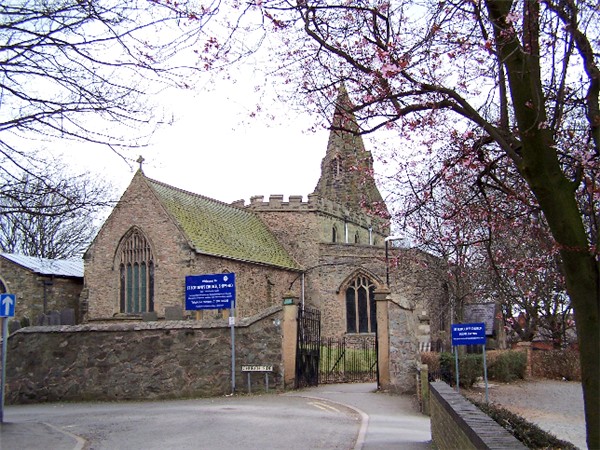
Parish Church of St Botolph

[edit]

The 11th century Parish church of St Botolph (the westernmost parish church in England to bear the name)[citation needed] and its land the Oakley Wood was originally given to Odo of Bayeux, half-brother of William the Conqueror, after the Norman conquest in 1066. The ownership of the estate reverted to the Crown a number of times including in 1534. A wood carving exists in the church depicting a visit of Queen Elizabeth I though it is at present unclear if the Queen ever came to Shepshed itself, but if she did, it would have been the farthest north that she travelled in the country.[citation needed] The older part of the town is still centred on the church.

The church's original patronage came from Leicester Abbey. Between 1699 and 1856, however, the patrons were the Phillips family of Garendon Hall. This family has been Lords of the Manor since its purchase by Sir Ambrose Phillips (1637–1691) in 1683. Garendon Hall (demolished 1964[5]) was built on the site of Garendon Abbey, a prominent Cistercian house which was founded in 1133 by Robert de Beaumont, 2nd Earl of Leicester and survived until its dissolution by Henry VIII in 1536. Garendon Abbey, whose economy was largely based on sheep farming, was one of the most important possessor of granges in Leicestershire.[6]

18th to 20th centuries

[edit]

The 18th century saw the enclosure of the common lands around Shepshed. There had been enclosures in the 15th and 16th centuries,[citation needed] but towards the end of the 18th century the last remaining common land, approximately 2,000 acres (8 km2), was enclosed and divided among the principal commoners of the village.

Shepshed experienced an 'earthquake' on 30 September 1750. The vicar of St. Botolph's church at the time, the reverend Thomas Heath, recorded in the parish registers: "Sept 30, 1750, this day (Sunday), while I was administering the Sacrament, between the hours of 12 and 1 o’clock, I and the congregation were very terrible of the shock of an earthquake."[7]

Much destruction was caused in the town when, on 30 June 1753, 85 bays of buildings were destroyed by fire which had happened at what is now known as Hall Croft, named after the school which had been burnt down in the fire.

There were many changes during the 19th century. Shepshed was briefly linked by canal to Loughborough, and to the coalmines of West Leicestershire when the Charnwood Forest Canal was opened in 1798, but success was only short lived. The following year, the dam at Blackbrook Reservoir, to the south of Shepshed, part of the ill-fated canal scheme, collapsed, causing widespread flooding in Shepshed and Loughborough. By 1804 the canal had proved an uneconomic venture and was abandoned, though modern roads and footpaths still follow the course it took through Shepshed.[8] The Charnwood Forest Railway (nicknamed the Bluebell Line on account of the proliferation of the flower) was opened in 1883,[9] but regular passenger services ceased in 1931. However, the goods service did not close until 1963. Shepshed railway station no longer stands though part of the old line forms a bridleway between the town and Thringstone including the now redundant viaduct at Grace Dieu.

Landmarks

[edit]

St Winefride’s Church

[edit]

St Winefride’s is the Roman Catholic parish church in Shepshed, forming part of the Diocese of Nottingham. The church building, located on Charnwood Road, dates from the 1928 and serves the local Catholic community with regular liturgies, including weekend and weekday Masses. It also plays a role in parish life through various volunteer-led activities and services.

The parish includes St Winefride’s Catholic Voluntary Academy, a primary school situated nearby, which serves local Catholic families and feeds into secondary education at De Lisle College in Loughborough.

The spelling "Winefride" in relation to St Winifred (also spelled Wenfrewy, Gwenfrewi, or Winifred) comes from older Anglicised or Latinised versions of her original Welsh name, Gwenffrewi.

Since 2023 the parish priest has been Fr. Patrick Edet Bassey.

Education

[edit]

The main school was previously Hind Leys Community College which educated pupils from 14 to 19, in the town, and included pupils not only from Shepshed, but also from local towns and villages such as Loughborough, Kegworth, Belton, Castle Donington, Diseworth, Long Whatton and Tonge. This school then combined with Shepshed High School to become the new Iveshead School which educates ages 11-19 from the same areas as the previous Hind Leys Community College. There are four primary schools in the town, and three of these feed into Iveshead; Oxley, St Botolph's (Recently Demolished) and Newcroft. The final primary school, St Winefride's, caters for Roman Catholic pupils until the age of 11, after which most of them transfer to De Lisle College 11–19 school in Loughborough. Newcroft Primary School became Newcroft Primary Academy in 2016.

Transport

[edit]

Shepshed is located close to junction 23 of the M1 motorway. The nearest railway station is Loughborough railway station, and East Midlands Airport is seven miles away.

Buses

[edit]

Shepshed is serviced by Arriva Midlands services 16/16A and 127 with frequent buses into Loughborough and Coalville,[10] and Diamond East Midlands' route 129 between Loughborough and Ashby.[11] The skylink Nottingham operated by trentbarton also links the village with East Midlands Airport and Nottingham.[12]

Sport

[edit]

The town is represented in the Northern Premier League by Shepshed Dynamo F.C., who play at the Dovecote Stadium. Ingles F.C. (formed in 1972) also have two football teams. The first team ground shares with Shepshed Dynamo at the Dovecote stadium while the reserves are based at Little Haw Lane. The club has progressed rapidly since 2013 with back to back promotions and now the first team currently play in the Midland League Division One with the reserves in the Leicestershire Senior League.

Shepshed Cricket Club was formed in 2015[13] from the merger of the towns 2 existing cricket teams; Shepshed Town[14] and Shepshed Messengers. Shepshed Town was established in 1869 and in recent years has been ranked among the top clubs in Leicestershire.[15] Following the merger, the club will field 4 senior sides as well as Under 15, Under 13 and Under 11 sides.

The major Rugby side in the town is Shepshed RFC. who train and play on the Hind Leys Campus. Founded in 1985, they won the LRU Division 4 in 2014 and the LRU Division 3 in 2015.[16]

Notable People

[edit]

Shepshed Fire Station

[edit]

Shepshed has a retained fire station, part of Leicestershire Fire and Rescue Service (LFRS), serving the town from the fire station on Charnwood Road. The station, which opened in 2002, replaced the previous station built on the same site in 1951[18] and was initially opened as a combined police and fire station. The police station was quickly downgraded to an office and then withdrawn completely, leaving Shepshed without a police station for the first time in many decades. LFRS took over the entire building and now operate a training centre alongside the retained station. In front of the station is a memorial to two Shepshed police officers who were murdered in the line of duty in 2002[19][20] and two long-serving firefighters, one of whom died en route to a fire call in 2006.[21]

The station operates a Scania pumping appliance and a Command Support Vehicle.[22]

References

[edit]
Revisions and contributorsEdit on WikipediaRead on Wikipedia
from Grokipedia
Shepshed is a and in the Charnwood Borough of , , located approximately 5 miles (8 km) northwest of on the northern edge of . With a population of 14,875 as recorded in the 2021 census, it serves as the second-largest settlement in the borough after . The town's name derives from its historical association with sheep, originally appearing as Scepeshefde in the of 1086, where it was noted as having 76 households and supporting a prosperous medieval economy centered on the trade. Merchants from regions like traveled to Shepshed to purchase locally produced , contributing to its growth as a key hub that persisted into the with framework as a principal industry. In the , the decline of traditional transformed Shepshed into a commuter or dormitory , benefiting from its proximity to the and easy access to cities such as (about 12 miles southeast) and (about 20 miles north). Today, the local economy focuses on retail, services, and , supported by a weekly market and town center regeneration efforts completed in 2024 that include pedestrianized areas and improved public spaces. Notable landmarks include the 11th-century Church of St Botolph, Shepshed's oldest surviving building with Norman origins and later medieval additions, and the designated Shepshed Conservation Area, which preserves historic structures like the Grade II-listed Pied Bull pub. The town also features the Shepshed War Memorial, unveiled in 1918 to honor local fallen from the World Wars, and maintains green spaces such as the nearby Blackbrook Reservoir for recreation.

Geography and demographics

Location and topography

Shepshed is a town located in the Charnwood Borough of , , situated approximately 5 miles (8 km) northwest of and on the northern edge of . The town's geographical coordinates are approximately 52°46′12″N 1°17′33″W, with an grid reference of SK4719. This positioning places Shepshed at the interface between the broader Soar Valley lowlands and the more elevated, forested uplands to the south and west. The of Shepshed features a lowland setting with gently rolling hills, transitioning from relatively flat terrain in the east to undulating slopes rising westward toward . The town lies in close proximity to the River Soar to the east, influencing local drainage patterns and providing a natural lowland contrast to the higher ground nearby. Elevations in the area range from about 100 to 150 meters above , with an average of 111 meters, contributing to varied landscapes that include open countryside and subtle gradients. Natural features around Shepshed include significant woodlands on the higher southern ground and former quarries to the east, which are partially screened by mature vegetation. Historically, the town's location has served as a gateway to , facilitating access to its scenic and geological resources while shaping its role within the regional landscape. The of Shepshed has exhibited steady growth since the early , reflecting broader demographic shifts in the region. Historical records show the population at 2,627 in 1801, increasing to 3,872 by 1841, 3,759 in 1851, 3,626 in 1861, 3,784 in 1871, 4,437 in 1881, 4,416 in 1891, and 5,293 in 1901. This period marked a gradual expansion from the trade era, with the population more than doubling over the century. Growth accelerated in the 20th and 21st centuries, driven by suburban development. The reached 12,882 in 2001, 13,505 in 2011, and 14,875 in the 2021 census, representing an annual change of 0.97% between 2011 and 2021. The town's proximity to urban centers like and has facilitated this trend through net inward migration, supporting patterns. In the 2021 census, Shepshed's demographic composition included 19.1% of residents aged 0-17 years, 59% aged 18-64 years, and 21.9% aged 65 years and over, indicating a balanced but slightly aging structure compared to national averages. Ethnically, the is predominantly at 96.1%, with Asian groups at 1.9%, mixed or multiple ethnicities at 1.2%, Black at 0.4%, and other ethnic groups at 0.4%, underscoring a largely profile. Household types in 2021 were dominated by one-family households (approximately 70%), including married or civil-partner couples (both with and without dependent children) and lone-parent families, followed by one-person households (around 25%), many headed by those aged 65 and over. Migration patterns show moderate inflows, with about 10% of residents having moved within the previous year, primarily from nearby districts, contributing to the sustained growth.

History

Origins and early settlement

The settlement of Shepshed likely originated during the Anglo-Saxon period, with its name deriving from elements meaning "hill where sheep graze," reflecting the area's pastoral character. Although direct evidence of pre-Conquest habitation is scarce, the etymology points to establishment between the 7th and 9th centuries, consistent with broader patterns of Anglo-Saxon settlement in . Shepshed is recorded in the of 1086 as Scepeshefde, under the ownership of King William as , within the hundred of Goscote in . The entry describes a community of 76 households—comprising villagers, freemen, smallholders, slaves, and men-at-arms—supporting 38 teams on , alongside 50 acres of , extensive , and a mill valued at 5 shillings. The valuation stood at 6 pounds annually, though the land may have been waste or underdeveloped prior to 1066. From its early days, Shepshed served as a on the northwestern edge of , with its economy centered on and the wool trade, which drove initial prosperity. Merchants, including those from , frequented the area to purchase , establishing it as a key hub for regional pastoral commerce. The of St Botolph, with foundations possibly tracing to the early medieval period, underscores the settlement's growing communal and religious structure. The place name evolved over centuries, appearing in various forms such as Sheepshead or Sheepshed until 1888, when the modern spelling "Shepshed" was officially adopted, aligning with its enduring sheep-related heritage.

Medieval to early modern developments

During the medieval period, Shepshed functioned as a market town centered on agriculture and pastoral farming, particularly sheep rearing, which supported its economic growth within the Charnwood region. Recorded in the Domesday Book of 1086 as Scepeshefde, the settlement was a royal manor valued at 6 pounds, supporting 38 plough teams on arable land, alongside 50 acres of meadow and woodland measuring 1 league long by 4 furlongs wide. The Market Place served as the commercial hub, accommodating traders and supported by inns, with a market cross noted as early as 1811, indicating customary market rights though no specific royal charter has been documented. Ties to monastic institutions were significant, as the Cistercian Garendon Abbey, founded in 1133 by Robert de Beaumont, 2nd Earl of Leicester, received endowments including the wood of Shepshed and surrounding lands, establishing granges for sheep farming that employed local labor and boosted wool production until the abbey's dissolution in 1536. The Parish Church of St Botolph, Shepshed's oldest surviving structure, traces its origins to the , with medieval street patterns radiating from its elevated site, reflecting its central role in community life. Originally supported by , the church features a Saxon font and Norman pillars, attesting to early Norman influences. Expansions occurred primarily in and 14th centuries, including an early 13th-century tower and alongside 14th-century aisles with piers, enhancing its capacity amid growing population and prosperity from the wool trade. A Tudor-era royal coat of arms survives within, underscoring the church's enduring ties to local and royal . In the Tudor and Stuart eras, Shepshed's social structure remained anchored in the manorial system inherited from its Domesday origins as a royal demesne, with common lands sustaining pastoral activities until gradual enclosures began in the 15th and 16th centuries, converting open fields to private pastures and prompting shifts in land use. These early enclosures laid roots for later transformations, though they disrupted traditional communal farming. Local legend, supported by a wooden carving in St Botolph's Church, suggests a possible visit by Queen Elizabeth I, but historical evidence remains unverified. The wool trade continued as a mainstay, linking medieval monastic practices to emerging domestic production by the mid-17th century.

Industrial era and 20th century

Shepshed experienced significant in the mid-18th century that marked the transition into its industrial period. On 30 September 1750, a notable struck the area during a Sunday service at St. Botolph's Church, as recorded by the vicar Thomas Heath in the parish registers, causing alarm but no reported major structural damage. Just three years later, on 30 June 1753, the Great Fire of Shepshed devastated the village, destroying 85 bays of buildings in a blaze whose origin remained uncertain. The late 18th century brought agricultural and economic shifts through the Enclosure Act of 1777, which privatized approximately 2,000 acres of open fields and common land, fundamentally altering traditional farming practices and consolidating holdings among principal landowners. This reorganization facilitated the rise of framework knitting, a key industry that expanded rapidly from the late , with over 1,000 frames in use by 1753 and about 900 by 1812 according to Blackner's census, making Shepshed a major center for production in . A short-lived operated from 1780 to 1845, further diversifying local manufacturing. Infrastructure developments supported this growth, including the Charnwood Forest Canal, opened in 1798 to transport coal from local mines to but closed by 1804 due to economic unviability. The Railway followed in 1883, connecting Shepshed to and facilitating goods transport until its closure in 1963 under the . In 1888, the town's name was officially standardized as Shepshed, evolving from the earlier Sheepshed or Sheepshead, which reflected its historical ties to the wool trade—a sector that had declined by the in favor of and . The saw Shepshed endure the impacts of both World Wars, with 162 local men commemorated on the for deaths in the First World War alone, originally unveiled in 1918 to honor the 781 enlistees from the parishes of Shepshed, Oaks, and Charley. Additional names were added post-1945 for Second World War losses. Post-war recovery included and urban expansion southward and westward from the historic core, driven by industrial growth and needs in the mid-20th century.

Governance

Local administration

Shepshed holds the status of a and within the Charnwood Borough of , , governed primarily at the local level by Shepshed Town Council. This elected body consists of 15 voluntary councillors serving four-year terms, providing essential administration for the area's approximately 14,875 residents. The town council's core functions include representing community interests, managing local services, and facilitating planning consultations in coordination with Charnwood Borough Council. It also organizes community events and supports initiatives to enhance the town's livability, such as maintenance of public spaces and liaison with higher-tier authorities on development matters. These responsibilities are guided by standing orders that outline operational procedures, including virtual meeting protocols adopted since 2020. Administratively, Shepshed originated as an ancient parish within the West Goscote Hundred of , a status formalized upon the establishment of civil parishes in the . Prior to 1974, it functioned as Shepshed Urban District, but the Local Government Act 1972 reorganized it into the modern Charnwood Borough, merging the urban district with Borough and Barrow upon Soar Rural District to create a unified district authority. This integration preserved Shepshed's parish-level governance while aligning it with broader borough services like and housing. Key facilities for local administration are housed at the council offices in the Community Centre at 47a Charnwood Road, Shepshed, LE12 9QE, which serve as the hub for meetings, public inquiries, and administrative operations. The offices operate Monday to Thursday from 9am to 3pm and Friday from 9am to 1pm, supporting direct resident engagement.

Political representation

Shepshed forms part of the parliamentary constituency in the UK . As of November 2025, the (MP) for is Jeevun Sandher of the Labour Party, who was elected in the July 2024 . In the 2024 general election, Labour secured 17,249 votes (40.8% of the total), marking a gain from the previous Conservative incumbent and reflecting a 2.0 increase in Labour's vote share compared to 2019; the Conservatives received 12,289 votes (29.1%), a decline of 18.6 points, while took 4,927 votes (11.7%). This result followed boundary changes in 2024 that incorporated Shepshed into from the former Charnwood constituency, which had been held by Conservative from 2015 until its abolition. Historically, the area leaned Conservative in national elections, with Charnwood delivering a 16.9% majority for the party in 2019, but the 2024 outcome highlighted a shift toward Labour amid broader national trends. At the local level, Shepshed is represented on Charnwood Borough Council through two wards: Shepshed East and Shepshed West, each electing two councillors for a total of four. The current councillors, elected in the May 2023 borough elections (next due in 2027), are Robin Popley (Conservative) and Myriam Roberts (Labour) for Shepshed East, and Jane Lennie (Labour) and David Northage (Conservative) for Shepshed West. In the 2023 elections, these wards showed balanced support, with Labour edging out in Shepshed East (Myriam Roberts: 724 votes, 36.4%; Robin Popley: 649 votes, 32.6%) and a close contest in Shepshed West (Jane Lennie: 767 votes, 36.1%; David Northage: 685 votes, 32.2%), alongside smaller shares for independents and other parties, indicating a competitive two-party dynamic locally. Shepshed also falls within the Shepshed division of , which oversees devolved services such as , social care, highways, and . The current county councillor, elected in the May 2025 county council election, is Helen Butler of , who won with 1,859 votes (44.9% share) in a single-member division. This victory represented a significant shift, as outperformed the Conservatives (1,054 votes, 25.4%) and Labour (742 votes, 17.9%), contrasting with the division's prior Conservative hold in 2021 and underscoring rising support in local voting trends amid national fragmentation. Overall, Shepshed's electoral patterns demonstrate a transition from traditional Conservative dominance to more varied outcomes, with Labour strengthening nationally and emerging locally in 2024–2025.

Economy

Historical industries

Shepshed's economy in the medieval period was dominated by pastoral agriculture, particularly for production, which was closely tied to Garendon Abbey founded in 1133. The abbey's lands supported extensive sheep rearing, with exported to via merchants from Bradford-on-Ave. This trade formed the foundation of the town's early prosperity, as evidenced by the place name's derivation from "sheep-shed," recorded in the of 1086 as a site for sheep folds (bercaria). By the mid-17th century, Shepshed had transitioned into a major center for domestic framework , a cottage industry that built on the heritage and employed the majority of inhabitants. The number of knitting frames grew rapidly, reaching approximately 1,000 by 1753 and peaking at 11,183 in 1812, with over 1,493 residents engaged in and woollen trades by 1801. Framework knitting involved entire households, including children, producing and other knitwear in home-based workshops, and by 1841 it accounted for more than 50% of the local workforce. Other early industries complemented textiles, including quarrying in the adjacent Charnwood Forest, where granite and Swithland slate were extracted for local construction and export. Quarrying dated back to Roman times for building stone, with small-scale operations supplying roads and buildings like St. Botolph's Church by the 18th century; Charnwood Quarry near Shepshed began significant granite extraction around 1850 using horse-worked railways. Agriculture remained vital, with fertile valleys supporting mixed farming alongside sheep rearing, while forestry in areas like Swithland Woods provided timber for local use and sale, as seen in 17th- and 18th-century estate records. The late 18th-century enclosures profoundly impacted Shepshed's economy, shifting from open fields to consolidated commercial farming. The major Enclosure Act of 1777 affected 2,000 acres, reallocating common lands and reducing access for smallholders, which intensified reliance on framework knitting as an alternative livelihood. This transition boosted but exacerbated poverty among displaced tenants, contributing to the dominance of domestic industries. Framework knitting's decline began in the early due to competition from mechanized steam-powered mills in nearby , which undercut cottage producers with cheaper, larger-scale output. Wages plummeted post-Napoleonic Wars, falling to as low as 4s 6d per week by the 1840s amid widespread destitution, prompting some workers to shift to quarrying. The arrival of canals and railways in the facilitated in remaining goods but could not reverse the textile sector's collapse.

Modern employment

Shepshed's modern economy has diversified beyond its historical wool and hosiery industries into key sectors including retail, , healthcare, light , and and storage. As of 2013, was a significant employer, accounting for approximately 32.9% of local jobs or around 1,500 positions, primarily concentrated in industrial areas south of the town such as Gelders Hall and Ashby Road. Healthcare and education also played prominent roles, with healthcare comprising about 15.4% of or roughly 700 jobs, while and storage contributed another 300-400 positions. In the broader Charnwood Borough, the rate stood at 72.7% as of the year ending June 2025. The town's strategic location adjacent to the facilitates high levels of commuting, with 77.8% of residents traveling by car to nearby urban centers like and for work, contributing to significant economic leakage as only 9% of retail spending is retained locally. Major employers include small and medium-sized enterprises (SMEs) in and services, alongside larger operations such as the operational Biffa-operated Newhurst Energy Recovery Facility. Unemployment in Shepshed aligns with broader Charnwood Borough trends, standing at 3.4% for the year ending June 2025, below the national average of 4.8%. Recent developments highlight a post-industrial shift toward growth and , supported by initiatives like the Shepshed public realm regeneration project and enhanced connectivity to . The borough's sector has continued to grow, with visitor numbers increasing by 2.4% in 2024 across the wider area. Challenges persist in addressing the legacy of declining traditional industries like wool processing, with efforts focused on fostering in advanced and digital services to broaden the base.

Landmarks

Religious sites

The parish church of St Botolph in Shepshed dates to the 11th century and serves as the primary Anglican place of worship for the community. It features elements of Norman architecture, including pillars, alongside a 13th-century west tower and spire, with significant expansions in the 15th century that added the nave, clerestory, aisles, and chancel. The church is constructed of Charnwood granite rubble with ashlar dressings and Swithland slate roofs, and it holds Grade I listed status due to its medieval features such as a 14th-century font and 15th-century benches. St Winefride's Church, the local Roman Catholic church, was constructed in 1928 to accommodate the expanding Catholic population in Shepshed. Designed in a late Gothic Revival style by Allan Reid of Young & Reid, it replaced an earlier 1842 church by A.W.N. Pugin that had become insufficient for the congregation's needs. The new building, located on Charnwood Road, cost approximately £9,400 to erect, plus additional funds for furnishings and , reflecting the community's commitment to traditional interwar . Shepshed's religious landscape also includes several 19th-century nonconformist chapels, particularly those associated with Methodist and Baptist traditions, which emerged amid the town's industrial growth. Methodism arrived in 1757, leading to the establishment of Wesleyan and Primitive Methodist chapels, with a notable United Methodist Free Church opening on Iveshead Road in 1879. By 1875, at least five such chapels operated, including Baptist congregations on Charley Way and Belton Street, underscoring the diversity of Protestant worship in the area.

Civic and public buildings

Shepshed , located on Charnwood Road, is a retained (on-call) facility operated by Fire and Rescue Service. The current building opened in 2002, replacing a 1951 structure on the same site, and underwent alterations in 2014 to incorporate specialist training capabilities. It houses appliances including a water rescue ladder (WrL) and control unit (CU), supporting emergency response across the local area. Shepshed Library, situated in Hall Croft, serves as a key public resource managed by . It offers services such as family history research support, homework assistance, and a housebound reader delivery program, contributing to and welfare. The library occupies a central position in the town's conservation area, enhancing accessibility within the historic town center. The Shepshed War Memorial, a Grade II listed structure of , features a square pillar on a three-stepped base with projecting corner piers and a plain topped by a . Designed by John Daymond & Son, it was unveiled in 1918 to honor War casualties and later expanded to include Second World War names from Shepshed, Oaks in Charnwood, and Charley parishes. Relocated to Glenmore Park in 1953, it is maintained by Shepshed and serves as the focal point for annual ceremonies. The Pied Bull pub, a dating to the , is a notable historic structure in the town center, originally serving as a . The Shepshed Conservation Area, designated in 1970, encompasses the historic core of the town, protecting over 100 and structures that reflect its heritage. Market Place represents the remnants of Shepshed's historical role as a market town, with records of markets dating back to the medieval period. Today, it hosts a weekly retail market on Fridays, featuring local traders, and underwent a £2.5 million regeneration in 2024 to expand pedestrian space and improve safety. The surrounding area includes late 19th-century commercial buildings from the industrial era, such as red-brick structures that reflect the town's framework knitting heritage.

Education

Primary schools

Shepshed provides primary for children aged 4 to 11 through four main institutions, reflecting the town's from 19th-century elementary schooling to modern academies and voluntary-aided schools. The provision traces back to the mid-19th century, when British schools and church-founded institutions emerged under the Elementary Act of 1870, which established school boards to build and manage public elementary in areas lacking sufficient facilities. In Shepshed, this led to the founding of key schools like the Shepshed British in , initially housed in a Baptist , which later developed into a board offering basic instruction in to local children from working-class families. Over time, these evolved with post-war expansions and modernizations, including new builds in the and to accommodate , transitioning from board-managed entities to state-funded primaries with enhanced facilities for inclusive . The schools collectively serve around 1,200 pupils, with typical enrollment ranging from 150 to 400 per institution, and intake capacities of 30 to 60 children annually. All provide support for special educational needs and disabilities (SEND), including , individualized learning plans, and access to specialist resources, in line with County Council's local offer for inclusive provision. Facilities across the schools emphasize engaging environments, such as interactive classrooms, outdoor play areas, and dedicated spaces for arts and sciences, fostering academic, physical, and social development. These institutions feed into Shepshed's secondary schools, ensuring a seamless transition at age 11. Newcroft Primary Academy, rated Outstanding by in May 2025, originated as the Shepshed British School and now operates as a two-form-entry with a capacity of 420 pupils and an annual intake of 60. It offers provision from age 3 and focuses on broad curriculum experiences, including support through teams; as of October 2024, it enrolls 396 pupils. St Winefride's Catholic Voluntary Academy, a voluntary-aided established in 1846 by the Rosminian Fathers, enrolls 154 pupils (as of October 2024) with a capacity of 210 and planned admission number of 30, emphasizing faith-based alongside core academics in a nurturing setting on Britannia Street. Oxley Primary School, a community school with roots in the local board system, enrolls approximately 252 pupils (as of 2024) and admits 39 per year, providing a welcoming environment with strong attendance rates of 92% and resources for SEND integration. St Botolph's Church of England Primary School, relocated to a modern shared campus in February 2022 to address Shepshed's expanding population, currently has 367 pupils (as of October 2024) against a capacity of 420 and supports SEND through differentiated teaching and specialized units. Its facilities include two halls, a laboratory, art studio, room, and a multi-use games area, promoting holistic .

Secondary education

Shepshed's secondary education is primarily provided by Iveshead School, a coeducational comprehensive academy for students aged 11 to 19, located on Forest Street in the town. Established in 2015 through the merger of Shepshed High School and Hind Leys College, it serves as a through-school offering seamless progression from Key Stage 3 to post-16 education on a single campus. The school has a capacity for approximately 1,000 pupils and currently enrolls around 991 students (as of 2024), with a near-even gender balance of 52.5% girls and 47.5% boys. In terms of academic performance, Iveshead School's results for 2024 showed an Attainment 8 score of 43.20. Ofsted's inspection on 24-25 September 2024 rated the quality of education and behaviour and attitudes as Good (no overall grade issued). A three-year allows students broader GCSE subject options, including core areas like English, mathematics, and sciences, alongside electives. Facilities at Iveshead School include a semi-professional , , sports hall, grass pitches, multi-use games area (MUGA), classrooms, and a dining hall, supporting a range of extracurricular activities. The provides pathways, with students able to study A-levels and vocational qualifications in a supportive environment, contributing to the school's emphasis on , enrichment, and success. Recent developments include a £9.8 million refurbishment and six-classroom extension completed in 2021, which added a new school foyer, outdoor learning spaces, and upgrades to existing buildings. In June 2024, approved a further expansion with a two-storey teaching block featuring 10 new classrooms, a , three rooms, a media studies suite, and a design technology area, aimed at accommodating growing pupil numbers and enhancing STEM specializations. This project, expected to take nearly two years, is under construction as of November 2025 and addresses local demand for secondary places in Shepshed.

Special education

Bowman Academy, a special academy for pupils aged 4 to 16 with social, emotional, and mental health (SEMH) needs, opened in September 2024 on Butthole Lane with a capacity of 64 places. It is operated by CIT Academies and provides specialized support as part of Shepshed's inclusive education offerings.

Transport

Road infrastructure

Shepshed benefits from strong connectivity to the national road network, primarily through its proximity to Junction 23 of the M1 motorway, located approximately 2 miles (3.2 km) to the west of the town centre. This interchange provides direct access to the M1, facilitating swift travel north towards Derby and south towards London, with the junction serving as a key gateway for local commuters and freight traffic. The A512 trunk road forms a vital east-west link through Shepshed, connecting the town to to the east and to to the west, continuing towards over a road distance of about 20 miles (32 km). Originally designated as a primary route in the mid-20th century, the A512 passes south of Shepshed's built-up area, crossing the M1 at Junction 23 and supporting daily vehicle flows exceeding 30,000 in peak sections near the interchange. Within Shepshed, the local road network includes several historic routes that trace back to pre-Roman times, notably Sullington Road, recognised as an ancient British trackway potentially dating to the or earlier, and Ring Fence Lane, another longstanding path integral to the area's medieval connectivity. These tracks, now integrated into the modern grid of residential and rural lanes, reflect Shepshed's evolution from agrarian settlement to , with ongoing maintenance by ensuring their usability for local access. Traffic management in Shepshed focuses on mitigating congestion around key pinch points, such as the A512's intersections with local roads like Road and Tickow Lane, where measures include signalised junctions and variable speed limits to handle peak-hour volumes. In 2022, a 50 mph speed restriction was imposed on sections of the A512 from M1 Junction 23 to Snells Nook Lane, aiming to enhance safety and flow amid growing commuter demand from nearby developments. Significant infrastructure developments have centred on the M1 Junction 23 and A512 corridor, with a £26.5 million improvement scheme completed in 2021 that included widening approximately 3 miles (5 km) of the A512 from single to , remodelled five junctions including a new at the interchange, and added dedicated slip roads to reduce delays. This project, led by County Council in partnership with , not only alleviates historic bottlenecks but also supports regional by enabling over 4,000 new homes and 5,700 jobs in the vicinity.

Public transport services

Shepshed is served by several bus routes operated by Arriva Midlands, Diamond Bus, and Trentbarton/Kinchbus, providing connections to nearby towns including Loughborough, Leicester, Coalville, Nottingham, and East Midlands Airport. In 2025, the local bus network saw enhancements, including revised timetables and new routes under Leicestershire County Council's initiatives, improving connectivity to surrounding areas. The Arriva 127 route runs from Leicester through Loughborough to Shepshed, with services operating every 20 minutes during peak hours on weekdays. Fares for single tickets on this route typically start at £3 for adults as of 2025, with day tickets available for unlimited travel across the Arriva network. The Arriva 16 route connects Coalville and Loughborough via Shepshed and Whitwick, offering hourly services throughout the day. Additionally, the Diamond Bus 129 provides links from Ashby-de-la-Zouch to Loughborough via Shepshed, with approximately two journeys per hour during operating times, and single fares around £3 from Shepshed to Loughborough as of 2025. The Skylink Nottingham service, jointly operated by Trentbarton and Kinchbus, extends from Nottingham and East Midlands Airport to Shepshed, running every 20 minutes during the day and hourly at night, with all-day tickets priced at £8.40 for unlimited travel on the route. For rail access, residents rely on railway station, approximately 4 miles away, which is served by with frequent services to destinations such as , , and St Pancras. Shepshed once had its own station on the Charnwood Forest Railway, opened in 1883, but passenger services ceased in 1931, with freight operations continuing until 1963; the site is now redeveloped with no remaining structures. Travel from Shepshed to Loughborough station typically involves a short bus ride on the 127 or 16 services. Recent improvements to in Shepshed include enhancements to bus as part of the town's public realm upgrades, including a new bus and information point in the town centre, completed as part of the public realm upgrades in 2024. County Council's Bus Service Improvement Plan outlines ongoing investments to maintain and expand local routes, including the introduction of new services like the LC16 from to via Shepshed, which began operating in 2025, aimed at increasing frequency and reliability. No specific rail extensions to Shepshed are currently proposed.

Sport and recreation

Association football

Shepshed Dynamo F.C., tracing its roots to the late 19th century through predecessor clubs like Shepshed Albion formed around 1879, was re-established in 1994 to revive local football traditions. The club currently competes in the Northern Premier League Division One Midlands, the sixth tier of the English football league system, following promotion from the United Counties League in 2021. Its home ground is The Dovecote Stadium on Butthole Lane, which has a capacity of approximately 2,500 spectators including 500 seated. Notable achievements include winning the Midland Alliance title in the 1995–96 season shortly after formation. Ingles F.C., founded in 1972 as a community-oriented club in Shepshed, fields its first team in the Division One. The reserves compete in the Senior League Division One, with the club emphasizing local player development across multiple squads. Facilities include the Thringstone Miners Social Centre on Homestead Road, where senior teams train and play following a 2021 relocation, while reserves and youth sides utilize pitches in Shepshed such as Little Haw Lane Playing Fields. Football in Shepshed fosters strong community ties through youth programs, with Shepshed Dynamo operating a youth and junior section for ages U6 to U16 that promotes inclusive participation in league and cup competitions. Ingles F.C. supports junior teams starting from age 6, including under-10s, under-11s, under-13s, under-17s, and girls' squads, alongside an inclusive program for children and adults with learning disabilities and additional needs launched in 2025. Notable matches highlight local rivalries, such as Dynamo's 2024 Boxing Day derby loss to Quorn F.C. by 4–1, which drew significant community attendance and underscored the passion for non-league football in the area.

Other sports and activities

Shepshed Cricket Club was formed in 2016 through the merger of two local clubs, Shepshed Town and Shepshed Messengers, to create a unified entity serving the community's cricketing needs. The club fields four senior Saturday teams, a midweek side, and junior sections across various age groups, including increasing participation in women's and girls' cricket. It competes in the Leicestershire and Rutland Cricket League, with its first XI recently promoted to Division 1 following a strong performance, while the second XI secured the Division 3 West title. Home matches are hosted at two grounds: the primary Morley Lane facility, which is undergoing improvements for better amenities, and the secondary Pudding Bag Lane site. Shepshed RFC operates as a community-focused rugby club offering teams from under-6s to seniors, emphasizing social values alongside competitive play. The club trains on evenings and participates in regional leagues, with its senior sides competing in divisions managed by the . Pitches are shared across local sites, including those at Hind Leys Community College, where facilities support multiple teams but require ongoing investment for optimal use during peak times. Historical community involvement includes front-row players like Paul Herringshaw, who contributed to the club's pack in past seasons. Beyond organized team sports, Shepshed residents engage in various recreational activities, particularly outdoor pursuits in the surrounding . Walking trails, such as the 6.8-mile Blackbrook Beauty Walk, offer circular routes through ancient woodlands with panoramic views and historical sites, starting near Shepshed and highlighting the area's geological heritage dating back 600 million years. Guided hikes, like the Grand Geological Tour from Morley Quarry, provide educational insights into rocks and fossils unique to the region. Indoor options include gyms such as and The Engine Room, which offer modern fitness equipment and classes, alongside community venues like for group exercises. Iveshead also opens its sports hall, , and multi-use games area to the public for hire, supporting broader access.

Community and notable figures

Community facilities

Shepshed Fire Station, located on Charnwood Road, opened in 2002 as a purpose-built facility for the Fire and Rescue Service. It operates with a retained crew providing on-call response with one fire appliance available. The station underwent alterations in 2014 to accommodate specialist training activities, supporting both local operations and broader service development. Its response area covers the rural Charnwood district east of . As of the 2024-2025 period, the station's on-call availability was 68.19%, with incidents including false alarms, fires, and special services. The Shepshed Library, situated on Hall Croft, serves as a key community resource managed by Leicestershire County Council, offering access to books, digital lending, computers, Wi-Fi, printing, photocopying, exhibition spaces, and meeting rooms. It features automatic doors, car parking, and facilities for digital skills sessions, supporting both individual learning and group activities. Adjacent health services are provided at Shepshed Health Centre on Field Street, a NHS facility delivering community-based care including paediatric audiology, general consultations, and support from local practices like Field Street Surgery and Forest House Surgery. Community halls in Shepshed include the Charnwood Road and Glenmore , both operated by and available for hire to host meetings, training courses, parties, markets, and events. These venues accommodate a variety of local gatherings, from social clubs to public markets, fostering community engagement in a central location. Social services in Shepshed are supported through council initiatives by the Shepshed Town Council, which coordinates local access to county-level provisions like and adaptations for disabled residents. A notable effort includes the Shepshed Support Space, a drop-in center launched in May 2025 offering appointment-free assistance from health, social, and welfare services without requiring GP referrals. Volunteer groups enhance these services, with the Shepshed Volunteer Centre providing community transport, befriending programs, activity groups, and events like Open Gardens. Additional contributions come from organizations such as Shepshed Foodbank, which relies on volunteers for food collection and distribution, and Shepshed Lions Club, focusing on charitable support and community projects.

Notable residents

Kiernan Dewsbury-Hall, born on 6 September 1998 in and raised in Shepshed, is a professional footballer who began his career with local club Shepshed Dynamo before joining City at age eight. He made his senior debut for in 2018, contributing significantly to their 2023-24 Championship-winning campaign with 12 goals and 15 assists, and earned caps for at under-21 level. In August 2025, Dewsbury-Hall transferred to Everton for an initial £25 million, potentially rising with add-ons, continuing his midfield role in the . His rise reflects Shepshed's strong ties to football, with early training at the town's non-league clubs fostering local talent. Bruce Woolley, born on 11 November 1953 and raised in Shepshed after his early years in nearby , is an English musician, songwriter, and producer known for his new wave and contributions. He co-wrote "Video Killed the Radio Star" with and , a track that topped the charts in 1979 as ' debut single and became the first aired on in 1981. Woolley released his debut album English Garden in 1979 with his band The Camera Club and later produced works for artists including The Art of Noise and , while performing on the local pub circuit during his formative years in Shepshed. John Duport (c. 1550–1617), born in Shepshed to Thomas and Cornelia Duport, was a prominent English scholar and cleric who served as Master of , from 1590 to 1617. Educated at the college where he became a in 1574, he was appointed to the first Cambridge company of translators for the King James Version of the in 1604, overseeing the translation of 1 Chronicles through the Song of Solomon, including . Duport's scholarly work, including and theological treatises, connected Shepshed's early intellectual heritage to broader Elizabethan and Jacobean literary traditions. Louis Norman, born on 18 December 1993 and based in Shepshed, is a professional flyweight boxer who trains at Shepshed Amateur Boxing Club. He won the English flyweight title in 2013 and defended it until 2015, compiling a professional record of 14 wins, 17 losses, and one draw as of 2023, with notable bouts including a 2023 fight against Leon Woodstock. Norman's career highlights Shepshed's ongoing role in nurturing combat sports talent through its local facilities. Smith Wild Churchill (1838–1902), born in Shepshed, was an English cricketer who played for and represented the in matches during the 1870s after emigrating. Educated at and , he debuted for Nottinghamshire in 1861 and later contributed to early exhibitions in America, linking Shepshed's 19th-century sporting legacy to transatlantic exchanges.

References

Add your contribution
Related Hubs
User Avatar
No comments yet.