Recent from talks
Nothing was collected or created yet.
Overhead press
View on Wikipedia
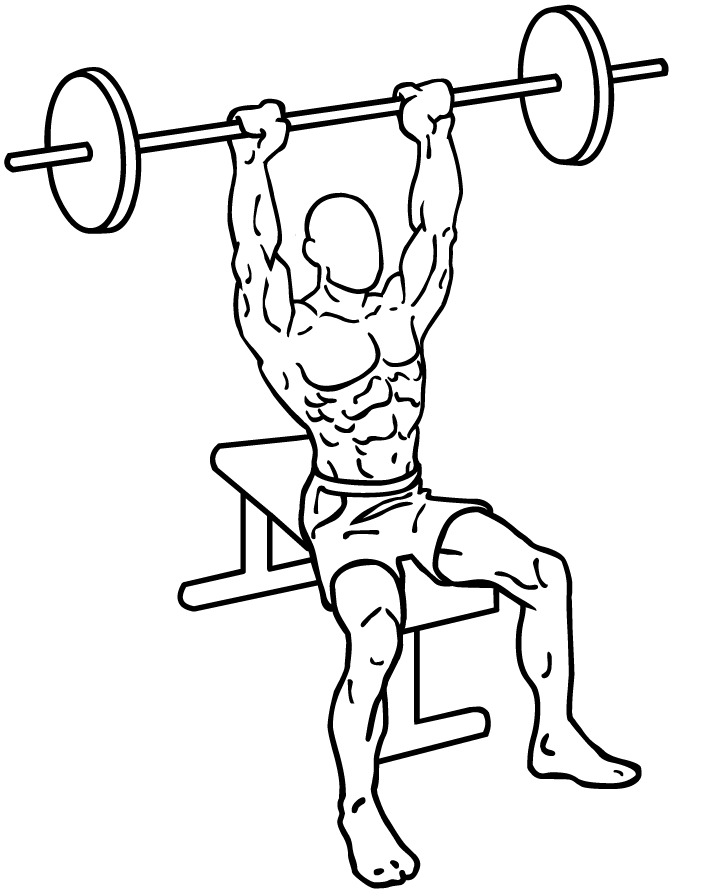
The overhead press, also known as the shoulder press, strict press or military press, is an upper-body weight training exercise in which the trainee presses a weight overhead while seated or standing. It is mainly used to develop the anterior deltoid muscles of the shoulder.[1]
The lift is set up by taking either a barbell, a pair of dumbbells or kettlebells, and holding them at shoulder level. The weight is then pressed overhead.[2] While the exercise can be performed standing or seated, standing recruits more muscles as more balancing is required in order to support the lift.[3] Other variations of the exercise include the push press, a similar movement that involves an additional dipping motion in the legs to increase momentum.[1] An overhead press may also be performed unilaterally, with the lift being performed one handed; or in an alternating fashion with both hands holding a dumbbell or kettlebell, and then pressing with one arm and then the other.[4]
In strength sports
[edit]Weightlifting
[edit]The standing version was once a component of the sport of Olympic weightlifting as part of the clean and press movement, but was removed in 1972 due to difficulties in judging proper technique.[5]
Strongman
[edit]In the sport of strongman, overhead presses are quite frequent where athletes are required to press implements such as logs and axles in addition to standard barbells. Strict presses, push presses and push jerks are often incorporated.[6]
Bodybuilding
[edit]Bodybuilders have also been using overhead presses as a staple to develop their shoulders. They primarily focus on strict presses to isolate the deltoids.
See also
[edit]References
[edit]- ^ a b Boly, Jake (16 March 2021). "The Overhead Press May Just Be the Best Pressing Movement Around". BarBend. Retrieved 2022-03-25.
- ^ "How To Overhead Press: A Beginner's Guide". Bodybuilding.com. 2015-08-12. Retrieved 2018-09-11.
- ^ "The Overhead Press: The Difference Between Seated, Standing, Dumbbell and Barbell". Breaking Muscle. 17 March 2022.
- ^ Boyle, Michael (2016). New Functional Training for Sports. Champaign: Human Kinetics. p. 168. ISBN 978-1-4925-3061-9.
- ^ Fair, John D. (2001). "The Tragic History of the Military Press in Olympic and World Championship Competition, 1928-1972". Journal of Sport History. 28 (3): 345–374. ISSN 0094-1700. JSTOR 43610198.
- ^ Tyler Stark (24 February 2025). "Strict Press, Push Press, Push Jerk… What's The Difference?". myprotein.com. Retrieved 16 June 2025.
Further reading
[edit]- Rippetoe, Mark; Kilgore, Lon (2007). Starting Strength: Basic Barbell Training. ISBN 978-0-9768054-2-7.
- Kapandji, Ibrahim Adalbert (2007). The Physiology of the Joints: The upper limb. ISBN 978-0-443-10350-6.
Overhead press
View on GrokipediaDefinition and History
Description
The overhead press is a fundamental compound pushing movement in resistance training, involving the lifting of a weight—typically a barbell or dumbbells—from shoulder height to full arm extension overhead while maintaining a stable torso. This multi-joint exercise primarily engages the deltoid muscles of the shoulders, triceps brachii, and upper portion of the pectoralis major, promoting overall upper-body strength and power development.[5][6] Variations include standing and seated executions, with the standing form demanding greater core engagement for postural stability compared to the seated version, which reduces lower-body involvement and allows for heavier loads focused on the upper body. Free-weight options like the barbell military press or dumbbell shoulder press emphasize balance and stabilizer activation, whereas machine-based types, such as the Smith machine or lever press, offer guided paths to minimize setup complexity and enhance safety for beginners.[7][8] Safe execution of the overhead press requires adequate shoulder mobility to achieve overhead alignment without compensatory strain and sufficient core stability, particularly in standing variations, to prevent spinal arching or momentum use. As a multi-joint exercise, it contrasts with isolation movements like lateral raises, which target singular muscles through single-joint actions, by recruiting multiple synergistic groups for functional, whole-body force production.[1][5]Origins and Evolution
The overhead press traces its origins to ancient physical training practices in Greece and Rome. Around the 5th century BCE, Greek athletes utilized halteres—handheld stone or lead weights typically weighing 2 to 9 kilograms—for strength training and to enhance jumping performance in events like the long jump during the Olympic Games.[9][10] In ancient Rome, gladiators and soldiers incorporated lifting exercises with improvised weights into conditioning regimens to build physical resilience for combat.[9] By the 19th century, the exercise had evolved into structured military training across European forces, where soldiers performed strict overhead presses with rifles or barbells to foster discipline and physical prowess, earning it the enduring name "military press."[11][12] This period marked a shift toward formalized strength development, influenced by the growing physical culture movement. In the early 20th century, the overhead press gained prominence in competitive weightlifting, debuting as part of the Olympic program at the 1920 Antwerp Games alongside snatches and jerks, with standardization of lifts by the 1928 Amsterdam Olympics.[13] Pioneers like Eugen Sandow, a key figure in modern bodybuilding since the late 19th century, promoted overhead pressing variations in his routines and publications to sculpt balanced physiques, helping integrate the exercise into global fitness protocols.[14][15] Post-1970s developments saw the overhead press adapt through bodybuilding innovations, notably Arnold Schwarzenegger's introduction of the "Arnold press"—a rotational dumbbell variation emphasizing greater shoulder activation—which popularized dynamic forms over strict military styles.[16] A pivotal milestone occurred in 1972 when the International Weightlifting Federation removed the clean and press from Olympic competition due to persistent judging controversies over form deviations and "cheating" techniques, refocusing the sport on the snatch and clean and jerk.[17][13]Technique and Execution
Step-by-Step Form
To perform the standard standing barbell overhead press, begin by unracking the barbell from a power rack set at shoulder height, using an overhand grip slightly wider than shoulder width to position the bar across the front of your shoulders or collarbone, with wrists straight and forearms vertical.[8][18] Stand with feet hip-width apart and parallel or slightly turned out at 15 degrees, knees locked, heels driven into the ground, and maintain a neutral spine with a slight natural arch in the lower back and chest lifted high.[18][19][20] Take a deep breath into your diaphragm to brace your core, then press the bar upward in a vertical line—starting from the collarbone position and moving it straight overhead—while keeping elbows pointed forward at about a 45-degree angle from the body to avoid flaring, and drive through your heels for stability without leaning back excessively. To avoid neck pain, maintain a neutral neck position (resting anatomical alignment with the spine) throughout the movement. Avoid excessive forward head posture (protraction) or cervical extension (looking up). Tuck your chin slightly to allow the bar to pass your face on the way up.[18][21] At the top of the movement, fully extend your arms to lockout with elbows straight, shrug your trapezius muscles upward to secure the bar directly over your midfoot and shoulders. Once the bar passes your forehead, move your torso slightly forward to bring your head under the bar while keeping your neck neutral and avoiding aggressive forward protrusion of the head. This ensures proper alignment and prevents compensatory neck strain. Ensure adequate shoulder flexion and thoracic mobility to facilitate the movement without neck compensation.[18][21] Exhale forcefully through the press or at the top while maintaining core bracing, then inhale as you lower the bar under control back to the starting position at the collarbone without bouncing or arching the back, ensuring a full range of motion from the overhead lockout position with arms fully extended to the initial rack position.[18][20] Common cues include "press in a straight line" to guide the bar path efficiently and "drive through heels" to engage the lower body for balance and power transfer.[18][19] For beginners, start with an empty barbell to master form through sets of 5-8 repetitions, gradually adding weight in small increments (such as 5-10 pounds per side) once technique is consistent, prioritizing controlled movement over heavy loads.[18] Equipment like a power rack facilitates safe unracking and spotting, as outlined in the Equipment and Setup section.[8][20]Equipment and Setup
The overhead press primarily utilizes an Olympic barbell, which has a standard weight of 20 kg (45 lb) for men's bars, along with calibrated weight plates to adjust the load.[22] These components allow for progressive resistance while maintaining balance and grip consistency, with the bar's knurling positioned approximately 42 cm apart to accommodate a shoulder-width grip.[23] To achieve a safe starting position, the barbell is placed in a power rack or on squat stands set at shoulder height, typically aligning with the upper chest or collarbone when unracked, enabling the lifter to dip under and position it securely across the front deltoids without excessive strain.[20] A power rack enhances safety by providing adjustable safety bars to catch the bar if the lift fails, particularly recommended for heavier loads or solo training.[18] For advanced training involving dynamic movements or drops, bumper plates made of dense rubber can be used instead of iron plates to minimize equipment damage and floor impact upon release.[24] Preparation includes performing warm-up sets with lighter loads, such as 50% of the planned working weight for 10-15 repetitions, gradually increasing to 70% to prepare the joints and muscles while monitoring bar speed to avoid fatigue.[25] Form checks can be facilitated by a spotter, who stands behind or to the side to assist if needed and provide verbal cues, or by using a mirror positioned in front to self-assess alignment and posture during setup.[26] Environmental considerations are essential for safe execution, including stable flooring such as rubber mats or platforms at least 3/8 inch thick to absorb shock, prevent slipping, and protect the surface from dropped weights.[27] Adequate ceiling height of at least 7 feet (ideally 8 feet or more) is required to accommodate full arm extension overhead without obstruction, and sufficient open space—approximately 8 feet by 8 feet—ensures no collisions with nearby equipment or individuals.[28] For individuals with lower back concerns, a seated variation using an adjustable bench with back support can reduce lumbar shear forces by stabilizing the torso and minimizing compensatory arching, allowing focus on shoulder engagement.[29]Muscles and Biomechanics
Primary and Secondary Muscles
The overhead press primarily engages the deltoids and triceps brachii as the main movers responsible for elevating the load overhead. The anterior and medial heads of the deltoid muscle drive shoulder flexion and abduction, respectively, while the posterior head provides secondary support in certain variations.[30] The triceps brachii, encompassing all three heads (long, lateral, and medial), facilitates elbow extension to lock out the arms at the top of the movement.[30] Secondary muscles contribute to stabilization and scapular control throughout the exercise. The upper trapezius elevates and upwardly rotates the scapula to support shoulder elevation, working in coordination with the serratus anterior, which protracts and upwardly rotates the scapula to maintain proper positioning and prevent winging.[31] The pectoralis major assists in shoulder flexion and stabilization during the initial phase of the lift.[32] Core muscles, including the rectus abdominis and obliques, activate to counter rotational forces and maintain spinal stability, particularly during the standing variation.[33] Electromyography (EMG) studies indicate substantial activation of the primary movers, with the anterior deltoid reaching approximately 70-80% of maximum voluntary isometric contraction (MVIC) and the medial deltoid around 66% MVIC during the barbell overhead press.[34] Triceps brachii activation is typically around 50-61% MVIC, reflecting its role in the pressing phase.[34] Stabilizer involvement is essential; for instance, the upper trapezius and serratus anterior facilitate scapular motion.[31] In the standing overhead press, individual differences influence lower body recruitment, with greater core and general lower body stabilization demands observed compared to seated variations to enhance balance and postural control.[35] This increased demand on the lower extremities helps distribute load and reduce upper body fatigue but varies based on technique and experience level.[36]Joint Mechanics
The overhead press involves coordinated movement at multiple joints, with the glenohumeral joint of the shoulder primarily undergoing flexion and abduction to elevate the load overhead. During this motion, the humerus moves from a position of approximately 90 degrees of shoulder flexion to full overhead extension, accompanied by 30-60 degrees of abduction depending on grip width and bar position. The rotator cuff muscles, including the supraspinatus and infraspinatus, play a critical role in stabilizing the humeral head within the glenoid fossa, counteracting anterior shear forces that arise from the downward pull of the load and deltoid contraction.[37][32] At the elbow joint, extension occurs from an initial flexion angle of about 90 degrees to full lockout at 0 degrees, driven by concentric contraction of the triceps brachii. Torque production at the elbow peaks in the mid-range of this extension (approximately 45-60 degrees of flexion), where the triceps' moment arm is most advantageous relative to the load vector. This phase demands maximal elbow extensor force to overcome inertia before transitioning to lighter loads near full extension.[38] Spinal involvement in the overhead press is limited to maintain stability, with minimal thoracic extension (typically less than 10 degrees) to align the upper body under the bar. The lumbar spine remains in a neutral position to minimize anterior-posterior shear forces, which can otherwise increase with excessive arching under heavy loads. Compressive forces along the spine are influenced by trunk posture, but neutral alignment helps distribute loads evenly without undue stress.[32] The bar path in a standing overhead press follows a slight forward arc initially—often described as a curvilinear trajectory—before shifting vertically overhead, which optimizes mechanical leverage by aligning the force vector closer to the body's center of mass. Peak loading occurs at the bottom position, where the combined weight and momentum create maximal joint moments at the shoulder and elbow. This path reduces shoulder abduction demands compared to a strictly vertical lift. Force vector analysis reveals that the initial forward displacement helps counterbalance the bar's tendency to drift anteriorly due to shoulder anatomy.[32] Through the kinetic chain, ground reaction forces generated at the feet—typically near body weight in strict presses for postural control, but peaking at up to 210% of body weight in heavy leg-drive variations like the push press—are transmitted proximally from the lower extremities to the trunk and upper body, enhancing overall stability and power transfer during the press.[4]Variations
Barbell Variations
The standing strict press, also known as the military press, is a foundational barbell variation performed without leg drive, emphasizing pure upper-body strength and shoulder stability. In this exercise, the lifter starts with the barbell in a front rack position across the upper chest, feet shoulder-width apart, and presses the bar overhead to full arm extension while maintaining a rigid torso and avoiding excessive back arching. This variation primarily targets the anterior and medial deltoids, triceps brachii, and upper trapezius, with significant involvement of core stabilizers like the erector spinae and abdominals to counterbalance the load. It is particularly effective for building foundational pressing strength and improving overhead mobility, though improper form can lead to shoulder impingement risks.[39] The seated overhead press modifies the strict press by performing it from a bench with back support, reducing lower-body involvement and isolating the upper body more effectively. The technique involves securing the barbell in the front rack on an adjustable bench set to a 75-90 degree incline, then pressing upward while keeping the back pressed against the pad to minimize momentum. This variation enhances focus on the deltoids and triceps by eliminating leg assistance and core sway, allowing for heavier loads in a controlled environment, and is commonly used in gym settings for hypertrophy and strength without taxing the full kinetic chain. It demands good shoulder range of motion to avoid compensatory movements.[40][41] The push press introduces explosive leg drive to the overhead press, enabling lifters to handle 20-30% more weight than in the strict variation by incorporating a quarter-squat dip and extension. Execution begins in the front rack, followed by a controlled dip at the knees, an upward drive through the legs to initiate the press, and a lockout overhead with the bar traveling in a straight line. This full-body movement builds power and coordination, targeting the deltoids and triceps alongside the quadriceps, glutes, and calves, making it ideal for developing athletic explosiveness while still challenging upper-body pressing. Proper timing is crucial to prevent elbow flare or spinal stress during the transition.[42][43] The behind-the-neck press starts with the barbell positioned across the upper back or base of the neck, requiring greater shoulder external rotation and targeting the rear deltoids more intensely than front-rack variations. The lifter presses the bar overhead from this starting point, maintaining an upright posture to engage the medial and posterior deltoids, upper trapezius, and triceps, with electromyographic studies showing significantly higher activation in these muscles compared to front presses (e.g., effect sizes of 3.68 for medial deltoids and 9.00 for posterior deltoids in the ascending phase). While it can enhance rear shoulder development and balance, it carries higher injury risk for beginners due to potential shoulder instability and reduced range of motion, and is generally recommended only for advanced lifters with adequate mobility.[32] In programming barbell overhead press variations for strength, a common approach involves 3-5 sets of 4-6 repetitions at 75-85% of one-repetition maximum, performed 2-3 times per week with progressive overload to build pressing capacity while allowing recovery. This rep scheme prioritizes neural adaptations and force production, integrating variations like strict presses for base strength and push presses for power development within a periodized routine.[44]Dumbbell and Machine Variations
The dumbbell overhead press serves as a unilateral variation of the traditional barbell overhead press, enabling each arm to move independently and thereby addressing muscular imbalances between sides of the body.[45] Performed either standing or seated, the seated variation—known in German as "sitzendes Kurzhantel-Schulterdrücken" or "sitzende Kurzhantel-Schulterpresse"—is a free-weight exercise executed by sitting on a bench with back support adjusted to 90 degrees, positioning dumbbells at shoulder height with palms facing forward and elbows pointing forward, pressing them overhead until the arms are fully extended, and then lowering them in a controlled manner back to shoulder height.[46][47] A neutral grip option, where palms face each other throughout the movement, can reduce wrist strain and emphasize the medial deltoids.[48] The Arnold press introduces a rotational component to the dumbbell overhead press, starting with dumbbells at shoulder height and palms facing the body, then rotating the wrists outward as the weights are pressed overhead to end with palms facing forward.[49] This motion enhances engagement across all three heads of the deltoid—anterior, medial, and posterior—promoting more comprehensive shoulder development compared to non-rotational presses.[50] Machine-based shoulder presses, commonly referred to in German as "Schulterpresse sitzend", "Schulterdrückmaschine", or specifically "Iso-Laterale Schulterpresse" (e.g., Hammer Strength), provide a guided alternative with a fixed bar path, which minimizes the demand on stabilizing muscles and allows beginners to focus on proper form without excessive balance requirements.[51] Ideal for high-volume training sessions, these machines enable safer progression for novices by reducing the risk of form breakdown under fatigue. The Smith machine variant further enhances safety through its counterbalanced track and built-in safety stops, permitting solo training with heavy loads while limiting bar deviation.[52] The kettlebell overhead press emphasizes single-arm execution, which intensifies grip strength demands due to the offset handle and requires greater core engagement to maintain stability throughout the lift.[53] Due to the inherent stabilization challenges in these free-weight and unilateral variations, rep schemes of 8-12 per set are commonly recommended for hypertrophy, as they align with moderate loads (60-80% of one-repetition maximum) that promote muscle growth while accommodating the added neuromuscular demands.[54]Benefits and Risks
Training Benefits
The overhead press, as a compound multi-joint exercise, significantly enhances upper-body pressing strength by targeting the deltoids, triceps, and upper trapezius, fostering power development that transfers to athletic activities involving overhead pushing, such as in basketball or wrestling.[4] This strength gain arises from the exercise's demand for coordinated force production across multiple muscle groups, leading to improved overall upper-body power output.[55] Dedicated training with the overhead press enables significant progress in pressing strength. For example, according to ExRx.net strength standards for a 123 lb (56 kg) male aged 18-39 performing the standing overhead press (barbell military press) with strict form—knees kept straight, no back bend (torso not laying back with shoulders behind hips), and full elbow extension—the following 1RM levels are representative:[56]- Untrained: 60 lb
- Novice: 80 lb
- Intermediate: 100 lb
- Advanced: 115 lb
- Elite: 140 lb
