


Community hub
Recent from talks
Contribute something
Nothing was collected or created yet.
Aisle
View on Wikipedia

An aisle is a linear space for walking with rows of non-walking spaces on both sides. Aisles with seating on both sides can be seen in airplanes, in buildings such as churches, cathedrals, synagogues, meeting halls, parliaments, courtrooms, theatres, and in long passenger vehicles. An aisle floor may be level or, as in theatres, sloping upward from a stage.
Aisles also cross through shops, where they have shelving on either side; warehouses, flanked by storage pallets; and factories, where they separate different work areas. In health clubs, exercise equipment is normally arranged along aisles.
They are distinguished from corridors, hallways, walkways, footpaths, pavements (American English sidewalks), trails, paths and open areas of buildings: aisles lie between other open or seating areas, which are all enclosed within a structure. Spaces between buildings are not considered aisles, regardless of their size.
The word is related to French aile (wing).

Typical physical characteristics
[edit]
Aisles have certain general physical characteristics:
- They are almost always straight, not curved.
- They are usually fairly long. An open space with three rows of chairs beside it would not usually be considered an aisle.
Width of various types of aisles
[edit]- Theatres, meeting halls, shops, etc., usually have aisles wide enough for 2–3 strangers to walk past each other without feeling uncomfortably close. In such facilities, a space that could comfortably accommodate more than four people side-by-side would generally be considered an "open area", rather than an "aisle".
- Factory work area aisles are usually wide enough for workers to comfortably sit or stand while working, while allowing safe and efficient movement of persons, equipment and/or materials.
- Passage aisles are usually just wide enough for a large person to carry a suitcase in each hand, but not for two people to pass side-by-side without touching. Usually, even without luggage one person must turn sideways for the other to pass.
- Warehouse aisles normally are at least 8–10 feet (2.4–3 meters) wide to fit mechanical loading equipment.
- Wedding aisles are at least wide enough for two people to walk comfortably beside each other.
- Vehicle aisles are wide enough for a designated type of vehicle to pass, either one way or two way.
Architecture
[edit]In architecture, an aisle is more specifically the wing of a house, or a lateral division of a large building. The earliest examples of aisles date back to the Roman times and can be found in the Basilica Ulpia (basilica of Trajan), which had double aisles on either side of its central area. The church of St. Peter's in Rome has the same number.[1]
Church architecture
[edit]-
 An aisle in Bath Abbey, Bath, England. The aisle is lined with wooden seating (pews), the nave seating can be seen on the right, beyond the arcade pillars. The roof of the aisle is fan-vaulted.
 -
 The nave-aisles in this plan view of a cathedral are shaded pink; the arcade pillars are black dots
 -
 Interior elevation view of a Gothic cathedral, looking from the nave, with nave-aisle arcade highlighted.


In church architecture, an aisle (also known as an yle or alley) is more specifically a passageway to either side of the nave that is separated from the nave by colonnades or arcades, a row of pillars or columns. Occasionally aisles stop at the transepts, but often aisles can be continued around the apse. Aisles are thus categorized as nave-aisles, transept-aisles or choir-aisles. A semi-circular choir with aisles continued around it, providing access to a series of chapels, is a chevet.[1]
In Gothic architecture, the aisles' roofs are lower than that of the nave, allowing light to enter through clerestory windows. In Romanesque architecture, however, the roofs are at roughly equal heights, with those of the aisle being only slightly lower than that of the nave. In Germany, churches where the roofs of the aisles and nave are the same height, such as St. Stephen's, Vienna, the Wiesenkirche at Soest, St. Martin's, Landshut, and the Frauenkirche (Church of Our Lady) in Munich are known as Hallenkirchen.[1]
When discussing overall design, architectural historians include the centrally-positioned nave in the number of aisles. Thus the original St Peter's Basilica in Rome, Milan Cathedral, Amiens Cathedral, Notre Dame de Paris and Alexander Nevsky Cathedral in Sofia[2] are all described as having five aisles, meaning they have two side aisles either side of the nave. Antwerp Cathedral even has seven aisles (three at either side of the central nave). In the United Kingdom, cathedrals generally only have one aisle on each side, with Chichester Cathedral, Elgin Cathedral and St Mary Magdalene, Taunton being the only three exceptions.
Supermarkets and retail stores
[edit]


In supermarkets there are two types of aisles, food aisles and checkout aisles.
Food aisles are where goods are displayed. At the end of food aisles may be found crown end displays, where high-margin goods are displayed for impulse purchase.
In retail stores that do not primarily sell food, aisles containing products would be referred to either generically as merchandise aisles, or by the particular products contained in the aisle, e.g., "the gardening aisle", "the sports equipment aisle".
Checkout aisles contain cash registers at which customers make their purchases. Regardless of the type of merchandise the establishment sells, it is common to display a range of "impulse buy" items along the checkout aisle, such as cold beverages, magazines, candy and batteries. These are often called "lanes" to distinguish them from the food aisles.
Signage
[edit]For customer convenience, supermarkets and retail stores commonly number the aisles and have signs indicating both the aisle number and the types of products displayed in that aisle.
Churches, courtrooms, legislatures, and meeting halls may identify individual rows, seats or sections but do not normally assign aisle numbers or display signs regarding aisles.
Libraries
[edit]
Libraries are commonly divided into several areas:
- Circulation desk
- Collections, areas where materials are grouped, e.g., Children's Collection. This may include book shelves, manuscripts, photos, etc.
- The "stacks", where books are shelved
- The Reference Room where materials with limited circulation are stored
- Public reading areas containing seats and desks
The spaces between rows of book shelves in the "stacks" area are called aisles and desks in the reading area are frequently arranged in rows with aisles.
Computer server rooms
[edit]
Server rooms are typically divided into hot and cold aisles for cooling efficiency, and access to servers.
Performance venues
[edit]


Cinemas, indoor theatres and concert halls
[edit]Films, stage plays and musical concerts ordinarily are presented in a darkened facility so the audience can see the presentation better. To improve safety, often the edges of the aisles in such facilities are marked with a row of small lights. The markers frequently are strings of light-emitting diodes (LEDs) because LEDs are durable, have low power consumption and use low voltages that are not subject to electrical codes. To provide a higher level of light focused downward, lighting fixtures referred to as luminaries are often built into the side of the seat facing the aisle.
Stadiums and outdoor arenas
[edit]Sport stadiums and outdoor arenas frequently have several types of aisles, including aisles to purchase tickets for events, aisles to enter the main event area and aisles to go to seating. Stadium seating routinely is separated into sections by aisles. Seating rows are accessed by stairsteps. To promote safety, aisles commonly are divided by a handrail in the middle of the aisle.
Stables and barns
[edit]
The floor plan of aisled barns resembles that of an aisled church. However, the nave in farm buildings is called an aisle thus a "three aisled barn".[3] Aisled barns have the big barn doors on the gable end of the building giving access to the center aisle, often called the drive floor or threshing floor. The side aisles may be the same widths making the barn symmetrical or the aisle where animals were housed may be narrower which is apparent outside the barn because the barn doors are then off-center. The area between the posts, perpendicular to the aisles are called bays. In stables there is a stable aisle down the centre with individual stalls facing the aisle.
Vehicles
[edit]On vehicles, the aisle is more specifically a passageway for passengers to move along within the vehicle.
-
 Bus aisle with stairs
 -
 London Circle Line tube train aisle with open gangways
 -
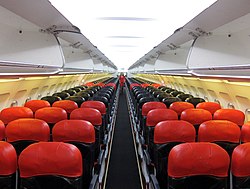 Narrow-body aircraft aisle


Safety and regulatory considerations
[edit]National and local government regulations require a minimum width for aisles in various building types. Regulatory agencies frequently inspect buildings, vehicles, etc., to enforce regulations requiring that aisles not be restricted. Inspectors have imposed fines for blocking or restricting passage when boxes or folding chairs are stored in aisles, for example. Insurance companies frequently have safety inspectors to examine the premises, both to determine whether insureds are complying with the insurer's requirements for coverage and to look for any practices that could lead to injury or property damage, including restricting passage in aisles. The Americans with Disabilities Act sets certain standards for building access and other design considerations in all new construction and major renovations in the U.S.[4] An architectural barrier is any feature that makes access or use of a building difficult, unreasonably dangerous or impossible. This can include aisles that are too narrow for easy access by a wheelchair.[5] Often, the only way to get from a row of chairs, shelves, workstations, etc., to an exit is by an aisle. Historically, many deaths and serious injuries have occurred due to fire, inhalation of smoke or noxious fumes, etc., because blocked or partially blocked aisles prevented persons from promptly leaving a dangerous area.
Regulations applicable to public carriers transporting passengers often require aisles to be completely clear in vehicles, such as airlines, buses and trains. Many insurance companies have requirements regarding minimum aisle width, unrestricted aisles and easy access to exits, and will refuse to insure companies that do not meet their requirements or will increase the premiums on companies that frequently violate the requirements.
See also
[edit]- Building design – Planning and specifications for construction
- Cathedral floorplan – Floor plan showing sections of walls and piers
- Indoor positioning system – Network of devices used to wirelessly locate objects inside a building
- Safety – State of being secure from harm, injury, danger, or other non-desirable outcomes
- Soutra Aisle – Hospital and church buildings, in Scottish Borders, Scotland
- Wedding – Ceremony where people are united in marriage ("walking down the aisle")
- Outline of architecture, also known as List of basic architectural topics – Product and process of planning, designing and constructing buildings and other structures
Literature
[edit]- Walter Horn, 'On the Origins of the Medieval Bay System', in: Journal of the Society of Architectural Historians 17 (1958), nr. 2, p. 2–23.
References
[edit]- ^ a b c One or more of the preceding sentences incorporates text from a publication now in the public domain: Spiers, Richard Phené (1911). "Aisle". In Chisholm, Hugh (ed.). Encyclopædia Britannica. Vol. 1 (11th ed.). Cambridge University Press. p. 447.
- ^ "Cathedral of St Alexander Nevsky". SofiaCode. 28 September 2013.
- ^ Upton, Dell, and John Michael Vlach. Common places: readings in American vernacular architecture. Athens: University of Georgia Press, 1986. 206. ISBN 0820307505
- ^ The ADA Standards for Accessible Design are part of the ADA Title III regulations
- ^ The ADA Small Business Guide provides information on removing architectural barriers.

External links
[edit]

- A diagram of the aisles in Saint-Benoît-sur-Loire
- Penn State College of Agricultural Sciences
- ADA Small Business Guide
- "aisle". Catholic Encyclopaedia (on-line ed.). 1907.
- "Aisle". Language of the Food Industry: Glossary of Supermarket Terms. Food Marketing Institute. Archived from the original on 18 December 2004. Retrieved 5 January 2005.
Aisle
View on GrokipediaEtymology and Historical Development
Linguistic Origins
The English word aisle derives from Middle English ele, first attested around 1398, referring to the lateral division of a church flanking the nave.[5] This term was borrowed from Old French ele (modern French aile), meaning "wing," which itself stems from Latin ala, denoting a wing or arm-like extension.[2] [1] The architectural connotation arose because early aisles were perceived as wing-like appendages to the central body of a basilica or church, separated by columns or arcades, a usage rooted in Roman engineering where alae described projecting side structures.[2] In its initial adoption into English, aisle was spelled without an 's', as ele, ile, or eill, reflecting its French pronunciation /ɛl/ or /ail/.[1] The modern spelling with a silent 's' emerged in the 17th century, influenced by folk etymology associating it with isle (from Old French ile, Latin insula), despite no linguistic relation between the two; this orthographic shift aimed to align aisle with contemporary conventions for words evoking isolation or separation, though it preserved the vowel sound /aɪl/.[2] [1] Pronunciation has remained consistent since Middle English, with the 's' unvoiced, underscoring the word's Romance origins over Germanic influences in English.[5] Linguistically, aisle exemplifies loanword assimilation, where a Latinate term via Norman French post-Conquest (1066) filled a gap in native Anglo-Saxon vocabulary for ecclesiastical architecture, as Old English lacked a direct equivalent for such side passages, often describing them generically as gang or weġ.[2] Over time, semantic broadening extended the term beyond sacred spaces, but its core etymon retains the bilateral, appendage-like imagery of ala, evident in cognates like Italian ala or Spanish ala for wing or flank.[1] No evidence supports alternative Proto-Indo-European roots beyond ala's reconstructed form h₂élh₁neh₂, tied to avian or structural projections.[2]Early Architectural Usage
The architectural aisle emerged in ancient Roman basilicas as lateral passages flanking the central nave, separated by rows of columns or piers to facilitate circulation and support clerestory lighting for the main space. This design element first appeared prominently in the Basilica Ulpia, constructed between 107 and 112 AD as part of Trajan's Forum in Rome, where the structure featured a broad central nave approximately 25 meters wide, bordered by four side aisles each about 6 meters wide, divided by monolithic columns spanning over 130 meters in length.[6] The aisles in such buildings enabled efficient movement for legal proceedings and public assemblies while structurally distributing loads to allow higher roofs over the nave.[7] Early Christian architecture adopted the Roman basilica plan following the Edict of Milan in 313 AD, which legalized Christianity and prompted the construction of large congregational churches with aisles to accommodate worshippers and liturgical processions. Constantine the Great commissioned basilicas like the Basilica of St. John Lateran (dedicated 324 AD) and Old St. Peter's Basilica (begun 326 AD, completed 333 AD), both incorporating double aisles on either side of the nave to separate the central processional path—reserved for clergy and rituals—from peripheral areas for laity.[8] These aisles, often lower-roofed than the nave, provided additional space for side chapels and tombs, enhancing functional capacity in structures that could seat thousands, as evidenced by Old St. Peter's nave exceeding 100 meters in length with aisles supporting arcades of reused marble columns.[9] In these early basilican churches, aisles served both practical and symbolic roles, channeling pedestrian flow toward apses for eucharistic celebrations and symbolizing hierarchical divisions within the community, a continuity from Roman civic use adapted to Christian needs without the pagan temples' cella-centric designs. By the 5th century, refinements appeared in basilicas like Santa Sabina in Rome (c. 432 AD), where aisles framed a nave with wooden trussed roofing, maintaining the longitudinal axis for axial progression during services.[10] This adaptation ensured the aisle's persistence as a core element in ecclesiastical architecture, prioritizing spatial clarity and structural stability over decorative excess in initial phases.Expansion to Secular and Modern Contexts
By the 19th century, the term "aisle" extended beyond ecclesiastical structures to secular buildings, particularly theaters and assembly halls, where it denoted passageways flanked by rows of seats analogous to church pews.[1] This linguistic shift paralleled the rise of public venues designed for mass gatherings, with the word's architectural connotation of a "wing-like" lateral space adapting to non-religious layouts.[2] In commercial environments, the application proliferated with the emergence of fixed-shelf retail in department stores during the late 19th century, such as those pioneered by A.T. Stewart's Marble Dry Goods Palace in New York in 1846, which featured organized walkways between merchandise sections. The self-service supermarket format, originating with Clarence Saunders' Piggly Wiggly in Memphis, Tennessee, in 1916, formalized aisles as linear paths between stocked shelving units, enabling efficient customer navigation and inventory access. By the 1930s, chains like King Kullen in Queens, New York (1930), amplified this usage, with aisles becoming a core element of store design for throughput and sales volume. In transportation, the term adapted to vehicular interiors by the early 20th century, initially for railroad passenger cars with seated compartments divided by central walkways.[1] Aviation adopted "aisle" for aircraft cabins following the commercialization of passenger flights in the 1920s, as seen in early models like the Douglas DC-3 (1936), where the narrow passageway between seat rows facilitated service and evacuation. This usage persisted in post-World War II jetliners, with aisle seats emerging as a preferred option for accessibility, reflecting ergonomic priorities in cabin configuration.[3] Warehouses and libraries similarly employed the term for shelving corridors, emphasizing functionality in storage and retrieval systems from the industrial era onward.Physical and Technical Characteristics
Standard Dimensions and Variations
In architectural and building contexts, standard aisle widths are governed by codes such as the International Building Code (IBC), which requires a minimum clear width of 48 inches (1219 mm) for stepped aisles in assembly spaces with seating on both sides to ensure safe egress.[11] For level aisles in similar settings, widths can be reduced to 36 inches (914 mm) if the occupant load is under 50, accommodating pedestrian flow while meeting fire safety requirements.[12] Variations occur based on usage and accessibility standards; in religious spaces like churches, main center aisles typically measure at least 4 feet (1219 mm), with side aisles at a minimum of 2 feet 6 inches (762 mm), though recommendations suggest wider dimensions of 5 feet (1524 mm) for main aisles to facilitate processions and comfort.[13] Library stack aisles adhere to ADA guidelines with a minimum of 36 inches (914 mm), preferably 42 inches (1067 mm), to allow wheelchair maneuverability between shelves, with parallel double-faced stacks separated by at least 36 inches (914 mm).[14][15] In commercial retail environments, aisles must comply with ADA minimums of 36 inches (914 mm) for accessibility routes, but practical standards often extend to 42-48 inches (1067-1219 mm) to permit two shopping carts to pass, enhancing customer navigation and safety.[16][17] OSHA does not mandate a universal minimum beyond egress paths but recommends aisles at least 3 feet (914 mm) wider than the largest equipment, with a practical floor of 4 feet (1219 mm) in warehouses to prevent collisions.[18] Transportation settings impose narrower constraints for efficiency; Federal Aviation Regulations (14 CFR 25.815) set aircraft main aisle widths at a minimum of 20 inches (508 mm) above 25 inches (635 mm) from the floor for planes with 20+ seats, reducible to 15 inches (381 mm) lower down or 9 inches (229 mm) with certification tests, prioritizing evacuation over comfort.[19] These dimensions reflect trade-offs between capacity, structural limits, and regulatory safety, varying inversely with space constraints compared to ground-based applications.[20]Design Principles and Ergonomics
Design principles for aisles prioritize efficient pedestrian flow, safety during egress, and integration with surrounding structures, often governed by building codes such as the International Building Code (IBC), which specifies minimum widths based on occupant load and seating arrangement.[21] For instance, stepped aisles serving seating on both sides require a minimum clear width of 48 inches (1220 mm), increasing to 60 inches (1520 mm) or more for higher capacities to prevent bottlenecks.[22] These dimensions ensure unobstructed movement while accounting for structural elements like handrails or barriers, which may reduce effective width. Ergonomic considerations emphasize human anthropometrics, including average shoulder breadth (approximately 16-20 inches for adults) and gait patterns, to minimize fatigue and collision risks.[23] For general non-work passageways, a minimum comfortable width of 36 inches (915 mm) provides ergonomic clearance for body movement (approximately 18-24 inches shoulder/body width) plus additional access space, distinguishing from work or egress-focused minimums. Passageway widths are designed to accommodate two-way traffic, with 36 inches (915 mm) as a baseline for single-file accessible routes under ADA standards, allowing wheelchair maneuverability and a 60-inch (1525 mm) turning radius where space permits.[24] Wider aisles, such as 42-48 inches in level or ramped configurations, support arm swing and load-carrying without impeding flow, drawing from human factors engineering that links narrower paths to reduced walking speeds and increased stress.[25] In architectural applications, aisles incorporate sightlines, lighting uniformity, and non-slip surfacing to enhance usability, particularly in high-traffic venues where ergonomic mismatches can elevate injury rates.[26] Variations exist for context-specific needs, such as narrower profiles in constrained spaces balanced against fire safety mandates from NFPA standards, ensuring aisles double as egress paths without compromising structural integrity.Architectural and Structural Applications
General Building Design
In general building design, aisles serve as linear circulation paths flanked by rows of fixed elements, such as seating, partitions, or equipment, enabling efficient pedestrian movement while maintaining spatial organization. These pathways are integral to occupant flow in structures like assembly halls, educational facilities, and multipurpose rooms, where they support daily operations and emergency egress by separating usable areas without impeding access.[27] Building codes establish minimum aisle dimensions to ensure safety, with widths scaled to occupant load and configuration. The 2021 International Building Code requires assembly aisles to provide at least 48 inches (1,219 mm) of clear width for stepped aisles serving seating on both sides, or 36 inches (914 mm) for level aisles with seating on one side only, with increases of 0.3 inches per inch of rise for sloped sections.[28] Similar standards apply in jurisdictions like New York City, mandating 44 inches minimum for primary aisles, reducible to 36 inches under limited conditions such as low occupant density.[29] These requirements derive from fire safety engineering, prioritizing unimpeded evacuation paths capable of handling peak flows without bottlenecks.[30] Design principles for aisles emphasize visibility, direct routing, and integration with overall layout to minimize travel distance and collision risks. Straight alignments are preferred for main aisles to enhance sightlines to exits and reduce navigation errors, while branching secondary aisles accommodate localized access in denser arrangements.[31] Materials selection focuses on durability and traction, such as non-slip flooring to prevent falls, with lighting positioned to avoid glare in pathways. Structurally, aisles often align with load-bearing elements like columns or walls, distributing forces from adjacent volumes and allowing for clerestory windows or varied roof profiles that improve ventilation without compromising stability.[27] In layout planning, aisle networks are optimized early to balance floor space utilization against circulation efficiency, typically allocating 20-30% of gross area to paths based on functional needs.[31]Religious and Ceremonial Spaces
In Christian ecclesiastical architecture, aisles denote the longitudinal passageways flanking the central nave of churches and cathedrals, typically separated by arcades or rows of piers.[32] These side spaces originated in early basilican churches adapted from Roman civic halls, where they enabled lateral access and divided the assembly area from peripheral functions.[33] By the Romanesque period, aisles supported expanded congregational capacity and structural reinforcement, evolving into integral components of larger edifices.[34] Gothic cathedrals refined aisle design for enhanced stability and illumination, with side aisle vaults maintained at roughly half the nave's height to minimize lateral thrust while permitting clerestory windows above the arcades.[35] This configuration, as seen in structures like those employing ribbed vaults and flying buttresses, distributed the weight of towering nave roofs outward to abutments, preventing collapse under gravitational loads.[36] Aisles thus braced high central volumes, allowing expansive glazed areas that flooded interiors with light, a deliberate engineering choice rooted in load-bearing masonry principles rather than mere aesthetics.[37] Ceremonially, aisles facilitate processional routes in liturgical rites, such as circumambulations around altars or ambulatory extensions behind apses accessing radiating chapels.[38] In wedding ceremonies held in churches, while the primary bridal procession traverses the nave's central axis—colloquially termed "the aisle"—side aisles provide ingress for attendants, ushers, and secondary participants, maintaining orderly flow amid pews.[39] Traditional Catholic processions, for instance, sequence ushers followed by bridesmaids along these paths before converging centrally, preserving spatial hierarchy during rites.[40] Such arrangements underscore aisles' role in directing movement without disrupting the focal sanctuary.Libraries and Knowledge Institutions
In libraries, aisles denote the navigable pathways between shelving units or stacks, enabling users to access bound volumes, periodicals, and other materials while optimizing space utilization. These pathways emerged as integral to library design during the transition from chained-book rooms to open-access stack systems in the late 19th century, influenced by figures like Melvil Dewey, who advocated for efficient shelving arrangements with perpendicular ranges creating parallel aisles.[41] Early American academic libraries incorporated alcoves branching from main aisles and multi-level galleries to expand capacity without sacrificing accessibility.[42] Building codes mandate a minimum clear aisle width of 42 inches (1065 mm) between stacks to accommodate pedestrian traffic, shelf-reaching, and emergency egress, with exceptions for alterations in existing structures.[14] Accessibility standards, such as those under the Americans with Disabilities Act, often require wider configurations—up to 60 inches (1500 mm) in some jurisdictions—to permit wheelchair maneuvering and passage of book carts, particularly at aisle ends.[43] Ergonomic considerations prioritize aisle dimensions that prevent fatigue during prolonged browsing, typically aligning with human factors guidelines recommending at least 36-48 inches for operator clearance in storage environments akin to library stacks.[25] In archives as knowledge institutions, aisles mirror library stacks but emphasize restricted access and preservation, with narrower widths in compact shelving systems that retract to maximize density, expanding only during retrieval.[44] Fire safety protocols necessitate aisles wide enough for hose access and sprinkler distribution, influencing designs in both libraries and archives since the early 20th century standardization efforts.[45] Modern iterations incorporate adjustable shelving and integrated technology, such as RFID scanners along aisles, to enhance retrieval efficiency without compromising structural integrity.[46]Commercial and Retail Environments
Supermarket and Store Layouts
Supermarkets predominantly employ a grid layout featuring parallel aisles flanked by shelving units, facilitating systematic product categorization and customer navigation. This arrangement positions perishable items like produce, dairy, and bakery goods along the store's perimeter, while non-perishables occupy central aisles to encourage prolonged browsing and impulse purchases.[47][48] Aisle widths in supermarkets typically range from 42 inches minimum per accessibility standards to approximately 7 feet to permit two-way traffic for shopping carts and pedestrians, enhancing flow and reducing congestion during peak hours. Wider aisles in high-traffic or stocking zones accommodate operational needs, such as cart maneuvering and employee access for restocking, thereby supporting ergonomic efficiency.[49][17][50] The grid design originated with early supermarkets in the early 20th century and persists due to its space optimization and ease of inventory management, though variations like diagonal or free-flow layouts appear in smaller retail stores for varied merchandising. In non-supermarket retail environments, aisles adapt to product types—narrower for apparel to promote browsing, wider for bulky goods—prioritizing sales velocity over rigid grids.[51][52][53]Navigation Aids and Signage
In commercial retail environments such as supermarkets, navigation aids and signage within aisles primarily consist of overhead markers, shelf labels, and directional indicators designed to facilitate efficient product location and reduce shopper disorientation. Aisle markers, typically suspended above gondola shelving, display numeric identifiers (e.g., "Aisle 5") and category descriptors like "Canned Goods" to enable quick orientation from store entrances or cross-aisles.[54][55] These elements align with wayfinding principles, where clear hierarchical labeling—starting with broad sections and narrowing to specifics—minimizes search time, as supported by retail layout analyses showing that organized signage correlates with 10-15% faster navigation in structured aisles.[56] Regulatory and ergonomic standards govern signage placement to balance visibility and safety: the bottom edge of overhead aisle signs must be at least 80 inches (203 cm) above the floor to avoid head clearance issues for average adult heights, while projections into the aisle are limited to no more than 4 inches (10 cm) to prevent obstructions in pathways typically 36-48 inches (91-122 cm) wide.[54] Shelf-edge labels and gondola headers, positioned at eye level (approximately 60-72 inches or 152-183 cm from the floor), use sans-serif fonts with high-contrast colors for legibility from distances of 5-10 feet (1.5-3 meters), adhering to best practices that prioritize readability over decorative elements to accommodate diverse shopper demographics including those with visual impairments.[54][57] Empirical studies indicate variable effectiveness, with behavioral research finding that only 15-20% of in-store signage is actively noticed by shoppers amid aisle clutter and decision fatigue, though targeted designs like illuminated or motion-graphic digital displays increase attention capture by up to 30% when placed at decision points.[58] Digital signage, increasingly integrated into aisles since the mid-2010s, allows real-time updates for promotions or stock alerts, outperforming static signs in dynamic environments by enabling centralized content management that adapts to inventory changes, as evidenced by retail trials showing reduced out-of-stock frustrations.[59][57] However, over-saturation risks cognitive overload, with guidelines recommending no more than 3-5 sign types per aisle segment to maintain navigational clarity without diluting impact.[60]Specialized and Industrial Settings
Data Centers and Server Facilities
In data centers and server facilities, aisles function as designated pathways between rows of equipment racks, enabling technician access for installation, maintenance, and repairs while supporting critical airflow management for thermal regulation. Standard server racks measure approximately 19 inches (48.3 cm) wide externally, with aisles typically positioned between alternating rows to separate intake and exhaust airflows, adhering to the hot aisle/cold aisle paradigm where rack fronts face cold aisles for cool air supply and rears align toward hot aisles for heat expulsion.[61][62][63] The ANSI/TIA-942 telecommunications infrastructure standard for data centers specifies minimum aisle widths of 3 feet (0.9 m) between rack rows, with 4 feet (1.2 m) recommended to accommodate safe human passage, equipment carts, and cable management without compromising structural or operational integrity. Cold aisles are often designed wider at 4 feet (1.2 m) to facilitate access to server fronts, while hot aisles may be narrower at 3 feet (0.9 m) since they primarily handle exhaust and require less intervention. These dimensions derive from ergonomic needs for personnel maneuvering—such as reaching rear connections or transporting gear weighing up to 3,000 pounds per rack—and from airflow dynamics to prevent recirculation of heated air, which could elevate inlet temperatures beyond safe thresholds like those outlined in ASHRAE guidelines.[64][65][66] To enhance cooling efficiency, aisle containment systems employ barriers such as curtains, panels, or doors to isolate hot and cold air streams, reducing mixing and allowing computer room air handlers to operate at higher return temperatures, thereby boosting chiller efficiency by up to 30% or more in high-density environments. Hot aisle containment, which encloses exhaust paths, often proves more flexible as it accommodates both raised-floor and non-raised setups, whereas cold aisle containment typically integrates with underfloor plenums 18-24 inches deep for supply air distribution. Implementation of these systems aligns with energy optimization strategies, as validated by field studies showing reduced power usage effectiveness (PUE) through precise air management.[67][68][69] Regulatory compliance, including fire safety egress under NFPA 75, mandates unobstructed aisles with widths sufficient for emergency evacuation, often aligning with or exceeding TIA-942 minima to ensure rapid access to suppression systems and exits amid dense rack layouts supporting loads up to 7.2 kPa on floors. Variations occur in hyperscale facilities, where custom aisle configurations prioritize automation over manual access, but core principles emphasize causal airflow separation to mitigate hotspots empirically observed in non-contained designs.[70][71]Agricultural Structures like Stables
In agricultural structures such as stables and barns, aisles function as dedicated passageways that separate rows of animal stalls or pens, facilitating the transport of feed, removal of manure, veterinary access, and safe handling of livestock to minimize labor inefficiencies and injury risks from confined movements.[72] These designs prioritize unobstructed flow for workers and equipment, with center-aisle configurations common in horse stables to enable servicing of bilateral stalls from a single corridor, akin to linear efficiency in industrial layouts.[73] For horse stables, standard aisle widths measure at least 12 feet to permit cross-tying animals for grooming or tacking, passage of wheelbarrows during mucking, and avoidance of collisions between horses or between horses and machinery.[74] Facilities handling larger volumes or incorporating tractors recommend 14 to 16 feet to reduce crowding hazards, as narrower spaces elevate the likelihood of kicks, slips, or equipment jams during routine operations.[75] Flooring in these aisles typically employs durable, non-slip materials like rubber mats or grooved concrete to mitigate fall risks from spilled water or manure, while adequate lighting and ventilation—often via open stall fronts or mesh doors—prevent respiratory issues in enclosed environments.[72] In broader livestock barns, such as those for cattle or sheep, aisles adopt similar principles but adapt to herd dynamics, with portable or modular designs featuring 10- to 12-foot center aisles to balance space for feed distribution and alley scraping without excessive structural costs.[76] Dairy freestall operations emphasize feed alleys of 10-12 feet for robotic or manual feeding, paired with wider cross-alleys up to 16 feet for manure handling equipment, ensuring causal links between aisle dimensions and operational throughput—narrower alleys correlate with higher congestion and slower cleanup cycles.[77] Empirical guidelines from agricultural extensions stress integrating drainage slopes (1-2% grade) to avert pooling that could foster bacterial growth or erode footing stability.[78] Historical precedents, like English tithe barns from the medieval period, incorporated wide central aisles originally for threshing grain but later repurposed for livestock access, influencing modern layouts where aisle placement optimizes natural light and airflow to curb ammonia buildup from urine.[73] Contemporary builds increasingly incorporate safety features such as padded walls near stall gates to cushion impacts and emergency tie-off points, reflecting data from veterinary assessments linking aisle ergonomics to reduced equine stress and injury rates.[78]Performance and Public Assembly Venues
Indoor Theaters, Cinemas, and Concert Halls
In indoor theaters, cinemas, and concert halls, aisles serve as essential passageways separating rows of fixed seating, enabling patron access to seats without disruption and ensuring rapid egress in emergencies. These venues, classified as assembly occupancies under building codes, require aisles to lead from every seated area to exits or exit access doorways, with designs prioritizing clear widths to accommodate crowd flow.[28] The International Building Code (IBC) mandates a minimum clear width of 48 inches (1,219 mm) for stepped aisles with seating on both sides, increasing based on occupant load and venue capacity to prevent bottlenecks during evacuation.[30] [79] Aisle placement and row lengths are regulated to balance capacity with safety; for instance, rows typically cannot exceed 12 chairs between aisles in many jurisdictions, limiting the distance patrons must travel laterally to reach an aisle.[80] In sloped-floor auditoriums common to theaters and concert halls, aisles often incorporate handrails, treads with nonslip surfaces, and consistent riser heights to mitigate fall risks, while cross-aisles at mid-levels divide seating into sections for shorter travel distances to exits.[79] Cinemas, with their flatter floors and reclining seats, emphasize wider aisles—often 36 to 44 inches minimum—to allow for wheelchair access and equipment servicing, aligning with accessibility standards integrated into egress paths.[81] Historically, aisle configurations evolved from 18th-century theater pits with simple benches to modern carpeted, contoured pathways following the Renaissance auditorium model, which introduced proscenium stages and tiered seating necessitating defined access routes.[82] By the 20th century, fire safety imperatives, spurred by incidents like the 1942 Cocoanut Grove nightclub fire that killed 492 due to obstructed exits, drove stricter codes emphasizing unobstructed aisles and illuminated paths.[21] In concert halls, aisles support acoustic optimization by minimizing reflective surfaces and enabling flexible staging, though primary design focuses on sightlines via staggered rows rather than aisle centrality.[81] Overall, these elements allocate approximately 18 square feet per patron, including aisles, to optimize occupancy without compromising flow.[83]Outdoor Stadiums and Arenas
Aisles in outdoor stadiums and arenas function as essential pathways separating sections of tiered seating, enabling spectator access, circulation, and emergency evacuation in large-capacity venues exposed to open-air conditions. These structures, often accommodating tens of thousands, integrate aisles with the stadium bowl design to optimize sightlines and flow, with widths and configurations governed by safety codes to handle dense crowds during events like football matches or concerts.[84] Design standards for aisles in such venues draw from the International Building Code (IBC), which mandates a minimum clear width of 48 inches (1219 mm) for stepped aisles flanked by seating on both sides, ensuring sufficient space for orderly movement. Aisle accessways, the horizontal clearance from the back of one row to the front of the next, require at least 12 inches (305 mm) to facilitate passage without obstruction. These requirements scale with occupancy; for instance, higher capacities demand wider primary aisles or additional intermediate ones to limit egress travel distances. Outdoor implementations often feature sloped or ramped aisles with handrails and non-slip surfaces to address weather-related hazards like rain, integrating durable concrete or composite materials for longevity.[11][85][79] In prominent examples, aisles connect to vomitories—wide radial tunnels from concourses to seating tiers—for efficient crowd distribution, as seen in renovations of venues like the Los Angeles Memorial Coliseum, where aisle steps and railings enhance safety amid tiered bowls. FIFA and UEFA guidelines emphasize that aisles must maintain unobstructed paths and contribute to overall bowl geometry, prioritizing clear views of the playing field while complying with local egress norms. Variations occur for bleacher-style seating in smaller arenas, where minimum aisle widths align with IBC Section 404.5 but adapt to portable or fixed outdoor setups.[86][84][87]Transportation and Vehicle Interiors
Aircraft Cabins
Aisles in commercial aircraft cabins serve as primary pathways for passenger movement, crew service, and emergency egress, dividing seating areas and enabling efficient cabin operations.[88] In narrow-body aircraft, such as the Boeing 737 and Airbus A320 families, cabins typically feature a single central aisle flanked by three seats on each side in economy class, with aisle widths averaging 17 to 18 inches to balance capacity and accessibility.[89] These dimensions accommodate standard seating configurations while complying with regulatory minima, though actual widths can vary slightly by model and airline customization.[90] Federal Aviation Administration (FAA) regulations under 14 CFR § 25.815 mandate minimum aisle widths based on aircraft passenger capacity and measurement height to ensure safe evacuation. For transport-category airplanes with 200 or more seats, the minimum width is 10 inches when measured less than 25 inches from the floor and 20 inches at or above 25 inches from the floor, facilitating cart passage and rapid passenger flow.[91] International Civil Aviation Organization (ICAO) standards align closely through Annex 8, emphasizing similar egress requirements for certified airworthiness.[92] Twin-aisle wide-body aircraft, like the Boeing 777 or Airbus A350, incorporate two parallel aisles—often with widths of 18 to 21 inches each—supporting denser seating arrangements such as 3-4-3 in economy, which enhance evacuation efficiency by reducing distance to exits for more passengers. Aisle design directly influences emergency evacuation performance, as demonstrated in FAA certification tests requiring full occupancy evacuation within 90 seconds, where narrower single aisles in high-density configurations can bottleneck flow if obstructions occur.[93] Studies and incident analyses underscore that proximity to aisles correlates with faster egress times, with aisle-seat passengers evacuating up to 30% quicker than those in window positions due to unobstructed access.[94] For passenger comfort, wider aisles mitigate disruptions from service carts and allow brief standing relief, though economic pressures have led airlines to minimize widths within regulatory limits, prioritizing seat density over spaciousness—evident in average economy aisle seats offering easier lavatory access but frequent elbow intrusions.[95] Configurations evolve with fuselage cross-sections: single-aisle fuselages around 12 feet wide limit expansion, while twin-aisle designs exceeding 19 feet enable parallel paths, reducing overall evacuation times in larger aircraft.[96]Ground Vehicles including Buses and Trains
In buses, aisles provide central passageways between parallel seat rows, enabling passengers to reach seats, standees areas, or exits while the vehicle is in motion or stationary. Typical aisle widths in standard U.S. intercity or transit buses range from 12 to 18 inches, though regulations vary by vehicle type and jurisdiction. For school buses, federal and state standards mandate a minimum aisle width of 12 inches at floor level and between seats at seat cushion height to facilitate safe passage.[97] Passenger-carrying vehicles must maintain an unobstructed main aisle of at least 10 inches wide, with aisles kept clear of obstructions for emergency egress. Federal Motor Vehicle Safety Standard 393.91 prohibits fixed aisle-facing seats unless they automatically fold to ensure a clear aisle during evacuation.[98] Accessibility under the Americans with Disabilities Act (ADA) requires buses to accommodate wheelchairs via designated securement areas, implying pathways of sufficient width—often 30 inches minimum—from entrances to these spaces.[99] For over-the-road buses, doors must provide at least 30 inches of clear width at the entrance, supporting broader internal circulation.[100] Safety features include slip-resistant flooring in aisles and handrails along walls or seats to prevent falls during acceleration or braking.[101] Double-decker or articulated buses may incorporate stairs adjacent to aisles, narrowing effective widths but complying with load-bearing and evacuation timelines specified in standards like FMVSS 217.[102] Train passenger cars feature aisles or gangways as longitudinal corridors between seating bays, differing by design: enclosed corridors in long-distance cars versus open gangways in subway or commuter variants for inter-car passage. Commuter rail cars under ADA guidelines must include at least one 32-inch wide door per side and a corresponding 32-inch wide internal passage to accessible seating.[103] Some U.S. rail cars maintain 32-inch aisles with 19-inch seats, balancing capacity and mobility.[104] International standards, such as those for urban rail, emphasize crashworthiness and fire safety for aisle-adjacent seats without prescribing uniform widths, though practical dimensions often exceed 24 inches to allow standing passengers.[105] Safety regulations prioritize clear aisles for rapid evacuation, with requirements for aligned doors, minimal gaps (no more than 3 inches horizontal), and slip-resistant surfaces.[106] In high-speed or monorail systems, aisles support level boarding within 5/8-inch vertical tolerance to prevent tripping hazards.[106] ADA compliance extends to priority seating near aisles and space for mobility aids, ensuring at least 30-by-48-inch clear floor areas adjacent to passages. Variations occur in bi-level cars, where upper-level aisles may narrow due to structural constraints but must meet egress standards.Safety, Regulations, and Debates
Egress and Fire Safety Requirements
Aisles form essential elements of egress paths in buildings, ensuring unobstructed routes for occupant evacuation during fires or emergencies. Under the International Building Code (IBC), Chapter 10 mandates that means of egress, including aisles, maintain minimum clear widths calculated based on occupant load, typically not less than 0.2 inches per occupant for stairways and level components in assembly settings, with aisles specifically addressed in Section 1029 for assembly occupancies.[21] For stepped aisles in assembly spaces, required widths are 48 inches (1,219 mm) where seating abuts both sides and 36 inches (914 mm) where seating is on one side only, increasing with occupant load to provide capacity for flow rates of 100 persons per minute per unit of width.[30] NFPA 101, the Life Safety Code, similarly requires aisles in new assembly occupancies (Chapter 12) to deliver sufficient egress capacity, with minimum clear widths of 36 inches for general exit access and adjustments for steeper slopes or higher loads, prohibiting dead-end aisles longer than specified limits to avoid trapping occupants.[107] In mercantile occupancies like retail stores, aisles must remain continuously free of obstructions, with widths ensuring at least two means of egress remote from each other, and no dead ends exceeding 20 feet in some configurations per IBC Section 1005.[21] For warehouses and storage facilities handling high-piled combustibles, NFPA 101 and related fire codes stipulate minimum aisle widths of 24 inches during operations, dead-end aisles not exceeding 50 feet, and flue spaces between storage to permit fire department access and sprinkler effectiveness.[108] Fire safety further demands that aisles incorporate features like handrails on stepped aisles over 30 inches high, slip-resistant surfaces, and illumination during emergencies, with NFPA 101 Section 7.8 requiring emergency lighting to activate upon power failure for visibility.[107] Obstructions such as merchandise displays or temporary setups are prohibited if they reduce required widths below code minima, as evidenced by enforcement actions under OSHA standards for general industry, which align with NFPA for clear exit routes at least 28 inches wide in existing structures.[109] These provisions stem from empirical data on evacuation dynamics, prioritizing flow efficiency to minimize casualties in historical fire incidents like the 1977 Beverly Hills Supper Club fire, where congested aisles contributed to 165 deaths.[107]Accessibility and ADA Compliance
The Americans with Disabilities Act (ADA), enacted in 1990, requires that aisles in public accommodations and commercial facilities provide accessible routes for individuals with mobility impairments, primarily through minimum clear widths to permit wheelchair passage. Under the 2010 ADA Standards for Accessible Design, accessible routes—including aisles—must maintain a clear width of at least 36 inches (915 mm) continuously, except where a 32-inch (815 mm) width is permitted over a maximum length of 24 inches (610 mm) for obstructions like doors swinging into the path.[110] This standard applies to circulation paths in buildings such as retail stores, libraries, and assembly areas, ensuring at least one unobstructed route through spaces with fixtures or merchandise. In retail environments, aisles between shelving or displays must include an accessible path of travel with the 36-inch minimum width, though alterations to existing narrow aisles (under 36 inches) are not always required unless readily achievable, defined as easily accomplishable without significant expense or difficulty.[111] Preferred widths reach 42 inches (1065 mm) in areas like library stacks to facilitate two-way traffic or maneuvering.[112] For assembly seating in venues like theaters or halls, aisles serving wheelchair spaces must comply with these widths and provide level, slip-resistant surfaces, with wheelchair areas dispersed throughout to avoid concentration in rear or isolated sections. Compliance is enforced through the U.S. Department of Justice, with frequent litigation over retail aisles narrower than required, often resulting in redesigns or settlements. Additional requirements address changes in level along aisles: where slopes exceed 1:20 (5%), ramps with handrails are mandated, limited to 30 feet (9 m) in length before landings measuring at least 60 inches (1525 mm) by 60 inches for turning.[113] Doors or gates along aisles must have operable parts within reach ranges (15-48 inches above floor) and minimum 32-inch clear openings when open 90 degrees.[114] These provisions prioritize empirical usability data from wheelchair dimensions, averaging 26-28 inches wide with maneuvering needs of 30-36 inches, balancing accessibility against practical building constraints.Critiques of Overregulation and Practical Trade-offs
Critics of building regulations, including those from industry groups like the National Association of Home Builders, contend that stringent egress requirements under the International Building Code (IBC) impose unnecessary rigidity on aisle design in assembly spaces, elevating construction costs without commensurate safety gains in low-risk modern environments equipped with sprinklers and alarms. These codes mandate minimum aisle widths—such as 44 inches for certain assembly occupancies serving over 50 people—based on occupant flow rates of approximately 0.2 inches per person for level aisles, derived from historical evacuation studies but potentially overlooking advancements in materials and detection technology that reduce fire spread risks. While such standards trace to tragedies like the 1942 Cocoanut Grove fire, which killed 492 due to narrow exits and locked doors, proponents of deregulation argue that uniform minima discourage innovative, site-specific designs that could balance safety with efficiency. Practical trade-offs manifest in reduced seating capacity and higher operational costs for venues like theaters and stadiums. For instance, IBC limits rows to no more than 14 seats between aisles in continental seating arrangements, constraining layouts and necessitating wider circulation paths that increase floor area per seat by up to 20-30% compared to pre-code eras, thereby diminishing revenue potential from ticket sales.[115] In stadium renovations, such as the University of Oklahoma's Gaylord Family Oklahoma Memorial Stadium project completed in 2019, widening aisles to meet updated codes resulted in a net capacity reduction despite expanded seating elsewhere, highlighting the tension between enhanced egress and fan accommodation.[116] Similarly, accessibility mandates under the Americans with Disabilities Act (ADA) require 36-inch minimum clear widths for aisles serving wheelchair spaces, which, while enabling inclusion, further erode usable area in compact venues, with compliance costs for physical modifications often exceeding 5,000 per site alteration in assembly settings.[117] These regulations also intersect with fire safety trade-offs, where allowances for sprinkler systems to substitute for stricter passive egress features—known as "sprinkler trade-offs"—have drawn scrutiny for potentially undermining overall tenability during failures, as sprinklers activate reliably only 90-95% of the time in tested scenarios.[118] Engineers note that while wider aisles facilitate 100 persons per minute per linear foot in simulations, real-world evacuations in smoke-protected assemblies often achieve lower rates due to behavioral factors, suggesting that overemphasis on width diverts resources from complementary measures like better signage or training.[79] In transportation contexts, such as aircraft cabins, Federal Aviation Administration rules enforce 20-inch minimum aisles, prioritizing rapid evacuation over passenger comfort or fuel-efficient narrow-body designs, with studies indicating that incremental width increases yield marginal time savings beyond 18 inches in low-occupancy drills.[119] Ultimately, these constraints elevate project expenses—estimated at 10-15% of total budgets for code-driven modifications—prompting debates on performance-based alternatives that quantify risks via probabilistic modeling rather than prescriptive minima.[120]References
- https://en.wikisource.org/wiki/The_Encyclopedia_Americana_%281920%29/Library_Architecture_and_Construction