Respect all members: no insults, harassment, or hate speech.
Be tolerant of different viewpoints, cultures, and beliefs. If you do not agree with others, just create separate note, article or collection.
Clearly distinguish between personal opinion and fact.
Verify facts before posting, especially when writing about history, science, or statistics.
Promotional content must be published on the “Related Services and Products” page—no more than one paragraph per service. You can also create subpages under the “Related Services and Products” page and publish longer promotional text there.
Do not post materials that infringe on copyright without permission.
Always credit sources when sharing information, quotes, or media.
Be respectful of the work of others when making changes.
Discuss major edits instead of removing others' contributions without reason.
If you notice rule-breaking, notify community about it in talks.
Do not share personal data of others without their consent.
The Confederate Monument, University of North Carolina, commonly known as Silent Sam, is a bronze statue of a Confederate soldier by Canadian sculptor John A. Wilson, which stood on McCorkle Place of the University of North Carolina at Chapel Hill (UNC) from 1913 until it was pulled down by protestors on August 20, 2018. Its former location has been described as "the front door" of the university[1] and "a position of honor".[2]
Establishing a Confederate monument at a Southern university became a goal of the North Carolina chapter of the United Daughters of the Confederacy (UDC) in 1907. UNC approved the group's request in 1908 and, with funding from UNC alumni, the UDC and the university, Wilson designed the statue, using a young Boston man as his model. At the unveiling on June 2, 1913, local industrialist and UNC trustee Julian Carr gave a speech espousing white supremacy,[3][4][5] while Governor Locke Craig,[6] UNC President Francis Venable[7][8] and members of the UDC[9] praised the sacrifices made by students who had volunteered to fight for the Confederacy.[10][11] The program for the unveiling simply referred to the statue as "the Confederate Monument",[12] with the name "Soldiers Monument" also being used around the same time.[13] The name Silent Sam is first recorded in 1954, in the student newspaper The Daily Tar Heel.[13]
Beginning in the 1960s, the statue faced opposition on the grounds of its racist message, and it was vandalized several times during the civil rights movement. Protests and calls to remove the monument reached a higher profile in the 2010s, and in 2018, UNC Chancellor Carol L. Folt described the monument as detrimental to the university,[14][15] and said that she would have the statue removed if not prohibited by state law. Increased protests and vandalism resulted in the university spending $390,000 on security and cleaning for the statue in the 2017–18 academic year. On the day before fall classes started in August 2018, the statue was toppled by protesters, and later that night removed to a secure location by university authorities.[2][3][16] A statement from Chancellor Folt said the statue's original location was "a cause for division and a threat to public safety," and that she was seeking input on a plan for a "safe, legal and alternative" new location.[17][18]
UNC-Chapel Hill's board of trustees recommended in December 2018 that the statue be installed in a new "University History and Education Center" to be built on campus, at an estimated cost of $5.3 million,[19][20][21] but this was rejected by the University of North Carolina Board of Governors.[22] The pedestal base and inscription plaques were removed in January 2019, with a statement from Chancellor Folt citing public safety.[23]
In November 2019 UNC donated the statue to the Sons of Confederate Veterans (SCV) with a $2.5 million trust for its "care and preservation", on the condition that the statue would not be displayed in the same county as any UNC school.[24] The agreement to donate the statue was made before the lawsuit was filed, and the lawsuit itself was overturned by the judge who originally approved it, who ruled that the SCV lacked standing to bring the lawsuit.[25]
During the American Civil War, over 1,000 students and employees of the University of North Carolina at Chapel Hill (UNC) enlisted,[26] of whom 287 are known to have lost their lives.[27] University president David Lowry Swain had petitioned the Confederacy to exclude students in their final two years from conscription, and this was granted in 1863, but revoked a year later.[28] Swain was able to keep the university open throughout the war by educating the few students unable to fight—those too young to enlist, exempt because of ill health, or discharged because of war injuries[29]—though the senior class in the spring of 1865 had only one student.[28]
In 1907, the North Carolina chapter of the United Daughters of the Confederacy (UDC) decided that its next major goal was to be "the erection, on the campus at the State University, of a monument to the students and faculty, who went out from its walls in 1861 to fight and die for the South."[30] University President Francis Preston Venable spoke to the 1909 UDC Convention, approving of the plan for a monument, and saying that record of the students who enlisted "should ever be before the eyes of the present-day students".[26] The request for a monument was presented to, and approved by, the UNC board of trustees on June 1, 1908.[31]
The monument was funded by the university, alumni, and the UDC. UNC and the UDC spent until 1913 fundraising the $7,500[a] that Canadian sculptor John Wilson charged for the statue,[33] which he discounted from his asking price of $10,000.[26][34] The Daughters originally were slated to give $1,500 of the cost of the statue,[26] though their success at fundraising led the university to ask for them to cover $2,500 by 1911.[34] Most of the rest of the cost was covered by alumni donations. UNC eventually had to give $500 to reach the contracted total of $7,500.[34] The statue was planned to be in place by 1911 for the 50th anniversary of the beginning of the Civil War.[26] Raising funds to pay for the statue delayed the project by two years.[34]
Unlike his earlier Daniel A. Bean sculpture (an unarmed 15-year-old Union Army enlistee),[35] John A. Wilson depicted the infantryman armed with a rifle, but with no cartridge box on his belt.[36] This has been explained as a choice to make the soldier "silent" by not providing ammunition to fire his gun.[36] However, historian Adam H. Domby suggests that the lack of a cartridge box stemmed from Wilson's lack of knowledge about the requirements of mid-19th century weaponry, saying "In fact, he was never meant to be silent, and those who organized, funded, and dedicated the monument would be horrified at the thought that future generations would see Sam as a pacifist."[37] As with the Bean sculpture, Wilson used a northerner, Harold Langlois of Boston, as his model.[33] That was part of a tradition of "Silent Sentinels", statues created in the North, often mass-produced, depicting soldiers without ammunition or with their guns at parade rest.[38] As with the other statues, the memorial was positioned to face north, towards the Union.[33]
A bronze plaque in bas-relief on the front of the memorial's base depicts a woman, representing the state of North Carolina, convincing a young student to fight for the Southern cause as he drops his books, representing students leaving their studies.[39] A smaller bronze plaque on the left side of the base says:
Erected under the auspices of the North Carolina division of the United Daughters of the Confederacy aided by the alumni of the university[b]
Another bronze plaque on the right reads:
To the sons of the university who entered the War of 1861–65 in answer to the call of their country and whose lives taught the lesson of their great commander that duty is the sublimest word in the English language[b][40]
"Duty is the sublimest word in the English language" is a quote from a letter attributed to Confederate commander Robert E. Lee, but revealed in 1914 to have been a forgery.[41]
Ours is the task to build a State worthy of all patriotism and heroic deeds, a State that demands justice for herself and all her people, a State sounding with the music of victorious industry, a State whose awakened conscience shall lead the State to evolve from the forces of progress a new social order, with finer development for all conditions and classes of our people.
-from the dedication speech of Governor Locke Craig, June 2, 1913".[10]
The program for the unveiling of the monument started at 3:30 pm, on June 2, 1913. Attendance was reported to be 1,000.[42] Speeches were given by, among others, Mrs. Marshall Williams, president of the local division of the United Daughters of the Confederacy; and Francis Preston Venable, the university's president. The University Band played Dixie while "students formally accepted the monument",[43] and the program concluded with a rendition by a quartet of "Tenting on the Old Camp Ground".[12][42]
In 1861 these students went to war. The boys who would have come here but for the war, left their homes to join the armies of Virginia and Tennessee...Nearly all the boys who left this institution to follow the flag of the Confederacy were killed or wounded in battle...The University laid upon the altar of Dixie the fairest and bravest of the world. This statue is a monument to their chivalry and devotion. It is an epic poem in bronze. Its beauty and its grandeur are not limited by the genius of the sculptor. The soul of the beholder will determine the revelation of its meaning. It will remind you, and those who come after you of the boys who left these peaceful classic shades for the hardships of armies at the front, for the fierce carnage of titanic battles, for suffering and for death. We unveil and dedicate this monument today, as a covenant that we, too, will do our task with fidelity and courage.[6][10]
The dedication speech which has attracted the most subsequent notice was given by Julian Carr, a prominent industrialist, UNC alumnus and trustee, former Confederate soldier, and the largest single donor towards the construction of the monument.[44]
This speech has been described by UNC history professor W. Fitzhugh Brundage as one in which Carr "unambiguously urged his audience to devote themselves to the maintenance of white supremacy with the same vigor that their Confederate ancestors had defended slavery."[45] In it, Carr emphatically praised the student-soldiers and soldiers of the Confederate Army for their wartime valor and patriotism,[3] adding that
the present generation ... scarcely takes note of what the Confederate soldier meant to the welfare of the Anglo Saxon race during the four years immediately succeeding the war ... Their courage and steadfastness saved the very life of the Anglo Saxon race in the South.
According to Brundage, Carr's phrase "the four years immediately succeeding the war" is a clear reference to the Reconstruction era, when the Ku Klux Klan, working to restore the dominance of traditional white hierarchy in the South, terrorized blacks and white Republicans.[45] Later in the speech; Carr stated:
One hundred yards from where we stand, less than ninety days perhaps after my return from Appomattox, I horse-whipped a negro wench until her skirts hung in shreds, because upon the streets of this quiet village she had publicly insulted and maligned a Southern lady, and then rushed for protection to these University buildings where was stationed a garrison of 100 Federal soldiers. I performed the pleasing duty in the immediate presence of the entire garrison, and for thirty nights afterwards slept with a double-barrel shot gun under my head.[3][4][45]
The monument appears on an undated, early 20th-century postcard.[46] A picture from 1918, with two soldiers in front, appeared in the 1961 yearbook Yackity Yack.[47]
The statue was called the "Soldiers Monument" in the first student newspaper reference to it in 1913, but was referred to as the "Confederate Monument" in the program for its unveiling, and this name was used from the 1920s through the 1940s.[12][13]
The earliest known use of the name "Silent Sam" is from 1954, in the campus newspaper The Daily Tar Heel.[13] A story developed that "Sam" would fire his gun if a virgin walked by, but never did (he was silent) because he never saw any. In 1937 this story was called an "old local wisecrack".[13]
In 1971, the monument was defaced with paint following a basketball victory.[48] In 1986, the statue was temporarily removed and shipped to Cincinnati, where it was cleaned and restored by bronze specialists Eleftherios and Mercene Karkadoulias. They repaired cracks, removed green oxidation, and gave the statue a protective wax coating. The refreshed statue was put back in place six months later. The cost was $8,600.[13][49]
The monument has been a subject of controversy and a site of protest since the 1960s. In 1965, a discussion about the monument's meaning and history occurred in the letters to the editor of the UNC student newspaper, The Daily Tar Heel.[31] In 1967, poet John Beecher "debated" Silent Sam, reading to the statue from his book of poetry To Live and Die in Dixie. Following the assassination of Martin Luther King Jr. in 1968, the monument was vandalized with orange, green, red, and yellow iridescent paint,[31][50] including a hammer and sickle.[51] In the early 1970s, the monument was the site of several demonstrations by the Black Student Movement.[31]
Students gathered by the statue to speak out after Los Angeles police officers were found not guilty in the 1992 Rodney King trial.[52] In 1997, a Martin Luther King Jr. Day march focusing on issues facing UNC housekeepers ended at the monument.[31]
Several protests in the late 2010s were directed toward the statue, along with calls for its removal. In January 2011, Adam Domby (then a graduate student in history at UNC, later assistant professor of history at the College of Charleston[54]), wrote a letter to The Daily Tar Heel entitled "Why Silent Sam was built: A historian's perspective".[55] The letter highlighted Julian Carr's speech at the dedication of the statue, which Domby had uncovered in the university archives in 2009. Carr's speech, in which he praised the Confederate soldier as a defender of the "Anglo Saxon race" and bragged about whipping an African-American woman "until her skirts hung in shreds", became a galvanizing force in activists' efforts to get the statue removed.[3]
On September 1, 2011, a group variously known as the Real Silent Sam Movement or Committee held a protest "to attract attention to the statue's history".[56] That group "campaigned over the past two years [2011–2013] to replace the current plaque with one that tells what they call "the true history of the confederate soldier."[57]
North Carolina NAACP President Reverend William Barber II spoke at a program held on the monument's centenary in 2013.[57]
In July 2015, the statue was vandalized with the words "Black Lives Matter", KKK, and "murderer", during a wave of vandalism targeting Confederate monuments.[58] A UNC history professor, Dr. Harry Watson, said that he believed the monument represented an important part of history but that its glorification promoted a false conception of the Civil War.[59] A second protest was held on October 12, University Day, on the steps of Wilson Library.[60]
Officials said that "a protective layer would be placed on the monument to ease cleaning efforts for future situations".[61]
In late July 2015, the North Carolina General Assembly passed SL 2015–170, the Cultural History Artifact Management and Patriotism Act of 2015, which states that "An object of remembrance [defined as "monument, memorial, or work of art"] located on public property may not be permanently removed". It does allow an object to be permanently relocated, provided that it is "relocated to a site of similar prominence, honor, visibility, availability, and access, ...within the boundaries of the jurisdiction from which it was relocated." Approval of the North Carolina Historical Commission is required.[62]
On the night of August 17–18, 2015, the statue, along with the Chapel Hill Post Office, were defaced with the words "Who is Sandra Bland?"[61][63] On September 9, 2015, the monument was blindfolded with "a Confederate bandanna".[64] Seeing how the monument was being defaced, a "Pro-Confederate Rally" in support of Silent Sam was announced for October 25; the protestors were from Alamance County, and had no connection with the university.[65] They were met by three times as many counterdemonstrators, "most of them students". One of the students handed out 158 copies of W.E.B. DuBois' seminal 1903 book The Souls of Black Folk — 158 being, according to the student, the number of years between the foundation of the university and its admitting black students.[66]
On October 12, 2015, University Day, a group of about two dozen students, calling itself The Real Silent Sam Coalition, interrupted a speech by Chancellor Folt, shouting "Tear it down, tear it down, or we'll shout you down". They received applause from some faculty present.[67]
On January 12, 2016, UNC police arrested a man for "spray-painting a message on Silent Sam".[68]
Already in August 2017, it was reported that Silent Sam "has been vandalized multiple times in recent years".[69] "Silent Sam has been a target for protest and vandalism for decades."[70] "The push to get UNC to remove the statue...took off in earnest in August 2017",[70] after the proposed removal of Confederate statues in Charlottesville, Virginia led to the Unite the Right rally on August 11–12, and on August 14, the toppling of the Confederate Soldiers Memorial in nearby Durham. Beginning in August there was "a year of sit-ins, rallies and protests involving students, faculty and community members".[70] On August 15, 2017, a video taken by a passer-by shows a man beating the statue with a hammer.[71]
On August 17, 2017, Chapel Hill mayor Pam Hemminger sent a letter to the University of North Carolina at Chapel Hill, requesting that it petition the North Carolina Historical Commission to immediately remove Silent Sam from campus "in the interest of public safety." "The possibility of a breach of the peace is high, and with it the likelihood that Silent Sam could suffer substantial damage."[72]
On August 21 Chancellor Folt issued a message urging students not to attend the rally scheduled for the next day, "considering the potential for a highly charged atmosphere and the very real possibility for confrontation with outside groups."[74] The rally was "being organized by groups not associated with the university... If we had the ability to immediately move the statue we would."[69]
The same day, UNC chancellor Carol Folt, UNC president Margaret Spellings, UNC board-of-governors chairman Lou Bissette, and UNC trustee chairman Haywood Cochrane wrote to Governor Roy Cooper,[75] warning of "significant safety and security threats"[76][77] concerning Silent Sam: "it is only a matter of time before an attempt is made to pull down Silent Sam in much the same manner we saw in Durham ... An attempt may occur at any time."[78] They also asked the governor to convene the North Carolina Historical Commission to take up the question of what to do with the statue,"[74][79] although "the panel has little leeway to remove the statue permanently."[80] The danger was not just the physical risks of taking such a heavy object off a pedestal, it was the probable confrontations between pro- and anti-Confederate demonstrators from outside the university.
Folt stated that if UNC could remove the statue it would, but was prohibited by the 2015 law cited above.[15][81][82] Cooper responded to Spellings, saying UNC could remove the statue if there was "a real risk to public safety," but did not himself say that the risk existed.[74][81] Folt replied that despite the governor's advice, the university did not think it could say it was a "risk to public safety" in the sense intended by the 2015 law,[77][83] which refers to "a building inspector or similar official" making that determination, "where the statue itself poses a physical hazard."[80] As put on a separate occasion, "UNC...doesn't agree that it's received the green light by anyone with authority to relocate the statue."[84] Removal will require legislative action.[85] Folt received considerable criticism from UNC-CH students and faculty for not taking a stronger position on the removal of Silent Sam.[86]
UNC's board of governors also criticized Folt for her request of the Governor, saying that the request "was a 'wholly unacceptable' unilateral decision by Spellings and Bissette". They said the letter to the governor should have been reviewed and approved by the entire board, instead of only the board's committee chairs. They said they would not have given their approval to send the letter to Cooper. ... "The letter exuded a weakness and hand wringing that does not accurately reflect the Board's opinion about how the potential of campus unrest should be treated", said the letter, which was dated August 22.[79] According to UNC-CH officials, "any petition to the North Carolina Historical Commission requesting the removal of the statue would have to come from the UNC Board of Governors. That body has shown no public interest in doing so at this point."[87]
UNC's board of trustees then released a statement supporting Folt, saying: "Above all, regardless of the circumstance, the chancellor has a responsibility to the people of North Carolina to uphold all state laws. With this new law, it is relatively easy for many individuals to speculate about its meaning or offer possible loopholes as ways to operate around the law. It would be unwise and imprudent for the University to take any action regarding the monument without additional legal clarity, and we would expect no less from our chancellor."[84]
On August 22, 2017, at the beginning of the school year, a "Rally for Removal of Silent Sam", announced on a poster describing the day as "the first day of Silent Sam's last semester", attracted about 800 people.[74][88] Thousands signed a change.org petition to remove it.[81] Chanting "Hey, hey. Ho, ho. This racist statue has got to go" and "Tear it down", protestors marched to the official residence of University President Margaret Spellings, briefly blocking traffic on Franklin Street, Chapel Hill's main street, which adjoins the oldest part of the campus, where Silent Sam was located. The statue was surrounded by police in riot gear.[69][89] Former UNC-CH Chancellor James Moeser, interviewed at the rally, said: "I used to be of the mind that we should contextualize history...but Charlottesville changed my mind." "Once statues like this become weaponized by the white supremacist[s] and the Nazis, keeping it up is untenable, I think it has to go. And I think it will go."[90]
On September 6, 2017, demonstrators chanted and made noise with drums, pots and pans, birthday party horns, and "anything they could get their hands on" in front of South Building, where Chancellor Folt's office is. Their stated intent was "disrupt[ing] business as usual", and they unusuccessfully asked Chancellor Folt to listen to their reasons why they felt Silent Sam should be removed.[80][91]
On September 21, the day before the North Carolina Historical Commission was to meet, UNC-CH issued a press release. It stated that the university was not making any proposal on Silent Sam to the Commission at that time. Given that the North Carolina Historical Commission had not yet made any ruling related to the 2015 law, and that Governor Cooper, through the North Carolina Department of Administration, had filed a petition to relocate three monuments located on the State Capitol grounds, "We are carefully following these proceedings, which we hope will shed light on what standards the commission will be using to evaluate such matters."[92] (The decision, which arrived two days after Silent Sam was toppled, was negative, as the North Carolina Historical Commission found that the law did not allow them to approve the request.[85])
On October 26, 35 professors from the School of Law posted a statement saying: "To many in our community, the armed soldier expresses the idea that some in our community are not equal. This disparaging and marginalizing symbol has no place at the core of an inclusive learning environment.... We also believe that the message it sends undercuts the University's mission "to teach a diverse community of undergraduate, graduate, and professional students to become the next generation of leaders. Maintaining this monument undercuts the value of equality protected by North Carolina law and the United States Constitution. We note that federal law obliges the University to provide an inclusive learning environment free of racial hostility...If the University remains uncertain of its legal ability to act, we ask it to seek a declaration in court to affirm UNC's right to remove the statue. This path would spare our students and faculty from the distraction, expense and pain of suing their home institution." They related the Silent Sam situation with another controversial issue, "the Board of Governors' recent ban on representation or counsel by the Center for Civil Rights."[93]
In November 2017, Maya Little, graduate student in history and leader of Silent Sam protests during 2017–2018,[94] posted documentation of the university's police department having used an undercover officer to gather information on the protestors,[95] which the university confirmed.[96] This discovery led to another rally outside South Building on November 14.[97]
A November 1 statement (posted November 9) from the Department of Communication stated "We understand 'Silent Sam' to be a symbol of the history and legacies of racial slavery, anti-black racism, and white supremacy that persist in the state of North Carolina, the university, and our country.... [W]e have a moral obligation to remove this symbol of violent oppression from our midst, and continue the work of dismantling systemic racism."[98]
The UNC Department of Geography, in a letter reported on November 9, stated that Silent Sam "contradicts values of diversity, social justice and anti-violence that our discipline embraces.... The continued presence of the monument is damaging to all of us who share this campus, but disproportionately jeopardizes the wellbeing of students with marginalized identities."[99] On November 27, the UNC School of Education posted a statement on its website, saying that the statue is and "was erected as a symbol of hatred, bigotry, and white supremacy". ... As educators, we have an obligation to continue the work of dismantling systemic racism."[100] "Faculty, staff, students and graduates from the UNC School of Social Work", in a letter reported on December 15, added their support, saying "Whatever else the memorial may symbolize to some, it was erected to glorify White people in the South, and, by extension, to carry on the subjugation of Black people. Its presence continues to legitimize and incite violence, dehumanization, and oppression. Such racist symbolism is antithetical to the ethos of this vibrant, public university."[87]
In late February 2018, an email was sent anonymously to Chancellor Folt, stating it was from 17 "senior faculty", "all Full Professors and Endowed Chaired [sic] Professors", who vowed "to move the statue themselves if the Chancellor has not done so by March 1st at midnight", saying they did not fear arrest. They claimed to be from the College of Arts and Sciences, the Medical School, the School of Public Health, and the School of Law, and quoted Edmund Burke: "the only thing necessary for the triumph of evil is for good people to do nothing". They said they would release the email to The Daily Tar Heel, the campus newspaper, if she did not reply first. On February 25 a university spokesperson confirmed the letter had been received.[101] On the same day the email, accompanied by a press release, was sent to The Daily Tar Heel, which published them.[102] The paper said it had met with a representative from the group, "who is a senior faculty member at UNC". In a statement on February 27, "the group said they received word...that Folt is preparing to ask Gov. Roy Cooper to petition the North Carolina Historical Commission for an urgent ruling to relocate Silent Sam", and "as a sign of good faith, understanding that the Chancellor is now seeking the quick removal of Silent Sam, we shall stand down for the present". Asked if Folt reached out or was planning to reach out to Cooper in response to the letter, Joanne Peters Denny, a UNC spokesperson, said these conversations were not happening: "We don't make our policy decisions based on threats from unauthenticated, anonymous groups".[103]
On April 30, 2018, Maya Little defaced the statue, which she called "a symbol of UNC's commitment to white supremacy",[94] with a mixture of red ink (some sources say paint) and her own blood. She described her action as "provid[ing] context": "This statue, Silent Sam, was built on white supremacy. It was built by white supremacists.... These statues symbolize the violence toward Black people. Without that blood on the statue, it's incomplete, in my opinion. It's not properly contextualized."[104] The act was publicized in advance and news media and the UNC Police were present.[105][106] She was arrested and charged with defacing a public statue, with a court date of August 20. She was also charged with a UNC Honor Code violation.[107] The statue cleaning began within minutes, although at her trial, "a campus maintenance supervisor testified it took several days to remove red stains at a cost of about $4,000 in supplies and labor".[108] Faculty in the History Department issued a statement supporting her.[109] At her trial on October 15, she admitted her guilt, but the judge withheld the verdict ("continued judgment"), so she received no sentence, and court fees and restitution were waived.[108] A petition Little posted on change.org asking for the Honor Court charges to be dropped received 6,600 signatures.[107]
In July 2018, Silent Sam, covered by a red X and the words "North Carolina needs a monumental change", was depicted in Raleigh on two identical billboards, on Blount Street near Hoke Street and on North Raleigh Boulevard near the intersection with Yonkers Road. They were paid for by the Make It Right Project, a project of the Independent Media Institute, which is working to have Silent Sam and nine other Confederate monuments removed.[110] The stated audience the billboards were intended to reach — thus the Raleigh locations — were the members of the North Carolina Historical Commission.[14][111] At about the same time, the Project printed posters with a picture of Silent Sam, an X over him, and the words "We need REAL heroes", and students put them up on the campus.[112]
In a press release dated August 15, the North Carolina Historical Commission stated that it "has received requests from private individuals to relocate the 'Silent Sam' monument at the University of North Carolina at Chapel Hill, but has not received a petition from the university, the UNC system, or its governing body, the Board of Governors."[113]
UNC had begun developing alternate signs and an interactive tour meant to place Silent Sam in context and tell the "true" history of UNC.[15][114] From July 1, 2017 – June 30, 2018, UNC spent $390,000 on security for the monument.[70] Of that, $3,000 was for cleaning the monument. The $387,000 remainder was spent on law enforcement personnel costs.[77]Silent Sam was under 24-hour video surveillance via a monitor in the campus Police Department.[71][107]
The base of Silent Sam on the night of August 20, 2018
I watched it groan and shiver and come asunder. I mean, it feels biblical. It's thundering and starting to rain. It's almost like heaven is trying to wash away the soiled contaminated remains.
On the night of August 20, 2018, the day before the 2018–19 academic year began, another "Remove Silent Sam" rally was held,[16] beginning with speakers at 7 p.m. The protest had been billed as a rally in support of graduate student Maya Little,[116] whose original court appearance for defacing the monument was scheduled for that day.[15][107][117][118][119] Protestors marched down and briefly blocked Franklin Street, Chapel Hill's main downtown street.[120] In contrast with the 2017 rally, police stayed in the background,[70] and video of the protest was reported as showing police moving away from the monument shortly before protesters pulled it down.[121]
In a speech at the protest, Little said, "It's time to tear down Silent Sam. It's time to tear down UNC's institutional white supremacy".[118][122]
Large signs with such inscriptions as "The whole world is watching", "Which side are you on?", "For a world without white supremacy", and a list of victims of racial violence (beginning with "Unnamed Black woman beaten by Julian Carr")[3] were held around the monument, blocking it from view while heavy ropes were tied to it.[118] A later report referred to "torches" as well.[121]WUNC Managing Editor Dave DeWitt, who was present, called it "a well-planned and executed effort".[123]
At 9:20 p.m., Silent Sam was felled;[120][124][125] the crowd cheered.[118] "People [were] screaming and jumping in disbelief."[3] A newscaster on the scene described the mood as "jubilation".[120] Holding signs and chanting "stand up, fight back" and "This is what democracy looks like", some protesters stamped on the statue or tried to cover it with dirt.
Police, who cordoned off the area around the pedestal, arrested one person who concealed their face in the public protest (prohibited in North Carolina).[120][124] Some police are reported to have been smiling.[126] Crowds remained around the base, and the Associated Press reported that students were drawn to see it as the news of the toppling spread.[125]
Later that night, campus staff loaded the statue, which did not seem to be seriously damaged,[126] onto a flat-bed dump truck and removed it from the site.[118]
On August 25 and 30 and on September 8, follow-up demonstrations were held at the site by supporters and critics of the toppling of the statue.[127] The August 30 demonstration was convened as a "Silent Sam Twilight Service" by Alamance County Take Back Alamance County, a group designated a hate group by the Southern Poverty Law Center.[128] (See Flaggers.) Chancellor Folt asked people not to come to these events for safety reasons. Some of these protests led to arrests for assault, resisting arrest, and inciting a public disturbance.[129][130][131] Supporters of Silent Sam were greatly outnumbered by counter-protesters.[132]
The morning after the toppling, UNC issued a statement on Twitter which read:
The tree planted at the site of the statue in 2020"Last night's actions were unlawful and dangerous, and we are very fortunate that no one was injured. The police are investigating the vandalism and assessing the full extent of the damage".[122]
A later statement from Chancellor Folt, UNC President Margaret Spellings, and other university leaders[133] said, "Last night's rally was unlike any previous event on our campus. This protest was carried out in a highly organized manner and included a number of people unaffiliated with the University. While we respect that protesters have the right to demonstrate, they do not have the right to damage state property."[134]
The State Bureau of Investigation agreed to help UNC police with their investigation into the toppling.[135] The chair of the UNC board of governors, Harry Smith, said on August 22, 2018, that the board would engage an outside firm to investigate the actions of the university and police at the protest, adding that Chancellor Folt had not herself ordered police to take a hands-off approach.[126]
On University Day, October 12, 2018, Chancellor Folt issued an apology for the university's connections to slavery, saying: "I reaffirm our university's commitment to facing squarely and working to right the wrongs of history so they are never again inflicted".[136]
In November 2020, a tree was planted at the site of the statue.[citation needed]
As of September 7, 2018, only one person had been charged with participating in the actual toppling of the Silent Sam statue.[137] At least 25 other people had been arrested on charges of misdemeanor riot, misdemeanor defacing of a public monument, causing damage to property, causing a public disturbance, defacing a public building, concealing one's face, resisting arrest, simple assault, and affray (fighting).[138][139][140][141] At a hearing on September 20, one person's charge was dropped, and that of another person was to be dropped following completion of community service.[138]
During 2017–2018, the UNC Police Department used an undercover police officer to gain information on the activities of campaigners against Silent Sam. This was discovered on November 2, 2017[142] when students saw the former "auto mechanic" in police uniform.[143] The Police Department has confirmed this and defended what they did as "intelligence gathering". The use of an undercover officer was bitterly resented by some Silent Sam protestors, and was brought up repeatedly during later protests.
The actions or inaction on August 20, 2018, of the UNC Campus Police and the Chapel Hill Police Department, which differed from their actions at the 2017 protest,[70] have been the subject of many comments. As mentioned above, they will be examined by outside investigators. One Chapel Hill officer was put on administrative leave with pay after his tattoo closely resembling that of a far-right group was seen during the Aug 20 protest.[144] Eight persons, all of whom had been arrested, signed a document alleging police misconduct at the September 8 protest.[127]
A Community Policing Advisory Committee meets monthly to receive feedback concerning the Campus Police. At the August meeting there were 2 attendees, "who wanted to speak about Silent Sam". The September 11 meeting had over 75 participants and was moved to the Chapel Hill Public Library. Campus Police Chief Chris Blue was asked to leave slightly after the meeting began, and he did so. More than 20 people spoke, all of them critical of various police actions: "The people who are there being violent are the police themselves," said an attorney who attended.[145] Several speakers alleged that the police were more lenient with demonstrators from outside the university than they were with student participants.[140]
At an earlier September 5 meeting on the campus, residents asked the town to reconsider its relationship with the Greensboro Police Department, whose Special Operations Division was called in to assist with crowd control during the August 30 protest.[144]
On September 20, 2018, about 75 demonstrators in front of South Building protested "police brutality" and what they called "targeting, harassing, and spying on anti-racist protesters."[146]
The pedestal remained in McCorkle Place without the Silent Sam statue until January 14, 2019.
Newspapers
Editorial in the Wilson Times: "When demonstrators pulled Silent Sam from his perch Monday night, the University of North Carolina joined an ignoble list of colleges where peaceful protest gives way to lawlessness and mob rule."[147] "North Carolina...has become a focal point in the debate over what should be done with markers honoring the Confederacy."[148]
Legislators
State Representative Bob Steinburg: "It is absolutely inexcusable and those responsible, including security who stood by and let it happen, need to be prosecuted, no excuses!! ... Whoever was on that security detail that allowed this to take place and are seen in this video and can be identified ... need to lose their jobs."[126]
State Representative Larry Pittman: "Chaos will be the result if nothing is done.... If we don't stand up and put a stop to this mob rule, it could lead to an actual civil war".[149]
Senate leader Phil Berger: "Many of the wounds of racial injustice that still exist in our state and country were created by violent mobs and I can say with certainty that violent mobs won't heal those wounds. Only a civil society that adheres to the rule of law can heal these wounds and politicians – from the Governor down to the local District Attorney – must start that process by ending the deceitful mischaracterization of violent riots as 'rallies' and reestablishing the rule of law in each of our state's cities and counties."[150]
House Speaker Tim Moore: "There is no place for the destruction of property on our college campuses or in any North Carolina community; the perpetrators should be arrested and prosecuted by public safety officials to make clear that mob rule and acts of violence will not be tolerated in our state."[150]
UNC's board of governors and president
Former state senator Thom Goolsby, a member of the board of governors: "NC State law is CLEAR. Silent Sam MUST be reinstalled."[126] He was the only member of the board of governors to vote against giving the university until November 15 to develop a plan, "saying the situation should be resolved quickly".[121]
Former Assistant U.S. Attorney Joseph Thomas Knott, a member of the board of governors, referred to the protestors as a "mob" and called for the immediate restoration of the monument.[151] He went on to say: "If the leaders of the university heed the threats of violent people, we will be saying that the principles necessary for a civilized society: civility, lawfulness, reasoned debate; those principles we all say are non-negotiable are negotiable after all.”[152][153]
A joint statement from UNC's board of governors chairman Harry Smith and UNC president Margaret Spellings: "The actions last evening were unacceptable, dangerous, and incomprehensible. We are a nation of laws — and mob rule and the intentional destruction of public property will not be tolerated."[150]
Governor and former governor
Governor Roy Cooper: "The actions that toppled Silent Sam bear witness to the strong feelings many North Carolinians have about Confederate monuments. I don't agree with or condone the way that monument came down, but protesters concluded that their leaders would not — could not — act on the frustration and pain it caused."[154] His office issued a similar statement.[155] Cooper has publicly stated his support for removal of Confederate monuments.[156] The announcement that the North Carolina Historical Commission found that the 2015 law prohibited removing three Confederate monuments at the state capitol, which removal Cooper had sought, by coincidence came two days after Silent Sam was toppled.[157] Cooper subsequently called for repeal of the 2015 law.[158]
Former governor Pat McCrory, in an August 21 interview, labeled the toppling as mob rule and questioned whether people will begin to call for the destruction of the Washington Monument or Jefferson Memorial, since George Washington and Thomas Jefferson owned slaves. "Do you think these left-wing anarchists are going to end with Silent Sam?" McCrory said. At another stage in the interview, he compared the actions of the protesters to that of the Nazis who tore down statues and burned books.[159]
Polling: Harper Polling surveyed 500 North Carolina "likely voters" between September 4 and 7, 2018. 70% disapproved of the toppling, 22% approved, and 9% were unsure or declined to answer. 39% said they favor removing Confederate monuments legally, and 50% were opposed. Results broke along age and party lines.[160] In a separate poll of "sixty North Carolina leaders in education, politics, business and advocacy" by the News & Observer, 30 of the 45 respondents said Confederate monuments should be removed.[161] The News & Observer later said that "public opinion on the monument was about as polarized as any political issue these days."[162]
Alumni and the general public: According to the Chronicle of Higher Education, it and other publications have received "a deluge" of emails "demand[ing] that the statue be re-erected".[86][163]
On November 11, 2018, Veterans Day, a plane towing a Confederate flag and the banner "Restore Silent Sam Now" flew over Chapel Hill. "Kevin Stone, North Carolina Division Commander of the Sons of Confederate Veterans, took credit on Facebook for the flight."[164]
The editorial board of The Charlotte Observer, North Carolina's largest newspaper, saw the toppling of the statue as an act of civil disobedience, "a tradition that goes back at least to Henry David Thoreau, who famously argued that it is the citizen's duty not to acquiesce and allow the government to perpetrate injustice." The toppling of the statue is compared to Rosa Parks, who broke the law by refusing to give up her bus seat, the Greensboro four, and the Boston Tea Party. The Observer said the action was not "mob rule": "Mob rule was what happened at Little Rock Central High School in 1957 when nine black students, even armed with a U.S. Supreme Court ruling, were turned back by an angry and violent white mob."[150]
Editorial board of the Winston-Salem Journal: "Silent Sam had to go.... Their cause was just, if not their methods. And it is easy to understand their mounting frustration and anger.... Blame 'mob rule' if you will. But it was poor leadership in Chapel Hill and Raleigh that ultimately led to Monday night."[165]
Editorial board of The Fayetteville Observer: "The most surprising thing about the toppling of "Silent Sam" on the UNC-Chapel Hill campus Tuesday night was that it took so long to happen. ... And as cities and states across the South have seen frequent protests and have wrestled with decisions about the nature, meaning and location of their many monuments to the Civil War and the soldiers who fought in it, North Carolina's official position has been to do nothing. ... It's clear that Silent Sam was meant to be a reminder to blacks of the doctrine of white supremacy that was prevalent then and is still too much with us today."[166] Myron Pitts, staff writer at The Fayetteville Observer, said in the newspaper "It was past time to remove UNC's Silent Sam. State and university officials' lack of leadership led to last week's events."[167]
Editorial in the Daily Tar Heel, UNC-CH's student newspaper: "[I]t's heartening to hear that leaders in UNC and Orange County do not want Silent Sam replaced or reinstated, but at the end of the day, their lack of action in the moments that matter make them complicit in white supremacy. Finding [Maya] Little guilty and spending $400,000 a year to keep a Confederate statue up relay the same message: The leaders in our community refuse to completely denounce white supremacy and its symbols.... When leaders refuse to completely denounce obvious symbols of white supremacy, no progress will be made toward systematic injustices that are woven into the culture of this University. The Editorial Board hopes community leaders will take substantive action in the future regarding Silent Sam and other Confederate symbols."[168]
Editorial in Technician, NC State student newspaper, reprinted in the Daily Tar Heel : "[W]e fully support the actions of the protesters. The practice of vandalism is something that in normal circumstances, Technician does not condone. However, as all legal recourse had been pursued, and UNC students' authority to shape their own campus environment had been undermined by the state and the university, we support the risk taken by these individuals, in full knowledge of the legal repercussions they may face."[169]
Editorial board of The Daily Reflector (Greenville, N.C.): "Frustrated at being given no alternatives, protesters took matters into their own hands.... Those responsible have to be charged and prosecuted.... But our history demonstrates the inevitability of the public's embrace of freedom and individual rights — and the progressive disappearance of institutions and symbols that stand in the way."[170]
Editorial board of The Washington Post: "It's not a surprise that citizens would take matters into their own hands when arbitrary curbs had been placed on local democracy."[171]
UNC students
The UNC undergraduate student government executive branch posted a letter to all students, saying "the African-American activists had 'courage and resilience' and had 'corrected a moral and historical wrong that needed to be righted if we were ever to move forward as a university.'"[172]
UNC faculty
Groups
42 UNC faculty members signed a letter published in The News & Observer on August 23 claiming UNC administration "dodged" the Silent Sam issue, leading to "not the most desirable" situation but one that had to come nonetheless. "The time is now for the university administration to show leadership, not bureaucratic obfuscation," the letter reads. "Show us that you and the university do indeed stand for Lux et Libertas, not sustaining and enforcing the symbols of human cruelty."[173] The letter quoted John F. Kennedy: "Those who make peaceful revolution impossible make violent revolution inevitable."[15][174]
29 faculty members in the Department of History (August 23): "Civil disobedience, particularly among students, has a long and storied history in the United States, especially in the American South. The hyperbolic characterization of Silent Sam's toppling as 'lawlessness' and 'mob action' by Chancellor Folt and UNC System leaders demonstrates a purposeful, obdurate disregard for historical and social context."[173]
The University of North Carolina's Center for the Study of the American South (August 23): "UNC's leadership refuses to recognize that their own inaction put our community in danger. We acknowledge the constraints they face but we urge them to stand on the right side of history and join us in rejecting simplistic interpretations of last night's actions as vandalism. Silent Sam was violence. Protestors who removed it sought to reorient our future toward non-violence."[173]
The University of North Carolina's Center for Civil Rights (September 7): "Martin Luther King, Jr. and the civil rights demonstrators of the 1950s and 1960s knew that there were just laws and unjust laws, and they were prepared to pay the price of violating unjust laws. As those who train new generations of students in law, we at the UNC Center for Civil Rights cannot advocate lawlessness, but we can teach about the traditions of resistance to unjust laws. We did not urge protesters to take the actions that brought down Silent Sam, but we do believe that the University of North Carolina at Chapel Hill and the State of North Carolina will be better for having Silent Sam removed from its place of honor on the campus. Silent Sam was never silent."[175]
Individuals
Joseph T. Glatthaar, Stephenson Distinguished Professor of American Civil War Studies, University of North Carolina: "I understand that many people want to honor the sacrifices and efforts of their ancestors, but Silent Sam represented the worst aspects and deeds of those ancestors.... The University and the state should offer magnanimous terms to those students and allow them to return to school unpunished."[176]
Barbara Rimer, Dean of the Gillings School of Global Public Health at the University of North Carolina at Chapel Hill, in a public letter, "suggested a monument to a person who promoted peace, equity or prevention, instead of a return to Silent Sam."[177] "An ever-potent symbol of a past we said we aimed to transcend, the statue sent a powerful, contradictory message. In its silence, it spoke loudly. It's no wonder that, as other states sought to move beyond the past by removing statues, our inability to do so caused wounds to fester until the pain became unbearable. It is not surprising that it happened Monday night. It is only surprising that it did not happen sooner."[178]
Former UNC-CH Chancellor James Moeser: "I will confess to you that one of my failings as chancellor was not removing that monument when I had had a chance to do it. [When activists toppled the statue] I gave a private cheer when our students had the courage to do what I didn't have the courage to do."[179]
Scholars (see also Glatthaar, above)
In an op-ed in The New York Times, scholars of slavery Ethan J. Kytle and Blain Roberts, authors of Denmark Vesey's Garden. Slavery and Memory in the Cradle of the Confederacy (2018),[180] professors of history at California State University, Fresno, with Ph.D.s in history from the University of North Carolina at Chapel Hill: "We once believed that Confederate statues should be left up but also placed in historical context.... Over time, however, we lost our enthusiasm for this approach.... The white supremacist intent of these monuments, in other words, is not a relic of the past.... The prominence of the memorials shows how white Southerners etched racism into the earth with impunity." Their recommendation: leaving the "empty pedestal — shorn all original images and inscriptions — eliminates the offending tribute while still preserving a record of what these communities did and where they did it.... The most effective way to commemorate the rise and fall of white supremacist monument-building is to preserve unoccupied pedestals as the ruins that they are — broken tributes to a morally bankrupt cause."[181]
Karen Cox, professor of history at the University of North Carolina at Charlotte and the author of Dixie's Daughters: The United Daughters of the Confederacy and the Preservation of Confederate Culture (2003): "People seem to be at their wit's end. When people feel they're not being heard, when people don't have a place at the table, then this is the result."[3]
Adam Domby, historian of the Civil War, Reconstruction, and the American South, with a Ph.D. in history from UNC at Chapel Hill: "I think ultimately what really did this (toppling) is the Heritage laws were really undemocratic.... They're taking away any recourse for communities who want to remove a monument."[182] It was Domby who unearthed the Carr speech (see above).
Legislators
In a joint statement, State Senator Valerie Foushee, Representative Verla Insko, and Representative Graig R. Meyer said the removal of UNC's Confederate statue was long overdue. "It was past time for Silent Sam to be moved from a place of honor on the campus of the University of the People. It is unfortunate that state legislators chose not to hear and pass the bill we filed earlier this year to move the monument to an indoor site where it would stand as a reminder of the bitter racial struggle that continues to burden our country.[159]
U.S. Representative David Price: "It should not have taken an act of civil disobedience to remove this monument to hate. We should not condone actions that threaten public health or safety but neither should politicians in Raleigh prevent local communities from taking action through peaceful means."[173]
Religious leaders
Olin T. Binkley Memorial Baptist Church: "Racism is still not eradicated in this day. We, members of a Chapel Hill faith community, seek to follow a man named Jesus who, at every turn, identified with the outcasts and spoke truth to power. He did not wait until a convenient time to speak or act. We believe it was time to act in ridding the UNC campus of a very public Silent Sam.... We support placing a placard in place of the statue, reminding us of what once stood there and what it stood for."[183]
Museum director
Former Orange County Historical Museum director Candace Midgett: "James Grossman, the executive director of the American Historical Association, has said that these statues were meant to create 'legitimate garb for white supremacy,' and queries why we would put up a statue of Robert E. Lee or Stonewall Jackson—or, I would add, Silent Sam—in times of real suppression of civil rights of people of color in places like Raleigh, in places like Chapel Hill. There's only one meaning to be extracted from that, and that is that these monuments are about touting white supremacy and intimidating people of color. That is why they were made, and that's what they continue to reflect where they stand. I believe the board of the university and the administration have this one chance to be on the right side of history, and I'm hoping they find a way to take it."[184]
On August 20, 2019, the anniversary of the toppling, a "Silent Sam is Down: Anniversary Party!" was held at the new Peace and Justice Plaza on Franklin Street.[185]
From August 2018, Silent Sam was being kept in an undisclosed location because of safety concerns. In September 2019, a student reporter found what appeared to be the statue and pedestal under tarpaulins in a storage yard on the UNC campus. The university declined to confirm or deny the report.[187]
The University of North Carolina system president, Margaret Spellings, summarised the situation: "The people who are paying the bills in the state of North Carolina, who underwrite in very significant ways the cost of operating that and every other institution in this system, by all polling and all accounts seem to support the restoration of the statue. Conversely, the community of Chapel Hill seems to feel very strongly that it should not be restored to its original place."[86]
Thom Goolsby, board of governors member and former state senator, has said that the law is "perfectly clear": "Silent Sam needs to go back up on that same spot. Anything short of that is giving into mob rule and anarchy, and I won't agree with it."[188]
The administrative board of the library stated publicly that it did not want the statue in any university library, and recommended that it go to a location such as Raleigh's North Carolina Museum of History.[189][190] On August 28, 41 department chairs in the College of Arts and Sciences sent a letter to Chancellor Folt opposing the return of Silent Sam to its pedestal or any prominent location on campus.[191] At the end of August, 37 Chapel Hill faith leaders wrote an open letter saying that "returning Silent Sam to its previous location furthers the goal of those who originally put it there: venerating white supremacy, and denigrating people of color."[192][193]
Mayor of Chapel Hill Pam Hemminger had written the university on August 17, 2017, requesting that Silent Sam be moved (see above). On September 21, 2018, Mayor Hemminger and the entire town council wrote Folt and other UNC leaders:
Prominent placement of the Silent Sam monument at McCorkle Place in downtown Chapel Hill is an offense to the entire Chapel Hill community, including African-American students, faculty members, university employees, local residents, and business persons who call Chapel Hill home, as well as to returning alumni and the countless fans and tourists who visit our Town every year. To them and to us, Silent Sam and its roots in pro-slavery, pro-segregation ideology represent the antithesis of the high value that UNC and the Town of Chapel Hill place on being a welcoming and inclusive place for all.
The Mayor also mentioned the threat to public safety, the negative impact on downtown Chapel Hill, and the "unsustainable strain" on finances and other resources that the statue represented.[194] The North Carolina Attorney General, Josh Stein, also made a statement supporting the removal or relocation of "statues that...promote white supremacy".[135]
Former Chancellor James Moeser said it was "inconceivable" that the statue go back on the pedestal, and proposed the creation of a civil rights museum on campus, perhaps in the Playmakers Theatre building, as a place where the statue could be displayed.[195]
On August 31, Chancellor Folt issued a statement saying that Silent Sam's original location was "a cause for division and a threat to public safety," and that, with the approval of the university system's board of governors, she was seeking input on a "safe, legal and alternative" location for the statue elsewhere on campus.[17] On November 9, a further statement from Chancellor Folt said that a decision had not yet been made, and the board of governors had granted a "short extension" to this deadline.[196]
On September 4, 2018, a letter from 450 UNC faculty members, supporting Folt's preference for relocating the statue, was sent to the board of governors, board of trustees, and key administrators. "The civic, economic, emotional, and cultural well-being of our community, as well as the university's educational mission, will suffer continued damage by the presence of the monument on McCorkle Place."[192] On the same day, 8 alumni co-chairs of a fundraising committee, most former members of the trustees or the board of visitors, sent a letter to the board of trustees: This is an "increasingly dangerous situation impacting our students and faculty and threatening to tarnish the reputation of our nation's first public university, as well as the State of North Carolina.... Now that Silent Sam is down, we are united in agreeing that it should not return to its former location."[192] The Chapel Hill-Carrboro Chamber of Commerce and the Chapel Hill Downtown Partnership also called for the permanent relocation of Silent Sam, saying the continued protests around the monument are hurting business and threatening the safety of the town.[197]
A September 7, 2018, statement in The Washington Post from 59 black UNC-CH faculty members asked that the university "permanently remove the Confederate statue and its pedestal from the University of North Carolina at Chapel Hill.... A symbol of racism, violence, and white supremacy has no place on our 21st century campus often called the 'University of the People'."[198] 417 other UNC-CH faculty signed a letter of support.[199]
On October 12, the Faculty Council, UNC's main faculty body, passed a resolution requesting the permanent removal of the statue and its base. "Returning the statue to the UNC-Chapel Hill campus would reaffirm the values of white supremacy that motivated its original installation," the resolution said. "Moreover, to do so would undermine the physical security of all members of our community."[200]
Overturned transfer to Sons of Confederate Veterans
In November 2019 the University of North Carolina's board of governors announced that ownership of the statue was being transferred to the North Carolina Division of the Sons of Confederate Veterans (SCV), on the condition that it not be displayed in any county in which the university has a campus. The university also agreed to fund an independent charitable trust – with $2.5 million in money not from the state – to be used for care and preservation of the statue.[201]
This settlement offer came on November 27, 2019, two minutes after the Sons of Confederate Veterans sued the UNC system and its board of governors. The settlement was ordered five minutes after the response was filed. A letter distributed to the SCV members, briefing them on the settlement, was published via Dropbox by attorney T. Greg Doucette.[202] It was removed by Dropbox due to a complaint of violation of the DMCA,[203] but subsequently republished by news sources.[204]
The agreement was criticised by university staff, alumni and students, who accused the university of a back-room deal with white supremacists. There had been no public meeting to discuss the settlement, or any public announcement of the lawsuit or potential deal until it was settled.[205]
On February 12, 2020, after the statue and money had been handed over to the SCV, Orange County Superior Court Judge Allen Baddour, who had originally approved the settlement, overturned it, noting that the deal had been agreed before the lawsuit existed, and ruling that the Sons of Confederate Veterans lacked standing for the suit.[25]
The university subsequently sought help from the judge to recover the statue and money from the SCV.[206][207] Baddour ruled April 8 that $2.42 million from the trust fund go back to the UNC system in 10 days. The trust would then be dissolved. Baddour also ruled that the statue be returned by May 5.[208] The statue and money were subsequently returned and Baddour dismissed the lawsuit on April 28.[209]
According to the Carolina Journal in September 2018, the controversy surrounding Silent Sam was becoming a political issue that could affect the 2018 elections in the state,[188] "a development that, in most cases, would hurt Democrats".[210] In a September poll, 76% of swing voters and 93% of Republicans disapproved of the toppling; as did 44% of Democrats, versus 41% who approved.[210][211]
Also according to the Carolina Journal, the Silent Sam affair has national implications: "As public universities bend under the force of rampant — sometimes violent — political unrest, all eyes turn to UNC-Chapel Hill, where the toppling of a Confederate statue recharges a national conversation about public safety and the future of free speech... The University of North Carolina at Chapel Hill is poised to set a national example of allowing lawful protest while protecting free speech. But campus administrators and law enforcers so far have come up short, some experts say."[212]
In response to an August 21 request from WRAL-TV, on September 12 the UNC-CH administration released 800 pages of emails and texts relevant to the toppling.[117]
Archival material on Julian Carr is in Special Collections, University of North Carolina at Chapel Hill Library. Much has been digitized and is available online.
^ ab"Governor Craig's Address"(PDF). Raleigh News and Observer. June 3, 1913. Archived(PDF) from the original on July 20, 2021. Retrieved September 4, 2018 – via University Archives at UNC Chapel Hill.
^"In Memorial to Carolina's War Dead". Carolina Alumni Review. UNC General Alumni Association. April 25, 2007. Archived from the original on February 23, 2018. Retrieved August 23, 2018.
^Domby, Adam H. (2020). The False Cause: Fraud, Fabrication, and White Supremacy in Confederate Memory. Charlottesville, Virginia: University of Virginia Press. p. 13. ISBN9780813943763.
^"Confederate Monument, UNC (Chapel Hill)". Documenting the American South: Commemorative Landscapes of North Carolina. University Library, University of North Carolina at Chapel Hill. March 19, 2010. Archived from the original on August 25, 2018. Retrieved August 22, 2018.
^Heuston, Sean (November 2014). "The Most Famous Thing Robert E. Lee Never Said: Duty, Forgery and Cultural Amnesia". Journal of American Studies. 14 (4) E96. doi:10.1017/S0021875814001315. S2CID147681360.
^"'Silent Sam' a Yankee". Carolina Alumni Review. January 1975. p. 6. Archived from the original on September 24, 2018. Retrieved September 24, 2018. As a model for the musket-carrying soldier, he used a young man from Boston, Harold V. Langlois.
^"Spring cleaning for 'Sam'". The Alumni Report. Vol. 28, no. 3. May 1981. p. 1. Archived from the original on September 28, 2018. Retrieved September 28, 2018.
^"Silent Sam's on sabbatical". Carolina Alumni Review. Summer 1986. p. 2. Archived from the original on September 28, 2018. Retrieved September 28, 2018.
^"Graffiti on 'Silent Sam' (photograph)". Hugh Morton Collection of Photographs and Films, University of North Carolina at Chapel Hill, Wilson Library. April 1968. Archived from the original on August 18, 2016. Retrieved September 22, 2018.
^"Confederate Monument". UNC The Graduate School. Archived from the original on September 6, 2018. Retrieved August 21, 2018.
^Hodge, Blake (September 10, 2015). "Silent Sam Blindfolded". Chapelboro (WCHL). Archived from the original on September 20, 2018. Retrieved September 19, 2018.
^Long, Travis (August 22, 2017). "Demonstrators drape 'Silent Sam' in black hood following Charlottesville violence (video)". In Stancill, Jane (ed.). UNC braces for Silent Sam Rally. Herald Sun. Archived from the original on September 18, 2018. Retrieved September 18, 2018.
^Wall, Julia (September 7, 2017). "Demonstrators loudly urge Chancellor Folt to take down Silent Sam during protest in September (video)". In Stancill, Jane (ed.). UNC board members criticize leaders' handling of Silent Sam statue. News & Observer. Archived from the original on September 17, 2018. Retrieved September 17, 2018. Students and activists gathered outside South Building on UNC's Campus in September with drums, pots and pans, and noise makers to disrupt business as usual and demand that Chancellor Folt take down Silent Sam.
^UNC-CH Department of Communication (November 9, 2017). "Statement on Silent Sam". Archived from the original on April 3, 2019. Retrieved September 22, 2018.
^Siddiqui, Samee (June 14, 2018). "Silent Sam, the Confederate statue at UNC-Chapel Hill, was doused with blood and red ink by protester Maya Little, Monday, April 30, 2018 (video)". In Stancill, Jane (ed.). UNC braces for Silent Sam Rally. News & Observer. Archived from the original on September 18, 2018. Retrieved September 18, 2018.
^Pitts, Myron B. (August 28, 2018). "It was past time to remove UNC's Silent Sam". The Fayetteville Observer. Archived from the original on September 11, 2018. Retrieved September 11, 2018. I saw on the news Silent Sam face down in the turf at my alma mater, the University of North Carolina. He's never looked better.
^Rimer, Barbara K. (August 22, 2018). "Toppling of the Silent Sam statue". Gillings School of Global Public Health, University of North Carolina at Chapel Hill. Archived from the original on August 27, 2018. Retrieved August 25, 2018.
^Kytle, Ethan J.; Roberts, Blain (2018). Denmark Vesey's Garden: Slavery and Memory in the Cradle of the Confederacy. New York: The New Press. ISBN978-1-6209-7365-3.
^41 department chairs in the UNC-CH College of Arts and Sciences (August 28, 2018). "Letter to Chancellor Carol Folt". Archived from the original on July 20, 2021. Retrieved September 26, 2018.{{cite web}}: CS1 maint: numeric names: authors list (link)
Manuscripts Department, Wilson Library, University of North Carolina (2005). "Slavery and the Making of the University". Archived from the original on November 27, 2018. Retrieved October 11, 2018.{{cite web}}: CS1 maint: multiple names: authors list (link)
Cirillo, Frank J. (August 22, 2018). "Why 'Silent Sam' had to go". The Washington Post. Archived from the original on September 7, 2018. Retrieved September 7, 2018. We can debate the propriety of how the statue got toppled, but not whether it should have gone.
silencesam.com, web site of The Carolina Community against Racist Commemoration, an anti-Sam group. (Domain created anonymously May 4, 2018, per whois.com.)
Silent Sam was a bronze statue of an anonymous Confederate infantryman, erected in 1913 on the main quadrangle of the University of North Carolina at Chapel Hill to honor students and alumni who left their studies to serve in the Confederate army during the American Civil War.[1][2] The monument, commissioned by the United Daughters of the Confederacy and sculpted by Canadian-born artist John A. Wilson, depicted a young soldier without a cartridge box or rifle at the ready—earning its name from the idea of silent, perpetual watchfulness over the campus.[3][4] At its June 2, 1913, unveiling, industrialist and UNC trustee Julian S. Carr delivered the dedication address, extolling the valor of Confederate fighters while boasting of personally horsewhipping an "amiable" African American woman into submission shortly after Reconstruction to restore "home rule," reflecting the era's prevailing white supremacist sentiments amid Jim Crow consolidation.[5][6]For over a century, the statue served as a campuslandmark but increasingly drew scrutiny as a symbol of the Lost Cause ideology and racial hierarchy, with protests escalating after the 2017 Unite the Right rally in Charlottesville.[7] On August 20, 2018, a group of protesters used ropes to topple the 5-ton figure from its pedestal during an unauthorized demonstration, an act university officials described as lacking legal authority yet prompting debates over historical preservation versus addressing symbols of oppression.[8][9] The statue's remains were stored off-campus, and in January 2019, outgoing chancellor Carol Folt authorized removal of the pedestal and inscriptions—actions criticized by some as capitulation to mob violence amid institutional pressures, while defended by others as advancing inclusivity; the monument's fate remains unresolved, stored in a UNC facility as of 2023.[9][10]
Origins and Construction (1909–1913)
Fundraising Campaign
The North Carolina Division of the United Daughters of the Confederacy launched the fundraising campaign for a Confederate monument at the University of North Carolina in 1908, seeking to commemorate students who had volunteered for military service in the Confederate army during the American Civil War.[11] The initiative drew on post-Reconstruction sentiments in the South, where voluntary associations raised funds to honor wartime sacrifices of local communities, often through appeals to alumni, families of veterans, and regional supporters emphasizing duty and loss over broader ideological narratives.[5]Campaign records indicate the monument targeted recognition of UNC's empirical contribution to Confederate forces, with approximately 1,800 students and alumni enlisting and suffering around 321 fatalities, providing a factual basis for the tribute amid a university enrollment disrupted by the war.[5] Funds were collected via small, individual donations from UDC members and sympathizers, exemplifying decentralized, community-driven efforts typical of early 20th-century Southern memorialization, which relied on personal networks rather than large institutional grants.[12]The total construction cost for the bronze statue reached $7,500, with the UDC securing roughly one-third through targeted solicitations, underscoring the scale of grassroots financing for such projects in an era of limited public budgets.[13][12] This approach ensured completion by 1913 without reliance on university funds, aligning with the organization's emphasis on private commemoration of military dead.
Design and Artistic Features
Silent Sam consists of a bronze statue depicting an unnamed Confederate infantryman poised in a vigilant stance, rifle held at the ready position across his chest.[14] The figure, sculpted by Canadian artist John A. Wilson, stands approximately 8 feet tall and embodies a youthful, resolute soldier without individualized features or inscriptions on the statue itself.[15][16] Wilson crafted the work in the early 1910s, employing classical techniques to convey readiness and stoic endurance, with the soldier's empty hands and lack of an ammunition cartridge box contributing to the enduring nickname "Silent Sam," as the figure appears perpetually unable to "speak" through gunfire.[14]The design eschews explicit Confederate iconography, such as flags or battle regalia, in favor of a universalized archetype of the infantryman, focusing on themes of duty and defense rather than partisan or ideological emblems.[4] Mounted atop a stone pedestal, the statue's orientation emphasized symbolic guardianship, with the soldier facing southward to evoke protection of the home front against external incursions.[17] This artistic choice underscores first-principles elements of martial preparedness—alert posture, weapon at hand—while avoiding direct glorification of slavery or specific wartime events, aligning with Wilson's broader oeuvre of commemorative military figures.[18] The pedestal features bas-relief panels illustrating students setting aside books for enlistment, further reinforcing the motif of interrupted civilian life in service to vigilance.[19]
Dedication and Original Intent
The Silent Sam monument was unveiled on June 2, 1913, during the University of North Carolina's commencement exercises at McCorkle Place, the historic entrance to the campus.[20] The ceremony featured speeches by prominent figures, including industrialist and UNC trustee Julian Shakespeare Carr, United Daughters of the Confederacy (UDC) committee chair Bettie Jackson London, university president Francis Preston Venable, and Governor Locke Craig.[20][21]In his dedication address, Carr underscored the monument's purpose as a tribute to the approximately 300 UNC students who interrupted their education to enlist in the Confederate army, with many perishing in battle.[22] He portrayed their service as exemplifying profound loyalty, bravery, and self-sacrifice, emphasizing how these young men prioritized duty to their state and cause over personal pursuits.[2] The UDC, which commissioned the statue, intended it to memorialize these alumni soldiers specifically, framing their departure from campus as a noble act of valor amid the Civil War.[23] Core remarks centered on honoring the military dead's disruption of studies for service, evoking themes of patriotism without primary emphasis on racial ideologies, though ancillary Lost Cause narratives romanticized the Confederate effort as a defense of heritage.[20]The statue's positioning at McCorkle Place was deliberate, designed to symbolize eternal vigilance and to inspire successive generations of students with the resolve demonstrated by their predecessors.[24] Venable, in accepting the monument on behalf of the university, reinforced its role as a perpetual reminder of the institution's ties to those who "left their studies for the tented field."[20] This placement at the campus gateway underscored the intent to instill a sense of duty and courage, positioning Silent Sam as a sentinel overlooking the academic quad.[25]
Campus Presence Through the 20th Century
Installation and Symbolism
Following its dedication on June 2, 1913, Silent Sam was permanently positioned on the University of North Carolina at Chapel Hill campus at the north edge of McCorkle Quad, overlooking Polk Place and facing the South Building.[26] The bronze figure of a Confederate infantryman, sculpted by John A. Wilson, stood approximately 10 feet tall atop a pedestal featuring bas-relief panels depicting students departing for war and wartime campus scenes.[22] This placement integrated the monument into the daily life of the campus, serving as a fixed orientation point and familiar backdrop for student photographs and gatherings.[27]The statue's design emphasized symbolism over overt messaging, with the soldier depicted in a vigilant pose—rifle shouldered at port arms, empty cartridge box absent to signify postwar peace, and an unwavering gaze southward evoking eternal readiness and watchfulness.[4] This imagery tied to the Southern martial tradition of duty and sacrifice, honoring the more than 300 UNC students and alumni who enlisted in Confederate forces during the Civil War without inscribed calls to ideology on the figure itself.[11] The pedestal inscription simply noted the "sons of the University" who "entered the Confederate service" from 1861 to 1865, reinforcing its role as a memorial to institutional loss and continuity.[28]In the early 20th century, Silent Sam functioned uncontroversially as an emblem of the university's historical ties to the Confederacy, blending into the campus landscape as a passive nod to alumni heritage amid a period of institutional growth and tradition-building.[29] Generations of students passed it routinely, viewing it as an enduring marker of Carolina's past rather than a site of active commemoration or division.[30]
Maintenance and Minor Incidents
Following its dedication in 1913, Silent Sam received routine maintenance as part of the University of North Carolina's campus upkeep, primarily handled by groundskeepers who addressed weathering and accumulated debris on the bronze statue and its pedestal.[31] This included periodic cleaning to preserve its appearance amid exposure to the elements and campus foot traffic, with no records of major structural repairs or alterations required during the first half of the 20th century.[26] Such efforts underscored the monument's integration into the everyday campus environment, funded through university operations rather than dedicated donor campaigns.Minor incidents prior to the 1960s were infrequent and typically involved playful antics by students, often tied to intercollegiate rivalries rather than ideological opposition. On September 28, 1954, students from North Carolina State University painted the statue's base black and placed a beer bottle on its rifle, prompting immediate cleanup by campus groundskeepers.[31] Similar pranks occurred in 1958, when "Duke" was inscribed on the statue, and throughout the late 1950s, including repeated instances of painting it in colors such as blue, green, or red, as well as draping lingerie on the rifle barrel.[31] These acts, described contemporaneously as leaving the monument "stolid and unruffled," were swiftly addressed without escalation or damage to the statue's integrity, reflecting its unchallenged status as a campus fixture.[31] No evidence exists of organized protests or sustained defacement campaigns during this period, distinguishing these episodes from later civil rights-era challenges.[26]
Role in University Tradition
Silent Sam was dedicated on June 2, 1913, coinciding with the University of North Carolina at Chapel Hill's annual Commencement exercises, thereby embedding the monument in the institution's ceremonial calendar from its inception.[32] This alignment underscored its role as a marker of alumni legacy, with the event drawing United Daughters of the Confederacy members and university officials to honor over 300 UNC students who served in the Confederate army during the Civil War.[22]Through the mid-20th century, the statue functioned as a fixed element of campus visual and cultural identity, frequently appearing in photographs of student activities, class groups, and informal gatherings near McCorkle Place.[2] University archives contain numerous images from the 1920s to 1950s depicting Silent Sam alongside everyday campus life, including proximity to events like alumni reunions and orientation sessions, where it served as a neutral backdrop symbolizing institutional continuity rather than active ritual.[33]This integration reflected a prevailing mid-century consensus among UNC students, faculty, and alumni to commemorate ancestors' wartime sacrifices as integral to familial lineage and Southern regional heritage, fostering non-partisan veneration tied to personal and institutional memory rather than ideological division. Anecdotal accounts from the era, preserved in university publications like the Carolina Alumni Review, portray the monument as a site of quiet ancestral reflection during homecoming and similar traditions, absent the politicized contention that emerged later.
Initial Controversies (1960s–2000s)
Civil Rights Era Challenges
During the Civil Rights Movement, Silent Sam faced initial organized opposition from black student activists at the University of North Carolina at Chapel Hill, who interpreted the statue as an emblem of white supremacy amid broader campus desegregation efforts. The Black Student Movement (BSM), established in November 1967 to advocate for black students' rights, began viewing Confederate monuments like Silent Sam as symbols reinforcing racial hierarchy, though formal petitions for its removal were not documented until later decades.[34][11]Opposition escalated following the assassination of Martin Luther King Jr. on April 4, 1968, when protesters vandalized the statue on April 8 with graffiti and iridescent paint in orange, green, red, and yellow, marking one of the earliest recorded defacements tied to civil rights grievances.[11][35] These acts reflected sporadic direct action rather than sustained campaigns for relocation, with limited broader campus or administrative engagement at the time.In the early 1970s, the BSM intensified protests linking Silent Sam to ongoing racial violence. On November 19, 1971, BSM members and the Afro-American Society of Chapel Hill High School gathered at the statue to memorialize James Cates, a black man killed by Chapel Hill police on November 11, and to decry perceived institutional complicity in racial injustice. A similar demonstration occurred in 1973 following the murders of two black men by a white motorcycle gang, involving paint splattering and calls to contextualize the monument's placement during Jim Crow enforcement.[36][37][29]University officials did not yield to these challenges, opting instead to clean and preserve the statue while upholding its role as a historical marker of university alumni who served in the Confederate army, consistent with commitments to free expression and heritage amid desegregation pressures. No formal removal proposals advanced through administrative channels, and the incidents remained isolated without precipitating policy shifts or widespread faculty support for relocation.[29][11]
Sporadic Vandalism and Debates
During the 1980s through 2000s, Silent Sam endured occasional vandalism, including graffiti labeling it a symbol of racism or white supremacy, though such acts remained infrequent compared to earlier civil rights-era incidents and were routinely addressed by university maintenance crews without incident escalation or policy repercussions.[38] These defacements, often appearing sporadically on the pedestal, were cleaned promptly—typically within days—using standard removal techniques, preserving the statue's position and allowing campus life to proceed uninterrupted.Academic discussions during this period increasingly scrutinized the monument's ties to Lost Cause narratives, which reframed the Confederacy's defeat as a noble struggle rather than a defense of slavery, as explored in faculty and studentrecords spanning 1969–2009.[39] Papers from figures like John Kenyon Chapman highlight debates over the statue's historical interpretation and campus symbolism, yet these yielded no institutional consensus for relocation or contextualization beyond informal discourse, with universityleadership maintaining its original placement.[39]The monument's persistence through these decades, amid a student body that grew more diverse—enrolling over 25,000 students by the early 2000s, including a rising share of Black undergraduates from under 5% in the 1970s to around 10%—demonstrates empirical tolerance rather than entrenched offense, as no sustained campaigns or administrative actions materialized to alter its status prior to the 2010s.[29] This endurance counters retrospective assertions of ubiquitous revulsion, given the absence of removal petitions or referenda in university records from the era.[38]
Contextual Shifts in Interpretation
The interpretation of Silent Sam evolved from a straightforward commemoration of Civil War dead to a contested symbol of racial ideology, reflecting broader academic and cultural trends influenced by ideological frameworks emphasizing power dynamics over historical specificity. Initially, through the mid-20th century, the statue was viewed on campus as a tribute to UNC students' sacrifices, with records indicating around 1,000 alumni and students served in Confederate forces, resulting in 287 deaths—a figure dwarfing Union participation from the university.[40] This aligned with primary dedication materials from 1913, which inscribed the pedestal with phrases honoring "the sons of the University" who fell in the war, underscoring a focus on martial valor amid familial and institutional loss rather than explicit political assertion.[5]By the 1960s, amid civil rights activism, reinterpretations emerged framing the monument as emblematic of opposition to integration, detached from its soldier-memorializing origins. Protests and defacements, starting as early as 1968, portrayed it as endorsing segregationist legacies, though such actions often overlooked the numerical dominance of Confederate over Union loyalties in UNC's alumni base, as documented in university military histories.[41] This period marked an initial pivot, where empirical commemoration yielded to symbolic critiques linking the statue to contemporaneous racial tensions, despite no evidence of its erection serving as a direct tool for disenfranchisement policies like Jim Crow.Into the 1980s and 1990s, academic lenses, shaped by the rise of critical theory in humanities departments, increasingly recast Confederate memorials as performative assertions of dominance, prioritizing interpretations of "hegemonic memory" over verifiable intents from archival sources like dedication oratory.[42] Such analyses, prevalent in university settings with noted left-leaning institutional biases, emphasized monuments' role in perpetuating inequality narratives, often generalizing from figures like dedication speaker Julian Carr's supremacist remarks—wherein he boasted of whipping an African American woman near the site—while underweighting the broader evidentiary record of grief-driven erection by alumni descendants.[5] Primary evidence, including United Daughters of the Confederacy fundraising appeals from 1908–1913, counters monolithic supremacist framings by stressing remembrance of student enlistees who "left their studies" for battle, suggesting ideological overlays amplified selective aspects amid evolving cultural priorities up to 2009.[20] This shift, while rooted in valid scrutiny of contextual speeches, illustrates how postmodern interpretive paradigms detached discourse from causal historical anchors like alumni demographics, favoring structural power critiques unsubstantiated by proportional Union-Confederate data.[40]
Escalation and Protests (2010–2018)
Renewed Activism and Campus Climate
In the mid-2010s, renewed activism against Silent Sam emerged amid the national Black Lives Matter movement, particularly following the June 2015 Charleston church shooting that prompted widespread scrutiny of Confederate symbols. The student-led Real Silent Sam Coalition advocated for adding a contextual plaque to the statue detailing its origins in commemorating white supremacist histories or for its outright removal, portraying it as an intimidating presence that glorified violence against Black people and hindered inclusivity.[43][44]This activism manifested in campus rallies and vandalism, including the July 6, 2015, spray-painting of "Black Lives Matter" and "murderer" on the statue, which activists linked to broader grievances over racial injustice rather than the monument's specific historical role in honoring university alumni who served in the Confederate army.[45][46] Protests escalated later in 2015, influenced by events like the death of Sandra Bland, with coalitions demanding the elimination of Silent Sam and similar symbols across UNC campuses as part of confronting perceived institutional racism.[47]Faculty and student bodies engaged in debates over the statue's symbolism, with departments like Anthropology issuing solidarity statements in March 2015 supporting contextualization efforts, while the Dialectic and Philanthropic Joint Senate voted in September 2015 against removal, citing preservation of historical context.[43][14] Faculty resolutions increasingly framed Silent Sam as a tacit endorsement of white supremacy, though these views aligned with prevailing academic perspectives on identity-driven reinterpretations of history, often prioritizing symbolic offense over empirical analysis of the statue's century-long coexistence with campus life.Claims of the monument deterring minority engagement contrasted with enrollment data, as Black undergraduate representation at UNC Chapel Hill held steady and modestly increased from 8.0% in fall 2010 to 9.2% in fall 2016, indicating no evident causal barrier to participation despite its presence.[48] University leaders, including Chancellor Carol Folt, expressed reservations about the statue but deferred action due to a 2015 state law prohibiting relocation of historical monuments without commission approval, reflecting administrative caution toward legal risks and potential disruptions over principled historical reevaluation.[49][50] This hesitancy amplified tensions, as activists interpreted inaction as complicity in maintaining a hostile campus climate tied to identity politics rather than fidelity to the monument's original commemorative intent.
Key Protest Events
On August 22, 2017, shortly after the Unite the Right rally in Charlottesville, Virginia, hundreds of protesters gathered at the Silent Sam statue on UNC Chapel Hill's McCorkle Place to demand its removal, viewing it as a symbol of white supremacy and racism.[51][52] Counter-protesters, including some carrying Confederate flags, defended the monument as a historical tribute to Confederate soldiers who were UNC students, arguing for its preservation under free speech and heritage principles.[53] Tensions led to three arrests for trespassing after protesters attempted to breach police barricades around the statue, but no damage occurred to the monument itself, and the rally dispersed without further incident.[54]Protests escalated in 2018, with demonstrators frequently referencing the Charlottesville events to intensify calls for immediate statue removal, framing delays as institutional complicity in honoring Confederate legacy.[55] Regular marches and vigils near the site drew crowds that contributed to UNC spending approximately $390,000 on security and cleaning from July 2017 to June 2018, reflecting heightened campus tensions.[56] Heritage preservation groups, such as local chapters advocating for Confederate monuments, organized counter-demonstrations emphasizing legal protections under North Carolina's monument law and the statue's role in commemorating university history rather than endorsing slavery or segregation.[29] These events underscored polarized rhetoric, with removal advocates highlighting empirical links between such monuments and post-Reconstruction Jim Crow enforcement, while defenders cited first-hand historical records of the statue's dedication to alumni soldiers.[22]
Institutional Responses Pre-Toppling
In July 2015, following the Charleston church shooting, the North Carolina General Assembly passed Session Law 2015-195, codified as G.S. § 100-2.1, which prohibited political subdivisions and public entities, including universities, from removing, relocating more than 75 feet, or altering monuments designated as objects of remembrance, such as Silent Sam, without approval from the North Carolina Historical Commission. This legislation directly constrained UNC-Chapel Hill's ability to consider relocation proposals discussed internally by administrators and faculty amid sporadic protests, effectively vetoing such options despite growing campus debates over the statue's symbolism.[57]Chancellor Carol L. Folt, in office since 2013, responded to escalating tensions by publicly acknowledging the statue's ties to the university's "complex history" of racial exclusion, including its erection amid Jim Crow-era white supremacist sentiments, while emphasizing preservation under state law to avoid legal violations.[58] UNC's Board of Trustees echoed this approach in an August 25, 2017, statement post-Charlottesville, recognizing Silent Sam's dedication speech by Julian Carr as invoking white supremacy but affirming its protected status and role in historical education, without endorsing removal.[59]To manage risks, the university allocated enhanced security resources, incurring costs of approximately $390,000 for policing, barriers, and vandalism cleanup at the site from July 2017 to June 2018.[37] These measures, combined with contextual rhetoric, aimed to balance competing stakeholder views but empirically failed to abate activist momentum, as evidenced by persistent demonstrations, faculty petitions for removal, and intensified clashes through spring 2018, which prioritized outright erasure over interpretive framing.[60][61]
The Toppling Incident (August 2018)
Precipitating Factors
The toppling of Silent Sam on August 20, 2018, was immediately precipitated by a rally advertised on Facebook under the title "Not One Left Standing," organized as a show of solidarity with graduate student Maya Little, who faced misdemeanor charges for throwing red paint on the statue during an April 2018 protest.[62] The event page, which garnered over 150 RSVPs and 350 expressions of interest, explicitly framed the gathering as a continuation of campus activism against Confederate symbols, drawing on heightened national scrutiny of such monuments following the violent clashes at the 2017 Unite the Right rally in Charlottesville, Virginia.[63] This momentum had already led to escalated protests at UNC Chapel Hill, including faculty resolutions and petitions urging removal, amid the university's legal constraints under North Carolina's 2015 monument protection law, which limited unilateral action by campus officials.[64]Activist strategies emphasized direct confrontation over permitted demonstrations, capitalizing on the timing just before the start of the 2018–19 academic year to amplify visibility and pressure university leadership, who had spent approximately $390,000 on statue security during the prior year due to repeated vandalism and demonstrations.[26]University police monitored the rally's social media promotions in advance, anticipating unrest based on patterns from earlier events, but internal miscommunications and assumptions of a contained protest reduced on-site readiness for escalation.[62] These factors converged to create an environment where approximately 250 participants shifted from speeches to improvised removal tactics, reflecting a tactical pivot toward extralegal action amid perceived institutional inaction.[65]
The Act of Removal
On August 20, 2018, shortly after 9:15 p.m., approximately 250 protesters toppled the Silent Sam statue by tying ropes to it behind tall gray banners that concealed their actions from immediate view.[66][67] The crowd, comprising students as well as non-students including recent graduates and bystanders, executed the removal amid chants of "Tar Heels," "Sam must fall," and "I believe that we will win."[66][67]The statue, depicting a Confederate soldier at the ready with rifle, was pulled down rapidly, landing face-first in the mud and causing the head to separate from the body while damaging the pedestal base.[66] Video recordings documented the mob's coordinated effort and subsequent celebratory stomping and kicking of the fallen figure, elements that belied assertions of non-violent intent.[67][66] This unauthorized act by the assembled group bypassed campus security measures, felling the 105-year-old monument in under five minutes once initiated.[66]
Immediate Security and Casualties
During the toppling of the Silent Sam statue on August 20, 2018, at approximately 9:22 p.m., UNC-Chapel Hill police officers did not intervene to prevent the act, having retreated earlier due to concerns for officer safety amid escalating crowd hostility.[62] This inaction stemmed in part from prior directives influenced by Chancellor Carol Folt's preference against deploying barricades, aimed at avoiding escalation of tensions or alarm among incoming students.[62] Police staffing was deemed inadequate for the event, with initial deployment of only 8 officers around the statue, later supplemented to 15-28 including mutual aid from Chapel Hill police.[62]No serious injuries or casualties were reported among protesters, bystanders, or officers during the incident, though an undercover officer actively directed people away from the falling statue to prevent harm.[62] The statue's fall caused property damage, including its toppling from the pedestal and prior application of red paint, but no broader structural harm to surrounding areas was noted.[62]Following the toppling, the crowd of 200-350 individuals rapidly dispersed, aided by heavy rain, with most leaving the McCorkle Place site shortly thereafter.[62] Initial arrests were minimal, limited to one during an earlier melee involving masked demonstrators, with five additional arrests or dispersal orders issued post-event; formal charges against key participants, such as those involved in the toppling, were filed days later.[62][68]
Legal Battles and University Handling
Violation of State Monument Protection Law
In June 2015, the North Carolina General Assembly enacted G.S. 100-2.1 as part of Session Law 2015-170, prohibiting state agencies and local governments from removing, relocating, or altering monuments, memorials, or works of art on public property that commemorate military service, including Confederate memorials, without prior approval from the North Carolina Historical Commission or, in certain cases, the General Assembly.[69] The legislation explicitly defined protected objects to include statues honoring armed forces participants in wars from the colonial era through World War I, aiming to halt impulsive removals amid national controversies over historical symbols following the June 2015 Charleston church shooting.[70]Silent Sam qualified as a protected state-owned monument under this statute, given its dedication to University of North Carolina students who served in the Confederate army during the Civil War. After protesters toppled the statue on August 20, 2018, the UNC-Chapel Hill Board of Trustees voted 9-0 on December 11, 2018, to pursue relocation to a new on-campus site housing a planned $5 million educational center for historical interpretation.[71]North Carolina Attorney General Josh Stein's office ruled this proposal unlawful, stating that the trustees lacked authority to authorize removal or relocation without Historical Commission review and legislative consent, as the action effectively constituted a prohibited alteration of a protected memorial.[72]The trustees' vote represented a direct circumvention of the statutory safeguards, bypassing required state oversight designed to ensure deliberative processes over iconoclastic impulses. This breach invalidated the relocation plan and precipitated fiscal liabilities for the UNC System, including over $390,000 in pre-toppling security expenditures from July 2017 to June 2018 alone—covering overtime, staffing, and cleaning—and ongoing post-removal costs for debris clearance, statue repair, secure storage in a state warehouse, and related insurance assessments, which strained university resources without advancing lawful disposition.[56] Such institutional overreach causally linked the statutory violation to avoidable financial penalties, underscoring the law's intent to impose accountability on public entities managing historical artifacts.
Litigation and Settlements
The Sons of Confederate Veterans (SCV), after acquiring purported property rights to the Silent Sam statue from the United Daughters of the Confederacy (UDC)—the original donors who commissioned and erected the monument in 1913—initiated litigation against the University of North Carolina (UNC) System in 2019, asserting ownership and demanding return of the statue along with compensation for its storage and preservation costs.[73][74] The UNC System countered that the UDC had effectively abandoned any proprietary interest decades earlier, with title vesting in the university through long-term possession and maintenance without reservation of rights by the donors.[75] This dispute invoked North Carolina's 2015 monument protection statute (N.C. Gen. Stat. § 14-269.8), which prohibits removal, relocation, or alteration of historical monuments, with the SCV arguing that UNC's post-toppling decisions to dismantle the pedestal and decline reinstallation constituted unauthorized administrative erasure in violation of the law's protections against both vigilante actions and official overreach.[73]In November 2019, the parties announced a consent judgment settling the suit, under which UNC would transfer physical custody of the statue to the SCV and fund a $2.5 million trust for its off-campus relocation, maintenance, and public display, drawing from private donor funds originally earmarked for the monument.[73][76] However, Orange County Superior Court Judge Allen Baddour voided the agreement in February 2020, ruling that the SCV lacked standing to sue at the time of filing since the UDC's rights transfer postdated the complaint, effectively dismissing the underlying action and affirming the statute's intent to bar circumvention of monument protections through premature or defective claims.[73][77] The decision highlighted procedural failures in UNC's negotiation process, including lack of prior state approval for the expenditure, and ordered the statue's return to UNC custody within 45 days.[78]Despite the voiding, ancillary settlements addressed litigation costs, with UNC agreeing in 2021 to pay approximately $75,000 toward the SCV's attorney fees from the dismissed case, sourced from the same monument-related funds, underscoring accountability gaps in the university's handling of donor assets and legal exposure.[79] A separate 2021 settlement with the Daily Tar Heel student newspaper, which had sued over access to negotiation records under public records laws, involved a $74,999 payment redirected to UNC-Chapel Hill student initiatives, further illustrating financial repercussions from opaque settlement practices.[80] These outcomes reflected broader critiques of UNC's failure to rigorously defend public property interests against contested ownership claims, potentially incentivizing similar challenges to protected monuments.[81]
Internal University Decisions
On December 3, 2018, UNC-Chapel Hill Chancellor Carol Folt and the Board of Trustees proposed relocating Silent Sam to a new University History and Education Center on the campus periphery, featuring state-of-the-art security at an estimated construction cost of $5.3 million and $800,000 in annual operating expenses.[82] The Board of Trustees approved the plan on December 4, 2018, following a closed-session discussion, though two members—Allie Ray McMullen and Savannah Putnam—voted against it amid criticism from students and faculty over costs and the proposal's failure to address broader historical context.[83] This internal recommendation aimed to contextualize the monument educationally but was rejected by the UNC System's Board of Governors on December 14, 2018, which cited fiscal concerns and potential violations of state law protecting historic monuments from relocation without legislative approval.[84][85]Following the rejection, Silent Sam and its remnants were maintained in an undisclosed secure storage facility, with university records indicating substantial associated expenses; pre-toppling security alone exceeded $390,000 in a single fiscal year, reflecting the ongoing financial burden of protection amid unresolved disposition.[56]Faculty governance input, including a September 5, 2018, Faculty Council resolution urging permanent removal and non-reinstallation on campus, appeared sidelined in these executive-level deliberations, as administrative proposals proceeded without formal integration of such recommendations despite solicited feedback.[86][87]Chancellor Folt's leadership drew scrutiny for its handling of residual elements, as she authorized the overnight removal of the pedestal and plaques on January 14, 2019—the same day she announced her resignation, initially set for May but accelerated to January 31 by an emergency Board of Governors meeting.[88][89] This sequence, executed without reinstallation provisions or prior system-level consultation, was characterized by observers as prioritizing short-term risk mitigation and personal transition over long-term curatorial responsibility, leaving the university without a clear internal strategy for the site's stewardship.[9]
Disposition and Ownership Disputes
Proposals for Relocation or Display
Following the toppling of Silent Sam on August 20, 2018, University of North Carolina at Chapel Hill administrators internally debated relocation options constrained by North Carolina's 2015 historic monument protection law, which prohibited removal or relocation without state approval. UNC officials, including interim chancellor William Roper, prioritized off-campus placement as the preferred disposition to avoid ongoing campus disruptions, citing logistical challenges such as legal barriers and potential for continued protests; however, no specific off-campus sites advanced beyond preliminary discussions due to these state-level restrictions.[90]In response, the UNC-Chapel Hill Board of Trustees approved a December 3, 2018, proposal for an on-campus "history center" at the campus periphery, estimated at $5.3 million in construction costs, to house the statue alongside educational exhibits on its historical context, Civil War-era university involvement, and related artifacts. This plan aimed to provide contextual display without restoring the original pedestal location, but feasibility concerns emerged immediately, including high financial demands amid budget scrutiny and spatial limitations for a dedicated facility on a crowded campus.[90][91]The proposal faced swift internal and public rejection, evidenced by student-led protests on December 4, 2018, involving hundreds demanding full removal rather than relocation, which highlighted symbolic objections to any on-campus presence perpetuating division. UNC system leadership, including the Board of Governors, withheld endorsement, stalling implementation; empirical indicators of opposition included unanimous faculty senate resolutions against contextual display and surveys showing over 70% of campus stakeholders favoring off-site or destructive options over preservation in situ or relocated form, underscoring a broader institutional preference for erasure over managed exhibition.[92][93]
Transfer to Sons of Confederate Veterans
In November 2019, the University of North Carolina System finalized a settlement agreement with the North Carolina Division of the Sons of Confederate Veterans (SCV), transferring custody of the Silent Sam statue, its pedestal, and related artifacts to the organization.[94][95] The agreement stipulated that the SCV would assume full responsibility for the monument's storage, preservation, maintenance, and future display at an off-campus site of its choosing, thereby relieving the university of associated ongoing expenses estimated in the hundreds of thousands annually.[76][12]As part of the deal, the UNC System committed $2.5 million from non-state funds to establish a trust dedicated exclusively to the monument's care, with principal preservation and expenditures limited to approved preservation activities.[73][81] This financial provision ensured the SCV could address structural repairs, security, and potential relocation without further burdening university resources.[76]The transfer was facilitated by the United Daughters of the Confederacy's (UDC) conveyance of its original property rights in the monument to the SCV prior to the latter's lawsuit against UNC, which claimed unlawful seizure following the 2018 toppling.[74][96] This resolution aimed to achieve definitive legal closure on ownership claims, notwithstanding objections from university faculty groups that courts found lacked direct standing to intervene in the private settlement between UNC and the SCV.[97][98]
Ongoing Challenges and Status as of 2025
As of October 2025, the Silent Sam statue continues to be held in secure, undisclosed storage by the University of North Carolina at Chapel Hill, with no public disclosure of its precise location to mitigate security risks associated with past vandalism and protests.[99]The 2020 judicial invalidation of the 2019 settlement— which had provisionally transferred custody and provided funding to the Sons of Confederate Veterans—has persisted without reversal or new litigation altering UNC's possession, as confirmed by the absence of appellate or federal court records indicating changes through 2024 and into 2025.[73][81]Proposals for museum relocation, historical center integration, or private exhibition discussed in prior years remain unexecuted, contributing to a de facto stasis where the monument's physical disposition faces no active institutional or legal challenges.[79]This empirical lull in developments contrasts with earlier narratives of perpetual contention, as recent searches yield no evidence of renewed public campaigns, funding allocations, or policy shifts specific to Silent Sam, underscoring a shift toward administrative quiescence over two decades post-unveiling.
Preservation vs. Erasure Debate
Arguments Emphasizing Historical Commemoration
The monument was originally commissioned to commemorate the University of North Carolina students and alumni who served in the Confederate forces during the Civil War, with approximately 1,000 enlisting and 287 dying in service, representing about 40 percent of the student body at the time.[100] Dedication records from its unveiling on November 2, 1913, describe it as honoring those who "entered the war of 1861-65" in response to their state's call, emphasizing sacrifice and duty rather than explicit ideological advocacy.[101] Proponents argue this aligns with universal practices of memorializing military dead across conflicts, focusing on the empirical fact of institutional loss—second only to World War II casualties among UNC alumni—without necessitating endorsement of the Confederacy's political aims.[102]Retention advocates contend that preserving such markers upholds causal historical continuity, preventing the selective expungement of events that shaped the university's identity and avoiding a sanitized narrative that omits Southern perspectives on the war's human costs.[103] This view prioritizes the statue's depiction of a nameless infantryman as symbolizing individual valor and communal grief, distinct from contemporaneous speeches or broader Lost Cause mythology, and parallels non-controversial tributes to Union or Allied soldiers irrespective of their causes.[104]The relative lack of persistent controversy before the 2010s, despite isolated civil rights-era vandalism, underscores its longstanding acceptance as a site of historical reflection rather than provocation, with the monument enduring over a century on campus without demands for removal until recent politicization.[37] This pattern, per defenders, counters claims of inherent offensiveness by evidencing empirical tolerance when viewed through a lens of military commemoration, though academic interpretations often emphasize contextual supremacist undercurrents amid institutional left-leaning biases in historical framing.[11]
Claims of Ideological Offense
Protesters and university officials advocating for Silent Sam's removal characterized the statue as a symbol of white supremacy and inherent racism, primarily citing the 1913 dedication speech by industrialist Julian S. Carr, who boasted of horse-whipping a Black woman in 1865 for "impudence" and praised the Confederacy's defense of the "Anglo-Saxon race."[105][106] These claims linked the monument to the Lost Cause ideology, interpreting its erection during the Jim Crow era as an intentional tool to reinforce racial subjugation and intimidate Black communities.[107], a student-produced hybrid film from the UNC School of Media & Journalism screened at the Cucalorus Film Festival, which follows the removal campaign and portrays institutional delays as complicity in student marginalization.[128] This work, aimed at fostering dialogue, centers removal proponents' viewpoints and has drawn critique for embedding bias akin to its academic origins, where opposition to Confederate symbols predominates.[129]The Commons, featured at the True/False Film Festival, examines conflicts over the statue's place on UNC's public grounds, offering glimpses of stakeholder clashes but still within festival circuits favoring interpretive lenses on social justice.[130] Independent video segments, such as WRAL's historical recap, provide chronological overviews but rarely challenge dominant erasure frames with emphasis on archival fidelity or southern military heritage.[131]
Enduring Symbolism in Southern History
Silent Sam, erected on November 2, 1913, by the United Daughters of the Confederacy, initially symbolized veneration for the approximately 300 University of North Carolina students who enlisted in the Confederate army during the Civil War, many of whom perished in combat.[22] The statue depicted an anonymous Confederate infantryman poised to march silently into battle, reflecting a Southern tradition of honoring familial and communal sacrifices in defense of perceived homeland sovereignty amid the war's devastations.[11] This commemoration aligned with post-Reconstruction efforts to memorialize the "Lost Cause," emphasizing valor and regional identity over defeat's political ramifications.[132]In the broader arc of Southern history, Silent Sam endures as a focal point for the perennial clash between ancestral piety—rooted in familial loyalty to soldiers who fought for states' rights and economic autonomy—and drives to excise symbols deemed incompatible with modern egalitarian norms.[37] Proponents of preservation argue it fosters contextual education on the Civil War's multifaceted causations, including tariffs, sectional economic disparities, and constitutional disputes, rather than reducing the conflict solely to moral binaries.[133] Empirical patterns indicate that intact monuments sustain vigorous historical inquiry and debate, as evidenced by sustained public engagement preceding removals, whereas their absence correlates with diminished opportunities for on-site contextualization that could illuminate primary motivations like local defense against invasion.[133][134]The statue's contested fate underscores a cautionary dynamic in cultural memory: ideological campaigns to purge physical emblems risk precipitating a selective historical amnesia, obscuring causal chains of military mobilization driven by immediate threats to communities rather than abstract ideologies.[135] Retained artifacts, by contrast, compel recurring scrutiny and pluralistic interpretation, preserving evidentiary anchors for future generations to dissect the war's origins empirically rather than through curated narratives.[136] This realism prioritizes monuments' role in provoking causal analysis over erasure, which historically parallels efforts to suppress inconvenient precedents in revolutionary upheavals.[133]


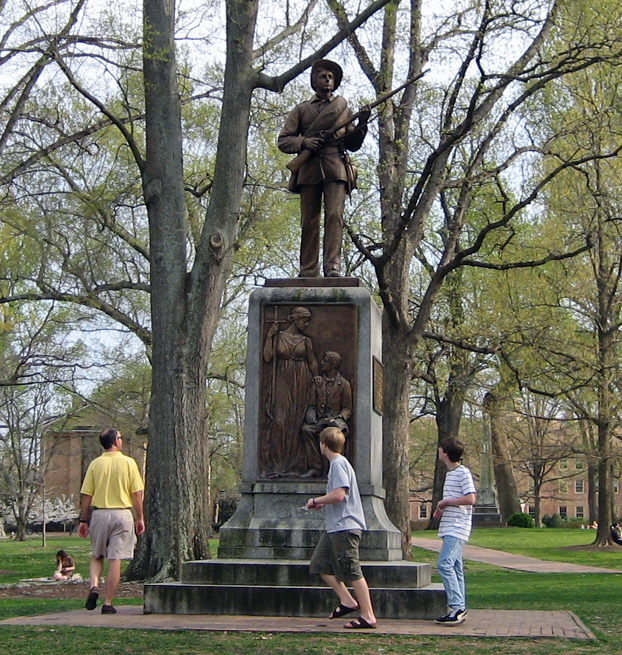


 Left side
 Front
Front Right side
.jpg)
.jpg)
.jpg)


