Hubbry Logo
Slope DaySlope DayMain
Open search
Slope Day
Community hub
Slope Day
logo
8 pages, 0 posts
0 subscribers
Be the first to start a discussion here.
Slope Day
Slope Day
from Wikipedia
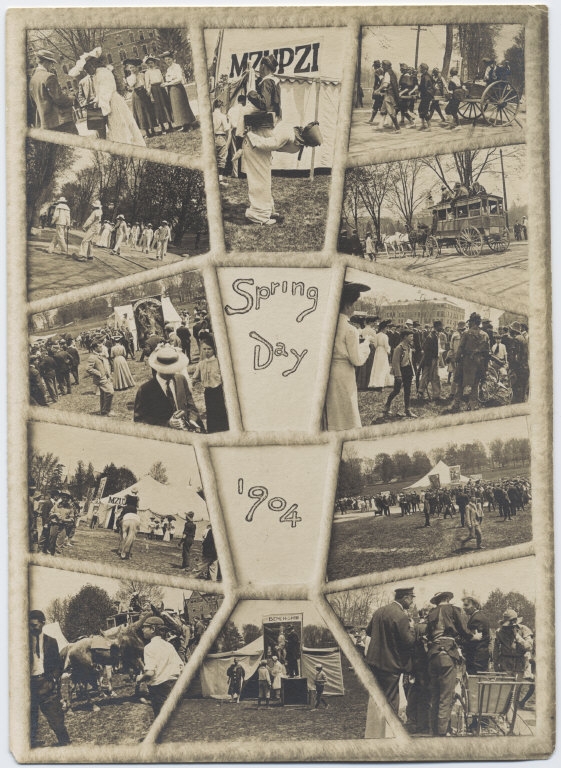
Images of Slope Day at Cornell University, then known as Spring Day, in 1904

Slope Day is an annual day of celebration held at Cornell University, historically held during the last day of regular undergraduate classes, though it has been moved to the following day as of 2014.[1] The Slope Day Programming Board (SDPB) is responsible for organizing the event, selecting artists, and managing the Slope Day's execution.[2] Though Slope Day has gone through many phases, in recent years the focus has shifted to live music and catered food and beverages on the slope on Cornell's primary campus in Ithaca, New York.

History

[edit]

19th century

[edit]
Sunshine Memorial Festival, Libe Slope, May 16, 1971
Slope Day 1971, then known as the Sunshine Memorial Festival
Libe Slope on the Cornell University campus in May 2006

Slope Day's origins can be traced to 1890, when the annual Navy Ball began on the Cornell University campus. The Navy Ball, held in October on the day before a major regatta on Cayuga Lake, was an evening dance with a band for the purpose of raising funds to support the Cornell crew and other athletic programs. Students traditionally skipped classes on the day of the regatta following the ball.

20th century

[edit]

In 1901, the Navy Ball was moved from October to May for the first time, and a committee including John L. Senior, Willard Dickerman Straight, and Henry Schoellkopf arranged the event and entertainment. Attendance in classes on the following day was dismal, and in 1902, the university declared the following day a holiday called Spring Day.

The annual Spring Day festivities involved a wide range of activities, from mock bullfights to circuses, typically on the Arts Quad. Spring Day remained a Cornell tradition for over 50 years.[3][4] However, during the 1960s and 1970s, official Spring Day celebrations were considered an anachronism, as Cornell was in the midst of Vietnam-era protests and civil unrest.

A brief revival occurred in the spring of 1971. The Sunshine Memorial Festival was organized by a Cornell student group, Ithaca Rapid Transit. It was sponsored by Maxwell's Coffee House, a student-run coffee house, founded by Daniel Vlock ’74 in 1971 in Mary Donlon Hall, a freshman dormitory, and Noyes Center. Maxwell’s was the first coffee house in North Campus and was named after a dog housed in the dormitory and not the Beatles song.

For the concert a plywood stage was constructed at the base of Libe Slope. The speaker system was provided by Cornell Engineering School students and was powered by extension cords plugged into outlets in student dormitory rooms. Several local bands played for free. The best known was Boffalongo, who subsequently became King Harvest and were known for their hit song "Dancing in the Moonlight". An estimated 5,000 people attended. Music and dancing took place until midnight when the Cornell Safety Patrol turned off the electricity. Two additional Sunshine Memorial Festival events were planned for the Spring and Fall of 1972. However, as is typical for Ithaca weather, they were rained out.

In 1979, an event then called "Springfest" was held on the last day of classes. Cornell Dining sponsored a chicken barbecue on Libe Slope and served beer to the students. At the time, New York State's drinking age was 18, making it easy for the university to sponsor both food and alcohol service for the event. For the next six years, Springfest involved live bands playing at the base of Libe Slope, with students dancing and drinking on the Slope itself.

In December 1985, New York state raised the drinking age to 21, so Cornell officials announced that the 1986 Springfest would be held in a fenced-in area on North Campus instead of the Slope. The student body responded with a massive "Take Back the Slope" campaign. All across campus, T-shirts, signs and chalk on sidewalks beckoned students to boycott the official Springfest and "Take Back the Slope." They did by the thousands, and the name "Slope Day" replaced "Springfest." In 1987, the university caved to pressure and had Robert Cray play on the Slope, but by 1988 the bands were gone once again and Slope Day became an unofficial event. For the next decade or so, the university tolerated Slope Day, and took little action to control it except for the banning of beer kegs in 1991. For many students the focus of Slope Day became the consumption of excessive amounts of alcohol.[citation needed]

Starting in the mid-1990s, the university began a more gradual reining in of Slope Day, instead of repeating the failed strategy of regaining control all at once. SlopeFest, an alcohol-free event featuring carnival-style entertainment started to take place on West Campus in 1999. In 2001, the amount and type of alcohol students could bring onto the slope was limited.

21st century

[edit]
O.A.R. performing at Slope Day 2004
Snoop Dogg performing at Slope Day 2005

Starting in 2003, the Slope Day Steering Committee, initially organized as the President's Council on Alcohol and Other Drugs by president-emeritus Hunter S. Rawlings III, took charge of Slope Day, restricted access to Libe Slope, brought live entertainment, and provided catered food and drink service. This time, the university's assertion of control succeeded.

The students did not revolt as their predecessors had done in the late 1980s, leading to increased University prohibitions against drinking at the event.

2021 Virtual Slope Day logo

In the 21st century, Slope Day measures have tried to limit excess underage drinking. Bracelets with tabs that are used as tickets to purchase alcohol are only offered to those who are of age, and only one drink is sold per purchase. Free water has been handed out to all attendees since 2006, and several volunteers on the slope have supervised students.

Due to the COVID-19 pandemic, for the first time ever, Slope Day became a 2-day event held fully online in 2020 and 2021.[2] It returned as a one-day, in-person event in 2022.

Music

[edit]
Libe Slope on the lower portion of this photograph, taken from McGraw Tower in May 2013
Rapper Dreezy after her Slope Day 2018 performance
Coin performing at slope day in 2023.
COIN performing at Slope Day 2023
Flo Rida performing at Slope Day 2024

Live musical performances are typically held during Slope Day. Past live performances have included:

SlopeFest

[edit]

SlopeFest is a carnival type event accompanying Slope Day. In the past, this event has included various raffles, an airbrush tattoo artist and inflatable games. Started in 1999 by concerned students of the Slope Day Programming Board, SlopeFest was held on West Campus and hosted carnival-style games, food, and live musical performances. Starting in 2004, SlopeFest was incorporated into the main events of Slope Day and held inside the event perimeter. SlopeFest is now held on Ho Plaza. The Slope Day Programming Board, composed of students, plans all aspects of SlopeFest.

Controversies

[edit]

R&B singer Kehlani, the scheduled front-runner for the 2025 Slope Day, was dropped by 15th president of Cornell University Michael Kotlikoff. The decision was announced in a university-wide email on April 23, citing "injected division and discord" and Kehlani's alleged "anti-semitic" and "anti-Israel sentiments."[31] On May 2, the Slope Day Programming Board announced Gunna as the replacement headliner in a University-wide email.

References

[edit]
[edit]
Revisions and contributorsEdit on WikipediaRead on Wikipedia
from Grokipedia
Slope Day is an annual student-led spring festival at , held on Libe to celebrate the end of spring semester classes with music performances, food vendors, and communal gatherings. The event, typically occurring on the following the last day of classes in early May, attracts thousands of participants and represents one of the institution's most prominent outdoor traditions, with origins linked to early 20th-century "" observances dating back over a century. Organized by the Slope Day Programming Board in collaboration with university administration, it features a headlining and various activities, though it has historically involved challenges related to crowd management, excessive alcohol consumption, and public safety incidents requiring police intervention. Notable controversies include the 2025 cancellation of R&B artist as headliner amid backlash over her pro-Palestinian activism, which some critics characterized as antisemitic, leading to a last-minute replacement and student protests.

Overview

Description and Traditions

Slope Day is an annual student-led celebration at Cornell University, held on the last day of regular undergraduate classes, typically in early May, to mark the end of the academic term through informal gatherings and festivities on the Libe Slope. Core traditions encompass communal picnics with food and drink, games, live music performances, and relaxation on the hillside, enabling students to socialize and decompress after exams. Unlike formal commencement exercises focused on graduation and speeches, Slope Day prioritizes unstructured student-initiated fun and community bonding, with attendance routinely surpassing 10,000 participants.

Location and Timing

Slope Day takes place on Libe Slope, a prominent grassy hillside on 's Ithaca campus that connects Central Campus to West Campus and offers scenic views. This location provides central accessibility for students while accommodating large gatherings amid its natural terrain overlooking Beebe Lake. The event occurs annually on the last weekday of regular undergraduate classes, typically in early to mid-May, such as May 7 in 2025. Setup by volunteers begins early in the morning, with gates opening around 11:30 a.m. and activities running until a 4:30 p.m. to align with policies. Given Ithaca's variable May climate, characterized by mild temperatures but frequent rain and thunderstorms, Slope Day includes weather-dependent measures. Severe conditions have prompted evacuations in past years, such as in when thunderstorms forced early closure around 2:30 p.m. The event generally proceeds in light rain but prioritizes safety through monitoring and rapid response to hazardous weather.

Historical Development

19th Century Origins

The earliest precursors to Slope Day emerged in the late amid Cornell University's nascent student culture, characterized by informal, student-led celebrations that reflected the institution's emphasis on practical, nonsectarian education in a rural setting. Founded in 1865, Cornell promoted and community among its diverse enrollees, many of whom traveled from across the to Ithaca's isolated , fostering organic gatherings as outlets for relief after rigorous academic terms. This environment, with limited administrative oversight, encouraged unstructured assemblies that prioritized bonding over formal structure, aligning with the university's land-grant mission to integrate practical pursuits with intellectual rigor. A key documented tradition from this period was the Navy Ball, initiated around 1890 as an evening of organized by students to fundraise for athletics. Held in prior to a Cornell-Navy football game, it represented one of the first large-scale, student-initiated events on campus, emphasizing communal participation without alcohol or rowdiness, consistent with prevailing norms of the era. Unlike later iterations, these early activities lacked specific ties to the Libe or end-of-term timing but laid groundwork for celebratory by highlighting student agency in recreation amid academic demands. records from the 1890s, including reminiscences in periodicals, portray such events as wholesome diversions that contrasted with the intense focus on examinations and , though explicit slope gatherings remain sparsely recorded.

20th Century Evolution

In the 1920s and 1930s, Spring Weekend events evolved to include informal student-led activities such as duck races on Beebe Lake and elaborate themed spectacles like the 1938 Circus Maximus, which featured Roman-inspired competitions, alongside Big Band dances in Barton Hall with performers including Glenn Miller and Jimmy Dorsey, reflecting a post-World War I emphasis on campus camaraderie documented in university traditions. During the 1940s and 1950s, the celebrations incorporated additional informal elements like battles of makeshift boats on Beebe Lake and free outdoor performances, culminating in the first recorded Libe concert by the University Band in 1953, followed by ensembles that foreshadowed future musical expansions and contributed to semi-organized year-end gatherings. Post-World War II enrollment surges, driven by the which ballooned Cornell's student population, coincided with broader participation in these events, providing structured relief from academic demands amid returning veterans' integration. By the and , countercultural shifts introduced louder through headliners like , , and performing in during , while 1973 featured Seatrain, , and , and 1977's SpringFest added free barbecues with acts like Commander Cody, maintaining the tradition's causal role in alleviating end-of-term stress despite growing alcohol consumption enabled by a lowered minimum drinking age. The 1980s saw increased administrative scrutiny as the minimum drinking age rose to 21 in 1984, prompting relocations like to North Campus in 1986 and cancellations following overcrowding and medical emergencies after the 1987 performance, leading students to organize unofficial "Take Back the " gatherings. In response, student-led groups such as the 1989 Springfest Coordinating Committee promoted alcohol-free options and safer practices, evolving into the 1993 formation of Students on the () for volunteer-managed logistics and safety, evidencing a transition to semi-organized with campus police handling minor incidents amid the event's notorious reputation for risky behavior.

21st Century Formalization and Changes

In the early , Slope Day underwent significant formalization with the establishment of the Slope Day Programming Board (SDPB) in , aimed at centralizing coordination, planning, and execution to address growing logistical complexities and liability risks associated with the event's expansion. This student-led body, operating under Campus Activities, shifted the event from student initiatives toward a structured annual , incorporating professional practices to manage attendance, vendors, and infrastructure on Libe Slope. Budget allocations for Slope Day escalated markedly in the , reflecting increased student demands for high-profile features and administrative emphases on risk mitigation; for instance, the Student Assembly approved a $400,000 increase in 2023, raising the 2024 budget from $315,000 to $715,000, primarily funded through mandatory student activity fees. These funds supported enhanced production elements, such as stage setups and security staffing, though critics have argued that such growth prioritizes spectacle over fiscal restraint, with expenditures exceeding certain university contributions to local public services. Safety protocols were integrated more rigorously following incidents in the that highlighted vulnerabilities to overcrowding, alcohol-related disruptions, and unauthorized access, prompting empirical adjustments based on campus security data; measures now include mandatory wristbands for entry, ID scanning at alcohol service points, clear-bag policies limited to 8x8 inches, and weapons detection systems to enforce sobriety and capacity controls. Staff discretion to eject attendees for violations has correlated with fewer reported chaos-related issues, underscoring a causal link between formalized barriers and diminished uncontrolled behavior, despite ongoing debates over whether these changes foster a safer environment or impose excessive that dilutes the event's organic traditions.

Event Organization and Components

Planning and Funding

The Slope Day Programming Board (SDPB), a student-governed entity chartered by the Student Assembly, directs the event's planning, encompassing theme development, logistical arrangements, and programming decisions to foster a student-centric celebration. Cornell University's administrative involvement is confined largely to safety enforcement, venue permitting, and logistical support through Student & Campus Life, preserving SDPB autonomy in creative and operational choices. Primary funding stems from the Undergraduate Student Activity Fee (USAF), a compulsory levy on tuition that the allocates via resolution. For the 2024 iteration, the assembly raised the budget from $315,000 to $715,000, equating to roughly $50 per undergraduate, drawn from the broader $310 annual USAF pool across approximately 15,000 students. This structure emphasizes student self-financing, with assembly votes reflecting direct democratic input on expenditure priorities, though it prompts scrutiny over trade-offs against competing campus or community needs, such as regional educational shortfalls where per-pupil state funding trails similar event costs. Headliner procurement follows a structured student-driven protocol: SDPB conducts multiple survey rounds to poll preferences, narrows options through voting, and executes bids within budgetary constraints. Budget expansions have aimed to enhance leverage, yet analyses of —gauged by factors like booking fees versus attendance metrics—reveal ongoing debates on efficiency, as escalated spending has not uniformly correlated with proportional gains in perceived event caliber.

Music Performances and Headliners

Slope Day's music performances center on a main stage on Libe Slope, featuring professional headliners supported by opening acts and student performers, drawing crowds of thousands of Cornell students. The event typically schedules sets from midday into the afternoon, with robust sound systems and staging designed to accommodate over 10,000 attendees on the grassy hillside. Headliners, selected through student surveys and budget assessments by the Slope Day Programming Board, are announced several months in advance to build anticipation, spanning genres such as hip-hop, rap, and electronic dance music. Historical examples include Snoop Dogg in 2005 alongside The Game and The Starting Line, Kanye West in 2004, and Drake in an earlier appearance, reflecting a mid-2000s emphasis on established rap and rock acts. More recent lineups feature Steve Aoki headlining in 2019 with Cousin Stizz and Ezi, and Kehlani with Louis the Child in 2025, indicating a shift toward contemporary pop and EDM artists. A substantial portion of the event's budget, which increased from $315,000 to $715,000 for 2024, is allocated to securing these performers, prioritizing high-profile names to enhance attendance and energy. Student acts, including DJs and bands, often open or perform on auxiliary setups, providing opportunities for campus talent amid the professional shows. While early 20th-century events featured orchestras like Sherbo's in 1920, the modern format evolved in the 2000s to emphasize big-name concerts, though some student feedback notes a perceived dip in "star power" relative to peak years like 2004-2015, despite rising budgets.

SlopeFest and Additional Activities

SlopeFest serves as an alcohol-free, interactive counterpart to the main Slope Day concert, typically held concurrently on Ho Plaza to promote inclusive participation among students, faculty, staff, and recent alumni. Organized by the student-led Slope Day Programming Board, it features carnival-style games, rides, a with "challenge by choice" options, free giveaways, and non-alcoholic refreshments, emphasizing low-barrier recreation in the afternoon leading into evening events. Food offerings under the BreakFest initiative, coordinated by Cornell Health, provide complimentary snacks and beverages to support communal gathering and hydration during the festivities, drawing on longstanding traditions of shared meals at year-end celebrations. Prizes and further incentivize , accommodating attendees uninterested in or excluded from alcohol-centric activities on . Launched in 1999 on West Campus as a deliberate counterprogramming effort to mitigate excessive associated with earlier Slope Day iterations, SlopeFest relocated to Ho Plaza in subsequent years to integrate more seamlessly with central campus access while maintaining its focus on sober, family-oriented fun. Beyond SlopeFest, additional options include the Alternative Slope Day trip, such as excursions to the Hoffman Challenge Course for team-building outdoor activities like low- and high-ropes elements, targeting students preferring structured, off-site recreation over campus crowds. These elements collectively extend the event's appeal, fostering participation rooted in historical precedents of variety shows, games, and group outings from 19th- and 20th-century observances.

Controversies

Performer Selection Disputes

In April 2025, Cornell University's Slope Day performer selection process drew significant controversy when R&B singer was announced as headliner on April 11, only for President Michael Kotlikoff to rescind the invitation on April 23, citing her "antisemitic, anti-Israel sentiments" expressed in posts and prior performances, which he argued would "inject division and discord" into the event. Kotlikoff's decision followed backlash from Jewish student groups, including Cornell , and pro-Israel advocates who highlighted Kehlani's documented participation in events featuring chants such as "F*** Israel" and posts perceived as endorsing antisemitic tropes, including calls for 's elimination. Supporters of the cancellation, including columnists in The Cornell Daily Sun, argued that Kehlani's verifiable statements crossed into by conflating with broader anti-Jewish rhetoric, justifying administrative intervention to maintain a non-hostile environment amid rising post-October 7, 2023, tensions. Opponents, including Kehlani herself—who stated on April 29, "I am not antisemitic" and framed her views as opposition to "genocide" in Gaza—contended that the revocation suppressed free expression on political issues, with organizations like labeling it a "dangerous precedent for " that prioritized certain viewpoints over artistic booking autonomy. Student reactions were divided: some praised the move for rejecting perceived , while others organized a rival "Community Slope Day" event on May 7 to what they viewed as institutional against pro-Palestinian , reflecting Cornell's student body's progressive leanings that often influence selections by the Slope Day Programming Board. Kehlani was replaced by rapper Gunna, announced in early May 2025, eliciting mixed responses—some students welcomed the less politically charged alternative for fostering unity, while critics decried it as a safer but less exciting choice that underscored ongoing tensions in artist vetting. Prior to 2025, disputes over headliners were less publicized but centered on perceived mismatches in act quality and cultural relevance, often tied to the board's selections favoring artists popular among Cornell's predominantly young, urban-oriented demographic rather than broader appeal, though without the ideological flashpoints of the Kehlani case. These incidents highlight how performer choices, managed by student-led groups under administrative oversight, can amplify underlying campus divisions, with empirical patterns showing a tilt toward performers aligned with left-leaning activism prevalent in Ivy League institutions.

Safety and Conduct Issues

Slope Day has been associated with significant safety risks, primarily stemming from excessive alcohol consumption among attendees, many of whom are underage students. In 2006, health officials reported 35 cases of alcohol poisoning requiring treatment on the event date of May 5, alongside 17 miscellaneous injuries, totaling over 50 medical interventions that year. Similar patterns persisted in subsequent years; for instance, in 2014, Cornell Police charged 12 individuals with unlawful possession of alcohol and four with related conduct violations during the event. Overconsumption remains a primary concern for responders, contributing to , impaired judgment, and elevated risks of disorderly behavior, as noted in annual police and medical assessments. Injuries from physical hazards, including falls on the steep, grassy terrain exacerbated by intoxication, have necessitated urgent responses. A notable 2015 incident involved a participant suffering severe injuries during the event, requiring transport by to a for evacuation to a regional . The slope's incline and crowded conditions amplify these dangers, with emergency calls peaking between noon and 2 p.m. when alcohol effects intensify. Cornell's amnesty policy, aimed at encouraging help-seeking for alcohol without punitive repercussions, acknowledges the event's high-risk alcohol environment but has not eliminated the underlying hazards tied to unchecked consumption. In response to recurring incidents, administrators have introduced targeted protocols. Current policies mandate clear or transparent bags limited to 8x8 inches and employ walk-through detection systems to curb , including alcohol, while allowing essentials like phones and keys. A fully staffed medical site with trained personnel operates on-site, and event timelines incorporate structured end times—effectively functioning as curfews—to disperse crowds before peak evening risks, a measure adopted following prior serious incidents including fatalities that prompted tighter controls. These steps reflect pragmatic efforts to mitigate chaos from lax oversight, though critics from conservative viewpoints argue that tolerating underage drinking as a "harmless " fosters broader cultural erosion by normalizing irresponsibility, contrasting with student defenses of the event as a vital, low-stakes . Empirical data from police logs underscores that without rigorous enforcement, such gatherings inherently invite preventable harms.

Administrative and Financial Criticisms

In 2025, President Michael Kotlikoff exercised veto authority over the Slope Day Programming Board's selection of headliner , citing her alleged antisemitic and anti-Israel sentiments expressed in performances, videos, and as incompatible with the event's goal of community unity. This administrative intervention prompted student groups to organize a parallel "Community Slope Day" event on May 7 as a against perceived , resulting in two concurrent celebrations on the Libe Slope: the official university-backed festival featuring Gunna and , and the grassroots alternative. The duplication of programming, security, and logistical efforts across the split events amplified resource strain, with the official event requiring last-minute replacement of the canceled performer and undisclosed additional funding potentially drawn from the standard budget. Critics argued this overreach undermined student self-governance, as the Programming Board operates under the Student Assembly to select artists, yet the president's unilateral decision highlighted gaps in formalized oversight protocols that could prevent such escalations. Financial scrutiny has centered on Slope Day's escalating costs, funded primarily through the Student Activities Fee (SAF) of $384 per undergraduate for the 2024-2025 , which supports a exceeding $700,000 . The 2023 Student Assembly approval doubled the prior year's allocation from $315,000 to $715,000 to attract higher-profile acts, but this outpaced comparable expenditures, such as the $650,000 annual contribution to the Ithaca City School District. The 2025 performer switch reportedly involved reallocating up to $400,000 originally earmarked for , sourced from SAF/tuition funds, without transparent recourse for refunds or offsets to students bearing the burden via mandatory fees. Proponents of tighter fiscal controls contend these sums divert resources from broader community benefits, like academic support or local partnerships, exacerbating fee pressures amid rising tuition—Cornell's comprehensive fees increased 4.2% for 2025-2026—while yielding limited accountability for expenditure efficacy. Debates pit administrative intervention against demands for student autonomy, with evidence from past incidents—such as performer-related disruptions—suggesting structured mechanisms mitigate and liability risks, including alcohol-fueled conduct issues that have prompted enhanced university policing. However, student advocates, including those behind Community Slope Day, decry the 2025 veto as inconsistent with free expression principles, arguing it fosters division rather than unity and erodes trust in without empirical justification for overriding board decisions. Empirical data from budget doublings show improved attendance and performer quality post-investment, yet persistent criticisms highlight insufficient audits or alternatives, such as scaled-back events or private funding, to alleviate student financial loads. This tension underscores broader accountability deficits, where presidential authority intersects with fee-dependent funding, potentially incentivizing over expansive programming.

Impact and Legacy

Role in Cornell Culture

Slope Day holds a prominent role in 's student culture as an enduring tradition that marks the informal closure of the spring academic semester. Observed annually on the day following the last classes, it functions as a communal gathering on the Libe Slope, one of few events transcending the university's decentralized structure and diverse student demographics. This rite unites undergraduates across disciplines—such as engineers, pre-meds, athletes, and first-generation students—fostering a shared sense of belonging amid Cornell's expansive, rural campus in Ithaca. Originating from early 20th-century spring festivities and formalized as Slope Day by the , the event embodies student-driven revelry that emphasizes community celebration over academic formality. Historical accounts highlight its evolution into an informal year-end assembly, where participants skip final classes to converge in excitement, reinforcing interpersonal bonds through collective participation. In sociological terms, Slope Day exemplifies a low-barrier social mechanism for sustenance in an isolated collegiate environment, distinct from more rigid traditions at peer institutions. Student-led since underscores Cornell's pragmatic orientation toward accessible, peer-governed rituals that prioritize experiential unity without institutional overreach.

Achievements and Positive Outcomes

Slope Day's endurance since 1901, initially as , underscores its success as an enduring tradition embedded in Cornell University's student culture, adapting through wars, activism, and pandemics while consistently drawing large crowds for communal celebration. The event promotes community cohesion by serving as a centralized gathering for students, , staff, and , with past iterations attracting record attendances during headline performances by artists including Drake and , thereby channeling end-of-year energy into structured festivities like music concerts and SlopeFest's alcohol-free activities. Relative to its scale, Slope Day has demonstrated low disruption rates, as in when the event concluded without serious incidents despite a of approximately 12,500, supported by evolving safety protocols such as entry screenings and volunteer oversight. It bolsters through student-led elements, including selection surveys conducted by the Slope Day Programming Board that reflect undergraduate preferences, fostering excitement and pride as evidenced by accounts of memorable experiences across generations.

Criticisms and Proposed Reforms

Criticisms of Slope Day have centered on its increasing politicization, which detracts from its intended role as a unifying campus celebration. In April 2025, the selection of singer as headliner sparked backlash due to her public pro-Palestinian statements and social media activity, which groups like and Cornellians for described as antisemitic and anti-Israel, potentially fostering division and safety risks for Jewish students. University President Michael Kotlikoff ultimately rescinded the invitation, arguing that Slope Day should unite rather than divide the community, though this decision prompted accusations of inconsistent administration and suppression of free expression from pro-Kehlani student groups. Left-leaning viewpoints, as articulated in Cornell Daily Sun columns, emphasized inclusivity and critiqued the cancellation as enforcing political orthodoxy, while right-leaning perspectives, such as those in The Cornell Review, prioritized apolitical standards to avoid endorsing divisive or hateful rhetoric. Safety and conduct issues have also drawn scrutiny, particularly related to excessive alcohol consumption and crowd management. Slope Day events have historically involved high-risk drinking, leading to EMS interventions for unconscious attendees and unstable crowds, as reported during the May 7, 2025, event where transported an unconscious individual via gator amid crowd instability. Past incidents include bizarre police responses to behaviors like peanut-throwing and branch-hanging, underscoring lapses in oversight despite security measures such as metal detectors and clear-bag policies. Critics, including community groups like Cayuga's Watchers, argue that lax enforcement promotes harm, with proposals for personal responsibility clashing against calls for more inclusive harm-reduction approaches. Additionally, observers have noted a perceived decline in performer appeal, attributing it to budget constraints or prioritization of ideological alignment over entertainment value, as evidenced by student complaints on forums about diminishing headliner quality since earlier years featuring artists like . Proposed reforms emphasize evidence-based enhancements for sustainability and neutrality. Advocates recommend stricter, merit-focused vetting for performers to prioritize broad appeal and avoid ideological controversies, as suggested in post-2025 analyses calling for transparent selection criteria independent of political pressures. The Student Assembly passed a May 2025 resolution prohibiting administrative rescission of approved performers, aiming to insulate decisions from external backlash while upholding community standards. For safety, expansions to sobriety initiatives—such as enhanced pre-event and stricter alcohol restrictions—have been floated by groups like Cayuga's Watchers to mitigate drinking harms, alongside demands for greater transparency given the event's $715,000 cost in 2024. These measures seek to restore Slope Day's focus on celebration through causal accountability rather than reactive interventions.

References

Add your contribution
Related Hubs
User Avatar
No comments yet.