Hubbry Logo
Solidarity ForeverSolidarity ForeverMain
Open search
Solidarity Forever
Community hub
Solidarity Forever
logo
8 pages, 0 posts
0 subscribers
Be the first to start a discussion here.
Solidarity Forever
Solidarity Forever
from Wikipedia
"Solidarity Forever"
Song
Written1914–1915
ComposerTraditional music
LyricistRalph Chaplin
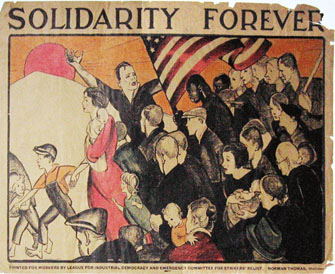
Poster for League for Industrial Democracy, designed by Anita Willcox during the Great Depression, showing solidarity with struggles of workers and poor in America
A portion of the song being sung at a union election day gathering in Wisconsin, United States

"Solidarity Forever" is a trade union anthem written in 1915 by Ralph Chaplin promoting the use of solidarity amongst workers through unions. It is sung to the tune of "John Brown's Body" and "The Battle Hymn of the Republic". Although it was written as a song for the Industrial Workers of the World (IWW), other union movements, such as the AFL–CIO, have adopted the song as their own. The song has been performed by musicians such as Utah Phillips, Pete Seeger, and John Darnielle. It was redone by Emcee Lynx and The Nightwatchman. It is still commonly sung at union meetings, protests and rallies in the United States, Australia, New Zealand and Canada, and has also been sung at conferences of the Australian Labor Party and the Canadian New Democratic Party. This may have also inspired the hymn of the consumer cooperative movement, "The Battle Hymn of Cooperation", which is sung to the same tune.

It has been translated into several other languages, including French, German, Polish, Spanish, Swahili and Yiddish.[1]

Lyrics

[edit]

When the union's inspiration through the workers' blood shall run,
There can be no power greater anywhere beneath the sun;
Yet what force on earth is weaker than the feeble strength of one,
But the union makes us strong.

Chorus:
Solidarity forever!
Solidarity forever!
Solidarity forever!
For the union makes us strong.

Is there aught we hold in common with the greedy parasite,
Who would lash us into serfdom and would crush us with his might?
Is there anything left to us but to organize and fight?
For the union makes us strong.

Chorus

It is we who plowed the prairies; built the cities where they trade;
Dug the mines and built the workshops, endless miles of railroad laid;
Now we stand outcast and starving ’midst the wonders we have made;
But the union makes us strong.

Chorus

All the world that's owned by idle drones is ours and ours alone.
We have laid the wide foundations; built it skyward stone by stone.
It is ours, not to slave in, but to master and to own.
While the union makes us strong.

Chorus

They have taken untold millions that they never toiled to earn,
But without our brain and muscle not a single wheel can turn.
We can break their haughty power, gain our freedom when we learn
That the union makes us strong.

Chorus

In our hands is placed a power greater than their hoarded gold,
Greater than the might of armies, multiplied a thousand-fold.
We can bring to birth a new world from the ashes of the old
For the union makes us strong.

Composition

[edit]

Ralph Chaplin began writing "Solidarity Forever" in 1913, while he was working as a journalist covering the Paint Creek–Cabin Creek strike of 1912 in Kanawha County, West Virginia, having been inspired by the resolve and high spirits of the striking miners and their families who had endured the violent strike (which killed around 50 people on both sides) and had been living for a year in tents. He completed the song on January 15, 1915, in Chicago, on the date of a hunger demonstration[clarification needed]. Chaplin was a dedicated Wobbly, a writer at the time for Solidarity, the official IWW publication in the eastern United States, and a cartoonist for the organization. He shared the analysis of the IWW, embodied in its famed "Preamble", printed inside the front cover of every Little Red Songbook.[2]

The Preamble begins with a classic statement of a two-class analysis of capitalism: "The working class and the employing class have nothing in common." The class struggle will continue until the victory of the working class: "Between these two classes a struggle must go on until the workers of the world organize as a class, take possession of the earth and the machinery of production, and abolish the wage system." The Preamble denounces trade unions as incapable of coping with the power of the employing class. By negotiating contracts, the Preamble states, trade unions mislead workers by giving the impression that workers have interests in common with employers.[3]

The Preamble calls for workers to build an organization of all "members in any one industry, or in all industries". Although that sounds a lot like the industrial unionism developed by the Congress of Industrial Organizations, the IWW would oppose John L. Lewis' campaign to split from the American Federation of Labor and organize industrial unions in the 1930s. The Preamble explains, "Instead of the conservative motto, 'A fair day's wage for a fair day's work,' we must inscribe on our banner the revolutionary watchword, 'Abolition of the wage system.'" The IWW embraced syndicalism, and opposed participation in electoral politics: "by organizing industrially we are forming the structure of the new society within the shell of the old".[4]

The outlook of the Preamble is embodied in "Solidarity Forever", which enunciates several elements of the IWW's analysis. The third stanza ("It is we who plowed the prairies") asserts the primacy of the role of workers in creating value. This is echoed in stanzas four and five, which provide ethical justification for the workers' claim to "all the world." The second stanza ("Is there aught we hold in common with the greedy parasite") assumes the two antagonistic classes described in the Preamble. The first and fifth stanzas provide the strategy for labor: union solidarity. And the sixth stanza projects the outcome, a new world brought to birth "from the ashes of the old".

Chaplin was not pleased with the widespread popularity of "Solidarity Forever" in the labor movement. Late in his life, after he had become a voice opposing (State) Communists in the labor movement, Chaplin wrote an article, "Why I wrote Solidarity Forever", in which he denounced the "not-so-needy, not-so-worthy, so-called 'industrial unions' spawned by an era of compulsory unionism". He wrote that among Wobblies "there is no one who does not look with a rather jaundiced eye upon the 'success' of 'Solidarity Forever.'" "I didn't write 'Solidarity Forever' for ambitious politicians or for job-hungry labor fakirs seeking a ride on the gravy train.… All of us deeply resent seeing a song that was uniquely our own used as a singing commercial for the soft-boiled type of post-Wagner Act industrial unionism that uses million-dollar slush funds to persuade their congressional office boys to do chores for them." He added, "I contend also that when the labor movement ceases to be a Cause and becomes a business, the end product can hardly be called progress."[5]

Despite Chaplin's misgivings, "Solidarity Forever" has retained a general appeal for the wider labor movement because of the continued applicability of its core message. Some performers do not sing all six stanzas of "Solidarity Forever," typically dropping verses two ("Is there aught we hold in common with the greedy parasite") and four ("All the world that's owned by idle drones is ours and ours alone"), thus leaving out the most radical material.[6]

Modern additions

[edit]

Since the 1970s women have added verses to "Solidarity Forever" to reflect their concerns as union members. One popular set of stanzas is:

We're the women of the union and we sure know how to fight.
We'll fight for women's issues and we'll fight for women's rights.
A woman's work is never done from morning until night.
Women make the union strong!
(Chorus)
It is we who wash the dishes, scrub the floors and clean the dirt,
Feed the kids and send them off to school—and then we go to work,
Where we work for half men's wages for a boss who likes to flirt.
But the union makes us strong!
(Chorus)[7]

A variation from Canada goes as follows:

We're the women of the union in the forefront of the fight,
We fight for women's issues, we fight for women's rights,
We're prepared to fight for freedom, we're prepared to stand our ground,
Women make the union strong.
(Chorus)
Through our sisters and our brothers, we can make our union strong,
For respect and equal value we have done without too long,
We no longer have to tolerate injustices and wrongs,
For the union makes us strong.
(Chorus)
When racism in all of us is finally out and gone,
Then the union movement will be twice as powerful and strong,
For equality for everyone will move the cause along,
For the union makes us strong.
(Chorus)[8]

The centennial edition of the Little Red Songbook includes these two new verses credited to Steve Suffet:

They say our day is over; they say our time is through,
They say you need no union if your collar isn't blue,
Well that is just another lie the boss is telling you,
For the Union makes us strong!
(Chorus)
They divide us by our color; they divide us by our tongue,
They divide us men and women; they divide us old and young,
But they'll tremble at our voices, when they hear these verses sung,
For the Union makes us strong!
(Chorus)[9]

Pete Seeger's adaptation of the song removes the second and fourth verses and rewrites the final verse as:

In our hands is placed a power greater than their hoarded gold
Greater than the might of atoms, magnified a thousand fold,
We can bring to birth a new world from the ashes of the old,
For the union makes us strong.
(Chorus)[10]
[edit]
Anarchist banner protest reading "Solidarity forever" in three languages, in Portland, Oregon, United States

"Solidarity Forever" is featured in the 2014 film Pride in which London organisation Lesbians and Gays Support the Miners collect funds to support the miners of a Welsh village during the 1984–1985 UK miners' strike.[11]

The Little Red Songbook by the IWW includes a satire reversion of Solidarity Forever, retitled Aristocracy Forever; mocking the adoption of the song by the AFL-CIO.

See also

[edit]

Notes

[edit]

References

[edit]
[edit]
Revisions and contributorsEdit on WikipediaRead on Wikipedia
from Grokipedia
"" is a labor anthem written by American radical in 1915 for the (IWW), a syndicalist union dedicated to organizing all workers into "one big union" to abolish wage slavery through and class struggle. Set to the tune of the Civil War-era "" (also used for ""), its lyrics portray industrial capitalism as a system of exploitation where "the boss" divides workers by race, gender, age, and nationality to maintain power, urging solidarity as the force capable of "forming chains no foe can break" to claim "what they have stolen from us." Chaplin, then a 28-year-old IWW organizer and editor, completed the song amid the economic hardships of the era, inspired by events like the 1914 Colorado coal strikes and a January 1915 hunger demonstration in , reflecting the IWW's emphasis on revolutionary unionism over mere wage bargaining. First published in the IWW's newspaper, it quickly became the union's hymn, sung at strikes, free-speech fights, and conventions, symbolizing the IWW's rejection of and political reform in favor of workplace and general strikes. Despite government repression under laws like the Espionage Act—amid which Chaplin was imprisoned—the song endured, later adopted by mainstream unions such as the , though its original call for workers to "rise like lions after slumber" clashed with reformist labor strategies. Its defining characteristic lies in unyielding class-war rhetoric, decrying how "they have taken untold millions that they never toiled to earn" while fostering worker unity as the causal mechanism for emancipation, a message that propelled its use in pivotal struggles like the 1916 Everett Massacre and 1917 strikes, even as the IWW faced near-destruction from raids and deportations. Chaplin himself later distanced from radicalism, but the anthem's legacy persists in labor , critiquing divisions engineered by employers to thwart collective power.

Origins

Authorship and Initial Composition

, an American journalist, artist, poet, and organizer for the (IWW), authored the lyrics to "Solidarity Forever" in 1915. He began drafting the poem during coverage of the 1912–1914 Kanawha coal miners' strike in but completed it amid the economic hardships of early 1915. On January 17, 1915, during a frigid day in , Chaplin finalized the lyrics while walking to a "Hunger Demonstration" rally organized by unemployed workers at , a settlement house known for social reform efforts. By then, Chaplin had been active in the IWW since joining in 1913, contributing as a prolific writer and editor for its publications, including Solidarity magazine and the Industrial Worker newspaper, where he honed propaganda skills through verse and illustration. The song debuted in IWW circles shortly after its completion, appearing in print for the first time in the ninth edition of the IWW's in 1916. Its immediate resonance as a call for class solidarity and led to widespread singing at IWW meetings and strikes, cementing its status as an unofficial anthem within months.

Historical Inspiration and Context

In the early , the experienced rapid industrialization amid massive , with over 8.8 million arrivals between 1900 and 1915 swelling the industrial workforce, particularly in factories, mines, and mills where unskilled laborers predominated. This influx provided employers with abundant cheap labor, enabling suppression of wages and extension of work hours; non-union manufacturing workers often earned as little as 16-20 cents per hour in sectors like , while standard shifts exceeded 10-12 hours daily, six days a week, with minimal safety protections or compensation for injuries. Economic pressures from practices further intensified exploitation, fragmenting tasks to deskill workers and reduce , as employers prioritized output over worker welfare in booming industries like coal, textiles, and munitions. The of April 20, 1914, exemplified the violent clashes arising from these conditions during the , where approximately 11,000 miners struck against the Company for union recognition, higher pay, and an eight-hour day after enduring systems and evictions. Company guards and troops attacked a strikers' tent colony with machine guns and set it ablaze, killing at least 21 people, including two women and 11 children, which galvanized national outrage and radicalized labor sentiments toward collective defense against such brutality. This event, coupled with over 1,500 strikes recorded in 1915 alone—many involving immigrants demanding basic reforms—highlighted systemic employer tactics, including private militias like the Baldwin-Felts detective agency and court injunctions that legally barred and union activities, framing solidarity as a pragmatic counter to isolated worker vulnerability. In response, the (IWW), founded in 1905, promoted "One Big Union" as an alternative to the American Federation of Labor's craft-based model, which limited membership to skilled, often native-born workers and pursued incremental reforms through . The IWW's philosophy emphasized class-wide organization across skills, industries, and ethnicities to wage against capitalism's root causes, viewing fragmented craft unions as ineffective against mass unskilled labor pools and employer divide-and-conquer strategies like importing strikebreakers. By 1915, amid escalating unrest, this approach underscored solidarity not as mere sentiment but as a causal necessity for workers to counter coordinated capital resistance, influencing cultural expressions of labor resistance.

Lyrics and Musical Elements

Full Lyrics and Structure

"Solidarity Forever" features four original verses composed by , each comprising four lines and followed by a repeating four-line chorus, emphasizing the transformative power of worker unity. The lyrics highlight the contrast between individual frailty and strength, vivid of workers as the builders of modern industry—"It is we who plowed the prairies; built the cities where they trade"—and the assertion that production rightfully belongs to those who labor, culminating in phrases like "All the world that's owned by idle drones is ours and ours alone." Verse 1
When the union’s inspiration through the workers’ blood shall run,
There can be no power greater anywhere beneath the sun;
Yet what force on earth is weaker than the feeble strength of one,
But the union makes us strong.
Chorus
Solidarity forever,
Solidarity forever,
Solidarity forever,
For the union makes us strong.
Verse 2
It is we who plowed the prairies; built the cities where they trade;
Dug the mines and built the workshops, endless miles of railroad laid;
Now we stand outcast and starving midst the wonders we have made,
But the union makes us strong.
Chorus Verse 3
Is there aught we hold in common with the greedy parasite,
Who would lash us into and would crush us with his might?
Is there anything left to us but to organize and fight?
For the union makes us strong.
Chorus Verse 4
All the world that's owned by idle drones is ours and ours alone.
We have been fools, and jerked around too long to be afraid to own the world.
From the product of our labor, we can bring to birth the world,
For the union makes us strong.
The poetic structure prioritizes communal singability through a repetitive chorus that echoes the tune's rhythmic affirmation, with verses adhering to a loose ABCB rhyme scheme and iambic meter adapted from "John Brown's Body" to facilitate group performance at rallies. This form builds progressively from the inherent weakness of isolated workers to the collective realization of their productive power, enabling the song's use as a mnemonic for solidarity. Chaplin completed the lyrics on January 15, 1915, with first publication appearing in the Industrial Worker newspaper shortly thereafter.

Tune and Adaptations

"Solidarity Forever" is set to the melody of "John Brown's Body," a popular marching song that emerged during the American Civil War in 1861 to honor the abolitionist John Brown. This tune originated from the earlier 19th-century camp meeting hymn "Say, Brothers, Will You Meet Us" (also known as "Canaan's Happy Shore"), a simple folk melody attributed in part to William Steffe in the 1850s, which lent itself to adaptation for secular purposes due to its repetitive structure and emphatic rhythm. The martial quality of the 4/4 time signature, with its steady beat and opportunities for swung eighth notes, made it ideal for group singing during labor marches and rallies, evoking military cadence while requiring no instrumental accompaniment. Ralph Chaplin chose this established tune to ensure immediate familiarity among workers, many of whom knew "John Brown's Body" or its variant "The Battle Hymn of the Republic" from patriotic and religious contexts, thereby accelerating the song's adoption within (IWW) circles after its 1915 composition. Early IWW usages preserved the core melody to maintain recognizability, with only minor lyrical modifications—such as substituting strike-specific verses—for particular organizing campaigns, avoiding alterations that could disrupt communal performance. This fidelity to the original rhythm and phrasing facilitated rapid dissemination through in union halls and picket lines, as the tune's simplicity allowed unpracticed singers to join choruses seamlessly.

Ideological Themes

Core Message of Worker Solidarity

The lyrics of "Solidarity Forever" articulate a foundational assertion that workers, as the primary creators of economic value through their labor, possess inherent leverage when acting collectively to dismantle exploitative wage systems and assert control over industry. Chaplin's verses highlight this by declaring, "It is we who plowed the prairies; built the cities where they ; Dug the mines and built the workshops, endless miles of railroad laid," positioning laborers as indispensable producers whose unified refusal to work can compel systemic change, in contrast to the "feeble strength of one" operating in isolation. This rejects individual bargaining as futile against employers' control of capital and tools, advocating as the mechanism to end "wage slavery" and redistribute power accordingly. Empirically, the song's emphasis on group leverage draws from documented instances where coordinated worker action yielded concessions unattainable through solitary efforts, such as the 1916 Mesabi Range miners' strike in Minnesota, where Industrial Workers of the World (IWW) organization secured an eight-hour day and minimum daily wages of $3 via mass participation and solidarity pledges. In the lumber sector, the 1916–1917 strikes across the Northwest, involving thousands of loggers and sawmill operators, resulted in wage increases of up to 50 cents per day in some mills through sustained collective shutdowns, demonstrating how unified labor withdrawal disrupted production more effectively than fragmented disputes. These outcomes underscore the pragmatic utility of solidarity in exploiting workers' numerical superiority and role in value creation to negotiate from strength. From a causal standpoint, the message frames as a direct counter to employers' asymmetric advantages in hiring, firing, and , enabling workers to enforce demands by halting output they alone sustain; yet this rests on a premise of irreconcilable class antagonism, presupposing perpetual conflict over production's fruits without substantiation for scenarios where negotiated partnerships have generated shared productivity gains, such as through productivity-linked incentives observed in certain early 20th-century outcomes. The chorus's repeated invocation—" forever, for the union makes us strong"—encapsulates this as an enduring of rooted in labor's foundational economic .

Relation to IWW Principles

"Solidarity Forever," composed by IWW member in 1915, encapsulates the organization's , which advocates for the abolition of the wage system through and class solidarity, rejecting conservative trade unionism in favor of to build "the new society within the shell of the old." The song's urge workers across industries to unite against capitalist exploitation, mirroring the preamble's emphasis on overcoming divisions of , , or to seize control of production, as articulated in the IWW's 1905 founding principles that positioned unions not merely as bargaining agents but as instruments for worker ownership of the . This alignment contrasts sharply with the American Federation of Labor's (AFL) , which prioritized skilled workers' exclusivity and economic concessions over militant class struggle, a model the IWW founding explicitly critiqued for fostering "craft jealousy" and weakening broader worker by separating trades rather than uniting them industrially. Chaplin's promotes an inclusive, militant "one big union" ethos, echoing the IWW's call for all wage workers to organize horizontally across sectors, eschewing the AFL's vertical hierarchies that excluded the unskilled and immigrant laborers central to IWW ranks. The song's advocacy for sabotage and unyielding solidarity further reflects IWW tactics outlined in its early documents, viewing fragmented reforms as insufficient against concentrated industrial power, instead promoting unified action to dismantle the employing class's dominance—a principle Chaplin later affirmed as integral to the organization's revolutionary framework.

Reception and Usage in Labor Movements

Early Adoption by IWW and Other Unions

"Solidarity Forever," composed by in 1915 as an (IWW) organizer, quickly embedded itself in the union's repertoire amid escalating labor conflicts. By 1916, it featured in IWW songbooks and gatherings, including post-event commemorations of the Everett Massacre on November 5, 1916, where workers sang it alongside other anthems to honor fallen comrades and sustain defiance against employer and state repression. The hymn's martial rhythm, adapted from "," resonated in rallies, providing a portable tool for morale during free-speech fights and deportations targeting IWW members. In 1917, the song amplified IWW efforts during widespread strikes, notably the lumber workers' actions in the that involved over 50,000 participants across , Washington, and , demanding better wages and conditions amid wartime production pressures. Sung in camps and picket lines, it underscored the union's "one big union" ethos, helping coordinate disparate groups of loggers, sawmill operators, and shingle weavers despite federal injunctions and vigilante violence that led to hundreds of arrests. IWW records note its role in maintaining cohesion, with Chaplin himself recalling its origins in observing miners' struggles that prefigured these mobilizations. By the 1930s, despite the IWW's revolutionary syndicalism clashing with the more pragmatic of the , "Solidarity Forever" crossed into mainstream circles via the (CIO). Formed in 1935 to pursue , the CIO integrated the song into its campaigns, with affiliates like the employing it during the 1936–1937 Flint sit-down strikes that unionized , drawing thousands to mass meetings. Steel Workers Organizing Committee drives in 1937 similarly featured it to rally diverse ethnic workforces in mills from to , contributing to contracts covering over 500,000 workers. Anecdotal accounts from CIO and IWW oral histories describe heightened participation at events where the song was performed, attributing surges in attendance—sometimes doubling prior figures—to its evocative call for , though no empirical studies quantify direct causal effects on organizing success. This adoption bridged radical and reformist labor factions, embedding the in broader Depression-era mobilizations against industrial autocracy.

Role in Strikes and Organizing Efforts

During the 1934 Teamsters strikes, which spanned May to July and involved over 2,000 drivers demanding recognition and wage hikes from 40 cents to 67.5 cents per hour, workers sang "Solidarity Forever" after pivotal union election votes, fostering morale amid violent police confrontations on "Bloody Friday" (July 16) that killed two strikers and injured dozens. The strikes succeeded in securing employer concessions and Local 574's dominance, though gains eroded over time due to subsequent employer resistance and internal union shifts. In the 1940s wartime labor disputes, including actions defying no-strike pledges amid production demands, the song was adopted as an official UAW piece and sung at rallies, aligning with over 14,000 strikes in 1943 alone that yielded wage adjustments tied to cost-of-living increases averaging 15-20%. These correlated with temporary improvements in hours and pay but faltered as government interventions, like the War Labor Board, imposed settlements and suppressed wildcats, highlighting limits when broader solidarity fractured under patriotic pressures or ethnic tensions. "Solidarity Forever" promoted cohesion in multi-ethnic workforces by framing class interests above divisions, as in where Trotskyist organizers unified Finnish, Irish, and Scandinavian truckers against bosses. Yet failures occurred where internal splits—such as vs. industrial union rivalries or communist purges—undermined efforts, as in some 1940s coal strikes where rank-and-file defections led to partial defeats despite the song's use. Union records from the list the song as a staple in songbooks distributed for organizing drives, aiding recruitment by invoking unity at meetings and pickets, with over 100,000 copies printed for events. However, it did not stem membership declines post-World War II, as private-sector union density dropped from 35.7% in 1954 to 31.2% by 1960 amid , , and right-to-work laws.

Cultural and Global Impact

The song "Solidarity Forever" has appeared in various folk recordings that extended its reach into broader musical audiences beyond organized labor contexts. , a prominent folk musician, recorded versions of the song as early as the 1940s with and continued performing it in subsequent albums, such as those compiled in releases like Talking Union and Other Union Songs. These recordings preserved the tune in the acoustic folk style, emphasizing its anthemic quality through Seeger's clear vocals and simple instrumentation, though commercial mainstream adoption remained limited owing to the lyrics' explicit advocacy for class struggle. Utah Phillips, another folk performer known for labor-themed narratives, included live renditions on his 1983 album We Have Fed You All a Thousand Years, captured during performances in in 1981, which highlighted spoken-word introductions alongside the melody to evoke historical worker resilience. Such folk interpretations, while not charting commercially, circulated through niche audiences via vinyl and later digital platforms, maintaining the song's presence in protest music traditions without diluting its radical origins. In film, the Pete Seeger version featured in the 2014 British comedy-drama Pride, which dramatizes the alliance between gay activists and striking Welsh miners in 1984, using the track to underscore themes of unexpected solidarity across social divides. Documentaries depicting labor history, such as Barbara Kopple's 1990 Oscar-winning American Dream on the 1985–1986 Hormel strike, incorporated the song or its echoes in archival footage and soundtracks to evoke the era's tensions, though its radical tone limited crossover into non-documentary cinema. Parodies critiquing union militancy appeared sparingly in media, but verifiable instances in 1980s conservative outlets remain undocumented in primary sources, reflecting the song's polarizing reception outside sympathetic circles.

Influence Beyond the U.S., Including Poland's

The song spread to other English-speaking countries through labor networks, becoming embedded in union traditions. In , it was recognized as a foundational by the early , with historical records noting its role in inspiring workers during strikes and organizing drives. In , activists adopted it amid labor conflicts, including anti-conscription campaigns where it rallied opposition to wartime industrial policies. A notable thematic resonance appeared in Poland's Solidarność movement, established on August 14, 1980, following strikes at the led by electrician , which demanded independent union rights amid communist rule. The movement's name and rhetoric of collective worker resistance against state-imposed control mirrored the song's refrain and emphasis on unity to overcome oppression, yet Polish participants developed their own anthems, such as Jacek Kaczmarski's "Mury," without documented use of Chaplin's lyrics. Wałęsa's English-translated memoir, published in 1987 as Solidarity Forever: A Way of Hope, invoked the phrase to underscore enduring labor defiance, but this reflected post-facto alignment rather than prior influence. Empirical evidence shows no direct transmission of the song to under Soviet restrictions, with parallels arising from shared archetypes of proletarian solidarity against authoritarianism. U.S. unions provided material aid to Solidarność, and Wałęsa sang "Solidarity Forever" at a 1981 AFL-CIO convention, illustrating Western labor's embrace of the Polish struggle but not reciprocal adoption.

Criticisms and Limitations

Ralph Chaplin's Evolving Perspective

In the years following his release from in 1923, grew increasingly disillusioned with the trajectory of organized labor, particularly its shift toward and accommodation with rather than revolutionary overthrow of the wage system. This evolution reflected his broader rejection of after the Russian Revolution's degeneration into , leading him to adopt staunch anti-communist positions and distance himself from former IWW allies like William Haywood who fled to the . By the , Chaplin, having transitioned to more conservative leanings, expressed regret over "Solidarity Forever" becoming an anthem for mainstream unions like those in the AFL and CIO, which he saw as pursuing incremental gains within the capitalist framework instead of the IWW's vision of worker control through one big union. In his 1948 autobiography Wobbly: The Rough-and-Tumble Story of an American Radical, he lamented the song's appropriation by organizations lacking commitment to abolishing class exploitation, viewing such usage as a distortion that diluted its original call for aimed at systemic change. Chaplin's post-World War II writings further critiqued this "bureaucratic unionism," arguing that the song's revolutionary ethos had been co-opted to legitimize partnerships with employers and , undermining true worker in favor of institutionalized compromise. He preferred the hymn remain associated with radical agitation, as evidenced in articles like "Why I Wrote Solidarity Forever," where he underscored its roots in ideological battles for proletarian rather than mere . This perspective aligned with his later advocacy for grassroots unionism over top-down structures, though he never fully renounced the IWW's core principles of .

Critiques of Union Solidarity Ideology

Critics of union solidarity ideology contend that it encourages workers to behave collectively like a , artificially inflating wages above market-clearing levels, which raises employer costs, discourages hiring, and ultimately harms consumers through higher prices and reduced output. This dynamic, rooted in first-principles of , parallels how producer monopolies stifle competition; empirical analyses show union wage premiums of 10-20% correlating with elevated in affected industries, as firms respond by substituting capital for labor or relocating operations. In the U.S. sector, high union density and resultant wage rigidity contributed to employment declines post-1970s, as inflexible contracts impeded adjustments to from low-wage countries and pressures, leading to a drop from 19.5 million jobs in 1979 to 12.1 million by 1990. Sectors with strong solidarity norms, such as autos and , faced repeated bankruptcies and plant closures—e.g., the Big Three automakers' market share fell from 80% in 1970 to under 50% by 2000—partly due to resistance to productivity-enhancing reforms, contrasting with non-union competitors' . Historically, the IWW's uncompromising solidarity tactics, including widespread strikes and anti-war agitation, triggered backlash via the , under which over 160 members were indicted in 1917 raids, with 101 convicted in trials by August 1918 for alleged conspiracy to war production. These prosecutions dismantled IWW leadership and membership, illustrating how militant can invite state suppression rather than sustained worker gains. Contemporary evidence underscores limitations in unionized environments, where solidarity mandates correlate with higher ; for instance, private-sector union membership hovered at 5.9% in 2024 amid stagnant recovery, while union-heavy sectors exhibit lower turnover but greater vulnerability to fiscal cuts. Free-market analysts argue that enforced overlooks individual incentives, fostering dependency over , as right-to-work (RTW) states—prohibiting compulsory —demonstrate superior performance: from 1977-1999, their gross state product grew 0.5% faster annually than non-RTW states, with population surging 90% versus 35% in union-security states over similar periods. Such outcomes support claims that voluntary contracts enable innovation and job creation, unencumbered by collective vetoes on efficiency measures.

Legacy and Modern Interpretations

Enduring Role in Contemporary Labor

In the 2020s, "Solidarity Forever" has been invoked at various labor actions to foster unity, though its deployment is sporadic compared to earlier eras. members sang the anthem at their special bargaining convention in on March 29, 2023, symbolizing resolve during contract negotiations. Similarly, British performer led a rendition in support of at a , picket line on October 12, 2022, amid ongoing organizing drives at the coffee chain. During the 2020 strike by Canada's Mount Allison Faculty Association, participants adapted the lyrics to emphasize academic labor issues, such as "Solidarity today, MAFA 2020 strike," while retaining the chorus on collective strength. These instances reflect the song's persistence as a rallying cry, yet its practical role in mobilization has diminished alongside broader trends in union density and organizing methods. U.S. union membership reached 10.0 percent of the wage and salary workforce in 2023, per figures, continuing a decades-long decline that limits widespread choral traditions in strikes. Digital platforms for communication and virtual campaigns have increasingly replaced physical gatherings where songs like this once built morale, rendering the anthem more ceremonial than central to recruitment. Adaptations occasionally tailor the lyrics to modern contexts, such as gig work or sector-specific grievances, but the original verses on industrial solidarity predominate without fundamental alteration. In 2024, the and Fund's annual calendar featured the song prominently, underscoring its symbolic endurance in labor education and tributes even as union ranks contract.

Debates on Relevance in Post-Industrial Economy

In the , characterized by a shift toward service, knowledge, and gig work, critics argue that the core message of "Solidarity Forever"—emphasizing unified worker action to overcome capitalist exploitation—encounters diminished applicability due to structural changes that erode traditional . Union membership in the United States fell to 9.9% of workers in 2024, down from 20.1% in 1983, reflecting broader difficulties in organizing fragmented workforces where strikes lose potency without concentrated production sites. In knowledge-based sectors, workers' leverage diminishes as roles emphasize individualized skills over collective assembly-line interdependence, making replacement easier and solidarity harder to sustain amid high employee replaceability. The rise of remote and flexible work post-COVID has exacerbated these challenges, complicating union organizing by dispersing workers geographically and reducing opportunities for on-site mobilization. Reports highlight how remote arrangements hinder , with unions struggling to enforce rights in hybrid models that prioritize individual over group cohesion. further undermines local solidarity by enabling cross-border capital mobility, correlating with declining union coverage as firms offshore operations or leverage foreign direct investment to bypass domestic wage pressures. Proponents counter that the song retains value for boosting morale in persistent frontline sectors like healthcare, where union density remains higher and addresses ongoing shortages and burnout, though ties such gains more to sector-specific leverage than the anthem's alone. Recent labor outcomes illustrate mixed causal efficacy of solidarity tactics. The ' 2023 "Stand Up" strike secured 25% wage increases over 4.5 years, elimination of tiered pay, and historic contracts at Ford, GM, and , demonstrating that coordinated action can still yield concessions in manufacturing holdouts resistant to full . Conversely, organizing failures in tech—such as Amazon's defeat of union votes in warehouses through aggressive anti-union campaigns and Google's use of consultants to quash efforts—underscore how intangible assets and global scalability dilute worker unity without complementary policy reforms like enhanced labor laws. These disparities suggest that while "Solidarity Forever" inspires resolve amid economic flux, its prescription of worker solidarity as sufficient causal force overlooks the need for institutional adaptations to counter capital's enhanced mobility.

References

Add your contribution
Related Hubs
User Avatar
No comments yet.