


Community hub
Recent from talks
Contribute something
Nothing was collected or created yet.
Sonipat
View on Wikipedia
Sonipat is a planned industrial city and administrative headquarter in Sonipat district of Haryana state of India. It comes under the National Capital Region and is around 45 kilometres (28 mi) from New Delhi. It lies 214 km (128 miles) southwest of Chandigarh, the state capital. The Yamuna River runs along its eastern boundary. Sonipat was historically known as Swarnprastha.
Key Information


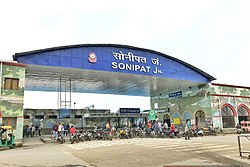
On 22 December 1972, Sonipat was designated a full-fledged district. Sonipat Junction railway station is the main railway junction on Delhi-Kalka line. It lies on Delhi Western Peripheral Expressway, Eastern Peripheral Expressway (NE II) and Grand Trunk Road (NH 44) as well as the planned Delhi–Sonipat–Panipat Regional Rapid Transit System.
Etymology
[edit]According to legend, Sonipat was earlier known as Swarnprastha, (lit. 'Golden City').[7][8] which later on became Swarnpath, and then Sonipat.[9]
History
[edit]References to the city are found in the epic Mahabharata as Svarnaprastha. It was one of the five villages demanded by Pandavas as the price of peace from Duryodhan in lieu of the kingdom Hastinapur. The other four villages were Panduprastha (Panipat), Vyaghraprastha (Baghpat), Tilaprastha (Tilpat) and Indraprastha (Delhi).[10]
Sonipat is listed in the Ain-i-Akbari as a pargana under Delhi sarkar, producing a revenue of 7,727,323 dam coins for the imperial treasury and supplying a force of 1000 infantry and 70 cavalry. It had a brick fort at the time, which was also mentioned.[11]
Sonipat came under Islamic rule after the Second Battle of Tarain in 1193. The Sikhs under Banda Singh Bahadur fought the Battle of Sonipat against the Mughals in 1709. Khanda village witnessed the Battle of Sonipat and won the battle against Mughals under the military leadership of Banda Singh Bahadur.[12]
Principalities
[edit]There were a few principalities and zamindaris of Jat Chaudharys of different clans.
- Kharkhoda was established by the Dahiya Jats who were rulers in Nagaur, Rajasthan. They migrated to Bagar tract and then to Deswal tract- Kharkhoda (Sonipat). They set up an independent principality containing over 52 villages.[13][14]
- Ahulana (Gohana) - The Malik Jats founded the Gohana region and made Ahulana their capital after leaving a Hansi caste stronghold. It was founded by Raja Huleram Malik from the lineage of Raja Jaitra Singh (Jatwan Malik). The Ahulana principality had the rights of tax collection during the Mughal period. They also participated in the revolt of 1857.[15]
Geography and topography
[edit]Sonipat is located at 28°59′N 77°01′E / 28.98°N 77.02°E.[16]
The district headquarters are situated in Sonipat. Other smaller towns around the town include Gohana, Ganaur, Mundlana, Kharkhoda and Rai. The total area of Sonipat district is 2,260 km2 and its population is 1,064,000. Sonipat is bordered by the states of Delhi and Uttar Pradesh as well as the districts of Rohtak, Jind and Panipat. The River Yamuna runs along the eastern boundary of the district.
District Sonipat comprises four sub-divisions, namely Ganaur, Sonepat, Kharkhoda and Gohana and eight blocks (Ganaur, Sonipat, Rai, Kharkhoda, Gohana, Kathura, Murthal and Mundlana) has been carved out of Rohtak and made a full-fledged district on 22 December 1972. Sonipat is the largest tehsil followed by Gohana. It has one municipal corporation (Sonipat) and three municipal committees (Ganaur, Gohana and Kharkhoda).
The water system in the district consists of the River Yamuna and the irrigation canals flowing out of it. There is no perennial river in the district. The underground water resources differ from area to area. The depth of the water table is the lowest in the Khader area along the Yamuna, where it is below 10 ft. It increases to 30 to 40 ft in some of the western and south eastern parts of the district. The ground water in some areas is saline and brackish. The ground water conditions indicate that the district faces the problem of occurrence of brackish water and water logging in eastern parts of the district.
Broadly speaking, the district is a continuous part of the Haryana-Punjab plain, but the area is not levelled in some parts. Over most of the district, the soil is fine loam of rich colour. However, some areas have sandy soil and others are composed of Kallar. The plain has a gradual slope to the south and east. The district may be roughly divided into three regions:
Along the River Yamuna is a narrow flood plain, three to six kilometres wide formed by the river along its course. The Khader plain is 20 to 30 feet lower, along the adjoining upland plain. It is composed of fine clay loam left by the receding floods of the Yamuna. Currently, rice and sugar cane cultivation is undertaken by the farmers in the Khadar area.
The upland plain consists of Sonepat tehsil lying to the west of the Khadar, and is the most extensive of the three regions: The Upland Plain is covered with old alluvium, which if properly irrigated, is highly productive. Extensive farming of crops, oil seeds, horticultural plants, vegetables and flowers is undertaken in this region. The ridges in Gohana tehsil represent the northernmost extension of the Aravallis.
A very small part of the district is covered with soil consisting of sand or sandy loam.
Climate
[edit]| Climate data for Sonipat | |||||||||||||
|---|---|---|---|---|---|---|---|---|---|---|---|---|---|
| Month | Jan | Feb | Mar | Apr | May | Jun | Jul | Aug | Sep | Oct | Nov | Dec | Year |
| Mean daily maximum °C (°F) | 21 (70) |
24 (75) |
30 (86) |
37 (99) |
40 (104) |
38 (100) |
35 (95) |
34 (93) |
34 (93) |
33 (91) |
28 (82) |
22 (72) |
31 (88) |
| Mean daily minimum °C (°F) | 8 (46) |
11 (52) |
16 (61) |
22 (72) |
27 (81) |
28 (82) |
28 (82) |
27 (81) |
26 (79) |
21 (70) |
14 (57) |
9 (48) |
20 (68) |
| Average rainfall mm (inches) | 19.7 (0.78) |
24.6 (0.97) |
24.6 (0.97) |
10.1 (0.40) |
40.7 (1.60) |
96.9 (3.81) |
190 (7.5) |
201 (7.9) |
134.3 (5.29) |
12 (0.5) |
4 (0.2) |
10 (0.4) |
767.9 (30.32) |
| Average relative humidity (%) | 66 | 58 | 47 | 32 | 35 | 53 | 68 | 71 | 66 | 55 | 51 | 63 | 55 |
| Source: https://www.worldweatheronline.com/sonipat-weather-averages/haryana/in.aspx | |||||||||||||
Climate of Sonipat is dry with hot summer and a cold winter. The weather becomes milder during the monsoon (period July to September). The post-monsoon months October and November constitute a transition period, prior to the onset of winter.
The winter starts in December when day and night temperatures fall rapidly. January is the coldest month when the mean daily minimum temperature is 6-7°C. During cold waves, the minimum temperature may go down to the freezing point of water, and frosts can occur. During the summer months of May and June, the maximum temperature sometimes reaches 47°C. Temperature drops considerably with the advancement of monsoon in June. However, the night temperature during this period continues to be high.
Humidity is considerably low during the greater part of the year. The district experiences high humidity only during the monsoon period. The period of minimum humidity (less than 20%) is between April and May.
The annual rainfall varies considerably from year to year. However, the maximum rainfall is experienced during the monsoon season, which reaches it is peak in the month of July. In fact, the monsoon period accounts for 75% of the annual rainfall in the district. On an average there are 24 days in a year with rainfall of 2.5 mm (or more) per day in district Sonepat.
During the monsoon, the sky is heavily clouded, and winds are strong. Winds are generally light during the post-monsoon and winter months.
Sonepat experiences a high incidence of thunder storms and dust storms, often accompanied by violent squalls (andhis) during the period April to June. Sometimes the thunder storm are being accompanied by heavy rain and occasionally by hail storms. In the winter months, fogs sometimes appear in the district.
Demographics
[edit]Sonipat city is governed by Municipal Corporation which comes under Sonipat Metropolitan Region. The Sonipat city is located in Haryana state of India.
| Title | Count | Details |
|---|---|---|
| District | – | Sonipat |
| Area | – | 2260 km2 |
| Division | – | Rohtak |
| Subdivisions | 4 | Gohana, Kharkhoda, Sonipat, Ganaur |
| Tehsils | 4 | Gohana, Kharkhoda, Sonipat, Ganaur |
| Subtehsils | 2 | Khanpur Kalan,Rai |
| Blocks | 8 | Sonipat, Gohana, Ganaur, Kharkhoda, Kathura, Mundlana, Rai, Murthal |
| Revenue Villages | 349 | – |
| Municipal Council/Committees/Co | 4 | Gohana, Kharkhoda, Sonipat, Ganaur |
| No. Of parliamentary Constituency | 1 | Sonipat |
| No. Of Assembly Constituencies | 6 | Rai, Kharkhoda, Sonipat, Gohana, Ganaur, Baroda |
According to the 2021 Indian Census, the current estimate population of Sonipat city in 2023 is 382,000, while Sonipat metro population is estimated at 402,000. As per provisional reports of Census India, population of Sonipat in 2011 is 278,149. Although Sonipat city has a population of 278,149; its urban/metropolitan population is 293,025.
The total number of literates in Sonipat city is 210,112, of which 118,281 are males while 91,831 are females. The average literacy rate of Sonipat is 85.48 percent of which male and female literacy was 90.82 and 79.45 percent. The sex ratio of Sonipat city is 875 per 1000 males. The child sex ratio of girls is 784 per 1000 boys.
The total number of slums in Sonipat and its outgrowth numbers 19,033 in which population of 98,508 resides. This is around 34.05% of total population of Sonipat city and its outgrowth which is 289,333.
Religion
[edit]City
[edit]| Religion | Population (1911)[17] | Percentage (1911) | Population (1941)[18]: 30 | Percentage (1941) | Population (2023) | Percentage (2023) |
|---|---|---|---|---|---|---|
Hinduism  [a] [a]
|
4,794 | 39.9% | 7,706 | 43.34% | 270,837 | 93.61 % |
Islam 
|
6,510 | 54.19% | 8,933 | 50.24% | 11,394 | 3.94% |
| Jain | Not known | Not known | Not known | Not known | 3,532 | 1.22 % |
Sikhism 
|
6 | 0.05% | 226 | 1.27% | 1,903 | 0.66 % |
Christianity 
|
56 | 0.47% | 13 | 0.07% | 484 | 0.17 % |
| Others[b] | 648 | 5.39% | 903 | 5.08% | 1,008 | 0.35 % |
| Total Population | 12,014 | 100% | 17,781 | 100% | 382,000 | 100% |
Tehsil (District)
[edit]| Religion | Population (1941)[18]: 58 | Percentage (1941) | Population (2023) | Percentage (2023) |
|---|---|---|---|---|
| Hinduism [a]
|
176,709 | 81.81% | 1,584,770 | 95.87% |
| Islam
|
35,275 | 16.33% | 51,414 | 3.11% |
| Jain | Not Known | Not known | 6,878 | 0.41% |
| Sikhism
|
613 | 0.28% | 5,112 | 0.30% |
| Christianity
|
724 | 0.34% | 1,602 | 0.09% |
| Others[c] | 2,687 | 1.24% | 3226 | 0.19% |
| Total Population | 216,008 | 100% | 1,653,001 | 100% |
Places of interest
[edit]Mughal architecture
[edit]There are several Mughal buildings on the outskirts of the city, including the Mosque of Abdullah Nasir-ud-din, who was a descendant from Mushid of Iran.
Yamuna River
[edit]The main water system in the district is the Yamuna River and its irrigation canals. The river flows besides the rural belt in the eastern side of district. It also acts as a natural boundary between the states of Haryana and Uttar Pradesh.
Economy
[edit]Industrial estates
[edit]There are six HSIIDC industrial estates namely Sonepat city, Barhi, Kundli, Murthal and Rai. The development of Sonepat Industrial area in the city started in the 1950s with Atlas Cycle.[19] Since then, many small and big industries have been established here. Atlas, E.C.E.[20] or the Birla Factory, OSRAM India (formerly part of E.C.E., but in October 1998 it was acquired by OSRAM[21]).
Rail Coach Naveenikaran Karkhana, Sonipat is a railway coach factory under RVNL which was successfully commissioned in October 2021.The Rail Coach Naveenikaran Karkhana at Sonipat is the first of its kind facility being set up to cater to the mid-life rehabilitation and refurbishment of coaches. The Rolling Stock Complex is designed for sustainable development with Industry 4.0 compliant assembly line.[22]
Education
[edit]Colleges
[edit]Universities
[edit]- Indian Institute of Information Technology, Sonepat
- Dr. B.R. Ambedkar National Law University, Sonipat (NLU)
- National Institute of Food Technology Entrepreneurship and Management
- Deenbandhu Chhotu Ram University Of Science and Technology
- Ashoka University
- O. P. Jindal Global University
- Bhagat Phool Singh Mahila Vishwavidyalaya
- SRM University, Haryana
- World University of Design
- Rishihood University
Sports
[edit]In July 1973 the government established the Motilal Nehru School of Sports, Rai, Sonipat[23] to provide education facilities with extra emphasis on sports. It trains athletes in field hockey, basketball, lawn tennis, equestrianism, gymnastics, swimming, shooting sports, volleyball, boxing, cricket, and football.
Transport
[edit]The Ministry of Road Transport and Highways proposed the first bus port in Sector 7, Sonipat.[24][25][26] It will be a joint venture between the Government of Haryana and NHAI.[27][24]
The proposed bus stand will be an ultra-modern 'bus port', with infrastructure at par with an international airport.[28][29][26]
Municipal corporation
[edit]Sonipat Municipal Corporation is the governing civic body of the Urban Area in Sonipat. The Municipal Committee Sonipat was established in the year 1933.[30]
Sonipat Lok Sabha
[edit]Sonipat (Lok Sabha constituency) is one of the 10 Lok Sabha (parliamentary) constituencies in Haryana state in northern India. Satpal Brahmchari from Congress party (INC) is Member of Parliament from Sonipat Seat
Notable people
[edit] |
- Seema Antil (discus thrower)
- Sanchit Balhara (Bollywood score composer)
- Preeti Bose (cricketer)
- Manushi Chhillar, (actress, model and the winner of Miss World 2017)
- Amit Kumar Dahiya (Olympian wrestler)
- Hoshiar Singh Dahiya (PVC)
- Jai Tirath Dahiya (leader)
- Kushal Singh Dahiya (martyr)
- Mehar Singh Dahiya (martyr poet)
- Padam Singh Dahiya (politician)
- Ravi Kumar Dahiya (Silver medalist Olympics, Wrestling)
- Rizak Ram Dahiya (MP Rajya Sabha, ex. MLA Rai)
- Rohit Dahiya (cricketer)
- Vikas Dahiya (Indian hockey player)
- Vinod Kumar Dahiya (Olympian wrestler)
- Vivek Dahiya (actor)
- Yogeshwar Dutt (wrestler)
- Krishna Gahlawat (MLA Rai and former minister)
- Himanshu Malik (Bollywood actor)
- Jitender Malik (politician)
- Meghna Malik (actress)
- Pardeep Narwal (kabbadi player)
- Sanjay Pahal (cricketer)
- Rajat Paliwal (cricketer)
- Rampal (spiritual leader)
- Nisha Warsi (hockey player)
See also
[edit]Notes
[edit]- ^ a b 1941 census: Including Ad-Dharmis
- ^ Including Jainism, Buddhism, Zoroastrianism, Judaism, or not stated
- ^ Including Jainism, Buddhism, Zoroastrianism, Judaism, or not stated
References
[edit]- ^ "Provisional Population Totals, Census of India 2011; Cities having population 1 lakh and above" (PDF). Office of the Registrar General & Census Commissioner, India. Archived from the original (PDF) on 7 May 2012. Retrieved 26 March 2012.
- ^ "Administration : Sonipat Municipal Corporation". 15 June 2024.
- ^ "About Sonepat". mcsonepat.gov.in. Retrieved 22 November 2020.
- ^ "Report of the Commissioner for linguistic minorities: 52nd report (July 2014 to June 2015)" (PDF). Commissioner for Linguistic Minorities, Ministry of Minority Affairs, Government of India. p. 24. Archived from the original (PDF) on 15 November 2016. Retrieved 23 June 2019.
- ^ IANS (28 January 2010). "Haryana grants second language status to Punjabi". Hindustan Times. Retrieved 23 June 2019.
- ^ "Haryanvi". Ethnologue. Retrieved 8 February 2020.
- ^ Gupta, Ramesh Chandra (1985). Urban geography of Delhi-Shahadra. Bhavna Prakashan.
- ^ Kauśika, Rs̥hi Jaiminī; Baruā, Jaiminī Kauśika (1967). Maiṃ apane Māravāṛī samāja ko pyāra karatā hūm̐ (in Hindi). Jaiminī-Prakāśana.
- ^ Sharma, Chandrapal (1 September 2017). भारतीय संस्कृति और मूल अंकों के स्वर : अंक चक्र : Bhartiya Sanskriti aur Mool Anko ke Swar Ank Chakra (in Hindi). Diamond Pocket Books Pvt Ltd. ISBN 9789352784875.
- ^ Gupta, Ramesh Chandra (1985). Urban geography of Delhi-Shahadra. Bhavna Prakashan. p. 29.
- ^ Abu'l-Fazl ibn Mubarak; Jarrett, Henry Sullivan (translator) (1891). The Ain-i-Akbari. Calcutta: Asiatic Society of Bengal. p. 287. Retrieved 21 January 2021.
{{cite book}}:|first2=has generic name (help) - ^ Sikhs In The Eighteenth Century. p. 28.
- ^ "Jijñāsā;: A Journal of the History of Ideas and Culture". 1974.
- ^ "Rajasthan [district Gazetteers].: Nagaur". 1975.
- ^ Ibbetson, Sir Denzil (1883). "Report on the revision of settlement of the Pánipat tahsil & Karnál parganah of the Karnál district, 1872-1880".
- ^ "Maps, Weather, and Airports for Sonipat, India". www.fallingrain.com.
- ^ "Census of India 1911. Vol. 14, Punjab. Pt. 1, Report". Retrieved 22 July 2022.
- ^ a b "CENSUS OF INDIA, 1941 VOLUME VI PUNJAB PROVINCE". Retrieved 22 July 2022.
- ^ "Atlas Cycles (Haryana) Ltd., Sonepat (India)". www.atlascyclesonepat.com.
- ^ "ECE Industries Ltd". www.eceindustriesltd.com.
- ^ Osram Sylvania. "OSRAM Americas | OSRAM SYLVANIA Homepage". Osramindia.com. Retrieved 1 July 2019.
- ^ "Hon'ble MP Lok Sabha, Ramesh Chander inspected Naveenikaran Karkhana, Sonipat project".
- ^ "Motilal Nehru School of SportsRai". Motilal Nehru School of SportsRai.
- ^ a b "सेक्टर-7 में बस पोर्ट काे सीएम की मंजूरी". Dainik Bhaskar (in Hindi). 20 July 2019. Retrieved 26 August 2020.
- ^ "World-class bus port to come up in Sonipat - Times of India". The Times of India. 2 June 2018. Retrieved 6 June 2019.
- ^ a b "बसपोर्ट के लिए दस एकड़ जमीन सेंट्रल ट्रांसपोर्ट के नाम होगी". Dainik Bhaskar (in Hindi). 31 August 2019. Retrieved 26 August 2020.
- ^ "सोनीपत में बनेगा प्रदेश का पहला बस पोर्ट". दैनिक ट्रिब्यून (in Hindi). 16 March 2019. Retrieved 6 June 2019.
- ^ "बसपोर्ट के लिए कार्रवाई तेज, एनएच-44 पर फ्लाईओवर या अंडरपास का प्रस्ताव". Dainik Bhaskar (in Hindi). 24 August 2020. Retrieved 26 August 2020.
- ^ "Haryana".
- ^ "About Us". mcsonepat.gov.in. Retrieved 11 January 2021.
External links
[edit]

Sonipat district topics | ||
|---|---|---|
| Cities and towns |  | |
| Villages | ||
| Education | ||
| Transport | ||
| Lok Sabha constituencies | ||
| Authority control databases: National |
|---|

Sonipat
View on GrokipediaSonipat is a city in the northern Indian state of Haryana that serves as the administrative headquarters of Sonipat district.[1] The district, established on 22 December 1972 by carving out territories from Rohtak district, covers an area of 2,260 square kilometers and recorded a population of 1,450,001 in the 2011 census, with 781,299 males and 668,702 females.[1] [1] Historically known as Sonprastha or "Suvarna Prastha" (place of gold) in Sanskrit, the city's ancient origins are tied to traditions from the Mahabharata era, where it is identified as one of the villages associated with the Pandavas.[2] [3] Geographically situated in the fertile Indo-Gangetic plain along the Yamuna River, Sonipat's economy relies heavily on agriculture, featuring extensive cultivation of rice, sugarcane, oilseeds, vegetables, and horticultural crops like banana and papaya, supported by canal irrigation and tubewells.[1] The region is transitioning toward industrialization, with historical significance in saltpetre production and growing manufacturing sectors, bolstered by its location approximately 45 kilometers north of Delhi in the National Capital Region.[1]
Etymology
Historical and Linguistic Origins
The name Sonipat originates from the Sanskrit terms Sonprastha or Swarnprastha, denoting a "place of gold" or "golden settlement," derived from suvarna (gold) and prastha (place or expanse).[2] [4] This etymology reflects traditions of the site's early prosperity, possibly tied to agricultural or trade wealth in the fertile Yamuna river valley.[5] Local historical accounts, including those from district records, trace the corruption of Swarnprastha through phonetic evolution in regional Prakrit and later Indo-Aryan dialects spoken in northern India, eventually yielding the modern Hindi/Punjabi form Sonipat.[3] Ancient texts like the Mahabharata reference Sonipat's precursor site in the context of the Pandavas' territorial claims, positioning Swarnprastha as one of the prasthas (settlements) near their capital Indraprastha, suggesting a foundation linked to Vedic-era polities around 1500–1000 BCE.[3] Archaeological evidence of early Iron Age settlements in the region supports habitation by Indo-Aryan groups, though direct inscriptional proof of the name remains absent, relying instead on oral and Puranic traditions preserved in Sanskrit literature.[5] Alternative local legends attribute the naming to the son of Hastinapur's Emperor Bahu, who purportedly established the town and named it after himself as Sonipat, but this lacks corroboration in primary Vedic or epic sources and appears secondary to the Swarnprastha derivation.[3] Linguistically, the shift from Sanskrit suvarna-prastha aligns with patterns in Haryanvi and neighboring Indo-Aryan languages, where initial sva- clusters simplify and ṛ sounds evolve, influenced by phonetic adaptations in medieval Jat and Ahir dialects dominant in Haryana since the post-Gupta period (circa 600 CE).[2] These origins underscore Sonipat's role as an early agrarian hub, with no evidence of pre-Indo-Aryan substrate names, consistent with broader Indo-Aryan settlement patterns in the upper Gangetic plain.[5]History
Ancient and Medieval Foundations
Sonipat's ancient origins trace to the Vedic period, with archaeological evidence of continuous habitation indicated by pottery finds spanning pre-Harappan, late-Harappan, Painted Grey Ware (PGW), early historical, Northern Black Polished Ware, and early medieval phases.[2] The PGW culture, dated approximately 1100–800 BCE and associated with late Vedic Iron Age settlements, has been identified at high mounds within the city, suggesting its emergence as an early urban center linked to the Kuru kingdom.[6] This material culture underscores strategic positioning on ancient trade routes connecting the Indus Valley and Ganges Basin, facilitating economic and cultural exchanges.[7] Literary traditions identify the site as Swarnaprastha or Sonaprastha, referenced in the Mahabharata epic as one of five villages—alongside Indraprastha, Paniprastha, Vyagraprastha, and Tilaprastha—demanded by Yudhishthira from Duryodhana to avert war.[2] The name derives from Sanskrit suvarṇa prastha, denoting a "place of gold," reflecting purported prosperity or fertile lands.[2] An alternative legend ascribes founding to Raja Soni, the thirteenth descendant of the Pandava Arjuna, though this remains unverified by empirical evidence.[2] Panini's Ashtadhyayi (circa 5th–4th century BCE) mentions Sonaprastha among prastha-named settlements, attesting to its antiquity in grammatical texts.[2] During the Mahajanapada era (circa 600–300 BCE), Sonipat functioned as a regional hub under Kuru influence, with artifacts including fortifications and inscriptions pointing to political and commercial significance, as corroborated by Vedic literature and later Mauryan-Gupta records.[7] Medieval continuity is evidenced by early medieval pottery and settlement remains at sites like Seoli and Qamaspur mounds, indicating habitation amid regional shifts.[6][2] By the 16th century, under the Lodi dynasty of the Delhi Sultanate, the area saw construction of the sandstone tomb for Khwaja Khizr—son of Darya Khan Sarwani—commissioned by Ibrahim Lodi, exemplifying architectural patronage in the late Sultanate phase before Mughal ascendancy.[6] Sparse records limit specifics on local governance, but proximity to Delhi integrated Sonipat into broader Sultanate and early Mughal administrative networks, with no major independent medieval polities documented.[2]Colonial and Post-Independence Developments
During the British colonial era, Sonipat functioned as a tehsil within the Delhi District of Punjab Province, encompassing an area of approximately 460 square miles and supporting a population of around 170,000 by the early 20th century, primarily engaged in agriculture.[8] The region came under direct British control following the Second Anglo-Maratha War in 1803, integrating into the expanding colonial administration that emphasized revenue collection through land assessments and canal irrigation systems, though Sonipat itself saw limited direct irrigation expansion compared to western Punjab tracts.[9] Colonial infrastructure developments included the establishment of the Delhi-Ambala railway line in the 1860s-1870s as part of the North Western Railway network, with Sonipat Junction serving as a key stop facilitating trade and troop movements between Delhi and northern India.[10] The British also constructed administrative buildings, such as the Tehsil office in Sonipat, reflecting the imposition of bureaucratic governance structures that persisted post-independence.[10] Agricultural practices remained dominated by wheat, gram, and millet cultivation on fertile alluvial soils, with the colonial revenue system reinforcing Jat-dominated landownership patterns amid occasional famines, like the 1869-1870 event affecting the broader Punjab.[11] Following India's independence in 1947, Sonipat, as part of East Punjab, underwent profound demographic changes due to the Partition, involving mass migrations where local Muslim populations largely relocated to Pakistan, replaced by Hindu and Sikh refugees from western Punjab, altering the religious composition and leading to communal tensions resolved through property reallocations.[12] Initially administered under the Punjab state, the area benefited from the Green Revolution starting in the mid-1960s, which introduced high-yield wheat varieties, chemical fertilizers, and tube wells, boosting agricultural output; by 1970-1971, Haryana's wheat production surged over 300% from pre-Green Revolution levels, with Sonipat contributing through its proximity to research institutions like the Indian Agricultural Research Institute influences.[13] On November 1, 1966, Haryana state was formed by bifurcating Punjab along linguistic lines, incorporating Sonipat into the new entity focused on Hindi-speaking agrarian districts.[1] The Sonipat district was formally delineated from Rohtak district on December 22, 1972, establishing it as an independent administrative unit with headquarters at Sonipat town, spanning 2,260 square kilometers and initially serving about 1.064 million residents.[1] Post-1972 developments emphasized rural electrification, road connectivity via National Highway 44, and initial industrial zoning, though agriculture remained dominant, with canal-irrigated lands expanding under state initiatives; by the 1980s, small-scale industries like textiles and agro-processing emerged, supported by proximity to Delhi's markets.Recent Urbanization and Growth
Sonipat's urbanization accelerated in the early 21st century, propelled by its strategic position in the National Capital Region (NCR) and enhanced infrastructure linkages to Delhi, transforming it from a peri-urban district into a burgeoning satellite hub.[14] The completion of the Kundli-Manesar-Palwal (KMP) Expressway in 2018 facilitated industrial and residential expansion, while the ongoing Delhi-Gurugram-Rohtak Regional Rapid Transit System (RRTS) corridor, set for phased operations by 2025, is projected to serve 50,000 daily commuters and alleviate congestion.[15] [16] The district's population grew from 1,256,696 in 2001 to 1,450,001 in 2011, reflecting a decadal growth rate of 15.71%, outpacing Haryana's state average and signaling urban influx driven by employment opportunities.[17] Urban projections under the Sonipat Master Plan 2031 anticipate accommodating up to 2,506,600 residents by integrating 7,071 hectares for townships and 606 hectares for commercial corridors, supported by a Haryana government allocation of ₹20,220 crore for sustainable urban infrastructure.[18] [19] This plan emphasizes zoned development around existing industrial estates like Kundli, where Haryana State Industrial and Infrastructure Development Corporation (HSIIDC) has expanded facilities with metalled roads, water systems, and common effluent treatment plants to attract manufacturing investments.[20] Industrial zones in Kundli, Rai, and Barhi have drawn data centers—including a Google facility—and manufacturing units, contributing to a forecasted 3.0-3.3x expansion in satellite township capacity from 2024 to 2030.[21] [22] Real estate growth is robust due to connectivity and affordability, with forecasts of 15-20% annual appreciation in some areas and high returns expected by 2030.[23][15] No official master plan or detailed predictions exist for 2040; continued growth is anticipated as part of NCR expansion, but remains speculative beyond 2031. Plotted developments and integrated projects have surged, fueled by proximity to NCR hubs, though rapid growth has strained water resources amid depleting groundwater levels.[24] [25] City population estimates reached approximately 404,000 by 2025, underscoring the shift toward peri-urban densification.[26]Geography
Location and Physical Features
![India_-Haryana-_Sonipat.svg.png][float-right] Sonipat is located in the Rohtak Division of Haryana state, northern India, approximately 44 kilometers north-northwest of New Delhi along National Highway 44. The city serves as the administrative headquarters of Sonipat district, which lies between latitudes 28°30' to 29°15' N and longitudes 76°36' to 77°21' E, with the urban center at roughly 28°59′N 77°01′E.[1][27] The district covers an area of 2,260 square kilometers and is bounded by the Yamuna River to the east, which forms the border with Uttar Pradesh; Delhi to the southeast; and Haryana districts including Rohtak, Jind, and Panipat to the west and north. The terrain consists of the flat Indo-Gangetic alluvial plain with a gentle southeastward slope, featuring elevations averaging 220 meters above mean sea level, though the Khadar zone along the Yamuna sits 6 to 9 meters lower than the upland areas.[1][28] Physiographically, the area divides into three zones: the narrow Khadar flood plain (3-6 km wide) with recent alluvial deposits and fine clay-loam soils susceptible to inundation; the extensive upland plain of older alluvium supporting fertile loamy soils ideal for agriculture; and a southwestern sandy region with saline-alkaline (kallar) soils and occasional ridges extending from the Aravallis. The Yamuna provides the sole perennial drainage, supplemented by seasonal drains like Drain No. 8 and irrigation canals, while groundwater levels vary from 3 meters in the east to 10-12 meters in the west.[1][29]Climate Patterns and Environmental Factors
Sonipat's climate is classified as dry subtropical, featuring extreme seasonal variations with hot summers, cold winters, and a pronounced monsoon period. Summers from May to June bring maximum temperatures reaching 47°C, accompanied by low humidity below 20%, dust storms, thunderstorms, and occasional hail. Winters, spanning December to February, record mean daily minimums of 6–7°C, with frost possible during cold spells and frequent fog reducing visibility. Transition periods include a milder post-monsoon phase in October–November and pre-monsoon heating in March–April.[1] Precipitation is concentrated during the southwest monsoon from June to September, which supplies about 75% of the annual total, peaking in July under heavily clouded skies and high humidity. The district receives an average annual rainfall of 567 mm, occurring over roughly 24 days with at least 2.5 mm per event, though variability leads to occasional droughts or floods influenced by Yamuna River proximity.[29][1] Environmental factors are shaped by alluvial plains with sandy loam, loam, and clay soils, which support agriculture but foster waterlogging and brackish groundwater in eastern zones near the Yamuna. Intensive irrigation for crops like wheat and rice has driven groundwater depletion, with Haryana's water table declining at rates exceeding natural recharge due to over-extraction. Agricultural inputs including fertilizers and pesticides contaminate surface and subsurface water, while post-harvest stubble burning elevates winter air pollution levels, particularly PM2.5 concentrations. Industrial effluents from manufacturing hubs like Kundli further degrade local water and soil quality, posing risks to aquatic ecosystems and public health.[1][29][30][31][32]Demographics
Population Dynamics and Census Data
According to the 2011 Indian census conducted by the Office of the Registrar General and Census Commissioner, Sonipat city (municipal limits) had a total population of 289,333, consisting of 154,407 males and 134,926 females, yielding a sex ratio of 874 females per 1,000 males.[33][34] This marked a significant rise from the 2001 census, when the city's population was approximately 229,403 (inferred from male population of 122,480 and similar sex ratio trends), reflecting a decadal growth rate of roughly 26% driven by proximity to Delhi and industrial expansion in the National Capital Region.[34] The broader Sonipat district recorded a population of 1,450,001 in 2011, with 781,299 males and 668,702 females, for a district-wide sex ratio of 856.[35] This constituted a decadal increase of 15.71% from the 2001 figure of 1,253,370, lower than Haryana's state average of 19.90% but indicative of steady rural-to-urban migration and agricultural mechanization reducing rural population pressures.[36][37] Population density stood at 683 persons per square kilometer in 2011, up from prior decades due to infrastructural developments like the Kundli-Manesar-Palwal expressway facilitating commuter influx.[38]| Census Year | Sonipat City Population | Decadal Growth Rate (City) | Sonipat District Population | Decadal Growth Rate (District) |
|---|---|---|---|---|
| 2001 | 229,403 | - | 1,253,370 | - |
| 2011 | 289,333 | ~26% | 1,450,001 | 15.71% |
Religious and Linguistic Composition
According to the 2011 Indian census, the religious composition of Sonipat district is overwhelmingly Hindu, with 1,390,149 persons (95.87% of the total population of 1,450,001) adhering to Hinduism.[39] Muslims constitute the second-largest group at 45,100 persons (3.11%), followed by Sikhs with 4,484 (0.31%) and Christians with 1,405 (0.10%).[39] Jains, Buddhists, and adherents of other religions or no religion account for the remaining approximately 0.61%.[39] In Sonipat city specifically, the 2011 census records a slightly lower proportion of Hindus at 93.61% (270,837 persons out of a city population of 289,333), with Muslims at 3.94% (11,399 persons) and smaller communities including Sikhs (0.05%), Christians (0.47%), and others.[26]| Religion | District Population | District Percentage |
|---|---|---|
| Hinduism | 1,390,149 | 95.87% |
| Islam | 45,100 | 3.11% |
| Sikhism | 4,484 | 0.31% |
| Christianity | 1,405 | 0.10% |
| Others | ~8,863 | 0.61% |