Hubbry Logo
Space hopperSpace hopperMain
Open search
Space hopper
Community hub
Space hopper
logo
8 pages, 0 posts
0 subscribers
Be the first to start a discussion here.
Space hopper
Space hopper
from Wikipedia

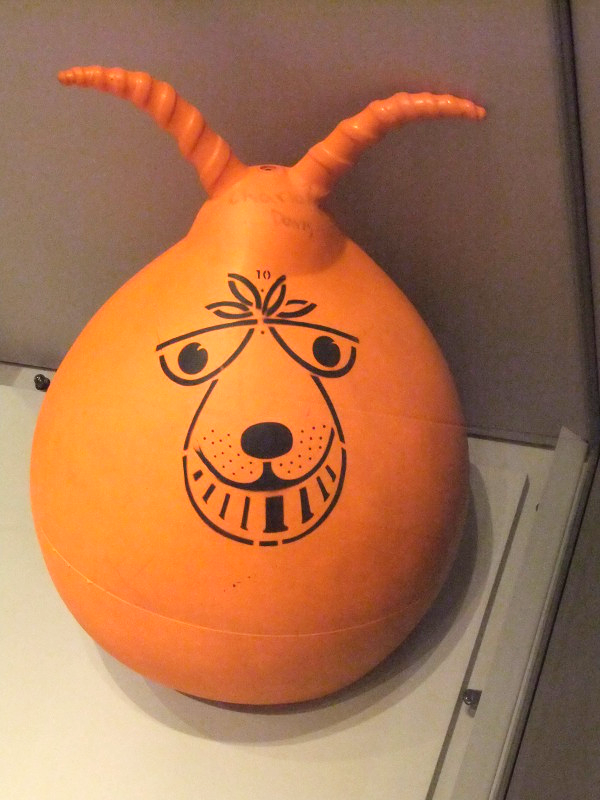
A space hopper

A space hopper (also known as a moon hopper, skippyball, kangaroo ball, bouncer, hippity hop, hoppity hop, sit and bounce, or hop ball) is a rubber ball (similar to an exercise ball) with handles that allow one to sit on it without falling off. The user can attempt to hop around on the toy, using its elastic properties to move forward.

The term "space hopper" is more common in the United Kingdom. The toy is less familiar in the United States and may be known as a "hoppity hop", "hippity hop", or a "sit and bounce". A similar toy, popular in the United States in the 1980s, was the pogo ball, which has a hard plastic ring encircling the ball instead of a handle.

Use

[edit]

The space hopper is a heavy rubber ball about 60–70 centimetres (24–28 in) in diameter, with two rubber handles protruding from the top. A valve at the top allows the ball to be inflated by a bicycle pump or car tire pump.

A child can sit on top, holding the two handles, and bounce up and down until the ball leaves the ground. By leaning, the driver can make the ball bounce in a particular direction. In practical terms, this is a very inefficient form of locomotion, but its simplicity, ease of use, low cost, and cheerful appearance appeal to children.

History

[edit]
Sun's Hoppity Horse, from the Children's Museum of Indianapolis collection

The space hopper was invented by Aquilino Cosani of Ledragomma, an Italian company that manufactured toy rubber balls. He patented the idea in Italy in 1968, and in the United States in 1971. Cosani called the toy "Pon-Pon".

Space hoppers were introduced to the United Kingdom in 1969. The Cambridge Evening News contained an advertisement for the hopper in November of that year[1] and described it as a trend. The space hopper became a major craze for several years and remained widely popular through the 1980s. The toy is sometimes considered a symbol of the 1970s.

The original space hopper in the United Kingdom was manufactured by Mettoy (Mettoy-Corgi). Wembley made a similar model, which had smooth handles rather than the ribbed original. The orange kangaroo design is now available in adult-sized versions in the UK.[2]

In the United States, the first mass-marketed hopping ball was a version of an earlier European toy—the Hoppity Hop, released by the Sun company after it introduced the ball in 1968 at the American International Toy Fair in New York.

Within the first three months, more than 300,000 units were sold across the country. Because of market and media saturation of this toy, any such ball, regardless of origin, is now generally known in the US by that name.

The earliest Hoppity Hops were made of rubber (usually red or blue) with a round ring handle on top and an automotive tire valve for inflation. In the 1970s, Sun introduced various character versions of the Hoppity Hop, such as the Hoppity Horse or Disney's Mickey Mouse and Donald Duck (with hard plastic versions of the character's head attached to the ball).

The Hoppity Hop sold steadily for decades, but by the 1990s, sales began to slip due to increased competition from foreign hoppers.

According to advertising materials, the Hoppity Hop's original targets were both adults and children. Since the balls only inflated to around 20 inches (51 cm), however, it is doubtful that any but the shortest adults could have gotten much use out of one.

The European "Hop!" balls appeared in the beginning of the 1990s and are still available. Made by Italy's Ledragomma/Ledraplastic, these are essentially an exercise ball with a handle attached. The sizes of these balls range from the "Hop! 45" to the "Hop! 66" (66 cm, about 26 in).

The Hop! 66 is still primarily child-sized. Demand for truly adult-proportioned hopping balls was met with two notable items: The first was Kitt 2000 Velp, of the Netherlands Mega Skippyballs, a large hopping ball that, by virtue of its size, was intended only for adult use. It came in three sizes: 120 centimetres (47 in), 100 centimetres (39 in), and 80 centimetres (31 in).

The Mega Skippyballs are made of extra-strong vinyl, and in the Netherlands, there are various Skippyball races and championships.

References

[edit]
[edit]
Revisions and contributorsEdit on WikipediaRead on Wikipedia
from Grokipedia
A Space Hopper is a large, rubber ball designed for children to sit on and bounce, featuring two horn-like handles for gripping and a whimsical printed face, typically in a pear-shaped orange form measuring around 62.5 cm in height and 106 cm in circumference. Invented in the early by Italian designer Aquilino Cosani of the Ledragomma company, the was originally named "Pon-Pon" after the sound it made during use and was inspired by kangaroo-like bouncing, with a for its handle design granted in 1968. Introduced to the market in 1968 by Mettoy Playcraft Ltd., it was rebranded as the Space Hopper—initially in blue before the iconic orange version—and quickly became a defining of the , achieving peak annual sales of 200,000 units in Britain through mass production and retail distribution. In the United States, it was marketed as the Hoppity Hop by Sun Corporation, which adapted the design slightly for local appeal, contributing to its global popularity as a playful exercise tool often featured in holiday camp races, television advertisements, and children's games like . The toy's enduring cultural impact includes variants such as animal-themed hoppers and later revivals during retro toy trends, though it required balancing skill from users and occasionally led to minor injuries from falls.

Design and Features

Physical Construction

The space hopper is an inflatable toy ball, with the original model featuring a pear-shaped body measuring approximately 62.5 cm in height and 106 cm in circumference, constructed from durable, elastic PVC or rubber material to facilitate high bouncing capability while supporting a seated user. Modern spherical variants typically measure 60-70 cm in diameter. Integrated into the design are two looped rubber handles protruding from the top, providing a secure grip for stability during use. An inflation valve positioned at the top allows the ball to be filled with air using standard pumps, such as bicycle pumps, creating an internal air chamber that enables elasticity and bounce heights through the compression and rebound of the material. The core components emphasize functionality and safety: the pear-shaped body forms a single airtight chamber, while the handles are molded or sealed directly onto the surface to prevent detachment under pressure. This construction relies on the elastic deformation of the inflated PVC or rubber walls, which store and release efficiently during bounces. Manufacturing begins with , where liquid PVC is poured into tear-shaped or spherical molds, rotated to evenly coat the interior—including areas for the —and then heated to cure the material into a seamless form. The is inserted post-molding, followed by a heat-sealing process to attach the looped securely, ensuring air retention; each unit undergoes leak testing and quality checks before packaging. These methods were developed for the original production, with the 1968 Italian by Aquilino Cosani covering the , prioritizing against punctures and repeated impacts.

Variations and Sizes

Space hoppers are available in a range of sizes to accommodate different age groups and uses, with standard child-sized models typically measuring 45 to 70 cm in diameter, suitable for children aged 3 to 10 years. Larger versions extend up to 120 cm in diameter, such as the Mega Skippyballs produced in 80 cm, 100 cm, and 120 cm sizes for fitness and recreational activities. Thematic variations often incorporate character branding or animal motifs to appeal to children, including Disney-licensed models featuring Mickey Mouse and Donald Duck with hard plastic character heads attached, introduced in the 1970s by manufacturer Sun. Generic designs mimic animals like kangaroos, sometimes referred to as kangaroo balls, enhancing playful aesthetics without altering core functionality. Regional adaptations reflect local naming conventions and minor design tweaks, with the favoring "Space Hopper" for models by Mettoy and , the latter featuring smooth handles compared to the original ribbed versions. In the United States, the is commonly known as "Hoppity Hop," while other global variants include "Moon Hopper" and "Skippyball," often differing in color schemes like red or orange bodies with white facial features. For instance, early 1969 Mettoy models were produced in red or orange with white faces, contrasting with larger, fitness-oriented balls in later iterations. Post-2000s updates include glow-in-the-dark variants, such as light-up models with internal LED balls that flash during use, and eco-friendly options made from phthalate-free PVC materials to meet modern safety standards.

History

Invention and Early Development

The space hopper was invented by Aquilino Cosani, an Italian entrepreneur born in 1924 in to Italian emigrants, who later returned to and became co-owner of the Ledragomma firm, a manufacturer of rubber and toys. Cosani drew inspiration from his earlier , the Swiss Ball—a large developed in 1963 for and fitness applications. This background in creating durable, bouncy inflatables positioned him to adapt the concept into a children's toy during the in . Conceived as a playful version of exercise balls to encourage active fun, the space hopper emerged from Cosani's observation of children's joy in bouncing, sparked by a 1960s documentary on kangaroos. Initial prototypes, named "Pon-Pon" after the sound they produced while in use, were developed in the early using PVC for its elasticity and outdoor durability. The design evolved through testing with children, refining the handles from rigid to flexible forms integrated with the ball material. This timeline reflected broader post-World War II trends in Italian rubber toy production, where firms like expanded into affordable inflatable balls and play items amid economic recovery and rising demand for simple, engaging toys. In , Cosani filed a in through Ledragomma for a manufacturing process enabling the industrial production of balls, balloons, and hollow bodies with integrated handles suitable for an elastic hopping toy. This innovation focused on seamless construction to ensure safety and longevity. A corresponding was granted in 1971, broadening international protection for the design. Before commercial release, prototypes underwent pre-market testing with Italian children, evaluating balance, coordination, and enjoyment to confirm the toy's potential for motor skill enhancement in play settings.

Commercial Launch and Popularity

In the United States, the toy was first commercially launched as the "Hoppity Hop" by the Sun Rubber Company in 1968, debuting at the American International Toy Fair in . The product saw immediate success, with the company receiving overwhelming orders and selling more than 300,000 units within its first three months on the market. In the , Mettoy introduced the Space Hopper in 1968, branding it with a space-age theme that aligned with the era's fascination with the Apollo moon landings. The initial models were blue, inflatable vinyl balls featuring ribbed handles and a cartoonish face, with orange versions soon becoming iconic; available in various sizes for children. Marketing efforts emphasized its fun, active play value as an outdoor toy, with advertisements in newspapers like the Cambridge Evening News in November 1969 and a television feature on the BBC children's show Blue Peter as early as November 1967. The Space Hopper quickly became a bestseller, reaching peak annual sales of around 200,000 units in the UK during the 1970s. By the early 1970s, the toy had spread to —building on its Italian origins—and , where it emerged as a popular holiday gift and playground staple throughout the decade. Its popularity began to fade in the late 1970s as electronic toys and video games gained favor among children, though production continued steadily into subsequent decades.

Usage and Play

Mechanics of Operation

The operation of a space hopper begins with the user straddling the inflated and gripping the integrated handles for balance. To initiate movement, the rider pushes downward with their legs against the ground, compressing the ball slightly and using the resulting elastic rebound to lift off and propel upward. This process relies on the ball's durable, air-filled PVC or rubber construction, which deforms under weight and force before snapping back to shape. Movement control is achieved primarily through body positioning, as the rider leans their torso forward, backward, or to the sides during the bounce cycle. This shifts the center of mass, directing the ball's and enabling directional hops while the handles prevent slippage. The elastic properties of the material facilitate this , converting the rider's input into controlled across flat surfaces. At its core, the involve the physics of elastic collisions, where the downward force compresses the ball, storing as elastic potential in the deformed material and air pressure within. Upon release, this converts to , launching the rider upward in a rebound. The efficiency of this conversion depends on the ball's ; under-inflation reduces rebound height and control, while over-inflation decreases deformation capacity, leading to harder landings and potential instability. Inflation is typically performed using a manual or foot pump inserted into the top after removing the plug, continuing until the reaches a firm but yielding consistency for effective bouncing. A or low- compressor can also be used, but high-pressure devices should be avoided to prevent bursting. Proper ensures the internal air supports the rider's weight without excessive rigidity. Despite its simplicity, the space hopper has limitations in practical use, as the repetitive bouncing requires significant energy input, making it inefficient for covering long distances compared to walking or wheeled . Additionally, on uneven or soft , the large contact area and low stability can cause tipping, restricting optimal performance to smooth, hard surfaces.

Developmental and Recreational Benefits

Space hoppers provide notable physical benefits by enhancing balance, coordination, and through the dynamic demands of bouncing and directional control. The proprioceptive and vestibular input from maintaining stability on the inflated strengthens core muscles, improves postural control, and refines whole-body movement patterns essential for everyday activities. on comparable ball exercises demonstrates significant gains in static balance among preschool children after structured sessions. On the cognitive front, engagement with space hoppers fosters spatial awareness and problem-solving abilities. Vestibular stimulation during bounces helps children better understand their body's orientation , while steering the hopper around paths or obstacles promotes planning and adaptive decision-making to achieve goals. Recreationally, space hoppers encourage active outdoor play, countering sedentary behaviors by facilitating energetic movement in a playful format. Suitable for individual practice or group games such as races, they support and enjoyment, increasing overall duration and intensity among young users. Intended for children aged 3 and older, space hoppers aid in developing confidence and endurance via low-intensity, repetitive motions that build stamina without overwhelming younger participants. In therapeutic contexts, space hoppers serve as tools for , offering low-impact exercise akin to Swiss ball routines to support motor development. They have been incorporated into programs for children with to enhance aerobic fitness, clear respiratory secretions, and improve treatment compliance through family-involved sessions. Similarly, bouncing activities on therapy balls improve balance in children with , promoting mobility and functional independence. Occupational therapists recommend them for sensory integration in children with autism or processing disorders, aiding coordination and body awareness.

Cultural Impact

Representations in Media

The space hopper, emblematic of the space-age enthusiasm, frequently appeared in British children's programming as a symbol of playful adventure and physical activity during the era's cultural fascination with futuristic themes. In a 1967 episode of the BBC's long-running children's show , presenters , , and demonstrated the toy's bouncing capabilities, highlighting its novelty and potential for outdoor fun, which contributed to its rising popularity in the following decade. This early exposure in underscored the space hopper's role in promoting imaginative, active play amid the post-Apollo space craze. In comedic television, the space hopper featured prominently in the 1972 episode "Charity Bounce" of the The Goodies, where the main characters embark on a sponsored bounce from using the toys, only to inadvertently circumnavigate the globe in a series of absurd mishaps. The episode satirized charity events and endurance challenges while showcasing the space hopper's bouncy mechanics in exaggerated, humorous scenarios, reflecting its status as a quintessential playground icon. Advertising campaigns in the further embedded the space hopper in media portrayals of family-oriented joy and exploration. In the UK, Mettoy Playcraft's promotional efforts, including television spots and print ads in publications like the Cambridge Evening News in 1969, depicted children and families engaging in carefree outdoor bouncing, positioning the toy as an accessible emblem of the era's optimistic, space-inspired leisure. Similarly, in the United States, Sun Rubber Company's Hoppity Hop variants appeared in 1970 television commercials aired during Saturday morning cartoons, featuring animated sequences of children hopping adventuriously across landscapes to evoke excitement and boundless energy. These ads emphasized the toy's role in fostering imaginative play, aligning with the cultural narrative of youthful freedom. Literary references in children's media often portrayed the space hopper as a staple of everyday antics. In the British The Perishers, serialized in the Daily Mirror, writer Maurice Dodd introduced the toy in 1972–1973 storylines, where the character Baby Grumplin frequently rode one, causing chaotic but endearing disruptions among the group of urban children and their dog, symbolizing unbridled childhood mischief. This depiction captured the toy's integration into contemporary , reinforcing its image as a fun, albeit unpredictable, companion in narratives of friendship and exploration. Across , the space hopper's Italian origins—patented by Aquilino Cosani of Ledragomma in —influenced its occasional appearances in regional media as a nod to innovative and cross-cultural play. Early promotional materials from highlighted its bouncy form as a modern take on traditional ball games, tying into broader European trends of that celebrated simple, joyful .

Nostalgia and Modern Revival

The Space Hopper has maintained a strong nostalgic appeal, evoking memories of childhood play and symbolizing an era of simple, active fun. Its iconic orange design with a grinning face and horn-like handles became a cultural touchstone, featured in museums such as the Victoria and Albert Museum's collection, where it is preserved as a key example of British toy design from 1968. Similarly, the Museum of has included it in exhibitions like "From Spinning Tops to Space Hoppers: Growing Up in ," highlighting its role in childhood recreation. This has driven revivals through retro toy lines, with European variants like the Hop! ball emerging in the early and modern reproductions capturing the original aesthetic for 70s-themed events and charity races. In the and beyond, the toy saw renewed interest through re-releases by various manufacturers, including durable vinyl versions that echo the original Mettoy production while incorporating updated safety features. Post-2010 adaptations have extended its use into adult fitness, with classes such as Hopper Happiness incorporating bouncing exercises, squats, and core workouts on the balls to burn calories and improve in a playful manner. These sessions, held in parks and gyms, blend with nostalgic games, appealing to those seeking fun alternatives to traditional workouts. Additionally, inspired designs like the High Frequency Impulse for Microgravity device—developed for astronauts to simulate jumping and combat muscle loss —have seen further advancement, including backing from in 2024 for integration into future space missions. The collector market for Space Hoppers, particularly 1969 Mettoy models, reflects growing interest in 1970s , with items appearing at specialist where niche toys can command premium prices due to their and condition. For instance, a Space Hopper sold for £16 at , while orange originals often fetch higher bids from enthusiasts valuing their of use. Online platforms host communities where collectors share restoration stories and trade examples, underscoring the toy's status as a tangible link to mid-20th-century play. This legacy extends culturally, representing innocence amid economic and social shifts, and inspiring contemporary content that revives its whimsical spirit through user-generated challenges and tributes. Today, Space Hoppers remain widely available through retailers like Amazon and , where retro editions with foot pumps sell steadily, often seeing increased demand during nostalgia-driven periods such as holiday seasons or retro toy fairs. These modern iterations, typically inflating to 60cm, cater to both children and adults, ensuring the toy's playful bounce endures in contemporary culture.

Safety and Regulations

Potential Hazards

While space hoppers provide active play, they present several physical risks primarily related to falls and instability during use. Children may tip over or lose balance while bouncing, leading to bruises, sprains, or more severe injuries such as head trauma upon impact with the ground. Riding toys like space hoppers contribute significantly to such incidents, accounting for over 40% of toy-related visits among children aged 5 to 17, with falls being the predominant mechanism. These risks are exacerbated by the of operation, where improper or excessive bouncing can cause sudden tipping. Material-related hazards also arise from the inflatable construction of space hoppers. Over-inflation can lead to sudden or bursting under pressure, potentially causing the user to fall abruptly and sustain injuries. Additionally, the handles or other small attached parts pose risks, particularly if they detach or are mouthed by young children, as these components may fail small parts tests under standards. Compliance with ASTM F963 requires such toys to avoid small parts that could cause aspiration or obstruction in children under 3 years. Environmental factors can amplify these dangers during play. Use on slippery or uneven surfaces, such as wet pavement, increases the likelihood of slips and subsequent falls, heightening injury potential. Outdoor settings introduce additional obstacles like traffic or debris, which may collide with the user during movement, though specific incident data for space hoppers remains limited. Age-specific considerations further highlight suitability issues. Space hoppers are generally not recommended for children under 3 years due to the balance and coordination demands required to maintain stability while seated and bouncing. Younger users may lack the motor skills to grip handles securely or anticipate tipping, increasing fall risks, while the toy's design aligns with standards like EN 71-1 for mechanical properties in older age groups.

Safety Standards and Recommendations

Space hoppers, as inflatable toys intended for children, are subject to stringent regulatory standards to ensure safety. In the United States, they must comply with ASTM F963, the Standard Consumer Safety Specification for , which mandates third-party testing for aspects such as material composition, including limits on (no more than 0.1% by weight), mechanical stability to prevent tipping or bursting, and overall physical hazards for toys aimed at children under 14 years old. In the , compliance with standards is required, covering mechanical and physical properties (EN 71-1) like stability and impact resistance, chemical safety (EN 71-3) prohibiting harmful substances such as and , and migration of elements to ensure non-toxicity. These regulations apply to space hoppers due to their inflatable nature and potential for dynamic play, with manufacturers certifying products through accredited labs to meet these directives. Usage recommendations emphasize adult supervision at all times, particularly for young children, to mitigate risks such as falls or collisions. Play should occur exclusively on flat, soft surfaces like grass or carpeted areas to impacts and reduce from uneven or hard flooring. Proper is critical to avoid bursts; balls should be filled to the manufacturer's specifications using a at , typically reaching about 1 bar (14.5 PSI) for standard models without over-pressurizing, which could lead to material failure. Manufacturer guidelines typically specify age ratings of 3 years and older for standard 45-60 cm models, with weight limits up to 50 kg (110 lbs) to ensure structural integrity during use. Maintenance involves regular inspections for leaks, punctures, or wear by checking the valve and surface for damage, and storing the deflated ball away from or heat sources to prolong durability. In modern revivals post-2000, space hoppers incorporate updates like non-slip bases and textured grips to enhance stability and comply with stricter child safety laws, such as the U.S. Consumer Product Safety Improvement Act (CPSIA) of 2008 and EU REACH regulations, which tightened phthalate bans and stability requirements. Parental advice includes avoiding indoor use on hard floors to prevent slips or injuries, and for group play, encouraging protective gear like helmets alongside clear play zones to further minimize hazards like those from uncontrolled bouncing.

References

Add your contribution
Related Hubs
User Avatar
No comments yet.