


Community hub
Recent from talks
Contribute something
Nothing was collected or created yet.
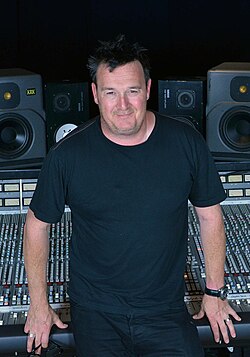
Spike Stent
View on Wikipedia
Key Information


Mark "Spike" Stent (born 3 August 1965) is an English record producer and mixing engineer who has worked with many international artists including Madonna, Marshmello, U2, Beyoncé, the Beatles, Björk, Depeche Mode, Echo & the Bunnymen, Grimes, Ed Sheeran, Beth Orton, Harry Styles, Frank Ocean, Vince Staples, Selena Gomez, All Saints, Spice Girls, Lady Gaga, Coldplay, Mansun, Gorillaz, Maroon 5, Muse, Lily Allen, Peter Gabriel, Gwen Stefani, Moby, No Doubt, Lenka, Usher, Kaiser Chiefs, Linkin Park, the Yeah Yeah Yeahs, Oasis, Keane, Massive Attack, Bastille, Diana Vickers and Take That.[1]
Career
[edit]Stent grew up in Hampshire, England and first gained experience as an engineer at Jacobs Studios as a teenager before a two-year stint at Trident Studios.[1] After Trident, Stent worked at Olympic Studios in Barnes, South London. While at Olympic, Stent worked with artists such as Massive Attack, Bjork, Madonna, U2, Keane, and Oasis.[citation needed] Radiohead enlisted him to produce their 2007 album In Rainbows, but the collaboration was unsuccessful.[2]
Stent works at two studios: Mix Suite LA in EastWest Studios and Mix Suite UK.
Awards and nominations
[edit]Grammy Awards
[edit]Billboard Music Awards
[edit]| Year | Artist | Album/Song | Award | Result |
|---|---|---|---|---|
| 2001 | Madonna | "Music" | Top Hot Dance Club Play | Won |
| 2001 | Madonna | "Music" | Top Hot Dance Maxi Single Sales | Won |
| 2005 | Gwen Stefani | "Hollaback Girl" | Digital Song the Year | Won |
Music Producers Guild (MPG) Awards
[edit]| Year | Award | Results | |
|---|---|---|---|
| 2011 | Mix Engineer of the Year MPG Awards | Won | [17] |
| 2014 | Mix Engineer of the Year MPG Awards | Won | [18] |
| 2015 | Mix Engineer of the Year MPG Awards | Won | [19] |
| 2020 | Mix Engineer of the Year MPG Awards | Won | [20] |
Selected film credits
[edit]| Artist | Track/Album | Year | Film |
|---|---|---|---|
| U2 | "Hold Me, Thrill Me, Kiss Me, Kill Me" | 1995 | Batman Forever |
| Tina Turner | "GoldenEye" | 1995 | GoldenEye |
| Björk | Selmasongs | 2000 | Dancer in the Dark |
| Madonna | "Die Another Day" | 2002 | Die Another Day |
Selected discography
[edit] | This section lists events whose chronological order is ambiguous, backward, or otherwise incorrect. (February 2026) |
2020s
[edit]- 2026: Holly Humberstone - Cruel World
- 2025: Lorde - Virgin
- 2025: Yungblud - "Zombie"
- 2024: Blink-182 - One More Time... Part-2
- 2024: Indochine - Babel Babel
- 2024: Julian Lennon "I Should Have Known" (Spike Stent Version)
- 2024: Liam Gallagher and John Squire Liam Gallagher John Squire
- 2020: Marilyn Manson – We Are Chaos
- 2020: 5 Seconds of Summer – Calm[21]
- 2020: Niall Horan – Heartbreak Weather[22]
- 2020: Ted When – Edge Off
- 2020: Miley Cyrus – Plastic Hearts
- 2021: John Mayer – Sob Rock
- 2022: Liam Gallagher – C'mon You Know
- 2023: Peter Gabriel – i/o
- 2023: Gorillaz – Cracker Island
- 2023: Foo Fighters – But Here We Are
- 2023: Blink-182 – One More Time...
- 2023: the Beatles – "Now and Then"
- 2026: Peter Gabriel – "o\i"
2010s
[edit]- 2019: Charli XCX featuring Lizzo – "Blame It on Your Love"
- 2018: Post Malone – "Stay"
- 2018: Cardi B – "Thru Your Phone"
- 2018: Elton John – Revamp tracks "Your Song" featuring Lady Gaga and "Bennie and the Jets" featuring Pink and Logic
- 2018: Pale Waves – "Heavenly"
- 2018: Jade Bird – "Lottery"
- 2018: Chvrches – Love Is Dead
- 2018: Years & Years – "Sanctify"
- 2018: Rudimental – "These Days" featuring Jess Glynne, Macklemore and Dan Caplen
- 2018: Marshmello featuring Anne Marie – "Friends"
- 2017: Kesha – "This Is Me"
- 2017: Miguel – "War & Leisure"
- 2017: Bishop Briggs – "Dream"
- 2017: Jessie Ware – Glasshouse
- 2017: PVRIS – "All We Know of Heaven, All We Need of Hell"
- 2017: Justin Bieber and BloodPop – "Friends"
- 2017: Muse – "Dig Down"
- 2017: Mondo Cozmo – "Plastic Soul"
- 2017: Niall Horan – "Slow Hands"
- 2017: Vince Staples – Big Fish Theory
- 2017: Harry Styles – Harry Styles[23]
- 2017: Ed Sheeran – ÷[24]
- 2017: Julia Michaels – "Issues"
- 2017: Julia Michaels – "Uh Huh"
- 2017: Julia Michaels – "Nervous Systems"
- 2017: Rita Ora – "Your Song"
- 2017: Liam Gallagher – "As You Were"
- 2017: DreamCar – "Dreamcar"
- 2017: Take That – "Giants"
- 2016: Gwen Stefani – This Is What the Truth Feels Like[24]
- 2015: Selena Gomez – Revival
- 2015: Florence + the Machine – How Big, How Blue, How Beautiful
- 2015: Chvrches – Every Open Eye[25]
- 2015: Grimes – Art Angels
- 2015: Duran Duran – Paper Gods
- 2014: Coldplay – Ghost Stories[24]
- 2014: Ed Sheeran – x[24]
- 2014: The Script – No Sound Without Silence
- 2014: Kasabian – 48:13
- 2013: Biffy Clyro – Opposites[24]
- 2013: Bastille – Bad Blood[24]
- 2013: Rudimental – Home[24]
- 2013: White Lies – Big TV[24]
- 2013: Haim – Days Are Gone[24]
- 2013: Moby – Innocents[24]
- 2013: John Newman – Tribute[24]
- 2013: One Direction – Midnight Memories[24]
- 2012: Frank Ocean – Channel Orange[24]
- 2012: No Doubt – Push and Shove
- 2012: Taylor Swift – Red[24]
- 2012: Muse – The 2nd Law[24]
- 2011: Florence + The Machine – Ceremonials
- 2011: Coldplay – Mylo Xyloto
- 2011: Bruce Springsteen – Wrecking Ball
- 2010: Lights – The Listening ("Ice")
- 2010: Usher – Raymond v. Raymond
- 2010: Nelly Furtado – The Best of Nelly Furtado ("Girlfriend in the City")
- 2010: Hurts – Happiness
- 2010: Goldfrapp – Head First
- 2010: Ellie Goulding – Lights
- 2010: P Diddy – Last Train to Paris ("Hello Good Morning")
- 2010: Take That – Progress
- 2010: James Blunt – Some Kind of Trouble
- 2010: The Wanted – The Wanted
- 2010: N.E.R.D – Nothing
- 2010: Duran Duran – All You Need Is Now
- 2010: The Script – Science and Faith
- 2010: Cheryl Cole – Messy Little Raindrops
- 2010: Christina Aguilera – Bionic ("Little Dreamer", "Kimono Girl", "Birds of Prey")
2000s
[edit]- 2009: Green Day – 21st Century Breakdown ("Last of the American Girls", "21 Guns", "Rain on Me")
- 2009: Lady Gaga – The Fame Monster ("Bad Romance", "Telephone" Featuring Beyoncé)
- 2009: Tegan & Sara – Sainthood ("Hell")
- 2009: Muse – The Resistance
- 2009: Vedera – Stages ("Satisfy", "Loving Ghosts", "Back to the Middle")
- 2009: Cheryl Cole – 3 Words ("Fight for This Love")
- 2009: Ciara – Fantasy Ride ("G Is for Girl")
- 2009: Franz Ferdinand – Tonight: Franz Ferdinand ("Katherine")
- 2009: FrankMusik – Complete Me ("Confusion Girl")
- 2009: The Yeah You's – Looking Through You
- 2009: The Yeah Yeah Yeahs – It's Blitz
- 2009: Lenka – Trouble Is a Friend
- 2009: Sean Garrett – Turbo 919 ("Why", "What You Doin' Turbo 919")
- 2009: Lily Allen – It's Not Me, It's You ("Everyone's at It", "The Fear")
- 2008: The Script – The Script ("Breakeven", "Talk You Down", "The Man Who Can't Be Moved")
- 2008: Sneaky Sound System – Sneaky Sound System ("Kansas City", "UFO")
- 2008: The Pussycat Dolls – Doll Domination ("When I Grow Up")
- 2008: CSS – Donkey
- 2008: Pink – Funhouse
- 2008: Beyoncé – I Am... Sasha Fierce
- 2008: Madonna – Hard Candy
- 2007: M.I.A – Kala ("Boyz", "Jimmy")
- 2007: Maroon 5 – It Won't Be Soon Before Long
- 2007: Arcade Fire – Neon Bible ("Black Mirror", "No Cars Go")
- 2007: Hard-Fi – Once Upon a Time in the West ("Suburban Knights")
- 2007: Stereophonics – Pull The Pin ("Rewind")
- 2007: Natasha Bedingfield – N.B
- 2007: Björk – Volta
- 2006: Depeche Mode – The Complete Depeche Mode ("A Pain That I'm Used To")
- 2006: The Feeling – Twelve Stops and Home
- 2006: Keane – Under the Iron Sea
- 2006: Gwen Stefani – The Sweet Escape
- 2005: Madonna – Confessions on a Dance Floor
- 2005: Goldfrapp – Supernature
- 2005: Fischerspooner – Odyssey
- 2005: Kaiser Chiefs – Employment ("Everyday I Love You Less and Less")
- 2005: Aqualung – Strange and Beautiful ("Easier to Lie")
- 2005: Dave Mathews Band – Stand Up
- 2005: The Black Eyed Peas – Monkey Business
- 2004: Björk – Medúlla
- 2004: Keane – Hopes and Fears
- 2004: Gwen Stefani – Love. Angel. Music. Baby.
- 2004: Natasha Bedingfield – Unwritten
- 2003: Massive Attack – 100th Window
- 2003: Madonna – American Life
- 2003: Dave Mathews Band – Some Devil
- 2003: The Black Eyed Peas – Elephunk
- 2002: Linkin Park – Reanimation
- 2002: Oasis – Heathen Chemistry
- 2001: No Doubt – Rock Steady
- 2001: Björk – Vespertine
- 2000: All Saints – Saints & Sinners ("Black Coffee", "Pure Shores")
- 2000: Madonna – Music
- 2000: Oasis – Standing on the Shoulder of Giants
- 2000: Oasis – Familiar to Millions
1990s
[edit]- 1999: Echo & The Bunnymen – What Are You Going to Do with Your Life? – (Rust (song))
- 1998: Massive Attack – Mezzanine
- 1998: Mansun – Six
- 1997: U2 – Pop
- 1997: Spice Girls – Spice World
- 1997: Erasure – Cowboy
- 1997: Björk – Homogenic
- 1996: Spice Girls – Spice
- 1994: Massive Attack – Protection
- 1994: Madonna – Bedtime Stories
- 1993: Depeche Mode – Songs of Faith and Devotion
- 1991: The KLF – The White Room
1980s
[edit]- 1989: ABC – Up
- 1988: The Mission – Children
- 1987: Erasure – It Doesn't Have to Be
- 1985: The Cult – Love
Notes and references
[edit]- ^ a b Tingen, Paul (January 1999). "Spike Stent: The Work Of A Top-flight Mixer". Sound on Sound. Retrieved 3 May 2025.
- ^ Vozick-Levinson, Simon (27 April 2012). "The making of Radiohead's In Rainbows". Rolling Stone. Archived from the original on 30 July 2019. Retrieved 30 July 2019.
- ^ "Grammys 1996". CNN. Retrieved 8 June 2016.
- ^ a b c d "Bjork Grammy Nominations". Bork. Retrieved 8 June 2016.
- ^ a b "Madonna Awards and Nominations". Madonna Awards and Nominations. Retrieved 8 June 2016.
- ^ "And The GRAMMY Went To ... Arcade Fire". Grammys. Retrieved 8 June 2016.
- ^ a b "Grammys 2009". Grammys. Retrieved 21 May 2016.
- ^ "Grammys 2010 Gaga". Grammys. Retrieved 21 May 2016.
- ^ "Grammys Muse 2010". Grammys. Retrieved 21 May 2016.
- ^ "Usher Grammy". Grammys. Retrieved 21 May 2016.
- ^ "Grammy Frank". Grammys. Retrieved 21 May 2016.
- ^ "2nd Law Nominations". Muse. Retrieved 8 June 2016.
- ^ a b c "Grammy Awards 2016". Grammys. Retrieved 21 May 2016.
- ^ a b "Florence and The Machine Grammy Nominations". Grammy Nominations. Retrieved 8 June 2016.
- ^ "Awards". GRAMMY.com. Retrieved 27 July 2017.
- ^ Pedersen, Erik (8 November 2024). "Grammy Nominations: Beyoncé Leads Field With 11 Including Album, Song & Record Of The Year Along With Taylor Swift, Sabrina Carpenter & Billie Eilish – Full List". Deadline. Penske Media Corporation. Retrieved 9 November 2024.
- ^ "MPG 2011". The Music Producers Guild. 21 January 2014.
- ^ "MPG 2014". The Music Producers Guild. 20 January 2014.
- ^ "MPG Awards 2015". MPG. 13 February 2015. Retrieved 21 May 2016.
- ^ "The Music Producers Guild Announces its 2020 Awards Winners". mpg.org.uk. 29 February 2020.
- ^ "Calm – 5 Seconds of Summer (Credits)". AllMusic. 27 March 2020. Retrieved 26 June 2020.
- ^ Niall Horan (2020). Heartbreak Weather (Media notes). Neon Haze Music / Capitol Records.
- ^ "Harry Styles - Harry Styles | Credits". AllMusic. 12 May 2017. Retrieved 27 July 2017.
- ^ a b c d e f g h i j k l m n o "Mark "Spike" Stent". AllMusic. Retrieved 22 May 2014.
- ^ Snapes, Laura (22 June 2015). "Keeping it Unreal: In the Studio with Chvrches". Pitchfork Media. Retrieved 26 September 2015.
External links
[edit]
Spike Stent
View on GrokipediaEarly life and career beginnings
Upbringing and education
Mark Stent, known professionally as Spike Stent, was born on 3 August 1965 in Alton, Hampshire, England.[8] He spent much of his childhood in Surrey, where the proximity of Jacobs Studios in Farnham sparked his fascination with recording technology during his teenage years.[2] This early exposure to a professional studio environment, without notable formal musical education, laid the groundwork for his self-taught skills in audio engineering; at age 16 in 1981, he joined Jacobs Studios as a general assistant, handling tasks like grounds maintenance before transitioning to hands-on learning under chief engineer Ken Thomas.[2]Initial studio work
Stent began his professional journey in the music industry at the age of 16 in 1981, starting as a tea boy and general assistant at Jacobs Studios in Surrey. There, he performed a variety of manual tasks, including grounds maintenance, before transitioning into assistant engineering roles under the guidance of chief engineer Ken Thomas, who mentored him in the fundamentals of recording techniques. This four-and-a-half-year apprenticeship at Jacobs provided Stent with hands-on exposure to the analog recording process during a time when multitrack tape machines and console-based workflows dominated studio operations.[2][9] In 1985, Stent moved to London's Trident Studios for a two-year stint, where he advanced to more active engineering duties, including assisting on sessions for emerging acts and contributing to extended remixes for 12-inch singles. Key influences during this period included producer John Paul Jones, for whom Stent engineered sessions with the band The Mission in 1987, earning his nickname "Spike" from the group's frontman Wayne Hussey during the recording of their album Children. His first credited works appeared in the early 1980s at Jacobs, such as assistant engineering on The Farmer's Boys' debut album With These Hands (1982), followed by full engineering credits on Test Dept.'s Beating the Retreat (1984) and The Cult's Love (1985). Stent went freelance later that year.[2][8][10] The analog era presented significant challenges that profoundly shaped Stent's technical expertise, including dealing with unreliable tape batches that could introduce noise or distortion, requiring meticulous calibration and manual splicing to achieve clean recordings. These limitations demanded a deep understanding of signal flow and console routing on equipment like SSL desks, fostering Stent's problem-solving skills and emphasis on precision in balancing elements—skills that emphasized creative adaptation over digital automation. Such experiences in the pre-digital landscape honed his ability to maximize the warmth and dynamics of analog gear while navigating the era's logistical hurdles, like limited track counts and real-time monitoring constraints.[9][2]Professional career
Breakthrough collaborations
Stent's breakthrough in the 1990s began with his contributions to Madonna's sixth studio album, Bedtime Stories, released in 1994. As a recording engineer on key tracks including the lead single "Secret," Stent helped shape the album's smooth fusion of R&B, hip-hop, and pop elements, providing a polished and intimate sonic foundation that marked a departure from Madonna's earlier dance-oriented work. His engineering role ensured clarity in the layered vocals and subtle instrumentation, contributing to the record's commercial success and critical acclaim for its emotional depth.[11] A pivotal collaboration followed in 1997 with Icelandic artist Björk on her third studio album, Homogenic. Stent mixed the majority of the tracks (1 through 9), playing a crucial role in integrating electronic beats and abstract rhythms with lush orchestral strings from the Icelandic String Octet, resulting in a groundbreaking blend that evoked Iceland's stark landscapes while pushing experimental pop boundaries.[12] This innovative textural marriage—combining trip-hop downtempo grooves with modern classical influences—earned widespread praise for its emotional intensity and sonic innovation, solidifying Stent's reputation for handling complex, genre-defying productions.[13] In the late 1990s, Stent extended his partnerships to rock acts, notably co-mixing U2's ninth studio album, Pop, also released in 1997. Working alongside Howie B and Steve Osborne, he refined the band's experimental electronica-infused rock sound, emphasizing dynamic textures through tight drum programming and spatial effects that captured the album's playful yet abrasive energy.[14] These efforts highlighted Stent's versatility in elevating rock productions with urban production techniques, contributing to Pop's bold departure from U2's arena-rock roots. Throughout these projects, Stent transitioned from assistant engineering to lead mixing roles, freelancing after stints at studios like Trident and establishing his signature style: a hard-hitting low end with forward kicks, thin bass lines, and recessed snares that delivered ultra-clear, impactful mixes adaptable to pop, electronic, and rock genres.[9] This evolution in the 1990s positioned him as a sought-after engineer capable of bridging diverse artistic visions with technical precision.Major projects and studio operations
In the 2000s, Stent solidified his reputation through high-profile mixing collaborations, including work on Beyoncé's third studio album I Am... Sasha Fierce (2008), where he handled mixing for several tracks such as "If I Were a Boy," "Single Ladies (Put a Ring on It)," and "Halo," contributing to the album's blend of R&B and pop elements.[15] He also mixed key singles on Lady Gaga's The Fame Monster EP (2009), notably "Bad Romance," which helped define its electro-pop intensity and commercial success.[16] These projects showcased Stent's ability to enhance vocal-driven tracks with precise dynamics and spatial depth, often using a combination of outboard compression and digital editing. To support his growing international workload, Stent established The Mix Suite in London's Barnes district around 2000, a dedicated space operated in partnership with EMI's Olympic Studios, featuring a 72-input SSL G Series console, Studer A820 multitrack recorders, and 48 tracks of Pro Tools for seamless hybrid workflows.[17] The studio's design by Sam Toyoshima included Genelec 1036A main monitors extending to 17.5 Hz, supplemented by KRK 9000Bs and Yamaha NS-10s, alongside outboard staples like Teletronix LA-2A compressors, Lexicon 480L reverbs, and Eventide DSP4000 harmonizers for creative effects.[17] In the mid-2000s, he expanded operations to Los Angeles, initially using Chalice Recording Studios' Studio G, before establishing Mix Suite LA in Santa Monica, California, around 2010, retaining an SSL G Series desk but integrating more in-the-box processing with Pro Tools and plug-ins like Waves SSL E-Channel and Soundtoys EchoBoy to accommodate faster turnaround times for U.S. clients.[1] His workflow emphasized starting with drums and bass for rhythmic foundation, followed by vocal integration, using subgroups for parallel compression and phase-aligned automation to maintain clarity across genres.[9] A significant challenge came during an attempted collaboration with Radiohead on their 2007 album In Rainbows, where Stent was brought in as producer in late 2005 but parted ways after two months due to creative mismatches, prompting the band to return to longtime collaborator Nigel Godrich; this experience underscored for Stent the need for strong artistic synergy in production roles.[18] Entering the 2010s, Stent's involvement deepened on Ed Sheeran's ÷ (Divide) (2017), where he mixed all 16 tracks at Mix Suite LA, applying subtle EQ and compression to balance acoustic elements with pop production for a unified album sound.[19] By the 2020s, his role evolved toward greater production oversight, as demonstrated on Dua Lipa's Future Nostalgia (2020), where he mixed tracks like "Cool" and "Break My Heart" while advising on the album's disco-infused cohesion, blending analog warmth with digital precision.[20] In subsequent years, Stent continued with high-profile mixes including The Beatles' "Now and Then" (2023), Blink-182's One More Time... (2024), and announced Spike AI, an AI-assisted mixing tool based on his techniques (2024).[21][7] This shift reflected his preference for SSL consoles paired with modern plug-ins like Metric Halo ChannelStrip, allowing oversight from pre-production through final mixes.[9]Awards and nominations
Grammy Awards
Spike Stent has received numerous accolades from the Recording Academy, with a focus on his expertise in mixing and engineering that enhances sonic clarity, dynamic range, and artistic vision across genres. His contributions have earned him 10 Grammy wins as of the 67th Annual Grammy Awards in 2025, primarily in production and engineering categories, alongside over 26 nominations. These honors underscore his role in elevating albums through meticulous audio craftsmanship, such as balancing intricate instrumentation and vocal performances to achieve commercial and critical success.[22] Stent's Grammy wins highlight his technical prowess in delivering polished, impactful mixes. In 2007, he won Best Dance/Electronic Album for Madonna's Confessions on a Dance Floor, where his mixing amplified the album's pulsating electronic textures and seamless transitions, contributing to its cohesive club-ready sound. The following year, for the 51st Grammys, he secured Best Contemporary R&B Album for Beyoncé's I Am... Sasha Fierce, praised for engineering that captured the album's blend of powerful vocals and layered production, enhancing its emotional depth and radio dominance. Continuing his streak in 2010 at the 52nd Grammys, Stent won Best Rock Album for Green Day's 21st Century Breakdown, with his mixing providing raw energy and clarity to the punk-rock arrangements amid complex guitar layers. In 2011 at the 53rd Grammys, he triumphed in Best Rock Album for Muse's The Resistance, where his engineering highlighted the album's orchestral-rock fusion, ensuring symphonic elements integrated dynamically without overpowering the core riffs. Also in 2011 at the 53rd Grammys (covering 2010 releases), Stent won Best Contemporary R&B Album for Usher's Raymond v. Raymond, his mixes delivering smooth, bass-heavy grooves that supported the album's introspective themes and chart-topping singles. Additionally, he earned Best Pop Vocal Album for Lady Gaga's The Fame Monster, engineering a bold, theatrical soundscape that amplified its pop innovation and vocal drama.[23] In 2013, at the 55th Grammys, Stent won Best Urban Contemporary Album for Frank Ocean's Channel Orange, his subtle mixing preserving the album's intimate, narrative-driven atmosphere while enhancing its neo-soul textures and live instrumentation feel. Fast-forward to 2018's 60th Grammys, he claimed Best Pop Vocal Album for Ed Sheeran's ÷, where his engineering crafted a versatile, intimate-yet-expansive mix that balanced acoustic warmth with electronic elements across the record's diverse tracks.[24] More recently, in 2024 at the 66th Grammys, Stent contributed to the Record of the Year win for Miley Cyrus's "Flowers," his mixing providing a crisp, empowering clarity that propelled the track's anthemic pop structure and self-reflective lyrics to global resonance. In 2025, at the 67th Grammys, he won Best Engineered Album, Non-Classical for Peter Gabriel's i/o, lauded for innovative engineering that integrated immersive spatial audio and intricate sound design, elevating the album's introspective prog-rock layers.[25][26] Beyond wins, Stent has amassed over 26 Grammy nominations, often in prestigious categories like Record of the Year and Album of the Year, reflecting his consistent influence on high-profile releases. Notable nominations include Record of the Year for tracks such as Beyoncé's "Single Ladies (Put a Ring on It)" in 2010 and The Beatles' "Now and Then" in 2025, acknowledging his work in revitalizing the archival track's emotional timbre and modern polish. These nods span engineering feats that prioritize sonic innovation, from dynamic compression in rock anthems to spatial depth in contemporary R&B.[22][23]| Year (Ceremony) | Project | Category | Key Contribution |
|---|---|---|---|
| 2007 (49th) | Confessions on a Dance Floor (Madonna) | Best Dance/Electronic Album | Enhanced electronic pulse and transitions for dancefloor impact. |
| 2009 (51st) | I Am... Sasha Fierce (Beyoncé) | Best Contemporary R&B Album | Balanced vocals and layers for emotional and commercial depth. |
| 2010 (52nd) | 21st Century Breakdown (Green Day) | Best Rock Album | Delivered raw energy through clear guitar and drum mixes. |
| 2011 (53rd) | The Resistance (Muse) | Best Rock Album | Integrated symphonic elements with rock dynamics seamlessly. |
| 2011 (53rd) | Raymond v. Raymond (Usher) | Best Contemporary R&B Album | Supported bass grooves and introspective themes with smooth engineering. |
| 2011 (53rd) | The Fame Monster (Lady Gaga) | Best Pop Vocal Album | Amplified theatrical pop with bold vocal and production drama. |
| 2013 (55th) | Channel Orange (Frank Ocean) | Best Urban Contemporary Album | Preserved intimate neo-soul atmosphere with subtle enhancements. |
| 2018 (60th) | ÷ (Ed Sheeran) | Best Pop Vocal Album | Balanced acoustic and electronic elements for versatile intimacy. |
| 2024 (66th) | "Flowers" (Miley Cyrus) | Record of the Year | Provided crisp clarity for anthemic pop empowerment. |
| 2025 (67th) | i/o (Peter Gabriel) | Best Engineered Album, Non-Classical | Innovated spatial audio for prog-rock introspection. |