Hubbry Logo
SpittoonSpittoonMain
Open search
Spittoon
Community hub
Spittoon
logo
8 pages, 0 posts
0 subscribers
Be the first to start a discussion here.
Spittoon
Spittoon
from Wikipedia
Side and top view of spittoon. On display at the National Museum of Cambodia.
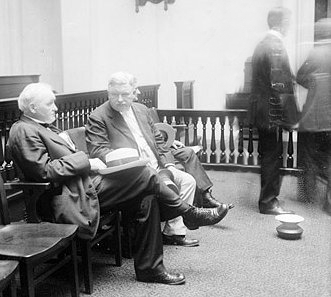
A Chicago courtroom, mid 1910s. A spittoon is seen on the floor at bottom right.
Decorated Surinam porcelain spittoon. Note this type of spittoon has a spout hole on the side for emptying.

A spittoon (or spitoon) is a receptacle made for spitting into, especially by users of chewing and dipping tobacco. It is also known as a cuspidor (which is the Portuguese word for "spitter" or "spittoon", from the verb "cuspir" meaning "to spit"), although that term is also used for a type of spitting sink used in dentistry.

United States in the 19th century

[edit]
Early 20th century toleware spittoon
Janitors at the United States Capitol with stack of spittoons, 1914

In the late 19th century, spittoons became a common feature of pubs, brothels, saloons, hotels, stores, banks, railway carriages, and other places where people (especially adult men) gathered, notably in the United States, but allegedly also in Australia.

Brass was the most common material for spittoons. Other materials used for mass production of spittoons ranged from basic functional iron to elaborately crafted cut glass and fine porcelain. At higher class places like expensive hotels, spittoons could be elaborately decorated.

Spittoons are flat-bottomed, often weighted to minimize tipping over, and often with an interior "lip" to make spilling less likely if they tip. Some have lids, but this is rare. Some have holes, sometimes with a plug, to aid in draining and cleaning.

Use of spittoons was considered an advance of public manners and health, intended to replace previously common spitting on floors, streets, and sidewalks. Many places passed laws against spitting in public other than into a spittoon.

Boy Scout troops organized campaigns to paint "Do not Spit on the Sidewalk" notices on city sidewalks. In 1909 in Cincinnati, Ohio, scout troops together with members of the Anti-Tuberculosis League painted thousands of such messages in a single night.[1] A mass-produced sign seen in saloons read:

If you expect to rate as a gentleman Do not expectorate on the floor

Spittoons were also useful for people suffering from tuberculosis who would cough up phlegm. Public spittoons would sometimes contain a solution of an antiseptic such as carbolic acid with the aim of limiting transmission of disease. With the start of the 20th century medical doctors urged tuberculosis sufferers to use personal pocket spittoons instead of public ones; these were small jars/flasks with tight-fitting lids which people could carry with them to spit into. Similar devices are still used by some tuberculosis sufferers.

After the 1918 flu epidemic, both hygiene and etiquette advocates began to disparage public use of the spittoon, and use began to decline. Chewing gum replaced tobacco as the favorite chew of the younger generation. Cigarettes were considered more hygienic than spit-inducing chewing tobacco. While it was still not unusual to see spittoons in some public places in parts of the US as late as the 1930s, vast numbers of old brass spittoons met their ends in the scrap drives[2][3] of World War II.

A large public collection of spittoons can be found at Duke Homestead State Historic Site[4] Durham, North Carolina. In 2008, the site's tobacco museum added 282 spittoons—claimed to be the world's largest collection—to its holdings of over 100.[5]

In Chinese society

[edit]
Spittoon, 14th Century.[6] The Walters Art Museum.

Spittoons have been used in China for a long time; the earliest porcelain spittoon was found in a tomb dating to Emperor Xianzong's reign during the Tang dynasty.[7] During the Qing dynasty and later in Japan, a golden spittoon would be among the numerous objects displayed in front of the emperor at major ceremonies.[8]

After China became a Communist state in 1949, the spittoon became much more prevalent: spittoons were placed at every conceivable public place, and were commonplace in homes as well. The mass introduction of spittoons was no doubt a public hygiene initiative, motivated by a desire to curtail the still common Chinese practice of spitting onto the floor. The spittoons used in China were typically made of white porcelain, sometimes with traditional Chinese art painted onto the exterior.[citation needed]

Spittoons were used even during official functions by the political leaders of China; especially when Deng Xiaoping had a frequent use of spittoon with other political leaders.[9] This eventually became a source of ridicule by the mass media outside China. As a response, the spittoons have largely been withdrawn from public spaces in China since the late 1980s.

In May 2015, the Spittoon Collective came into being, probably the largest English-language literary collectives in China. They publish the Spittoon[10] literary magazine.

Latter-day models

[edit]
Spitting into a spittoon at a wine tasting

While spittoons are still made, they are no longer commonly found in public places (except as decorations). There are a few companies that currently make spittoons for users of smokeless tobacco, such as MudJug, Spitbud, and Mud Bud by DC Crafts Nation. Professions in which spittoons are commonly used are coffee, tea and wine tasting. A taster will sip samples and then spit them into a spittoon in order to avoid intoxication.[11] Makeshift spittoons, such as large mixing bowls, can be used by people with a cold who are frequently coughing up phlegm.

Spittoons remained in use in the Southern United States in public buildings at least until the 1970s. For example, the Georgia Capitol Museum in the Georgia Capitol Building in Atlanta, Georgia, has on display a spittoon of the type that was used in legislative sessions into the 1970s.

The United States Senate also has spittoons spread across the Senate Chamber as they are considered a Senate tradition.[12] Similarly, each Justice on the United States Supreme Court has a spittoon next to his or her seat in the courtroom. However, the spittoons function merely as wastebaskets; the last time the spittoon was used for its customary purpose was in the early 20th century.[13]

See also

[edit]

References

[edit]
[edit]
Revisions and contributorsEdit on WikipediaRead on Wikipedia
from Grokipedia
A spittoon, also known as a cuspidor, is a receptacle designed for spitting into, particularly to collect from users of or . Spittoons originated in ancient and became widespread in the United States during the as an alternative to indiscriminate on floors, streets, and sidewalks, which was a common habit among tobacco chewers. Spittoons were prevalent in American homes, public buildings, and institutions like the U.S. Congress by the 1830s, where was a popular practice among lawmakers. Their adoption in the was viewed as an improvement in public manners, helping to contain -tinctured . In settings like taverns, hotels, trains, and legislative halls, spittoons were essential accessories of tobacco culture, often placed strategically to encourage hygienic disposal. Typically crafted from durable materials to withstand frequent use and cleaning, spittoons were commonly made of metals such as pewter, brass, galvanized iron, or ceramic stoneware, with designs featuring wide mouths, low profiles, and sometimes sawdust linings for absorption. Early examples, like a pewter model from 1835-1840, were affordable household items comparable to everyday tableware, reflecting their integration into daily life. More ornate versions appeared in public spaces, though maintenance challenges, including unsanitary conditions from overuse, were noted as early as the 1890s in congressional reports. The use of spittoons declined sharply in the early alongside broader anti- campaigns driven by germ theory and concerns over diseases like , which linked public to contagion. As overtook and indoor spitting bans were enforced in cities, spittoons faded from common use, though they remain cultural artifacts in museums, symbolizing a bygone era of American habits.

Definition and Terminology

Definition

A spittoon is a receptacle designed specifically for collecting or spit, particularly from users of , snuff, or betel nut. Its primary function is to promote by containing spit that would otherwise be discarded indiscriminately on floors, streets, or grounds in public or private spaces, thereby reducing the spread of germs and maintaining cleanliness. This specialized is distinct from general receptacles or modern equivalents like trash bins, as it is tailored for the targeted disposal of expectorated rather than broader refuse. While synonymous with the term cuspidor, a spittoon emphasizes its role in accommodating the copious generated by or use. The association with -induced salivation stems from the irritant effects of chewing or , which stimulate the salivary glands and produce excess that users typically spit out to avoid discomfort or swallowing. Similarly, , often combined with other stimulants, results in a bright red residue that requires frequent expectoration.

Etymology and Synonyms

The term "spittoon" originated in around 1811 as a formed by combining the verb "spit" with the "-oon," a rare English formation akin to "saloon" or "." This word denoted a vessel for receiving and replaced earlier designations like "spitting box," which had been used in . Another common synonym, "cuspidor," entered English in 1779 through colonial borrowing from the "cuspidor," meaning "one who spits" or "spittoon." The Portuguese term derives from the verb "cuspir" ("to spit"), ultimately tracing back to the Latin "conspuere" ("to spit upon"), and it disseminated into English via Iberian trade and colonial networks in the . During the , "spittoon" gained wider recognition in English , with the citing its earliest printed evidence from 1840 in British usage. Merriam-Webster similarly dates its first known American appearance to 1823, reflecting the term's rapid adoption amid rising consumption. Regional linguistic variations persisted, such as "spit box" in early British contexts, attested from the as an alternative for the same receptacle.

History

Early Origins

The earliest documented evidence of spittoon-like receptacles dates to China's (circa 1046–256 BCE), where ceramic vessels were used as containers for spit in elite and ritual contexts, reflecting early practices of managing bodily fluids in structured social settings. These vessels, often part of broader ceramic traditions for household and ceremonial use, served practical hygiene needs among the aristocracy, predating the widespread adoption of and highlighting spittoons' roots in pre-modern sanitation customs. In ancient cultures outside , pre-tobacco uses of spittle basins emerged for general , independent of specific chewing habits. Roman hygiene practices included channels in public latrines supplied by aqueducts to maintain cleanliness in communal spaces. Similarly, in medieval Europe, ewers and basins were standard for personal washing as part of routines emphasizing hand and face before meals, though these were not exclusively for spitting. The introduction of tobacco to Asia in the mid-16th century via Portuguese traders marked a pivotal shift, prompting adaptations of existing spittoon-like items for the red-tinged saliva from early tobacco chewing, particularly in coastal China where the practice blended with longstanding betel nut traditions. Betel nut chewing, an ancient Southeast Asian custom dating back thousands of years, already necessitated spittoons to contain the vivid red spittle produced, with vessels commonly placed in homes and public areas for this purpose. By the , the rising popularity of chewing in both and drove the evolution from ad-hoc containers, such as shells or simple , to purpose-built spittoons designed specifically for , often crafted from durable materials to handle frequent use in households and venues. In , these emerged alongside the chewable form of , which gained traction among diverse social classes, while in , they accommodated the combined influences of and newly introduced .

19th-Century Development in the United States

In the mid-19th century, the use of spittoons surged in the United States amid the widespread popularity of , particularly among men such as , politicians, laborers, and workers in various industries. This habit, which produced copious amounts of , led to their placement in homes, railroad cars, hotels, and legislative chambers to contain expectoration and maintain cleanliness in public and private spaces. By the and , spittoons had become commonplace fixtures, reflecting the cultural acceptance of tobacco chewing as a across American society. A notable illustration of their ubiquity occurred during a heated altercation in the U.S. on February 6, 1858, when Representative Galusha Grow and South Carolina's Laurence Keitt initiated a brawl involving nearly 50 members debating statehood and slavery, during which John Covode grabbed a heavy stoneware spittoon to threaten participants amid the chaotic melee with thrown objects and physical scuffles. The incident underscored how integral spittoons were to the daily environment of , where chewing tobacco was a prevalent practice among lawmakers. By the late , initiatives promoted spittoons as a measure to combat the spread of , which was fueled by concerns over airborne bacteria in . Amid rising fears of the disease, which killed one in seven people in the U.S. at the time, campaigns by organizations like the National Association for the Study and Prevention of Tuberculosis encouraged their use in public buildings to prevent floor-spitting, leading to mandates in cities such as New York by 1896 and enforcement through fines for non-compliance. These efforts positioned spittoons as essential tools for in venues like streetcars and theaters. Mass production of spittoons accelerated during this period, with , emerging as a key center due to its burgeoning industry, which began producing yellowware and Rockingham-glazed models as early as the 1840s for distribution to railroads and hotels. By the 1880s, durable spittoons had become the standard in high-traffic public areas like railway carriages and legislative halls, valued for their sturdiness and ease of cleaning amid ongoing use.

Adoption in Chinese Society

The adoption of spittoons in Chinese society traces back to the (c. 1046–256 BCE), where early vessels served as precursors for containing refuse and spittle during rituals and daily activities. These rudimentary forms evolved into more specialized examples by the (618–907 CE), such as the zhadou, a glazed vessel used for spitting dregs or clearing the mouth during tea ceremonies. By the Ming (1368–1644) and Qing (1644–1912) dynasties, zhadou became common in households and public spaces, crafted from fine in and functioning as slops jars for food scraps, residue, and spittle, often placed on tables for convenience. This integration reflected practical needs in communal eating and drinking customs, distinct from Western associations. The 16th-century introduction of tobacco by Portuguese traders to coastal regions further embedded spittoons into daily life, as chewing and snuff use prompted the need for discreet spitting vessels among both elites and commoners. Concurrently, , a practice dating to the (206 BCE–220 CE) and prevalent in southern , reinforced their utility due to the red-stained produced, with zhadou serving as polite receptacles in social settings like weddings and gatherings. In public venues, such as teahouses and imperial courts, ornate or zhadou symbolized refinement while accommodating these habits, evolving from earlier prototypes into ubiquitous household items. In 20th-century Communist , spittoons remained prevalent as public conveniences in trains, offices, streets, and official functions, aligning with widespread to clear —a habit viewed as healthful cleansing rather than rude when directed into a vessel. Leaders like , a heavy smoker, routinely used spittoons during meetings, including 1980s Sino-British negotiations, underscoring their acceptance in elite circles despite growing concerns. Culturally, into spittoons was deemed polite for expelling impurities after meals or to maintain respiratory health, contrasting with open seen as unhygienic, particularly amid outbreaks. Post-1980s anti-spitting campaigns, spearheaded by , marked a sharp decline, with public education drives, fines, and removal of spittoons from urban spaces to curb disease transmission and modernize . These efforts, building on earlier initiatives, largely eradicated them from cities by the late 1980s, though remnants persist in rural areas for elderly betel nut users in the south.

Design and Materials

Traditional Forms and Shapes

Traditional spittoons commonly featured bowl-shaped or funnel-rimmed forms, designed with wide mouths to facilitate accurate aiming and containment of expectorated matter. These designs incorporated low centers of gravity to enhance stability and prevent accidental tipping during use. Variations in form included stationary wall-mounted or floor-fixed cuspidors prevalent in public buildings such as courthouses and railroad stations, which were built for communal access and durability against heavy traffic. In contrast, portable chamber-pot styles were favored for domestic or travel settings, offering mobility while maintaining a compact, handle-equipped profile for easy transport. Stability was prioritized through heavy basing, particularly in brass models where lead weights were embedded in the base to anchor the spittoon on uneven surfaces like train floors or saloon tables, ensuring it resisted overturning even if disturbed. Elite versions often incorporated decorative elements, such as engraved floral or geometric patterns on 19th-century American brass pieces, or imperial motifs like phoenixes and florals on Chinese examples from the late 19th to early 20th centuries.

Common Materials and Manufacturing

From the mid-19th century onward, emerged as the predominant material for spittoons and due to its excellent resistance, which protected against the acidic nature of , and its attractive polished shine that allowed for decorative engravings. Often, these models featured a weighted base, sometimes incorporating lead for added stability to prevent tipping during use. For more affordable options, was employed in functional spittoons, offering durability at a lower cost while still providing sufficient weight. Galvanized iron was also used for its resistance and low cost in 19th-century production. Ceramic materials gained prominence in 19th-century American production, particularly yellowware and Rockingham-glazed from pottery centers like , and . These ceramics were valued for their non-porous glazed surfaces, which facilitated easy cleaning and promoted hygiene by resisting absorption of spittle. In Chinese contexts, was the material of choice, produced through high-temperature firing in kilns such as those in , yielding ornate, waterproof pieces with intricate designs that enhanced both functionality and aesthetics. Earlier portable versions sometimes utilized for its malleability and lightweight properties or graniteware, an enameled tin or iron, which combined portability with a smooth, cleanable enamel coating. Mass production of spittoons expanded significantly after industrial advances in the , enabling widespread availability. Metal spittoons, especially and iron, were manufactured via in foundries, where molten metal was poured into molds to form the shapes efficiently at scale. For ceramics, slip-casting techniques became standard, involving the pouring of liquid clay slip into plaster molds that absorbed excess water to form the vessel, followed by glazing and firing; this method, refined in the late , allowed for precise replication of complex forms in yellowware and . These processes, supported by mechanized wheels and improved furnace technologies, transitioned spittoon production from artisanal workshops to industrialized output.

Cultural and Social Significance

Role in Western Public Life

In the late , spittoons became ubiquitous in American public spaces, including legislatures, railroads, and saloons, serving as symbols of refined consumption amid emerging anti- regulations. By the 1870s, these vessels were standard fixtures in venues frequented by men, such as the U.S. ' Speaker's offices, where elaborate ceramic spittoons flanked desks to accommodate lawmakers' habits. Railroads equipped passenger cars and stations with cast or iron spittoons to manage the expectoration from widespread use among travelers. Similarly, saloons across the Midwest and West integrated spittoons into their decor, often placing them near bars and tables to promote orderly in these male-dominated social hubs. This proliferation coincided with local ordinances in the 1870s and 1880s prohibiting indiscriminate on sidewalks or floors, except into designated receptacles, thereby positioning spittoons as markers of civilized public behavior. Gender norms shaped spittoon usage distinctly, with men relying on versions for while women turned to private alternatives for snuff. In settings like banks, hotels, and courtrooms, spittoons catered primarily to male patrons engaging in the vigorous, visible practice of chewing loose or plugs, which generated substantial . Women, who favored drier snuff dipped into the lip or , typically used discreet "spit cups" or "ladies' cuspidors"—small, decorative or vessels—kept at home or in boudoirs to maintain propriety and avoid display. These private items, often adorned with floral patterns, reflected societal expectations of feminine , contrasting with the robust, metallic spittoons associated with masculine spaces. Spittoons played a key role in early initiatives, particularly in curbing the spread of during the 1890s campaigns. As medical understanding linked the disease to airborne bacteria in , reformers advocated spittoons as essential tools to contain infectious droplets, with organizations like the National Association for the Study and Prevention of promoting their use in offices, transit, and homes. Campaigns distributed pocket spittoons and installed public ones filled with disinfectants, emphasizing that proper disposal reduced transmission risks in crowded urban environments. These efforts, amplified by laws in cities like New York starting in 1896, framed spittoons not just as etiquette aids but as vital barriers against the "white plague." By the , spittoons faded from Western public life due to shifting preferences and stricter enforcement. The rise of cigarettes, which produced less saliva than , diminished the need for expectoration aids, while aggressive anti-spitting ordinances in major cities led to their removal from public venues. This decline marked a broader evolution in social manners, as indoor norms and supplanted the spittoon's role in containing -related habits.

Practices in Chinese Culture

In Chinese society, spittoons, known as zhadou, have a long history dating back to at least the (618–907 CE), where early examples were discovered in imperial tombs, indicating their use for containing expectorated matter in elite settings. By the (1644–1912), spittoons became integral to courtly life, with ornate imperial examples crafted in materials like and featuring designs such as patterns, placed prominently during ceremonies to manage spit from or betel nut use among officials and attendants. Their adoption aligned with the 16th-century introduction of to coastal regions, where chewing practices, including betel nut combined with , necessitated discreet disposal methods in refined environments like homes and public gatherings, positioning spittoons as a civilized alternative to ground-spitting. During the Republican era (1912–1949), spittoons remained commonplace in urban and social spaces, supporting the cultural habit of nut and chewing prevalent in southern provinces, where they facilitated hygiene in teahouses and domestic settings without direct ground contamination. In the 20th century, particularly under Mao Zedong's leadership (1949–1976), spittoons were normalized in public venues like the , where they accommodated phlegm-clearing as a perceived health practice rooted in traditional views of expelling impurities, even during high-level meetings. This tolerance extended to leadership contexts, as evidenced by spittoons placed near Mao during his 1972 discussions with U.S. President , underscoring their everyday utility amid diplomatic exchanges. Spittoons also carried symbolic weight in diplomacy, blending practicality with cultural display; Chinese leaders like routinely used them during negotiations with foreign dignitaries in the late , such as spitting into a spittoon while conversing with U.S. in 1977, highlighting a directness in state interactions. Post-1949, usage shifted with initiatives, including 's early 1980s propaganda drive against , which deployed thousands of volunteers in cities like and to educate on and impose small fines, thereby diminishing the routine need for spittoons in urban areas. Despite this, spittoons persisted in rural and traditional contexts, where endured, though their prominence waned as modern sanitation norms took hold.

Modern Usage and Legacy

Collectibility and Antiques

Following the decline in practical use after the 1930s, driven by campaigns against and the rise of cigarette smoking, spittoons transitioned into sought-after antiques, particularly among collectors interested in American material culture. Brass examples from railroads and hotels, such as those stamped with Union Pacific markings, emerged as prized items in mid-20th-century auctions, often fetching $50 to $200 for authenticated pieces in good condition, reflecting their association with frontier-era travel and hospitality. These artifacts gained particular appeal among enthusiasts of tobacco history, who value spittoons for their ties to 19th-century chewing culture. Originals are typically distinguished from replicas by their substantial weight—typically 2 to 5 pounds (0.9 to 2.3 kg) for models due to weighted bases for stability—and the natural developed from decades of use, contrasting with the brighter, uniform finish of modern reproductions. Ceramic spittoons from , producers like the Harker Pottery Company, are especially prized for their rarity and decorative glazes, such as Rockingham mottled brown, with surviving examples from the 1850s onward commanding higher values due to limited production runs. Several museums preserve spittoons as emblems of 19th-century , highlighting their role in public spaces like legislatures and transportation hubs. The Henry Ford Museum in , displays a cast-iron spittoon from the era, underscoring everyday in frontier settings. Similarly, the U.S. ' History, Art & Archives collection features brass "Speaker spittoons" from the Capitol, once ubiquitous in congressional offices, now exhibited to illustrate the building's tobacco-stained past. Modern valuation of spittoon antiques hinges on factors like condition, , and maker's marks from foundries or potteries, such as those etched on Union Pacific brass or stamped on East Liverpool ceramics, which authenticate age and origin. Interest peaked during 1970s nostalgia revivals, when antique markets boomed amid cultural fascination with Victorian and artifacts, driving up prices for well-preserved pieces before stabilizing in later decades.

Contemporary Applications

In contemporary settings, spittoons maintain limited practical applications, particularly in regions where cultural habits involving betel nut or chewing persist despite regulatory efforts. In rural areas of , where betel nut consumption remains common, portable spittoons are used to manage spitting associated with paan masala and gutkha, even as urban bans on public spitting proliferate to curb health risks like and public nuisance. These devices, often made of lightweight plastic for portability, are available in markets catering to such practices, providing a contained alternative to open spitting. Similarly, in parts of rural , residual use of spittoons accompanies betel nut traditions, though urban hygiene campaigns have largely supplanted them with fines and awareness drives. Beyond functionality, spittoons appear in decorative roles within themed environments that evoke historical without encouraging active use. In Western-style reenactments, hotels, and saloon-themed bars, they are placed as props to recreate 19th-century ambiance, often alongside rustic furnishings to enhance immersive experiences. These non-utilitarian placements underscore their cultural relic status, appearing in settings like Old West-inspired venues where they contribute to visual rather than practical disposal. market trends occasionally influence such decor choices, with collectors sourcing period pieces for authenticity. Health policies worldwide illustrate contrasting approaches to spitting and spittoon legacy, balancing eradication with ongoing challenges in tobacco-heavy regions. Singapore's stringent anti-spitting laws, formalized in the early and reinforced with fines up to S$1,000 in , effectively phased out public spittoons as part of broader prevention and urban cleanliness initiatives. In contrast, tobacco-prevalent areas like parts of continue to debate hygiene measures, with guidelines advocating bans on use and in public to mitigate disease transmission, yet enforcement remains inconsistent amid cultural entrenchment. These policies reflect evolving priorities, prioritizing education and penalties over relic provision.

References

Add your contribution
Related Hubs
User Avatar
No comments yet.