Hubbry Logo
Springfield Model 1863Springfield Model 1863Main
Open search
Springfield Model 1863
Community hub
Springfield Model 1863
logo
8 pages, 0 posts
0 subscribers
Be the first to start a discussion here.
Contribute something
Springfield Model 1863
from Wikipedia
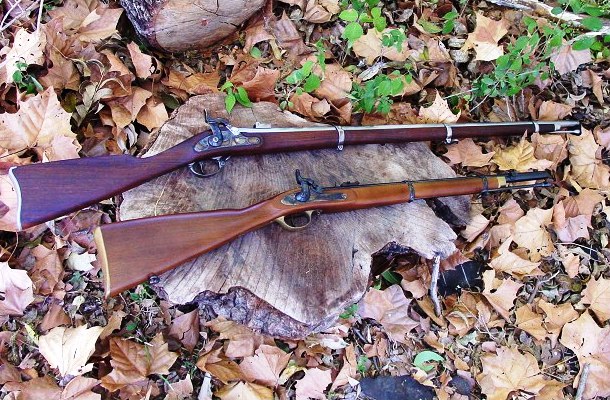
Springfield Model 1863 rifled musket and Enfield Pattern 1861 musketoon

Key Information

Springfield and Enfield lockplates

The Springfield Model 1863 was a .58 caliber rifled musket manufactured by the Springfield Armory and independent contractors between 1863 and 1865.

The Model 1863 was only a minor improvement over the Springfield Model 1861. As such, it is sometimes classified as just a variant of the Model 1861. The Model 1861, with all of its variants, was the most commonly used longarm in the American Civil War, with over 700,000 manufactured. The Model 1863 also has the distinction of being the last muzzle-loading longarm produced by the Springfield Armory.

The Model 1863 was produced in two variants. The Type I eliminated the band springs and replaced the flat barrel bands with oval clamping bands. It also featured a new ramrod, a case-hardened lock, a new hammer, and a redesigned bolster (percussion chamber). Several of these modifications were based upon Colt's contract Model 1861, known as the "Colt special". 273,265 Type I variants were manufactured in 1863.

The Type II is sometimes referred to as the Model 1864, but is more commonly referred to as just a variant of the Model 1863. This version re-introduced band springs, replaced the clamping bands with solid oval bands, and replaced the three leaf rear sight with single leaf sight. A total of 255,040 of these were manufactured from 1864 to 1865. After the war, many surplus rifles were sent south of the border to Mexico to arm the Mexican army in their fight against the French in the 1861-67 War

By the end of the Civil War, muzzle-loading rifles and muskets were considered obsolete. In the years following the Civil War, many Model 1863 muskets were converted into breech-loading "Trapdoor Springfields". The breech-loading weapons increased the rate of fire from three to four rounds per minute to eight to ten rounds per minute. The Model 1863 could be converted to breech-loading for about five dollars, at a time when a new rifle would cost about twenty dollars. The conversion of Model 1863 rifles therefore represented a significant cost savings to the U.S. military. The US Military adopted various models like the Springfield Model 1866.

See also

[edit]

References

[edit]
[edit]
Revisions and contributorsEdit on WikipediaRead on Wikipedia
from Grokipedia
The Springfield Model 1863 was a .58-caliber percussion-lock rifle-musket produced by the and private contractors from 1863 to 1865, serving as the primary shoulder arm for Union infantry during the . Featuring a 40-inch rifled barrel, an overall length of 56 inches, and a weight of approximately 9 pounds, it fired a .58-inch and was designed for muzzle-loading with to facilitate and field repairs. Approximately 273,000 Type I variants were manufactured at the Armory in 1863 alone, with total production exceeding 700,000 units across variants, reflecting wartime demands for reliable, cost-effective weaponry. As a direct evolution of the earlier Model 1861 rifle-musket, the Model 1863 incorporated manufacturing simplifications to boost output, such as replacing the steel barrel with a forged iron one and eliminating the Maynard tape priming system in favor of standard percussion caps, which reduced costs while maintaining up to 300 yards. The Armory, under Superintendent B. Dyer, expanded operations during the , achieving peak production of over 276,000 rifle-muskets in 1864 through mechanized processes like roll-welding for barrels and steam-powered machinery, employing more than 2,800 workers across two shifts. Two main variants emerged: the Type I, with barrel bands secured by screws for easier assembly, and the Type II (also known as the Model 1864), which used leaf springs for bands to improve durability and reduce production time—totaling around 250,000 Type II units by war's end. Widely issued to Federal troops, including garrison units and , the Model 1863 saw extensive use in major engagements such as Gettysburg, , and Cedar Creek, where its accuracy and reliability supported tactics despite the era's emphasis on . Post-war, surplus arms were sold to veterans for as little as $6 under General Orders No. 101, flooding civilian markets and influencing American firearms development into the late . Its legacy endures as a symbol of industrialized warfare, with the Springfield Armory's system setting standards for future military production.

Development and Production

Origins and Improvements

The served as the primary for Union forces during the early stages of the , emerging as the standard infantry arm due to its reliability and adaptability for the . Production at the faced intense pressures from surging wartime demand, prompting the U.S. government to outsource to private contractors to meet the needs of rapidly expanding armies. This high demand strained resources, leading to efforts to refine designs for efficiency without compromising performance. The development of the Model 1863 drew inspiration from the British rifle-musket, which gained prominence during the (1853–1856) and demonstrated the superiority of rifled barrels over smoothbores for long-range accuracy with expanding bullets. U.S. ordnance observers noted these advancements, influencing American designs to prioritize rifled muskets in .58 caliber for enhanced battlefield effectiveness. Officially adopted on February 9, 1863, the Model 1863 represented a cost-effective evolution of the Model , incorporating targeted modifications to address production constraints and operational issues amid ongoing demands. Key enhancements included a redesigned and to shorten the flash channel, reducing misfires from ignition delays by providing a more direct path from the to the main powder charge and eliminating the clean-out screw. The lock plate was case-hardened for improved durability and resistance to wear, while the initial Type I variant omitted band springs, substituting simpler clamping bands to lower costs and simplify assembly. These changes collectively reduced the weapon's weight and streamlined production, ensuring sustained output for Union troops.

Manufacturing Details

The Springfield Model 1863 rifle-musket was primarily produced at the federal in , which served as the central hub for U.S. military manufacturing during the Civil War. To address surging demand, production was augmented by private contractors, including the in and the Whitney Arms Company in , who were supplied with armory blueprints, gauges, and inspectors to ensure parts interchangeability with government output. Overall production reached approximately 700,000 units between 1863 and 1865, with the manufacturing 273,265 Type I models and 255,040 Type II models, and private contractors contributing additional units of similar patterns. Production peaked in 1864, when the armory and contractors achieved a daily output capacity of up to 900 rifle-muskets, driven by workforce expansion to over 2,800 skilled laborers amid national labor shortages. By war's end in 1865, output tapered as contracts expired and resources shifted. Manufacturing emphasized through mechanized processes, including steam-powered machinery for barrel and , which allowed for three-groove in .58-caliber barrels made from rather than more expensive to maintain cost efficiency. Key challenges included inconsistent iron quality, dependency on imported metals, and supply disruptions for fittings, which occasionally delayed assembly despite coordinated federal procurement efforts. The average cost per new rifle-musket was around $20, a factor that later supported economical post-war conversions rather than full replacements.

Design Features

Physical Specifications

The Springfield Model 1863 rifle musket measured 56 inches in overall length, with a 40-inch rifled barrel optimized for elongated bullets like the , continuing the design from the Model 1861. The barrel featured 3-groove with a right-hand twist rate of one turn in 72 inches, providing stabilization for the .58-inch caliber projectile during flight. Unloaded, the weapon weighed approximately 9 pounds, making it a substantial but manageable load for use. In terms of ballistic performance, the Model 1863 achieved a muzzle velocity of approximately 900–1,000 feet per second when firing a standard 500-grain Minié ball with a 60-grain black powder charge, enabling aimed fire at effective ranges of 400–500 yards and a maximum range of approximately 900 yards under ideal conditions. Sighting arrangements included a fixed iron blade front sight mounted near the muzzle and a rear leaf sight; the Type I variant employed a two-leaf adjustable rear sight graduated up to 300 yards, while the Type II used a simpler single-leaf design. These specifications reflected the Model 1863's role as a refined percussion-lock rifled musket, balancing accuracy improvements with production efficiency.

Operating Mechanism

The Springfield Model 1863 functioned as a muzzle-loading percussion , relying on cartridges for efficient loading in combat. Each cartridge consisted of a combustible envelope containing 60 grains of fine-grained black (Ffg) and a .58-caliber , designed to expand upon firing for better accuracy in the rifled barrel. To load, the first handled the cartridge from the ammunition box, then tore open one end with the teeth to expose the . The was poured down the muzzle to charge the barrel, followed by inserting the and wadding, which were seated firmly against the charge using the . Finally, a copper was placed on the (also called the ) to prime the weapon, completing the preparation for firing. The percussion lock mechanism ignited the main charge through a hammer striking the , which detonated to send a flash through the into the powder. A key improvement in the Model 1863 was the redesigned —a reinforced area around the —with a shortened and more direct flash channel from the to the barrel chamber, utilizing a flat without a clean-out to better contain side flash and reduce gas escape, thereby enhancing reliability and ignition efficiency. When ready to fire, the was drawn to the full-cock position, and pulling the trigger released it to strike the cap, propelling the downrange. Trained soldiers could achieve a of 2–3 rounds per minute under ideal conditions, though this varied with experience and circumstances. The , essential for seating the load, featured a straight shank design measuring approximately 40 inches in , with a tulip-shaped head for handling and a threaded end for tools like a ball puller. In the Type I configuration, it was retained in the stock's ramrod channel primarily by friction against the wood, without the use of retaining springs, allowing quick withdrawal in three fluid motions for loading. For safety, the lock included a half-cock position on the , which served as a precautionary notch to prevent accidental discharge during handling or loading by holding the hammer away from the until intentionally moved to full-cock. This feature was critical in the field to avoid premature ignition of the main charge.

Variants

Type I Configuration

The Type I Configuration represented the initial production variant of the Springfield Model 1863 rifle musket, manufactured during 1863 primarily at the , with 273,265 units produced there. Additional Type I units were produced by private contractors, including 13,000 by Norris & Clement. This design incorporated several modifications aimed at simplifying manufacturing and reducing costs compared to the preceding Model 1861, while maintaining the overall .58-caliber form. Key distinct features included the elimination of barrel band springs, with the three oval-shaped clamping bands instead held in place by friction and secured via screws marked "U". The lock plate was case-hardened in mottled colors, featuring a flat profile with beveled edges and markings of "U.S. SPRINGFIELD" along with the "" date. An elongated provided enhanced flash protection at the percussion chamber, and the was newly designed in a tapered form for improved handling and retention. The stock was constructed from black walnut with an oil finish, complemented by brass buttplate and nosecap for durability and aesthetics, alongside an iron . The sighting system utilized a fixed blade front sight integrated with the and a graduated rear sight calibrated up to 300 yards, with an optional flip-up leaf for longer ranges. Under heavy field use, the friction-dependent barrel bands were susceptible to slippage, which compromised reliability and ultimately prompted the mid-production shift to the Type II configuration with added retaining springs.

Type II Configuration

The Type II configuration of the , produced from 1864 to 1865, incorporated modifications to enhance reliability and simplify maintenance over the initial variant. A total of 255,040 units were manufactured at the during this period, and it is sometimes designated as the Model 1864. These changes responded to field reports of wear and loosening components in the Type I, prioritizing practical improvements without altering the core operating mechanism shared with earlier designs. A primary enhancement was the reintroduction of barrel band springs, which securely retained the solid barrel bands without the need for clamps. This addressed the Type I's reliance on friction-based retention, which was prone to failure under environmental stress such as mud, rain, or prolonged marching. The tapered barrel profile and matching from the Type I were retained, maintaining the overall balance and loading efficiency. The rear sight was simplified to a single-leaf pattern, graduated for basic range adjustments up to 500 yards, replacing the more complex multi-leaf design for quicker field adjustments. The lock plate continued to be case-hardened for , inscribed with "1864" or "1865" behind the , while the bolster area around the percussion remained unchanged in contour. Standard markings featured "U.S. SPRINGFIELD" ahead of the on the lock plate and an eagle motif stamped on the barrel near the breech.

Operational History

American Civil War Service

The Springfield Model 1863 rifle-musket became the primary long arm for Union infantry by mid-1863, rapidly equipping regiments across major field armies including the and . Its production at the and by federal contractors allowed for widespread issuance, with total production exceeding 700,000 units (including contractors) distributed to Union forces by the war's end in 1865. This volume ensured that volunteer regiments, such as those in the Eastern and Western Theaters, received standardized weaponry that contributed to the Union's overall firepower superiority over Confederate forces often reliant on imported or improvised arms. In tactical employment, the Model 1863 was integral to line infantry formations delivering coordinated volleys at effective ranges of 100 to 200 yards, while skirmishers utilized its rifled barrel for longer-distance fire up to 300 yards. Its reliability shone in key engagements, such as the Battle of Gettysburg in July 1863, where Union troops withheld fire until Confederate advances reached 200 to 300 yards, maximizing the Minié ball's accuracy and inflicting heavy casualties during assaults like Pickett's Charge. Similarly, at the Battle of the Wilderness in May 1864, the rifle equipped about 63 percent of the Army of the Potomac's infantry, supporting defensive stands and counterattacks in dense underbrush where close-range reliability proved vital. However, the weapon's percussion lock and muzzle-loading mechanism limited its rate of fire to around three rounds per minute, constraining sustained volley fire in prolonged exchanges despite its accuracy with the .58-caliber Minié projectile. Logistically, the Model 1863 was supplied through federal arsenals, primarily the in , which coordinated production and distribution to sustain Union armies in both the Eastern and Western Theaters. This centralized system delivered arms efficiently via rail and wagon trains, though field reports occasionally noted Union troops employing captured Confederate imitations, such as Richmond Armory copies of the Springfield pattern. The rifle's prevalence in volunteer units underscored its role in bolstering Union combat effectiveness, with its facilitating repairs under campaign conditions.

Post-War Use and Conversions

Following the conclusion of the in 1865, vast quantities of surplus Springfield Model 1863 rifle-muskets were stored in U.S. government arsenals, reflecting the overproduction of approximately 700,000 units during the conflict. Many of these were subsequently released to private citizens through sales authorized under General Orders 101, with individual muskets priced at $6.00 each as of June 1865, allowing veterans and civilians to acquire them for personal use such as hunting or militia service. To modernize the inventory economically amid the shift to breech-loading designs, converted approximately 25,000 Model 1863 rifle-muskets into the Model 1866 configuration between 1867 and 1869 using the Allin system. The conversion process, which cost about $5 per unit compared to $20 for a new , involved milling out the rear portion of the barrel, installing a hinged , reaming the bore to .64 caliber, inserting a rifled iron liner to reduce it to .50 caliber, and chambering for the metallic cartridge, while retaining the original percussion lockplate, , and sling. These modifications significantly enhanced reloading speed and reliability over the original muzzle-loading design. Surplus Model 1863 rifle-muskets also saw foreign service, with surplus arms including Springfield rifle-muskets provided to to support Juarista Republican forces against the French intervention from 1865 to 1867, and others exported to France for use in the of 1870–1871. By the 1870s, the Model 1863 and its conversions were largely phased out in U.S. military service in favor of more advanced repeating rifles like the Krag-Jørgensen, though the influenced subsequent single-shot designs such as the Model 1873. Many remaining examples were scrapped, dismantled for parts, or sold as surplus through the 1880s, contributing to the scarcity of originals today. In the , unrestored Model 1863 rifle-muskets hold significant collector value, with prices as of 2013 typically ranging from $750 in good condition to over $2,000 in fine condition, depending on provenance and originality.

References

Add your contribution
Related Hubs
Contribute something
User Avatar
No comments yet.