Hubbry Logo
Squam LakeSquam LakeMain
Open search
Squam Lake
Community hub
Squam Lake
logo
8 pages, 0 posts
0 subscribers
Be the first to start a discussion here.
Squam Lake
Squam Lake
from Wikipedia

Squam Lake is a lake located in the Lakes Region of central New Hampshire, United States, south of the White Mountains, straddling the borders of Grafton, Carroll, and Belknap counties. The largest town center on the lake is Holderness. The lake is located northwest of much larger Lake Winnipesaukee.

Key Information

It drains via a short natural channel into Little Squam Lake, and then through a dam at the head of the short Squam River into the Pemigewasset at Ashland. Covering 6,791 acres (27.48 km2),[1] Squam is the second-largest lake located entirely in New Hampshire.

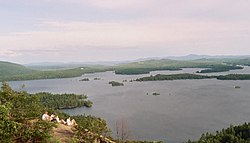
Squam Lake in 2006
Squam Lake from the Asquam House, Holderness, NH

Squam Lake was originally called Keeseenunknipee,[clarification needed] which meant "the goose lake in the highlands". The white settlers that followed shortened the name to "Casumpa", "Kusumpy" and/or "Kesumpe" around 1779. In the early 19th century, the lake was given another Abenaki name, Asquam, which means "water". Finally, in the early 20th century, Asquam was shortened to its present version, Squam.

Squam Lake is much less commercialized than its neighbor Lake Winnipesaukee, which has waterfront attractions in Meredith, Weirs Beach, and other locations. Unlike the numerous businesses dotting the shores of Winnipesaukee, only a few are present on Squam, and none of them are located on Squam itself (there is an ice cream shop, a general store/marketplace, a restaurant, two marinas, and multiple gas stations on Little Squam). The Squam Lakes Association maintains only four boat-launching sites on the entire lake in order to keep it as quiet and private as possible.

The 1981 film On Golden Pond was filmed in the town of Center Harbor on Squam Lake.[2] There are two tour boat services on the lake, both based in Holderness. One is Experience Squam, a private charter, and the other is the Squam Lakes Natural Science Center. Both services show filming locations and items of natural significance.

Squam Lake is a nesting site for common loons and is a good place to see them in breeding plumage during the summer months. Bald eagles and great blue herons are also known to nest on the lake.

The lake is classified as a cold- and warmwater fishery, with observed species including rainbow trout, landlocked salmon, lake trout, lake whitefish, smallmouth and largemouth bass, chain pickerel, horned pout, and white perch.[3]

Islands

[edit]

Squam Lake has about 30 named islands and numerous smaller, unnamed islets. The named islands are:

  • Basin Island
  • Birch Island
  • Bowman Island
  • Carnes Island
  • Chocorua (Church) Island
  • Duck Island
  • Great Island
  • Groton Island
  • High Haith (at 243 acres (98 ha), the largest island, but only separated from mainland by narrow ditch bridged by road)
  • Hoag Island
  • Hubble Island
  • Kate Island
  • Kent Island
  • Kimball Island
  • Laurel Island
  • Little Loon Island (nesting site to bald eagles in 2003, 2005, 2006, 2012)
  • Long Island
  • Loon Island
  • Merrill Island
  • Mink Island
  • Mooney (or Moon) Island
  • Mouse Island
  • Otter Island
  • Perch Island
  • Potato Island
  • Sheep Island
  • Three Sisters (three separate islands)
  • Utopia Island
  • Yard Island[4]

Events

[edit]

On June 26, 1932, while vacationing on Squam Lake, astronomer Adelaide Ames was taking a canoe tour with a friend on the lake when the boat capsized. She was presumed to have drowned and her body was found after a ten-day search on July 5, 1932. She died at the age of 32.[5]

See also

[edit]

References

[edit]
[edit]
Revisions and contributorsEdit on WikipediaRead on Wikipedia
from Grokipedia
Squam Lake is an oligotrophic freshwater lake in the Lakes Region of central , , covering 6,762 acres as the centerpiece of a 36,644-acre watershed encompassing the towns of , Ashland, Center Harbor, Sandwich, and Moultonborough. It ranks as the second-largest lake entirely within the state, connected to the smaller Little Squam Lake (408 acres) via a channel, and characterized by complex morphology including numerous coves, bays, and approximately 30 named islands. With an average depth of 23 feet (7 meters) and a maximum depth of 89 feet (27 meters), the lake maintains high due to low nutrient levels, supporting a dimictic mixing cycle with turnover in spring and fall. Geologically, Squam Lake was sculpted by the Laurentide Ice Sheet during the Pleistocene epoch, approximately 2 million to 13,000 years ago, through glacial scouring that left behind striations, erratics, and the basin's distinctive U-shaped valleys. English settlement in the surrounding area began in the mid-18th century, transforming the landscape from Abenaki indigenous lands—originally known to them as Keeseenunknipee, meaning "the goose lake in the highlands"—to colonial farmlands, though the lake itself remained largely undeveloped. Conservation efforts intensified in 1904 with the founding of the Squam Lakes Association by lakefront property owners to reclaim and protect the watershed from pollution and overuse, leading to ongoing monitoring of water quality parameters such as transparency, phosphorus, and dissolved oxygen since 1978. The lake's pristine environment supports diverse , including populations of common loons—a state-threatened species—whose nesting success is tracked amid challenges from mercury and (PCB) contamination, prompting strict fish consumption advisories. Squam Lake also hosts a varied fishery with cold-water species like and landlocked , alongside warm-water , managed under New Hampshire's large lake regulations. Culturally, it achieved widespread recognition as the primary filming location for the 1981 film On Golden Pond, highlighting its serene, forested shores and contributing to regional tourism focused on , viewing, and low-impact . Recent impacts, such as delayed ice formation, have affected traditional activities like the annual while underscoring the need for adaptive watershed management.

Geography

Location and Dimensions

Squam Lake is situated in the Lakes Region of central , United States, spanning the counties of Grafton, Carroll, and Belknap. It lies within the towns of Center Harbor, , Moultonborough, and Sandwich, while adjacent Little Squam Lake extends into Ashland. The lake's position places it amid a of rolling , approximately 20 miles northeast of , the state's largest lake. The lake covers a surface area of 6,785 acres (2,746 ha), making it New Hampshire's second-largest lake entirely within the state. It measures approximately 7.0 miles (11.3 km) in maximum length and 4.6 miles (7.4 km) in maximum width, giving it an irregular, somewhat oval shape with numerous coves and islands. Its maximum depth reaches 99 feet (30 m), while the average depth is about 24 feet (7.3 m). The surface elevation stands at 561 feet (171 m) above sea level. The surrounding terrain consists primarily of forested hills and ridges, with the Squam Range—a southern extension of the White Mountains—rising to the north and west. Approximately 86% of the adjacent land remains forested, contributing to the lake's pristine and less developed character compared to the busier nearby. Squam Lake connects to the smaller Little Squam Lake via a narrow channel.

Hydrology and Watershed

Squam Lake's hydrology is characterized by inputs primarily from direct , infiltration, and runoff from 34 small , with no major rivers serving as significant sources. Annual in the watershed averages 49.4 inches, accounting for a substantial portion of the lake's water supply, while and flows provide the remainder through the predominantly forested drainage area. These inflows support the lake's volume without reliance on large-scale river systems. Water exits Squam Lake eastward through the short Squam Channel into Little Squam Lake, then flows via the Squam River—approximately two miles long—to join the at Ashland, . The carries the drainage southward to the , which ultimately discharges into the Atlantic Ocean near . This progression defines the lake's outlet pathway within the broader river system. The combined watershed of Squam Lake and Little Squam Lake spans 36,644 acres, equivalent to approximately 57 square miles (148 km²), and includes about 20% open water amid largely undeveloped terrain across seven central towns (Ashland, Campton, Center Harbor, , Meredith, Moultonborough, and Sandwich). Squam Lake itself covers 6,785 acres within this basin. The watershed's low development density—less than 3% impervious surfaces—contributes to efficient natural filtration of inflows. The lake maintains excellent , classified as oligotrophic due to low nutrient concentrations, with median total levels at 6.5 and transparency averaging 8.7 meters, indicating exceptional clarity. These conditions reflect minimal external nutrient loading from the watershed. Water levels fluctuate seasonally, rising in spring from snowmelt-driven runoff and declining in summer due to increased and reduced , with an overall flushing rate of 0.4 times per year—replacing the lake's volume every 2.4 years.

History

Indigenous Peoples and Early Names

The Squam Lake watershed lies within N'dakinna, the traditional homelands of the Abenaki, Penacook, and other Wabanaki peoples, who have maintained a continuous presence in the region for over 11,000 years. These Indigenous groups, part of the broader Algonquian-speaking Wabanaki Confederacy, utilized the lake and surrounding landscape as a vital resource area for fishing, hunting waterfowl, and seasonal gathering, reflecting their diversified economy that integrated aquatic and terrestrial environments. Lakes like Squam served as key travel corridors for trade and migration among Wabanaki communities across New Hampshire and beyond. The lake's original Indigenous name was Keeseenunknipee, translating to "the goose lake in the highlands," a designation that highlighted its elevated position amid the White Mountains and the abundance of geese that frequented its waters as a migratory stopover and hunting ground. This name underscored the ecological significance of the area to the Western Abenaki, who observed and named features based on their deep environmental knowledge. While permanent villages were rare in the immediate vicinity due to the semi-nomadic lifestyle of these peoples, the region supported seasonal camps for hunting, fishing, and gathering wild plants and resources. Archaeological evidence attests to this long-term Indigenous presence, with artifacts discovered along Squam Lake's shores indicating thousands of years of seasonal occupation and activity. A notable find is a recovered in 1939 from Veerie Cove on the lake's northwest shore by local fishermen, initially believed to date to the but later radiocarbon-dated in 2020 to the mid-17th century (approximately 1640–1660 CE). Crafted from a single white pine log and measuring about 12 feet in length, the canoe exemplifies Western watercraft technology used for , , and transport in New Hampshire's inland waters. It is now preserved at the Historical Society.

European Settlement and Development

European settlers began adapting the indigenous name for the lake soon after contact in the mid-18th century. The original term, Kees-ee-hunk-nip-ee, meaning "goose lake in the highlands," was shortened by white settlers to variations such as Casumpa, Kusumpy, or Kesumpe around 1779. By the early , it evolved further to Asquam, derived from the word for "water," before being simplified to Squam Lake in the early . Initial European settlement in the towns surrounding Squam Lake—Holderness, Center Harbor, and Moultonborough—occurred in the late 18th century, driven primarily by logging and farming opportunities. In Holderness, the first colonial inhabitants arrived in the 1760s, primarily from Durham and Portsmouth, establishing permanent homes by 1763; the town's population reached 329 by 1790. Center Harbor saw its earliest European settlement around 1763 with Moses Senter building a log house near the lake, leading to a population of 263 by 1800 and 486 by 1820 through subsistence farming and road development. Moultonborough, granted in 1763 and incorporated in 1777, had its first settlements in the eastern areas near the Ossipee Range, where mixed agriculture and early logging mills supported initial growth. During the , development accelerated with along the Squam River and the rise of seasonal in the "Five Towns" area encompassing , Center Harbor, Moultonborough, Sandwich, and Ashland. Mills for sawing lumber, grist, paper, and cloth proliferated along the river starting in the late , with significant operations like those in nearby Ashland beginning in 1810, harnessing waterpower for industrial expansion. Early summer emerged in Center Harbor by the mid-1800s, including the Senter House (ca. 1800) and Moulton House (ca. 1835), attracting visitors via steamboats and stagecoaches; these facilities marked the transition from agrarian isolation to a burgeoning . Population in the region grew steadily, with Moultonborough peaking at 1,752 residents in 1840 before declining to 901 by 1900 due to agricultural shifts, while overall watershed towns saw sustained increases tied to milling and tourism.

Ecology and Conservation

Flora and Fauna

Squam Lake supports a rich shaped by its oligotrophic, cold, and clear waters, as well as the surrounding upland forests and wetlands. The lake's hosts over 550 of vascular , 191 , 27 , 43 mammals, and 23 amphibians and reptiles, according to a comprehensive 2001-2002 bio-inventory conducted in the Squam Lakes watershed. An ongoing citizen-science bioinventory project using continues to document in the watershed, potentially expanding these counts. These habitats provide essential breeding, foraging, and migration grounds for native and . The flora surrounding Squam Lake consists primarily of hemlock-hardwood-pine and northern hardwood-conifer forests, covering approximately 73% of the adjacent town of Holderness. Dominant tree species include eastern hemlock (Tsuga canadensis), eastern white pine (Pinus strobus), red oak (Quercus rubra), American beech (Fagus grandifolia), and sugar maple (Acer saccharum), with old-growth stands of hemlock present at sites like Five Finger Point. In aquatic and wetland areas, native emergent and submerged plants thrive, such as cattails (Typha spp.) in shorelines, white water lily (Nymphaea odorata), pondweeds (Potamogeton spp.), water shield (Brasenia schreberi), arrowhead (Sagittaria latifolia), and pipewort (Eriocaulon septangulare), which occur in scattered abundances supporting the lake's low-nutrient, clear conditions with Secchi depths of 6-7.3 meters. Variable-leaf milfoil (Myriophyllum heterophyllum), an invasive aquatic plant, is also present but sparse. Avifauna in the Squam Lake region is diverse, with the lake designated as an due to its role in breeding, migration, and congregation. The (Gavia immer), New Hampshire's state , maintains 14 territorial nesting pairs here as of 2024, representing approximately 4% of the state's population as of 2025, with monitoring efforts tracking productivity and habitat use on the lake and its islands. Bald eagles (Haliaeetus leucocephalus) have an active nesting territory established since 2000, with successful reproduction documented, including one chick in 2003. Great blue herons (Ardea herodias) form one of the state's largest colonies on , with 86 nests recorded in a 1993 survey and fluctuations between 60 and 130 nests since the 1970s. Ospreys (Pandion haliaetus) are regular summer visitors, utilizing open water for fishing. Waterfowl are abundant, including Canada geese (Branta canadensis) as common residents and common mergansers (Mergus merganser) in flocks exceeding 200 individuals during migration, with high counts up to 1,000 in winter. The lake's fish community benefits from its cold, oxygen-rich waters, supporting both coldwater and warmwater species. Key species include (Oncorhynchus mykiss), landlocked (Salmo salar Sebago), lake trout (Salvelinus namaycush), (Micropterus dolomieu), (Micropterus salmoides), and (Esox niger), all observed through trapping and surveys. These populations are sustained by the lake's oligotrophic status, which maintains low nutrient levels and high water clarity conducive to species like trout and salmon. Mammals and amphibians inhabit the lake's shoreline wetlands and surrounding forests, with beavers (Castor canadensis) and North American river otters (Lontra canadensis) frequently observed through sightings, tracks, scat, lodges, and slides in the watershed. These semi-aquatic species utilize the lake for and travel. Amphibians, totaling 23 species, breed in vernal pools and wetlands, including wood frogs (Lithobates sylvaticus) and spotted salamanders (Ambystoma maculatum), which migrate to these temporary waters in spring for .

Conservation Organizations and Initiatives

The Squam Lakes Association (SLA), founded in 1904 as the Squam Lakes Improvement Association and incorporated as a nonprofit in 1905, serves as a primary steward of the lake's environmental health. The organization conducts ongoing monitoring through sampling and analysis to track pollutants and ecological changes in the watershed. Since the discovery of variable milfoil in 2000, SLA has led removal efforts using diver-assisted hand-harvesting and suction dredging to control this invasive , preventing its spread across the lake. Additionally, SLA maintains over 20 miles of public trails and manages campsites to promote low-impact access while preserving habitats. The Squam Lakes Conservation Society (SLCS), established in 1960 as one of New Hampshire's earliest land trusts dedicated exclusively to the Squam watershed, focuses on permanent land protection through conservation easements and direct ownership. To date, SLCS has safeguarded more than 10,000 acres, including forests, wetlands, and shorelines critical for wildlife corridors and water filtration. These easements restrict development to maintain ecological integrity, while SLCS stewards public trails open for hiking and biking, such as those in the Whitten Woods and Belknap Woods properties, fostering with conserved landscapes. Founded in 1966, the Squam Lakes Center advances ecological through immersive exhibits and programs centered on the region's . Its live animal exhibit trail features native species including black bears, mountain lions, raptors like bald eagles and broad-winged hawks, and river otters in naturalistic enclosures along a three-quarter-mile path with boardwalks through meadows, forests, and marshes. The center offers guided programs, such as raptor migration workshops and sustainability summits, to teach visitors about local ecology, impacts, and . Key conservation initiatives around Squam Lake emphasize species protection, watershed health, and sustainable use. The Squam Lakes Association, in collaboration with the Preservation Committee, deploys artificial nesting rafts to support reproduction, with nine rafts floated in recent years to mitigate predation and water level fluctuations; these efforts have helped stabilize the local loon population following declines in the mid-2000s. Watershed campaigns, led by SLA and partners like SLCS, promote and stormwater management to reduce nutrient runoff, building on decades of monitoring data. Low-impact boating guidelines, including restrictions on wake boats and for users to avoid disturbing nesting areas, are enforced through and volunteer patrols to minimize habitat disruption. Overall, these efforts have resulted in approximately 35% of the lake's shoreline and nearly 30% of the watershed being permanently conserved.

Islands

Major Islands and Features

Squam Lake features approximately 30 named islands and numerous smaller unnamed islets, contributing to its intricate and scenic layout. The largest island is High Haith, covering 243 acres and connected to the mainland by a narrow bridged channel, making it technically a but classified as an due to its distinct water-surrounded form. Among the notable islands, Loon Island serves as a key nesting site for bald eagles, reflecting the lake's overall importance as a breeding for these birds. The Three Sisters consist of a small cluster of three separate rocky islands, characterized by rugged shorelines that exemplify the lake's varied coastal . Bear Island, a smaller , features prominent stone outcrops along the edges. Chocorua Island, also known as Church Island, features a historic non-denominational . The islands exhibit diverse topography, ranging from lush, forested interiors to exposed rocky outcrops, shaped by glacial scouring during the last Ice Age that created the lake's basin and irregular 61-mile shoreline. This glacial origin has resulted in a mosaic of elevations and habitats across the islands, enhancing the lake's ecological complexity without extensive human alteration.

Human Use of Islands

In the late , the surrounding area supported and broader operations that cleared surrounding forests, with sawmills contributing to such as thick sawdust accumulations in coves. Early visitors, including figures like Frank G. Webster, utilized islands like Carnes for retreats, prompting purchases for personal use amid the lake's growing appeal as a recreational site. By the early , larger islands became sites for private summer estates, exemplified by Isabella Curtis's 1902 acquisition of Moon Island, where she constructed a family camp in 1904 to embody the era's trend toward secluded seasonal homes. Today, public access to Squam Lake's islands remains limited, with only Moon Island (30 acres) and Bowman Island (23 acres) available for primitive camping through reservations managed by the Squam Lakes Association (SLA). These sites accommodate small groups via boat access, featuring tent platforms, fire rings, and composting toilets, but require packing out all waste and adhering to capacity limits of 6 to 12 people per site. Regulations emphasize preservation, including prohibitions on motorized boats within campsite float lines to maintain tranquility and a ban on dogs on Moon Island. Conservation easements held by the Squam Lakes Conservation Society restrict development on select islands, such as Kimball Island, ensuring perpetual protection of natural features while allowing limited private ownership. Most of the lake's 33 islands are privately owned, fostering their role as symbols of seclusion, with High Haith—the largest at 243 acres, connected to the mainland by a narrow bridge—serving as an exclusive retreat accessible yet insulated from broader lake traffic.

Human Activities

Recreation and Access

Squam Lake offers a variety of boating opportunities, supported by three public boat launches that provide access for visitors. These include the Squam Lakes Association launch at 534 US Route 3 in Holderness, open from dawn to dusk with a $5 fee for non-members; the free public launch on Route 113 in Holderness (accessing Little Squam Lake); and the High Haith launch at 315 High Haith Road in Center Harbor with a single cement ramp. Rentals are widely available for kayaks, canoes, motorboats, and sailboats through outfitters such as the Squam Lakes Association, Holderness Harbor, and Squam Boat Livery, allowing exploration of the lake's 61 miles of shoreline. To protect sensitive areas, no-wake zones are enforced in several coves and channels, including the area from Sandwich Town Beach to Camp Hale and the channel between Bowman Island and Moon Island, as regulated by the New Hampshire Marine Patrol. Fishing on Squam Lake is popular for species like and landlocked , with regulated seasons to ensure sustainability. The open-water season for and begins April 1 and extends through September 30, with a combined daily limit of four , of which no more than two may be or ; smelt fishing is prohibited from March 15 to June 15. is permitted from January 1 to March 31 on designated waters, though may not be taken through the ice. Guided fishing charters, such as those offered by Fishing Charters launching from the public ramp in , provide options for anglers seeking , , or year-round. Hiking trails surrounding Squam Lake offer scenic overlooks and access to natural features, with the West Rattlesnake Mountain trail being a prominent example. This 1.4-mile round-trip path from the trailhead on Squam Lake Road/Route 113 ascends gently through forest to an open ledge summit with panoramic views of the lake and its islands, managed by the Squam Lakes Association. Paddling excursions in kayaks or canoes allow visitors to explore quiet coves and shoreline habitats directly from the water, complementing land-based hikes. Recreational access varies by season, with and paddling peaking in summer when warm weather draws crowds to the launches and rentals. Winter activities shift to on the frozen lake and snowshoeing on surrounding trails, such as the 6.5-mile route to the Red Hill Firetower overlooking Squam Lake. Non-resident fees apply at certain launches, like the $5 charge at the Squam Lakes Association site, while conservation rules from organizations like the Squam Lakes Association may limit trail access during to protect habitats.

Tourism and Economy

Squam Lake serves as a key attraction in New Hampshire's Lakes Region, drawing visitors primarily through narrated boat cruises operated by the Squam Lakes Natural Science Center from ; these tours, conducted on small covered pontoon boats accommodating about 20 passengers, attract nearly 10,000 participants annually. The lake's location amid the surrounding towns of , Center Harbor, Sandwich, and Moultonborough provides easy access to resorts, inns, and other lodging options that enhance its appeal as a serene getaway. Tourism significantly bolsters the local economy by supporting businesses in lodging, boat rentals, and guided excursions, with low-density shoreline development helping to sustain the lake's reputation as a peaceful retreat free from high-speed restrictions. The Squam Lakes Natural Science Center exemplifies this impact, generating over $3 million in annual revenue while contributing to broader regional spending that exceeded $750 million in 2023. The economy exhibits strong seasonality, peaking in summer when numerous vacation homes and seasonal cottages along the 61 miles of shoreline see heavy use by families and vacationers. Year-round activity persists through attractions like the science center's trails, which draw 68,000 visitors annually, providing steady support for local services. Efforts toward are prominent, with the Squam Lakes Association advocating eco-friendly practices such as using native plants in floating wetlands for and recommending non-toxic materials for docks and shoreline structures to preserve the lake's "quiet" status and ecological integrity.

Cultural Significance

Role in Film and Literature

Squam Lake achieved international prominence through its central role in the 1981 Academy Award-winning film On Golden Pond, directed by and starring as Norman Thayer, as Ethel Thayer, and as their daughter Chelsea. Adapted from Ernest Thompson's 1979 play of the same name, the production was filmed primarily on the lake's shores and among its islands in the town of Center Harbor, , capturing the serene woodlands, waters, and wildlife that define the location. The film's literary roots trace to Thompson's original play, a poignant exploration of aging, family reconciliation, and the restorative power of , which premiered on Broadway in and drew inspiration from the tranquil rhythms of lake life. Squam Lake's cultural depiction extends to local preserved in historical texts, such as Eva A. Speare's 1965 book Indians of , which recounts indigenous legends tied to the lake, including tales of its shores and a site known as Squaw Cove associated with ancient stories. Beyond cinema and theater, Squam Lake has appeared in broader media portrayals of New England's natural landscapes, including a 2011 National Geographic adventure feature on , which highlighted the lake's pristine waters and wildlife through photographs of local activities. The lake's common s, emblematic in On Golden Pond, have also been spotlighted in conservation-focused media, such as educational videos and reports by the Loon Preservation Committee documenting efforts to protect nesting sites and monitor populations on Squam. The enduring legacy of On Golden Pond has transformed Squam Lake into a site for film enthusiasts, spurring guided boat tours to key filming spots and contributing to a surge in visitors seeking the depicted idyllic setting. This cultural association has led numerous lakeside properties and businesses to incorporate "Golden Pond" into their names, reinforcing the lake's romanticized image in popular imagination.

Notable Historical Events

In the late 19th century, intensive in the Squam Lake watershed led to significant environmental alterations, including the construction of dams that temporarily raised and fluctuated water levels to facilitate log drives and milling operations. These activities, part of broader water control efforts by the Winnipesaukee Lake Company, affected and local ecosystems across connected lakes like Squam. Responding to these logging booms and associated —such as accumulation in coves and hazardous —the Squam Lakes Improvement Association was founded in 1904 by concerned landowners, later incorporating as the Squam Lakes Association in 1905 to address water level maintenance, elimination, and navigation safety. On June 26, 1932, astronomer Adelaide Ames drowned in a canoeing accident on Squam Lake while vacationing with a friend, an incident that underscored early 20th-century boating risks on the lake despite her prominence as a Harvard researcher. In 1939, fishermen recovered a from Veerie Cove on Squam Lake, initially thought to be relatively recent but radiocarbon-dated in 2020 to the mid-17th century (circa 1650 CE), providing new insights into Indigenous watercraft use and pre-colonial activity in the region. The 1981 filming of On Golden Pond on Squam Lake marked a modern cultural milestone, with Hollywood crews collaborating closely with the local community to utilize the lake's natural setting, including the construction of temporary sets like a shoreline home to depict the story's summer retreat.

References

Add your contribution
Related Hubs
User Avatar
No comments yet.