


Community hub
Recent from talks
Contribute something
Nothing was collected or created yet.
Bell pattern
View on Wikipedia
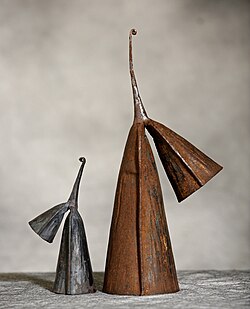
A bell pattern is a rhythmic pattern of striking a hand-held bell or other instrument of the idiophone family, to make it emit a sound at desired intervals. It is often a key pattern[1][2] (also known as a guide pattern,[3] phrasing referent,[4] timeline,[5] or asymmetrical timeline[6]), in most cases it is a metal bell, such as an agogô, gankoqui, or cowbell, or a hollowed piece of wood, or wooden claves. In band music, bell patterns are also played on the metal shell of the timbales, and drum kit cymbals.
Sub-Saharan African music
[edit]

Gerhard Kubik notes that key patterns are not universally found in sub-Saharan Africa: "Their geographical distribution mainly covers those parts of Africa where I.A.4 (Kwa languages) and the 'western stream' of the I.A.5 (Benue–Congo languages), or 'Bantu' languages are spoken, with offshoots into the Lower Zambezi valley and the Nyasa/Ruvuma area in southeast Africa" [within the larger Niger–Congo-B group].[7] Use of the patterns has since spread throughout the greater Niger–Congo language family. The use of iron bells (gongs) in sub-Saharan African music is linked to the early iron-making technology spread by the great Bantu migrations. The spread of the African bell patterns is probably similarly linked.
Throughout Africa, wherever these gongs have occurred they have been manufactured by the same process of welding the two halves together along a wide flange. This indicates a common origin.
— James Walton, (1955: 22) [8]
Kubik observes that "at the broadest level," the various key patterns "are all interrelated."[6] Key patterns exist in their own right,[9] as well as in relation to the three inner reference levels of elementary pulsation, main reference beat, and primary cycle.[10] Kubik further states that key patterns represent the structural core of a musical piece, something like a condensed and extremely concentrated expression of the motional possibilities open to the participants (musicians and dancers).[11]
[Key patterns] express the rhythm’s organizing principle, defining rhythmic structure, as scales or tonal modes define harmonic structure . . . Put simply, key patterns epitomize the complete rhythmic matrix.
— David Peñalosa, (2009: 51)[12]
Key patterns are generated through cross-rhythm.[13] They typically consist of 12 or 16 pulses, and have a bipartite structure, which evenly divides the pattern into two rhythmically opposed cells of 6 or 8 pulses each.[14] The key pattern defines the musical period; the first cell is antecedent, and the second is consequent.[15][16] The asymmetrical array of attack-points contradicts the metrical symmetry of the two cells.[17]
Standard pattern
[edit]![\drums {
\numericTimeSignature
\time 4/4
\bar ".|:"
hh8.[ hh16] r8[ hh16 hh16] r8[ hh8] hh8.[ hh16]
\bar ":|."
}](http://upload.wikimedia.org/score/i/k/ikacov1pls6sp0ugcofy9syfhs2z9nk/ikacov1p.png)
![\drums {
\time 12/8
\bar ".|:"
hh8[ r hh] r[ hh hh] r[ hh r] hh[ r hh]
\bar ":|."
}](http://upload.wikimedia.org/score/c/v/cvigcc1c677c93oxen1u0zzy00b87xz/cvigcc1c.png)
The most commonly used key pattern in sub-Saharan Africa is the seven-stroke figure known in ethnomusicology as the standard pattern,[18][19][20] or bembé.[21] The standard pattern is expressed in both a triple-pulse (12
8 or 6
8) and a duple-pulse (4
4 or 2
2) structure.[22] Many North American percussionists refer to the triple-pulse form as the 6
8 bell.[23] The standard pattern has strokes on: 1, 1a, 2& 2a, 3&, 4, 4a.
In 12
8:
1 & a 2 & a 3 & a 4 & a ||
X . X . X X . X . X . X ||
In 4
4:
1 e & a 2 e & a 3 e & a 4 e & a ||
X . . X . . X X . . X . X . . X ||


The axatse (Ghanaian beaded gourd instrument) part which typically accompanies the 12-pulse standard pattern in Ewe music is verbalized as: "pa ti pa pa ti pa ti pa ti pa pa". The "pa"s sound the standard pattern by striking the gourd against the knee. The "ti"s sound pulses in between the bell strokes, by raising the gourd in an upward motion and striking it with the free hand. As is common with many African rhythms, the axatse part begins (first "pa") on the second stroke of the bell (1a), and the last "pa" coincides with 1. By ending at the beginning of the cycle, the axatse part contributes to the cyclic nature of the overall rhythm. See: standard bell with accompanying axatse part. Atsiagbekor.
12
8 bell patterns
[edit]
8) African bell patterns (ⓘ, ⓘ, ⓘ, ⓘ)
There are many different triple-pulse bell patterns found in sub-Saharan Africa. These are but a small sample. Bell patterns 1 and 2 are considered by A. M. Jones to be the two simplified forms of the standard pattern.[24] Pattern 2 was the first African bell pattern to be transcribed.[25] Pattern 2 contains exactly the same pattern of attack-points as Pattern 1, but begins on a different stroke, has a different relationship to the main beats, and therefore, is a related, but different key pattern.[26] Pattern 3 is another variant of the standard pattern, one which contains exactly the same pattern of attack-points as the standard pattern, but in a different relationship to the main beats. The geographical border of Pattern 3 seems to be the Niger River. Kubik states that east of the Niger, Pattern 3 is used "among the Igbo, and the large group of Benue-Congo speakers from eastern Nigeria through western Cameroon, down to southern Democratic Republic of the Congo, eastern Angola and northern Zambia."[27] The pattern is also used in Cuba and Haiti. Pattern 4 is a bell pattern used by the Hausa people of Nigeria.[28] It is also used in the Cuban-Congolese rhythm palo. The figure is sometimes referred to as a horizontal hemiola.[29]
Three-beat cycle bell patterns
There is a category of 12
8 bell patterns based on "slow" cycles of three cross-beats across four or eight main beats. Three-over-eight (3:8) is one of the most metrically contradictive, and extraordinarily dynamic cross-rhythms found in African music. Within the context of a single four-beat cycle (single measure or musical period), the cross-rhythmic ratio is 1.5:4. The three cross-beats, spanning 24 pulses, are represented as whole-notes below for visual emphasis.

The following 24-pulse bell pattern is used in the Ewe rhythm kadodo.[30] The three single strokes are muted. The kadodo bell pattern is an embellishment of three "slow" cross-beats spanning two measures, or three-over-eight (3:8).

4
4 bell patterns
[edit]
4) African bell patterns (ⓘ, ⓘ, ⓘ, ⓘ, ⓘ)
Pattern 1 (4
4 standard pattern) is played on the head of a small Yoruba bata drum in Benin.[31] Pattern 2 is used by the Yoruba and Igbo people of Nigeria.[32] Pattern 3 is the bell part in fufume (Ghana).[33] Pattern 4 is used by the Ga people (Ghana) for the rhythm gahu.[34] Patterns 3 and 5 are used in the Ghanaian rhythm kpanlogo.[35] Patterns 2 and 3 are known in Cuba as rumba clave and son clave respectively.
Single-celled bell patterns
[edit]Some bell patterns are single-celled and therefore, not key patterns.[36] A single-celled pattern cycles over two main beats, while a two-celled key pattern cycles over four main beats. The most basic single-celled pattern in duple-pulse structure consists of three strokes, known in Cuban music as tresillo.


Metric structure
[edit]Divisive rhythm versus additive rhythm
[edit]Sub-Saharan African rhythm is divisive rhythm. However, perhaps because of their seemingly asymmetric structure, bell patterns are sometimes perceived in an additive rhythmic form. For example, Justin London describes the five-stroke version of the standard pattern as "2-2-3-2-3",[39] while Godfried Toussaint describes the seven-stroke form as "2-2-1-2-2-2-1."[40] The following example of the five-stroke standard pattern is represented within an additive structure: 2+2+3+2+3.[26]

The bell pattern, and every aspect of the overall rhythm, is considered divisive within both cultural understanding, and by most contemporary music theoreticians. Novotney states: "The African rhythmic structure which generates the standard pattern is a divisive structure and not an additive one . . . the standard pattern represents a series of attack points, . . . not a series of durational values."[41] Kubik concurs: "Although on the level of structural analysis it cannot be denied that different 'distances' of strokes, combining two or three elementary pulses, are 'added up' within the cycle, performers do not think of time-line patterns as 'additive rhythms,' . . . 'Additive rhythms' are the analytic construction of the musicologist."[42] Agawu states: "Additive rhythm . . . is a highly problematic concept for African music . . . it is not in sync with indigenous conceptions of musical structure. It arises as a kind of default grouping mechanism for those transcribers who either disregard the choreography or fail to accord it foundational status."[43]
Tresillo is often interpreted as an additive rhythm because of the irregular grouping of its strokes: 3+3+2. However, tresillo is generated through cross-rhythm: 8 pulses ÷ 3 = 2 cross-beats (consisting of three pulses each), with a remainder of a partial cross-beat (spanning two pulses). In other words, 8 ÷ 3 = 2, r2. Tresillo is a cross-rhythmic fragment. It contains the first three cross-beats of the four-over-three cross-rhythm.[44]

Although the difference between the two ways of notating this rhythm may seem small, they stem from fundamentally different conceptions. Those who wish to convey a sense of the rhythm’s background [main beats], and who understand the surface morphology in relation to a regular subsurface articulation, will prefer the divisive format. Those who imagine the addition of three, then three, then two sixteenth notes will treat the well-formedness of 3+3+2 as fortuitous, a product of grouping rather than of metrical structure. They will be tempted to deny that African music has a bona fide metrical structure because of its frequent departures from normative grouping structure—Agawu (2003: 87).[45]
In divisive form, the strokes of tresillo contradict the beats. In additive form, the strokes of tresillo are the beats.
Counter-meter versus polymeter
[edit]A.M. Jones correctly identified the importance of this key pattern, but he mistook its accents as indicators of meter rather than the counter-metric (cross-rhythmic) phenomena they actually are. Similarly, while Anthony King identified this five-stroke figure as the ‘standard pattern’ in its simplest and most basic form, he did not correctly identify its metric structure. King represented the pattern in a polymetric 7
8 + 5
8 time signature.[46]

Because this triple-pulse pattern is generated from cross-rhythm, it is possible to count or feel it in several different ways, and divide by several different beat schemes. In the diagram below the five-stroke bell pattern is shown on top and a beat cycle is shown below it. Any or all of these structures may be the emphasis at a given point in a piece of music using the bell pattern.

The example on the left (6
8) represents the correct count and ground of the bell pattern.[20] The four dotted quarter-notes across the two bottom measures are the main beats. All key patterns are built upon four main beats.[47][48][49] The bottom measures on the other two examples (3
2 and 6
4) show cross-beats. Observing the dancer's steps almost always reveals the main beats of the music. Because the main beats are usually emphasized in the steps and not the music, it is often difficult for an "outsider" to feel the proper metric structure without seeing the dance component. Kubik states: "In order to understand the motional structure of any music in Africa, one has to look at the dancers as well and see how they relate to the instrumental background" (2010: 78).[50]
For cultural insiders, identifying the . . . ‘dance feet’ occurs instinctively and spontaneously. Those not familiar with the choreographic supplement, however, sometimes have trouble locating the main beats and expressing them in movement. Hearing African music on recordings alone without prior grounding in its dance-based rhythms may not convey the choreographic supplement. Not surprisingly, many misinterpretations of African rhythm and meter stem from a failure to observe the dance—Agawu (2003).[51]
Afro-Cuban music
[edit]
Standard pattern
[edit]The method of constructing iron bells in Cuba is identical to how it is done in Africa.[52] Not surprising, many African bell patterns are played in Cuba as well. The standard pattern is the most widely used bell pattern in Cuba. Some of the Afro-Cuban rhythms that use the standard pattern are: Congolese (Bantu): palo, triallo; Lucumí (Yoruba): iyesá (12
8 form), bembé, agbe; Arará (Fon): sabalú, egbado; "Haitiano" (Fon, Yoruba): vodú-radá, yanvalú, nagó; the rumba form columbia.[53]

4 ⓘ. Note that the standard bell pattern is the clave but with and pickups before the first and third notes, and the hi-hat marks the main beats (quarter-notes).[54]
In the Yoruba-based, Afro-Cuban rhythms agbe (toque güiro) and bembé, standard pattern variations are used spontaneously.[55]

The following 24-pulse bell pattern is used in the arará rhythm afrekete. The first measure simply sounds the four main beats. Notice that the first five strokes of the second measure are identical to the first five strokes of the standard pattern.

Three-beat cycle bell patterns
[edit]There are several 12
8 bell patterns based on "slow" cycles of three beats across four or eight main beats. The three-beat cycle is represented as half-notes in the following example for visual emphasis.

This bell pattern, an embellishment of the three-beat cycle, is used in the Afro-Cuban rhythm abakuá. It consists of three sets of three strokes each.
The bell pattern is also played in a displaced position, beginning on 4a, the pulse immediately preceding beat 1.
.jpg)
The following 24-pulse bell pattern is used in the arará rhythm afrekete. The Arará are Cuban descendants of the Fon/Ewe ethnic group, so it's perhaps not surprising that it is the same pattern as the bell part used in the Ewe rhythm kadodo, shown earlier in this article. However, as used in afrekete, the part begins in the second measure of 12
8. Notice that the first five strokes are identical to the first five strokes of the standard pattern. Like the kadodo bell, this pattern is an embellishment of the 3:8, or 1+1⁄2:4 cross-rhythm.

4
4 Cuban bell patterns
[edit]A variety of Cuban 4
4 bell patterns have spread worldwide due to the global success of Cuban-based popular music.

4 Afro-Cuban patterns. ⓘ, ⓘ, ⓘ, ⓘ, ⓘ
Pattern 1 is son clave, usually played on wooden claves. Pattern 2 is the baqueteo, the key pattern used in danzón and the first expression of clave in written music. The baqueteo consists of the son clave strokes, plus four additional strokes. Not technically a bell pattern, the baqueteo is played on the güiro and on the heads of the timbales. The slashed noteheads are muted tones and the regular noteheads are open tones.
In the 1940s the cowbell was added to the timbales in the first danzón-mambos of the charanga orchestras. Arcaño y sus Maravillas introduced this development. Later, multiple cowbells, a cymbal and the occasional woodblock were added to the timbale setup. Patterns 3 and 4 are guaguancó cáscara patterns adopted as mambo bell parts. During the mambo era of the 1940s, bongo players began regularly using a large hand-held cowbell during the montuno section in son groups. This bongo bell role was introduced in the son conjunto of Arsenio Rodríguez. Pattern 5 is the basic bongo bell pattern.

The rhythmic basis for one of the most enduring Latin jazz tunes comes from a cáscara variant adopted as a mambo bell pattern. "Manteca," co-written by Dizzy Gillespie and Chano Pozo in 1947, is the first jazz standards to be rhythmically based on clave.[57] The rhythm of the melody in the A section is identical to a common mambo bell pattern.

Timbale bell and bongo bell interplay
[edit]Patterns 3 and 4 are timbale bell parts that were introduced in mambo big bands. During the early 1940s Machito and his Afro-Cubans was the first band to employ the triumvirate of congas, bongos and timbales, the standard battery of percussion used in contemporary salsa. In the montuno section the bongo bell and the timbale bell parts are sounded simultaneously in a contrapuntal interplay.
In the 1970s José Luis Quintana "Changuito" developed the technique of simultaneously playing timbale and bongo bell parts when he held the timbales chair in the songo band Los Van Van. The example below shows the combined bell patterns (written in a 2-3 clave sequence).

Afro-Brazilian music
[edit]
Afro-Brazilian music uses a variety of bell patterns, many of which are different than the patterns used in Cuba.

Bell pattern 1 is used in maculelê and some Candomblé and Macumba rhythms. Pattern 1 is known in Cuba as son clave. Bell 2 is used in afoxê and can be thought of as pattern 1 embellished with four additional strokes. Bell 3 is used in batucada. Pattern 4 is the maracatu bell and can be thought of as pattern 1 embellished with four additional strokes.
See also
[edit]Sources
[edit]- ^ Novotney, Eugene N. (1998: 165) Thesis: The 3:2 Relationship as the Foundation of Timelines in West African Musics, UnlockingClave.com. Urbana, IL: University of Illinois.
- ^ Peñalosa, David (2012: 255) The Clave Matrix; Afro-Cuban Rhythm: Its Principles and African Origins. Redway, CA: Bembe Inc. ISBN 1-886502-80-3.
- ^ Gerstin, Julian (2013) "Rhythmic Structures in the African Continuum" Analytical Approaches to World Music.
- ^ Agawu, Kofi (2003: 73) Representing African Music: Postcolonial Notes, Queries, Positions. New York: Routledge.
- ^ Nketia, Kwabena (1961: 78) African Music in Ghana. Accra: Longmans.
- ^ a b Kubik, Gerhard (1999: 54) Africa and the Blues. Jackson, MS: University Press of Mississippi. ISBN 1-57806-145-8.
- ^ Kubik, Gerhard (2010: 57). Theory of African Music v. 2. Chicago Press.
- ^ Walton, James (1955: 22) 1955 “Iron Gongs from the Congo and Southern Rhodesia” Royal Anthropological Institute of Great Britain and Ireland, v. 55, pp. 20-23 Feb. For more on early iron-working and the Bantu migrations see: Newman, James, L. (1995: 107-109, 140-149.) The Peopling of Africa, A Geographic Interpretation. New Haven, CT: Yale University Press. ISBN 0-300-07280-5.
- ^ A.M. Jones (1959: v. 1: 211). Cited by Kubik, Gerhard (2010: 60). Theory of African Music v. 2. Chicago Press.
- ^ Kubik, Gerhard (2010: 60).
- ^ Gerhard Kubik cited by Agawu, Kofi (2006: 1-46). “Structural Analysis or Cultural Analysis? Comparing Perspectives on the ‘Standard Pattern’ of West African Rhythm” Journal of the American Musicological Society v. 59, n. 1.
- ^ Peñalosa, David (2009: 51). The Clave Matrix; Afro-Cuban Rhythm: Its Principles and African Origins. Redway, CA: Bembe Inc. ISBN 1-886502-80-3.
- ^ Novotney, Eugene D. (1998). Thesis: The 3:2 Relationship as the Foundation of Timelines in West African Musics, Web. UnlockingClave.com. Urbana, IL: University of Illinois.
- ^ Kubik, Gerhard (2010: 62-63). Theory of African Music v. 2. Chicago: University of Chicago Press.
- ^ "The time span of the bell rhythm and its division into beats establish meter, a concept that implies a musical period" Locke, David "Improvisation in West African Musics" Music Educators Journal, Vol. 66, No. 5, (Jan., 1980), p. 125-133. Published by: MENC: The National Association for Music Education.
- ^ "We find that all its melodic design is constructed on a rhythmic pattern of two measures, as though both were only one, the first is antecedent, strong, and the second is consequent, weak" Grenet, Emilio, translated by R. Phillips (1939). Popular Cuban Music New York: Bourne Inc.
- ^ Peñalosa (2009: 65-67).
- ^ Jones, A.M. (1959: 210-213) Studies in African Music. 1978 edition: ISBN 0-19-713512-9.
- ^ King, Anthony (1960). “The Employment of the Standard Pattern in Yoruba Music” American Music Society Journal.
- ^ a b Novotney, Eugene D. (1998: 155). Thesis: The 3:2 Relationship as the Foundation of Timelines in West African Musics, UnlockingClave.com. Urbana, IL: University of Illinois.
- ^ Toussaint, Godfried. Classification and Phylogenetic Analysis of African Ternary Rhythm Timelines. The International Society of the Arts, Mathematics, and Architecture.
- ^ Peñalosa (2009: 55)
- ^ Alan Dworsky and Betsy Sansby (2001). Hip Grooves for Hand Drums, p.77. ISBN 0-9638801-5-2.
- ^ Jones, A.M. (1959: 212) Studies in African Music. 1978 edition: ISBN 0-19-713512-9.
- ^ Curtis, Natalie (1920: 98). Songs and Tales from the Dark Continent. New York: Dover Press.
- ^ a b Montfort, Matthew (1987). Ancient Traditions Future Possibilities: Rhythmic Training Through the Traditions of Africa, Bali and India, p.16-17. ISBN 0-937879-00-2.
- ^ Kubik, Gerhard (2010: 82). Theory of African Music v. 2. Chicago Press.
- ^ Stone, Ruth M. (2005: 82). Music in West Africa; Experiencing Music, Expressing Culture. New York: Oxford University Press.
- ^ Tenzer, Michael ed. (2006). Analytical Studies in World Music p. 102. Oxford University Press.
- ^ "Kadodo," Ritual Music of the Yeve, (Ladzekpo brothers). Makossa phonorecord 86011 (1982).
- ^ "Ogogo" Yoruba Drums from Benin, West Africa. Smithsonain CD 04294 (1980).
- ^ Hartigan, Royal (1995: 63). West African Rhythms for Drumset. Van Nuys, CA: Alfred Publishing.
- ^ Kofi, Francis (1997: 42). Traditional Dance Rhythms of Ghana v. 1. Everett, PA: Honey Rock.
- ^ Locke, David (1998) Drum Gahu: An Introduction to African Rhythm Tempa, Arizona: Whitecliff Media Co.
- ^ Hartigan (1995: 29).
- ^ Peñalosa (2009: 55).
- ^ Garrett, Charles Hiroshi (2008). Struggling to Define a Nation: American Music and the Twentieth Century, p.54. ISBN 9780520254862. Shown in common time and then in cut time with tied sixteenth & eighth note rather than rest.
- ^ Sublette, Ned (2007), Cuba and Its Music: From the First Drums to the Mambo, p.134. ISBN 9781556526329. Shown with tied sixteenth & eighth note rather than rest.
- ^ London, Justin (2012). Hearing in Time, p.155. ISBN 9780199744374.
- ^ Toussaint, Godfried (2005). Pattern Recognition and Data Mining, p.22. Sameer Singh, Maneesha Singh, Chid Apte, Petra Perner, eds. ISBN 9783540287575.
- ^ Novotney (1998: 158).
- ^ Kubik, Gerhard (2010: 58). Theory of African Music v. 2. Chicago Press.
- ^ Agawu (2003: 94).
- ^ Peñalosa, David (2010). Rumba Quinto p. xxx. Redway, CA: Bembe Books. ISBN 1-4537-1313-1
- ^ Agawu, Kofi (2003: 87). Representing African Music: Postcolonial Notes, Queries, Positions New York: Routledge.
- ^ King, Anthony (1961:14). Yoruba Sacred Music from Ekiti. Ibadan University Press.
- ^ Novotney (1998: 250).
- ^ Mauleón (1993: 47). Salsa Guidebook for Piano and Ensemble. Petaluma, California: Sher Music. ISBN 0-9614701-9-4.
- ^ Peñalosa (2009: 1-3).
- ^ Kubik, Gerhard (2010: 78). Theory of African Music v. 2. Chicago: University of Chicago Press.
- ^ Agawu, Kofi (2003: 73). Representing African Music: Postcolonial Notes, Queries, Positions New York: Routledge.
- ^ Walton (1955: 60)
- ^ Coburg, Adrian (2004) Percussion Afro-Cubana v. I, Percisión Folklorico Percusión mayor y menor Bern, Switzerland.
- ^ Thress, Dan (1994). Afro-Cuban Rhythms for Drumset, p.9. ISBN 0-89724-574-1.
- ^ "Toque de güiros," Anthogoía de la música afro-cubana. Egrem CD boxed set 0011.
- ^ Waxer, Lise (2002). The city of musical memory, p.239. ISBN 0-8195-6442-7.
- ^ "Manteca" Manteca (Dizzy Gillespie). Phantom Sound & Vision CD (c. 1948).
External links
[edit]Bell pattern
View on GrokipediaDefinition and Origins
Historical Background
Bell patterns originated in the musical traditions of West and Central African societies, including the Akan, Yoruba, and Ewe peoples, where they served as foundational rhythmic timelines in ensemble performances.[5] These patterns, played on iron bells, trace their roots to Iron Age practices, with archaeological evidence of clapperless iron bells appearing in sites across sub-Saharan Africa from contexts dating to the later first millennium CE.[6] Ethnographic studies from the mid-20th century, such as those by A.M. Jones among the Ewe in Ghana, document their pervasive use in polyrhythmic structures, confirming a continuity from precolonial oral traditions.[5] The standard bell pattern, a seven-stroke cycle in 12/8 meter, emerged as a seminal example anchoring these rhythms across ethnic groups.[7] In these societies, bells such as the gankogui—a double iron clapper bell struck with a wooden stick—played crucial roles in signaling events, accompanying rituals, and structuring communal dances.[5] Among the Ewe, the gankogui provided an unvarying temporal reference in dances like Agbadza and Adzida, synchronizing drums, claps, and dancers while evoking spiritual and social cohesion.[7] Similar iron clappers featured in Yoruba konkonkolo patterns and Akan ensembles, often in ceremonial contexts to invoke ancestral presence or mark communal gatherings.[5] Early European documentation, including 16th-century Portuguese explorer accounts of West African coastal rituals, noted the prominence of such resonant metal instruments in performative traditions, highlighting their cultural centrality before widespread colonial disruption.[8] The transatlantic slave trade from the 16th to 19th centuries transmitted these bell patterns to diaspora communities in the Americas, where enslaved Africans preserved them orally amid efforts to suppress indigenous practices.[9] Despite prohibitions on drumming and cultural expression, rhythms from regions like the Gold Coast (including Ewe and Akan influences) endured through clandestine performances, adapting into forms like the Afro-Cuban clave while retaining core polyrhythmic elements.[9] Anthropologist Melville Herskovits's studies underscore this resilience, showing how bell-derived timelines maintained African temporal frameworks in New World musics.[9] In griot traditions of Mali and Senegambia, bells anchored rhythmic cycles within oral musical ensembles, reinforcing the hereditary role of these performers as historians and communal anchors.[10] Mandinka griots (jali) incorporated instruments like the ngarinya—a long tubular iron bell—to punctuate praise songs and epics, ensuring rhythmic stability during extended narratives of lineage and history.[10] This practice, rooted in the medieval Mali Empire, exemplified bells' function in sustaining cultural memory through cyclical patterns in non-dance contexts.[11]Core Characteristics and Instruments
A bell pattern, also referred to as a timeline or key pattern, constitutes a short, repeating ostinato in sub-Saharan African music, typically comprising 3 to 7 strokes per rhythmic cycle, which functions as a foundational anchor for layering complex polyrhythms within an ensemble.[12][13] This repetitive structure maintains a constant pulse, guiding performers and ensuring rhythmic cohesion without variation in its core form.[14] Central to its identity are traits such as a high-pitched, metallic timbre designed for maximum audibility amid dense percussion layers, achieved through binary or ternary subdivisions that emphasize precise timing over melodic content.[14][13] As a key pattern, it orients other instruments by establishing an unchanging referential framework, allowing improvisational elements to interlock around it.[12] Unlike melodic timelines in other traditions, bell patterns remain strictly rhythmic, devoid of pitch sequences or harmonic implications, focusing solely on temporal organization.[12] The primary instruments for executing bell patterns are idiophones, notably double bells forged from iron, such as the gankogui used in Ewe drumming traditions of Ghana and Togo, which consist of two conjoined conical bells producing distinct high and low tones when struck with a wooden beater.[12][15] Iron bells like the dawuro exhibit acoustic properties including a piercing, resonant timbre that cuts through ensembles, with tonal variation derived from striking techniques—such as damping against the body for muted effects or allowing free vibration for sustained ring.[12][14] Bronze variants occasionally appear, offering a brighter, more sustained resonance due to the metal's density and elasticity.[14] Cowbells and clappers serve similar roles, providing sharp, metallic attacks adaptable to the ostinato.[13] These patterns trace their roots to African ritual and communal practices, where the bells' enduring form underscores their role in signaling events or invoking spiritual elements.[14]Rhythmic and Metric Framework
The standard bell pattern consists of seven strokes over twelve eighth-note pulses in 12/8 meter, notated as x . x . x x . x . x . x (positions 1, 3, 5, 6, 8, 10, 12), often grouped additively as 2+2+1+2+2+2+1.[16][2]Divisive versus Additive Rhythm
In music theory, divisive rhythm refers to the even subdivision of a beat or pulse into equal parts, typically following a binary (2:1) structure that aligns with Western metric frameworks. For instance, related patterns like the tresillo (a three-note motif integral to many African-derived rhythms) in 4/4 time feature strokes on beats 1, 2.5 (2&), and 4, creating a clear, symmetrical division that reinforces the underlying pulse stream.[17] This approach emphasizes regularity, where the entire cycle is parsed through consistent halving or quartering of the measure, providing a stable foundation for ensemble coordination.[18] In contrast, additive rhythm involves grouping pulses into uneven, asymmetric sets that sum to the total cycle length, often resulting in ternary or irregular configurations. The bell pattern exemplifies this in 12/8, with its 2+2+1+2+2+2+1 grouping over 12 pulses and strokes on 1, 3, 5, 6, 8, 10, 12, producing a forward-leaning propulsion through its off-kilter phrasing.[16] This structure prioritizes motivic accumulation over uniform division, allowing rhythms to unfold as layered composites rather than strict partitions.[19] The distinction between divisive and additive rhythms profoundly influences metric perception in bell patterns: divisive forms offer clarity by aligning accents with expected pulse divisions, facilitating easy entrainment for performers and listeners, whereas additive forms generate hemiola-like tension through their irregular intervals, which disrupt steady metric flow and heighten rhythmic ambiguity.[17] For example, the bell's additive cycle with strokes on 1, 3, 5, 6, 8, 10, 12 evokes a sense of displacement against a divisive backdrop, enriching the polyrhythmic texture without resolving into even beats.[16] Cultural preferences for these rhythmic types vary across West African traditions, with divisive structures prevalent in some Akan styles for their metric precision, while additive approaches dominate in Ewe music, such as the agbadza dance, where the bell pattern's 2+2+1+2+2+2+1 grouping fosters a cyclical, multidetermined time feel.[17] In Ewe agbadza, performers often internalize the additive bell cycle as a referential timeline, adapting other parts to its uneven pulse sums for communal synchronization during rituals.[16]Counter-Meter, Polymeter, and Polyrhythm
In African rhythmic traditions, the bell pattern often functions as a counter-meter by accenting off-beats that conflict with the prevailing metric structure, creating tension and forward momentum. For instance, in a 4/4 adaptation, the bell's seven-note pattern (strokes approximating positions 1, 1.5, 2, 2.5, 3.5, 4, 4.5 in eighth-note subdivisions) implies layered hemiolas, overlaying triple feels against duple beats and emphasizing "weak" portions of the bar.[20] This counter-metric effect arises from the bell's role as a timeline ostinato, which performers and dancers use to navigate the groove despite the opposition.[17] Polymeter occurs when the bell pattern operates in an independent meter concurrent with other ensemble layers, such as a 12/8 bell cycle superimposed over a 4/4 bass line, allowing multiple metric interpretations within the same temporal span. In Ewe drumming ensembles, the standard bell pattern in 12/8 (strokes at positions 1, 3, 5, 6, 8, 10, 12, notated as x . x . x x . x . x . x in eighth notes) can support alternative groupings like 6/4 or 3/2, as listeners or performers parse the pulses differently.[21] This layered metric independence fosters a sense of perpetual motion, with the bell providing a stable reference amid the divergence.[17] Polyrhythm in bell patterns manifests through layered ratios, such as 3:2 or 2:3, where the bell serves as the referential ostinato against which other rhythms interlock. The 3:2 polyrhythm, common in West African traditions, divides a cycle into three even pulses on one layer versus two on another, with alignments occurring every twelve pulses to resolve the cycle.[20] Stroke alignments can be visualized as follows, showing the bell (B) and a contrasting 2:3 layer (C, e.g., a bass or clap pattern) over 12 pulses (eighth-note subdivisions):| Pulse: | 1 | 2 | 3 | 4 | 5 | 6 | 7 | 8 | 9 | 10 | 11 | 12 |
|---|---|---|---|---|---|---|---|---|---|---|---|---|
| Bell (referential) | B | B | B | B | B | B | B | |||||
| Contrast (2:3) | C | C | C | C | C |
Applications in African Music
Standard Patterns in Sub-Saharan Traditions
The standard bell pattern is a foundational 7-stroke ostinato played in 12/8 time across West and Central African percussion ensembles. This pattern features strikes on pulses 1, 3, 5, 6, 8, 10, and 12 within the 12-pulse cycle, providing a syncopated timeline that organizes the polyrhythmic interplay among drums and other instruments. The gankogui, a double iron bell, typically performs this role, with the high-pitched bell struck on the even pulses and the low-pitched on the odd for tonal contrast, ensuring rhythmic alignment and forward momentum in the ensemble.[2] In Ewe traditions of Ghana and Togo, the pattern underpins dances such as agbekor, a historical warrior rhythm that simulates battle movements through layered percussion. Here, it supports call-and-response structures, where the lead drummer (heno) signals variations while the ensemble responds, maintaining communal synchronization during performances. Similarly, in Akan music of Ghana, the pattern drives adowa, a graceful funeral dance emphasizing social commentary and mourning, with the bell guiding the apentemma drum's interlocking phrases. Yoruba ensembles in Nigeria and Benin employ it in religious and social contexts, such as bata drumming for orisha ceremonies, where it frames responsive singing and dance invocations.[20] The pattern's notation in a 12-pulse cycle can be represented as follows, with "x" indicating a stroke and "." a rest:| Pulse | 1 | 2 | 3 | 4 | 5 | 6 | 7 | 8 | 9 | 10 | 11 | 12 |
|---|---|---|---|---|---|---|---|---|---|---|---|---|
| Stroke | x | . | x | . | x | x | . | x | . | x | . | x |
Variations in 12/8 and 4/4 Contexts
In Sub-Saharan African music, the standard 12/8 bell pattern, characterized by its ternary subdivision and seven primary strokes, provides a foundational timeline that accommodates variations to enhance rhythmic density while preserving cyclic structure. One prominent adaptation within the 12/8 framework is the "long bell" pattern, which introduces additional strokes to create a five-note configuration, typically placed on pulses 1, 4, 7, 9, and 10 of the 12/8 cycle. This variation imparts a fuller ternary feel, often used in Ewe drumming ensembles from Ghana to reinforce the metric hierarchy and support polyrhythmic layering by other instruments like the gankogui double bell.[2][17] Adaptations to 4/4 time signatures involve converting the ternary pattern into a binary form, aligning strokes with the duple pulse to suit faster tempos or hybrid ensembles that blend traditional African elements with Western influences. A common 4/4 rendition features five strokes, such as on beats 1, the 'e' of 1, 2, the '&' of 2, and 4, effectively overlaying the bell's syncopation onto a quaternary subdivision while maintaining the original cycle's referential points. This binary conversion is evident in Ghanaian highlife music, where the bell pattern related to the gahu rhythm is recontextualized in 4/4, with the final stroke shifted to an offbeat eighth note to drive danceable grooves. Similarly, in Nigerian jùjú music, 4/4 bell adaptations provide a timeline that interlocks with guitar riffs and percussion, overlaying duple meters in popular ensembles.[9][22][2] These metric shifts present challenges in upholding polyrhythmic integrity, as the addition or repositioning of strokes can introduce metrical ambiguity or tension between ternary and binary interpretations. For instance, incorporating extra beats in the long bell may misalign with supporting rhythms, requiring performers to navigate perceptual multistability to sustain the ensemble's cohesive feel. Such adaptations highlight the bell pattern's flexibility, allowing it to anchor diverse Sub-Saharan traditions without losing its role as a regulative beat.[17][9]Single-Celled Bell Patterns
Single-celled bell patterns consist of straightforward ostinatos that repeat over a short cycle of 4 to 8 pulses, lacking complex internal subdivisions, which distinguishes them from more elaborate multi-celled structures in African rhythmic traditions.[20] A representative example is the 3-stroke pattern in 6/8 time, where strikes occur on pulses 1, 3, and 5, creating a sparse, foundational timeline that emphasizes even spacing across the measure.[2] This pattern, often notated as:X . X . X .
X . X . X .
Applications in Afro-Cuban Music
Standard Pattern and Clave Integration
The standard African bell pattern, a foundational 12/8 rhythm prevalent in West African traditions such as the Ewe Agbekor ensemble, features seven strokes across twelve pulses, creating a 3:2 ratio of accents that underpins polyrhythmic structures. In Afro-Cuban music, this pattern evolved into the cascara or clave bell, transposed to a 4/4 meter as a repeating pattern with strokes typically placed on beats 1, the "and" of 2, beat 3, and the "and" of 4, preserving the approximate 3:2 syncopation while aligning with duple-pulse European influences in Cuban popular forms like son and rumba.[24] This adaptation maintained the pattern's role as a temporal anchor, allowing it to integrate seamlessly into hybrid ensembles.[2] The historical shift of this pattern into Cuban contexts occurred primarily through 19th-century cabildos, mutual aid societies established by enslaved Africans in Cuba to preserve ethnic and cultural identities under colonial rule. These organizations, particularly those of the Yoruba (known as Lucumí in Cuba), who comprised a significant portion of slaves arriving between 1820 and 1840, facilitated the retention and adaptation of Yoruba rhythmic practices, including bell patterns derived from sacred and social music of the Yoruba people in present-day Nigeria and Benin. Cabildos provided clandestine spaces for drumming, dancing, and bell-playing rituals, which influenced the emergence of Afro-Cuban genres by blending African elements with local conditions, such as restrictions on triple meters in favor of 4/4 for broader accessibility.[25][26] In Afro-Cuban ensembles such as conga and batá drum groups, the adapted bell pattern integrates closely with the son clave, reinforcing its inherent syncopation by providing a persistent ostinato that guides improvisation and interlocking rhythms among percussionists. The bell's strokes emphasize the clave's off-beat accents, ensuring rhythmic cohesion in call-and-response structures typical of son and rumba, where it functions analogously to its African precursor as the unchanging "key" against which other parts weave variations. This synergy highlights the pattern's enduring utility in maintaining groove and cultural continuity.[2] To illustrate the adaptation, the following side-by-side notation compares the African standard bell in 12/8 (seven strokes over twelve eighth-note pulses, often notated as hits on pulses 1, 3, 4, 6, 7, 9, 10) with its Cuban 4/4 counterpart (cascara pattern over two bars, repeating hits on 1, 2&, 3, 4& for alignment with the 3:2 feel across the cycle). Both approximate the 3:2 ratio, with the Cuban version simplifying rests for duple meter flow.| Meter | Bar 1 (Pulses/Beats) | Bar 2 (Pulses/Beats) | Source |
|---|---|---|---|
| African 12/8 | x . x x . x . (hits: 1,3,4,6) | x . x x . (hits: 7,9,10; cycle repeats) | Leake (2015) [2] |
| Cuban 4/4 (Son Cascara) | x . x . x . x (hits: 1, 2&, 3, 4&) | x . x . x . x (hits: 1, 2&, 3, 4&; repeating pattern) | [24] |