


Community hub
Recent from talks
Contribute something
Nothing was collected or created yet.
Rack and pinion
View on Wikipedia
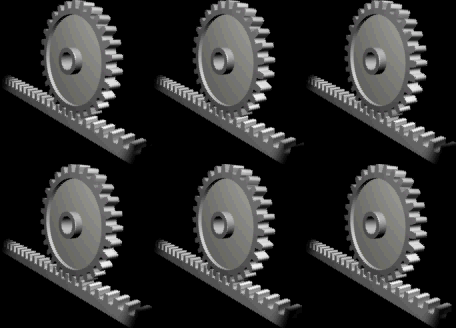
A rack and pinion is a type of linear actuator that comprises a circular gear (the pinion) engaging a linear gear (the rack).[1] Together, they convert between rotational motion and linear motion: rotating the pinion causes the rack to be driven in a line. Conversely, moving the rack linearly will cause the pinion to rotate.
The rack and pinion mechanism is used in rack railways, where the pinion mounted on a locomotive or a railroad car engages a rack usually placed between the rails, and helps to move the train up a steep gradient. It is also used in arbor presses and drill presses, where the pinion is connected to a lever and displaces a vertical rack (the ram). In pipelines and other industrial piping systems, a rack displaced by a linear actuator turns a pinion to open or close a valve. Stairlifts, lock gates, electric gates, and the mechanical steering mechanism of cars are other notable applications.
The term "rack and pinion" may be used also when the rack is not straight but arcuate (bent), namely just a section of a large gear.[2]
A single pinion can simultaneously drive two racks, parallel but opposite; which will always be displaced by the same distance, only in opposite directions. Conversely, by applying opposite forces to the two racks one can obtain pure torque on the pinion, without any force component. This double rack and pinion mechanism can be used, for example, with a pair of pneumatic actuators to operate a valve with minimum stress.[3]
Applications gallery
[edit]-

-
 Electric gate
 -
 Automobile steering mechanism
 -
 Rack railway wheelset
 -
 Funicular wheelset and brake
 -
 Double-rack pneumatic valve actuator


History
[edit]The time and place of the invention of the rack-and-pinion mechanism are unknown, but it presumably was not long after the invention of gears. The south-pointing chariot from China and the Antikythera mechanism are evidence of these being well-known already a couple of centuries BC.[citation needed]
In 1598, firearms designer Zhao Shizhen developed the Xuanyuan arquebus (軒轅銃), featuring a rack-and-pinion matchlock mechanism derived from an Ottoman Turkish matchlock design.[4] The Wu Pei Chih (1621) later described Ottoman Turkish muskets that used a rack-and-pinion mechanism.[5][6]
The use of a variable rack (still using a normal pinion) was invented by Arthur Ernest Bishop[7] in the 1970s, so as to improve vehicle response and steering "feel", especially at high speeds. He also created a low cost press forging process to manufacture the racks, eliminating the need to machine the gear teeth.
Comparison with Worm gear
[edit]A rack and pinion has roughly the same purpose as a worm gear with a rack replacing the gear, in that both convert torque to linear force. However the rack and pinion generally provides higher linear speed — since a full turn of the pinion displaces the rack by an amount equal to the pinion's pitch circle whereas a full rotation of the worm screw only displaces the rack by one tooth width. By the same token, a rack and pinion mechanism yields a smaller linear force than a worm gear, for the same input torque. Also, a rack and pinion pair can be used in the opposite way, to turn linear force into torque; whereas a worm drive can be used in only one way.[8]
Geometry
[edit]The teeth of a rack and pinion pair may be either straight (parallel to the rotation axis, as in a spur gear) or helical. On the pinion, the profile of the working tooth surfaces is usually an arc of involute, as in most gears. On the rack, on the other hand, the matching working surfaces are flat. One may interpret them as involute tooth faces for a gear with infinite radius. In both parts the teeth are typically formed with a gear cutter (a hob).[1]
See also
[edit]
References
[edit]
- ^ a b Gear Nomenclature, Definition of Terms with Symbols. American Gear Manufacturers Association. 2005. p. 72. ISBN 1-55589-846-7. OCLC 65562739. ANSI/AGMA 1012-G05.
- ^ Phillips, Jack (2003). General Spatial Involute Gearing. Berlin, Heidelberg: Springer Berlin Heidelberg. ISBN 3662053020.
- ^ "Automax SuperNova Series Pneumatic Rack & Pinion Actuators" (PDF). Flowserve Corporation. Archived from the original (PDF) on 31 August 2016. Retrieved 7 July 2014.
- ^ Zhao Shizhen (1598): Shen Qi Pu (神器譜)
- ^ Needham, Joseph (1986), Science & Civilisation in China, vol. V:7: The Gunpowder Epic, Cambridge University Press, p. 446, ISBN 0-521-30358-3
- ^ 和田, 博徳 (October 1958). 明代の鐡砲傳來とオスマン帝國 : 神器譜と西域土地人物略」『史學』第31巻1-4. Tokyo: 三田史学会、東京. pp. 692–719.
- ^ "Rack and pinion variable ratio steering gear". Google Patent Search. Retrieved 2007-03-22.[dead link]
- ^ ZHY Gear(1023): "Worm Gears vs. Rack and pinion". Online article at the company's website. Archived on 2024-07-28.


Rack and pinion
View on GrokipediaPrinciples of Operation
Basic Mechanism
A rack and pinion is a type of linear actuator that consists of a circular pinion gear that meshes with a linear rack gear, enabling the conversion of rotational motion into linear motion or vice versa.[1] The pinion is typically a small cylindrical gear with teeth around its circumference, while the rack is a straight bar featuring teeth along one edge, functioning as a gear with an infinite radius.[11] This setup forms a simple gear pair where the meshing teeth ensure synchronized movement between the two components.[12] In operation, the teeth of the rotating pinion engage with the corresponding teeth on the rack, causing the rack to move linearly along its length as the pinion turns.[1] This engagement allows the pinion to push or pull the rack depending on the direction of rotation, with the teeth distributing the load across multiple contact points for smooth transfer.[11] Force transmission occurs through the contact between the pinion's teeth and the rack's teeth, where applied torque on the pinion generates a linear force on the rack, proportional to the gear's mechanical advantage.[12] The mechanism supports two primary types of motion conversion: rotary-to-linear and linear-to-rotary. These conversions are bidirectional, allowing the system to function in either direction based on the input.[1][11] Rack and pinion systems offer basic advantages including direct and efficient power transfer due to their straightforward design, which minimizes energy loss, and the potential for minimal backlash when properly manufactured and assembled.[12] Their simplicity also contributes to high mechanical efficiency, typically ranging from 98% to 99.5%, making them suitable for applications requiring precise linear control.[12]Kinematics and Dynamics
The kinematics of a rack and pinion system describe the relationship between the rotational motion of the pinion and the linear motion of the rack. The linear velocity of the rack is directly proportional to the angular velocity of the pinion, given by the equation , where is the pitch radius of the pinion.[13] This relation arises because the point of contact between the rack teeth and pinion moves at the same tangential speed as the rack's linear speed. Similarly, the linear displacement of the rack corresponds to the angular displacement of the pinion via , with measured in radians.[13] These equations assume ideal meshing without slippage, providing a foundational understanding of motion conversion in the system.[14] In dynamic analysis, the forces transmitted through the rack and pinion determine the system's ability to handle loads and torques. The tangential force applied to the rack equals the torque on the pinion divided by the pinion's pitch radius, expressed as .[14] At the contact point between teeth, additional forces include the normal force, which acts perpendicular to the tooth surface and supports the load without contributing to motion, and frictional forces that oppose sliding along the contact line.[15] Friction at this point arises from the relative sliding velocity during meshing, influencing energy dissipation and requiring lubrication to minimize wear.[15] Backlash in a rack and pinion system refers to the clearance or play between the mating teeth of the rack and pinion when no load is applied, allowing slight relative movement.[16] This play primarily results from manufacturing tolerances, such as variations in tooth thickness or spacing during cutting or grinding processes, which prevent perfect fit without excessive friction.[17] Backlash adversely impacts precision by introducing lost motion in reversible systems, leading to inaccuracies in positioning and potential vibrations under cyclic loading.[18] Rack and pinion systems typically achieve high efficiency, up to 97%, owing to the predominantly rolling contact between teeth that minimizes sliding losses.[19] Efficiency losses primarily stem from friction at the tooth contact points and any sliding components, though proper lubrication and precise manufacturing can maintain values near 97% in well-designed setups.[19] These factors make rack and pinion mechanisms suitable for applications requiring reliable power transmission with low energy dissipation.[20]Design and Geometry
Gear Profiles and Meshing
The standard tooth profile for rack and pinion systems employs involute curves on the pinion gear, which mesh with straight-sided teeth on the rack to ensure a constant velocity ratio during operation. This conjugate profile design allows the pinion's curved flanks to roll smoothly against the rack's linear teeth, maintaining uniform motion without slippage. The involute shape on the pinion is generated from the unwinding of a string around a base circle, providing inherent advantages in manufacturability and tolerance to center distance variations.[11][21] The pressure angle, typically 20° in modern designs but occasionally 14.5° or 17.5° for specific applications, defines the inclination of the tooth flanks and the direction of force transmission during meshing. This angle determines the orientation of the line of action, which is the path along which the contact point travels and is perpendicular to the rack's straight flanks while tangent to the pinion's base circle. The line of action can be expressed geometrically as the common normal to the tooth profiles at the contact point, inclined at the pressure angle relative to the tangent at the pitch point, ensuring the force vector aligns properly for efficient power transfer.[22][21] Meshing in a rack and pinion occurs through point contact that progresses along the pitch line, with the involute and straight profiles generating conjugate action to produce smooth, continuous linear motion from the pinion's rotation. At any instant, the contact point lies on the line of action, and the common normal to both profiles passes through the fixed pitch point, guaranteeing a constant speed ratio regardless of tooth position. This point contact minimizes sliding friction compared to line contact in other gear types, though it requires precise alignment to avoid undercutting or interference.[22][11] The rack's tooth geometry features straight flanks inclined at the pressure angle, with addendum and dedendum heights standardized to match the pinion's module , typically set as addendum and dedendum to provide clearance and strength. These dimensions ensure full-depth teeth that align perfectly with the pinion's profile, promoting even load distribution across the contact line. The module serves as the fundamental scaling parameter, defining the pitch and tooth proportions for interchangeable components.[23][22] Special profiles, such as cycloidal teeth, can be used on the pinion to mesh with modified rack flanks, offering advantages like reduced noise and wear due to broader contact areas and smoother engagement paths compared to involute systems. Cycloidal profiles achieve lower operating noise in high-speed applications by minimizing impact during entry and exit. Additionally, helical racks with angled teeth provide reduced backlash through gradual multi-tooth engagement and axial thrust that preloads the mesh, enhancing precision in positioning tasks without split gearing. These variants maintain the core conjugate principles but are selected for environments demanding quieter or more accurate operation.[24][25]Sizing and Performance Calculations
Sizing rack and pinion systems begins with the selection of the module , a fundamental metric parameter in gear design that defines the size scale. The circular pitch , which is the distance along the pitch circle between corresponding points on adjacent teeth, is calculated as . Standard module values typically range from 1 mm to 10 mm for most industrial applications, allowing designers to match the system's linear travel requirements and load capacities to available manufacturing capabilities.[11] The pinion's pitch diameter is determined by the module and the number of teeth , given by . To prevent undercutting—where the gear cutter removes material from the tooth root during generation—the minimum number of pinion teeth is typically 18 for a standard 20° pressure angle full-depth involute profile when meshing with a rack.[26][27] Performance calculations for load capacity focus on the bending strength of the teeth, primarily evaluated using the Lewis formula for the pinion, as the rack's straight teeth experience distributed loading. The bending stress is computed as , where is the tangential load, is the face width, and is the Lewis form factor dependent on tooth geometry and pressure angle. This stress must remain below the material's allowable bending strength to avoid tooth failure under static or dynamic loads.[28][29] For wear and fatigue resistance, particularly pitting on the tooth surfaces, the Hertzian contact stress is assessed to predict surface durability. The maximum contact stress for a rack and pinion is derived from Hertzian theory for line contact between the curved pinion tooth and the straight rack flank, approximated as , where is the effective modulus of elasticity, is the pinion tooth radius of curvature at the pitch point, and other factors account for load distribution. Pitting resistance ratings ensure this stress does not exceed material-specific limits over the expected number of load cycles, often guided by standards that modify Hertzian equations for gear-specific geometry.[30] Tolerances in rack and pinion design are governed by AGMA standards, which classify accuracy into grades (e.g., Q3 to Q12, with higher numbers indicating higher precision) based on parameters like pitch error, profile error, and runout. Tighter accuracy grades reduce backlash—the clearance between meshing teeth—to as low as 0.005 mm for high-precision systems, minimizing positional errors in linear motion. This precision also lowers noise levels by reducing vibration from irregular meshing, with AGMA Grade 10 or better often specified for low-noise applications like precision actuators.[31][18]Applications
Automotive and Transportation
In automotive applications, the rack and pinion mechanism serves as the core of steering systems, converting the rotational motion of the steering wheel into linear motion to direct the vehicle's wheels. The pinion gear, mounted on the steering shaft, meshes with the linear rack, causing it to move laterally and push or pull the connected tie rods. These tie rods, in turn, pivot the steering knuckles to angle the front wheels, enabling precise control during turns. This direct integration provides a straightforward linkage from driver input to wheel response, typically with steering ratios ranging from 15:1 to 20:1 in passenger cars, where multiple turns of the steering wheel (about 2.5 to 3.5 lock-to-lock) achieve full wheel deflection for balanced maneuverability at various speeds.[32] Power-assisted variants of rack and pinion steering have become ubiquitous since the mid-20th century, significantly reducing driver effort while maintaining feedback. Hydraulic power steering systems, which emerged in the 1950s, use fluid pressure from an engine-driven pump to assist steering movement and were later adapted for rack and pinion designs in the 1960s and 1970s, often applied via pistons integrated into or alongside the rack housing. Electric power steering (EPS), which emerged in the 1980s and gained prominence in the 2000s, employs electric motors directly on the pinion or rack to provide variable assistance based on speed and conditions, eliminating hydraulic components for lighter weight and efficiency. These systems are standard in nearly all passenger vehicles today, with EPS particularly suited to electric vehicles (EVs) for its energy efficiency, drawing power only when needed to extend battery range by 3-5% compared to hydraulic alternatives.[33][10][34] The rack and pinion design offers key advantages in transportation, including a compact footprint that fits well in front-wheel-drive layouts and under the vehicle's subframe, contributing to improved fuel economy through reduced weight and drag. Its responsive nature delivers direct steering feel with minimal backlash, enhancing handling precision, while variable-ratio implementations—adjusting effective gearing from quicker low-speed ratios (e.g., 12:1) to slower high-speed ones (e.g., 18:1)—boost stability in sports cars like the BMW M4, where faster response aids agile cornering without excessive sensitivity on highways. Post-1970s, rack and pinion became the standard in most modern cars, starting with compact models like the 1975 AMC Pacer and spreading to mainstream sedans by the 1980s for its simplicity and reliability over recirculating-ball systems. In EVs, such as those from Tesla and Nissan, EPS rack and pinion enables advanced features like autonomous parking with precise control, further optimizing regenerative braking integration.[35][36][37] Beyond road vehicles, rack and pinion mechanisms have historical applications in railway transportation, particularly for operating turnouts and point switches in rack-assisted systems. In early 19th-century locomotives, such as those using John Blenkinsop's 1811 patented design, the mechanism powered wheel adhesion on inclines by engaging a central rack rail, with turnouts simplified by interrupting the rack to allow switching without complex movable racks. Modern rack and pinion turnouts, used in steep-gradient lines like those in Switzerland's Rhaetian Railway, employ dual motors and pre-assembled components to shift points accurately, ensuring safe transitions between adhesion and cog sections while minimizing slippage on snow or ice. This setup remains vital for locomotives on mountain routes, providing controlled linear motion for precise track changes.[38][39]Industrial and Precision Uses
In industrial machinery, rack and pinion systems provide reliable linear motion conversion for stationary applications requiring high precision and load handling, distinct from dynamic transportation uses. These systems excel in environments demanding consistent performance under heavy loads, such as manufacturing setups where rotational input from motors drives linear output along the rack. For instance, anti-backlash designs minimize play to ensure accurate positioning, supporting operations in controlled industrial settings.[40] In CNC machines, rack and pinion drives facilitate linear slides for precise tool positioning, particularly in large-format routers and mills where long travel distances are needed. High-precision racks, often helical for smoother meshing and reduced noise, pair with anti-backlash mechanisms like dual pinions or preloaded nuts to achieve positional accuracy within 0.003-0.005 inches, making them suitable for industrial cutting and milling tasks. These systems offer advantages in cost-effectiveness and uptime for machines under $60,000, though they require compensation for inherent backlash in tight-tolerance work.[40][41][42] Rack and pinion mechanisms are integral to elevators and lifts, enabling vertical motion control through a pinion gear mounted on the car that engages a fixed vertical rack. In industrial settings, these systems often incorporate optional counterweight arrangements to balance loads and enhance efficiency, eliminating the need for hoist ropes or cables while supporting variable capacities up to several tons. This design allows for reliable operation in harsh conditions like construction sites or factories, with minimal maintenance and scalable speeds via variable frequency drives.[43][44][45] In robotics, rack and pinion actuators drive arm extensions and linear joints, converting rotary motion from servos into precise translational movement with integrated position feedback for closed-loop control. These setups, often using linear servos, enable repeatable positioning in collaborative robots and manipulators, supporting applications like assembly lines where accuracy and feedback from encoders or sensors ensure synchronization. The configuration provides compact, high-force output suitable for industrial automation tasks.[46][47][48] For printing and packaging equipment, rack and pinion systems handle synchronized linear feeds and conveyor adjustments, ensuring precise alignment for processes like paper feeding, cutting, and folding. In conveyor systems, they facilitate belt tensioning via side-mounted adjustments, maintaining consistent operation at high speeds without slippage. This reliability supports efficient, high-volume production in industrial packaging lines.[49][50] Post-2020 developments have integrated rack and pinion systems with additive manufacturing for custom racks tailored to specific industrial needs, using 3D printing with high-performance plastics like iglide for wear-resistant, low-friction components. In large-scale 3D printers, helical racks paired with servo motors enable precise linear motion over extended travels, enhancing speed and reliability in prototyping and manufacturing. Additionally, Industry 4.0 advancements incorporate smart sensors into rack and pinion drives for predictive maintenance, monitoring vibrations and wear to anticipate failures and reduce downtime in smart factories.[51][52][53]Historical Development
Origins and Early Applications
The rack and pinion mechanism emerged as a distinct engineering concept during the Renaissance, with early conceptual designs attributed to Leonardo da Vinci in the late 15th and early 16th centuries. Da Vinci's sketches and notes in codices such as the Codex Atlanticus illustrate the use of a worm-rack variant in various automata and lifting devices, including a worm screw engaging a straight rack to convert rotary motion into linear displacement for practical applications like hoisting mechanisms.[54] These designs built on broader gear principles known since antiquity but represented one of the first documented integrations of a linear toothed bar with a circular gear for controlled linear motion.[55] By the 18th and early 19th centuries, the mechanism gained traction in precision instruments and early industrial tools, though specific patents for rack configurations appeared sporadically in Britain and Europe for applications like adjustable mounts and winches. In machine tools, it became integral to 19th-century lathes, where the rack allowed precise, hand-cranked advancement of the tool carriage along the bed, enabling accurate metalworking operations in workshops and factories.[56] This adoption marked a shift from manual pushing to geared control, improving repeatability in machining processes during the Industrial Revolution. Initial industrial expansions included water-powered lifting systems, where rack and pinion arrangements facilitated vertical transport in mills and docks. A notable example is the 1871 U.S. patent by Albert Lucius for a hydraulically driven rack and pinion elevator, utilizing water pressure on a horizontal cylinder to engage the gears and raise loads efficiently in multi-story buildings.[57] Such designs leveraged the mechanism's simplicity for heavy-duty, non-electric lifts before widespread steam or hydraulic dominance. A pivotal theoretical advancement came in 1841 with Robert Willis's Principles of Mechanism, which formalized the rack as a "straight-lined wheel" of infinite radius and analyzed its conjugate meshing with the pinion to ensure constant velocity transmission without slippage. Willis's work, drawing on kinematic principles, established the mechanism's geometric foundations, influencing subsequent engineering treatises and designs by emphasizing epicycloidal profiles for smooth engagement.[58]Evolution in Modern Engineering
The modern rack and pinion steering mechanism for automobiles was patented in 1922 by Gustave Dumont.[8] It saw significant adoption in automotive steering during the 1930s, with the Citroën Traction Avant introducing it as a production feature in 1936 to enhance precision and responsiveness over traditional systems.[59] By the 1970s, this design gained widespread use in smaller and mid-sized vehicles, particularly in the United States, where Ford implemented it in models like the 1974 Pinto and Mustang II, gradually replacing worm gear systems for improved efficiency and direct feel in compact cars.[60] Post-1980s material advancements shifted rack and pinion components from traditional steel toward lightweight composites and plastics, enabling reduced vehicle weight and better fuel economy without sacrificing durability.[61] For marine applications, corrosion-resistant alloys such as 316 stainless steel and aluminum alloys like 5052 have become standard, providing enhanced longevity in saltwater environments for steering systems in boats and offshore equipment.[62] In the 1990s, precision enhancements addressed backlash issues critical for aerospace, with anti-backlash designs incorporating split racks and preloaded pinions to achieve zero-clearance meshing and higher accuracy in actuators and control surfaces.[63] These innovations, often using dual-pinion preloading, improved positional repeatability in high-stakes environments like satellite deployment mechanisms.[64] The digital era from the 2000s integrated rack and pinion steering with electronic control units (ECUs) in electric power steering (EPS) systems, where sensors and motors provide variable assist based on speed and torque inputs for smoother operation.[65] Post-2015, 3D printing enabled rapid prototyping of custom rack and pinion assemblies, allowing engineers to test lightweight, optimized designs in linear motion systems with minimal material waste.[66] By the 2020s, rack and pinion systems evolved for autonomous vehicles, incorporating redundant steering architectures with dual actuators and ECUs to ensure failover safety in driverless operations, as seen in ZF's supplies to Kodiak AI for truck autonomy.[67] Sustainable manufacturing practices have also advanced, utilizing recycled metals like high-percentage scrap aluminum alloys to produce racks, reducing carbon footprints in automotive supply chains.[68]Comparisons and Alternatives
Versus Worm Gears
Rack and pinion systems convert rotational motion from the pinion to linear motion along the rack, typically achieving a direct 1:1 ratio that can be adjusted for specific needs, making them ideal for applications requiring straightforward linear translation. In contrast, worm gears provide high reduction ratios, often 10:1 or greater, enabling significant torque multiplication while transmitting motion between perpendicular shafts, and they incorporate a self-locking feature when the lead angle is low, preventing back-driving under load.[69][70][71] Efficiency in rack and pinion mechanisms exceeds 90%, benefiting from rolling contact that minimizes friction losses, whereas worm gears exhibit lower efficiency, ranging from 50% at high ratios like 300:1 to about 90% at lower ratios such as 5:1, primarily due to sliding friction between the worm and wheel.[72][73] Regarding backlash and precision, rack and pinion systems allow for adjustable meshing to achieve low backlash through methods like altering center distance or using anti-backlash designs, supporting high positional accuracy in linear applications. Worm gears, while compact and capable of backlash adjustment via axial shifting of a duplex worm, often exhibit higher inherent backlash due to their sliding action, though this can be mitigated for moderate precision needs.[74][75] Rack and pinion setups are generally simpler in design and lower in cost for direct linear motion requirements, involving fewer components and easier manufacturing compared to the more intricate worm gear assemblies needed for perpendicular high-torque transmission.[76] In use cases, rack and pinion excels in responsive linear actuation, such as automotive steering systems where quick, precise control is essential. Worm gears, however, are preferred for heavy-duty applications demanding irreversibility and high torque in compact spaces, like winches and elevators, where self-locking prevents unintended motion.[69][71]Versus Other Linear Actuators
The rack and pinion mechanism offers distinct advantages over other linear actuators in applications requiring high-speed, long-travel linear motion with moderate loads, but it trades off some precision and load capacity compared to alternatives like ball screws. Ball screws provide superior precision and higher load-bearing capacity due to their recirculating ball bearings, which minimize friction and enable efficiencies often exceeding 90%, making them ideal for precision tasks in CNC machines and robotics. However, ball screws are more expensive to manufacture and install, particularly for long strokes, as their accuracy can degrade over extended lengths due to thermal expansion and whip; in contrast, rack and pinion systems maintain consistent accuracy regardless of travel distance and are simpler to service, with efficiencies often exceeding 90%, though they exhibit more backlash and wear from metal-on-metal contact.[77][78][79] Lead screws, a cost-effective alternative, rely on sliding friction between the screw and nut, resulting in lower efficiencies typically ranging from 20% to 40%, which limits their suitability for high-speed or energy-efficient operations but provides inherent self-locking for vertical loads without additional braking. Rack and pinion systems surpass lead screws in efficiency and speed, delivering smoother, more constant force transmission for dynamic applications, though they lack the natural self-locking feature and may require anti-backlash measures.[80][81][82] Belt drives excel in flexibility and quiet operation, particularly in harsh environments where dust or debris might damage gears, but they suffer from stretch over time, reducing positional accuracy and stiffness compared to the rigid, backlash-minimizable structure of rack and pinion. Rack and pinion provides better load handling and precision for rigid, repeatable motion, though it generates more noise and requires lubrication to mitigate wear.[83][84][79] Hydraulic actuators deliver exceptional power density and scalability for very high loads, often in heavy industrial settings, but they are prone to leaks, require fluid maintenance, and introduce compliance that compromises precision in clean or dry environments. Rack and pinion, as a purely mechanical system, ensures greater reliability and cleanliness without hydraulic risks, though it is limited to moderate loads relative to hydraulics' near-unlimited force potential.[85][86][87]| Actuator Type | Key Strengths vs. Rack & Pinion | Key Weaknesses vs. Rack & Pinion | Typical Efficiency | Best For |
|---|---|---|---|---|
| Ball Screw | Higher precision, lower friction, longer lifespan | Higher cost, length limitations | >90% | Precision, short-to-medium strokes[77][80] |
| Lead Screw | Lower cost, self-locking | Lower efficiency, higher friction | 20-40% | Budget vertical holds[81][82] |
| Belt Drive | Quieter, flexible for curves | Stretch, lower stiffness/accuracy | 80-95% | Harsh, low-precision travel[83][79] |
| Hydraulic | Higher force, scalable | Leaks, maintenance, less precise | N/A (fluid-based) | Heavy loads, compliance-tolerant[85][86] |