Hubbry Logo
StetsonStetsonMain
Open search
Stetson
Community hub
Stetson
logo
8 pages, 0 posts
0 subscribers
Be the first to start a discussion here.
Stetson
Stetson
from Wikipedia

Stetson is an American brand of hat manufactured by the John B. Stetson Company. "Stetson" is also used as a generic trademark to refer to any campaign hat, particularly in Scouting.

Key Information

John B. Stetson gained inspiration for his most famous hats when he headed west from his native New Jersey for health reasons. On his return east in 1865, he founded the John B. Stetson Company in Philadelphia. He created a hat that has become symbolic of the pioneering American West, the "Boss of the Plains". This Western hat would become the cornerstone of Stetson's hat business and is still in production today.

Stetson eventually became the world's largest hat maker, producing more than 3,300,000 hats a year in a factory spread over 9 acres (36,000 m2) in Philadelphia. In addition to its Western and fashion hats, Stetson also produces trucker hats, fragrance, apparel, footwear, eyewear, belts, bourbon, and other products evoking the historic American West.

Stetson University and Stetson University College of Law in Florida were named after John B. Stetson in 1899 for his contributions to the school. The university's athletic teams are known as the Hatters, and the official mascot is known as "John B."

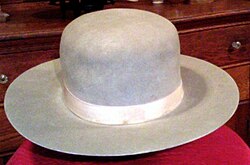
Prospector's hat

[edit]

John B. Stetson was born in 1830 in Orange, New Jersey, where his father, Stephen Stetson, was a hatter. He worked in his father's shop until he went West for his health.[1] Stetson created a rugged hat for himself made from thick beaver felt while panning for gold in Colorado. According to legend, Stetson invented the hat while on a hunting trip while showing his companions how he could make cloth out of fur without tanning.[2][3] Fur felt hats are lighter, they maintain their shape, and withstand weather and renovation better.[4]

Stetson made an unusually large hat from felt he made from hides collected on the trip and wore the hat for the remainder of the expedition. Although initially worn as a joke, Stetson soon grew fond of the hat for its ability to protect him from the elements. It had a wide brim, a high crown to keep an insulating pocket of air on the head, and was used to carry water.[citation needed]

As their travels continued, a cowboy is said to have seen J. B. Stetson and his unusual hat, rode up, tried the hat on for himself, and paid Stetson for it with a five dollar gold piece, riding off with the first western Stetson hat on his head.[5]

Boss of the Plains

[edit]
Boss of the Plains hat

Stetson's western adventures came to an end in 1865. Stetson, then 35 years old and in better health, returned east and established his own hat firm in Philadelphia, Pennsylvania, which produced high-quality hats for outdoor use. After producing some initial designs based on popular styles of the day, Stetson decided to create a hat based on his experiences in the American West, which he called the "Boss of the Plains".[6] The high-crowned, wide-brimmed, soft-felt western hats that followed are intimately associated with the American cowboy image.[7]

The original "Boss", manufactured by Stetson in 1865, was flat-brimmed, had a straight-sided crown with rounded corners. These lightweight, waterproof hats were natural in color, with four-inch crowns and brims.[8] A plain hatband was fitted to adjust head size.[9] The sweatband bore John B. Stetson's name.

Mass production

[edit]
Stetson's nine-acre factory in Philadelphia (1894)

Stetson sent a sample hat to merchants throughout the Southwest with a letter asking for a minimum order of a dozen "Boss of the Plains" hats.[2] The hat was an immediate success: in less than a year, Stetson set up a new factory in the outskirts of Philadelphia to handle his growing business.[2] According to Bender, within a decade the name Stetson had become synonymous with the word "hat" almost everywhere in the West.[10] By 1886, Stetson's hat company was the largest globally and had mechanized the hat-making industry ("producing close to 2 million hats a year by 1906").[2] The Stetson Hat Co. ceased production in 1968 and licensed another hat company.[2] However, these hats still bear the Stetson name, with the hats produced in St. Joseph, Missouri. Later the license was transferred to another hat company in Texas.[2]

"Today's cowboy hat has remained basically unchanged in construction and design since the first one was created in 1865 by J.B. Stetson."[11]

Stetson also produced "dress" hats, distinguished from "western" hats by narrower brims and shorter crowns. However, his "Boss of the Plains" style hat and its many variants fueled the company's growth and fame.[citation needed]

Singing cowboys and ten-gallon hats

[edit]
Tom Mix, an early 20th-century movie star, wearing a ten-gallon hat

In the 19th century and the first half of the 20th century, a hat was an indispensable item in every man's wardrobe. Stetson focused on expensive, high-quality hats that represented a real investment for the working cowboy and a statement of success for the city dweller.

Early on, Stetson hats became associated with legends of the West, including "Buffalo Bill", Calamity Jane, Will Rogers, and Annie Oakley. George Custer allegedly rode into the Battle of Little Big Horn wearing a Stetson.[12] Later on, Western movie cowboys were quick to adopt the Stetson; many were drawn to the largest, most flamboyant styles available.

Texans were known for their preference for the "Ten Gallon" model. According to Win Blevins' Dictionary of the American West (p. 388), the term "ten-gallon" has nothing to do with the hat's liquid capacity but derives from the Spanish word galón (braid), ten indicating the number of braids used as a hatband. However, an early Stetson advertising image, a painting of a cowboy dipping his hat into a stream to provide water for his horse, symbolized the cowboy hat as an essential part of a stockman's gear and was later featured inside every western style hat.

Changing fashions

[edit]
Stetson Royal

Stetson also produced women's hats, operating a millinery department from the 1930s to 1950s. Hat sales suffered during the Depression years, but Stetsons remained ubiquitous until Americans' embrace of headwear faded after WWII. Stetson had operations in Australia, Brazil, Colombia, Finland, Guatemala, Ireland, Japan, Mexico, New Zealand, Norway, South Africa, and West Germany at its peak.[6]

Stetson changed its business strategy in the early 1970s, closing its Philadelphia factory in 1971 and continuing in the hat business through licensing arrangements with several manufacturers.

Popular demand for western-style hats spiked during the 1980s after the success of Indiana Jones and Urban Cowboy movies. Both western and dress hats continue to be popular men's accessories.

Salva Kiir Mayardit, now-incumbent President of South Sudan, received a black Stetson hat as a gift from U.S. President George W. Bush in 2006. Since then, he continues to wear it as a key part of his public image, owning several other identical hats and rarely being seen without one.

Diversification

[edit]

In the 1980s, Stetson began to diversify, releasing the first Stetson cologne in 1981 and Lady Stetson in 1986. Luggage, handbags, umbrellas, and scarves also carried the Stetson mark. Currently, the brand carries western hats, fashion hats, fragrances, eyewear, apparel, footwear, belts, accessories, and bourbon. Stetson is available in the United States, Canada, Mexico, Europe, and Asia.

Military and police uniforms

[edit]

United States

[edit]
The Cavalry Stetson hat with non-commissioned officer (yellow) cord

The hat was first sold in Central City, Colorado, in 1865 in a style called the "Boss of the Plains." In some versions of the famous American folk ballad "Stagger Lee," Billy Lyons is killed by Stack A Lee over a Stetson hat. Troopers of modern-day U.S. Army cavalry regiments will often wear a Cavalry Stetson on ceremonial occasions in place of the ACU patrol cap or beret.

The Homicide and Robbery Bureau of the Dallas Police used the Stetson hat as a badge of office.[13]

In addition, on April Fools' Day, 2011, the U.S. Army released a humorous statement that the official black beret of the Army would be replaced by Stetsons. The statement was supplemented by pictures of soldiers with Stetsons photoshopped over their berets, including an Army dog toting a Stetson.[14]

The Legion of Frontiersmen created in 1905 in England also wore the Stetson,[citation needed] as well as the South African Constabulary, organized by Robert Baden-Powell in 1901.[citation needed]

Canadian military

[edit]

In the Second Boer War, the flat-brimmed Stetson became the standard issue of the 2nd Canadian Contingent, becoming recognized throughout the British Empire as a symbol of Canada. Twelve hundred Canadian troops were part of the South African Constabulary under the leadership of Robert Baden-Powell, and it was after seeing these troops in action at the Relief of Mafeking that Baden-Powel ordered 10,000 of these hats for the British Troops under his command.[15]

Canadian police

[edit]
North-West Mounted Police officers, Yukon, 1900, wearing the famous scarlet uniform that includes a flat-brimmed Stetson hat with a Montana Crease.

The Royal Canadian Mounted Police (RCMP) Red Serge dress uniform includes a Stetson with a flat brim. The Stetson was first used unofficially by the North-West Mounted Police, in place of the traditional white pith helmet, not practical[further explanation needed] for the Canadian West. The color for the RCMP Stetson is sometimes referred to as "Belgian Belly"; it is a reddish buff, pastel-like color of the underfur of the Belgian hare. It is also a very little-used "second name" for the Stetson. Although called a Stetson, the hat type is similar to a campaign hat.

The Ontario Provincial Police also wore the Stetson (grey woven fabric) as part of their uniform from 1909 to 1930s and again from 1997 to 2009.

The Calgary Police Service may wear a black Stetson as an optional part of their uniform, reflecting the city's western roots and cowboy heritage. Although worn by some officers year-round, the hat is especially prominent during the Calgary Stampede.

See also

[edit]

References

[edit]

Further reading

[edit]
[edit]
Revisions and contributorsEdit on WikipediaRead on Wikipedia
from Grokipedia
Stetson is an American brand of premium hats and Western apparel, founded in 1865 by hatter in , , and renowned worldwide for its durable hats that embody the spirit of the . The company's signature product, the "," introduced in the 1860s, featured a lightweight fur-felt construction with a high crown and wide brim designed for protection against sun, rain, and dust, revolutionizing headwear for , prospectors, and frontiersmen during the post-Civil War expansion westward. John B. Stetson (1830–1906), born into a family of hatmakers in as the seventh of twelve children, apprenticed in the trade before health issues from prompted his relocation to the Rockies in the early 1860s, where he joined and crafted his first hat from beaver felt during a rainstorm to sell to a traveler. Starting with a modest $60 loan from his sister, Stetson established the in a one-room workshop, quickly scaling production to meet demand from the growing cattle industry and by the early producing millions of hats annually. The brand's hats, often handcrafted using traditional felting techniques with high-quality furs like beaver and rabbit, gained cultural prominence through their adoption in Western films and literature, and as symbols of . Beyond hats, Stetson expanded into men's and women's boots, clothing, and accessories, maintaining a commitment to American manufacturing and ethical labor practices that included profit-sharing and employee welfare programs initiated by the founder, who also established what became in , in 1883 to provide education for workers' families. As of 2025, owned by Hatco, which acquired the manufacturing rights in 1987, the company continues to produce timeless styles like the Open Road while innovating with modern materials, preserving its legacy as a global leader in Western headwear with products designed for longevity and generational heirlooms.

Founding and Early Development

John B. Stetson and Hat Invention

was born on May 5, 1830, in , as the seventh of twelve children to Stephen L. Stetson, a skilled hatter, and Susan Batterson Stetson. Growing up in a family immersed in the hat-making trade, young John left school early to apprentice in his father's business, learning the intricate processes of fur felting and hat construction. In his twenties, Stetson was diagnosed with , a condition that prompted him to seek healthier climates and new opportunities in starting in 1859. By 1860, Stetson's health had improved during his time in , where he joined the and worked briefly in a St. Joseph, Missouri, brickyard before heading further west. Observing the impracticality of common headwear like coonskin caps—which offered little protection from sun, rain, or fleas—and drawing inspiration from the wide-brimmed sombreros worn by Mexican vaqueros, sometimes referred to as "ten-gallon" hats due to decorative braiding, Stetson began experimenting with hat designs suited to frontier life. While in during the early , facing harsh weather, he crafted his first prototype hat using skills honed in his family's workshop. This pioneering hat was a wide-brimmed, high-crowned felt creation made from a blend of , , and , selected for their durability and weather-resistant qualities when processed through felting. The design featured a tall, creased crown approximately four inches high and a broad brim up to four inches wide, providing essential shade from the intense sun, resistance to and , and the ability to hold for drinking or even to offer to a in arid conditions. Initial testing during a severe Colorado rainstorm in the 1860–1862 period demonstrated its robustness, as the hat remained intact and functional while other coverings failed. Stetson sold his first hat for a $5 gold piece during this period, validating its appeal among frontiersmen before he returned east around to establish a formal hat-making enterprise in .

Establishment of the John B. Stetson Company

The was founded in in , , by , who launched operations in a modest loft at Seventh and Callowhill Streets with a $60 loan from his sister, which he used to rent the space and start operations. Initially operating as a hat repair shop, the business soon expanded to manufacturing durable fur felt hats amid the economic recovery following the . Despite initial constraints in a environment marked by and market instability, the enterprise emphasized quality craftsmanship to establish credibility in a competitive industry. Early operations centered on assembling a small initial workforce of skilled hatters to handle the labor-intensive process of sourcing and processing fur pelts—primarily from and rabbit—into premium felt material, while production remained artisanal and small-scale. efforts began locally in Eastern retail outlets, but by 1869, Stetson introduced to penetrate Western markets, where demand for rugged headwear was surging due to expansion in ranching and . These strategies helped navigate financial hurdles by prioritizing high-end products that commanded premium prices, gradually building a reputation for reliability and without relying on large-scale investment. Stetson cultivated a paternalistic company culture from the outset, prioritizing employee welfare to foster loyalty and productivity; by the 1870s, this included profit-sharing programs that distributed earnings directly to workers, alongside housing initiatives through the Building Association, which offered low-interest loans for home purchases. Educational opportunities were provided via apprenticeships and on-site programs, while health support encompassed a that evolved into a free for employees and their families unable to afford care. Such measures not only addressed the hardships of industrial labor in post-Civil War but also differentiated the company as a progressive employer. Rapid growth necessitated a relocation in 1874 to a expansive 12-acre complex at Germantown and Columbia Avenues in , where new multi-story factories were constructed with enhanced safety features to accommodate an expanding workforce and increased output. This move marked a pivotal step in scaling operations while maintaining the focus on quality that had propelled the company beyond its humble beginnings.

Iconic Hat Designs

Boss of the Plains

The Boss of the Plains, introduced in 1865, marked a pivotal breakthrough for the John B. Stetson Company as its flagship product, designed specifically to meet the rugged demands of the American frontier. Crafted from fine fur felt derived from beaver, rabbit, and other small animals, the hat featured a smooth, rounded crown and a round, flat brim, providing essential protection from sun, rain, and wind while remaining lightweight and durable for everyday use in harsh conditions. Its construction emphasized weather resistance through the natural properties of the fur felt, making it suitable for all-weather wear without additional treatments. The open crown design allowed for customization, enabling wearers to add creases by hand—such as the Montana peak, a pinched style that became popular among users adapting the hat to their preferences. Market positioning highlighted the as a premium accessory tailored for ranchers and miners, priced between $5 and $20 depending on material quality and customization, which positioned it as an accessible yet high-end investment for working men in the expanding West. This pricing reflected its superior craftsmanship compared to common headwear like coonskin caps or derbies, appealing to those needing reliable gear for labor-intensive roles. The hat drew inspiration from an earlier prototype Stetson crafted during his 1862 health trip to , where he fashioned a basic felt from available materials to shield against a rainstorm. Commercially, the achieved rapid adoption across , becoming synonymous with the emerging archetype by the 1870s as cattle drives and frontier life popularized its practical form. This personal involvement in manufacturing helped solidify the model's reputation for longevity, with many hats enduring years of heavy use among hands and prospectors.

Prospector's Hat and Early Variations

The prospector's hat originated in the 1860s during the in , when , seeking improved health after a tuberculosis diagnosis, joined a expedition and crafted an improvised hat from beaver felt to shield himself from relentless rain and intense sun. This design featured an unusually wide brim—up to four inches—for superior shade and the ability to scoop and carry water, while the high, rounded crown created an insulating air pocket for ventilation and occasional utility in holding small tools or panning equipment. Tailored specifically for miners and frontiersmen enduring harsh outdoor conditions, it marked an early adaptation beyond urban hat styles, emphasizing durability and multifunctionality in the rugged American West. Early variations of the prospector's hat emerged through user customizations, as wearers modified the open with dents or pinches for better grip and rainwater runoff, and curved the brim asymmetrically for enhanced protection during travel or labor. These adaptations influenced the foundational "" model introduced in 1865 upon Stetson's return to , which retained the wide brim and high but standardized the shape for broader appeal among Western workers. Both the original prospector's style and its variants utilized premium fur felt, primarily from , prized for its natural water resistance, lightweight structure, and longevity in extreme weather. Craftsmanship centered on traditional hand-blocking techniques, where moistened felt was stretched over wooden forms to shape and brim, followed by shellacking for stiffness and pouncing—a fine sanding and oiling process—to achieve a smooth, supple finish. Early options for customization included sweatbands for comfort and adjustable hatbands, allowing prospectors to personalize for fit and style while maintaining the hat's practical integrity. Stetson targeted sales of these hats to mining communities in and , where ongoing gold rushes demanded reliable headwear; by the late , the designs gained traction among prospectors, contributing to the company's rapid expansion into Western markets as durable alternatives to flimsier imported styles.

Production and Expansion

Mass Production Techniques

In the 1870s, the pioneered advancements at its facility, relocating to a larger complex at Fourth Street and Montgomery Avenue in 1874 to accommodate expanded operations. This vertically integrated setup encompassed all stages of hat in-house, from pelt to , minimizing external dependencies. Key innovations included the of steam-powered machinery for felting and shaping processes, where fur was agitated, boiled, and pressed under heat and pressure to form durable felt. Chemical treatments, such as applying acid solutions in the carroting stage, prepared animal pelts (primarily from , , and ) for efficient felting by enhancing matting. Additionally, iron cutting and pressing machines mechanized cutting and forming, transforming labor-intensive manual techniques into scalable industrial methods that improved both speed and consistency. To support this growth, Stetson rapidly expanded its workforce, employing nearly 4,000 workers by the mid-1880s across specialized departments dedicated to fur processing, hat forming, and finishing tasks. Production lines featured collaborative teams, such as three-person units for blocking—consisting of a tipper, brimmer, and blocker—who used steam and manual adjustments to shape crowns and brims precisely. This departmental structure enabled high-volume output while maintaining craftsmanship, with workers handling steps like , (sanding and oiling the felt), and sweatband fitting. Quality assurance relied on Stetson's proprietary "X" grading system, marked on the sweatband to denote felt quality based on factors including fur type, source, age, and color uniformity; higher designations like 10X signified premium blends with superior durability and finish. These methods ensured product consistency amid scaling, culminating in annual production of approximately 2 million hats by and positioning the company as the world's largest hat manufacturer.

Growth During the American West Era

During the late , the rapidly expanded its sales networks across , leveraging distributors and illustrated catalogs to supply hats to remote ranches, operations, and emerging towns. By the , the company's products were distributed through a growing network of western retailers, facilitated by the burgeoning railroad infrastructure that connected to frontier markets. For instance, the 1899 Stetson trade catalog highlighted various hat styles available to dealers nationwide, underscoring the role of printed materials in broadening market reach. By 1899, nearly 2,800 retailers throughout the were selling Stetson hats, reflecting the brand's deepening penetration into western commerce. This growth was inextricably linked to the economic transformations of , including massive cattle drives, widespread under the Homestead Act of 1862, and accelerating urbanization as settlers poured into territories like , , and the Dakotas. The demand for durable headwear surged amid these developments, as Stetson hats provided essential protection from harsh sun, rain, and dust for ranchers, miners, and farmers. The company's expansion was further bolstered by early international ventures, with exports to commencing in 1881 to meet growing demand among fashionable consumers abroad. Mass production techniques adopted in the factory enabled this scale, allowing Stetson to meet rising orders without compromising quality. By 1900, Stetson had achieved remarkable peaks, operating the world's largest hat factory and employing about 1,200 workers, with production reaching 600,000 hats that year alone. The company continued to expand, reaching production of over two million hats annually by 1906 and employing up to 5,000 workers by the early 20th century, with sales valued at approximately $11 million by 1917. The brand's prominence was epitomized by its adoption by iconic figures such as Cody, whose endorsement in amplified visibility among western audiences. In 1899 alone, the factory manufactured 50,000 dozen hats, equivalent to 600,000 units, underscoring the company's market dominance. Despite these successes, the company navigated significant economic turbulence, particularly the , a severe depression that triggered widespread bank failures and . Stetson survived this crisis through diversified sales channels that extended beyond the volatile western markets, maintaining steady demand from urban centers and international buyers. This resilience allowed the firm to rebound and solidify its position as a cornerstone of American manufacturing by the early .

Cultural and Fashion Impact

Association with Cowboys and Western Media

Stetson hats gained prominence in American popular culture through their association with Wild West shows and rodeos in the late 19th and early 20th centuries. William F. "Buffalo Bill" Cody prominently featured Stetson hats in his Wild West arena shows, which launched in 1883 and toured extensively for three decades, helping to popularize the wide-brimmed, high-crowned design as the quintessential cowboy headwear. Cody's custom Stetson, with its tall crown, exemplified the evolving style that became known as the "ten-gallon" look, standardizing the silhouette in performances by the early 1900s as shows emphasized rugged Western authenticity. These exhibitions, including rodeo elements, reinforced the hat's image as an essential accessory for cowboys, influencing public perception and attire in frontier reenactments. The rise of Hollywood Western films in the 1930s and 1940s further cemented Stetson's connection to cowboy iconography, particularly through endorsements by singing cowboys like and . Autry, starring in over 90 films, and Rogers, who appeared in dozens of B-Westerns, frequently wore Stetson hats, portraying heroic ranch hands and boosting the brand's visibility during the genre's . Their on-screen personas, blending music and adventure, aligned with Stetson's marketing of the hats—derived from the original design—as symbols of the spirit. This era's cinematic boom amplified demand, with Western stars driving Stetson sales to their peak in the 1940s as audiences emulated the film's rugged aesthetic. By the mid-20th century, "Stetson" had evolved into common for any , reflecting the brand's cultural dominance in . This linguistic shift originated from the hat's widespread adoption by ranchers and performers, where it became interchangeable with "hat" in regional . Stetson's strategic marketing, including targeted promotions in media aimed at younger audiences, reinforced this association, embedding the hat in the collective imagination of lore. Following , the widespread adoption of casual attire and the rise of automobile culture contributed to a sharp decline in hat-wearing among American men, profoundly impacting Stetson sales. By 1968, the company's annual revenues had plummeted from a postwar peak of $29 million in 1947 to just $8 million, representing a roughly 72% drop as hats transitioned from everyday essentials to optional accessories. This shift was exacerbated by cultural icons like President appearing hatless at his 1961 , signaling a broader move away from formal headwear. To adapt to urban and city-oriented fashions in the , Stetson introduced -inspired lines that blended traditional craftsmanship with contemporary styles suitable for metropolitan settings. These included softer crowns and narrower brims appealing to professionals and socialites, positioning the as a symbol of sophistication during the and . Concurrently, the company launched women's hat production around 1930 in , offering high-fashion options like wide-brimmed felt hats, berets, pillboxes, and turbans designed for urban elegance and daily city wear. By the end of the decade, Stetson maintained two dedicated women's lines with over 200 styles annually, including whimsical "Wedding Cake Crowns" that catered to evolving tastes in feminine millinery. Stetson experienced notable revivals amid shifting popular trends, beginning with the 1970s urban cowboy phenomenon that peaked with the 1980 film , which glamorized Western attire for city dwellers and spurred round-the-clock production at Stetson's factory. This momentum carried into the alongside a surge in country music popularity, exemplified by artists like , whose signature Stetson hats became emblematic of the genre's mainstream appeal and boosted demand for the brand's Western styles. By the 2000s, Stetson hats gained traction as fashion statements beyond the U.S., with emerging markets in and embracing them as symbols of Americana and rugged chic. In , dedicated Stetson lines expanded through high-end retailers, while in , the hats appealed to urban consumers seeking Western-inspired accessories, reflecting the brand's adaptation to global luxury trends. In the 2020s, Stetson continued to influence through high-profile endorsements and anniversary milestones. 's 2024 album Cowboy Carter and her appearance in a Stetson at the 2024 amplified Western fashion's mainstream resurgence, leading to a 250% increase in cowboy hat searches and positioning Stetson as a key element in contemporary "cowboy core" aesthetics. The brand's 160th anniversary in 2025 was marked by the release of Stetson: American Icon (Rizzoli), a book chronicling its cultural legacy with portraits of icons from to , alongside limited-edition collections and exhibits at that highlighted its enduring impact on American style.

Military and Uniform Uses

United States Applications

Stetson hats were adopted by U.S. cavalry units as early as the 1870s, with the serving as a durable base model for the s that provided protection from the elements during service. These wide-brimmed felt hats became integral to military attire, emphasizing practicality for mounted operations in harsh terrains. The s supplied by Stetson saw continued use in major conflicts, including the Spanish-American War of 1898, where they equipped troops with the characteristic Montana peak crown for improved ventilation and rain shedding. During , Stetson produced the M1911 officer's , a standard issue featuring a pinched crown and leather sweatband, worn by U.S. personnel in and other theaters. In , Stetson hats became a hallmark of the Texas Rangers' uniform by the 1920s, with rangers modifying them using badges crafted from Mexican cinco peso coins that prominently feature an eagle emblem. During , Stetson ramped up production of campaign hats for U.S. Army officers, including the Montana crease variant, to meet demands for durable headgear in diverse combat environments. Post-war, their integration persisted in uniforms, as exemplified by the , who incorporate Stetson-style campaign hats as a formal component of trooper attire to evoke tradition and authority.

Canadian Military and Police Adoption

The Stetson hat has been a hallmark of the Royal Canadian Mounted Police (RCMP) uniform since the inception of its predecessor, the , in 1873, when members unofficially adopted the wide-brimmed "" model for mounted patrols to shield against sun, rain, and snow in the harsh western frontier. This practical choice, preferred over the official , led to its formal adoption in 1904 under Dress Regulations, establishing the iconic "Mountie" style characterized by a peak crown, a flat wide brim approximately three inches deep, and the placement of the RCMP —featuring a central head encircled by wheat sheaves symbolizing Canada's agricultural heritage—on the front. The hat's fur-felt construction, typically from or , provides natural insulation suited to northern climates, with members personally funding early purchases until official procurement began. In Canadian military contexts, Stetson hats saw significant use during , with the Canadian Expeditionary Force issuing orders for them, including a batch in June-July 1917 for the to support and field operations where the broad brim offered protection from weather and debris. Stetson acquired expertise in fur felts through the 1935 purchase of Wolthausen Hat Corporation in . Beyond the RCMP, Stetson hats expanded into other police forces, notably the Ontario Provincial Police (OPP), which incorporated wide-brimmed "pony hats" as standard uniform headwear upon the force's creation in 1909, continuing through the 1920s with custom wool-felt variants for enhanced warmth during winter patrols. This adoption reflected the hat's proven utility in rural and northern enforcement, where the felt's water-resistant and insulating properties were essential. As of 2025, the RCMP continues to use Stetson-style hats for dress uniforms, manufactured by Dorfman Milano in the United States under contract.

Modern Era and Diversification

Post-1970 Revival and Operations

In 1970, the ceased manufacturing operations in the United States amid a sharp decline in the overall market, transitioning instead to a licensing model where the brand was briefly licensed to third-party producers while its assets were sold off. This shift followed years of reduced demand for traditional headwear, leading to the permanent closure of its factory in 1971. The company's move to licensing marked a low point, with production outsourced and quality control challenges emerging as the brand navigated an uncertain period without in-house manufacturing. The revival began in the 1980s, fueled by renewed cultural interest in Western styles, notably through the 1980 film , which sparked a broader resurgence in cowboy apparel and hats. Manufacturing rights were acquired in 1987 by Hatco, Inc., based in , allowing Stetson to resume domestic production after a brief filing in 1986 by its prior licensee, the John B. Stetson Hat Division of Stevens Hat Manufacturing Co. By 2000, the company had consolidated operations in for greater cost efficiency, leveraging the region's lower labor costs and proximity to Western markets while maintaining core craftsmanship standards. This relocation solidified Stetson's return to active production, with Hatco handling the bulk of U.S.-made hats alongside other brands like . As of 2025, Stetson operates as a under the ownership of Xiao Li Tan, with manufacturing centered at its primary facility in , and select partnerships for international production, including in to support global distribution. To mark its 160th anniversary in 2025, Stetson launched a Rizzoli-published titled Stetson: American Icon, chronicling its history and craftsmanship, alongside organized factory tours in to showcase ongoing production processes.

Expansion into Apparel and Current Products

In the mid-20th century, as demand for hats declined due to changing fashions, Stetson diversified into apparel and accessories, including , ties, and shoes, to sustain the brand. This expansion was part of a broader following the company's transition to a licensing model in 1970, which enabled partnerships for producing non-hat items and helped revive the brand during its post-1970 resurgence. Today, Stetson's product lineup extends beyond hats to include men's and women's , such as the Sundance collection, and Western apparel like durable shirts, , and outerwear designed for use. Premium hat lines remain central, with models like the Open Road 6X , characterized by a western crown and 2 3/4-inch bound-edge brim, priced between $100 and $500 to reflect quality craftsmanship. High-end items, including boots and hats, are handcrafted in factories using traditional techniques and natural materials like fur felt and buffalo fibers for durability and water resistance. Basic lines are produced overseas to balance costs, while the brand emphasizes sustainable alternatives such as and for eco-conscious options in its collections. Stetson's market position in 2025 centers on heritage-driven through its official site, where boots and apparel sales complement hat offerings, alongside targeted collaborations like the Gameday Hat collection with , featuring custom university-branded Western hats for fans. These efforts aim to grow apparel and boots to a significant portion of overall sales, appealing to both traditional Western enthusiasts and modern consumers.

References

Add your contribution
Related Hubs
User Avatar
No comments yet.