


Community hub
Recent from talks
Contribute something
Nothing was collected or created yet.
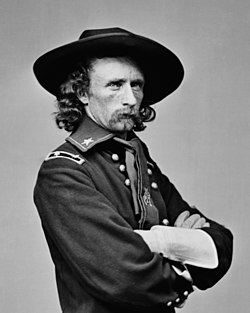
George Armstrong Custer
View on Wikipedia
George Armstrong Custer (December 5, 1839 – June 25, 1876) was a United States Army officer and cavalry commander in the American Civil War[1] and the American Indian Wars.[2]
Key Information


Custer graduated from the United States Military Academy at West Point, New York, last in his graduating class of 1861 (34th out of a starting class of 108 candidates, 68 passing the entrance exam, of whom 34 graduated).[3] Nonetheless, Custer achieved a higher military rank than any other U.S. Army officer in his class.[4] Following graduation, he worked closely with future Union Army Generals George B. McClellan and Alfred Pleasonton, both of whom recognized his abilities as a cavalry leader. He was promoted in the early American Civil War (1861–1865), to brevet brigadier general of volunteers when only aged 23. Only a few days afterwards, he fought at the pivotal Battle of Gettysburg in Pennsylvania in early July 1863, where he commanded the Michigan Brigade. Despite being outnumbered, the new General Custer defeated Confederate States Army cavalry of General J. E. B. Stuart's attack at East Cavalry Field on the crucial third day of the Gettysburg clash.
In 1864, Custer served in the Overland Campaign and with Union cavalry commander General Philip Sheridan's army in the Shenandoah Valley campaigns later that summer, defeating Confederate General Jubal Early at Cedar Creek. In the last year of the war of 1865, Custer destroyed or captured the remainder of Early's forces at the Battle of Waynesboro in Western Virginia. Custer's division blocked the Southern Army of Northern Virginia's final retreat from their fallen capital city of Richmond in early April 1865, and Custer received the first flag of truce from the exhausted Confederates. He was present at the Army of Northern Virginia commanding General Robert E. Lee's surrender ceremony at the McLean House to Union Army General-in-Chief Ulysses S. Grant at Appomattox Court House, Virginia. After the war, Custer was commissioned as a lieutenant colonel in the standing Regular Army and sent west to fight in the ongoing Indian Wars, mainly against the Lakota / Sioux and other Great Plains native peoples. On June 25, 1876, while leading the Army's 7th Cavalry Regiment at the Battle of the Little Bighorn in the southeastern Montana Territory against a coalition of Western Native American tribes,[5] he was killed along with every soldier of the five companies he led of his regiment. This event became known as "Custer's Last Stand".[6]
Custer's dramatic end was as controversial as the rest of his life and career, and the reaction to his life remains divided, even 150 years later. His mythologized status in American history was partly established through the energetic lobbying of his adoring wife Elizabeth Bacon "Libbie" Custer (1842–1933) throughout her long widowhood, which spanned six decades well into the 20th century.[7]
Family and ancestry
[edit]Custer's paternal ancestors, Paulus and Gertrude Küster, came to the North American English colonies around 1693 from the Rhineland in Germany, probably among thousands of Palatines whose passage was arranged by the English government to gain settlers in New York and Pennsylvania.[8][9]
Custer's maternal ancestors were of English and Ulster Scots descent, having ancestries from England and Northern Ireland.[10][failed verification]
According to family letters, Custer was named after George Armstrong, a minister, in his devout mother's hope that her son might join the clergy.[11]
Birth, siblings, and childhood
[edit]Custer was born in New Rumley, Ohio, to Emanuel Henry Custer (1806–1892), a farmer and blacksmith, and his second wife, Marie Ward Kirkpatrick (1807–1882), who was of English and Scots-Irish descent.[12] He had two younger brothers, Thomas and Boston. His other full siblings were the family's youngest child, Margaret Custer, and Nevin Custer, who suffered from asthma and rheumatism. Custer also had three older half-siblings.[13] Custer and his brothers acquired a life-long love of practical jokes, which they played out among the close family members.[citation needed]
Emanuel Custer was an outspoken Jacksonian Democrat who taught his children politics and toughness at an early age.[14] In a February 3, 1887, letter to his son's widow Libby, Emanuel related an incident from when George Custer (known as Autie) was about four years old:
"He had to have a tooth drawn, and he was very much afraid of blood. When I took him to the doctor to have the tooth pulled, it was in the night and I told him if it bled well it would get well right away, and he must be a good soldier. When he got to the doctor he took his seat, and the pulling began. The forceps slipped off and he had to make a second trial. He pulled it out, and Autie never even scrunched. Going home, I led him by the arm. He jumped and skipped, and said 'Father you and me can whip all the Whigs in Michigan.' I thought that was saying a good deal but I did not contradict him."[15]
Education
[edit]
To attend school, Custer lived with an older half-sister and her husband in Monroe, Michigan. Before entering the United States Military Academy, Custer attended the McNeely Normal School, later known as Hopedale Normal College, in Hopedale, Ohio. The school was known for training teachers for elementary schools. While attending Hopedale, Custer and classmate William Enos Emery were known to have carried coal to help pay for their room and board. After graduating from McNeely Normal School in 1856, Custer taught school in Cadiz, Ohio.[16] His first sweetheart was Mary Jane Holland.[17]
Custer entered West Point as a cadet on July 1, 1857, as a member of the class of 1862. His class numbered seventy-nine cadets embarking on a five-year course of study. With the outbreak of the American Civil War in 1861, the course was shortened to four years, and Custer and his class graduated on June 24, 1861. He was 34th in a class of 34 graduates: 23 classmates had dropped out for academic reasons while 22 classmates had already resigned to join the Confederacy.[18]
Throughout his life, Custer tested boundaries and rules. In his four years at West Point, he amassed a record total of 726 demerits, one of the worst conduct records in the history of the academy. The local minister remembered Custer as "the instigator of devilish plots both during the service and in Sunday school. On the surface he appeared attentive and respectful, but underneath the mind boiled with disruptive ideas."[19] A fellow cadet recalled Custer as declaring there were only two places in a class, the head and the foot, and since he had no desire to be the head, he aspired to be the foot. A roommate noted, "It was alright with George Custer, whether he knew his lesson or not; he simply did not allow it to trouble him."[20]
Civil War
[edit]McClellan and Pleasonton
[edit]
Like the other graduates, Custer was commissioned a second lieutenant; he was also assigned to the 2nd U.S. Cavalry Regiment and tasked with drilling volunteers in Washington, D.C. On July 21, 1861, he was with his regiment at the First Battle of Bull Run during the Manassas Campaign where Army commander Winfield Scott detailed him to carry messages to Major General Irvin McDowell. After the battle, he continued participating in the defense of Washington D.C. until October 1861, when he became ill. He was absent from his unit until February 1862. In March, he participated with the 2nd Cavalry in the Peninsula Campaign in Virginia until April 4.
On April 5, Custer served in the 5th Cavalry Regiment which participated in the Siege of Yorktown from April 5 to May 4 and was aide to Major General George B. McClellan. McClellan was in command of the Army of the Potomac during the Peninsula Campaign. On May 24, 1862, during pursuit of Confederate General Joseph E. Johnston up the Peninsula, General McClellan and his staff were reconnoitering a potential crossing point on the Chickahominy River, they stopped, and Custer overheard General John G. Barnard mutter, "I wish I knew how deep it is." Custer dashed forward on his horse out to the middle of the river, turned to the astonished officers, and shouted triumphantly, "McClellan, that's how deep it is, General!"[21]
Custer was assigned to lead an attack with four companies of the 4th Michigan Infantry across the Chickahominy River above New Bridge. The attack was successful, resulting in the capture of 50 Confederate soldiers and the seizing of the first Confederate battle flag of the war. McClellan termed it a "very gallant affair" and congratulated Custer personally. In his role as aide-de-camp to McClellan, he began his life-long pursuit of publicity.[21] He was promoted to the rank of captain on June 5, 1862. On July 17, he was demoted to the rank of First Lieutenant. He participated in the Maryland Campaign in September to October, the Battle of South Mountain on September 14, the Battle of Antietam on September 17, and the March to Warrenton, Virginia, in October.

On June 9, 1863, he became aide to Brevet Lieutenant Colonel Alfred Pleasonton, who was commanding the Cavalry Corps, Army of the Potomac. Recalling his service under Pleasonton, he was quoted as saying that "I do not believe a father could love his son more than General Pleasonton loves me."[22] Pleasonton's first assignment was to locate the army of Robert E. Lee, moving north through the Shenandoah Valley in the beginning of what was to become the Gettysburg Campaign.
Brigade command
[edit]

Pleasonton was promoted on June 22, 1863, to major general of U.S. Volunteers. On June 29, after consulting with the new commander of the Army of the Potomac, George Meade, Pleasonton began replacing political generals with "commanders who were prepared to fight, to personally lead mounted attacks".[23] He found just the kind of aggressive fighters he wanted in three of his aides: Wesley Merritt, Elon J. Farnsworth (both of whom had command experience), and Custer. All received immediate promotions, Custer to brigadier general of volunteers,[24] commanding the Michigan Cavalry Brigade ("Wolverines"), part of the division of Brigadier General Judson Kilpatrick.[25] Despite having no direct command experience, he became one of the youngest generals in the Union Army at the age of 23. He immediately shaped his brigade to reflect his aggressive character.
Now a general officer, he had greater latitude in choosing his uniform. Though often criticized as being gaudy, it was more than personal vanity. Historian Tom Carhart observed that "A showy uniform for Custer was one of command presence on the battlefield: he wanted to be readily distinguishable at first glance from all other soldiers. He intended to lead from the front, and to him it was a crucial issue of unit morale that his men be able to look up in the middle of a charge, or at any other time on the battlefield, and instantly see him leading the way into danger."[26]
Hanover and Abbottstown
[edit]On June 30, 1863, Custer and the First and Seventh Michigan Cavalry had just passed through Hanover, Pennsylvania, while the Fifth and Sixth Michigan Cavalry followed about seven miles behind. Hearing gunfire, he turned and started off to the sound of the guns. A courier reported that Farnsworth's Brigade had been attacked by rebel cavalry from side streets in the town. Reassembling his command, he received orders from Kilpatrick to engage the enemy northeast of town near the railway station. Custer deployed his troops and began to advance. After a brief firefight, the rebels withdrew to the northeast. This seemed odd, since it was assumed that Lee and his army were somewhere to the west. Though seemingly of little consequence, this skirmish further delayed Stuart from joining Lee. As Captain James H. Kidd, commander of F troop, Sixth Michigan Cavalry, later wrote: "Under [Custer's] skillful hand the four regiments were soon welded into a cohesive unit...."[27]
Next morning, July 1, they passed through Abbottstown, Pennsylvania, still searching for Stuart's cavalry. Late in the morning they heard sounds of gunfire from the direction of Gettysburg. That night at Heidlersburg, Pennsylvania, they learned that General John Buford's cavalry had found Lee's army at Gettysburg. The next morning, July 2, orders came for Custer to hurry north to disrupt General Richard S. Ewell's communications and relieve the pressure on the Union forces. By midafternoon, as they approached Hunterstown, Pennsylvania, they encountered Stuart's cavalry.[28] Custer rode ahead alone to investigate and found that the rebels were unaware of the arrival of his troops.
Returning to his men, he carefully positioned them along both sides of the road where they would be hidden from the rebels. Further along the road, behind a low rise, he positioned the First and Fifth Michigan Cavalry and his artillery, under the command of Lieutenant Alexander Cummings McWhorter Pennington Jr. To bait his trap, he gathered A Troop, Sixth Michigan Cavalry, and called out, "Come on boys, I'll lead you this time!" and galloped directly at the unsuspecting rebels. As he had expected, the rebels, "more than two hundred horsemen, came racing down the country road" after Custer and his men.
He lost half of his men in the deadly rebel fire and his horse went down, leaving him on foot.[29] He was rescued by Private Norvell Francis Churchill of the 1st Michigan Cavalry, who galloped up, shot Custer's nearest assailant, and pulled Custer up behind him.[30] Custer and his remaining men reached safety, while the pursuing rebels were cut down by slashing rifle fire, then canister from six cannons. The rebels broke off their attack, and both sides withdrew.
Spending most of the night in the saddle, Custer's brigade arrived at Two Taverns, Pennsylvania, roughly five miles southeast of Gettysburg around 3:00 a.m. on July 3. There he was joined by Farnsworth's brigade. By daybreak they received orders to protect Meade's flanks. At this point, he was about to experience perhaps his finest hours during the war.
Gettysburg
[edit] | This section needs additional citations for verification. (June 2021) |
Robert E. Lee's battle plan, shared with only a small number of his subordinates, was to defeat George Meade through a combined assault using all of his resources. General James Longstreet would attack Cemetery Hill from the west, J.E.B. Stuart's cavalry would attack Culp's Hill from the southeast, and Richard S. Ewell would attack Culp's Hill from the north. Once the Union forces holding Culp's Hill had collapsed, the rebels would roll up the remaining Union defenses on Cemetery Ridge. To accomplish this, Lee sent Stuart with six thousand cavalrymen and mounted infantry on a long flanking maneuver.[31]
By mid-morning on July 3, Custer had arrived at the intersection of Old Dutch Road and Hanover Road, two miles east of Gettysburg. He was later joined by Brigadier General David McMurtrie Gregg, who ordered Custer to deploy his men at the northeast corner. Custer then sent out scouts to investigate nearby wooded areas. Meanwhile, Gregg had positioned Colonel John Baillie McIntosh's brigade near the intersection and sent the rest of his command to do picket duty two miles to the southwest. After additional deployments, 2,400 cavalry under McIntosh and 1,200 under Custer remained together with Colonel Alexander Cummings McWhorter Pennington Jr.'s and Captain Alanson Merwin Randol's artillery, who had a total of ten three-inch guns.
About noon, Custer's men heard cannon fire, Stuart's signal to Lee that he was in position and had not been detected. About the same time, Gregg received a message warning that a large body of rebel cavalry had moved out on the York Pike and might be trying to get around the Union right. A second message from Pleasonton ordered Gregg to send Custer to cover the Union far left. Since Gregg had already sent most of his force off to do other duties, it was clear to both Gregg and Custer that Custer must remain. Custer's brigade had about 2,700 men facing 6,000 Confederates.
Soon afterward, fighting broke out between the skirmish lines. Stuart ordered an attack by his mounted infantry under General Albert G. Jenkins, but the Union line held, with men from the First Michigan cavalry, the First New Jersey Cavalry, and the Third Pennsylvania Cavalry. Stuart ordered Jackson's four gun battery into action; Custer ordered Pennington to answer. After a brief exchange in which two of Jackson's guns were destroyed, there was a lull in the action.
About one o'clock, the massive Confederate artillery barrage began in support of the upcoming assault on Cemetery Ridge. Jenkins's men renewed the attack but soon ran out of ammunition and fell back. Resupplied, they again pressed the attack. Outnumbered, the Union cavalry fell back, firing as they went. Custer sent most of his Fifth Michigan cavalry ahead on foot, forcing Jenkins's men to fall back. Jenkins's men were reinforced by about 150 sharpshooters from General Fitzhugh Lee's brigade, and shortly after Stuart ordered a mounted charge by the Ninth Virginia Cavalry and the Thirteenth Virginia Cavalry. Now it was Custer's men who were running out of ammunition. The Fifth Michigan was forced back and combat was reduced to vicious, hand-to-hand combat.
Seeing this, Custer mounted a counterattack. Riding ahead of the fewer than 400 new troopers of the Seventh Michigan Cavalry, he shouted, "Come on, you Wolverines!" As he swept forward, he formed a line of squadrons five ranks deep – five rows of eighty horsemen side by side – chasing the retreating rebels until their charge was stopped by a wood rail fence. The horses and men became jammed into a solid mass and were soon attacked on their left flank by the dismounted Ninth and Thirteenth Virginia Cavalry and on the right flank by the mounted First Virginia Cavalry. Custer extricated his men and raced south to the protection of Pennington's artillery near Hanover Road. The pursuing Confederates were cut down by canister, then driven back by the remounted Fifth Michigan Cavalry. Both forces withdrew to a safe distance to regroup.
It was then about three o'clock. The artillery barrage to the west had suddenly stopped. Union soldiers were surprised to see Stuart's entire force about a half-mile away coming toward them, not in line of battle, but "formed in close column of squadrons... A grander spectacle than their advance has rarely been beheld".[32] Stuart recognized he now had little time to reach and attack the Union rear along Cemetery Ridge; he must make one last effort to break through the Union cavalry.
Stuart passed by McIntosh's cavalry – the First New Jersey, Third Pennsylvania, and Company A of Purnell's Legion, which had been posted about halfway down the field – with relative ease. As Stuart approached, the Union troops were ordered back into the woods without slowing down Stuart's column, which was "advancing as if in review, with sabers drawn and glistening like silver in the bright sunlight...."[33]
Stuart's last obstacle was Custer and his 400 veteran troopers of the First Michigan Cavalry directly in the Confederate cavalry's path. Outnumbered but undaunted, Custer rode to the head of the regiment, "drew his saber, threw off his hat so they could see his long yellow hair" and shouted... "Come on, you Wolverines!"[34] Custer formed his men in line of battle and charged. Historian William E. Miller observed that "So sudden was the collision that many of the horses were turned end over end and crushed their riders beneath them...."[35]
As the Confederate advance was stopped, its right flank was struck by troopers of the Fifth, Sixth, and Seventh Michigan. McIntosh was able to gather some of his men from the First New Jersey and Third Pennsylvania and charged the rebel left flank. "Seeing that the situation was becoming critical, I [Captain Miller] turned to [Lieutenant Brooke-Rawle] and said: 'I have been ordered to hold this position, but, if you will back me up in case I am court-martialed for disobedience, I will order a charge.'"[36] The rebel column disintegrated, and individual troopers fought with saber and pistol.
Within twenty minutes the combatants heard the sound of the Union artillery opening up on Pickett's men. Stuart knew that whatever chance he had of joining the Confederate assault was gone. He withdrew his men to Cress Ridge.[37]
Custer's brigade lost 257 men at Gettysburg, the highest loss of any Union cavalry brigade.[38] "I challenge the annals of warfare to produce a more brilliant or successful charge of cavalry", Custer wrote in his report.[39] "For Gallant And Meritorious Services", he was awarded a Regular Army brevet promotion to major.
Shenandoah Valley and Appomattox Court House
[edit]General Custer also participated in Sheridan's campaign in the Shenandoah Valley. In this campaign, the civilian population was specifically targeted in what is known as the Burning.[40][41][42]
In 1864, with the Cavalry Corps of the Army of the Potomac reorganized under the command of Major General Philip Sheridan, Custer (now commanding the 3rd Division) led his "Wolverines" to the Shenandoah Valley where by the year's end they defeated the army of Confederate Lieutenant General Jubal Early in the Valley Campaigns of 1864. During May and June, Sheridan and Custer (Captain, 5th Cavalry, May 8 and Brevet Lieutenant Colonel, May 11) took part in cavalry actions supporting the Overland Campaign, including the Battle of the Wilderness, after which Custer ascended to division command and the Battle of Yellow Tavern, where J.E.B. Stuart was mortally wounded.
In the largest all-cavalry engagement of the war, the Battle of Trevilian Station, in which Sheridan sought to destroy the Virginia Central Railroad and the Confederates' western resupply route, Custer captured Hampton's divisional train but was then cut off and suffered heavy losses (including having his division's trains overrun and his personal baggage captured by the enemy) before being relieved. When Lieutenant General Early was ordered to move down the Shenandoah Valley and threaten Washington, D.C., Custer's division was again dispatched under Sheridan. In the Valley Campaigns of 1864, the Union troops engaged the Confederates at the Third Battle of Winchester and effectively destroyed Early's army during Sheridan's counterattack at Cedar Creek.
Having defeated Early, Sheridan and Custer returned to the main Union Army lines at the Siege of Petersburg, where they spent the winter. In April 1865, the Confederate lines finally broke and Robert E. Lee began his retreat to Appomattox Court House, pursued by the Union cavalry. Custer distinguished himself by his actions at Waynesboro, Dinwiddie Court House, and Five Forks. His division blocked Lee's retreat on its final day and received the first flag of truce from the Confederate force.
After a truce was arranged, Custer was escorted through the lines to meet Longstreet, who described Custer as having flaxen locks flowing over his shoulders, and Custer said "in the name of General Sheridan I demand the unconditional surrender of this army." Longstreet replied that he was not in command of the army, but if he was, he would not deal with messages from Sheridan. Custer responded that it would be a pity to have more blood shed upon the field, to which Longstreet suggested the truce be respected and then added "General Lee has gone to meet General Grant, and it is for them to determine the future of the armies."[43]
Custer was present at the surrender at Appomattox Court House, and the table upon which the surrender was signed was presented to him as a gift for his wife by Sheridan, who included a note praising Custer's gallantry. Libbie Custer treasured the gift of the historic table, which is now in the Smithsonian Institution.[44] On April 15, 1865, Custer was promoted to major general in the U.S. Volunteers, making him the youngest major general in the Union Army at age 25.
On April 25, after the war officially ended, Custer had his men search for and illegally seize a large prize racehorse named "Don Juan" near Clarksville, Virginia, worth an estimated $10,000 (several hundred thousand dollars today), along with his written pedigree. Custer rode Don Juan in the grand review victory parade in Washington, D.C., on May 23, creating a sensation when the scared thoroughbred bolted. Owner Richard Gaines wrote to General Grant, who ordered Custer to return the horse to Gaines, but Custer did not do so. Instead, he hid the horse and won a race with it the next year before the horse suddenly died.[45]
Reconstruction duties in Texas
[edit]On June 3, 1865, at Sheridan's behest, Major General Custer accepted command of the 2nd Division of Cavalry, Military Division of the Southwest, to march from Alexandria, Louisiana, to Hempstead, Texas, as part of the Union occupation forces. Custer arrived at Alexandria on June 27 and began assembling his units, which took more than a month to gather and remount. On July 17, he assumed command of the Cavalry Division of the Military Division of the Gulf (on August 5, officially named the 2nd Division of Cavalry of the Military Division of the Gulf), and accompanied by his wife, he led the division (five regiments of veteran Western Theater cavalrymen) to Texas on an arduous 18-day march in August. On October 27, the division departed to Austin. On October 29, Custer moved the division from Hempstead to Austin, arriving on November 4. Major General Custer became Chief of Cavalry of the Department of Texas, from November 13 to February 1, 1866, succeeding Major General Wesley Merritt.
During his entire period of command of the division, Custer encountered considerable friction and near mutiny from the volunteer cavalry regiments who had campaigned along the Gulf coast. They desired to be mustered out of Federal service rather than continue campaigning. They resented the imposition of discipline (particularly from an Eastern Theater general) and considered Custer nothing more than a vain dandy.[46][47]
Custer's division was mustered out beginning in November 1865, replaced by the regulars of the U.S. 6th Cavalry Regiment. Although their occupation of Austin had apparently been pleasant, many veterans harbored deep resentments against Custer, particularly those in the 2nd Wisconsin Cavalry, because of his attempts to maintain discipline. Upon its mustering out, several members planned to ambush Custer, but he was warned the night before and the attempt thwarted.[48]
Post-war options
[edit]


On February 1, 1866, Major General Custer mustered out of the U.S. volunteer service and took an extended leave of absence until September 24.[51] During this time he explored several options in New York City,[52] where he considered careers in railroads and mining.[53] Offered a position (and $10,000 in gold) as adjutant general of the army of Benito Juárez of Mexico, who was then in a struggle with the Mexican Emperor Maximilian I (a satellite ruler of French Emperor Napoleon III), Custer applied for a one-year leave of absence from the U.S. Army, which was endorsed by Grant and Secretary Stanton. However, Sheridan and Mrs. Custer disapproved, and after his request for leave was opposed by U.S. Secretary of State William H. Seward, who was against having an American officer commanding foreign troops, Custer refused the alternative of resignation from the Army to take the lucrative post.[53][54]
Following the death of his father-in-law in May 1866, Custer returned to Monroe, Michigan, where he considered running for Congress. He took part in public discussion over the treatment of the American South in the aftermath of the Civil War, advocating a policy of moderation.[53] He was named head of the Soldiers and Sailors Union, regarded as a response to the hyper-partisan Grand Army of the Republic (GAR). Formed in 1866, it was led by Republican activist John Alexander Logan.
In September 1866, Custer accompanied President Andrew Johnson on a journey by train known as the "Swing Around the Circle" to build up public support for Johnson's policies towards the South. Custer denied a charge by the newspapers that Johnson had promised him a colonel's commission in return for his support, but Custer had written to Johnson some weeks before seeking such a commission. Custer and his wife stayed with the president during most of the trip. At one point, Custer confronted a small group of Ohio men who repeatedly jeered Johnson, saying to them: "I was born two miles and a half from here, but I am ashamed of you."[55]
Indian Wars
[edit]On July 28, 1866, Custer was appointed lieutenant colonel of the newly created 7th Cavalry Regiment,[56] which was headquartered at Fort Riley, Kansas.[57] He served on frontier duty at Fort Riley from October 18 to March 26, and scouted in Kansas and Colorado until July 28, 1867. He took part in Major General Winfield Scott Hancock's expedition against the Cheyenne. On June 26, Lt. Lyman Kidder's party, made up of ten troopers and one scout, were massacred while en route to Fort Wallace. Lt. Kidder was to deliver dispatches to Custer from General Sherman, but his party was attacked by Lakota Sioux and Cheyenne. Days later, Custer and a search party found the bodies of Kidder's patrol.
Following the Hancock campaign, Custer was arrested and suspended at Fort Leavenworth, Kansas, until August 12, 1868, for being absent without leave (AWOL), after having abandoned his post to see his wife. At the request of Major General Sheridan, who wanted him for his planned winter campaign against the Cheyenne, he was allowed to return to duty before his one year of suspension had expired and join his regiment on October 7, 1868. He then went on frontier duty, scouting in Kansas and Indian Territory through October 1869.
Under Sheridan's orders, he took part in establishing Camp Supply in Indian Territory in early November 1868 as a supply base for the winter campaign. On November 27, 1868, he led the 7th Cavalry Regiment in an attack on the Cheyenne encampment of Chief Black Kettle – the Battle of Washita River. He reported killing 103 warriors; 53 women and children were taken as prisoners. Estimates by the Cheyenne of their casualties were substantially lower (11 warriors plus 19 women and children).[58] Custer had his men shoot most of the 875 Indian ponies they had captured.[59] The Battle of Washita River was regarded as the first substantial U.S. victory in the Southern Plains War, and it helped force a large portion of the Southern Cheyenne on to a U.S.-assigned reservation.
In 1873, he was sent to the Dakota Territory to protect a railroad survey party against the Lakota. On August 4, 1873, near the Tongue River, the 7th Cavalry Regiment clashed for the first time with the Lakota. One man on each side was killed. In 1874, Custer led an expedition into the Black Hills and announced the discovery of gold on French Creek near present-day Custer, South Dakota. Custer's announcement triggered the Black Hills Gold Rush. Among the towns that immediately sprung up was Deadwood, South Dakota, notorious for its lawlessness.
Grant, Belknap and politics
[edit]
In 1875, the Grant administration attempted to buy the Black Hills region from the Sioux. When the Sioux refused to sell, they were ordered to report to reservations by the end of January 1876. Mid-winter conditions made it impossible for them to comply. The administration labeled them "hostiles" and tasked the Army with bringing them in.
Custer was to command an expedition planned for the spring, part of a three-pronged campaign. While Custer's expedition marched west from Fort Abraham Lincoln, near present-day Mandan, North Dakota, troops under Colonel John Gibbon were to march east[60] from Fort Ellis, near present-day Bozeman, Montana, while a force under General George Crook was to march north[60] from Fort Fetterman, near present-day Douglas, Wyoming.
Custer's 7th Cavalry was originally scheduled to leave Fort Abraham Lincoln on April 6, 1876, but on March 15 he was summoned to Washington to testify at congressional hearings. Rep. Hiester Clymer's Committee was investigating alleged corruption involving Secretary of War William W. Belknap (who had resigned March 2), along with President Grant's brother Orville and traders granted monopolies at frontier Army posts.[61] It was alleged that Belknap had been selling these lucrative trading post positions where soldiers were required to make their purchases. Custer himself had experienced first hand the high prices being charged at Fort Lincoln.[62]
Concerned that he might miss the coming campaign, Custer did not want to go to Washington. He asked to answer questions in writing, but Clymer insisted.[63] Recognizing that his testimony would be explosive, Custer tried "to follow a moderate and prudent course, avoiding prominence."[64] Despite this, he provided a quantity of unsubstantiated accusations against Belknap.[60] His testimony, given on March 29 and April 4, was a sensation, being loudly praised by the Democratic press and sharply criticized by Republicans. Custer wrote articles published anonymously in The New York Herald that exposed trader post kickback rings and implied that Belknap was behind them. During his testimony, Custer attacked President Grant's brother Orville on unproven grounds of extorting money in exchange for exerting undue influence.[60] Historian Stephen E. Ambrose speculated that around this time Custer was presented with the idea of becoming the Democratic candidate in the upcoming 1876 United States presidential election, adding further motivation for Custer to rejoin his regiment and win further accolades in the Sioux Wars.[65]
After Custer testified, Belknap was impeached, and the case sent to the Senate for trial. Custer asked the impeachment managers to release him from further testimony. With the help of a request from his superior, Brigadier General Alfred Terry, Commander of the Department of Dakota, he was excused.[60] However, President Grant intervened, ordering that another officer fulfill Custer's military duty.[60] General Terry protested, arguing that he had no available officers of rank qualified to replace Custer. Both Sheridan and Sherman wanted Custer in command, but had to support Grant. General Sherman, hoping to resolve the issue, advised Custer to meet personally with Grant before leaving Washington. Three times Custer requested meetings with the president, but each request was refused.[66]
Finally, Custer gave up and took a train to Chicago on May 2, planning to rejoin his regiment. A furious Grant ordered Sheridan to arrest Custer for leaving Washington without permission. On May 3, a member of Sheridan's staff arrested Custer as he arrived in Chicago.[67] The arrest sparked public outrage. The New York Herald called Grant the "modern Caesar" and asked, "Are officers... to be dragged from railroad trains and ignominiously ordered to stand aside until the whims of the Chief magistrate ... are satisfied?"[68] Grant relented, but insisted that Terry—not Custer—personally command the expedition. Terry met Custer in St. Paul, Minnesota, on May 6. He later recalled that Custer "with tears in his eyes, begged for my aid. How could I resist it?"[69] Custer and Terry both wrote telegrams to Grant asking that Custer be able to lead his regiment, with Terry in command.[60] Sheridan endorsed the effort.[60]
Grant was already under pressure for his treatment of Custer. His administration worried that if the "Sioux campaign" failed without Custer, then Grant would be blamed for ignoring the recommendations of senior Army officers. On May 8, Custer was told that he would lead the expedition, but only under Terry's direct supervision. Elated, Custer told General Terry's chief engineer, Captain Ludlow, that he would "cut loose" from Terry and operate independently.[70]
Battle of the Little Bighorn
[edit]


By the time of Custer's Black Hills Expedition in 1874, the level of conflict and tension between the U.S. and many of the Plains Indians tribes (including the Lakota Sioux and the Cheyenne) had become exceedingly high. European-Americans continually broke treaty agreements and advanced further westward, resulting in violence and acts of depredation by both sides. To take possession of the Black Hills (and thus the gold deposits), and to stop Indian attacks, the U.S. decided to corral all remaining free Plains Indians. The Grant government set a deadline of January 31, 1876, for all Lakota and Arapaho wintering in the "unceded territory" to report to their designated agencies (reservations) or be considered "hostile".[71]
At that time, the 7th Cavalry's regimental commander, Colonel Samuel D. Sturgis, was on detached duty as the Superintendent of Mounted Recruiting Service and in command of the Cavalry Depot in St. Louis, Missouri,[72] which left Lieutenant Colonel Custer in command of the regiment. Custer and the 7th Cavalry departed from Fort Abraham Lincoln on May 17, 1876, part of a larger army force planning to round up remaining free Indians. Meanwhile, in the spring and summer of 1876, the Hunkpapa Lakota holy man Sitting Bull had called together the largest gathering of Plains Indians at Ash Creek, Montana (later moved to the Little Bighorn River) to discuss what to do about the whites.[73] It was this united encampment of Lakota, Northern Cheyenne, and Arapaho Indians that the 7th Calvary met at the Battle of the Little Bighorn in the Crow Indian Reservation[74] created in old Crow Country (in the Fort Laramie Treaty of 1851, the valley of the Little Bighorn is in the heart of the Crow Indian treaty territory and was accepted as such by the Lakota, the Cheyenne, and the Arapaho).[75] The Lakotas were staying in the valley without consent from the Crow tribe,[76] which sided with the Army to expel the Indian invaders.[77]
Around June 15, Major Marcus Reno while scouting, discovered the trail of a large village on the Rosebud River.[78] On June 22, Custer's entire regiment was detached to follow this trail. On June 25, some of Custer's Crow Indian scouts identified what they claimed was a large Indian encampment in the valley near the Little Bighorn River. Custer had first intended to attack the Indian village the next day, but since his presence became known, he decided to attack immediately and divided his forces into three battalions: one led by Major Reno, one by Captain Frederick Benteen, and one by himself. Captain Thomas M. McDougall and Company B were with the pack train. Reno was sent north to charge the southern end of the encampment, Custer rode north, hidden to the east of the encampment by bluffs and planning to circle around and attack from the north,[79][80] and Benteen was initially sent south and west to scout Indian presence and potentially protect the column from the south.
Reno began a charge on the southern end of the village, but halted some 500–600 yards short of the camp, and had his men dismount and form a skirmish line.[81] They were soon overcome by mounted Lakota and Cheyenne warriors who counterattacked en masse against Reno's exposed left flank,[82] forcing Reno and his men to take cover in the trees along the river. Eventually, the troopers engaged in a bloody retreat up the bluffs above the river, where they made their stand.[83][84] This opening action of the battle cost Reno a quarter of his command.
Custer may have seen Reno stop and form a skirmish line while he led his command to the northern end of the main encampment, where he may have planned to sandwich the Indians between his attacking troopers and Reno's command in a "hammer and anvil" maneuver.[85] According to Grinnell's account, based on the testimony of the Cheyenne warriors who survived the fight,[86] at least part of Custer's command attempted to ford the river at the north end of the camp, but were driven off by Indian sharpshooters firing from the brush along the west bank of the river. From that point the soldiers were pursued by hundreds of warriors onto a ridge north of the encampment. Custer and his command were prevented from digging in by Crazy Horse. Those warriors had outflanked him and were now to his north, at the crest of the ridge.[87] Traditional white accounts give credit to Gall for the attack that drove Custer up onto the ridge, but Indian witnesses have disputed that account.[88]
Hurrah boys, we've got them! We'll finish them up and then go home to our station.
For a time, Custer's men appear to have been deployed by company, in standard cavalry fighting formation—the skirmish line, with every fourth man holding the horses, though this arrangement would have robbed Custer of a quarter of his firepower. Worse, as the fight intensified, many soldiers could have taken to holding their own horses or hobbling them, further reducing the 7th's effective fire. When Crazy Horse and White Bull mounted the charge that broke through the center of Custer's lines, order may have broken down among the soldiers of Calhoun's command,[90] though Myles Keogh's men seem to have fought and died where they stood. According to some Lakota accounts, many of the panicked soldiers threw down their weapons[91] and either rode or ran towards the knoll where Custer, the other officers, and about 40 men were making a stand. Along the way, the warriors rode them down, counting coup by striking the fleeing troopers with their quirts or lances.[92]
Initially, Custer had 208 officers and men under his direct command, with an additional 142 under Reno, just over 100 under Benteen, and 50 soldiers with Captain McDougall's rearguard, accompanied by 84 soldiers under 1st Lieutenant Edward Gustave Mathey with the pack train. The Lakota-Cheyenne coalition may have fielded over 1,800 warriors.[93] Historian Gregory Michno settles on a low number of around 1,000 based on contemporary Lakota testimony, but other sources place the number at 1,800 or 2,000, especially in the works by Utley and Fox. The 1,800–2,000 figure is substantially lower than the higher numbers of 3,000 or more postulated by Ambrose, Gray, Scott, and others. Some of the other participants in the battle gave higher estimates:
- Spotted Horn Bull – 5,000 braves and leaders
- Maj. Reno – 2,500 to 5,000 warriors
- Capt. Moylan – 3,500 to 4,000
- Lt. Hare – not under 4,000
- Lt. Godfrey – minimum between 2,500 and 3,000
- Lt. Edgerly – 4,000
- Lt. Varnum – not less than 4,000
- Sgt. Kanipe – fully 4,000
- George Herendeen – fully 3,000
- Fred Gerard – 2,500 to 3,000
An average of the above is 3,500 Indian warriors and leaders.[94]
As the troopers of Custer's five companies were cut down, the native warriors stripped the dead of their firearms and ammunition, with the result that the return fire from the cavalry steadily decreased, while firing from the Indians constantly increased. The surviving troopers apparently shot their remaining horses to use as breastworks for a final stand on the knoll at the north end of the ridge. The warriors closed in for the final attack and killed every man in Custer's command. As a result, the Battle of the Little Bighorn has come to be popularly known as "Custer's Last Stand".
Personal life
[edit]
On February 9, 1864, Custer married Elizabeth Clift Bacon (1842–1933), whom he had first seen when he was 10 years old.[95] He had been socially introduced to her in November 1862, when home in Monroe on leave. She was not initially impressed with him,[96] and her father, Judge Daniel Bacon, disapproved of Custer as a match because he was the son of a blacksmith. It was not until well after Custer had been promoted to the rank of brigadier general that he gained the approval of Judge Bacon. He married Elizabeth Bacon 14 months after they formally met.[97]
In November 1868, following the Battle of Washita River, Custer was alleged (by Captain Frederick Benteen, chief of scouts Ben Clark, and Cheyenne oral tradition) to have unofficially married Mo-nah-se-tah, daughter of the Cheyenne chief Little Rock, in the winter or early spring of 1868–1869 (Little Rock was killed in the one-day action at Washita on November 27).[98] Mo-nah-se-tah gave birth to a child in January 1869, two months after the Washita battle. Cheyenne oral history tells that she also bore a second child fathered by Custer in late 1869. Some historians, however, believe that Custer had become sterile after contracting gonorrhea while at West Point and that the father was in actuality his brother Thomas.[99] Clarke's description in his memoirs included the statement, "Custer picked out a fine looking one and had her in his tent every night."[100]
In addition to "Autie", Custer acquired several nicknames. During the Civil War, after his promotion to become the youngest brigadier general in the Army aged 23, the press called him "The Boy General". During his years on the Great Plains in the American Indian Wars, his troopers referred to him with grudging admiration as "Iron Butt" and "Hard Ass" for his stamina in the saddle and strict discipline, as well as with the more derisive "Ringlets" for his long, curling blond hair, which he perfumed with cinnamon-scented hair oil.[101]
Throughout his travels, he gathered geological specimens, sending them to the University of Michigan. On September 10, 1873, he wrote Libbie, "the Indian battles hindered the collecting, while in that immediate region it was unsafe to go far from the command...."[102]
During his service in Kentucky, Custer bought thoroughbred horses. He took two on his last campaign, Vic (for Victory) and Dandy. During the march he changed horses every three hours.[103] He rode Vic into his last battle. Custer took his two staghounds Tuck and Bleuch with him during the last expedition. He left them with orderly Burkman when he rode into battle. Burkman joined the packtrain. He regretted not accompanying Custer but lived until 1925, when he took his own life.[104]
Appearance
[edit]Custer was fastidious in his grooming. Early in their marriage, Libbie wrote, "He brushes his teeth after every meal. I always laugh at him for it, also for washing his hands so frequently."[105] He was 5'11" tall and wore a size 38 jacket and size 9C boots.[106] At various times he weighed between 143 pounds (at the end of the 1869 Kansas campaign)[107] and a muscular 170 pounds. A splendid horseman, "Custer mounted was an inspiration."[108] He was quite fit, able to jump to a standing position from lying flat on his back. He was a "power sleeper", able to get by on short naps after falling asleep immediately on lying down.[109] He "had a habit of throwing himself prone on the grass for a few minutes' rest and resembled a human island, entirely surrounded by crowding, panting dogs".[110]
The common media image of Custer's appearance at the Last Stand—buckskin coat and long, curly blonde hair—is wrong. Although he and several other officers wore buckskin coats on the expedition, they took them off and packed them away because it was so hot. According to Soldier, an Arikara scout, "Custer took off his buckskin coat and tied it behind his saddle."[111] Further, Custer—whose hair was thinning—joined a similarly balding Lieutenant Varnum and "had the clippers run over their heads" before leaving Fort Lincoln.[112]
Death
[edit]It is unlikely that any Native American recognized Custer during or after the battle. Michno summarizes: "Shave Elk said, 'We did not suspect that we were fighting Custer and did not recognize him either alive or dead.' Wooden Leg said no one could recognize any enemy during the fight, for they were too far away. The Cheyenne warriors did not even know a man named Custer was in the fight until weeks later. Antelope said none knew of Custer being at the fight until they later learned of it at the agencies. Thomas Marquis learned from his interviews that no Indian knew Custer was at the Little Bighorn fight until months later. Many Cheyenne were not even aware that other members of the Custer family had been in the fight until 1922 when Marquis himself first informed them of that fact."[113]
Several individuals claimed responsibility for killing Custer, including White Bull of the Miniconjous, Rain-in-the-Face, Flat Lip, and Brave Bear.[114] In June 2005, at a public meeting, Northern Cheyenne storytellers said that according to their oral tradition, Buffalo Calf Road Woman, a Northern Cheyenne heroine of the Battle of the Rosebud, struck the final blow against Custer, which knocked him off his horse before he died. She hit him with a club-like instrument.[115][116]
A contrasting version of Custer's death is suggested by the testimony of an Oglala named Joseph White Cow Bull, according to novelist and Custer biographer Evan Connell. He says that Joseph White Bull stated he had shot a rider wearing a buckskin jacket and big hat at the riverside when the soldiers first approached the village from the east. The initial force facing the soldiers, according to this version, was quite small (possibly as few as four warriors) yet challenged Custer's command. The rider who was hit had shouted orders that prompted the soldiers to attack and was next to a rider who bore a flag, but when the buckskin-clad rider fell off his horse after being shot, many of the attackers reined up. The allegation that the buckskin-clad officer was Custer, if accurate, might explain the supposed rapid disintegration of Custer's forces.[117] However, several other officers of the Seventh, including William Cooke, Tom Custer and William Sturgis, were also dressed in buckskin on the day of the battle, and the fact that each of the non-mutilation wounds to George Custer's body (a bullet wound below the heart and a shot to the left temple) would have been instantly fatal casts doubt on his being wounded or killed at the ford, more than a mile from where his body was found.[118] The circumstances are, however, consistent with David Humphreys Miller's suggestion that Custer's subordinates would not have left his dead body behind to be desecrated.[119]
During the 1920s, two elderly Cheyenne women spoke briefly with oral historians about their having recognized Custer's body on the battlefield and said that they had stopped a Sioux warrior from desecrating the body. The women were relatives of Mo-nah-se-tah, who had allegedly borne two children with Custer. Mo-nah-se-tah was among 53 Cheyenne women and children taken captive by the 7th Cavalry after the Battle of Washita River in 1868 in which Custer commanded an attack on the camp of Chief Black Kettle. Mo-nah-se-tah's father Cheyenne chief Little Rock was killed in the battle.[120]
During the winter and early spring of 1868–1869, Custer reportedly[by whom?] sexually assaulted teenage Mo-nah-se-tah. Cheyenne oral history alleges that she later bore Custer's child in late 1869.[120][98] Custer, however, had apparently become sterile after contracting venereal disease at West Point, leading some historians to believe that the father was really his brother Thomas.[98] In the Cheyenne culture of the time, such a relationship was considered a marriage.[citation needed] The women allegedly told the warrior: "Stop, he is a relative of ours," and then shooed him away. The two women said they shoved their sewing awls into his ears to permit Custer's corpse to "hear better in the afterlife" because he had broken his promise to Stone Forehead never to fight against Native Americans again.[121]
When the main column under General Terry arrived two days later, the army found most of the soldiers' corpses stripped, scalped, and mutilated.[122][123] Custer's body had two bullet holes, one in the left temple and one just below the heart.[124] Capt. Benteen, who inspected the body, stated that in his opinion the fatal injuries had not been the result of .45 caliber ammunition, which implies the bullet holes had been caused by ranged rifle fire.[125] Some time later, Lieutenant Edward S. Godfrey described Custer's mutilation, telling Charles F. Bates, that an arrow "had been forced up his penis."[126]
The bodies of Custer and his brother Tom were wrapped in canvas and blankets, then buried in a shallow grave, covered by the basket from a travois held in place by rocks. When soldiers returned a year later, the brothers' grave had been scavenged by animals and the bones scattered. "Not more than a double handful of small bones were picked up."[127] Custer was reinterred with full military honors at West Point Cemetery on October 10, 1877. The battle site was designated a National Cemetery in 1886.[128]
Controversial legacy
[edit]
Public relations and media coverage during his lifetime
[edit]Custer has been called a "media personality",[129][130] and he valued good public relations and used the print media of his era effectively. He frequently invited journalists to accompany his campaigns (one, Associated Press reporter Mark Kellogg, died at the Little Bighorn), and their favorable reporting contributed to his high reputation, which lasted well into the latter 20th century. Effusive praise from William Eleroy Curtis, the first journalist to report the discovery of gold in the Black Hills,[131] laid the foundation for Custer's status as a hero who furthered the "manifest destiny" of the United States.[132]
Custer enjoyed writing, often writing all night long. Before leaving the steamer Far West for the final leg of the journey, Custer wrote all night. His orderly John Burkman stood guard in front of his tent and on the morning of June 22, 1876, found Custer "hunched over on the cot, just his coat and his boots off, and the pen still in his hand."[133] Custer wrote a series of magazine articles of his experiences on the frontier, which were published in book form as My Life on the Plains in 1874. The work is still a valued primary source for information on U.S.-Native relations.[citation needed]
Posthumous legacy
[edit]After his death, Custer achieved lasting fame. Custer's wife Elizabeth, who had accompanied him in many of his frontier expeditions, did much to advance his fame with the publication of several books about her late husband: Boots and Saddles, Life with General Custer in Dakota,[134] Tenting on the Plains, or General Custer in Kansas and Texas[135] and Following the Guidon.,[136] thus enhancing a "Custer myth".[137] The emergence of this myth was also supported by the secrecy of the Official Record of the 1879 Court of Inquiry, which was not released until 1951.[138]
The deaths of Custer and his troops became the best-known episode in the history of the American Indian Wars, due in part to a painting commissioned by the brewery Anheuser-Busch as part of an advertising campaign. The enterprising company ordered reprints of a dramatic work that depicted "Custer's Last Stand" and had them framed and hung in many United States saloons. This created lasting impressions of the battle and the brewery's products in the minds of many bar patrons.[139] Henry Wadsworth Longfellow wrote an adoring (and in some places, erroneous) poem.[140] President Theodore Roosevelt's lavish praise pleased Custer's widow.[141]
President Grant, a highly successful general but recent antagonist, criticized Custer's actions in the battle of the Little Bighorn. Quoted in the New York Herald on September 2, 1876, Grant said, "I regard Custer's Massacre as a sacrifice of troops, brought on by Custer himself, that was wholly unnecessary – wholly unnecessary."[142] General Phillip Sheridan took a more moderately critical view of Custer's final military actions.[143]
General Nelson Miles, who inherited Custer's reputation as a skilled Indian fighter,[citation needed] and others praised him as a fallen hero betrayed by the incompetence of subordinate officers. Miles noted the difficulty of winning a fight "with seven-twelfths of the command remaining out of the engagement when within sound of his rifle shots".[144]
The assessment of Custer's actions during the American Indian Wars has undergone substantial reconsideration in modern times. Documenting the arc of popular perception in his biography Son of the Morning Star (1984), author Evan S. Connell notes the reverential tone of Custer's first biographer Frederick Whittaker, whose book was rushed out the year of Custer's death.[145] Connell concludes:
These days it is stylish to denigrate the general, whose stock sells for nothing. Nineteenth-century Americans thought differently. At that time he was a cavalier without fear and beyond reproach.[146]
In 1953, W.A. Graham stated in The Custer Myth:
But for the "blaze of glory" that formed the setting for his dramatically tragic departure at the hands of yelling savages, he would probably be just another name of a long list of names in our histories of the Civil War, in which as "The Boy General" he made an outstanding record as a leader of Cavalry, as did also numerous others who have been long since all but forgotten.[138]
Criticism and controversy
[edit]Debate over tactics
[edit]When writing about Custer, neutral ground is elusive. What should Custer have done at any of the critical junctures that rapidly presented themselves, each now the subject of endless speculation and rumination? There will always be a variety of opinions based upon what Custer knew, what he did not know, and what he could not have known...
The controversy over blame for the disaster at Little Bighorn continues to this day. Major Marcus Reno's failure to press his attack on the south end of the Lakota/Cheyenne village and his flight to the timber along the river after a single casualty have been cited as a factor in the destruction of Custer's battalion, as has Captain Frederick Benteen's allegedly tardy arrival on the field and the failure of the two officers' combined forces to move toward the relief of Custer.[147] Some of Custer's critics have asserted tactical errors.[143]
- While camped at Powder River, Custer refused the support offered by General Terry on June 21 of an additional four companies of the Second Cavalry. Custer stated that he "could whip any Indian village on the Plains"[citation needed] with his own regiment and that extra troops would simply be a burden.
- At the same time, he left behind at the steamer Far West on the Yellowstone and a battery of Gatling guns, although he knew he was facing superior numbers. Before leaving the camp, all the troops, including the officers, also boxed their sabers and sent them back with the wagons.[148]
- On the day of the battle, Custer divided his 600-man command, despite being faced with vastly superior numbers of Sioux and Cheyenne and disregarding his scouts' warnings that it would be inadvisable in that situation.[149]
- The refusal of an extra battalion reduced the size of his force by at least a sixth, and rejecting the firepower offered by the Gatling guns played into the events of June 25 to the disadvantage of his regiment.[150]
Custer's defenders, however, including historian Charles K. Hofling, have asserted that Gatling guns would have been slow and cumbersome as the troops crossed the rough country between the Yellowstone and the Little Bighorn.[151] Custer rated speed in gaining the battlefield as essential and more important. Supporters of Custer claim that splitting the forces was a standard tactic, so as to demoralize the enemy with the appearance of the cavalry in different places all at once, especially when a contingent threatened the line of retreat.[152]
U.S. Air Force Academy military historian David Mills rates Custer among The Worst Military Leaders in History in that 2022 anthology. His personal courage and skill as a cavalryman notwithstanding, "Custer was lucky rather than good, and it was only a matter of time before his carelessness caught up with him." He quotes Grant as writing to Sherman that Little Bighorn was "a sacrifice of troops brought on by Custer himself that was wholly unnecessary." Focusing on Custer's failure to heed the intelligence about the true numbers of Sioux forces that day, Mills observes that "personal bravery and unthinking aggression are no substitute for careful consideration of the enemy's disposition; nor is luck a substitute for competence."[149]
Attacks on Indigenous peoples
[edit]Sharply criticizing the self-styled "Indian fighter", U.S. Indigenous people's organized movements have emphasized Custer's role in the U.S. government's treaty violations and other injustices against Native Americans.
Standing Rock Sioux theologian and author Vine Deloria Jr. made a comparison between Custer and Nazi SS officer Adolf Eichmann, referring to Custer as the "Eichmann of the Plains" in a 1996 Los Angeles Times interview.[153] In his 1969 book Custer Died for Your Sins, Deloria condemned Custer's violations of the 1868 Fort Laramie Treaty that established the Black Hills region as unceded territory of the Sioux and Arapaho peoples.[154] Custer's violations of the Fort Laramie Treaty included an 1874 gold expedition and the 1876 Battle of Greasy Grass (Battle of the Little Bighorn).[155]
Critics have also highlighted Custer's 1868 Washita River surprise attack that killed Cheyenne non-combatants including mothers, children, and elders. Custer was following Generals William Sherman and Philip Sheridan's orders for "total war" on the Indigenous nations. Describing total war methods, Sherman wrote, "We must act with vindictive earnestness against the Sioux, even to their extermination, men, women, and children...during an assault, the soldiers can not pause to distinguish between male and female, or even discriminate as to age."[156] There is credible evidence that, following the attack, Custer and his men sexually assaulted female captives.[157] Another historian writes, "There was a saying among the soldiers of the western frontier, a saying Custer and his officers could heartily endorse: 'Indian women rape easy.'"[158]
Indigenous criticism of Custer's posthumous legacy may have begun immediately after Custer died. Good Fox (Lakota) recounted:
"I was told that after the battle two Cheyenne women came across Custer's body. They knew him, because he had attacked their peaceful village on the Washita. These women said, 'You smoked the peace pipe with us. Our chiefs told you that you would be killed if you ever made war on us again. But you would not listen. This will make you hear better.' The women each took an awl from their beaded cases and stuck them deep into Custer's ears."[159]
In 1976, the American Indian Movement (AIM) celebrated the centennial of Sioux, Cheyenne, and Arapaho victory in the Battle of Greasy Grass, performing a victory dance around the marker of Custer's death.[160] AIM continued protesting there, demanding the official renaming of the "Custer Battlefield," finally winning this demand in 1991.[161]
From the mid-2010s, when Native American veterans hold their powwow celebrations, Custer's personal guidon flag is dragged on the ground. This is meant as an act of indigenous historical/cultural reclamation as the Battle of Little Bighorn was one of the rare victories of Native Americans against the United States.[162]
In May 2021, the United Tribes of Michigan unanimously passed a resolution calling for the removal of a Custer statue in Monroe, Michigan. The resolution stated in part:
"(It) is widely perceived as offensive and a painful public reminder of the legacy of Indigenous people's genocide and present realities of systemic racism in our country... Custer is notoriously known as the 'Indian Killer' [...] Custer does not deserve any glory, nor the right to further torment minoritized citizens 145 years postmortem."[163]
Monuments and memorials
[edit]


- Counties are named in Custer's honor in six states: Colorado, Idaho (which is named for the General Custer Mine, which was named for Custer), Montana, Nebraska, Oklahoma, and South Dakota.
- Townships in Illinois, Michigan, and Minnesota were named for Custer.
- Other municipalities named after Custer include the villages of Custer, Michigan, and Custar, Ohio; the city of Custer, South Dakota, and Custer City, Oklahoma; and the unincorporated town of Custer, Wisconsin.
- Custer National Cemetery is within Little Bighorn Battlefield National Monument, the site of Custer's death.
- The George Armstrong Custer Equestrian Monument of Custer, by Edward Clark Potter, was erected in Monroe, Michigan, Custer's boyhood home, in 1910.
- Fort Custer National Military Reservation, near Augusta, Michigan, was built in 1917 on 130 parcels of land, as part of the military mobilization for World War I. During the war, some 90,000 troops passed through Camp Custer.
- The establishment of Fort Custer National Cemetery (originally Fort Custer Post Cemetery) took place on September 18, 1943, with the first interment. On Memorial Day 1982, more than 33 years after the first resolution had been introduced in Congress, impressive ceremonies marked the official opening of the cemetery.[164]
- Custer Hill is the main troop billeting area at Fort Riley, Kansas. Custer's 1866 residence on the post has been preserved and is currently maintained as the Custer House Museum and meeting space (also sometimes referred to as Custer Home).
- The 85th Infantry Division was nicknamed The Custer Division.
- The Black Hills of South Dakota are replete with evidence of Custer, with a county, town, and Custer State Park all located in the area.
- A prominent mountain peak in the Black Hills bears his name.[citation needed]
- The Custer house at Fort Abraham Lincoln, near present-day Mandan, North Dakota, has been reconstructed as it was in Custer's day, along with the soldiers' barracks, block houses, and more. Annual re-enactments are held of Custer's 7th Cavalry's leaving for the Little Bighorn.[165]
- On July 2, 2008, a marble monument to Brigadier General Custer was dedicated at the site of the 1863 Civil War Battle of Hunterstown, in Adams County, Pennsylvania.
- Custer Monument at the United States Military Academy was first unveiled in 1879. It now stands next to his grave in the West Point Cemetery.
- Custer Memorial Monument at his birthplace was erected by the Ohio State Archaeological and Historical society in 1931. It is located near the remains of the foundation of his birthplace homestead in New Rumley, Ohio. Custer Monument is managed locally by the Custer Memorial Association.[166]
Dates of rank
[edit]| Insignia | Rank | Date | Component |
|---|---|---|---|
| None | Cadet | July 1, 1857 | United States Military Academy |
 |
Second Lieutenant | June 24, 1861 | Regular Army |
 |
Captain | June 5, 1862 | Temporary aide de camp (Discharged on March 31, 1863.) |
 |
First Lieutenant | July 17, 1862 | Regular Army |
 |
Brigadier General | June 29, 1863 | Volunteers |
 |
Brevet Major | July 3, 1863 | Regular Army |
|
Captain | May 8, 1864 | Regular Army |
 |
Brevet Lieutenant Colonel | May 11, 1864 | Regular Army |
 |
Brevet Colonel | September 19, 1864 | Regular Army |
 |
Brevet Major General | October 19, 1864 | Volunteers |
|
Brevet Brigadier General | March 13, 1865 | Regular Army |
|
Brevet Major General | March 13, 1865 | Regular Army |
|
Major General | April 15, 1865 | Volunteers (Mustered out on February 1, 1866.) |
|
Lieutenant Colonel | July 28, 1866 | Regular Army |
See also
[edit]
References
[edit]- ^ "George Armstrong Custer | Biography, Battles, Death, & Facts". Encyclopedia Britannica. Retrieved February 6, 2020.
- ^ Kraft, Louis (September 1, 2006). "George Armstrong Custer: Changing Views of an American Legend". HistoryNet. Retrieved February 6, 2020.
- ^ Ambrose, Stephen E. (1975). Crazy Horse and Custer: The Parallel Lives of Two American Warriors. New York: New American Library (published 1986). pp. 99–100. ISBN 0-452-00802-6.
- ^ "Biographical register of the officers and graduates of the U.S. Military Academy at West Point, N.Y., from its establishment, in 1802, to 1890. With The early history of the United States Military Academy". usma.primo.exlibrisgroup.com.
- ^ "George Armstrong Custer". American Battlefield Trust. November 4, 2009. Retrieved February 6, 2020.
- ^ "Battle of the Little Bighorn | Summary, Location, & Custer's Last Stand". Encyclopedia Britannica. Retrieved February 6, 2020.
- ^ Louise Barnett, Touched by Fire: The Life, Death, and Mythic Afterlife of George Armstrong Custer (New York: Henry Holt, 1996), pp. 4–5.
- ^ Wert, Jeffry D. (1996). Custer: The Controversial Life of George Armstrong Custer. New York: Simon & Schuster. ISBN 978-0-684-81043-0., p. 15.
- ^ Connell, Evan S. (1984). Son Of The Morning Star. San Francisco, California: North Point Press. ISBN 978-0-86547-160-3., p. 352.
- ^ Custer in the 1850 US census, North Township, Harrison County, Ohio.
- ^ Merington, Margurite (1987). The Custer Story: The Life and Intimate Letters of George A. Custer and His Wife Elizabeth. Lincoln: University of Nebraska Press. ISBN 978-0-8032-8138-7.
- ^ Custer in the 1850 US census, North Township, Harrison County, Ohio.
- ^ Wert (1996), pp. 17–18.
- ^ Kidd, James (2001). At Custer's Side. Kent State University Press. p. 74.
The elder Custer was a democrat, a 'Jacksonian' Democrat, and remained such all his life. His sons were trained in that political faith.
- ^ Elizabeth Bacon Custer, Tenting on the Plains, or General Custer in Kansas and Texas. (New York, Harper & Brothers, Inc., 1895). p. 182.
- ^ "General George Custer Biography, US 7th Cavalry". Custer Lives!. Archived from the original on February 14, 2012. Retrieved May 16, 2012.
- ^ Jim Donovan, Custer and the Little Bighorn: The Man, The Mystery, The Myth, 2011 – 0785825894, p 22. Quote: "A Young Romantic Custer at age seventeen. This is the first known photograph of the future Boy General, taken June 1857 in Cadiz, Ohio. He is holding a photograph of Mary Jane Holland, his first serious romance. pretty teenage daughter, Mary Jane, caught his eye and Armstrong Custer was in love. It was his first serious romance, and the two began spending plenty of time together. He wrote her often—the beginning of a lifelong habit of committing his most private thoughts to paper"
- ^ Tom Carhart, Lost Triumph: Lee's Real Plan at Gettysburg and Why It Failed. (New York: G. P. Putnam & Sons, 2003), p. 39.
- ^ Wert, Jeffry (2015). Custer. Simon & Schuster. p. 21.
- ^ "George Custer: Facts Summary Information". Retrieved March 31, 2014.
- ^ a b Tagg, Larry. (1988). The Generals Of Gettysburg: Appraisal Of The Leaders Of America's Greatest Battle. Savas Publishing Company, ISBN 1-882810-30-9, p. 184.
- ^ Urwin, Gregory J. W (1983). Custer Victorious: The Civil War Battles of General George Armstrong Custer. U of Nebraska Press. pp. 41. ISBN 0803295561.
- ^ Tom Carhart, Lost Triumph: Lee's Real Plan at Gettysburg and Why It Failed. (New York: G. P. Putnam & Sons, 2003), pp. 117- 118.
- ^ "Custer and the Civil War". March 21, 2018. Retrieved June 18, 2021.
- ^ "Lt Col George Armstrong Custer – Little Bighorn Battlefield National Monument (U.S. National Park Service)". www.nps.gov.
- ^ Tom Carhart, Lost Triumph: Lee's Real Plan at Gettysburg and Why It Failed. (New York: G. P. Putnam & Sons, 2003), p. 119.
- ^ James Harvey Kidd, Personal Recollections of a Cavalryman With Custer's Michigan Cavalry Brigade in the Civil War. (Ionia, MI:The Sentinel Press, 1908), pp. 132–133.
- ^ Tom Carhart, Lost Triumph: Lee's Real Plan at Gettysburg and Why It Failed. (New York: G. P. Putnam & Sons, 2003), pp. 126–127.
- ^ Tom Carhart, Lost Triumph: Lee's Real Plan at Gettysburg and Why It Failed. New York: G. P. Putnam & Sons, 2003, pp. 132–133.
- ^ Connell, Mike. "Custer and the Man Who Saved im". The Times Herald. Retrieved June 10, 2015.
- ^ Tom Carhart, Lost Triumph: Lee's Real Plan at Gettysburg and Why It Failed. (New York: G. P. Putnam & Sons, 2003), pp. 158–161.
- ^ William E. Miller, "The Cavalry Battle near Gettysburg". Battles and Leaders of the Civil War, Vol. 3, p. 402.
- ^ William Brooke-Rawle, The Right flank at Gettysburg". (Philadelphia: McLaughlin Brothers, 1878), p. 20.
- ^ Tom Carhart, Lost Triumph: Lee's Real Plan at Gettysburg and Why It Failed. New York: G. P. Putnam & Sons, 2003, p. 235.
- ^ William E. Miller, "The Cavalry Battle near Gettysburg". Battles and Leaders of the Civil War, Vol. 3, p. 404.
- ^ William E. Miller, "The Cavalry Battle near Gettysburg". Battles and Leaders of the Civil War, Vol. 3, pp. 404–405.
- ^ Tom Carhart, Lost Triumph: Lee's Real Plan at Gettysburg and Why It Failed. (New York: G. P. Putnam & Sons, 2003), p. 240.
- ^ Larry Tagg, The Generals Of Gettysburg: Appraisal Of The Leaders Of America's Greatest Battle. Boston, MA: Da Capo Press,2008, p. 185.
- ^ James S. Robbins, Last in their Class: Custer, Pickett and the Goats of West Point. (New York, NY: Encounter Books, 2006), p. 268.
- ^ The Burning: Sheridan's Devastation of the Shenandoah Valley (1st ed.). Charlottesville, VA: Rockbridge Publishing. 1998. ISBN 9781883522186.
- ^ Gallagher, Gary W (December 15, 2006). The Shenandoah Valley Campaign of 1864. Univ of North Carolina Press. ISBN 9780807877111.
- ^ "The Burning - Cedar Creek & Belle Grove National Historical Park (U.S. National Park Service)". Archived from the original on June 21, 2015.
- ^ Longstreet, p.627.
- ^ Wert, p. 225.
- ^ "That Time When Custer Stole a Horse". Smithsonian Magazine. November 2015. Retrieved July 26, 2016.
- ^ Wert (1996), pp. 232–238.
- ^ Richter, William L. "It is Best to Go Strong-Armed: Army Occupation of Texas, 1865–66", Arizona and The West (Summer 1985), Vol. 27, No. 2, p. 121-122.
- ^ Richter, "It is Best to Go Strong-Armed: Army Occupation of Texas, 1865–66", p. 135.
- ^ Mark Kellogg, "Notes: May 17 to June 9, 1876, of the Little Bighorn Expedition", Contributions to the Historical Society of Montana, Volume 9 (1923): p. 215.
- ^ Barry, David Francis. "The Custer Clan, a hunting party in 1875, seated under tent". Digital Public Library of America. Archived from the original on July 15, 2022.
- ^ "George A. Custer • Cullum's Register • 1966". penelope.uchicago.edu.
- ^ Utley 2001, p. 38.
- ^ a b c Utley 2001, p. 39.
- ^ Wert (1996), p. 241.
- ^ Utley 2001, pp. 39–40.
- ^ Utley 2001, p. 40.
- ^ Utley 2001, p. 41.
- ^ "The Story of the Battle of the Washita". National Park Service (USA). November 1999. Archived from the original on January 11, 2007. Retrieved May 2, 2010.
- ^ Schultz, Duane (2010). "The snow was made red with blood". Custer: lessons in leadership. New York: St. Martin's Press. pp. 111–26. ISBN 978-0-230-11424-1.
- ^ a b c d e f g h Nevin 1973, p. 202.
- ^ Edgar I. Stewart, Custer's Luck. (Norman, OK: University of Oklahoma Press,1967) p. 124.
- ^ Stewart, Custer's Luck. pp. 120–121
- ^ Stewart, Custer's Luck, p. 124.
- ^ Marguerite Merrington, The Custer Story: The Life and Intimate Letters of General George A. Custer and his Wife Elizabeth. (Lincoln, NE: University of Nebraska Press, 1987), p. 293.
- ^ Ambrose, Stephen E. (1996). Crazy Horse and Custer: The Parallel Lives of Two American Warriors. First Anchor. pp. 400–408.
- ^ Merrington, The Custer Story. p. 281
- ^ Stewart, Custer's Luck, pp. 132–133.
- ^ James Wengert, The Custer Dispatches. (Manhattan, KS: Sunflower University Press, 1987), p. 5
- ^ Stewart, Custer's Luck, p. 136.
- ^ Stewart, Custer's Luck, p. 138
- ^ 1868 Fort Laramie Treaty. The Cheyenne were not part of this treaty and had no designated agency. The reservation was for the Lakota and Arapaho.
- ^ "Online version of Cullum's Register of Graduates of the United States Military Academy – Class of 1846 – Samuel D. Sturgis". Retrieved December 10, 2018.
- ^ Marshall 2007, p. 15.
- ^ Kappler, Charles J.: Indian Affairs. Laws and Treaties. Vol. II. Washington, 1904, p. 1008-1011. Treaty with the Crows, 1868.
- ^ Kappler, Charles J.: Indian Affairs. Laws and Treaties. Vol. II. Washington, 1904, p. 594.
- ^ Hoxie, Frederick E.: Parading Through History. The Making of the Crow Nation in America, 1805–1935. Cambridge,1995, p. 108.
- ^ Dunlay, Thomas W.: Wolves for the Blue Soldiers. Indian Scouts and Auxiliaries with the United States Army, 1860–90. Lincoln and London, 1982, pp. 113–114.
- ^ U.S. Army Center of Military History. "Seventh Regiment of Cavalry – Center of Military History". Archived from the original on July 3, 2016.
- ^ Welch 2007, p. 149.
- ^ Ambrose, Stephen E. (1996). Crazy Horse and Custer: The Parallel Lives of Two American Warriors. New York: Anchor Books. ISBN 0-385-47966-2, p. 437.
- ^ Marshall 2007, p. 2.
- ^ Goodrich, Thomas (1997). Scalp Dance: Indian Warfare on the High Plains, 1865–1879. Mechanicsburg, PA: Stackpole Books, p. 242, testimony of scout Billy Jackson.
- ^ Marshall 2007, p. 4.
- ^ Ambrose 1996, p. 439.
- ^ Vern Smalley, More Little Bighorn Mysteries, Chapter 14.
- ^ Grinnell, 1915, pp. 300–301.
- ^ Marshall 2007, pp. 7–8.
- ^ Michno, Gregory F. (1997). Lakota Noon: The Indian Narrative of Custer's Defeat. Mountain Press Publishing Company. ISBN 0-87842-349-4, p. 168.
- ^ Windolph, Charles (1954). I Fought with Custer: The Story of Sergeant Windolph, Last Survivor of the Battle of the Little Big Horn as told to Frazier and Robert Hunt. U of Nebraska Press. p. 86. ISBN 9780803247468.
{{cite book}}: ISBN / Date incompatibility (help) - ^ Michno (1997), pp. 205–206.
- ^ Welch 2007, p. 183; cf. Grinnell, p. 301, whose sources say that by this time, about half the soldiers were without carbines and fought only with six-shooters.
- ^ Michno (1997), p. 215.
- ^ Michno (1997), pp. 10–20.
- ^ Vern Smalley, Little Bighorn Mysteries, p. 6.
- ^ Connell (1984), p. 113.
- ^ Barnett, Louise (1996). Touched by Fire: The Life, Death, and Afterlife of George Armstrong Custer. New York: Henry Holt and Company, Inc. ISBN 978-0-8050-3720-3., p. 22.
- ^ Connell (1984), pp. 113–114.
- ^ a b c Utley, Robert M. (2001). Cavalier in Buckskin: George Armstrong Custer and the Western Military Frontier, revised edition. Norman, OK: University of Oklahoma Press. ISBN 0-8061-3387-2, p. 107.
- ^ Wert (1996), pp. 287–288.
- ^ Montana: The Magazine of Western History (Montana Historical Society), vol. 67. no 3, Autumn 2017, p. 7.
- ^ James Welch and Paul Stekler, Custer: The Battle of Little Bighorn and the Fate of the Plains Indians. New York: W. W. Norton and Company, 1994. p. 60.
- ^ Elizabeth B. Custer, Boots and Saddles, or Life in Dakota With General Custer.(New York: Harper and Brothers, 1885), p. 285.
- ^ E. A. Brininstool, Troopers with Custer: Historic Incidents of the Battle of the Little Bighorn. (Lincoln, NE: University of Nebraska Press, 1989), p. 63.
- ^ Nathaniel Philbrick, The Last Stand. (New York: Penguin Group, 2010), p, 152
- ^ Marguerite Merington, The Custer Story: The Life and Intimate Letters of General George A. Custer and His Wife Elizabeth. Lincoln, NE: University of Nebraska Press, 1987. p. 109.
- ^ Thomas O'Neill, Passing Into Legend: the Death of Custer. (Brooklyn, NY: Arrow and Trooper, 1991), pp. 14–15.
- ^ Lawrence A. Frost, General Custer's Libbie. (Seattle: Superior Publishing Co., 1976), p. 187
- ^ Custer's Indian Battles. (Bronxville, NY: Unknown, 1936), p. 29.
- ^ Custer's Indian Battles. (Bronxville, NY: Unknown, 1936), pp. 12, 34.
- ^ Katherine Gibson Fougera, With Custer's Cavalry. (Lincoln, NE: University of Nebraska Press: 1986), p. 110.
- ^ Kenneth Hammer, Custer in '76: Walter Camp's Notes on the Custer Fight. (Norman, Oklahoma: University of Oklahoma Press, 1990), p. 188.
- ^ T. M. Coughlin, Varnum: The Last of Custer's Lieutenants. Bryan, TX: J. M. Carroll, 1980. p. 35.
- ^ Gregory F. Michno, Lakota Noon: The Indian Narrative of Custer's Defeat. (Missoula, MT: Mountain Press, 1997) p. 293.
- ^ Dee Brown, Bury my Heart at Wounded Knee, Vintage, 1991, ISBN 978-0-09-952640-7, p.296-297.
- ^ "Retrobituaries: Buffalo Calf Road Woman, Custer's Final Foe". mentalfloss.com. June 22, 2017. Retrieved March 21, 2019.
- ^ Kidston, Martin J. (June 28, 2005). "Northern Cheyenne break vow of silence". Helenair.com. Retrieved October 23, 2009.
- ^ Connell (1984), pp. 413–414.
- ^ Wert, 1996, p. 355.
- ^ David Humphreys Miller, Custer's Fall: The Indian Side of the Story. University of Nebraska Press, 1985.
- ^ a b Greene 2004, p. 169.
- ^ Powers, Thomas (November 2010). "How Little Bighorn was won". Smithsonian Magazine.
- ^ Marshall 2007, p. 11
- ^ Welch 2007, pp. 175–181.
- ^ Welch 2007, p. 175.
- ^ Connell (1984), P. 410.
- ^ Richard Hardoff, The Custer Battle Casualties: Burials, Exhumations, and Reinterments. (El Segundo, CA: Upton and Sons, 1989, ISBN 0912783141), p. 21.
- ^ Richard Hardoff, The Custer Battle Casualties: Burials, Exhumations, and Reinterments. (El Segundo, CA: Upton and Sons, 1989, ISBN 0912783141), pp. 25, 45.
- ^ "Custer National Cemetery – Big Horn County – Montana". mrail.net. Archived from the original on April 25, 2019. Retrieved February 18, 2020.
- ^ Ravage, John W. (1997). Black pioneers: images of the Black experience on the North American frontier. Salt Lake City: University of Utah Press. p. 74. ISBN 978-0-87480-546-8.
- ^ Adams, Michael C.C. (2006). "George Armstrong Custer". In Hall, Dennis G.; Hall, Susan (eds.). American icons: an encyclopedia of the people, places, and things that have shaped our culture. Westport, Connecticut: Greenwood Press. p. 186. ISBN 978-0-275-98429-8.
- ^ "William Eleroy Curtis". The Brooklyn Daily Eagle. October 6, 1911.
- ^ Slotkin, Richard (1998). The Fatal Environment: The Myth of the Frontier in the Age of Industrialization, 1800–1890. University of Oklahoma Press. ISBN 9780806130309.
- ^ Glendolin D. Wagner, Old Neutrement. (Lincoln, NE: University of Nebraska Press, 1989), pp. 137–138.
- ^ Elizabeth B. Custer, Boots and Saddles, or Life in Dakota with General Custer. (New York: Harper and Brothers, 1885)
- ^ Elizabeth B. Custer, Tenting on the Plains, or General Custer in Kansas and Texas. (New York, C.L. Webster and Co., 1887)
- ^ Elizabeth B. Custer, Following the Guidon. (New York: Harper & Brothers, 1890)
- ^ Ezra J. Warner (1964), Generals in blue: lives of the Union commanders, Baton Rouge: Louisiana State University Press, p. 110
- ^ a b Graham, William Alexander; Dustin, Fred (1953). The Custer Myth: A Source Book of Custeriana. Stackpole Company. pp. xii.
- ^ Griske, Michael (2005). The Diaries of John Hunton. Heritage Books. pp. 78–79. ISBN 978-0-7884-3804-2.
- ^ Connell (1984), pp. 380–391.
- ^ Connell (1984), p. 325.
- ^ a b Barnett (1996), p. 540.
- ^ a b Graham, William A. (1953). The Custer Myth. Harrisburg, PA: The Stackpole Co. pp. 115–117. ISBN 0811703479.
{{cite book}}: ISBN / Date incompatibility (help) - ^ Barnett (1996), p. 311.
- ^ Connell (1984), p. 287.
- ^ Connell (1984), p. 411.
- ^ Nelson Appleton Miles, Personal recollections and observations of General Nelson A. Miles embracing a brief view of the Civil War, or, From New England to the Golden Gate : and the story of his Indian campaigns, with comments on the exploration, development and progress of our great western empire. (Chicago: Werner, 1896). Chapter XXII, pp. 289–290.
- ^ "William Slaper's Story of the Battle", Personal account by a trooper in M company 7th Cavalry.
- ^ a b Mills, David (2022). "George A. Custer". In Jennings, John M.; Steele, Chuck (eds.). The Worst Military Leaders in History. London: Reaktion Books. pp. 167, 179–180. ISBN 9781789145830. Retrieved February 21, 2025.
- ^ Goodrich, Scalp Dance, 1997, pp. 233–234.
- ^ Hofling, Charles K (June 1985). Custer and the Little Big Horn: A ... – Google Books. Wayne State University Press. ISBN 978-0-8143-1814-0. Retrieved November 4, 2010.
- ^ "Supporters". stevenwkohlhagen.com. Retrieved June 22, 2018.
- ^ Patricia Ward Biederman, "Symposium Will Take a Closer Look at Custer," Los Angeles Times, August 8, 1996.
- ^ Vine Deloria Jr., Custer Died for Your Sins: An Indian Manifesto (Norman: University of Oklahoma Press, 1969).
- ^ Kimbra Cutlip, In 1868, Two Nations Made a Treaty, the U.S. Broke It and Plains Indian Tribes are Still Seeking Justice, Smithsonian Magazine, November 7, 2018.
- ^ Roxanne Dunbar-Ortiz, An Indigenous Peoples' History of the United States (Boston: Beacon Press, 2014), 146.
- ^ Jerome Green, Washita: The U.S. Army and the Southern Cheyennes, 1867–1869 (Norman: University of Oklahoma Press, 2004), 169.
- ^ Nathaniel Philbrick, The Last Stand: Custer, Sitting Bull, and the Battle of Little Bighorn (New York: Viking, 2010), 139.
- ^ Peter Matthiessen, In the Spirit of Crazy Horse (New York: Viking, 1991), 170.
- ^ Grace Lichtenstein, Custer's Defeat Remembered In Entreaties on Peace, New York Times, June 25, 1976.
- ^ Bruce E. Johansen, Encyclopedia of the American Indian Movement (Santa Barbara: Greenwood, 2013), 94.
- ^ "Powwow Trail Blog". Powwow Trail Blog. December 9, 2016. Retrieved August 23, 2025.
- ^ Blake Bacho, United Tribes of Michigan approve efforts to remove ‘Indian Killer’ Custer monument, The Monroe News, 28 May 2021.
- ^ "Fort Custer National Cemetery". United States Department of Veterans Affairs. Retrieved December 22, 2008.
- ^ "Custer's last policy: General George Custer's life insurance policy is now on display at the fort he called home before the Battle of Little Bighorn". The Free Library. November 1, 2006. Retrieved November 4, 2010.
- ^ "Custer Monument".
Bibliography
[edit]| External videos | |
|---|---|
 Booknotes interview with Louise Barnett on Touched by Fire, October 13, 1996, C-SPAN Booknotes interview with Louise Barnett on Touched by Fire, October 13, 1996, C-SPAN |
- Ambrose, Stephen E. (1996 [1975]). Crazy Horse and Custer: The Parallel Lives of Two American Warriors. New York: Anchor Books. ISBN 0-385-47966-2.
- Barnett, Louise (1996) Touched by Fire: The Life, Death, and Mythic Afterlife of George Armstrong Custer New York, Henry Holt and Company, Inc. ISBN 0803262663
- Boulard, Garry (2006) The Swing Around the Circle: Andrew Johnson and the Train Ride that Destroyed a Presidency ISBN 9781440102394
- Caudill, Edward and Paul Ashdown (2015). Inventing Custer: The Making of An American Legend. Lanham, MD: Rowman and Littlefield. ISBN 9781442251861
- Connell, Evan S. (1984). Son Of The Morning Star. San Francisco, California: North Point Press. ISBN 978-0-86547-160-3.
- Eicher, John H.; Eicher, David J. (2001). Civil War High Commands. Stanford, California: Stanford University Press. ISBN 978-0-8047-3641-1.
- Goodrich, Thomas. Scalp Dance: Indian Warfare on the High Plains, 1865–1879. Mechanicsburg, PA: Stackpole Books, 1997. ISBN 081171523X
- Gray, John S. (1993). Custer's Last Campaign: Mitch Boyer and the Little Bighorn Remembered. University of Nebraska Press. ISBN 978-0-8032-7040-4.
- Grinnell, George Bird (1915). The Fighting Cheyennes. The University of Oklahoma Press reprint 1956. pp. 296–307. ISBN 978-0-7394-0373-0.
{{cite book}}: ISBN / Date incompatibility (help) - Longacre, Edward G. (2000). Lincoln's Cavalrymen: A History of the Mounted Forces of the Army of the Potomac. Stackpole Books. ISBN 0-8117-1049-1.
- Longstreet, James, From Manassas to Appomattox: Memoirs of the Civil War in America, J.B. Lippincott, 1908.
- Mails, Thomas E. (1972). Mystic Warriors of the Plains. Doubleday. ISBN 038504741X
- Marshall, Joseph M. III. (2007). The Day the World Ended at Little Bighorn: A Lakota History. New York: Viking Press. ISBN 9780670038534
- Merington, Marguerite, Ed. The Custer Story: The Life and Intimate Letters of General Custer and his Wife Elizabeth. (1950) OCLC 1027056
- Michno, Gregory F. (1997). Lakota Noon: The Indian Narrative of Custer's Defeat. Mountain Press Publishing Company. ISBN 0-87842-349-4.
- Nevin, David (1973). The Old West: Soldiers. New York: Time-Life Books.
- Perrett, Bryan. Last Stand: Famous Battles Against the Odds. London: Arms & Armour, 1993. ISBN 0304350559
- Scott, Douglas D.; Fox, Richard A.; Connor, Melissa A.; Harmon, Dick (1989). Archaeological Perspectives on the Battle of the Little Bighorn. University of Oklahoma Press. ISBN 978-0-8061-3292-1.
- Punke, Michael, "Last Stand: George Bird Grinnell, the Battle to Save the Buffalo, and the Birth of the New West", Smithsonian Books, 2007, ISBN 978-0-06-089782-6
- Robbins, James S. The Real Custer: From Boy General to Tragic Hero. Washington, DC: Regnery Publishing, 2014, ISBN 978-1-62157-209-1
- Tagg, Larry. (1988). The Generals of Gettysburg. Savas Publishing. ISBN 1-882810-30-9.
- Urwin, Gregory J. W., Custer Victorious, University of Nebraska Press, 1990, ISBN 978-0-8032-9556-8.
- Utley, Robert M. (2001). Cavalier in Buckskin: George Armstrong Custer and the Western Military Frontier, revised edition. Norman, OK: University of Oklahoma Press. ISBN 0-8061-3387-2.
- Vestal, Stanley. Warpath: The True Story of the Fighting Sioux Told in a Biography of Chief White Bull. Lincoln: University of Nebraska Press, 1934. OCLC 250280757
- Warner, Ezra J. (1964). Generals in Blue: Lives of the Union Commanders. Louisiana State University Press. ISBN 978-0-8071-0822-2.
{{cite book}}: ISBN / Date incompatibility (help) - Welch, James, with Paul Stekler. (2007 [1994]). Killing Custer: The Battle of Little Bighorn and the Fate of the Plains Indians. New York: W.W. Norton & Company.
- Wert, Jeffry D. Custer: The Controversial Life of George Armstrong Custer. New York: Simon & Schuster, 1996. ISBN 0-684-83275-5.
- Wittenberg, Eric J. (2001). Glory Enough for All : Sheridan's Second Raid and the Battle of Trevilian Station. Brassey's Inc. ISBN 978-1-57488-353-4.
Further reading
[edit]- Custer, Elizabeth Bacon (May 19, 1999). Boots and Saddles: Or, Life in Dakota with General Custer. Harper & Brothers, NY., 1885. ISBN 978-1-58218-126-4. Retrieved November 4, 2010.
- Custer, Elizabeth Bacon (June 19, 1999). Tenting on the Plains: General Custer in Kansas and Texas. Charles I. Webster & Co, 1887. ISBN 978-1-58218-051-9. Retrieved November 4, 2010.
- Finerty, J.F (1890). War-path and bivouac: or, The conquest of the Sioux: a narrative of stirring personal experiences and adventures in the Big Horn and Yellowstone expedition of 1876, and in the campaign on the British border, in 1879. Donohue Brothers.
- Kraft, Louis (2008). "Custer: The Truth Behind the Silver Screen Myth". American History (Feb): 26–33.
- Newsom, T.M. (2007). Thrilling scenes among the Indians. With a graphic description of Custer's last fight with Sitting Bull. Kessinger Publishing, LLC. ISBN 978-0-548-62988-8. Retrieved July 17, 2012.
- Stiles, T.J. Custer's Trials: A Life on the Frontier of a New America (2015), Pulitzer Prize.
- Victor, F.F. (1877). . Columbian book company.
- Whittaker, F. (1876). A complete life of Gen. George A. Custer : Major-General of Volunteers; Brevet Major-General, U.S. Army; and Lieutenant-Colonel, Seventh U.S. Cavalry. Sheldon and Company. ISBN 978-0-9966994-3-3
- Donovan, J. (2009). A Terrible Glory: Custer and the Little Bighorn – The Last Great Battle of the American West. Little, Brown & Company. ISBN 978-0-316-06747-8.
A Terrible Glory: Custer and the Little Bighorn.
External links
[edit]
- Indian Wars and the Year of George Custer Archived October 27, 2021, at the Wayback Machine
- Friends of the Little Bighorn Battlefield
- Custer Battlefield Museum
- Little Big Horn Associates
- Little Bighorn History Alliance
- Kenneth M Hammer Collection on Custer and the Battle of the Little Bighorn, Harold G. Andersen Library, University of Wisconsin-Whitewater
- Gallery of Custer images
- Encyclopedia of Oklahoma History and Culture -Custer, George Armstrong
- . Encyclopædia Britannica (11th ed.). 1911.
- Custer, Elizabeth Bacon (1900). . Appletons' Cyclopædia of American Biography.
- Works by Gen. George A. Custer at LibriVox (public domain audiobooks)

- George A. and Elizabeth B. Custer papers, Vault MSS 364 at L. Tom Perry Special Collections, Harold B. Lee Library, Brigham Young University
- Charles F. Bates Papers. Yale Collection of Western Americana, Beinecke Rare Book and Manuscript Library.


George Armstrong Custer
View on GrokipediaGeorge Armstrong Custer (December 5, 1839 – June 25, 1876) was a United States Army cavalry officer who achieved rapid promotions during the American Civil War through bold leadership in key battles, attaining brevet rank of major general at age 25, the youngest in the Union Army.[1] Born in New Rumley, Ohio, he graduated last in his West Point class of 34 in 1861 amid the outbreak of war.[2]
After Appomattox, Custer reverted to his permanent rank of lieutenant colonel and commanded the 7th Cavalry Regiment in post-war frontier campaigns against Plains Indian tribes resisting U.S. expansion, including the controversial 1868 Washita River engagement where his forces destroyed a Cheyenne village.[3] His career ended in defeat at the Battle of the Little Bighorn, where he and over 260 troopers under his direct command were killed by a numerically superior force of Lakota Sioux, Northern Cheyenne, and Arapaho warriors led by Sitting Bull and Crazy Horse.[2] Custer's Civil War exploits, such as repulsing Confederate cavalry at Gettysburg's East Cavalry Field and pursuing Lee's army to surrender, earned him acclaim for daring charges and captured colors, though his aggressive style drew criticism for casualties and discipline issues.[4][1] The Little Bighorn disaster amplified debates over his judgment, with some viewing it as tactical overreach amid intelligence failures and others as a consequence of broader strategic pressures in subduing non-treaty-compliant tribes.[2]
Early Life and Education
Ancestry and Family Background
George Armstrong Custer's paternal lineage originated in Germany, descending from Palatine immigrants who arrived in colonial America during the late 17th century. The family name derived from the German Küster, an occupational term for a church sexton or custodian.[5] His great-great-great-grandfather Paulus Kuster emigrated from Kaldenkirchen in the Rhineland (now Germany) around 1691, settling initially in New York before the family moved southward into Pennsylvania.[6] Paulus's son Arnold Kuster (1669–1738), born in Germany, continued the line through multiple generations of farmers and tradesmen in Pennsylvania and Virginia.[7] Custer's father, Emanuel Henry Custer (February 10, 1806–November 8, 1892), was born in Creswell, Maryland, but grew up in Pennsylvania before relocating to Ohio as a young man.[8] Emanuel was the son of John Fedele Custer (1782–1830), a farmer of German descent, and Catherine Valentine (1783–1877), whose family also traced roots to early German settlers in Pennsylvania.[9] Emanuel worked as a blacksmith and farmer, embodying the family's working-class ethos; he first married Matilda Viers (1804–1835) in 1828, with whom he had three children before her death from childbirth complications, and later remarried.[10] On his mother's side, Custer's ancestry reflected Scotch-Irish and English influences common among frontier settlers. His mother, Maria Ward Kirkpatrick (January 31, 1807–January 7, 1882), was born near Burgettstown, Pennsylvania, to James Grier Ward (1766–1824), a farmer who migrated from Pennsylvania to Ohio, and Catherine Rogers (dates uncertain), of probable English stock.[11] Maria first wed Israel Randall Kirkpatrick around 1823, bearing two daughters before his death in 1835; she then married Emanuel Custer on February 23, 1836, in Harrison County, Ohio, becoming stepmother to his surviving children while giving birth to George and his full siblings.[12] The blended family resided on a modest farm in New Rumley, Ohio, where Emanuel's vociferous support for the Union cause during the Civil War contrasted with his Democratic political leanings, fostering an environment of patriotic fervor amid economic simplicity.[13]Birth, Siblings, and Childhood
George Armstrong Custer was born on December 5, 1839, in the rural village of New Rumley, Harrison County, Ohio.[2][4] His father, Emanuel Henry Custer (1806–1892), worked as a farmer and blacksmith of German descent, while his mother, Maria Ward Kirkpatrick (1807–1882), was of Irish and Scottish ancestry; she was Emanuel's second wife, having married him in 1836 after his first wife's death.[14][15] Custer was the first child of Emanuel and Maria's marriage, followed by full siblings Nevin (born circa 1842), Thomas Ward (1845–1876), Boston (1848–1876), and Margaret (born circa 1852).[16] He also had older half-siblings from Emanuel's prior marriage to Matilda Viers, who died in 1835, including a half-sister Lydia Ann Reed.[17] Several of these siblings, notably Thomas and Boston, later joined Custer in military service during the Civil War and Indian Wars.[18] Custer's early childhood unfolded on the family farm in agrarian New Rumley, where he assisted with chores amid a modest household of limited means.[4] As a young child, he earned the lifelong nickname "Autie" from mispronouncing his middle name.[4] Around age seven, he relocated to Monroe, Michigan, to live with his half-sister Lydia and her husband David Reed, attending a local school while laboring on their farm; this period provided his primary formal education before West Point.[19] The move reflected family circumstances, as Emanuel sought better opportunities for his son in the growing Michigan community.[19]Military Education at West Point
George Armstrong Custer received an appointment to the United States Military Academy at West Point in June 1857 and entered as a cadet that summer, following two years of teaching at a boys' academy in Ohio after briefly attending Hopedale Normal College.[4] [20]
Throughout his four-year tenure from July 1857 to June 1861, Custer exhibited poor academic performance, consistently ranking near the bottom in examinations across core subjects including mathematics, French, drawing, and philosophy, with his final standing determined by the lowest aggregate scores in the class.[20] [21]
His conduct record was equally dismal, amassing 726 demerits—one of the highest totals in academy history—for infractions such as unauthorized absences, tardiness to formations, smoking, and disorderly behavior, including 97 demerits in the final six months alone; these violations nearly led to expulsion but were overlooked amid the academy's disruptions from impending civil war and cadet resignations.[20] [22]
Despite academic and disciplinary shortcomings, Custer demonstrated aptitude in equestrian skills and physical activities, which aligned with his later cavalry prowess.[21]
The Class of 1861 began with 108 entrants but dwindled to 34 graduates due to academic failures, voluntary withdrawals, and 21 Southern cadets resigning to join the Confederacy, allowing Custer to complete the course and graduate on June 24, 1861, ranked last (34th of 34).[20] [22]
Upon graduation, he was commissioned as a second lieutenant in the 2nd U.S. Cavalry, immediately deploying to the field as the Civil War erupted.[4]
Civil War Service
Initial Commands under McClellan and Pleasonton
Following his graduation from West Point on June 24, 1861, Custer was commissioned as a second lieutenant in the 5th United States Cavalry but quickly transitioned to staff duties.[4] In late May 1862, during the Peninsula Campaign, Custer volunteered to guide a reconnaissance party across the swollen Chickahominy River near Grapevine Bridge, demonstrating personal courage by being the first to cross the stream, open fire on Confederate positions, and among the last to withdraw.[1] This action impressed Major General George B. McClellan, who appointed Custer as an aide-de-camp on his staff with the brevet rank of captain in June 1862.[1][22] Custer served on McClellan's staff through the Seven Days Battles and the subsequent Maryland Campaign, including the Battle of Antietam on September 17, 1862, where he was present during President Abraham Lincoln's review of the army.[4] On July 17, 1862, he received a promotion to first lieutenant in the regular army while continuing these duties.[22] McClellan's cautious leadership style provided Custer with exposure to high-level command operations, though the general's hesitancy in pursuing Confederate forces after Antietam limited aggressive engagements for the staff.[23] After McClellan was relieved of command in November 1862 following the Battle of Antietam, Custer was reassigned to the staff of Major General Alfred Pleasonton, commander of the Army of the Potomac's Cavalry Corps, retaining his temporary captain rank.[23][4] Under Pleasonton, Custer participated in early 1863 cavalry operations, including skirmishes around Fredericksburg and the lead-up to the Chancellorsville Campaign, where Union cavalry sought to counter Confederate screening forces more aggressively than under previous commanders.[4] Pleasonton's emphasis on bold reconnaissance and raids suited Custer's energetic style, fostering his reputation for initiative amid the corps' efforts to gather intelligence and disrupt enemy supply lines.[1] These staff roles honed Custer's understanding of cavalry tactics, setting the stage for his independent field commands later in the year.[4]Rise to Brigade Command
Following the Battle of Antietam in September 1862, Custer transferred to the staff of Brigadier General Alfred Pleasonton in the Army of the Potomac's Cavalry Corps, holding the temporary rank of captain.[24] During this period, he gained notice for acts of personal bravery. Pleasonton, seeking aggressive leaders to counter Confederate cavalry under J.E.B. Stuart, favored Custer's bold style.[25] In June 1863, amid the Gettysburg Campaign, Pleasonton reorganized the Cavalry Corps into divisions and recommended promotions for several junior officers to fill brigade commands.[4] On June 29, 1863, Custer received appointment as brigadier general of volunteers, advancing from captain and bypassing intermediate ranks such as major and lieutenant colonel—a jump enabled by wartime volunteer commissions and Pleasonton's advocacy. [26] At 23 years old, he became the youngest general in U.S. Army history to that point. Custer assumed command of the Michigan Cavalry Brigade, comprising the 1st, 5th, 6th, and 7th Michigan Cavalry regiments, within Brigadier General Judson Kilpatrick's Third Division.[4] This all-Michigan unit, known for its combat effectiveness despite high casualties, aligned with Custer's aggressive tactics, setting the stage for its employment in upcoming engagements.[24] The promotion reflected not only Custer's demonstrated initiative but also the Union Army's urgent need for dynamic cavalry leadership amid escalating Confederate invasions.[25]Battles of Hanover, Abbottstown, and Gettysburg
On June 29, 1863, at age 23, George Armstrong Custer received a brevet promotion to brigadier general of volunteers and assumed command of the Michigan Cavalry Brigade—comprising the 5th, 6th, and 7th Michigan Cavalry Regiments, along with the 1st Michigan (dismounted)—within Brigadier General Hugh Judson Kilpatrick's division of the Army of the Potomac's Cavalry Corps.[4][24] This rapid elevation reflected his prior aggressive leadership in smaller commands, though it occurred amid a broader Union effort to counter Confederate General Robert E. Lee's invasion of Pennsylvania.[27] The brigade's first major test under Custer came the next day, June 30, 1863, at the Battle of Hanover, Pennsylvania, where Kilpatrick's division encountered the vanguard of Major General J.E.B. Stuart's Confederate cavalry division screening Lee's army.[28] As Union troopers paraded through Hanover, Stuart's horsemen attacked from the south, prompting Custer to dismount portions of his Michigan regiments and deploy them in house-to-house fighting while artillery dueled across the town.[28][27] Custer personally led the 6th Michigan Cavalry in a close-range saber charge against numerically superior Confederate dismounted troopers, advancing to within 300 yards before melee combat ensued; this aggressive tactic helped repel the initial assault and delayed Stuart's junction with Lee's infantry.[27] Union forces suffered approximately 360 casualties, including 73 killed, while Confederate losses exceeded 500, with Stuart capturing about 150 Union prisoners before withdrawing eastward.[27] Following Hanover, Custer's brigade pursued Stuart's retreating column toward Gettysburg, passing through or near Abbottstown, Pennsylvania, on July 1, where minor skirmishes occurred as Kilpatrick's division screened Union movements and gathered intelligence amid the unfolding Confederate advance.[29] These actions, though not a pitched battle like Hanover, involved Custer's Wolverines in probing Confederate flanks and securing roads leading to the main Union concentration at Gettysburg, contributing to the disruption of Stuart's timely arrival to Lee.[29] At the Battle of Gettysburg on July 3, 1863, Custer's brigade played a decisive role in the cavalry clash at East Cavalry Field, approximately four miles southeast of the main battlefield, where Brigadier General David McM. Gregg's division, including Custer's command, confronted Stuart's renewed attempt to strike the Union rear.[30] Positioned in the center of Gregg's line along the Low Dutch and Hanover Roads, Custer deployed his regiments to blunt Confederate probes, with Battery M, 2nd U.S. Artillery providing supporting fire.[31] Facing mounting pressure from dismounted Confederate troopers and horse artillery, Custer ordered countercharges by the 1st Michigan (dismounted infantry acting as skirmishers) and mounted assaults from the 5th, 6th, and 7th Michigan Cavalry, personally leading elements into the fray with drawn saber to shatter enemy formations.[30] These ferocious attacks, suffering heavy losses—the 7th Michigan alone reported 322 casualties—ultimately repelled Stuart's force, preventing a potential threat to the Union right flank and contributing to the overall Federal victory, though Custer's report emphasized the brigade's endurance despite exhaustion from prior marching.[30] The Michigan Brigade's performance at Gettysburg solidified Custer's reputation for bold leadership in cavalry combat.[24]Shenandoah Valley Campaign and Appomattox
In August 1864, Brigadier General George Armstrong Custer, commanding the Michigan Cavalry Brigade within Major General Philip Sheridan's Army of the Shenandoah, participated in operations to eliminate Confederate threats in the Valley.[32] On September 19, at the Battle of Opequon (Third Winchester), Custer secured a crossing of Opequon Creek on the Union right flank after engaging Confederate skirmishers, then led a charge through Fort Collier that broke the Confederate left flank, forcing Lieutenant General Jubal Early's retreat to Fisher's Hill.[33] Three days later, on September 22, Custer supported Sheridan's infantry attack at Fisher's Hill, contributing to the routing of Early's army, which briefly abandoned the Valley.[33] Promoted to command the Third Cavalry Division in October, Custer pursued Early's forces. On October 9, at Tom's Brook, he executed a flanking attack alongside Brigadier General Wesley Merritt, decisively defeating Confederate cavalry under Major General Thomas Rosser and earning the engagement the nickname "Woodstock Races" for the disorganized Confederate flight.[32] [33] On October 19, at Cedar Creek, Custer's division held the Union right flank during Early's surprise morning assault, which initially routed Union forces; Custer then launched a critical charge against the Confederate left, collapsing their lines and enabling Sheridan's counterattack that secured a decisive Union victory, effectively ending major Confederate operations in the Valley.[32] [33] In early 1865, Custer's division remained active, leading a flank attack at Waynesboro on March 2 that shattered Early's remaining forces, capturing over 1,100 prisoners and 11 cannons.[32] During the Appomattox Campaign in April, Sheridan's cavalry, including Custer's command, pursued General Robert E. Lee's Army of Northern Virginia. On April 8, Custer's approximately 3,000 troopers arrived at Appomattox Station around 4:00 p.m., engaging Confederate reserves under Brigadier General Reuben Walker in a five-hour fight; they captured three supply trains, 25 cannons, nearly 1,000 prisoners, five battle flags, and about 200 wagons, severing Lee's last supply lines and prompting surrender deliberations.[34] [35] These actions contributed to Lee's capitulation at Appomattox Court House on April 9, after which Custer issued a congratulatory order to his troops and received promotion to major general of volunteers on April 15.[35]Achievements, Promotions, and Civil War Legacy
Custer's military career during the Civil War was marked by rapid promotions, reflecting his aggressive tactics and battlefield successes. Commissioned as a second lieutenant in the 2nd U.S. Cavalry upon graduating from West Point on June 24, 1861, he advanced to brevet captain in 1862 while serving on General George B. McClellan's staff during the Peninsula Campaign.[1] On June 29, 1863, at age 23, Custer received a brevet promotion to brigadier general of volunteers, the youngest Union general at the time, and assumed command of the Michigan Cavalry Brigade in Judson Kilpatrick's division.[4] By September 30, 1864, he was elevated to command the Third Cavalry Division.[1] Following victories in the Shenandoah Valley, he earned a brevet major general rank after the Battle of Cedar Creek on October 19, 1864.[24] On April 15, 1865, Custer was promoted to full major general of volunteers, again the youngest in the Union Army at age 25.[24]| Date | Promotion | Notes |
|---|---|---|
| June 24, 1861 | Second Lieutenant, 2nd U.S. Cavalry | Upon West Point graduation.[4] |
| 1862 | Brevet Captain | Staff service under McClellan.[1] |
| June 29, 1863 | Brevet Brigadier General of Volunteers | Youngest Union general; commanded Michigan Brigade.[4] |
| September 30, 1864 | Command of Third Cavalry Division | Expanded leadership role.[1] |
| October 19, 1864 | Brevet Major General | After Cedar Creek victory.[24] |
| April 15, 1865 | Major General of Volunteers | Youngest at age 25; Appomattox campaign.[24] |
Postwar Military Duties
Reconstruction Service in Texas
Following the surrender of Confederate forces in 1865, Major General George Armstrong Custer, holding brevet rank while his substantive rank remained captain in the Regular Army, was assigned to occupation duties in Texas as part of General Philip Sheridan's Military Division of the Gulf to secure federal authority and prevent Confederate resurgence.[36] On August 8, 1865, Custer departed Alexandria, Louisiana, with his cavalry division of approximately 4,500 troops, marching into Texas to establish control amid the state's provisional government under Unionist Andrew Jackson Hamilton.[37] His command focused on disarming former rebels, enforcing loyalty oaths, and suppressing potential guerrilla activity, aligning with Sheridan's directive to dismantle lingering Confederate structures without immediate civil unrest.[36] Custer's division arrived in Hempstead, Texas, around mid-August 1865, establishing initial headquarters there before relocating to Austin in October 1865, where operations centered at the Blind Asylum building on what later became part of the University of Texas campus.[38] During this roughly five-month tenure, Custer emphasized rigorous discipline, prohibiting unauthorized foraging on civilian resources and the sale of government horses, measures intended to maintain order and army integrity but which provoked resentment among troops accustomed to looser wartime practices.[38] [39] These enforcements, while adhering to federal military regulations, contributed to high desertion rates and internal friction within the division, as soldiers chafed under restrictions in a region still recovering from war devastation.[38] Custer's wife, Elizabeth Bacon Custer, accompanied him, documenting the austere conditions and tense local atmosphere in her memoirs, noting resistance from Texan civilians who viewed the occupation as punitive.[40] Custer's Texas service exemplified the broader Reconstruction challenges in the state, where federal troops enforced the dismantling of secessionist institutions under the Joint Committee on Reconstruction's oversight, yet faced logistical strains from supply shortages and political opposition from ex-Confederates.[24] No major battles occurred, but routine patrols and administrative actions underscored the occupation's role in transitioning Texas toward readmission, with Custer's command supporting Sheridan's removal of disloyal officials.[36] By early 1866, as volunteer forces faced muster-out amid army reductions, Custer departed Texas, his brevet status preserved but substantive promotion pending, marking the end of his direct involvement in Southern enforcement before reassignment to frontier duties.[24]Decisions on Postwar Career Paths
Following the conclusion of the Civil War, Custer's volunteer service ended with the muster-out of U.S. forces on February 1, 1866, reverting him to his regular army rank of captain in the 5th Cavalry, a significant demotion from his brevet major general status.[4] He immediately requested and received an extended leave of absence until September 24, 1866, during which he traveled extensively with his wife Elizabeth, visiting family in Michigan and considering postwar prospects amid the army's postwar contraction from over one million to about 54,000 personnel by mid-1866. Although lucrative civilian business opportunities and potential political offices were available to a war hero of his prominence, Custer declined paths requiring resignation from the army, prioritizing continued military service over financial stability or domestic life. This choice reflected his ambition for renewed command and glory, particularly as the army formed new regiments for frontier duties against resistant Native American tribes on the Great Plains, where patronage from superiors like General Philip Sheridan promised rapid advancement.[4] On July 28, 1866, while still on leave, Custer accepted appointment as lieutenant colonel of the newly created 7th U.S. Cavalry Regiment, headquartered at Fort Riley, Kansas, positioning him for expeditions into contested territories rather than routine garrison or Reconstruction duties. Custer reported to his new command in the fall of 1866, embracing the regiment's role in subduing Cheyenne and Sioux resistance, which aligned with federal policies of securing rail expansion and settlement routes.[41] His early enthusiasm for this path, however, clashed with disciplinary realities; during the 1867 Hancock Expedition against Plains tribes, Custer abandoned his post on May 23 without authorization to rendezvous with Elizabeth in Fort Leavenworth, 250 miles away, prompting a court-martial on charges including desertion and disobedience.[42] Convicted on July 11, 1867, he received a one-year suspension without pay or command, though Sheridan reinstated him after eight months in March 1868, underscoring Custer's value for aggressive frontier operations despite personal recklessness. These events highlighted the trade-offs of his military commitment: prospects for fame amid high-risk campaigns, tempered by institutional constraints and his own impulsivity.Campaigns in the Indian Wars
Early Engagements and Washita River Battle
Following his suspension from duty in 1867, Lieutenant Colonel George Armstrong Custer was reinstated in September 1868 by General Philip Sheridan to lead the 7th U.S. Cavalry in a winter campaign against Plains tribes conducting raids on Kansas settlements.[3] Prior to this, Custer's early postwar engagements with Native Americans occurred during the Hancock Expedition of 1867, where his regiment served as the cavalry component under Major General Winfield Scott Hancock's command to pacify Cheyenne and other tribes along the Santa Fe Trail.[43] In April 1867, after negotiations broke down, Hancock ordered the destruction of a deserted Southern Cheyenne and Lakota village near Fort Larned, Kansas, on April 19, prompting the occupants to flee and escalating retaliatory raids across the region.[43] Custer led pursuits of the fleeing warriors but engaged in no significant combat, as the Indians dispersed into the plains; his regiment also conducted scouting missions in June 1867 near the Republican River forks, encountering small parties but achieving no decisive encounters.[44] These actions, intended to secure frontier travel routes, instead intensified hostilities, contributing to the broader Indian Wars on the Southern Plains.[3] The campaign culminated in the Battle of the Washita River on November 27, 1868, when Custer's 7th Cavalry, numbering approximately 700 men, launched a surprise dawn attack on a Southern Cheyenne village led by Chief Black Kettle along the Washita River in Indian Territory (present-day Oklahoma).[45] Sheridan's strategy emphasized striking villages in winter to deny mobility and supplies to raiding bands, as tribes had violated treaties by attacking settlers despite Black Kettle's prior peace efforts following the 1864 Sand Creek Massacre.[46] Dividing his force into four battalions, Custer enveloped the village from multiple directions, overrunning lodges and killing Black Kettle and his wife in the initial assault; his official report claimed 103 Cheyenne warriors killed, though contemporary and later accounts indicate significant civilian casualties, including women and children, with total Cheyenne deaths estimated at around 150.[47][45] U.S. losses included 22 killed (among them Major Joel Elliott, whose isolated detachment Custer did not immediately reinforce) and 13 wounded; this decision fueled controversy within the 7th Cavalry, particularly from Captain Frederick Benteen, Elliott's friend, who accused Custer of abandoning the detachment.[48][49][50][51]. With the cavalry destroying over 800 ponies and capturing 53 prisoners before withdrawing that afternoon.[48][49] The engagement, while tactically successful in disrupting a Cheyenne encampment regarded as hostile by U.S. forces and yielding materiel like 100 robes and ammunition, drew criticism for the disproportionate civilian toll and Custer's aggressive pursuit amid reports of surrendering non-combatants; however, it aligned with federal policy to compel treaty compliance through decisive force against villages harboring raiders, leading to temporary submissions from some Cheyenne bands.[52][45] Custer's report emphasized the warriors' resistance, including organized counterattacks, substantiating the military necessity under Sheridan's directive to treat encountered villages as enemy positions.[47] This victory boosted Custer's reputation and facilitated Sheridan's broader pacification efforts, though it foreshadowed ongoing conflicts with Plains tribes.[3]Exploration and Mapping Expeditions
Following his reassignment to the 7th Cavalry Regiment after Reconstruction duties and subsequent Indian Wars engagements, Lieutenant Colonel George Armstrong Custer took part in the Yellowstone Expedition of 1873, a major U.S. Army operation to facilitate surveys for the Northern Pacific Railroad's westward expansion through Montana Territory.[53] The expedition's primary objectives included protecting civilian engineers and topographers as they mapped terrain, assessed resources, and identified viable rail routes along the Yellowstone River, amid threats from hostile Sioux and Cheyenne tribes.[54] Commanded by Colonel David S. Stanley of the 22nd Infantry, the force comprised approximately 1,500 soldiers, including four companies of Custer's 7th Cavalry, 275 wagons, survey personnel, and scouts; it departed Fort Abraham Lincoln, Dakota Territory, on June 8, 1873.[55] Custer, serving as second-in-command and leading the cavalry elements, directed reconnaissance missions that preceded the main column, enabling surveyors to chart elevations, water sources, timber stands, and soil quality essential for railroad engineering.[53] His detachments covered rough trails to key points like the mouth of Glendive Creek, where they clashed with Indian warriors, as in the August 4 skirmish at Honsinger Bluff, resulting in two cavalry deaths and several Indian casualties after Custer's men repelled an ambush.[53] Further mapping progressed under protection during advances to Pompeys Pillar and the Big Horn River, yielding detailed topographical data that informed federal reports on the region's feasibility for settlement and infrastructure, though Native resistance delayed full surveys.[54] The expedition encountered additional combat on August 11 at Pease Bottom, where Custer's command, encamped along the Yellowstone, fought off a Sioux attack led by chiefs like Black Moon, killing at least two warriors while suffering one wounded soldier; these actions secured temporary perimeters for continued cartographic work.[53] By late September, after traversing over 1,000 miles and producing preliminary maps of the northern plains' hydrology and geography, the force returned to Fort Lincoln, having substantiated the area's potential despite logistical strains from arid conditions and supply issues.[55] Custer's aggressive scouting tactics, while criticized by Stanley for risking troops, ensured the survival of survey teams and contributed to the Army's broader postwar efforts to document uncharted western territories for economic development.[53]Black Hills Expedition and Gold Rush Conflicts
In June 1874, the U.S. Army authorized an expedition to the Black Hills region of Dakota Territory, ostensibly to identify suitable locations for a military post amid reports of Lakota Sioux raids on settlements and reservations. On June 8, Lieutenant Colonel George A. Custer received orders from General Alfred H. Terry to lead the survey with the 7th Cavalry Regiment, accompanied by a scientific corps, engineers, and civilian experts.[56] The expedition departed Fort Abraham Lincoln on July 2, consisting of over 1,000 personnel, including 995 soldiers from the 7th Cavalry, 110 wagons, dozens of Indian scouts, four reporters, two miners, and Custer's wife Elizabeth B. Custer.[57][58] The column advanced northwest, crossing into the Black Hills around July 22 after navigating harsh terrain and limited water sources. Custer divided forces into reconnaissance parties, one of which, under Captain William F. Ludwig, confirmed the presence of gold deposits on French Creek near the expedition's southern camps. On August 2, prospector Horatio S. Ross and others panned significant quantities, with Custer personally verifying the finds and dispatching enthusiastic reports to the New York Times describing gold "from the grass roots" in abundance.[59][60] In a letter dated August 15 to the Assistant Adjutant General, Custer affirmed the deposits' richness, emphasizing their accessibility without deep mining.[56] Custer's publicized dispatches, amplified by embedded journalists from the New York Herald, ignited national interest and prompted an influx of prospectors into the Black Hills starting late 1874, despite the area's reservation status under the 1868 Treaty of Fort Laramie, which had guaranteed Sioux possession. The treaty prohibited white settlement without tribal consent, yet federal enforcement proved lax as miners evaded patrols, establishing camps like Deadwood by 1876.[56][61] The rush peaked in 1876–1877, drawing thousands and yielding substantial yields, but it eroded Sioux control over sacred lands, fostering resentment and sporadic violence.[62] Efforts to resolve tensions included a failed 1875 purchase negotiation at Standing Rock Agency, where Sioux leaders demanded $70 million or annuity increases, terms rejected by the Grant administration amid pressure from mining interests. Custer, testifying before Congress in 1874, advocated extinguishing Sioux title to facilitate settlement, aligning with expansionist policies.[62] The ensuing encroachments violated treaty terms, prompting the Interior Department to declare non-compliant bands hostiles on January 31, 1876, and order military enforcement, which escalated into the Great Sioux War. This conflict, rooted in the gold rush's disregard for indigenous rights, culminated in broader confrontations including Custer's defeat at Little Bighorn.[62][58]Pursuit of Hostile Tribes and Frontier Defense
In early 1876, the U.S. government declared all Sioux and Cheyenne not on agency reservations by January 31 as hostile, authorizing military campaigns to compel compliance and curb raids on settlers and railroad lines in the northern Plains. Lieutenant Colonel George Armstrong Custer, commanding the 7th Cavalry Regiment, received orders to participate in a multi-column offensive under Brigadier General Alfred Terry to locate and subdue these non-reservation bands, primarily Lakota Sioux under Sitting Bull and Crazy Horse, and Northern Cheyenne led by Dull Knife, who had evaded agency surrender and conducted depredations against frontier outposts and emigrants. This effort aimed to secure transportation routes like the Northern Pacific Railroad and protect expanding white settlements from intermittent attacks that disrupted economic development in Dakota Territory and Montana.[63][64] Custer's 7th Cavalry, numbering approximately 692 officers and enlisted men along with 33 Indian scouts and support personnel, departed Fort Abraham Lincoln, Dakota Territory, on May 17, 1876, initiating a grueling 300-mile march northwest across the badlands toward the Yellowstone River. The column endured harsh weather, including blizzards and mud, while foraging for supplies and maintaining discipline amid reports of hostile sightings; Custer emphasized rapid movement to surprise potential villages, drawing on his prior experience against nomadic tribes that scattered upon detection. By June 10, the regiment reached the mouth of the Rosebud River, linking with Terry's Dakota Column (about 1,000 troops total with Gibbon's Montana Column), where intelligence from Major Marcus Reno's scout revealed fresh pony trails indicating a large non-agency encampment moving south.[65][66] On June 22, Terry detached Custer's entire regiment for an aggressive reconnaissance in force up the Rosebud valley, tasking him to pursue the trail, flank the hostiles from the south, and engage if feasible, while coordinating with converging forces to envelop the village estimated at 1,500 lodges. Custer advanced with 12 companies divided into battalions under himself, Reno, and Captain Frederick Benteen, covering 50-60 miles daily through rugged terrain, relying on Crow and Arikara scouts for tracking; this maneuver reflected the Army's doctrine of concentrated pursuit to prevent the coalescence of mobile warrior bands that threatened isolated forts like Tongue River Depot and civilian traffic on the Bozeman Trail remnants. The operation underscored frontier defense imperatives, as unchecked hostile mobility enabled hit-and-run tactics that killed dozens of settlers annually and stalled mining and rail expansion post-Black Hills gold discovery.[64][67] Throughout the campaign, Custer enforced strict orders against straggling and emphasized offensive tactics to deny hostiles sanctuary, informed by his 1868-1869 campaigns where timely strikes dispersed villages before reinforcements arrived; however, the vast terrain and superior numbers of the aggregated tribes—swollen by agency escapees seeking traditional hunting grounds—challenged conventional cavalry pursuits, as ponies outpaced supply-limited troops. Military records indicate the 7th Cavalry's role effectively screened eastern approaches, deterring diversions while Terry's command guarded supply lines, though logistical strains from overland marches limited sustained chases beyond 10-14 days without resupply. This phase exemplified the Army's shift toward systematic frontier pacification, prioritizing empirical tracking of pony herds and tipi traces over unverified peace overtures from biased agency officials who often underestimated off-reservation resolve.[65][68]Political Entanglements
Involvement in Grant Administration Scandals
In early 1876, investigations by a U.S. House committee chaired by Democrat H. W. Clymer uncovered evidence of corruption in the Grant administration's handling of military sutler appointments, particularly at frontier posts like Fort Sill, where traders paid kickbacks—often 25 to 50 percent of monthly profits—for exclusive contracts granted by Secretary of War William W. Belknap.[69] Belknap, a former Union general and close Grant associate, had personally approved these arrangements, allowing his associates, including the wife of his clerk, to receive payments without competitive bidding, netting thousands annually.[70] George Armstrong Custer, then lieutenant colonel of the 7th Cavalry with extensive frontier experience, was subpoenaed as a witness due to his observations of sutler operations during campaigns against Native American tribes.[69] On March 29 and April 4, 1876, Custer testified before the Clymer Committee, recounting hearsay from officers and traders that Belknap received direct kickbacks from Fort Sill's sutler, Caleb P. Marsh, who had secured the post through Belknap's influence for $12,000 to $24,000 yearly in bribes.[70] He further alleged, again on hearsay, that President Ulysses S. Grant's brother Orvil Grant participated in similar "trader post rings" by leveraging family ties to extract fees from appointees, though Custer admitted lacking direct evidence.[71] Custer's testimony, delivered amid national media attention, amplified the scandal's exposure, contributing to Belknap's resignation on March 2, 1876—hours before the House voted unanimously to impeach him on 11 articles of bribery and malfeasance—despite the Senate's later acquittal on grounds of his prior resignation stripping jurisdiction.[69] The sessions delayed Custer's preparations for the Sioux expedition by nearly two weeks, as he sought release from committee chairmen, who prioritized his potential corroboration of the "Indian ring" of profiteers exploiting Native contracts.[72] The disclosures strained Custer's relations with Grant, who viewed the accusations—especially against his brother—as disloyalty from a subordinate already distrusted for prior leave abuses and press criticisms of army bureaucracy.[71] Grant initially revoked Custer's command of the 7th Cavalry on April 7, 1876, assigning it to Alfred Terry, only reinstating him after interventions by General Philip Sheridan and congressional pressure, reflecting the administration's sensitivity to scandals amid Grant's second term marred by multiple corruption probes.[70] Custer's role highlighted tensions between military testimony and executive loyalty, with no evidence he personally profited but his candor fueling perceptions of administrative cronyism.[69]Belknap Impeachment and Political Aspirations
In 1876, Lieutenant Colonel George Armstrong Custer became entangled in the scandal surrounding Secretary of War William W. Belknap, who faced accusations of profiting from kickbacks in the appointment of military post traders at frontier forts.[69] Traders secured lucrative monopolies by paying percentages of their gross receipts—often 40 to 75 percent—to Belknap's wife or her proxies, enabling the sale of overpriced goods to soldiers and enabling indirect arms supplies to Native American tribes via these posts.[69] Custer, drawing from his experiences commanding the 7th Cavalry at Fort Abraham Lincoln and prior expeditions, possessed firsthand knowledge of these practices, including inflated corn prices during the 1873 Yellowstone campaign.[69] Summoned to Washington, D.C., Custer testified before the House Select Committee on the Belknap Scandal, chaired by Democrat Hiester Clymer, on March 29 and April 4, 1876.[69] His account corroborated whistleblower claims by detailing the "Indian ring" of corruption, implicating Belknap in approving trader appointments for personal gain and extending suspicions to President Ulysses S. Grant's brother Orvil, who allegedly benefited from similar arrangements at posts like Fort Sill.[2][70] Though Belknap resigned on March 2, 1876, hours before the House impeachment vote, Custer's evidence bolstered the proceedings, which passed 186-0 and led to a Senate trial where Belknap was acquitted on jurisdictional grounds since he held no office.[70][69] Custer's testimony provoked Grant's ire, as the president viewed it as politically opportunistic amid investigations into his administration's scandals.[2] Grant promptly revoked Custer's leave extension, ordering his arrest on April 17, 1876, for deserting his post without permission—a move that temporarily sidelined him from the 7th Cavalry.[69] Interventions by General Alfred H. Terry and public pressure reinstated Custer just before the Sioux expedition departed Fort Abraham Lincoln on May 17, 1876, though the episode underscored tensions that influenced his urgent push for decisive action against Lakota and Cheyenne forces later that summer.[2][69] This involvement aligned with Custer's longstanding political ambitions, which extended beyond military service to national stature.[73] As a celebrated Civil War hero, Custer emulated figures like Zachary Taylor and Grant, whose battlefield triumphs propelled them to the presidency, and he pursued fame through frontier exploits to build a platform for higher office.[74] His anti-corruption stance in testifying against Belknap—despite personal reluctance and Grant's Republican loyalty—appealed to Democratic critics of the administration during the 1876 election cycle, positioning Custer as a reform-minded outsider capable of leveraging a major Indian victory for political leverage.[75][73] Speculation persists that survival at Little Bighorn could have elevated him toward presidential contention in future cycles, reflecting his drive for "greatness" over mere wealth or scholarship.[73]Battle of the Little Bighorn
Prelude: Yellowstone Campaign and Intelligence Failures
In spring 1876, as part of the U.S. Army's multi-column offensive against non-treaty Lakota Sioux and Northern Cheyenne bands during the Great Sioux War, General Alfred H. Terry assembled the Dakota Column—also known as the Yellowstone Column—for operations along the Yellowstone River in Montana Territory. Departed from Fort Abraham Lincoln in Dakota Territory on May 17, 1876, the column comprised approximately 1,000 troops, including Lieutenant Colonel George Armstrong Custer's entire 7th Cavalry Regiment of 31 officers and 600 enlisted men, supported by infantry, artillery, and the steamer Far West for logistics.[65] The force advanced northwest to the Yellowstone River, reaching the Powder River mouth by early June, where it linked with supply lines amid reports of large hostile encampments evading agency reservations.[76] By June 21, Terry's column rendezvoused with Colonel John Gibbon's Montana Column near the Rosebud River's mouth, where reconnaissance by Crow and Rees (Arikara) scouts under Lieutenant James Bradley revealed a massive Indian trail—indicating thousands of ponies and lodges—heading up the Rosebud from a recent Sioux-Cheyenne village site.[77] At a council aboard the Far West on June 21–22, Terry, Gibbon, and Custer devised a pincer strategy: Gibbon and infantry would advance up the Big Horn River, while Custer's cavalry swung wide to the south and east to block escape routes, converging on any village along the Little Big Horn River; Terry emphasized annihilation but granted Custer tactical discretion due to the 7th's mobility.[65] Custer departed the rendezvous on June 22 with 631 men, unencumbered by wagons, following the trail south while screening his movements to avoid detection.[78] As the 7th Cavalry closed in, intelligence from scouts increasingly warned of an unprecedented hostile concentration, yet Custer downplayed the scale, influenced by prior successes like the 1868 Washita campaign where villages had fractured under surprise attack. On June 24, half-breed scout Louis Richard and others reported a village trail two miles wide with signs of 1,500–2,000 lodges, far exceeding typical non-treaty bands, but Custer interpreted the movement as flight rather than consolidation for defense.[79] That evening, Captain Frederick Benteen's detachment confirmed heavy traffic indicating thousands of warriors, and Crow scouts like White Man Runs Him urged caution, estimating enemy numbers at seven times the cavalry's strength; Custer dismissed these as exaggerations, refusing delays for fuller reconnaissance or signals to Terry for support.[80] These lapses compounded systemic underestimations: federal Indian agents had reported only 1,200–2,000 hostiles unaccounted for in 1875, ignoring Lakota calls to arms post-Black Hills incursions, while the army's dispersed columns operated without real-time coordination—General George Crook's June 17 Rosebud clash depleted his force without alerting Terry.[81] Custer's haste on June 25, advancing upon sighting dust plumes without confirming village extent or fortification, stemmed from overconfidence in mobility and underappreciation of unified resistance, leading to engagement against a camp of 7,000–8,000 with 1,500–2,500 fighters.[79] [82] Such failures reflected not isolated error but broader doctrinal flaws in frontier campaigning, prioritizing speed over verified intelligence amid vague directives.[83]Strategic Decisions and Division of Forces
Custer's strategic approach to the Battle of the Little Bighorn on June 25, 1876, centered on an immediate offensive against the Lakota, Northern Cheyenne, and Arapaho village along the Little Bighorn River, diverging from the broader pincer plan coordinated with General Alfred Terry's column, which anticipated a convergence on June 27.[64] Having spotted the village around noon, Custer opted not to wait for Terry's infantry and artillery reinforcements or for full reconnaissance, driven by concerns that the nomadic encampment might disperse if delayed, a recurring tactical fear in Plains campaigns.[64] This haste reflected Custer's aggressive doctrine, honed in Civil War pursuits, but overlooked warnings from Crow and Arikara scouts estimating a pony herd of over 1,000 animals—indicating a village far larger than the 300-500 lodges he initially assessed.[64] To execute a multi-pronged envelopment, Custer directed Adjutant William W. Cooke to divide the 7th Cavalry's 12 companies—totaling about 647 officers and enlisted men, plus 40-50 scouts—into three battalions shortly after 12:00 p.m.[84] Major Marcus Reno received Companies A, M, and G (approximately 140 men) with orders to charge the southern end of the village, cross the river, and engage to prevent escape while drawing warriors away from the main force.[84] Captain Frederick Benteen commanded Companies D, H, and K (roughly 125 men) as a mobile reserve, instructed to sweep the left flank (to the southwest) for any fleeing Indians and hold terrain overlooking the village.[85] Custer retained five companies (C, E, F, I, and L, about 215 men) under his direct command, along with the headquarters detachment and most scouts, maneuvering north parallel to the river to strike the camp's northern or rear sectors simultaneously.[84] The pack train, with ammunition reserves and about 120 men under Captain Thomas McDougall (Company B), trailed Reno initially but was later redirected to link with Benteen.[64] This division aimed to compress the village from multiple angles, leveraging cavalry mobility to encircle and fragment the encampment before warriors could consolidate, a tactic Custer had employed successfully against smaller Cheyenne bands like at Washita in 1868.[64] However, the maneuver presupposed an enemy force of 800-1,500 warriors, underestimating the actual concentration of 1,500-1,800 combatants from an 8,000-person village, which enabled rapid massing against isolated battalions.[64] Reno's advance faltered amid intense resistance around 2:30 p.m., forcing a retreat to defensive positions on bluffs east of the river, where Benteen's battalion linked up by 4:00 p.m. after receiving Cooke's terse note: "Benteen. Come on. Big village. Be quick. Bring packs. W.W. Cooke."[84] Custer's detachment, screened from view after veering north around 2:00 p.m., proceeded independently without further coordination, exposing each element to sequential defeat rather than mutual support.[64] Historians assess the split as a causal factor in the disaster, given the 7th Cavalry's inferior numbers and carbine limitations against repeating rifles held by many Indians; undivided concentration might have delayed or deterred engagement until Terry's arrival, though Custer prioritized decisive action to claim credit in the expedition.[86] Primary accounts, including Reno's official report, confirm no unified fallback plan existed, amplifying risks from the fragmentation.[84] While some defenses invoke standard frontier envelopment against fluid foes, the disproportionate village size—verified post-battle by Terry's counts—rendered the tactic untenable without artillery or infantry backing.[86]Course of the Battle and Custer's Last Stand
On June 25, 1876, Lieutenant Colonel George Armstrong Custer, commanding five companies of the 7th Cavalry totaling approximately 210 men, advanced northward along the bluffs overlooking the Little Bighorn River after dividing his regiment into separate battalions.[65] Earlier that afternoon, Major Marcus Reno had led three companies (about 140 men) in a failed assault on the southern end of the Native American village, retreating across the river to defensive positions on the bluffs around 3:00 p.m. amid heavy resistance from an estimated 1,500 to 2,000 warriors.[64] [65] Captain Frederick Benteen, with three other companies, had been dispatched earlier to scout the left flank and returned to join Reno's entrenchment by mid-afternoon, where they repelled ongoing attacks but received urgent messages from Custer via Sergeant Daniel Kanipe and Trumpeter John Martini calling for ammunition packs and reinforcements, including the noted order "Benteen, come on. Big village. Bring packs. P.S. Bring packs. W.W. Cooke."[65] [87] Custer's battalion, including Companies C, E, F, I, and L under captains such as Miles Keogh, George Yates, Thomas Custer, and James Calhoun, along with adjutant William W. Cooke and others, initially probed toward the Medicine Tail Coulee ford around 2:00-3:00 p.m., encountering skirmishers that forced a withdrawal northward to a ridge line.[65] By late afternoon, warriors under leaders such as Crazy Horse enveloped the command, striking first at Company L on Calhoun Hill, where Captain James Calhoun's men formed a defensive perimeter but were overrun, with Calhoun among the first officers killed.[88] The surviving elements, including Custer, consolidated on what became known as Last Stand Hill, approximately 0.4 miles north of Calhoun Hill, where intense fighting ensued as ammunition depleted and horses were shot to form barricades.[67] Native accounts, such as that of Cheyenne warrior Two Moon, describe a desperate close-quarters melee where soldiers fired volleys before resorting to hand-to-hand combat, with Custer reportedly wounded early but continuing to fight until struck down near the hill's crest.[89] The annihilation of Custer's command concluded by approximately 5:00-6:00 p.m., with all 210 men killed, including Custer, his two brothers, nephew, and brother-in-law, marking the only total defeat of a U.S. Army unit by Native forces during the Indian Wars.[66] [65] Reno and Benteen's combined force of about 260 men held their bluffs against probing attacks into the evening, unaware of Custer's fate until the next day, June 26, when warriors briefly assaulted their position again before withdrawing upon sighting approaching relief columns under General Alfred Terry.[65] The failure to achieve coordination—exacerbated by Reno's retreat, Benteen's delayed response to Custer's calls, and Custer's independent maneuvers without awaiting Terry's convergence—allowed the village's warriors to concentrate against isolated elements, leading to the collapse of the U.S. envelopment plan.[87]Tactical Debates and Archaeological Evidence
Historians continue to debate Custer's tactical decisions at the Little Bighorn on June 25, 1876, particularly his division of the 7th Cavalry's approximately 600 men into three battalions: Major Marcus Reno's for a frontal assault, Captain Frederick Benteen's for flank security, and Custer's own five companies for a flanking maneuver, which fragmented command and communication amid an underestimation of the opposing force's size at 1,000-1,500 warriors rather than the actual 1,500-2,500.[86] This approach aligned with Custer's prior successes in aggressive, multi-pronged attacks, such as at the Washita River in 1868, but deviated from cautionary lessons like the 1866 Fetterman disaster, where over-pursuit against concentrated Indians proved fatal.[86] Critics attribute the defeat to Custer's rejection of reinforcements like Gatling guns and additional cavalry from General Alfred Terry, compounded by dismissal of Crow scout warnings about the village's scale and the Indians' readiness to fight rather than flee.[86] Defenders contend the decisions followed 1870s frontier doctrine for movement to contact and hasty attack, reasonable given incomplete intelligence and the era's emphasis on mobility over heavy artillery.[86] Archaeological evidence from National Park Service investigations in the 1980s and 1990s, employing metal detector surveys over 765 acres and excavations at 37 marker sites, recovered over 5,000 artifacts including 927 cartridge cases, 1,572 bullets, and human remains, providing empirical data on firing patterns and troop movements that refine battle reconstructions.[90] [91] Spatial analysis of .45-70 Springfield cartridge cases reveals Custer's battalion initially formed defensive skirmish lines on Calhoun Hill with heavy firing from 15 Springfields and 3 Colts, indicating organized resistance before a retreat along Nye-Cartwright Ridge to Last Stand Hill, where concentrated casings suggest close-range, intense combat but minimal Indian bullet impacts, implying a rapid rout rather than prolonged standoff.[91] Excavated remains, such as those at Marker 128 showing gunshot wounds, cut marks, and possible war club trauma on a 19-22-year-old soldier, alongside evidence of extensive mutilation on Last Stand Hill, corroborate Indian accounts of warriors exploiting terrain for fire and maneuver, outflanking isolated groups.[91] Further findings highlight disparities in firepower: while U.S. troopers relied on single-shot Springfields, Indians wielded 47 weapon types including repeating rifles like Winchesters and captured army arms, enabling suppressive fire that overwhelmed Custer's 210 men in his wing.[90] Artifact distributions in Medicine Tail Coulee indicate a feinted advance toward a ford by Companies E and F before rejoining under fire, challenging narratives of a unified charge and supporting a sequence of tactical disintegration into panic and flight from Custer Hill, absent evidence of determined firearm resistance or fortifications.[92] [91] Osteological exams of remains, including ricochet wounds from tumbling bullets, confirm chaotic close-quarters fighting and post-battle mutilation patterns aligning more closely with Native testimonies than early U.S. heroic "Last Stand" depictions, though debates persist on whether archaeology fully resolves questions of command cohesion or individual actions like Reno's retreat.[91] [92]Death and Immediate Aftermath
Discovery of the Defeat and Rescue Efforts
The besieged remnants of Major Marcus Reno's and Captain Frederick Benteen's battalions, comprising about 350 officers and enlisted men of the 7th Cavalry, maintained defensive positions on the bluffs above the Little Bighorn River from June 25 through June 26, 1876, repelling sporadic assaults by Lakota Sioux and Northern Cheyenne warriors while suffering 47 killed and 52 wounded.[93] Lacking resupply and water, the defenders endured until the afternoon of June 27, when Brigadier General Alfred H. Terry's relief column—consisting of Colonel John Gibbon's 7th Infantry, elements of the 2nd Cavalry, and attached Gatling guns—arrived after marching from the Yellowstone River confluence.[94] Terry's timely intervention ended the siege, as the Native forces had largely dispersed northward upon detecting the approaching column, allowing the survivors to receive medical aid, ammunition, and rations.[77] Scouting parties dispatched from the relief column soon uncovered the full extent of the defeat approximately four miles north along the river, where Lieutenant Colonel George Armstrong Custer's five companies lay annihilated on what became known as Last Stand Hill and adjacent ridges.[65] The site revealed 210 dead soldiers, including Custer, subjected to ritual mutilation by the victors, with bodies scattered amid spent cartridges and abandoned equipment indicating a desperate final stand against overwhelming numbers.[94] Total 7th Cavalry fatalities reached 263, confirming the tactical disaster amid the regiment's divided operations.[93] Recovery efforts commenced immediately, with Terry's command burying the dead in shallow graves on June 28 using available tools, while marking officer positions for later identification; the commander's body, identified by dental records and personal effects, received a blanket-wrapped interment atop the hill.[94] No organized pursuit of the fleeing Native encampment—estimated at 7,000–8,000 people—followed due to the command's exhaustion and logistical constraints, though Terry dispatched messengers via the steamboat Far West to relay news of the debacle to higher authorities, reaching Fort Abraham Lincoln by July 5.[77] The discovery galvanized U.S. military reinforcements across the Plains, escalating the Great Sioux War.[94]Burial and Reinterment
Following the Battle of the Little Bighorn on June 25, 1876, General Alfred Terry's relief column arrived on June 27 and oversaw the initial burials of the 7th Cavalry dead, including Lieutenant Colonel George Armstrong Custer, who was interred in a shallow grave approximately 18 inches deep and six feet long on what became known as Last Stand Hill, marked only by a wooden stake.[95][96] The burials were hasty due to the remote location, extreme heat, and threat of further hostile action, with most soldiers placed where they fell without coffins or formal markers; Custer's body, unlike many others, showed no evidence of scalping or mutilation, which aided later identification efforts.[97][95] In July 1877, under orders from the War Department, a detachment led by Captain George K. McGunnegle exhumed the remains of the officers for reburial at eastern sites, as the battlefield graves were deemed temporary and vulnerable to erosion or desecration.[96] Custer's skeletal remains were located near Battle Ridge based on the original burial site, confirmed by the presence of long golden hair adhering to the skull, absence of tobacco stains on the teeth (consistent with Custer's known habits), and proximity to artifacts like uniform buttons; the bones were collected, placed in a mahogany coffin filled with alcohol for preservation, and shipped via steamboat and rail to New York.[98][97] While most other officers' remains, such as those of Captain Myles Keogh, were reinterred at Fort Leavenworth National Cemetery, Custer's were destined for West Point Cemetery to honor his academy ties.[99] On October 10, 1877, Custer's coffin received full military honors at West Point, with a procession, artillery salute, and attendance by dignitaries including his widow Elizabeth Bacon Custer; the remains were interred in a plot overlooking the Hudson River, marked by a simple headstone.[100] Subsequent archaeological and forensic analyses, including a 1991 osteological study, have questioned the certainty of identification, noting discrepancies such as the skeleton's estimated age (appearing older than Custer's 36 years) and dental features, suggesting possible commingling of remains or error in the 1877 exhumation amid scattered bones and poor documentation; however, no definitive alternative identification has been established, and the West Point burial stands as the official resting place.[98][101]Reno Court of Inquiry
The Reno Court of Inquiry was convened by order of General of the Army William T. Sherman on January 13, 1879, at Chicago, Illinois, to examine Major Marcus A. Reno's conduct during the Battle of the Little Bighorn on June 25–26, 1876.[102] Reno, who had commanded the initial assault on the Lakota and Cheyenne village and subsequently retreated to defensive positions on Reno Hill, requested the inquiry following widespread public and military criticism that portrayed his withdrawal as cowardly and contributory to Lieutenant Colonel George Armstrong Custer's defeat.[103] President Rutherford B. Hayes approved the proceedings, which were presided over by Colonel Wesley Merritt with Captains William H. Jackson and Edward P. Pearson as members; Captain Frederick Benteen, who led a support battalion and assumed tactical command on Reno Hill after linking up with Reno's force, testified extensively but was not the primary subject.[104] Over 25 days of testimony from January 13 to February 26, 1879, more than 20 witnesses, including 7th Cavalry survivors such as Benteen, Lieutenant George Wallace, and Sergeant Daniel Kanipe, detailed the battle's sequence. Reno's battalion of Companies A, G, and M had engaged the village's southern end around 3:00 p.m. on June 25, facing overwhelming numbers estimated at 800–1,000 warriors, leading to a disordered retreat across the Little Bighorn River with 35 killed and 40 wounded.[105] Benteen recounted receiving Custer's order to "come on...big village, be quick, bring packs," but delays from ammunition resupply and lack of clear signals from Reno prevented immediate reinforcement northward; he emphasized the dire ammunition shortages and Indian pressure that pinned their combined force on the hill until Terry's relief column arrived on June 27.[106] Testimonies highlighted Reno's intoxication allegations—stemming from a single witness claiming he smelled whiskey—but these were unsubstantiated and dismissed amid conflicting accounts of leadership under fire.[107] The court's findings, issued February 27, 1879, fully exonerated Reno, stating his actions "were in accordance with the military maxim that no commander is justified in throwing away lives by ordering his command to attack a greatly superior force in position without a fair prospect of success."[102] It implicitly cleared Benteen of dereliction, noting his battalion's critical role in repelling attacks that killed 18 more troopers and wounded 52, preserving the remnant force.[93] Critics, including some contemporaries and later historians such as Nathaniel Philbrick in "The Last Stand" and James Donovan in "A Terrible Glory," who assert that Reno was intoxicated, demonstrated incompetence, and failed to exercise leadership throughout the battle, argued the inquiry avoided scrutinizing Custer's division of forces or overall strategy, potentially shielding institutional blame by focusing narrowly on Reno's isolated decisions amid incomplete intelligence on the village's size (later estimated at 7,000–8,000 inhabitants).[87] Nonetheless, the official record affirmed that Reno and Benteen's entrenchment prevented total annihilation, with no evidence of intentional abandonment of Custer's command.[108] The exoneration restored Reno's reputation temporarily but did not end scrutiny; in 1880, he faced a separate court-martial on unrelated personal conduct charges, resulting in dismissal from service effective April 1, 1880, upheld despite later reversals.[109] Benteen, respected for his combat record, retired as captain in 1882 without further formal proceedings, though debates over his delay in scouting persisted in post-battle analyses.[93] The inquiry's transcripts, preserved in U.S. Army archives, remain the primary contemporaneous account of survivor perspectives, underscoring tactical constraints like numerical disparity (Custer's 700 men versus thousands of hostiles) over individual fault.[104]Personal Life
Marriage to Elizabeth Bacon and Family
George Armstrong Custer met Elizabeth Clift Bacon, known as Libbie, in November 1862 at a Thanksgiving party in Monroe, Michigan, while on leave from military service.[110] Bacon, born on April 8, 1842, in Monroe to affluent judge Daniel Stanton Bacon and Eleanor Sophia Page, was the family's only child to reach adulthood after the early deaths of three siblings and her mother in 1855.[111] Her father initially opposed the match due to Custer's humble origins and uncertain prospects as a junior officer, but relented after Custer's rapid promotions during the Civil War.[112] The couple married on February 9, 1864, in Monroe, with Custer then a recently promoted brigadier general at age 23, the youngest in U.S. Army history.[113] Elizabeth accompanied her husband on active duty whenever regulations permitted, joining him at army posts and even traveling to battlefronts, where she socialized with officers' wives and influenced his career through her charm and connections.[111] Their marriage, marked by mutual devotion, involved frequent relocations to frontier forts such as Fort Abraham Lincoln in Dakota Territory by 1873, where she managed household affairs amid harsh conditions.[114] The Custers had no children together, a fact attributed to the demands of military life and possible infertility, though unconfirmed rumors persisted of Custer fathering offspring with Native American women during campaigns, such as a purported son with Cheyenne captive Mo-nah-se-tah in 1868; no verifiable evidence supports these claims, and Elizabeth maintained the public image of a childless union.[115] Custer's immediate family included his parents Emanuel and Maria Kirkpatrick Custer, brothers Nevin, Thomas, Boston, and James, and sister Margaret, several of whom accompanied the couple on postings, with brothers Thomas and Boston serving under him in the 7th Cavalry.[116] Elizabeth's role extended to supporting Custer's self-promotion, writing letters and managing his correspondence to bolster his reputation.[117]Physical Appearance and Public Persona
George Armstrong Custer measured approximately 5 feet 10 inches in height, with a lithe, vigorous build that supported his reputation for endurance in combat. He had blue eyes, a golden-tinted mustache, and long, curly blonde hair often worn flowing to his shoulders, which he had curled daily to maintain its distinctive wavy appearance.[118][119] Custer devoted considerable attention to his personal presentation, frequently wearing self-designed uniforms that emphasized flamboyance over standard military issue, including black velvet jackets trimmed with coils of gold lace, red sashes, spurs, and wide-brimmed hats. This sartorial choice projected an image of the beau sabreur, a dashing swordsman, which aligned with his self-promoted persona as a bold and gallant cavalry commander during the Civil War.[120][121] His public persona was further cultivated through frequent photographic sessions in these outfits and exploits that garnered media attention, fostering perceptions among contemporaries of a reckless yet charismatic leader unencumbered by vices like tobacco or alcohol, which he abstained from to preserve his physical prowess.[122][4]Personality Traits and Self-Promotion
George Armstrong Custer exhibited a personality marked by intense ambition and a relentless pursuit of recognition, traits evident from his early military career through his post-Civil War exploits.[123] Contemporaries described him as volatile and brash, capable of bold successes yet prone to self-inflicted setbacks driven by overconfidence.[124] His drive extended to political aspirations, with accounts indicating he viewed decisive victories over Native American tribes as a pathway to national prominence and even presidential candidacy.[125] Custer's bravery was undisputed, as he frequently led charges from the front, earning admiration from troops for his personal courage and tactical opportunism.[126] However, this daring often bordered on recklessness, with critics attributing lapses in judgment to his narcissistic tendencies and disregard for orders when they conflicted with his instincts.[127] He balanced this with attention to logistical details in campaigns, though his aggressive style prioritized speed over caution.[128] Vanity played a prominent role in Custer's self-image, manifested in his refusal to cut his long, curly blond hair until the fall of Richmond in 1865 and his adoption of customized, ostentatious uniforms featuring velveteen piping and fringed buckskin to stand out amid battlefield chaos.[129] [120] These choices, while partly practical for command visibility, reflected personal flamboyance, as he took meticulous care with his appearance even in frontier conditions.[130] Custer engaged in deliberate self-promotion as a showman of the era, cultivating a heroic persona through battlefield theatrics and media engagement.[131] He authored My Life on the Plains in 1874, a memoir chronicling his 1867–1869 campaigns against Plains Indians, which glorified his leadership and adventures to appeal to a public fascinated by frontier exploits.[132] Posing for photographers in dramatic attire and leaking stories to newspapers further amplified his fame, positioning him as the quintessential cavalry commander amid competition for acclaim in the post-Civil War Army.[123] This promotional zeal, while boosting his career, drew accusations of exaggeration from detractors who viewed it as symptomatic of unchecked ego.[133]