


Community hub
Recent from talks
Contribute something
Nothing was collected or created yet.
Steyr M
View on Wikipedia
The Steyr M is a series of semi-automatic pistols developed by Steyr Mannlicher GmbH & Co KG of Austria for police services and the civilian shooting market.
Key Information


History
[edit]Design on the Steyr M began in 1999 by Friedrich Aigner and Wilhelm Bubits. Steyr wanted to take advantage of recent advancements in manufacturing techniques.
Design work on the new pistol began in the early 1990s and the final product known as the M9 (adapted to fire the 9×19mm Parabellum cartridge) was officially unveiled in the spring of 1999.[1]
The M40 version chambered in .40 S&W was developed before the M9, followed later by the M357 (chambered in .357 SIG) and two smaller variants of the M9 and M40 designated the S9 and S40 respectively.
These pistols were developed primarily for concealed carry and have a shortened barrel, slide, smaller frame and a reduced magazine capacity.[1]
In 2013, the Steyr M (Medium) and S (Small) form factors were complemented by the L (Large) sized series and the C (Compact) sized series both available in 9×19mm Parabellum and .40 S&W chamberings as the L9-A1, L40-A1, C9-A1 and C40-A1.
Design details
[edit]

Grip
[edit]The Steyr M series uses a very high grip profile which holds the barrel axis close to the shooter's hand and makes the Steyr M more comfortable to shoot by reducing muzzle rise and allowing for faster aim recovery in rapid shooting sequence.
Sighting
[edit]The Steyr M series derives its name from the unique "trapezoidal" sight picture of its fixed, low-profile iron sights.
The unique sighting arrangement consists of a triangular front sight and a trapezoid rear notch that lead the eye to the target for quicker target acquisition and allow for instinctive aiming.[2]
The front sight contains a non-luminescent white triangle contrast element designed to mate with two white rectangles on the rear sight. Optional adjustable or non-adjustable tritium-illuminated three-dot low light situation sights can also be fitted to the Steyr M; these have a conventional rectangular profile.
The original pistol's frame also has proprietary mounting rails for attaching accessories, such as a tactical light or laser pointer.[3]
Operation
[edit]The Steyr M series of pistols employs the mechanically locked Browning short recoil method of operation with a linkless, vertically dropping barrel.[1][2]
The cold-hammer-forged conventional rifled barrel is locked to the slide by means of a single rectangular lug around the barrel chamber that recesses into the ejection port in the slide.
When fired, the recoil impulse from the ignited cartridge drives the barrel and slide back, locked together until the bullet leaves the barrel and pressures drop to a safe level. A locking block integrated into the frame then engages a lug at the base of the chamber and drives the barrel downward, separating it from the slide and terminating any further rearward movement while the slide continues back in a straight line.
Hammerless and striker-fired, the Steyr M features a double action only (DAO) pre-set trigger mechanism[1] marketed as a "Reset Action" trigger. When the trigger is in the forward position, the firing pin spring remains lightly compressed (pre-cocked by the forward motion of the slide as it returns to battery).
Pulling the trigger all the way to the back will compress the firing pin spring completely, draw the firing pin fully to the rear and position the trigger bar to release the firing pin and fire a round. The trigger travel is 4 mm (0.16 in) with a pull weight of 25 N (5.6 lbf).[4] The slide is precision-milled from steel;[2] and coated in a tenifer finish.[5][better source needed]
The frame is an injection-molded synthetic polymer[2] and parts of the trigger and striker mechanisms are pressed from sheet metal.[3]
Magazines
[edit]The pistols are fed using a detachable steel magazine of the single position feed type with the cartridges arranged in a staggered column pattern. The magazine's follower and floor plate are fabricated from polymer.
The magazine catch-release is located on the left side of the frame, directly behind the trigger guard.
After expending the last cartridge from the magazine, the pistol's slide remains locked open on the metal slide stop, located on the left side of the frame and operated with the thumb.
Safety mechanism
[edit]The pistol has a multi-stage safety system consisting of two automatic internal safeties, two external trigger safeties and a manual lock safety.[1]
First trigger safety
[edit]The first external trigger safety acts as the primary fail-safe. A small, spring-loaded inner trigger is housed in a wide, outer trigger and cannot be actuated unless the inset trigger is depressed first.[1]
This keeps the trigger from being pulled by an inadvertent off-angle trigger pull. This trigger safety also activates and when released—deactivates the two internal safeties: the firing pin and drop safety.
The firing pin safety is contained in the pistol's slide and blocks the longitudinal movement of the striker.[1]
Second trigger safety
[edit]The second trigger safety is an optional, manually operated plastic bar located inside the trigger guard and projecting out from the base of the pistol's frame when activated, revealing a small white dot.
This indicates that the pistol is currently incapable of being fired. It is used as an additional safety that disables the trigger with the firing pin spring cocked (after reloading the pistol).
This safety is engaged by simultaneously pushing in two buttons on both sides of the frame and then deactivated by simply lifting the trigger finger and pushing the bar up and into the pistol's frame, thus allowing the trigger to be pulled back and the weapon fired.[4]
These safeties enable safe handling of the pistol with a round present in the chamber (the so-called "cocked and locked" condition) and allow for rapid deployment and immediate firing; this arrangement however does not permit the firing mechanism to be re-cocked in case of a misfire after the trigger has been pulled.[3]
Other safety features
[edit]Other safety features include a loaded chamber indicator and an integrated limited access lock operated using a key to prevent unauthorized use.[4]
The latter key can be either a handcuff key or a special factory-supplied key. If required, the access lock can be omitted. The locking mechanism is located above the trigger area of the pistol and is characterized by a small circular plate with two holes in it (in the police version of the pistols there is a handcuff key hole instead of the two small holes). It has two positions: "F" and "S".[3]
When pushed in and rotated to the "S" position with the provided key, the lock disables the trigger and barrel and prevents the pistol from being disassembled. This unique system of limiting access to the weapon was patented (U.S. patent 6,212,812) by Friedrich Aigner in 1999.[3]
Comparison with other pistols
[edit]While the Steyr M is frequently compared to Glock-series pistols (both are polymer-framed striker-fired pistols, with Tenifer finishes), there are several differences in the details of the design.
For example, the M-series had a fully supported chamber in all chamberings from the start (Some Glock models also had this feature from the start, other Glock models evolved to having more supported chambers when compared to their original internal layout), unique triangular/trapezoid sights, three loaded chamber indicators (both visual and tactile as the extractor will protrude slightly when the chamber is loaded, there is also a witness hole on the top of the barrel and a rod on the back of the slide that protrudes when the chamber is loaded) and a different grip angle (111°).
Takedown is also considerably different as on the Steyr M, a button must be depressed while a takedown lever is rotated down. Glock pistols require you to pull two levers downward while pulling slightly back on the slide in order to take the pistol apart. Both designs, however, require the user to pull the trigger to complete a field strip.
Product evolution
[edit]First-generation models
[edit]
The original M models were produced from 1999 to 2004 and are considered "first generation" designs.
The first generation guns were produced in the M (Medium) and S (Sub-Compact/Small) sizes, and were chambered in 9mm, .40 S&W and .357 SIG.
These models are most easily distinguished by their frames, which have no grip texture at all aside from some straight lines molded into the polymer.
The Steyr Arms "target" logo is also in the center of both sides of the grip, and there is a single finger groove on the front strap.
The first generation guns also have no thumb rests, and have an early proprietary accessory rail, as standardized rails had not been established yet.
The first generation S9 frame is too small for a rail and does not have one.
The first generation models only came in black, with a flat black coating on the slide, however this black coating is commonly worn off on guns that were used heavily.
The first generation models are the only guns in the series that have a rounded trigger guard, somewhat resembling the Smith & Wesson SW. The first generation models are also notable because they were the only generation that had the manual safety on every gun manufactured, located inside the trigger guard. Beginning with the second generation, the manual safety feature was optional.
Second-generation models
[edit]
In 2004, an improved version of the pistol replaced the original Steyr M in production. The new 'second generation' Steyr M-A1 and S-A1 pistols received several improvements.
These incorporated more textured surfaces on the grip and magazine well, which were both redesigned to improve ergonomics.
Other features include enhanced finger grooves, stippling on the front and back straps, a straightened trigger guard, thumb rests and a single-slot 2324 Picatinny accessory rail.
The second generation models also incorporated a dark gray finish on the slide, a departure from the flat black finish of the first generation guns.
The gray finish was retained on the third and fourth generation models.
On second generation guns, the manual safety button was now optional (not in models sold in the United States, all US imports lack the manual safety).[6]
Later 'second generation' models also have a modified extractor for easier ejecting of casings. Second generation models also incorporated Steyr's target insignia with "Mannlicher" molded into the left side of the grip to signify the company.
In 2009, Steyr stopped importing the second generation line, citing economic fluctuation that meant they were unable to price the guns competitively.[7]
Transition models between the second and third generations also exist, with a non-ambidextrous safety and some with an early version of the Steyr "target" logo on the grip of third generation guns, identical to the Steyr company logo on the grip of first generation guns.
Third-generation models
[edit]
In 2010, Steyr Mannlicher US began reimporting Steyr M-A1 and S-A1 pistols with a newly updated design.[8]
Third generation guns can be confusing because they are marked A1 just like the second generation guns and share the same grip design, but they can be identified by the Steyr Arms target insignia (without the company name) on both sides of the grip.
Third generation models also have a roll pin in the slide just under the rear sight element, a reversible magazine release button for left-handed shooters, an improved trigger and magazines with a plus-two round baseplate.
These new 15+2 (in 9mm) and 12+2 (in .40) magazines are fully compatible and interchangeable with both newer guns and older guns in the series.
Steyr offers conversion kits to swap 'third generation' models between 9×19mm Parabellum and .40 S&W. These kits consist of a slide, barrel, recoil spring assembly and magazine. .357 SIG production ceased in 2014. The third generation also saw the introduction of two new models.
The first was introduced in 2010 and designated the C-A1 (for "Compact"), which combined the longer M-sized grip and the shorter S-sized slide and barrel.
The Cs were offered in 9×19mm Parabellum and .40 S&W chamberings as the C9-A1 and C40-A1. For Italy only, the C9-A1 is offered in the 9×21mm chambering.
In 2013, the L-A1 size was introduced which incorporated front cocking serrations and a longer barrel at 115 mm (4.5 in) than the M size. At the time, the third generation models were produced for the longest period of time and are typically the most commonly seen in the series.
Fourth-generation models
[edit]
In 2019 Steyr introduced the A2 MF series in 9×19mm Parabellum in three form factors: the Large size L9-A2 MF, Medium M9-A2 MF and Compact C9-A2 MF.
The "S" models were not continued in the fourth generation. The "MF" in the designations stands for "Modular Frame".
The 'fourth generation' A2 MF series have a (serialized) chassis/trigger pack, making them not backwards compatible to previous series.
In 1999, Wilhelm Bubits and Friedrich Aigner, the designers of the original Steyr M, filed the first ever patent for a modular handgun.[9] However it was not until the fourth generation models where Steyr offered a fully removable serialized firing control unit. Yet, this part cannot be placed into other frames, as the frame itself is also serialized and Steyr does not offer different grip frame modules for this purpose.[10]
In addition to the modular design, the most notable change on the fourth generation design is the revised grip frame, which features a full-length STANAG 2324 Picatinny rail on all models, as well as a squared trigger guard, flared magazine well and a lengthened beaver tail.
The grip was redesigned to be more ergonomic, removing the finger rest on the front strap, incorporating more aggressive surface texturing and allowing users to change the grip size with interchangeable back-straps and side grip inlay panels.
The slide layout is different from previous models, has different font and all models come with front cocking serrations.
Internally, the design is largely the same, but the ejector was modified to counteract erratic spent cartridge case ejection. The magazines were modified with new, longer baseplates and orange followers.
These new magazines will not work on older models without a baseplate change, but all older magazines are fully interchangeable with the fourth generation models.
Dimensionally, the A2 MF series are somewhat longer and wider than the preceding A1 series and can be ordered with an olive drab grip frame.[11][12][13]
| Series | Model | Cartridge | Length | Height | Width | Barrel Length | Weight (unloaded) | Magazine Capacity |
|---|---|---|---|---|---|---|---|---|
| M | M9 | 9×19mm 9×21mm |
176 mm (6.9 in) | 136 mm (5.4 in) | 30 mm (1.2 in) | 101 mm (4.0 in) | 747 g (26.3 oz) | 10, 14, 15, 17 |
| M40 | .40 S&W | 767 g (27.1 oz) | 10, 12 | |||||
| M357 | .357 SIG | 778 g (27.4 oz) | ||||||
| M-A1 | M9-A1 | 9×19mm 9×21mm |
102 mm (4.0 in) | 766 g (27.0 oz) | 10, 14, 15, 17 | |||
| M40-A1 | .40 S&W | 10, 12 | ||||||
| M357-A1 | .357 SIG | 776 g (27.4 oz) | ||||||
| S | S9 | 9×19mm | 168 mm (6.6 in) | 117 mm (4.6 in) | 91 mm (3.6 in) | 725 g (25.6 oz) | 10, 14, 15, 17 | |
| S40 | .40 S&W | 10, 12 | ||||||
| S-A1 | S9-A1 | 9×19mm 9×21mm |
166.5 mm (6.6 in) | 123 mm (4.8 in) | 92 mm (3.6 in) | 664 g (23.4 oz) | 10, 14, 15, 17 | |
| S40-A1 | .40 S&W | 170 mm (6.7 in) | 96 mm (3.8 in) | 678 g (23.9 oz) | 10, 12 | |||
| C-A1 | C9-A1 | 9×19mm 9×21mm |
170 mm (6.7 in) | 132 mm (5.2 in) | 92 mm (3.6 in) | 766 g (27.0 oz) | 15, 17 | |
| C40-A1 | .40 S&W | 175 mm (6.9 in) | 96 mm (3.8 in) | 780 g (28 oz) | 10, 12 | |||
| L-A1 | L9-A1 | 9×19mm | 188.5 mm (7.4 in) | 142 mm (5.6 in) | 115 mm (4.5 in) | 817 g (28.8 oz) | 17 | |
| L40-A1 | .40 S&W | 136 mm (5.4 in) | 838 g (29.6 oz) | 12 | ||||
| A2 MF | L9-A2 MF | 9×19mm | 200 mm (7.9 in) | 142 mm (5.6 in) | 33 mm (1.3 in) | 115 mm (4.5 in) | 785 g (27.7 oz) | 10, 17 |
| M9-A2 MF | 9×19mm | 187 mm (7.4 in) | 102 mm (4.0 in) | 780 g (28 oz) | ||||
| C9-A2 MF | 9×19mm | 177 mm (7.0 in) | 92 mm (3.6 in) | 766 g (27.0 oz) |
Distribution
[edit]The M class of handguns is imported by Steyr Arms. Steyr Arms is a wholly owned subsidiary of Steyr Mannlicher GmbH & Co KG and is its exclusive importer and distributor in the United States. Steyr Arms is located at 2530 Morgan Road in Bessemer, Alabama. Contact information is (205) 417-8644; www.steyrarms.com
Users
[edit]Current users
[edit] Cape Verde
 Falkland Islands
 Georgia
- Used by Police SWAT[15]
 Malaysia
 Pakistan
 Thailand
 Taiwan


Failed bids
[edit] United Kingdom
- 19 M9A1 pistols evaluated as a replacement for the Browning L9A1 pistol, lost to the Glock 17 Gen 4[17][18]

Gallery
[edit]-
 'Generation 1.5' Steyr S9-A1 (has the second generation rail but the first generation grip texture)
 -
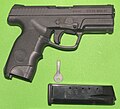 'Third generation' Steyr M40-A1 with magazine and limited access lock key, and manual safety
 -
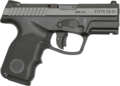 'Third generation' Steyr S9-A1.
 -
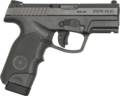 'Third generation' Steyr C9-A1.
 -
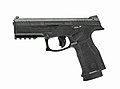 'Fourth generation' Steyr L9-A2 MF.
 -
 'Fourth generation' Steyr M9-A2 MF with olive drab green frame.
 -
 Steyr trapezoidal pistol sights.
 -
 Steyr adjustable pistol sights.
 -
 Steyr rectangular pistol sights.
 -
 'Third generation' Steyr conversion kit between 9×19mm Parabellum and .40 S&W.


See also
[edit]- Caracal pistol—also designed by Wilhelm Bubits
Citations
[edit]- ^ a b c d e f g Woźniak, Ryszard: Encyklopedia najnowszej broni palnej—tom 4 R-Z, page 103. Bellona, 2002.
- ^ a b c d Kinard, Jeff (2004). Pistols: An Illustrated History of Their Impact. ABC-CLIO. p. 276.
- ^ a b c d e Woźniak, 104
- ^ a b c "Steyr M-A1 instruction manual". Retrieved 25 July 2023.
- ^ "Gun Review: Steyr M9A1 - The Truth About Guns". 30 March 2012.
- ^ Ayoob, Massad (2007). The Gun Digest Book of Combat Handgunnery. Iola, Wisconsin: Gun Digest Books. pp. 248–250. ISBN 978-1-4402-2654-0.
- ^ "Steyr Arms no longer importing Steyr pistols -The Firearm Blog". 2 March 2009.
- ^ "Steyr Arms press release: July Newsletter-Steyr Arms to Import Pistol Again!". Archived from the original on 16 July 2011. Retrieved 16 December 2010.
- ^ "Pistol, whose housing is composed of plastic".
- ^ "IDEX 2023: Steyr C9-A2 MF – an Often Overlooked Austrian Handgun". 2 May 2023.
- ^ "Pistol A2 MF". 13 February 2019. Retrieved 25 July 2023.
- ^ Roberts, Patrick (29 January 2019). "New Steyr Arms L9A2 MF Pistol & 6.5 Creed Scout Rifle | SHOT 2019". Recoil. Retrieved 25 July 2023.
- ^ "Steyr A2 MF modular frame pistol". Retrieved 25 July 2023.
- ^ Jane's Information Group Ltd. "Special Forces (Land) (Falkland Islands) - Jane's Amphibious and Special Forces". articles.janes.com. Archived from the original on 2 September 2012. Retrieved 26 April 2025.
- ^ "Armament of the Georgian Army". Geo-army.ge. Archived from the original on 9 March 2012. Retrieved 1 January 2013.
- ^ "檢整槍齡30年克拉克手槍 涼山特勤隊對配備「古董」手槍不滿 -- 上報 / 調查". Up Media. Archived from the original on 9 June 2021. Retrieved 12 July 2021.
- ^ Information regarding service pistols at 10 November 2018 service.gov.uk
- ^ Information regarding service pistols at 12 December 2018 service.gov.uk
General bibliography
[edit]- Kinard, Jeff (2004). Pistols: An Illustrated History of Their Impact. Santa Barbara, California: ABC-CLIO. ISBN 1-85109-470-9.
- Woźniak, Ryszard; Tomasz Begier (2002). Encyklopedia najnowszej broni palnej—tom 4 R-Z (in Polish). Warsaw: Bellona. ISBN 83-11-09312-1.
External links
[edit]
- Steyr Mannlicher—official site Archived 2007-05-15 at the Wayback Machine
- Steyr L-A1 instruction manual
- Steyr M-A1 instruction manual
- Steyr C-A1 instruction manual
- Steyr S-A1 instruction manual
- Steyr A2 MF instruction manual
- Modern Firearms
- REMTEK—Arms
- The Sight M1911A1—Steyr M series history and review
- Steyr M9—brief article in Guns Magazine, Oct. 1999, by Massad Ayoob
Steyr M
View on GrokipediaHistory
Development origins
The development of the Steyr M series originated in the early 1990s at Steyr Mannlicher GmbH & Co KG in Austria, where engineers Friedrich Aigner and Wilhelm Bubits led the project to create a modern polymer-framed semi-automatic pistol capable of competing with the dominant Glock 17 in the law enforcement and civilian markets.[8] Bubits, a retired Austrian police officer with prior experience at Glock, brought practical insights into striker-fired designs, while Aigner contributed expertise in modular components, as evidenced by their joint work on key patents for the pistol's frame and safety systems.[9] This initiative was driven by the growing demand for lightweight, reliable handguns that could address limitations in existing models, particularly in handling and user safety.[6] Central to the design were innovations aimed at enhancing ergonomics, safety, and modularity, including a high grip profile that positioned the hand closer to the bore axis for reduced muzzle flip and improved control during rapid fire.[10] The polymer frame allowed for interchangeable backstraps and side panels to accommodate various hand sizes, promoting modularity without compromising structural integrity, as detailed in U.S. Patent 6,260,301 B1 filed in 1998 by Aigner and Bubits for a plastic housing with integrated guide rails.[11] Safety features were prioritized with a multi-level system incorporating internal drop safeties, trigger safeties, and an optional key-operated lock, reflecting the era's emphasis on preventing accidental discharges in professional use.[12] These elements were inspired by field feedback from police operations, seeking to surpass the simplicity of competitors while maintaining high reliability. The initial prototype, designated the M40 and chambered in .40 S&W, was unveiled at the 1999 SHOT Show in Atlanta, marking the public debut of the series after years of internal prototyping and refinement.[13] Early testing focused on potential police adoption, highlighting the pistol's exceptionally low bore axis—lower than that of the Glock 17—and its trapezoidal sights, which contributed to superior accuracy in high-stress scenarios.[14] These attributes positioned the Steyr M as a forward-thinking alternative, with prototypes undergoing rigorous evaluations for ergonomics and operational safety before entering limited production.[3]Production timeline
Serial production of the Steyr M series commenced in 1999 at the manufacturer's facility in Steyr, Austria, with initial offerings in 9×19mm Parabellum and .40 S&W calibers.[15] The M9 model in 9mm was the first to launch, followed closely by the M40 in .40 S&W.[15] In 2001, the lineup expanded to include the .357 SIG caliber with the introduction of the M357 model.[16] In 2004, the second-generation A1 series was introduced, featuring a manual safety, improved grip texturing, and enhanced modularity. The .357 SIG variant remained in production until 2014, when it was discontinued amid shifting market preferences toward more common calibers like 9mm.[17] This decision reflected broader industry trends, as demand for the higher-velocity .357 SIG round waned following changes in law enforcement adoption.[18] Company restructuring played a key role in the series' evolution, including a rebranding from Steyr Mannlicher to Steyr Arms effective January 1, 2019, to better align with international operations.[2] This period saw the phase-out of less popular calibers due to market dynamics, focusing resources on core offerings. In later years, the adoption of modular frame designs paved the way for the A2 MF series, introduced in 2019 as an updated continuation of the M line with enhanced ergonomics and customization options.[3]Design
Frame and ergonomics
The Steyr M series features a high-profile polymer frame constructed from injection-molded synthetic material, providing a lightweight yet durable foundation for the pistol's design.[4] This frame integrates a full-length Picatinny rail (MIL-STD-1913) on the dust cover in models from the A1 generation onward, enabling attachment of accessories such as lights or lasers. Unloaded weights for these pistols typically range from 766 to 787 grams (approximately 27 to 27.8 ounces), depending on the variant, contributing to manageable handling without excessive bulk.[4][19] Ergonomics emphasize a high grip profile and low bore axis, positioning the barrel close to the shooter's hand for reduced muzzle flip and flatter shooting trajectories. The grip angle measures 111 degrees, promoting natural pointability and instinctive aiming without wrist adjustment.[14][20] The A1 generation, introduced in 2004, enhanced grip ergonomics with aggressive texturing on the front strap, backstrap, and sides, along with contoured finger grooves to improve control and mitigate recoil during rapid fire.[19] The fourth-generation A2 MF models further advanced customization through interchangeable backstraps and side panels in varying sizes, allowing users to adjust for hand fit and achieve a more secure hold.[4][21] Variant sizes influence balance and suitability: the compact C models (overall length approximately 177 mm) prioritize concealability for everyday carry, while medium M models (187 mm) offer balanced handling for general use, and long-slide L models (200 mm) enhance sight radius and stability for precision shooting.[4]Barrel and slide
The barrel of the Steyr M series pistols is a cold hammer-forged match-grade component designed for enhanced accuracy and durability.[22] It features a Mannox® finish, Steyr Arms' proprietary nitride treatment that provides corrosion resistance and reduced friction.[22] Barrel lengths vary by model, typically ranging from 3.6 inches in compact variants to 4.5 inches in full-size models, contributing to the pistol's overall balance and handling characteristics.[22] The slide is constructed from steel and also receives the Mannox® finish for improved wear resistance and smooth operation.[22] It includes rear and forward serrations to facilitate racking and manipulation, particularly under stress.[23] The slide's weight is calibrated to complement the frame, promoting stable recoil management.[24] The barrel and slide operate via a short-recoil system with a linkless, vertically tilting barrel that locks directly into the slide ejection port, minimizing movement during firing for reliable cycling and precision.[14] Select variants offer threaded barrels (e.g., 1/2x28 RH or M13.5x1 LH) for suppressor attachment.[25]Sights and optics
The Steyr M series pistols feature a proprietary trapezoidal iron sight system, consisting of a triangular front sight blade and a corresponding U-shaped rear notch that aligns to form a trapezoid for rapid target acquisition. This design enables shooters to confirm sight alignment using peripheral vision, reducing the time needed to acquire a target compared to traditional square-post sights, while maintaining precision for combat and defensive applications. The standard configuration incorporates a three-dot setup with white dots on the front sight and rear sight posts to facilitate quick alignment in daylight conditions.[26] These fixed sights are mounted in dovetail cuts on the slide, allowing for windage adjustment by drifting the rear sight laterally with a sight pusher tool, ensuring users can zero the pistol for specific ammunition without altering elevation. The dovetail mounting system also supports straightforward replacement with aftermarket sights from reputable manufacturers, enabling customization while preserving the slide's structural integrity.[3] In later models of the series, including the fourth-generation variants, the slides accommodate optic-ready configurations through adapter plates that replace the rear iron sight, permitting the direct mounting of compact red dot sights such as the Trijicon RMR for enhanced speed and accuracy in dynamic shooting scenarios. Additionally, night sight options with tritium inserts are available, integrating seamlessly into the trapezoidal framework to provide self-illuminating glow for low-light targeting without external light sources, extending usability to nocturnal or indoor environments.[27][28]Operating system
The Steyr M series pistols employ a short recoil operating system derived from the Browning locked-breech design, utilizing a linkless, vertically dropping barrel for mechanical locking. In this configuration, the barrel and slide move rearward together a short distance upon firing before the barrel drops vertically—guided by cams in the frame—to disengage from the slide, allowing extraction and reloading. This linkless approach eliminates the pivoting link found in conventional tilting-barrel mechanisms, potentially reducing wear and simplifying the action while maintaining a secure lockup via a single rectangular lug encircling the barrel's chamber area that engages recesses in the slide.[19][14] The cycle of operation begins with the striker impacting the primer, igniting the propellant and propelling the bullet down the rifled barrel (6 right-hand grooves). The resulting recoil impulse drives the locked barrel and slide rearward approximately 3-5 mm until the bullet exits, at which point decreasing chamber pressure allows the barrel's locking lug to disengage as the barrel cams downward. An indirect firing pin block, integrated into the striker assembly, remains engaged to prevent inertial firing until the trigger fully compresses it, ensuring the firing pin cannot move forward inadvertently during slide movement. The unlocked slide then continues rearward, where the claw extractor on the slide's right side grips and withdraws the spent cartridge case from the chamber, flinging it clear via the fixed ejector positioned in the frame.[29][30] As the slide reaches its full rearward travel, it compresses the recoil spring, which is captured on a full-length polymer or metal guide rod assembly extending through the slide's underside for precise alignment and reduced frame battering. This spring-driven forward motion strips the top round from the magazine, chambers it, and raises the barrel to re-engage the locking lug, readying the pistol for the next shot. The design's reliance on mechanical recoil without gas-assist elements—evolved from Steyr's prior fixed-barrel experiments like the GB—prioritizes simplicity and consistent cycling across calibers such as 9mm Parabellum and .40 S&W. The robust recoil spring and guide rod contribute to operational reliability by maintaining proper slide velocity and timing under varied ammunition loads.[29][14]Trigger and controls
The Steyr M employs a double-action-only (DAO) striker-fired trigger mechanism, branded as the Reset Action system, which delivers a consistent pull weight of approximately 5.5 pounds (2.5 kg) across all shots without the variable first pull typical of traditional double-action triggers.[31] This design pre-cocks the striker partially, resulting in a smooth, predictable 4 mm (0.16 in) travel and a short reset distance of around 0.3 inches, facilitating quick successive shots while maintaining safety through integrated passive mechanisms.[31][19] The pistol's controls emphasize minimalism and reliability, with no external manual safety or decocker to complicate operation under stress; instead, it depends on internal safeties such as a trigger blade safety, drop safety, and firing pin block that automatically engage unless the trigger is intentionally pulled.[31] The slide release lever allows manual operation of the slide, locking it rearward after the final round from the magazine is expended to indicate an empty firearm.[31] From the third generation onward, the Steyr M includes a reversible magazine release button, enhancing usability for left-handed shooters by permitting easy reconfiguration without tools.[3] These features build on the series' ergonomic evolution while preserving the core simplicity of the control layout.[15]Magazines and feeding
The Steyr M series pistols utilize double-stack, detachable box magazines constructed primarily from stainless steel for durability and corrosion resistance, featuring injection-molded polymer followers and base plates.[32][33] These magazines employ a staggered column arrangement with precision-machined feed lips and steel wire springs to ensure consistent tension and smooth operation.[32][34] Magazine capacities vary by caliber, frame size, and regional restrictions, typically offering 17 rounds for full-size 9×19mm Parabellum models (M9/L9), 17 rounds for compact 9mm variants (C9), 12 rounds for full-size .40 S&W (M40/L40) or .357 SIG (M357/L357) configurations, and 10-round limited-capacity options across all calibers where legally required.[35][15] Flush-fit magazines align with the pistol's grip for concealed carry, while extended options provide additional capacity and improved control for larger frames.[35][36] The polymer followers incorporate anti-tilt designs to maintain proper alignment of cartridges, promoting reliable feeding even under rapid fire or adverse conditions.[32][15] Magazines are compatible across Steyr M generations within the same frame size (e.g., M-series full-size), though baseplate variations accommodate generational updates and model-specific ergonomics.[37] Each pistol ships with two magazines, and the system supports drop-free ejection via the ambidextrous release button, facilitating quick reloads.[35][37] A last-round slide hold-open feature engages automatically when the magazine is empty, locking the slide rearward to signal reload and aiding in malfunction clearance; any failure in this function is typically attributable to a weakened magazine spring.[37] Overall, the feeding mechanism demonstrates high reliability, with field testing confirming consistent performance across thousands of rounds without notable malfunctions.[36][15]Safety systems
The Steyr M series employs a multi-layered safety system designed to prevent accidental discharge during handling, carrying, or impact. Central to its external safeties is the double-trigger mechanism, where a secondary blade integrated into the trigger face must be fully depressed before the primary trigger can engage, ensuring that inadvertent contact does not initiate firing.[3] This feature, standard across models, enhances user control while maintaining a consistent trigger pull weight.[7] Internally, the pistol includes a firing pin block housed in the slide, which inhibits forward movement of the striker until the trigger assembly is activated, thereby blocking unintended ignition of the primer.[19] Complementing this is the drop safety system, an automatic mechanism that disconnects the trigger bar from the sear upon impact, preventing the striker from releasing even if the pistol falls from typical holster heights.[7] Additionally, a loaded chamber indicator—optional on certain variants—protrudes from the rear of the slide when a round is present, providing both visual and tactile confirmation without requiring slide manipulation.[7] The design eschews a grip safety, prioritizing simplicity and reliability through its passive internal protections, which render the pistol inherently holster-safe for concealed or duty carry.[3] These features collectively ensure compliance with rigorous drop safety protocols, allowing safe retention in holsters without manual intervention.[7]Variants
First-generation models
The first-generation Steyr M pistols were introduced in 1999 and remained in production until 2004, marking the initial release of Steyr Mannlicher's polymer-framed, striker-fired handgun line designed for both law enforcement and civilian use.[38][8] These models included full-size variants designated as the M9 chambered in 9×19mm Parabellum, the M40 in .40 S&W, and the M357 in .357 SIG, each featuring a 4-inch barrel and standard capacities of 15 rounds for the M9, 12 rounds for the M40 and M357. The M357 in .357 SIG was discontinued in 2014.[39][10] Compact counterparts, the S9 and S40, offered shorter 3.6-inch barrels with reduced capacities of 10 rounds for the S9 and 8 rounds for the S40, prioritizing concealed carry applications.[39][8] Constructed with a black polymer frame lacking aggressive texturing or an integrated accessory rail, the first-generation models emphasized a minimalist design with smooth contours for comfortable handling.[38][10] The trigger system employed an initial double-action-only (DAO) mechanism, refined as the "Reset Action" for a consistent pre-cocked pull weight around 5.5 pounds, allowing partial reset during firing for improved follow-up shots without full striker release.[10] Fixed iron sights with a trapezoidal rear notch and a front post were standard, providing reliable target acquisition out to typical handgun distances.Second-generation models
The second-generation Steyr M series, comprising the M-A1 and S-A1 models, represented incremental enhancements introduced in 2004 to address user preferences for improved ergonomics and accessory compatibility while retaining the core design principles of the original pistols.[8] These updates focused on refining the frame and controls without altering the fundamental operating mechanism, maintaining availability in the same calibers as the first generation, such as 9×19mm Parabellum and .40 S&W.[10] Key modifications included the integration of a Picatinny rail on the dust cover, replacing the proprietary accessory mount of earlier models and enabling secure attachment of tactical lights, lasers, or other accessories.[8] The grips were redesigned with checkered panels and more aggressive texturing on the front strap and sides, enhancing purchase and control during rapid fire or in adverse conditions.[40] These ergonomic changes, informed by initial user feedback on handling, also contributed to better recoil management by promoting a more natural pointing grip and leveraging the series' low bore axis. The trigger mechanism saw refinement to a double-action-only configuration with a reset action system, delivering an average pull weight of 5.5 pounds for improved consistency and precision.[41] Tritium night sights became available as an optional upgrade, utilizing self-illuminating vials for enhanced visibility in low-light scenarios without requiring external power sources.[42] Overall, these models emphasized practical upgrades for professional and civilian users, bridging the gap to later generations.Third-generation models
The third-generation Steyr M models, produced from approximately 2010 to 2019, represented evolutionary refinements to the A1 series, emphasizing expanded size options and enhanced user controls to broaden appeal for duty, defensive, and sporting applications. These updates built on the core polymer-framed, striker-fired design while introducing practical improvements for versatility. Key variants included the M9-A1 as the mid-size model with a 4-inch barrel, suitable for general-purpose use; the L9-A1, featuring a longer 5-inch slide for enhanced sight radius and velocity in duty scenarios; and the C9-A1 compact variant with a shorter 3.6-inch barrel, optimized for concealed carry without sacrificing the series' ergonomic advantages.[43][44][7] A significant control enhancement was the reversible magazine catch, which could be easily swapped between sides of the frame via relief cutouts, facilitating ambidextrous operation for left- or right-handed shooters. This feature addressed previous limitations in the series, improving accessibility during high-stress situations. Additionally, the models retained a strong emphasis on .40 S&W chambering alongside 9mm, with dedicated variants like the M40-A1 and L40-A1 offering higher stopping power for law enforcement preferences, while maintaining compatibility with 15-round magazines in that caliber.[43][40][7] The slide finish, often a Melonite or similar nitrided treatment, provided superior corrosion resistance compared to earlier iterations, enhancing durability in adverse conditions without adding weight. These pistols reached peak annual production in the range of tens of thousands of units during this period, reflecting steady demand in professional and civilian markets. For competitive shooting, specialized configurations like the M9 Competition emerged, incorporating an adjustable trigger mechanism for finer pull weight tuning to meet precision demands.[45][46][7]Fourth-generation models
The Steyr A2 MF series, introduced in 2019, represents the fourth generation of the Steyr M pistol line, focusing on enhanced modularity to accommodate diverse user preferences. Available in three sizes—Compact (C9-A2 MF), Medium (M9-A2 MF), and Large (L9-A2 MF)—these striker-fired handguns feature a fully modular polymer frame that allows for quick-swap interchangeable backstraps and side grip panels, enabling users to customize grip size and texture without tools.[47][3] Chambered primarily in 9×19mm Parabellum with 17-round magazines standard, the A2 MF also supports optional .40 S&W variants (such as the L40-A2 MF) with 15-round capacity, though these have seen limited production in recent years. The series includes optic-ready slide milling as a standard feature, with a rear cut compatible with popular red-dot sights like the Trijicon RMR or Holosun models, facilitating direct mounting without adapters. Ergonomic enhancements include a low bore axis for reduced muzzle flip, an aggressively flared magwell for faster reloads, and contoured controls optimized for gloved use, contributing to improved handling across the size variants.[48][49] Unloaded weights vary by model but have been refined for balance, with the Compact version at approximately 27 ounces (including empty magazine at 3.14 ounces), emphasizing lightweight polymer construction without sacrificing durability. Production of the A2 MF continues as of 2025, maintaining availability through Steyr Arms distributors worldwide. In September 2025, Steyr announced the AT series (ATc for competition and ATd for defense) as a new modular, hammer-fired successor line, potentially phasing in alongside or replacing the A2 MF over time.[4][50]Comparisons
Technical specifications table
| Model | Caliber | Capacity | Barrel Length | Weight (unloaded) | Trigger Pull | Dimensions (L x H x W) | Muzzle Velocity (approx.) | Effective Range |
|---|---|---|---|---|---|---|---|---|
| Steyr M9-A1 | 9×19mm | 17+1 | 115 mm (4.53 in) | 787 g (27.8 oz) | 5.6 lbf (25 N) | 201 mm × 142 mm × 33 mm (7.9 in × 5.6 in × 1.3 in) | 1,180 ft/s (360 m/s) | 50 m |
| Steyr M40-A1 | .40 S&W | 12+1 | 115 mm (4.53 in) | 780 g (27.5 oz) | 5.6 lbf (25 N) | 201 mm × 142 mm × 33 mm (7.9 in × 5.6 in × 1.3 in) | 1,050 ft/s (320 m/s) | 50 m |
| Glock 17 Gen5 | 9×19mm | 17+1 | 114 mm (4.49 in) | 625 g (22.0 oz) | 5.5 lbf | 202 mm × 139 mm × 32 mm (7.95 in × 5.47 in × 1.26 in) | 1,200 ft/s (366 m/s) | 50 m |
| SIG Sauer P320 Full-Size | 9×19mm | 17+1 | 119 mm (4.7 in) | 732 g (25.8 oz) | 6.5 lbf (avg.) | 203 mm × 140 mm × 34 mm (8.0 in × 5.5 in × 1.3 in) | 1,200 ft/s (366 m/s) | 50 m |