



Community hub
Recent from talks
Contribute something
Nothing was collected or created yet.
Chemical equation
View on Wikipedia | This article includes a list of general references, but it lacks sufficient corresponding inline citations. (October 2023) |
A chemical equation or chemistry notation is the symbolic representation of a chemical reaction in the form of symbols and chemical formulas. The reactant entities are given on the left-hand side, and the product entities are on the right-hand side with a plus sign between the entities in both the reactants and the products, and an arrow that points towards the products to show the direction of the reaction.[1] The chemical formulas may be symbolic, structural (pictorial diagrams), or intermixed. The coefficients next to the symbols and formulas of entities are the absolute values of the stoichiometric numbers. The first chemical equation was diagrammed by Jean Beguin in 1615.[2]
Structure
[edit]A chemical equation (see an example below) consists of a list of reactants (the starting substances) on the left-hand side, an arrow symbol, and a list of products (substances formed in the chemical reaction) on the right-hand side. Each substance is specified by its chemical formula, optionally preceded by a number called stoichiometric coefficient.[a] The coefficient specifies how many entities (e.g. molecules) of that substance are involved in the reaction on a molecular basis. If not written explicitly, the coefficient is equal to 1. Multiple substances on any side of the equation are separated from each other by a plus sign.
As an example, the equation for the reaction of hydrochloric acid with sodium can be denoted:
- 2HCl + 2Na → 2NaCl + H2
Given the formulas are fairly simple, this equation could be read as "two H-C-L plus two N-A yields[b] two N-A-C-L and H two." Alternately, and in general for equations involving complex chemicals, the chemical formulas are read using IUPAC nomenclature, which could verbalise this equation as "two hydrochloric acid molecules and two sodium atoms react to form two formula units of sodium chloride and a hydrogen gas molecule."
Reaction types
[edit]Different variants of the arrow symbol are used to denote the type of a reaction:[1]
net forward reaction reaction in both directions[c] equilibrium[d] stoichiometric relation resonance (not a reaction)


State of matter
[edit]To indicate physical state of a chemical, a symbol in parentheses may be appended to its formula: (s) for a solid, (l) for a liquid, (g) for a gas, and (aq) for an aqueous solution. This is especially done when one wishes to emphasize the states or changes thereof. For example, the reaction of aqueous hydrochloric acid with solid (metallic) sodium to form aqueous sodium chloride and hydrogen gas would be written like this:
- 2HCl(aq) + 2Na(s) → 2NaCl(aq) + H2(g)
That reaction would have different thermodynamic and kinetic properties if gaseous hydrogen chloride were to replace the hydrochloric acid as a reactant:
- 2HCl(g) + 2Na(s) → 2NaCl(s) + H2(g)
Alternately, an arrow without parentheses is used in some cases to indicate formation of a gas ↑ or precipitate ↓. This is especially useful if only one such species is formed. Here is an example indicating that hydrogen gas is formed:
- 2HCl + 2Na → 2 NaCl + H2 ↑
Catalysis and other conditions
[edit]
If the reaction requires energy, it is indicated above the arrow. A capital Greek letter delta (Δ) or a triangle (△)[e] is put on the reaction arrow to show that energy in the form of heat is added to the reaction. The expression hν[f] is used as a symbol for the addition of energy in the form of light. Other symbols are used for other specific types of energy or radiation.
Similarly, if a reaction requires a certain medium with certain specific characteristics, then the name of the acid or base that is used as a medium may be placed on top of the arrow. If no specific acid or base is required, another way of denoting the use of an acidic or basic medium is to write H+ or OH− (or even "acid" or "base") on top of the arrow. Specific conditions of the temperature and pressure, as well as the presence of catalysts, may be indicated in the same way.
Notation variants
[edit]
The standard notation for chemical equations only permits all reactants on one side, all products on the other, and all stoichiometric coefficients positive. For example, the usual form of the equation for dehydration of methanol to dimethylether is:
- 2 CH3OH → CH3OCH3 + H2O
Sometimes an extension is used, where some substances with their stoichiometric coefficients are moved above or below the arrow, preceded by a plus sign or nothing for a reactant, and by a minus sign for a product. Then the same equation can look like this:
![{\displaystyle {2\,\mathrm {CH} {\vphantom {A}}_{\smash[{t}]{3}}\mathrm {OH} {}\mathrel {\xrightarrow {{\overset {}{-}}\mathrm {H} {\vphantom {A}}_{\smash[{t}]{2}}\mathrm {O} } } {}\mathrm {CH} {\vphantom {A}}_{\smash[{t}]{3}}\mathrm {OCH} {\vphantom {A}}_{\smash[{t}]{3}}}}](https://wikimedia.org/api/rest_v1/media/math/render/svg/a9322a7fd3bb1fb28dab61d3c7fa287ab389d3c7)
Such notation serves to hide less important substances from the sides of the equation, to make the type of reaction at hand more obvious, and to facilitate chaining of chemical equations. This is very useful in illustrating multi-step reaction mechanisms. Note that the substances above or below the arrows are not catalysts in this case, because they are consumed or produced in the reaction like ordinary reactants or products.
Another extension used in reaction mechanisms moves some substances to branches of the arrow. Both extensions are used in the example illustration of a mechanism.
Use of negative stoichiometric coefficients at either side of the equation (like in the example below) is not widely adopted and is often discouraged.[5]
![{\displaystyle {2\,\mathrm {CH} {\vphantom {A}}_{\smash[{t}]{3}}\mathrm {OH} ~\;{-}\;~\mathrm {H} {\vphantom {A}}_{\smash[{t}]{2}}\mathrm {O} {}\mathrel {\longrightarrow } {}\mathrm {CH} {\vphantom {A}}_{\smash[{t}]{3}}\mathrm {OCH} {\vphantom {A}}_{\smash[{t}]{3}}}}](https://wikimedia.org/api/rest_v1/media/math/render/svg/8bd3a1101f75d22efd346977da25d7af801f3836)
Balancing chemical equations
[edit]Because no nuclear reactions take place in a chemical reaction, the chemical elements pass through the reaction unchanged. Thus, each side of the chemical equation must represent the same number of atoms of any particular element (or nuclide, if different isotopes are taken into account). The same holds for the total electric charge, as stated by the charge conservation law. An equation adhering to these requirements is said to be balanced.
A chemical equation is balanced by assigning suitable values to the stoichiometric coefficients. Simple equations can be balanced by inspection, that is, by trial and error. Another technique involves solving a system of linear equations.
Balanced equations are usually written with smallest natural-number coefficients. Yet sometimes it may be advantageous to accept a fractional coefficient, if it simplifies the other coefficients. The introductory example can thus be rewritten as
![{\displaystyle {\mathrm {HCl} {}+{}\mathrm {Na} {}\mathrel {\longrightarrow } {}\mathrm {NaCl} {}+{}{\mathchoice {\textstyle {\frac {1}{2}}}{\frac {1}{2}}{\frac {1}{2}}{\frac {1}{2}}}\,\mathrm {H} {\vphantom {A}}_{\smash[{t}]{2}}}}](https://wikimedia.org/api/rest_v1/media/math/render/svg/80e085e0596a151cce3a1c5ff82a23fa9cf11535)
In some circumstances the fractional coefficients are even inevitable. For example, the reaction corresponding to the standard enthalpy of formation must be written such that one molecule of a single product is formed. This will often require that some reactant coefficients be fractional, as is the case with the formation of lithium fluoride:
![{\displaystyle {\mathrm {Li} {\mskip {2mu}}(\mathrm {s} ){}+{}{\mathchoice {\textstyle {\frac {1}{2}}}{\frac {1}{2}}{\frac {1}{2}}{\frac {1}{2}}}\,\mathrm {F} {\vphantom {A}}_{\smash[{t}]{2}}{\mskip {2mu}}(\mathrm {g} ){}\mathrel {\longrightarrow } {}\mathrm {LiF} {\mskip {2mu}}(\mathrm {s} )}}](https://wikimedia.org/api/rest_v1/media/math/render/svg/59965a014de31ada99dbcba42504eba58769a8e7)
Inspection method
[edit]
4 + 2 O
2 → CO
2 + 2 H
2O, a coefficient of 2 must be placed before the oxygen gas on the reactants side and before the water on the products side in order for, as per the law of conservation of mass, the quantity of each element does not change during the reaction

This chemical equation is being balanced by first multiplying H3PO4 by four to match the number of P atoms, and then multiplying H2O by six to match the numbers of H and O atoms.
The method of inspection can be outlined as setting the most complex substance's stoichiometric coefficient to 1 and assigning values to other coefficients step by step such that both sides of the equation end up with the same number of atoms for each element. If any fractional coefficients arise during this process, the presence of fractions may be eliminated (at any time) by multiplying all coefficients by their lowest common denominator.
- Example
Balancing of the chemical equation for the complete combustion of methane

is achieved as follows:
- A coefficient of 1 is placed in front of the most complex formula (CH4):
- The left-hand side has 1 carbon atom, so 1 molecule of CO2 will balance it. The left-hand side also has 4 hydrogen atoms, which will be balanced by 2 molecules of H2O:
- Balancing the 4 oxygen atoms of the right-hand side by 2 molecules of O2 yields the equation
- The coefficients equal to 1 are omitted, as they do not need to be specified explicitly:
- It is wise to check that the final equation is balanced, i.e. that for each element there is the same number of atoms on the left- and right-hand side: 1 carbon, 4 hydrogen, and 4 oxygen.

![{\displaystyle {1\,{\text{CH4}}{}+{}{\mathord {?}}\,{\text{O2}}{}\mathrel {\longrightarrow } {}1\,{\text{CO2}}{}+{}2\,\mathrm {H} {\vphantom {A}}_{\smash[{t}]{2}}\mathrm {O} }}](https://wikimedia.org/api/rest_v1/media/math/render/svg/9e853c398b48546cbf247c4b33439e7bd193939c)
![{\displaystyle {1\,\mathrm {CH} {\vphantom {A}}_{\smash[{t}]{4}}{}+{}2\,\mathrm {O} {\vphantom {A}}_{\smash[{t}]{2}}{}\mathrel {\longrightarrow } {}1\,\mathrm {CO} {\vphantom {A}}_{\smash[{t}]{2}}{}+{}2\,\mathrm {H} {\vphantom {A}}_{\smash[{t}]{2}}\mathrm {O} }}](https://wikimedia.org/api/rest_v1/media/math/render/svg/5dcef39b057cc4f23c77325bcf43dda36aecc244)
![{\displaystyle {\mathrm {CH} {\vphantom {A}}_{\smash[{t}]{4}}{}+{}2\,\mathrm {O} {\vphantom {A}}_{\smash[{t}]{2}}{}\mathrel {\longrightarrow } {}\mathrm {CO} {\vphantom {A}}_{\smash[{t}]{2}}{}+{}2\,\mathrm {H} {\vphantom {A}}_{\smash[{t}]{2}}\mathrm {O} }}](https://wikimedia.org/api/rest_v1/media/math/render/svg/fff89c129e6222f641b40a710d97016377395720)
System of linear equations
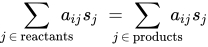
[edit]For each chemical element (or nuclide or unchanged moiety or charge) i, its conservation requirement can be expressed by the mathematical equation
where
- aij is the number of atoms of element i in a molecule of substance j (per formula in the chemical equation), and
- sj is the stoichiometric coefficient for the substance j.
This results in a homogeneous system of linear equations, which are readily solved using mathematical methods. Such system always has the all-zeros trivial solution, which we are not interested in, but if there are any additional solutions, there will be infinite number of them. Any non-trivial solution will balance the chemical equation. A "preferred" solution is one with whole-number, mostly positive[g] stoichiometric coefficients sj with greatest common divisor equal to one.
Example
[edit]Let us assign variables to stoichiometric coefficients of the chemical equation from the previous section and write the corresponding linear equations:
![{\displaystyle {{\mathit {s}}{\vphantom {A}}_{\smash[{t}]{1}}~{\text{CH4}}{}+{}{\mathit {s}}{\vphantom {A}}_{\smash[{t}]{2}}~{\text{O2}}{}\mathrel {\longrightarrow } {}{\mathit {s}}{\vphantom {A}}_{\smash[{t}]{3}}~{\text{CO2}}{}+{}{\mathit {s}}{\vphantom {A}}_{\smash[{t}]{4}}~{\text{H2O}}}}](https://wikimedia.org/api/rest_v1/media/math/render/svg/07f85bf087629c1dc5eb9a008bf0d368c8c27bb3)
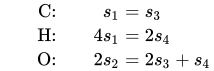
All solutions to this system of linear equations are of the following form, where r is any real number:

The choice of r = 1 yields the preferred solution,

which corresponds to the balanced chemical equation:
Matrix method
[edit]The system of linear equations introduced in the previous section can also be written using an efficient matrix formalism. First, to unify the reactant and product stoichiometric coefficients sj, let us introduce the quantity
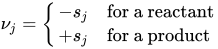
called stoichiometric number,[h] which simplifies the linear equations to
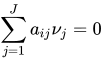
where J is the total number of reactant and product substances (formulas) in the chemical equation.
Placement of the values aij at row i and column j of the composition matrix
- A =
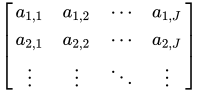
and arrangement of the stoichiometric numbers into the stoichiometric vector
- ν =
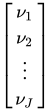
allows the system of equations to be expressed as a single matrix equation:
- Aν = 0
Like previously, any nonzero stoichiometric vector ν, which solves the matrix equation, will balance the chemical equation.
The set of solutions to the matrix equation is a linear space called the kernel of the matrix A. For this space to contain nonzero vectors ν, i.e. to have a positive dimension JN, the columns of the composition matrix A must not be linearly independent. The problem of balancing a chemical equation then becomes the problem of determining the JN-dimensional kernel of the composition matrix. It is important to note that only for JN = 1 will there be a unique preferred solution to the balancing problem. For JN > 1 there will be an infinite number of preferred solutions with JN of them linearly independent. If JN = 0, there will be only the unusable trivial solution, the zero vector.
Techniques have been developed[6][7] to quickly calculate a set of JN independent solutions to the balancing problem, which are superior to the inspection and algebraic method[citation needed] in that they are determinative and yield all solutions to the balancing problem.
- Example
Using the same chemical equation again, write the corresponding matrix equation:
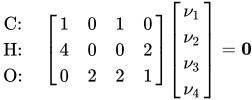
Its solutions are of the following form, where r is any real number:
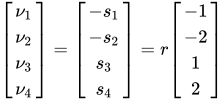
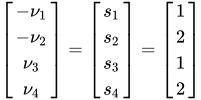
The choice of r = 1 and a sign-flip of the first two rows yields the preferred solution to the balancing problem:
Ionic equations
[edit]An ionic equation is a chemical equation in which electrolytes are written as dissociated ions. Ionic equations are used for single and double displacement reactions that occur in aqueous solutions.
For example, in the following precipitation reaction:
![{\displaystyle {\mathrm {CaCl} {\vphantom {A}}_{\smash[{t}]{2}}{}+{}2\,\mathrm {AgNO} {\vphantom {A}}_{\smash[{t}]{3}}{}\mathrel {\longrightarrow } {}\mathrm {Ca} (\mathrm {NO} {\vphantom {A}}_{\smash[{t}]{3}}){\vphantom {A}}_{\smash[{t}]{2}}{}+{}2\,\mathrm {AgCl} {\mskip {2mu}}(\mathrm {v} )}}](https://wikimedia.org/api/rest_v1/media/math/render/svg/a60caffe451e908b0e37044b6d780b454afc6154)
the full ionic equation is:
![{\displaystyle {\mathrm {Ca} {\vphantom {A}}^{2+}{}+{}2\,\mathrm {Cl} {\vphantom {A}}^{-}{}+{}2\,\mathrm {Ag} {\vphantom {A}}^{+}{}+{}2\,\mathrm {NO} {\vphantom {A}}_{\smash[{t}]{3}}{\vphantom {A}}^{-}{}\mathrel {\longrightarrow } {}\mathrm {Ca} {\vphantom {A}}^{2+}{}+{}2\,\mathrm {NO} {\vphantom {A}}_{\smash[{t}]{3}}{\vphantom {A}}^{-}{}+{}2\,\mathrm {AgCl} {\mskip {2mu}}(\mathrm {v} )}}](https://wikimedia.org/api/rest_v1/media/math/render/svg/f0c766d96acad66802d2ed0d4da1b68a0f7b7aee)
or, with all physical states included:
![{\displaystyle {\mathrm {Ca} {\vphantom {A}}^{2+}{\mskip {2mu}}(\mathrm {aq} ){}+{}2\,\mathrm {Cl} {\vphantom {A}}^{-}{\mskip {2mu}}(\mathrm {aq} ){}+{}2\,\mathrm {Ag} {\vphantom {A}}^{+}{\mskip {2mu}}(\mathrm {aq} ){}+{}2\,\mathrm {NO} {\vphantom {A}}_{\smash[{t}]{3}}{\vphantom {A}}^{-}{\mskip {2mu}}(\mathrm {aq} ){}\mathrel {\longrightarrow } {}\mathrm {Ca} {\vphantom {A}}^{2+}{\mskip {2mu}}(\mathrm {aq} ){}+{}2\,\mathrm {NO} {\vphantom {A}}_{\smash[{t}]{3}}{\vphantom {A}}^{-}{\mskip {2mu}}(\mathrm {aq} ){}+{}2\,\mathrm {AgCl} {\mskip {2mu}}(\mathrm {v} )}}](https://wikimedia.org/api/rest_v1/media/math/render/svg/607e8960ed2262e138b2d020e1a038b1700efc68)
In this reaction, the Ca2+ and the NO3− ions remain in solution and are not part of the reaction. That is, these ions are identical on both the reactant and product side of the chemical equation. Because such ions do not participate in the reaction, they are called spectator ions. A net ionic equation is the full ionic equation from which the spectator ions have been removed.[8] The net ionic equation of the proceeding reactions is:

or, in reduced balanced form,

In a neutralization or acid/base reaction, the net ionic equation will usually be:
![{\displaystyle {\mathrm {H} {\vphantom {A}}^{+}{\mskip {2mu}}(\mathrm {aq} ){}+{}\mathrm {OH} {\vphantom {A}}^{-}{\mskip {2mu}}(\mathrm {aq} ){}\mathrel {\longrightarrow } {}\mathrm {H} {\vphantom {A}}_{\smash[{t}]{2}}\mathrm {O} {\mskip {2mu}}(\mathrm {l} )}}](https://wikimedia.org/api/rest_v1/media/math/render/svg/3ba86d546c335f4424cde3ca3e6d4c6b4fde47ff)
There are a few acid/base reactions that produce a precipitate in addition to the water molecule shown above. An example is the reaction of barium hydroxide with phosphoric acid, which produces not only water but also the insoluble salt barium phosphate. In this reaction, there are no spectator ions, so the net ionic equation is the same as the full ionic equation.
![{\displaystyle {3\,\mathrm {Ba} (\mathrm {OH} ){\vphantom {A}}_{\smash[{t}]{2}}{}+{}2\,\mathrm {H} {\vphantom {A}}_{\smash[{t}]{3}}\mathrm {PO} {\vphantom {A}}_{\smash[{t}]{4}}{}\mathrel {\longrightarrow } {}6\,\mathrm {H} {\vphantom {A}}_{\smash[{t}]{2}}\mathrm {O} {}+{}\mathrm {Ba} {\vphantom {A}}_{\smash[{t}]{3}}(\mathrm {PO} {\vphantom {A}}_{\smash[{t}]{4}}){\vphantom {A}}_{\smash[{t}]{2}}{\mskip {2mu}}(\mathrm {v} )}}](https://wikimedia.org/api/rest_v1/media/math/render/svg/ac8ce09f4f27e1cb96c3cffbaa3d09323f244b88)
![{\displaystyle {{\mathrm {3Ba^{2}+} }{}+{}{\mathrm {6OH^{\text{-}}} }{}+{}{\text{6H+}}}+\underbrace {2\,\mathrm {PO} {\vphantom {A}}_{\smash[{t}]{4}}{\vphantom {A}}^{3-}} _{\mathrm {phosphate} }{{}\mathrel {\longrightarrow } {}{\text{6H2O}}{}+{}\underbrace {\mathrm {Ba} {\vphantom {A}}_{\smash[{t}]{3}}(\mathrm {PO} {\vphantom {A}}_{\smash[{t}]{4}}){\vphantom {A}}_{\smash[{t}]{2}}{\mskip {2mu}}(\mathrm {v} )} _{\mathrm {barium} ~\mathrm {phosphate} }}}](https://wikimedia.org/api/rest_v1/media/math/render/svg/30887789728a5f55e509321b6c3f24fe7ea19107)
Double displacement reactions that feature a carbonate reacting with an acid have the net ionic equation:
![{\displaystyle {2\,\mathrm {H} {\vphantom {A}}^{+}}+\underbrace {\mathrm {CO} {\vphantom {A}}_{\smash[{t}]{3}}{\vphantom {A}}^{2-}} _{\mathrm {carbonate} }{{}\mathrel {\longrightarrow } {}\mathrm {H} {\vphantom {A}}_{\smash[{t}]{2}}\mathrm {O} {}+{}\mathrm {CO} {\vphantom {A}}_{\smash[{t}]{2}}\uparrow {}}}](https://wikimedia.org/api/rest_v1/media/math/render/svg/5f31bfcd08a92ebd1de3c052683e394fbb81cade)
If every ion is a "spectator ion" then there was no reaction, and the net ionic equation is null.
Generally, if zj is the multiple of elementary charge on the j-th molecule, charge neutrality may be written as:

where the νj are the stoichiometric coefficients described above. The zj may be incorporated[6][7] as an additional row in the aij matrix described above, and a properly balanced ionic equation will then also obey:
History
[edit]![[icon]](https://en.wikipedia.org/wiki/File:Wiki_letter_w_cropped.svg) | This section is empty. You can help by adding to it. (June 2022) |
Typesetting
[edit] | This section is empty. You can help by adding to it. (June 2022) |
See also
[edit]Notes
[edit]- ^ Not to be confused with a related quantity called stoichiometric number.
- ^ Not to be confused with yield (chemistry), a quantification of synthesis efficiency.
- ^ The notation ⇄ was proposed in 1884 by the Dutch chemist Jacobus Henricus van 't Hoff. Van 't Hoff called reactions that didn't proceed to completion "limited reactions". He wrote (translation from French):[3]
Now Mr. Pfaundler has joined these two phenomena in a single concept by considering the observed limit as the result of two opposing reactions, driving the one in the example cited to the formation of sea salt [i.e., NaCl] and nitric acid, [and] the other to hydrochloric acid and sodium nitrate. This consideration, which experiment validates, justifies the expression "chemical equilibrium", which is used to characterize the final state of limited reactions. I would propose to translate this expression by the following symbol:
- HCl + NO3 Na ⇄ NO3 H + Cl Na.
I thus replace, in this case, the = sign in the chemical equation by the sign ⇄, which in reality doesn't express just equality but shows also the direction of the reaction. This clearly expresses that a chemical action occurs simultaneously in two opposing directions.
- ^ The notation was suggested by Hugh Marshall in 1902.[4]
- ^ Triangle (△) was originally the alchemical symbol for fire.
- ^ This expression comes from the Planck equation for the energy of a photon, E = hν. The Greek letter ν ("nu") is sometimes mistakenly replaced with a Latin letter v ("vee").
- ^ A negative stoichiometric coefficient signifies a substance placed on the incorrect side of the chemical equation.
- ^ An equivalent approach is flipping the signs of aij for reactants instead of replacing the stoichiometric coefficients sj with stoichiometric numbers νj.

References
[edit]- ^ a b IUPAC, Compendium of Chemical Terminology, 5th ed. (the "Gold Book") (2025). Online version: (2006–) "chemical reaction equation". doi:10.1351/goldbook.C01034
- ^ Crosland, M.P. (1959). "The use of diagrams as chemical 'equations' in the lectures of William Cullen and Joseph Black". Annals of Science. 15 (2): 75–90. doi:10.1080/00033795900200088.
- ^ van 't Hoff, J.H. (1884). Études de Dynamique Chemique [Studies of chemical dynamics] (in French). Amsterdam, Netherlands: Frederik Muller & Co. pp. 4–5.
Or M. Pfaundler a relié ces deux phénomênes ... s'accomplit en même temps dans deux sens opposés.
- ^ Marshall, Hugh (1902). "Suggested Modifications of the Sign of Equality for Use in Chemical Notation". Proceedings of the Royal Society of Edinburgh. 24: 85–87. doi:10.1017/S0370164600007720.
- ^ "Why is the minus sign (-) not allowed in reaction equations?". Stack Exchange. 2017-09-20. Answer by Nicolau Saker Neto. Archived from the original on 2021-06-15.
- ^ a b Thorne, Lawrence R. (2010). "An Innovative Approach to Balancing Chemical-Reaction Equations: A Simplified Matrix-Inversion Technique for Determining the Matrix Null Space". Chem. Educator. 15: 304–308. arXiv:1110.4321.
- ^ a b Holmes, Dylan (2015). "The null space's insight into chemical balance". Dylan Holmes. Retrieved Oct 10, 2017.
- ^ James E. Brady; Frederick Senese; Neil D. Jespersen (December 14, 2007). Chemistry: matter and its changes. John Wiley & Sons. ISBN 9780470120941. LCCN 2007033355.
| International | |
|---|---|
| National | |
| Other | |

Chemical equation
View on GrokipediaFundamentals of Chemical Equations
Definition and Purpose
A chemical equation is a symbolic representation of a chemical reaction, depicting the transformation of reactants into products through the use of chemical formulas and mathematical symbols. It provides a concise way to express the identities and relative quantities of substances involved in the reaction, without detailing the underlying atomic or molecular mechanisms.[6][7] The primary purpose of a chemical equation is to summarize the stoichiometry of a reaction, allowing chemists to predict the amounts of products formed from given reactants and to illustrate fundamental conservation laws, such as the conservation of mass and atoms. By representing reactions in this standardized form, equations facilitate quantitative analysis in laboratory settings and theoretical modeling, enabling calculations for yields, limiting reagents, and reaction efficiencies. However, they do not describe the kinetics or pathways of the reaction itself.[6][8][9] For instance, the reaction of hydrogen with oxygen to form water can be initially represented as hydrogen + oxygen → water, highlighting the symbolic nature of how reactants combine to yield products.[6]Basic Components
A chemical equation represents the transformation of substances through symbolic notation, where the core elements include chemical formulas for the involved species, numerical coefficients to specify quantities, and arrows to indicate the direction of the reaction. Chemical formulas are concise notations that depict the composition of reactants and products using elemental symbols from the periodic table, with subscripts denoting the number of atoms of each element in a molecule or compound.[10] For instance, the formula H₂O indicates one molecule of water consisting of two hydrogen atoms and one oxygen atom, where the subscript 2 specifies the count for hydrogen, and the absence of a subscript for oxygen implies a count of one.[11] These formulas must remain unchanged in an equation, as altering subscripts would represent a different substance.[5] Coefficients are whole numbers placed before chemical formulas to indicate the relative number of molecules or formula units participating in the reaction, ensuring the equation adheres to the law of conservation of mass when balanced.[12] In the example , the coefficient 2 before H₂ signifies two molecules of hydrogen gas, while the 1 before O₂ is typically omitted but understood.[13] These coefficients are adjusted during the balancing process but are integral to showing stoichiometric ratios.[14] The reaction arrow serves as the directional indicator in a chemical equation, separating reactants on the left from products on the right and denoting the forward progression of the transformation.[15] A single arrow (→) represents an irreversible reaction that proceeds completely from reactants to products, as in the combustion of hydrogen shown above.[16] For reversible reactions or those at equilibrium, a double arrow (⇌) is used to indicate that the process can occur in both directions simultaneously.[17]Notation and Conventions
Reactants, Products, and Arrows
In a chemical equation, the reactants are the starting substances that undergo transformation, represented by their chemical formulas positioned on the left side of the equation and separated by plus signs (+).[18] The products, which are the resulting substances formed from the reaction, are similarly denoted by their chemical formulas on the right side, also separated by plus signs.[18] This left-to-right convention symbolizes the directional flow from initial materials to outcomes, ensuring a clear visual representation of the reaction process.[19] The reactants and products are connected by arrows that indicate the nature and direction of the reaction. The standard single arrow (→) denotes an irreversible or unidirectional forward reaction, where the transformation proceeds primarily from left to right without significant reversal under standard conditions.[20] For reactions that can proceed in both directions, a double arrow (⇌) is used to signify reversibility or equilibrium, implying that both forward and reverse processes occur at comparable rates.[19] A variant equilibrium arrow (⇋) may appear in some notations for similar purposes, though ⇌ is more commonly recommended.[20] Additional arrow variants provide contextual details about specific outcomes. An upward arrow (↑) next to a product indicates gas evolution, showing that a gaseous substance is released from the reaction mixture.[21] A downward arrow (↓) denotes the formation of a precipitate, a solid that separates from the solution.[21] These indicators are placed adjacent to the relevant formula on the product side. Arrows often pair with state symbols for added clarity on physical conditions.[19] For instance, the combustion of hydrogen can be represented as: Here, hydrogen and oxygen act as reactants on the left, connected by a single arrow to water as the product on the right, illustrating a unidirectional synthesis reaction.[18]State Symbols and Physical Conditions
State symbols are used in chemical equations to indicate the physical state of each reactant and product at the specified conditions, providing essential context for the reaction's feasibility and behavior. The standard symbols include (s) for solid, (l) for liquid, (g) for gas, and (aq) for aqueous solution, where aqueous denotes substances dissolved in water.[19][22] These symbols are placed in parentheses immediately following the chemical formula, with no space between the formula and the parenthesis, and are written in roman (upright) typeface.[19][22] For example, the dissolution of sodium chloride in water is represented as , highlighting the transition from a solid to ions in solution.[22] Physical conditions, such as temperature and pressure, are often specified in chemical equations to denote the environment under which the reaction occurs, influencing the states and rates of the substances involved. These conditions are typically noted above or below the reaction arrow in smaller font or described in accompanying text.[22] The Greek letter delta () placed above the arrow commonly indicates that heat is applied to drive the reaction, as in the thermal decomposition of calcium carbonate: .[22] Specific temperatures or pressures may also be included, such as 25 °C or 1 atm, to clarify non-standard scenarios.[22] For thermodynamic equations, standard conditions provide a consistent reference point for comparing reaction properties like enthalpy and Gibbs free energy. According to IUPAC recommendations, these are defined as a temperature of 298.15 K (25 °C) and a pressure of 1 bar (10⁵ Pa), superseding the older 1 atm standard.[19] This standardization ensures that state symbols reflect the expected physical forms under these conditions, such as water as rather than .[19]Catalysts and Other Modifiers
In chemical equations, catalysts are substances that accelerate the rate of a reaction without being consumed or appearing in the net stoichiometry of the reactants and products. They are conventionally denoted by placing their chemical formula or name directly above or below the reaction arrow, ensuring they are clearly distinguished from the balanced components of the equation. This placement emphasizes that catalysts participate temporarily in the reaction mechanism but are regenerated, providing an alternative pathway with lower activation energy. For instance, platinum (Pt) is a common heterogeneous catalyst used in oxidation reactions and is indicated above the arrow.[23] A representative example is the catalytic decomposition of hydrogen peroxide, where manganese(IV) oxide (MnO₂) serves as the catalyst: Here, MnO₂ facilitates the breakdown by providing a surface for peroxide decomposition but remains unchanged and is excluded from the stoichiometric balance, unlike true reactants. This notation aligns with standard practices in inorganic and physical chemistry, where catalysts like enzymes or metals are similarly positioned to highlight their role in rate enhancement without altering equilibrium.[24] Inhibitors, or negative catalysts, counteract this by slowing reaction rates, often through adsorption or complex formation that blocks active sites. Their notation in equations is less formalized than for catalysts and typically appears in accompanying text, such as "in the presence of inhibitor X," rather than a dedicated symbol over the arrow. In specialized contexts, like polymerization reactions, inhibitors may be noted above the arrow with a minus sign or descriptive label (e.g., -I for inhibitor), but this is not universally standardized and depends on the reaction type. Unlike catalysts, inhibitors may be partially consumed over time, though they are still omitted from primary stoichiometry./Kinetics/07%3A_Case_Studies-_Kinetics/7.02%3A_Case_Study_2-_Inhibitors_and_Catalysts) Beyond catalysts and inhibitors, other modifiers influence reaction conditions and are denoted above the arrow to specify external factors affecting kinetics or feasibility. Heat is indicated by the Greek delta (Δ), signifying thermal energy input required to overcome activation barriers, as in dehydration reactions. Light, particularly ultraviolet or visible photons, is represented by "hν" or "hv" (from Planck's relation E = hν, where h is Planck's constant and ν is frequency), common in photochemical processes like halogenation. Electricity is often shown with a single-barbed arrow (→ with e⁻) or textual note for electrolytic reactions. Pressure conditions, such as elevated values needed for gas-phase equilibria, are annotated with phrases like "high P" or specific units (e.g., 200 atm), ensuring the equation conveys environmental necessities without altering molecular formulas. These modifiers complement state symbols by addressing dynamic influences on rate and yield.[23][25]Balancing Chemical Equations
Conservation Principles
The law of conservation of mass, a foundational principle in chemistry, states that in a chemical reaction, matter is neither created nor destroyed, meaning the total mass of the reactants must equal the total mass of the products.[26] This principle ensures that chemical equations accurately represent the transformation of substances without implying the generation or loss of material.[27] A direct consequence of mass conservation is the requirement for atom balance, where the number of atoms of each element must be the same on both sides of the equation. Since atoms are the fundamental units of matter and cannot be created or destroyed in ordinary chemical reactions, balancing equations verifies that the reaction adheres to this atomic conservation.[14] For instance, the unbalanced equation violates atom balance, with two hydrogen atoms and two oxygen atoms on the reactant side but only two hydrogen atoms and one oxygen atom on the product side; adjusting coefficients to achieves equality, with four hydrogen atoms and two oxygen atoms on each side.[5] In ionic equations, an additional conservation principle applies: the total electrical charge must balance between reactants and products.[28] This ensures that the equation reflects the neutrality of the overall reaction, as ions cannot spontaneously gain or lose charge without corresponding counterparts.[27] Balanced equations based on these conservation principles enable stoichiometric calculations by providing mole ratios between reactants and products, which are essential for predicting reaction yields and quantities.[29] These ratios derive directly from the coefficients, quantifying the proportional relationships inherent in the conserved atoms and charges.[30]Inspection Method
The inspection method, commonly referred to as the trial-and-error approach, involves systematically adjusting the coefficients of chemical formulas in an equation until the number of atoms of each element is equal on both sides, thereby enforcing the conservation of atoms.[15] This intuitive technique is particularly effective for straightforward reactions where the number of elements and compounds is limited.[5] The step-by-step process begins by identifying the most complex molecule, typically an organic compound or one with multiple elements, and assigning it a coefficient of 1 to serve as the reference. Next, balance the elements that appear in the fewest formulas, starting with metals or non-hydrogen/oxygen elements, by adjusting coefficients on the opposite side of the equation. Hydrogen and oxygen atoms are balanced last, as they often appear in multiple compounds and require iterative tweaks. If fractional coefficients arise during balancing, they are retained temporarily and then eliminated by multiplying all coefficients by the appropriate integer denominator to yield whole numbers.[15][31] This method offers advantages in its simplicity and speed for non-complex reactions, requiring no advanced mathematical tools and relying solely on visual inspection and logical adjustment.[32] However, it is limited in efficiency for equations involving numerous elements, large coefficients, or redox processes, where trial-and-error can become time-consuming and error-prone, often necessitating algebraic methods instead.[5] A detailed example illustrates the process using the combustion of propane, a common hydrocarbon reaction. Begin with the unbalanced equation: First, balance carbon atoms, which appear in the complex reactant propane (C₃H₈) and product CO₂; three carbon atoms on the left require a coefficient of 3 for CO₂: Next, balance hydrogen atoms; eight hydrogen atoms in C₃H₈ require a coefficient of 4 for H₂O: Finally, balance oxygen atoms; the right side now has 3×2 + 4×1 = 10 oxygen atoms, so the coefficient for O₂ must be 5 to provide 10 oxygen atoms on the left: This iterative adjustment confirms the equation is balanced, with 3 C, 8 H, and 10 O on both sides.[15][5]Algebraic and Matrix Methods
The algebraic method for balancing chemical equations involves assigning variables to the stoichiometric coefficients of the reactants and products, then setting up a system of linear equations based on the conservation of atoms for each element. For a general reaction , where A, C, and D contain a particular element, the equation for that element would be . This system is solved simultaneously, often by fixing one coefficient (e.g., to 1) and expressing others in terms of it, followed by multiplying through by the least common denominator to obtain integer values.[33] Consider the reaction . Assign coefficients as . For phosphorus: , simplifying to . For oxygen: . Fixing yields and , resulting in the balanced equation .[34] The algebraic method is especially valuable for balancing complex redox equations, where multiple elements change oxidation states and the inspection method becomes inefficient due to high or non-obvious coefficients. For example, consider the redox reaction between concentrated sulfuric acid and hydrogen iodide: . Here, sulfur is reduced from +6 to -2, and iodine is oxidized from -1 to 0. Assign coefficients: . Set up the system:- S:
- I:
- O:
- H:
- H:
- S:
- N:
- O: