String harmonic
String harmonic
Main page
1611482

String harmonic

logo
Community Hub0 subscribers
Read side by side
from Wikipedia
Playing a harmonic on a string. Here, "+7" indicates that the string is held down at the position for raising the pitch by 7 semitones.

Playing a string harmonic (a flageolet) is a string instrument technique that uses the nodes of natural harmonics of a musical string to isolate overtones. Playing string harmonics produces high pitched tones, often compared in timbre to a whistle or flute.[1][2] Overtones can be isolated "by lightly touching the string with the finger instead of pressing it down" against the fingerboard (without stopping).[2] For some instruments this is a fundamental technique, such as the Chinese guqin, where it is known as fan yin (泛音, lit. "floating sound"), and the Vietnamese đàn bầu.

Overtones

[edit]

When a string is plucked or bowed normally, the ear hears the fundamental frequency most prominently, but the overall sound is also colored by the presence of various overtones (frequencies greater than the fundamental frequency). The fundamental frequency and its overtones are perceived by the listener as a single note; however, different combinations of overtones give rise to noticeably different overall tones (see timbre).[3] A harmonic overtone has evenly spaced nodes along the string, where the string does not move from its resting position.

Nodes

[edit]
Table of harmonics, indicating in colors on which positions the same overtones occur

The nodes of natural harmonics are located at the following points along the string:

Harmonic Stop note Sounded note relative to open string Cents above open string Cents reduced to one octave Length fraction Audio
2 octave octave (P8) 1,200.0 0.0 12 Play
3 just perfect fifth P8 + just perfect fifth (P5) 1,902.0 702.0 13, 23 Play
4 just perfect fourth 2P8 2,400.0 0.0 14, 34 Play
5 just major third 2P8 + just major third (M3) 2,786.3 386.3 15 to 45 Play
6 just minor third 2P8 + P5 3,102.0 702.0 16, 56
7 septimal minor third 2P8 + septimal minor seventh (m7) 3,368.8 968.8 17 to 67 Play
8 septimal major second 3P8 3,600.0 0.0 18, 38, 58, 78
9 Pythagorean major second 3P8 + Pythagorean major second (M2) 3,803.9 203.9 19, 29, 49, 59, 79, 89 Play
10 just minor whole tone 3P8 + just M3 3,986.3 386.3 110, 310, 710, 910
11 greater undecimal neutral second 3P8 + lesser undecimal tritone 4,151.3 551.3 111 to 1011 Play
12 lesser undecimal neutral second 3P8 + P5 4,302.0 702.0 112, 512, 712, 1112
13 tridecimal 2/3-tone 3P8 + tridecimal neutral sixth (n6) 4,440.5 840.5 113 to 1213 Play
14 2/3-tone 3P8 + P5 + septimal minor third (m3) 4,568.8 968.8 114, 314, 514, 914, 1114, 1314
15 septimal (or major) diatonic semitone 3P8 + just major seventh (M7) 4,688.3 1,088.3 115, 215, 415, 715, 815, 1115, 1315, 1415 Play
16 just (or minor) diatonic semitone 4P8 4,800.0 0.0 116, 316, 516, 716, 916, 1116, 1316, 1516

Above, the length fraction is the point, with respect to the length of the whole string, the string is lightly touched. It is expressed as a fraction n/m, where m is the mode (2 through 16 are given above), and n the node number. The node number for a given mode can be any integer from 1 to m − 1. However, certain nodes of higher harmonics are coincident with nodes of lower harmonics, and the lower sounds overpower the higher ones. For example, mode number 4 can be fingered at nodes 1 and 3; it will occur at node 2 but will not be heard over the stronger first harmonic. Ineffective nodes to finger are not listed above.

The fret number, which shows the position of the node in terms of half tones (or frets on a fretted instrument) then is given by:
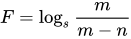
With s equal to the twelfth root of two, notated s because it's the first letter of the word "semitone".

Artificial harmonics

[edit]
Artificial harmonics on a G fundamental, as written (below) and as sounding (top). The round note (below) is pressed with one finger, and the square note is lightly touched with another one. Play
Natural versus artificial harmonic

When a string is only lightly pressed by one finger (that is, isolating overtones of the open string), the resulting harmonics are called natural harmonics.[4] However, when a string is held down on the neck in addition to being lightly pressed on a node, the resulting harmonics are called artificial harmonics.[4] In this case, as the total length of the string is shortened, the fundamental frequency is raised, and the positions of the nodes shift accordingly (that is, by the same number of frets), thereby raising the frequency of the overtone by the same interval as the fundamental frequency.

Artificial harmonics are produced by stopping the string with the first or second finger, and thus making an artificial 'nut,' and then slightly pressing the node with the fourth finger. By this means harmonics in perfect intonation can be produced in all scales.

Artificial harmonics are more difficult to play than natural harmonics, but they are not limited to the overtone series of the open strings, meaning they have much greater flexibility to play chromatic passages. Unlike natural harmonics, they can be played with vibrato.[6]

This technique, like natural harmonics, works by canceling out the fundamental tone and one or more partial tones by deadening their modes of vibration. It is traditionally notated using two or three simultaneous noteheads in one staff: a normal notehead for the position of the firmly held finger, a square notehead for the position of the lightly pressed finger, and sometimes, a small notehead for the resulting pitch.[7]

The most commonly used artificial harmonic, due to its relatively easy and natural fingering, is that in which, "the fourth finger lightly touches the nodal point a perfect fourth above the first finger. (Resulting harmonic sound: two octaves above the first finger or new fundamental.),"[8] followed by the artificial harmonic produced when, "the fourth finger lightly touches the nodal point a perfect fifth above the first finger (Resulting harmonic sound: a twelfth above the first finger or new fundamental.),"[8] and, "the third finger lightly touches the nodal point a major third above the first finger. (Resulting harmonic sound: two octaves and a major third above the first finger or new fundamental.)"[8][9]

In some cases, especially in the electric guitar technique, it is common to refer to Pinch Harmonics as Artificial Harmonics (AH) and to refer to harmonics produced by other means as Natural Harmonics.[citation needed]

Guitar

[edit]
The fundamental and the double- and triple-frequency overtones of a guitar string.

There are a few harmonic techniques unique to guitar.

Pinch harmonics

[edit]

Pinch harmonics performed on an acoustic guitar

A pinch harmonic (also known as squelch picking, pick harmonic, or squealy) is a guitar technique to achieve artificial harmonics in which the player's thumb or index finger on the picking hand slightly catches the string after it is picked,[10] canceling (silencing) the fundamental frequency of the string, and letting one of the overtones dominate. This results in a high-pitched sound which is particularly discernible on an electrically-amplified guitar as a "squeal". Zakk Wylde (Ozzy Osbourne guitarist) is best known for this sound.

Tapped harmonics

[edit]

Tapped harmonics were popularized by Eddie Van Halen. This technique is an extension of the tapping technique. The note is fretted as usual, but instead of striking the string the excitation energy required to sound the note is achieved by tapping at a harmonic nodal point. The tapping finger bounces lightly on and off the fret. The open string technique can be extended to artificial harmonics. For instance, for an octave harmonic (12-fret nodal point) press at the third fret, and tap the fifteenth fret, as 12 + 3 = 15.

Flicked and struck harmonics

[edit]

Some players, such as Dimebag Darrell, used a less common technique to play natural harmonics. His variation consists of "flicking the string, dumping the [whammy] bar (...), [making] the string kinda flap, and just tap a harmonic"[11] on the corresponding nodal point before releasing the bar.

Mattias Eklundh has a similar technique, but it does not require flicking the string first. Instead, he uses his middle finger to strike the string on any nodal point, hard enough to make the string ring but without letting the finger press down on the fretboard.[12] The vibrato bar can be used in a similar way Dimebag used it, making it easier to make the harmonics ring, but it is not required. Eklundh also frequently uses such harmonics in combination with normal notes, allowing him to use them in a more musical way.[13]

String harmonics driven by a magnetic field

[edit]

This technique is used by effect devices producing a magnetic field that can agitate fundamentals and harmonics of steel strings. There are harmonic mode switches as provided by newer versions of the EBow and by guitars built in sustainers like the Fernandes Sustainer and the Moog Guitar. Harmonics control by harmonic mode switching and by the playing technique is applied by the Guitar Resonator where harmonics can be alternated by changing the string driver position at the fretboard while playing.

See also

[edit]

References

[edit]
Revisions and contributorsEdit on WikipediaRead on Wikipedia
from Grokipedia
A string harmonic is a pure, flute-like tone produced on a stringed instrument by lightly touching the vibrating string at one of its nodal points—typically fractions such as 1/2, 1/3, or 1/4 of its length—while bowing or plucking it, which suppresses lower partials and emphasizes an overtone from the harmonic series.[1][2] These harmonics arise from standing waves on the string, where the fundamental frequency f1f_1 and its integer multiples (nf1nf_1, for n=2,3,n = 2, 3, \ldots) create resonant modes, with the frequency determined by the string's tension, linear density, and length via the formula fn=n2LFμf_n = \frac{n}{2L} \sqrt{\frac{F}{\mu}}.[3][1] In musical performance, string harmonics are divided into natural harmonics, produced on the open string at nodal points, and artificial (or false) harmonics, generated by stopping the string with one finger and lightly touching a node a perfect fourth above it to produce a pitch a twelfth above the stopped fundamental.[2][4] Their ethereal quality, resulting from the dominance of higher partials, makes them valuable in orchestral and solo writing for evoking lightness or otherworldly effects, as seen in works by composers like Borodin and Shostakovich.[2] Historically, the study of string harmonics dates to ancient Pythagorean experiments, which linked string divisions to consonant intervals through whole-number ratios, laying foundational principles for Western music theory and acoustics.[5]

Fundamentals

Definition and Principles

A string harmonic is a technique employed on string instruments in which a performer lightly touches a nodal point on the vibrating string to isolate higher overtones, suppressing the fundamental pitch and producing a clear, ethereal sound.[6] This method divides the string into fractional segments that vibrate as partials, yielding tones purer and more flute-like than those from the full string vibration, which emphasizes the richer timbre of the fundamental frequency.[6] The core principle relies on the distinction between the string's complete vibration—generating the fundamental—and its subdivided vibrations, which highlight overtones as higher-frequency components of the sound.[6] By applying only gentle pressure at precise nodes, the technique prevents motion at that point without damping the overall vibration, allowing sustained partials to dominate.[7] Historically termed "flageolet," this refers specifically to high harmonics evoking the whistle of a small flute, and it differs fundamentally from stopped notes, where full pressure shortens the string to create a new fundamental rather than isolating existing overtones.[7] For basic understanding, consider an open string vibrating fully to sound its fundamental pitch; lightly touching it midway isolates the second overtone, producing a pitch one octave higher with a bell-like purity, while a firm press at the same spot yields a stopped note an octave above the open string.[6] These overtones briefly represent the harmonic series of integer multiples beyond the fundamental.

Historical Context

The concept of string harmonics traces its roots to ancient explorations of vibrating strings, particularly through Pythagorean principles that emphasized harmonic intervals derived from simple numerical ratios. In ancient Greece, Pythagoras and his followers used the monochord—a single-string instrument—to demonstrate how dividing a string at specific points produced consonant intervals like the octave (1:2 ratio), fifth (2:3), and fourth (3:4), laying foundational influences on later string instrument tuning and overtone understanding.[8] These ideas persisted into the Renaissance, informing 16th- and 17th-century treatises on lute and viol playing, where harmonic-like effects were occasionally noted as incidental overtones or resonant phenomena, though not systematically exploited as techniques.[9] The classical development of string harmonics as a deliberate technique emerged in the 18th century with violin music, marking a shift from theoretical acoustics to practical application. By mid-century, composers like Jean-Joseph Cassanéa de Mondonville featured extensive natural harmonics in works such as Les sons harmoniques (c. 1738), including double-stopped variants for ethereal effects.[9] The technique gained traction in the Romantic era, with Niccolò Paganini popularizing both natural and artificial harmonics in virtuoso pieces like his Caprices (1802–1817), integrating them into rapid passages and left-hand pizzicato for dramatic color.[10] Hector Berlioz further advanced their orchestral role, employing harmonics in symphonic works like the Queen Mab scherzo from Roméo et Juliette (1839) to evoke supernatural timbres, influencing widespread adoption among 19th-century composers.[11] In the 20th century, string harmonics evolved through extended techniques, particularly in microtonal and avant-garde contexts, expanding beyond traditional intonation. Composers like Krzysztof Penderecki incorporated harmonics into cluster and aleatoric textures in pieces such as Threnody for the Victims of Hiroshima (1960), using them for dissonant, wailing effects in string ensembles.[9] Giacinto Scelsi pushed boundaries further with microtonal oscillations around single pitches, employing harmonics and glissandi in works like Anahit (1965) to blend Eastern influences with Western strings, creating fluid, meditative soundscapes.[12] String harmonic techniques also appear in non-Western traditions, demonstrating parallel evolutions. The Japanese koto employs natural harmonics by lightly touching strings at nodal points while plucking, producing bell-like overtones in traditional sankyū ensembles, a practice documented in Edo-period (17th–19th century) performance manuals.[13]

Physics

Harmonic Series and Overtones

In the physics of vibrating strings, the harmonic series refers to the set of frequencies at which a string can naturally oscillate as standing waves, consisting of the fundamental frequency ff and its integer multiples 2f2f, 3f3f, 4f4f, and so on.[14] These integer multiples arise from the boundary conditions of a string fixed at both ends, producing resonant modes where the string divides into an integer number of equal segments.[15] When two tones have fundamental frequencies in low integer ratios—such as 1:2 for an octave or 2:3 for a perfect fifth—their partials tend to coincide more frequently, resulting in consonant intervals that sound harmonious due to reduced beating between overlapping frequencies.[16] The frequency of the nnth harmonic derives from the standing wave condition on an ideal string of length LL under tension, where the wavelength λn\lambda_n for the nnth mode satisfies nλn/2=Ln \lambda_n / 2 = L, so λn=2L/n\lambda_n = 2L / n. The wave speed v=T/μv = \sqrt{T / \mu}, with TT as tension and μ\mu as linear mass density, then gives the frequency fn=v/λn=nv/(2L)f_n = v / \lambda_n = n v / (2L).[15] This yields fn=nf1f_n = n f_1, where f1=v/(2L)f_1 = v / (2L) is the fundamental.[14] The terms "harmonics" and "overtones" are sometimes used interchangeably but have precise distinctions: harmonics denote the integer-multiple frequencies starting from the fundamental (n=1n=1), while overtones refer specifically to all partials above the fundamental (n2n \geq 2).[15] In an ideal flexible string, the series is perfectly harmonic, but real strings exhibit inharmonicity due to material stiffness, which introduces dispersion and causes higher frequencies to deviate slightly upward from exact integer multiples, altering the perceived timbre.[17] This effect becomes more pronounced in shorter, thicker strings, such as those on pianos, but is minimal in longer, thinner strings like those on guitars.[18]

Nodes and Antinodes

In standing waves on a vibrating string fixed at both ends, nodes are points of zero transverse displacement where destructive interference occurs between incident and reflected waves, resulting in no net motion.[19] Antinodes, in contrast, are points of maximum displacement where constructive interference leads to the largest amplitude oscillations.[19] These fixed positions alternate along the string, with the ends always serving as nodes due to the boundary conditions.[20] For the nth harmonic, the string accommodates n half-wavelengths, placing nodes at equal intervals of L/n from each end (where L is the total string length), including the endpoints.[21] Thus, there are n+1 nodes in total, spaced L/n apart. For example, the second harmonic (octave) has an additional node at L/2, dividing the string into two equal segments.[3] The wave patterns for specific harmonics illustrate these node and antinode distributions clearly. In the second harmonic, nodes at 0, L/2, and L flank two antinodes at L/4 and 3L/4, creating two symmetric loops that vibrate oppositely.[19] The third harmonic features nodes at 0, L/3, 2L/3, and L, with antinodes at L/6, L/2, and 5L/6, forming three loops of decreasing wavelength toward the center.[21] For the fifth harmonic, nodes occur at 0, L/5, 2L/5, 3L/5, 4L/5, and L, with five antinodes midway between them, resulting in five tightly packed loops that produce a higher-pitched tone.[19] Practically, lightly touching the string at a node position during vibration suppresses the fundamental mode and lower partials by enforcing zero displacement there, isolating the desired higher harmonic for production on instruments like violins or guitars.[1] This technique exploits the standing wave geometry to emphasize specific overtones without altering the string's tension or length.[3]

Types

Natural Harmonics

Natural harmonics are produced on string instruments by lightly touching the open string at a nodal point, without fully stopping the vibration, which isolates and excites a specific overtone from the harmonic series while damping the fundamental and other partials. This technique forces the string to vibrate in a higher normal mode, with the node at the point of contact preventing displacement there. For instance, touching the string at its midpoint—corresponding to the 12th fret on fretted instruments like the guitar—yields the first overtone, an octave above the open string's fundamental pitch.[22][23] The resulting sound has a pure, ethereal quality due to its composition primarily of a single dominant frequency, lacking the complex timbre of the full string vibration. These pitches align with the harmonic series, where divisions of the string length produce specific intervals: a 1/2 division sounds the octave, 1/3 the octave plus a perfect fifth (twelfth), and 1/4 the double octave. On the violin G string, for example, touching at the 1/2 node produces G4 (one octave above open G3), at 1/3 yields D5 (a twelfth above), and at 1/4 sounds G5 (two octaves above).[22][24] Common positions for natural harmonics on fretted instruments include the 7th fret (approximating 1/3 division), 12th fret (1/2), and 19th fret (1/3 from the bridge end, for higher overtones). On fretless instruments like the violin, these occur at precise fractional divisions of the string length, such as the nodes referenced above for the G string.[23][24] Higher natural harmonics tend to be quieter because their amplitudes decrease with increasing mode number, resulting from energy distribution across the string. Additionally, inharmonicity—arising from string stiffness that raises the frequencies of higher partials beyond integer multiples of the fundamental—can affect intonation, causing pitch deviations that require adjustments for accurate tuning, such as up to 18 cents sharp for mid-range notes on piano strings.[22][25]

Artificial Harmonics

Artificial harmonics, also referred to as false or synthetic harmonics, are generated on string instruments by firmly stopping the string with one finger on the fingerboard (acting as an effective nut) or at a fret on guitars—to establish a fundamental pitch, while simultaneously lightly touching the string at a nodal point further along its length with another finger to isolate and amplify a specific overtone from the harmonic series.[6] This dual action shortens the effective vibrating length of the string, producing a pitched harmonic that is a multiple of the stopped fundamental, allowing performers to access overtones beyond those available on open strings.[24] The technique requires precise finger placement to dampen unwanted vibrations while permitting the desired partial to resonate clearly.[26] A key characteristic of artificial harmonics is their versatility in pitch control, enabling production in any key or position on the fingerboard, which contrasts with the fixed positions of natural harmonics.[6] For instance, if the string is stopped at C with the index finger, lightly touching a perfect fourth higher (at the node corresponding to the second harmonic) yields a clear C an octave above the stopped pitch, effectively transposing the stopped pitch up an octave.[24] This method draws from the physics of overtones, where the touched node divides the stopped string segment to excite higher partials.[26] Common variants depend on the interval touched relative to the stopped note, determining the overtone produced: touching at half the stopped length (1/2) isolates the octave harmonic; one-third (1/3) produces the twelfth (or compound fifth); and one-fourth (1/4) yields the second octave (double the fundamental).[26] These options allow for a range of timbres and pitches, such as major thirds or minor thirds above the octave for more complex extensions.[24] Compared to natural harmonics, artificial harmonics offer advantages in volume, as the stopped string provides a more robust excitation, and in range, facilitating higher-register notes with greater dynamic control, vibrato, and articulation while extending the instrument's effective tessitura.[6] This makes them particularly valuable for melodic lines in upper registers, where they can displace octaves downward for playability without altering the notated pitch.[26]

Techniques on Bowed Strings

Production on Violin Family

On the violin family instruments—violin, viola, cello, and double bass—harmonics are produced by lightly touching the string at specific nodal points while bowing, allowing the string to vibrate in fractional segments and emphasize overtones. This technique applies to both natural harmonics, where the string vibrates freely from an open or stopped fundamental, and artificial harmonics, where a stopped note serves as the base for the overtone.[27][28] Bowing techniques emphasize light pressure and precise contact to avoid damping the vibration or exciting unwanted fundamentals. For clarity, the bow is applied with minimal weight near the bridge, producing a pure, flute-like tone, while sul ponticello bowing—positioned closer to the bridge—yields brighter, more ethereal harmonics suitable for extended effects. On the cello, harmonics respond well to this near-bridge placement due to the instrument's longer string length, facilitating easier excitation of higher overtones. Smooth bow engagement is crucial, often requiring separate practice of left-hand placement and right-hand stroke to prevent skidding or uneven rhythm.[29][26][30] Finger placement involves a delicate touch to isolate the node without pressing the string to the fingerboard, typically using the index or pinky for natural harmonics on open strings. For natural harmonics, the finger rests softly at divisions like the midpoint for the octave overtone or the quarter-point for two octaves above, as on the violin's G string where the fourth finger in fourth position touches for the octave. Artificial harmonics require the first finger to solidly stop a note, followed by the fourth finger lightly touching a fourth above it—such as on the violin's E string in high positions to extend the range—forming a scaffold-like hand position with vertical finger approach to maintain intonation. The cello's lower range particularly favors natural harmonics, leveraging its extended neck for comfortable access to lower nodal points without shifting. On the double bass, natural harmonics are often produced on open strings using the first or fourth finger for nodal points like the octave (midpoint) or twelfth (at 1/3 length), with artificial harmonics less common due to the instrument's size; the thicker strings require firmer but still light bowing near the bridge to excite overtones clearly, and the longer scale provides ample reach but demands precise intonation to avoid wolf tones.[27][28][29][28] Producing harmonics presents challenges, primarily in intonation sensitivity due to the precise nodal locations, where even slight finger misalignment can alter pitch or mute the sound. On smaller instruments like the violin and viola, the shorter neck demands greater accuracy compared to the cello or double bass, which offer more positional leeway. Additionally, muting adjacent strings is often necessary to prevent sympathetic vibrations from muddying the intended harmonic, requiring coordinated left-hand damping.[28][26][30]

Applications in Orchestral Music

In orchestral music, string harmonics serve expressive roles that enhance coloristic effects and soloistic passages within ensemble contexts. For instance, they create shimmering, ethereal textures that evoke atmospheric depth, as seen in the high violin harmonics during moments of calm in Claude Debussy's La Mer, where they contribute to the sea's luminous, wave-like impressions.[31] Similarly, in Maurice Ravel's Tzigane for violin and orchestra, the solo violin employs natural harmonics to produce an otherworldly, gypsy-inspired timbre that contrasts with the orchestra's rhythmic drive, heightening the piece's virtuosic and exotic character.[32] Ensemble techniques involving harmonics expand textural possibilities beyond individual lines, often through divisi playing to form harmonic clusters or layered overtones. Divisi harmonics allow string sections to divide into subgroups, each producing partials that blend into dense, iridescent sonorities. In the 20th century, Krzysztof Penderecki's Threnody to the Victims of Hiroshima employs sul tasto harmonics—bowing over the fingerboard—to generate flute-like, muted overtones across the string sections, contributing to the piece's dissonant clusters and expressionistic lament for the atomic bombing's victims.[33] Notation for harmonics in orchestral scores emphasizes clarity for ensemble coordination, using diamond-shaped noteheads to indicate finger touch points on the string while small round notes or octave brackets denote the sounding pitch. This convention, rooted in 19th-century practices and refined in the 20th, ensures performers across sections align partials precisely, as in Berlioz's treatise where harmonics are marked to facilitate their delicate, unified execution.[34][35]

Techniques on Plucked and Struck Strings

General Methods

On plucked string instruments such as the harp, natural harmonics are produced by lightly touching the string at a nodal point—typically one-half, one-third, or one-quarter of its length from the bridge—with the base of the fingers or a fingertip, while plucking the string segment beyond the node with the other hand or fingernail.[36][1] This touch creates a fixed node that suppresses lower modes, allowing only the desired harmonic to vibrate freely, resulting in a clear, flute-like tone an octave higher for the midpoint touch or a perfect fifth higher for the one-third position.[1][37] Artificial harmonics on fretted plucked string instruments, such as the guitar or lute, involve first stopping the string at a fret or division point to define a shorter fundamental length, then lightly touching a fractional point along that segment (e.g., halfway) and plucking nearby to isolate higher overtones; on non-fretted instruments like the harp, artificial harmonics are less common and typically rely on alternative methods such as pedal adjustments.[1] A gentle pluck near the bridge enhances the purity of the harmonic by minimizing excitation of unwanted modes, as the initial displacement aligns closely with the desired standing wave pattern.[38] For struck string instruments like the piano, harmonics are generated by lightly touching a nodal point on the string with a fingertip—often while wearing a glove to reduce damping—simultaneously with depressing the corresponding key to strike the string via the hammer.[39] Common positions include the midpoint for the second partial (an octave above the fundamental) or further divisions for higher partials, such as the third partial (a perfect fifth above the second) on longer bass strings.[39][1] To isolate the harmonic, adjacent strings must be damped manually, and stronger strikes can excite higher flageolet harmonics on lower-register strings, though the resulting tone rings more clearly on extended concert grand pianos due to greater string length.[39] In prepared piano techniques, objects may be placed to alter damping, but the core method relies on precise nodal contact during the strike.[39] Acoustically, harmonics on plucked and struck strings exhibit shorter sustain compared to bowed strings, as the initial excitation from plucking or striking dissipates energy rapidly without continuous input, leading to quicker decay of the vibration.[1][40] Plucked excitations typically produce fewer higher harmonics than bowed ones, yielding a purer, less complex timbre, while the instrument's body resonance amplifies the fundamental and lower partials, contributing to the overall projection despite the brief duration.[40]

Guitar-Specific Techniques

Pinch harmonics, also known as squealies or pick harmonics, are a distinctive guitar technique where the thumb of the picking hand lightly touches the string immediately after it is plucked, creating a node that isolates upper partials and produces a high-pitched, wailing tone.[41] This method relies on a firm downstroke with the pick while the thumb grazes the string, allowing it to bounce off for excitation; the grip is adjusted so the thumb hovers over the pick's tip, extending its reach.[42] Common execution points include the 3rd, 5th, and 7th frets from the bridge on the low E string, corresponding to natural nodal positions that facilitate the harmonic resonance.[42] Tapped harmonics extend artificial harmonic production by fretting a note or chord with the left hand and then precisely tapping a right-hand finger—typically the index—directly above a fretwire at a nodal point, generating a clear overtone an octave higher without plucking.[43] This allows for rapid, fluid sequences across the fretboard, as exemplified in Eddie Van Halen's style, where the technique combines with slides and bends for melodic runs in rock and metal contexts.[44] The accuracy of the tap is crucial, as it must align exactly with the node to avoid damping the fundamental while sustaining the harmonic.[43] Flicked harmonics represent a variation within artificial techniques, involving a quick flicking motion of the pick across a fretted string while the thumb's flesh mutes the fundamental vibration almost instantly, emphasizing the overtone through the abrupt contact.[45] This approach, often executed with a choked-up pick grip for precision, can be applied anywhere on the neck and blends seamlessly with standard picking patterns to add textural flair. Struck harmonics, less common but utilized on extended-range instruments like harp guitars, involve percussively striking the strings with a mallet or nail at nodal points to excite overtones, producing chime-like sustains in experimental or folk applications.[46] Magnetic field harmonics on electric guitars employ electromagnetic devices such as the E-Bow, a handheld sustainer that uses a magnetic field to vibrate the string continuously, isolating rich upper partials in "harmonic mode" for ethereal, sustained tones without physical plucking.[47] In this mode, activated by flipping a switch toward the high strings, the device enhances overtones across the register, particularly effective when positioned near the bridge or combined with bends for dynamic swells.[48] The E-Bow's normal mode can also yield octave harmonics by adjusting its proximity to the pickup, creating feedback-like effects amplified through the guitar's electronics.[48] On acoustic guitars, harmonics are typically produced naturally or artificially for clean, bell-like timbres in folk and classical styles, relying on light touches at nodes like the 12th or 7th fret without amplification to highlight their pure resonance.[49] In contrast, electric guitars amplify these sounds through distortion and effects, making techniques like pinch and tapped harmonics more pronounced and aggressive, as the gain boosts upper partials for a screaming quality not achievable acoustically.[50] This distinction arises from the electric's pickup and amp interaction, which favors harmonic emphasis over the acoustic's unprocessed projection.[50] In amplified and distorted electric guitar contexts (e.g., heavy metal tones), pinch harmonics emphasize upper partials with significant spectral energy typically in the 3–8 kHz range, giving them their characteristic piercing "squeal" that cuts through dense mixes. A low-pass filter (LPF) applied around 6 kHz—common in post-production, cab simulations, or graphic EQ high-cut settings—rolls off frequencies above this point to eliminate excessive fizz, hiss, and brittleness (often from 8–16 kHz+), while preserving the core harmonic presence and sustain of the squeal. This technique is widely used to achieve polished, professional-sounding guitar tones without dulling the aggressive bite essential to styles like Metallica's heavy rhythms and leads. Steeper LPF slopes or lower cutoffs (below ~5 kHz) may begin to attenuate the squeal noticeably, but 6–8 kHz is generally safe and beneficial for mix clarity.

Notation and Performance

Standard Notation Practices

In standard musical notation, string harmonics are indicated using specialized symbols to distinguish the touch points from the sounding pitches. For natural harmonics on bowed string instruments, diamond-shaped noteheads mark the precise node on the string where the finger lightly touches, while the staff position typically represents the sounding pitch.[51] This convention ensures performers locate the correct position without ambiguity, as the diamond notehead does not always correspond to a fretted note but rather the harmonic's nodal point.[52] Artificial harmonics, which require stopping the string with one finger while lightly touching a node with another, are notated with the fundamental pitch shown as a standard notehead and a small open circle above it to indicate the touch point for the upper finger.[51] The sounding pitch, usually a fourth or fifth above the stopped note, is written at its actual pitch on the staff, often requiring an 8va sign for harmonics in higher registers to avoid excessive ledger lines.[51] Abbreviations such as "flz." (for flageolet) or "arm." (for armonico) may appear above the staff to alert performers to the technique on bowed strings.[53] On plucked strings like the guitar, notation varies between standard staff and tablature. In staff notation, natural harmonics use diamond-shaped noteheads at the sounding pitch, similar to bowed strings, while artificial harmonics may include "A.H." markings.[54] Tablature commonly denotes natural harmonics with the fret number enclosed in angle brackets (e.g., <12> for the 12th-fret harmonic) or an "h" suffix to specify the node, ensuring clarity for the performer's hand position.[55] Notation software such as Sibelius and Finale presents challenges in rendering and playback of harmonics, often requiring manual adjustments or plugins for accurate sounding pitches, as default playback may ignore diamond noteheads or fail to simulate the ethereal timbre.[56] For instance, artificial harmonics in these programs can result in stuck notes or incorrect durations unless hidden voices are used to layer the sounding pitch over silent diamond heads.[57]

Examples in Repertoire

In Niccolò Paganini's 24 Caprices for Solo Violin, Op. 1, the theme of Caprice No. 24 serves as a foundation for virtuoso arrangements, including Fritz Kreisler's version, which incorporates artificial harmonics to highlight technical brilliance and ethereal timbres in the solo violin line.[58] Benjamin Britten's Suite No. 1 for Cello, Op. 72 (1964) exemplifies natural harmonics on bowed strings in the 'Marcia' movement, where they produce a bugle-like call that alternates with col legno battuto rhythms on the wooden side of the bow, enhancing the movement's stark, percussive contrast.[59] Toru Takemitsu's orchestral work Winter (1971) draws on string harmonics to evoke a piercing, icy atmosphere, with glassy natural harmonics in the strings building a shimmering, wind-like texture alongside celesta and harp figurations.[60] In his chamber piece And Then I Knew 'Twas Wind (1992) for flute, viola, and harp, harmonics on the harp and strings contribute to delicate, crystalline layers that blend Japanese-inspired timbres with Western modernism.[61] In popular and rock genres, Eddie Van Halen's guitar solo in "Eruption" (1978) from Van Halen's debut album prominently features tapped and pinch harmonics, executed during rapid scalar runs and two-handed tapping sequences to achieve squealing, sustained overtones that amplify the piece's explosive energy.[62] Celtic folk music on the harp often integrates natural harmonics sparingly for atmospheric effect, as in traditional Irish tunes arranged for lever harp, where they add haunting drones or bell-like resonances to modal melodies without dominating the repertoire's melodic focus.[63] String harmonics frequently enhance texture in solo repertoire by simulating polyphony; for instance, in Britten's cello suite, the harmonics' high, flute-like pitches overlay the fundamental line, evoking multiple independent voices in a monophonic setting and deepening the illusion of contrapuntal dialogue.[59] Similarly, the artificial harmonics in Kreisler's arrangement of Paganini's Caprice No. 24 introduce luminous overtones that expand the solo violin's perceived ensemble quality, transforming a single instrument into a multifaceted sonic entity.[58]

References

User Avatar
No comments yet.