Sulis
Sulis
Main page
2183546

Sulis

logo
Community Hub0 subscribers
Read side by side
from Wikipedia

Gilt bronze head from the cult statue of Sulis Minerva from the Temple at Bath, found in Stall Street in 1727 and now displayed at the Roman Baths (Bath).

In the localised Celtic polytheism practised in Great Britain, Sulis[note 1] was a deity worshiped at the thermal spring of Bath. She was worshiped by the Romano-British as Sulis Minerva, whose votive objects and inscribed lead tablets suggest that she was conceived of both as a nourishing, life-giving mother goddess and as an effective agent of curses invoked by her votaries.[1]

Etymology

[edit]

The exact meaning of the name Sulis has been a matter of debate, but an emerging consensus among linguists regards the name as cognate with Old Irish súil ("eye, sight").[2][3][4]

A common Proto-Celtic root *sūli-, related to the various Indo-European words for "sun" (cf. Homeric Greek ἡέλιος, Sanskrit sūryah, from c *suh2lio-) has also been proposed,[2] although the Brittonic terms for "sun" (Old Breton houl, Old Welsh heul) feature a diphthong that is absent from Sulis and they are not attested as a feminine form or with the -i- inflection.[3] Pierre-Yves Lambert argues for a Proto-Celtic form *su-wli-, composed of the prefix su- ("good") attached to the Celtic verbal theme *wel- ("to see").[2]

The medieval Welsh personal name Sulgen (< Sulien; "born from Sulis") and the Breton personal name Sul, borne by a local saint, are also related.[3]

Cult at Bath

[edit]

Sulis was the local goddess of the thermal springs that still feed the spa baths at Bath, which the Romans called Aquae Sulis ("the waters of Sulis").[5] Sulis was likely venerated as a healing divinity, whose sacred hot springs could cure physical or spiritual suffering and illness.[6] According to scholar Miranda Green, the cult of Sulis at Bath was active until the mid-fourth century CE.[7] Her name primarily appears on inscriptions discovered in an extensive temple area to her at Bath, with only a single instance outside of Britain at Alzey, Germany.[8][9]

An overhead view of the Great Bath of the Roman Baths at Bath

At the Roman temple at Bath, several ancient additions to the altar area suggest that sacrifice there was a major part of worshipping the goddess.[10] The open area surrounding the altar may have been used for processions and public offerings of meats and liquids.[10] A majority of the finds at the spring consist of coins and curse tablets (see "Inscribed tablets" section next), with over 12,500 Roman coins and 18 Celtic coins having been found in the reservoir.[10] In addition, items have also been retrieved that were likely private offerings, such as jewelry, gemstones, plates, bowls, military items, wooden and leather objects.[10]

Pewter vessels found in the spring reservoir have led some scholars to conclude that physical contact with the water may have been important for transfer of healing properties, with these vessels being used to pour the water over visitors' bodies.[11]

From the evidence of funerary inscriptions discovered on the site, it appears that visitors to the sacred springs may have included retired soldiers, soldiers acting as tourists, and/or soldiers looking for relief from injury or illness.[12] In order to afford the inscriptions, those who recorded their visit with altars or tombstones would likely have been of higher status.[12]

The Temple to Sulis Minerva was known for burning coal in the altar-fire instead of wood.[13] This coal would have been brought by slaves, who would also assist in cleaning and service for cult meals.[13]

The gilt bronze cult statue of Sulis Minerva "appears to have been deliberately damaged" sometime in later Antiquity, perhaps by barbarian raiders, Christian zealots, or some other forces.[14]

Inscribed tablets

[edit]

About 130 curse tablets, mostly addressed to Sulis, have been found in the sacred spring at the Roman baths in Bath.[15] Typically, the text on the tablets offered to Sulis relates to theft; for example, of small amounts of money or clothing from the bath-house. It is evident, from the localized style of Latin ("British Latin") used, that a high proportion of the tablets came from the native population.[16] In formulaic, often legalistic, language, the tablets appeal to the goddess Sulis to punish the known or unknown perpetrators of the crime until reparations are made. Sulis is typically requested to impair the physical and mental well-being of the perpetrator, by the denial of sleep, causing normal bodily functions to cease, or even by death. These afflictions are to cease only when the property is returned to the owner or disposed of as the owner wishes, often by its being dedicated to the goddess.[17] One message found on a tablet in the Temple at Bath (once decoded) reads: "Docimedis has lost two gloves and asks that the thief responsible should lose their minds [sic] and eyes in the goddess' temple."[18]

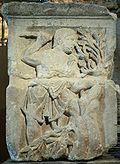
Latin epitaph of Gaius Calpurnius, a priest of Sulis at Bath, who died at the age of 75 and was commemorated by his wife, a freedwoman[19]

The tablets were often written in code, by means of letters or words being written backwards; word order may be reversed and lines may be written in alternating directions, from left to right and then right to left (boustrophedon). While most texts from Roman Britain are in Latin, two scripts found here, written on pewter sheets, are in an unknown language which may be Brythonic. If so, they would be the only examples of writing in this language ever found.[20]

The only dated tablet of the collection is Bath tablet 94, though no year is given alongside the day and month.[21] This can be inferred, however, by comparison to handwriting used on other tablets, which range from the 'Old Roman cursive' of the second and third centuries CE to the 'New Roman cursive' of the fourth century CE.[21] As argued by Tomlin in his 2020 publication, this shows the popularity of the inscriptions, and therefore the likely belief in their efficacy, for at least two centuries.[21]

Syncretism with Minerva

[edit]

At Bath, the Roman temple was dedicated to Sulis Minerva as the primary deity of the temple spa. It is likely that devotion to Sulis existed in Bath before the Roman presence in the area, by the local Celtic Dobunni tribe, who may have believed that Sulis had curative powers.[22] Sulis' pre-Roman presence has also been suggested by the discovery of eighteen Celtic Iron Age coins at the lowest levels of the site, as documented by Barry Cunliffe in 1988.[23] This is one of the reasons Sulis is named first in the syncretic Sulis Minerva.[24] Through the Roman Minerva syncresis, later mythographers have inferred that Sulis was also a goddess of wisdom and decisions.

Of the 17 dedicatory altars and bases found at the Roman temple at Bath, 9 evoke Sulis Minerva through her single or double name.[25] In particular, there are two altars found at the Cross Bath (RIB 146)[26] and Hot Bath (RIB 150)[27] sites respectively, which list 'Sulis Minerva' in full.[25] The altar found at the Hot Bath reads "To the goddess Sulis Minerva Sulinus, son of Maturus, willingly and deservedly fulfilled his vow" (RIB 150).[27]

Altar from the Hot Bath, which reads "To the goddess Sulis Minerva Sulinus, son of Maturus, willingly and deservedly fulfilled his vow."

Sulis was not the only goddess exhibiting syncretism with Minerva. Senua's name appears on votive plaques bearing Minerva's image,[citation needed] while Brigantia also shares many traits associated with Minerva. The identification of multiple Celtic gods with the same Roman god is not unusual (both Mars and Mercury were paired with a multiplicity of Celtic names). On the other hand, Celtic goddesses tended to resist syncretism; Sulis Minerva is one of the few attested pairings of a Celtic goddess with her Roman counterpart.[citation needed]

Dedications to "Minerva" are common in both Great Britain and continental Europe, most often without any Celtic epithet or interpretation (cf. Belisama for one exception).

Solar goddess

[edit]

Based on her name's etymology, as well as several other characteristics, such as the association with sight, civic law, and epithets relating to light, Sulis has been interpreted as a solar deity, at least in pre-Roman times.[citation needed] Some researchers have further suggested a role as the de facto Celtic solar deity, the associated Sulevia and similar names being the goddess's attestations elsewhere.[28][29]

Modern worship

[edit]

Sulis has a number of modern-day worshipers among the Wiccan and pagan communities.[30] As of 1998, some people still deposited offerings in the waters of the Roman baths.[30]

Sulis in art and epigraphy

[edit]

Sulis Minerva's head

[edit]

A gilt bronze head of the goddess Sulis Minerva was discovered in Bath in 1727 (see top right), which was probably from a cult statue that stood inside her temple, next to the sacred spring.[31] It is possible that this statue was positioned across the temple courtyard from the sacrificial altar site.[31] The statue may be a product of the foundation of the Roman site, dating from the late first-century CE.[31] There are only two other known gilt bronze finds from Roman Britain.[31]

Temple pediment and Gorgon's head

[edit]

Discovered in 1790, this pediment from the Temple of Sulis Minerva features a large Gorgon's head in its centre.[32] It was likely carved in the first century CE, by craftsmen from northern Gaul.[33] Originally at a height of fifteen metres, the pediment would have been supported by four fluted columns.[32] There are also several accompanying images on the pediment, such as Tritons (the half-fish and half-men servants to Neptune), a face-helmet shaped like a dolphin's head, a small owl, and female Victories standing on globes.[32]

Pediment from Temple of Sulis Minerva at Bath

One interpretation of the central image, giving the piece its name, is that the head represents the mythical Gorgon.[34] As Greek mythology has it, the hero Perseus killed the Gorgon and gave the head to Athena, who wore it on her breastplate. Thus, the Roman Baths Museum suggests a possible connection between the Gorgon to the goddess Sulis Minerva (Minerva being the Roman equivalent of the Greek Athena).[34] While the Gorgon on the pediment is male and the mythical Gorgon was female, it has been suggested that the pediment image was altered to reflect a combination of Celtic and classical styles.[34]

Another interpretation is that the central head reflects a water god, due to similarities with other water gods from Britain. For example, the Roman Baths Museum points to a silver dish from Mindenhall depicting the god Oceanus.[35]

Silver dish depicting the god Oceanus from the Mildenhall treasure found in Suffolk, England, in 1942 or 1943.

In a 2016 article, Eleri H. Cousins argued that much of the imagery on the pediment can be linked to imperial iconography, including the Victories, the oak wreath and the star at its apex.[36] In addition, Cousins highlighted other examples of similar first- and second-century architectural features, particularly Gorgon imagery found in Gaul and Spain, to suggest that the Forum of Augustus in Rome was used as an overall archetype.[36] According to Cousins, the pediment and its imagery are not just 'Roman' or 'Celtic', but result from a mixture of styles and concepts from "the local to the empire-wide".[36]

Altar-like statue base

[edit]

The altar-like statue base was found on the pavement nearby the steps of the Temple for Sulis Minerva.[37] The base reads, "To the goddess Sulis, Lucius Marcius Memor, soothsayer, gave (this) as a gift" (RIB III, 3049).[38] This is the only known instance of a haruspex, or professional diviner who interpreted sacrificed animals' entrails, from Britain.[38] The original inscription used the abbreviation 'HAR' to distinguish Memor as a haruspex, but it appears there was a later addition of the letters 'VSP'.[37] This may have been an attempt to clarify his position as more than an informal 'soothsayer', and suggests that Memor may not have been attached to the temple itself, but rather that he may have been a visiting member of the governor's staff.[38]

Altar-like tombstone

[edit]

This tombstone resembling an altar (see top left) was found with two cinerary urns outside the city of Bath,[39] in the parish of Bathwick, 800 metres north-east of the Roman Baths.[40] The tombstone reads, "To the spirits of the departed; Gaius Calpurnius Receptus, priest of the goddess Sulis, lived 75 years; Calpurnia Trifosa, his freedwoman (and) wife, had this set up" (RIB 155).[40] Receptus' widow's name, Trifosa, is Greek and means 'De Luxe', and would have likely been her given name when she was a slave, before she was freed and married to her former owner, the priest Receptus.[39]

Sulis in modern literature

[edit]

Sulis has captured the attention of multiple creative writers and storytellers.[41]

Sulis and the Roman Baths have been re-imagined in the following works of historical fiction:

  • The Waters of Sul (1989) – Moyra Caldecott
  • Flavia's Secret (2008) – Lindsay Townsend
  • Crown of Acorns (2010) – Catherine Fisher
  • The Curse-Maker (2011) – Kelli Stanley
  • Memento Mori: A Crime Novel of the Roman Empire (2018) – Ruth Downie
  • The Sinister Booksellers of Bath (2023) – Garth Nix

See also

[edit]

References

[edit]
[edit]
Revisions and contributorsEdit on WikipediaRead on Wikipedia
from Grokipedia
Sulis was a Romano-Celtic goddess primarily worshipped at the hot springs of Bath (ancient Aquae Sulis) in Somerset, England, where she was syncretized with the Roman deity Minerva, forming the composite figure Sulis Minerva associated with healing, wisdom, and protective curses.[1][2] The town of Aquae Sulis, meaning "the waters of Sulis," derived its Roman name from her, reflecting her role as the divine guardian of the naturally occurring thermal waters believed to possess curative properties.[3] In the late 1st century AD, the Romans constructed a classical temple complex dedicated to Sulis Minerva adjacent to the Sacred Spring, featuring a cella housing her cult statue and a surrounding courtyard as a sacred precinct, which served as the focal point for rituals and offerings at the site.[3][4] Key evidence of her cult includes over 130 lead curse tablets (defixiones) discovered in the Sacred Spring, inscribed primarily in Latin but showing Celtic linguistic influences, where devotees invoked Sulis Minerva to recover stolen property, punish thieves, and bind wrongdoers through supernatural justice.[5][6] These tablets, dating from the 2nd to 4th centuries AD, reveal a hybridized religious practice blending Celtic reverence for natural waters with Roman imperial cult elements, often requesting the goddess to "hunt down" culprits or cause them physical harm until justice was served.[6][7] Among the most notable artifacts is the gilt-bronze head of Sulis Minerva, unearthed in 1727 from the Sacred Spring, depicting her with elaborate hair, a Corinthian helmet, and traces of gilding, likely part of a larger cult statue that symbolized her dual Celtic and Roman attributes.[8] Thousands of coins and other votive offerings, including jewelry and pewter, were also deposited in the spring as dedications to her, underscoring her importance as a patroness of healing and prosperity in Roman Britain.[9] The cult persisted from the Roman conquest in the 1st century AD through the 5th century, illustrating the enduring appeal of local deities within the broader Romano-British religious landscape.[3][2]

Name and Etymology

Name Origins

The name Sulis first appears in Roman records with the designation of the thermal spring site at Bath as Aquae Sulis ("Waters of Sulis") around 60 CE, shortly after the Roman conquest of Britain in 43 CE and the subsequent development of the area into a major spa town.[10] This renaming reflects the Romans' adoption of the local Celtic deity's name for the settlement, indicating pre-existing worship at the site.[11] Linguistically, Sulis is classified as a Brittonic name from the Celtic language spoken in southern Britain, likely deriving from the Proto-Celtic root sūli-, which is connected to concepts of "eye" or "sun" through cognates like Old Irish súil ("eye") and broader Indo-European terms for solar phenomena.[12] This etymology suggests associations with vision, light, or celestial bodies, aligning with patterns in Celtic nomenclature.[11] The name bears resemblance to the continental Celtic goddesses known as the Suleviae, a group of healing and protective deities attested in Gaul and Britain, whose name shares the same root and implies "good guides" or "those of good sight."[13] Archaeological evidence from inscriptions confirms Sulis as the indigenous name predating Roman influence, with early dedications invoking her directly. For instance, curse tablets (defixiones) from the sacred spring, dated to the 2nd to 4th centuries CE, address "Sulis" in a mix of Latin and Celtic forms, such as ad fontem deae Sulis ("at the spring of the goddess Sulis"), demonstrating continuity of the native title.[14] Altar dedications from the temple precinct, like RIB 143 (c. 100–200 CE), dedicate offerings to "Deae Suli" for health and safety, further verifying the pre-Roman Celtic origin of the name before its adaptation into Sulis Minerva.[15]

Interpretations

The name Sulis has elicited several scholarly interpretations regarding its etymological significance, often tying into themes of vision, healing, and celestial influence in Celtic contexts. One longstanding proposal derives Sulis from the Proto-Indo-European root *sol-, associated with the sun, which aligns with potential solar connotations for the deity and reflects broader Indo-European linguistic patterns seen in Latin sōl.[12] Alternatively, linguists have connected the name to the Celtic term *sūli- or Old Irish súil meaning "eye," suggesting connotations of a "good eye" linked to prophetic insight or healing properties, as articulated in analyses of Gaulish onomastics.[16] These interpretations emphasize Sulis's conceptual role in overseeing natural phenomena like the thermal springs at Bath, where her cult centered.[17] Debates among 19th- and 20th-century philologists, including John Rhys, centered on whether Sulis originated as a localized water spirit tied to specific British springs or represented a wider Celtic deity embodying solar and healing attributes, with evidence drawn from comparative Indo-European studies and early inscriptions.[18] This discussion highlighted the challenges of reconstructing pre-Roman Celtic beliefs from limited epigraphic data, often weighing Sulis's apparent singularity against patterns in continental Celtic nomenclature.[6] Modern linguistic scholarship since 2000 has explored potential connections between Sulis and the Gaulish Suleviae, a group of mother goddesses invoked in inscriptions across Gaul and Britain, positing shared roots in protective or nurturing divine functions without establishing direct identity.[19] These analyses, informed by renewed examinations of Romano-Celtic dedicatory texts, underscore Sulis's possible integration into broader networks of female divinities focused on fertility and well-being, though such links remain interpretive rather than definitive.

Identity and Attributes

Syncretism with Minerva

Following the Roman invasion of Britain in 43 CE under Emperor Claudius, the process of religious syncretism accelerated as Roman administrators and settlers integrated local Celtic deities into their pantheon through interpretatio romana, a practice of equating foreign gods with Roman equivalents to foster cultural cohesion and maintain pax deorum (peace with the gods).[19] At Aquae Sulis (modern Bath), the indigenous British goddess Sulis, already associated with the site's thermal springs, was merged with the Roman Minerva by the late 1st century CE, forming the hybrid deity Sulis Minerva.[11] This fusion is evidenced in the construction of a Roman-style temple complex around 65–75 CE, shortly after the suppression of the Boudiccan revolt, which stabilized Roman control in the southwest.[11] The merged attributes of Sulis Minerva combined Sulis's Celtic roles in healing—linked to the curative properties of the hot springs—and prophecy, particularly through judicial curses (defixiones) seeking divine retribution, with Minerva's Roman domains of wisdom, strategic warfare, and craftsmanship.[11] This synthesis is reflected in temple dedications where devotees invoked the goddess for both physical restoration and supernatural enforcement of justice, as seen in over 130 lead curse tablets from the sacred spring, many addressing her dual identity.[20] Scholarly analysis attributes this blending to Roman religious policy, which tolerated and adapted native cults to align with imperial ideology, allowing local elites to retain cultural ties while adopting Roman forms.[19] The choice of Minerva over deities more directly tied to water, such as nymphs or Neptune, likely stemmed from deeper conceptual alignments rather than Sulis's aquatic aspects alone; Minerva's emphasis on intellectual insight and protective justice complemented the prophetic and vengeful elements in Sulis's cult, evidenced by the prevalence of curse invocations for recovering stolen property or punishing wrongdoers. A key factor in this pairing may have been shared symbolism involving the eye: Minerva's traditional attribute of the owl, representing vigilant wisdom and sight, paralleled possible etymological roots of "Sulis" in Proto-Celtic *sūli- ("eye" or "sun"), suggesting themes of divine oversight and illumination.[11] Bilingual inscriptions at Bath explicitly demonstrate this syncretism, often employing the formula "Deae Suli Minervae" (To the Goddess Sulis Minerva) to honor the hybrid form. Similar phrasing appears on pewter vessels recovered from the spring, such as those in RIB 2417.5–8, reinforcing her unified identity in ritual offerings throughout the 2nd–4th centuries CE.[11]

Solar Associations

Interpretations of Sulis as a solar deity stem primarily from etymological analysis and comparative mythology, distinguishing her native Celtic attributes from the Roman Minerva overlay. The name "Sulis" derives from Proto-Celtic roots linked to concepts of the sun (*sūli- or *sol-), eye (*sūl-), and sight, evoking imagery of solar illumination and visionary insight rather than solely aquatic domains.[12] This etymology positions her as a goddess embodying the life-giving and revelatory power of the sun, particularly in healing contexts where light and warmth metaphorically infuse thermal springs.[21] However, this solar interpretation remains debated among scholars, with some favoring derivations emphasizing "sight" or "good view" over direct solar connotations.[22] Scholarly analysis, notably by Miranda Green in her 1986 work The Gods of the Celts, portrays Sulis as a Celtic sun goddess tied to healing, prophecy, and justice, contrasting sharply with Minerva's traditional Roman profile as a non-solar deity of wisdom and crafts. Green argues that Sulis's cult at Bath integrated solar motifs, such as perpetual flames symbolizing unending daylight, to emphasize renewal and foresight—qualities absent in purely Roman interpretations.[23] This view challenges earlier 19th-century scholarship, which confined Sulis to a water-centric role without acknowledging solar elements, often overlooking epigraphic evidence of her broader cosmic oversight in curse tablets seeking retribution under her watchful gaze.[24] Comparative mythology further supports these solar links through parallels with Gaulish deities like the Suleviae, a triad or collective of goddesses attested in inscriptions across Roman Gaul and Britain, whose names echo "Sulis" and suggest shared solar and protective attributes. These connections evoke Indo-European motifs of sun deities as nurturers of growth and seers, with Sulis embodying a feminine solar principle that bridges light, water, and fertility.[21]

Cult and Worship

Sanctuary at Aquae Sulis

The site of the sanctuary at Aquae Sulis was situated amid the natural hot springs emerging from the ground in what is now Bath, Somerset, England, where geothermal activity produces water at approximately 46°C (115°F). In the pre-Roman Iron Age, the area served as a settlement for the Dobunni tribe, who regarded the springs as sacred and associated them with the local goddess Sulis, though direct archaeological evidence for structured worship remains limited to scattered Iron Age artifacts and enclosures near the springs.[25][10] Following the Roman invasion of Britannia in AD 43, the springs were formalized into a major cult center, with the settlement renamed Aquae Sulis around AD 60 to reflect its thermal waters ("waters of Sulis"). The primary temple construction occurred during the Flavian period (c. AD 70–80), comprising a tetrastyle prostyle structure in the Corinthian order with columns rising about 8 meters high, enclosing a cella dedicated to the syncretic deity Sulis Minerva, and featuring an adjacent open-air altar within a walled precinct (temenos) of roughly 0.5 hectares. Adjacent to the temple lay the elaborate bath complex, including the Sacred Spring—a reservoir where the hot water pooled for ritual immersion—and the Great Bath, a large lead-lined pool measuring approximately 24 by 15 meters, supported by hypocaust underfloor heating and surrounded by tessellated pavements and colonnades.[26][10][25] The sanctuary underwent multiple construction phases, beginning with the initial Flavian temple and baths, followed by 2nd-century AD expansions that included additional bathing facilities like the East Baths, reflecting a shift toward a more civilian and Romano-Celtic architectural style with a central tower over the cella. Archaeological excavations, particularly those conducted between 1979 and the 1980s by the Bath Archaeological Trust, uncovered these elements, including fragments of the temple pediment, hypocaust pillars, and mosaic floors, confirming the site's integration of religious and recreational functions. By the late 3rd century, a defensive town wall enclosed the sanctuary within a 9-hectare urban area, but activity waned in the 4th century amid broader Roman economic decline, with the baths falling into disuse by around AD 400.[27][28] Renowned as a healing sanctuary, Aquae Sulis drew pilgrims from across the Roman Empire seeking relief from ailments through the mineral-laden waters, which were believed to possess curative properties for skin conditions, rheumatism, and infertility, as evidenced by the site's pan-Roman visitor profile in inscriptions and artifacts spanning Britannia to the Mediterranean. Recent scholarship, including analyses from 2020–2021, underscores its appeal as a multifaceted destination combining religious devotion, social interaction, and therapeutic bathing, distinct from military garrisons elsewhere in the province.[29][26]

Votive Practices and Inscriptions

Votive offerings at the sanctuary of Sulis Minerva included a wide array of items deposited into the sacred spring, such as coins, jewelry, and pewter artifacts, which served as petitions for healing or justice from the goddess. Over 12,000 coins, including rare Celtic examples, were recovered from the spring's reservoir, alongside personal items like fibulae, combs, and intaglios, often deliberately damaged or worn before deposition to symbolize the relinquishment of loss or affliction to the divine. Pewter vessels, such as jugs and pans inscribed with dedications to Sulis Minerva, were particularly common, reflecting their use in ritual libations before being offered as thanks or supplications. These practices underscore the spring's water as a transformative medium in Romano-Celtic worship, where deposition ritually transferred burdens to the goddess. The most distinctive votive elements are the over 130 curse tablets, or defixiones, discovered in the spring, dating from approximately 100 to 400 CE and primarily invoking Sulis Minerva for retribution against thieves. Crafted from thin sheets of lead or pewter alloy, these tablets were inscribed, often rolled, and cast into the waters as binding prayers, dedicating stolen property to the goddess to compel her intervention. A representative example is the tablet of Docimedis, who cursed the thief of his gloves: "Docimedis has lost two gloves. (He asks) that (the person) who has stolen them should lose his mind and eyes in the temple where (she) appoints." Another tablet concerns the carrying off of 'Vilbia' (possibly a person or garment) and pleads for the culprit's identification and punishment, illustrating the personal stakes of everyday crimes like thefts of clothing, rings, or vessels at the baths. These tablets reveal Sulis's role as a patron of justice, blending protective and vengeful aspects in a uniquely British context.[30] The inscriptions on these tablets exhibit a mix of Latin and Celtic linguistic elements, reflecting the syncretic cultural environment of Roman Britain. Most are in Latin, using scripts like Roman Capital, Old Roman Cursive, or New Roman Cursive, with occasional Greek influences, but Celtic loanwords and personal names—such as "baro" (possibly meaning "judge" or "thief" in a local dialect)—appear, indicating native participation in the ritual. Terms evoking soul-stealing or supernatural torment, like derivations from exanimare (to deprive of life or spirit), underscore the curses' magical intent, where the goddess was entreated to afflict the offender's vitality. Scholarly analysis, including a 2021 thesis on the cult's ritual language, highlights how this bilingualism embedded social tensions and local traditions within Roman formulary, transforming standard defixio templates into personalized appeals for divine arbitration.[6] Broader worship practices at the sanctuary incorporated these votives into communal rituals, with artifact distributions suggesting bathing as a preparatory or purificatory act before offerings. Pilgrims likely immersed in the thermal waters to invoke Sulis's healing powers, followed by processions around the temple and spring, where items were ritually discarded. Seasonal festivals, inferred from peak deposition periods in spring and summer, may have amplified these activities, fostering communal petitions amid the site's therapeutic and judicial functions.[11]

Archaeological Artifacts

Gilt Bronze Head of Sulis Minerva

The gilt bronze head of Sulis Minerva was discovered in 1727 by workmen repairing the King's Bath at the Roman site of Aquae Sulis in Bath, England, specifically in the Sacred Spring where it had likely been deliberately deposited as part of ancient rituals.[31] This find, one of the earliest indications of the site's Roman significance, dates to approximately 75 CE and was crafted using the lost-wax casting technique typical of Roman bronze sculpture.[10] The artifact is slightly larger than life-size, measuring about 25 cm in height, and represents the surviving portion of a monumental cult statue dedicated to the goddess.[8] Iconographically, the head depicts a serene female figure with an oval face, idealized classical features, and centrally parted wavy hair that falls in stylized locks, evoking both Roman realism and subtle Celtic abstraction in its simplified forms.[10] Small rivet holes along the hairline and crown indicate attachment points for a tall Corinthian-style helmet, a hallmark attribute of Minerva, suggesting the complete statue portrayed the armed goddess in a protective pose.[8] This blend of styles underscores the syncretic identity of Sulis Minerva, merging local British and continental Roman elements in a manner unique to the Aquae Sulis sanctuary.[10] As the probable head of the temple's central cult image, the sculpture held profound ritual importance, embodying the goddess's dual role in healing and wisdom while serving as a focal point for votive offerings and pilgrimages at the site.[31] Scholarly analysis, including the comprehensive 1985 excavation report by Barry Cunliffe and Peter Davenport, interprets it as evidence of elite craftsmanship imported or commissioned early in the Roman occupation of Britain, highlighting the sanctuary's status as a major religious center.[10] Gilt bronze sculptures are exceptionally rare in Roman Britain, with only two other known fragments, emphasizing the head's exceptional value as a symbol of imperial investment in local cults.[8] Today, the head is housed and displayed at the Roman Baths Museum in Bath, where conservation efforts have preserved its fragile state despite post-discovery damage from rough handling and exposure.[10] Scientific examinations, including X-ray and surface analyses conducted in the late 20th century and revisited in the 2010s, reveal six successive layers of gilding— the initial two applied via fire-gilding (mercury-gold amalgam heated to vaporize the mercury) and the later four using gold leaf—indicating multiple repairs or regildings over the statue's lifespan, possibly extending its use for centuries.[32] Recent 2020s studies, building on these findings, have confirmed the extensive original gilding covered the entire surface, restoring understanding of its once-brilliant golden sheen in temple lighting.[10]

Temple Pediment and Gorgoneion

The pediment of the Temple of Sulis Minerva at Bath, featuring a prominent Gorgoneion, was discovered in fragments during excavations in 1790 amid the ruins of the temple complex.[33] These limestone pieces, originally part of a triangular structure measuring approximately 7.9 meters wide and 2.4 meters high, were supported by four fluted Corinthian columns rising to a height of about 15 meters.[34] The accepted reconstruction, proposed by archaeologists Ian A. Richmond and J.M.C. Toynbee in 1955, assembles the fragments to depict a central male Gorgon's head mounted on a circular shield, encircled by oak wreaths, and flanked by winged female figures (possibly Victories) holding globes, with additional motifs including Tritons, a dolphin-crested helmet, and an owl at the apex beneath a star symbol. This reconstruction dates the pediment to the late Neronian or early Flavian period, around 60–80 CE, based on stylistic analysis and contextual archaeological evidence from the site.[35] Artistically, the pediment exemplifies a Romano-Celtic hybrid style, likely carved by craftsmen from northern Gaul, blending classical Roman proportions with provincial vigor and exaggerated features such as the Gorgon's staring eyes, swirling serpentine hair or beard, and robust, bearded face evoking a sense of dynamic power rather than classical terror.[34] The central head, often interpreted as a gorgonesque male figure akin to Medusa but with localized adaptations like the owl (a symbol of Minerva's wisdom), integrates Roman imperial iconography—such as the shield and wreaths—with Celtic elements, including potential water deity associations tied to the site's sacred springs.[33] These features, including the prominent eyes, may symbolically connect to the etymology of Sulis, derived from Proto-Celtic roots cognate with Old Irish súil meaning "eye," suggesting themes of vision, oversight, and prophetic insight in the goddess's cult.[11] Interpretations of the Gorgoneion emphasize its role as a protective emblem at the sanctuary's entrance, serving apotropaic functions to ward off evil and safeguard the healing waters below, much like classical Gorgoneia that petrified threats with their gaze.[20] The motif's solar connotations are evident in the star or sun-like apex and the radiating hair patterns, aligning with Sulis Minerva's associations with solar healing and renewal, as the goddess oversaw therapeutic baths believed to cure ailments through divine intervention.[11] This protective symbolism extends to the temple's broader role as a place of judicial curses and votive healing, where the Gorgoneion's watchful presence reinforced Sulis's authority over oaths and restorations.[34] Comparisons to classical Gorgoneia, such as those on the roundels of Augustus's Forum in Rome or the Medusa clipeus from Mérida, Spain, highlight adaptations for local contexts: while Roman examples stress imperial invincibility, the Bath version incorporates Celtic motifs like the owl and water elements, transforming the fierce Medusa into a syncretic guardian suited to a British spa sanctuary.[34] Such hybridity underscores the pediment's function in bridging Roman monumental architecture with indigenous reverence for Sulis, emphasizing protection, healing, and cosmic oversight without direct parallels to purely Greek monstrous forms.

Other Monuments

Beyond the prominent sculptural finds, additional monuments associated with the cult of Sulis Minerva include altar bases and dedicatory stones that reflect personal vows and offerings from devotees. A notable example is the oolitic limestone statue base (RIB 3049), discovered in 1965 near the temple steps at Bath, which resembles an altar due to its moulded capital and base but features a flat top suitable for supporting a statue. Dedicated by Lucius Marcius Memor, a haruspex or soothsayer, the inscription reads "To the goddess Sulis, Lucius Marcius Memor, soothsayer, gave (this) as a gift," indicating a professional's contribution to the sanctuary around the late second or early third century CE.[36] This base, positioned in the temple precinct, underscores the integration of elite religious practitioners in the cult's material expressions.[37] Tombstones and memorials further illustrate the personal dimensions of Sulis worship, often linking the goddess to lifecycle events and community roles. An altar-like tombstone (RIB 155), found reused in a medieval wall at Bath, commemorates Gaius Calpurnius Receptus, a priest of Sulis who lived 75 years, erected by his freedwoman and wife Calpurnia Trifosa in the late second century CE. The inscription invokes the departed spirits while highlighting Receptus's sacerdotal service, suggesting the goddess's role in funerary contexts among her inner circle of worshippers.[38] Such memorials, though not exclusively dedicatory, evoke Sulis's protective attributes in death as in life.[37] Minor inscriptions provide glimpses into the cult's accessibility across social strata, with fragments revealing vows from ordinary individuals. For instance, a small white marble fragment (RIB 3050), excavated in 1979 and reused in a late Roman wall at the Bath sanctuary, bears partial text possibly referencing a dedication, updated in the Somerset Historic Environment Record as of 2024 to confirm its association with Sulis Minerva worship.[39][40] These epigraphic remnants, alongside other brief dedications like those on pewter vessels, demonstrate participation by diverse classes, from artisans to soldiers, in the goddess's honors. Recent scholarship from 2020 to 2024 has analyzed these lesser monuments as indicators of the cult's subtle dissemination beyond Bath, particularly through portable artifacts such as inscribed metalware and jewelry that could travel with devotees. Studies emphasize how such items, including trullae and rings bearing Sulis's name, suggest informal networks extending the goddess's influence into broader Romano-British society without fixed temples elsewhere.[37] This evidence complements the sanctuary's fixed inscriptions, highlighting the cult's adaptability in everyday religious practice.[40]

Modern Interpretations

Neopagan Revival

In the late 20th century, Sulis emerged as a figure in neopagan practices, particularly within Wicca and Druidry, where she is venerated as a goddess of healing waters and solar energy. This adoption aligns with the broader revival of interest in pre-Christian British deities during the growth of modern pagan movements, amplified by Bath's status as a major tourist destination showcasing her ancient sanctuary. Practitioners draw on her historical role at the thermal springs to invoke themes of renewal and vitality in contemporary rituals.[41] Modern worship of Sulis often involves rituals at the Roman Baths in Bath, where devotees make offerings via official contactless donation points or cash boxes to support site conservation, a practice encouraged by authorities to honor her legacy without risking damage to the heritage.[9] Solar festivals, tied to her luminous attributes, feature invocations during solstices, while women's craft circles incorporate her imagery in empowerment workings focused on prophecy and self-healing. Groups like the Order of Bards, Ovates & Druids reference her syncretic form in broader Celtic-inspired ceremonies, emphasizing solitary or small-group meditations at natural waters.[42][43] Key texts shaping this revival include Judith Shaw's 2013 essay "Sulis, Celtic Sun Goddess of Healing and Prophecy," which portrays Sulis Minerva as a feminist icon embodying empowerment through divine insight and restorative flames tended by priestesses, inspiring modern goddess-centered spirituality. Shaw's later writings, such as her 2014 reflections on invoking Sulis for personal wholeness, further position her as a beacon for women's journeys toward light and autonomy. Rachel Patterson's 2024 book Pagan Portals - Sulis: Solar Goddess of the Spring Waters provides practical guidance for neopagans, detailing altars, candle-making, and oath rituals to foster direct connections with Sulis in Wiccan and eclectic practices.[44][45][41] Ethical discussions within neopagan communities highlight tensions around engaging ancient sites like Bath, emphasizing respectful pilgrimage over appropriation to avoid commodifying indigenous spiritual heritage. Projects like the Sacred Sites initiative (2009) underscore the need for pagans to balance personal devotion with preservation, advocating protocols for non-disruptive rituals at shared cultural landmarks.[46]

Cultural Representations

Sulis has appeared in various modern literary works, often reimagined as a symbol of ancient wisdom, healing, and environmental connection. In Catherine Fisher's 2014 young adult fantasy novel Circle of Stones, the goddess Sulis plays a central role in a narrative blending contemporary Bath with historical and mystical elements, where a teenage protagonist encounters her through the city's thermal springs. Similarly, J.F. Penn's 2021 short story "A Midwinter Sacrifice" depicts Sulis awakening in modern Bath, tying her curative powers to themes of ritual and urban disruption around water sources.[47] More recent eco-fiction, such as elements in Jamie Marchant's Kronicles of Korthlundia series (starting 2017), portrays Sulis as a divine force influencing ecological and social justice narratives involving sacred waters.[48] In visual arts and media, Sulis is frequently represented through museum exhibits and creative recreations that emphasize her Romano-Celtic iconography. The Roman Baths Museum in Bath displays the original gilt bronze head of Sulis Minerva alongside interpretive illustrations and replicas of her cult statue, allowing visitors to engage with her as a guardian of healing springs.[8] In 2024, the Brickthology project featured a detailed LEGO model of Sulis, depicting her as a solar goddess overseeing the Bath sanctuary, which highlights her appeal in popular culture and educational modeling.[49] Documentaries on Roman Britain, such as the BBC's 2014 series Roman Voices, include animations and expert discussions of Sulis Minerva's temple, portraying her as a syncretic deity central to Aquae Sulis's identity. Scholarly publications continue to influence popular perceptions of Sulis, particularly in reframing her as a figure of resilience and renewal amid contemporary environmental concerns. The 2020 Cambridge University Press volume The Sanctuary at Bath in the Roman Empire by Eleri H. Cousins explores Sulis's role in healing rituals, connecting her thermal waters to broader discussions of sustainability and cultural heritage in the face of climate impacts on natural springs. This work has inspired public lectures and articles that position her as a metaphor for ecological healing in modern Britain. Despite her prominence in Western mythology studies, representations of Sulis remain largely confined to European contexts, with limited exploration in non-Western interpretive frameworks, though recent global mythology anthologies suggest potential for broader comparative analyses.[50]

References

User Avatar
No comments yet.